

Saved Bookmarks
This section includes 7 InterviewSolutions, each offering curated multiple-choice questions to sharpen your Current Affairs knowledge and support exam preparation. Choose a topic below to get started.
| 1. |
An object travels with the speed of 96 miles per hour. Calculate the speed of the object in SI units. |
|
Answer» 1 HOUR `= 3.6 xx10^(3)s:. "conversion factor"=((3.6xx10^(3)m))/((1hr))` `("96 MILES")/("1 hr")=(("96 miles")xx("conversion factor"))/(("1 hr")xx("conversion factor"))` `=(("92 miles")xx(1.6xx10^(3)m))/(("1 mile"))=(1)/(("hr"))xx((1"hr"))/((3.6 xx10^(3)s))=42.7 "m s"^(-1)`. |
|
| 2. |
An object is located at a height of Skrn from the surface of the carth. The object is located in which part of atmosphere? |
|
Answer» THERMOSPHERE |
|
| 3. |
An object is located at a height of 18 km from thesurface of earth. The object is located in : |
|
Answer» thermosphere |
|
| 4. |
An LPG (liquefied petroleum gas) cylinder weighs 14.8 kg when empty. When full, it weighs 29.0 kg and shows a pressure of 2.5 atm. In the course of use at 27^(@)C, the weight of the full cylinder reduced to 23.2 kg. Find out the volume of the cubic metres used up at the normal usage conditions, and the final pressure inside the cylinder. Assume LPG to be n-butane with normal boiling point of 0^(@)C |
|
Answer» Solution :Decrease in the AMOUNT of PG`=29.0-23.2=5.8" kg"=(5800)/(58)" kg moles"=100" moles"` Volume of 100 moles at 1 ATM `300" K "(nRT)/(P)=(100" moles"xx0.0821" L atmK^(-1)xx300 K)/(1 atm)` `=2463" L "=2463xx10^(-3)m^(3)=2.463m^(3)` Final pressure inside the cylinder. As the cylinder contains liquefied petroleum gas in equibrium with its vapours, therefore, so LONG as temperature remains constant and some LPG is present, pressure with remain constant. As the cylinder STILL contains LPG=23.2-14.8=8.4 kg, pressure inside the cylinder will be same, i.e., 2.5 atm. |
|
| 5. |
An MgCl_2aqueous solution is 10^(-3)molar. The hardness of water is |
|
Answer» 10 PPM |
|
| 6. |
An LPG cylinder contains 15kg of butane gas at 27°C and 10 atmospheric pressure. It was leaking and its pressure fell down to 8 atmospheric pressure after one day. The gas leaked is________kg. |
|
Answer» |
|
| 7. |
An IUPAC name for the following compound is: |
|
Answer» 4-Isobutyl-3,4-dimethylheptane |
|
| 8. |
An isotope of hydrogen (A) reacts with diatomic molecule of element which occupies group number 16 and period number 2 to give compound (B) is used as a modulator in nuclear reaction. (A) adds on to a compound (C ), which has the molecular formula C_(3)H_(6) to give (D) Identify A,B,C and D. |
|
Answer» Solution :An isotope of hydrogen Deuterium (A) reacts with diatomic molecule of element belongs to group number 16 and PERIOD number 2 oxygen `O_(2)` to give a compound (B) which is heavy WATER `D_(2)O.D_(2)O` is used period as molerator in nuclear reaction. `underset("Deuterium (A)")(2D_(2)+)O_(2)tounderset("Heavy water (B)")(2D_(2)O)` (ii) Deuterium reacts with `C_(3)H_(6)` PROPANE (C) to give DEUTERO propane `C_(2)D_(6)(D)`. `3D_(2)_underset("Propane")(C_(3)H_(6))tounderset("Deutero propane")(C_(3)D_(6)+3H_(2))` `{:(A,"Deuterium",D_(2)),(B,"Heavy water",D_(2)O),(C,"Propane",C_(3)H_(6)),(D,"Deutero propane",C_(3)D_(6)):}` |
|
| 9. |
An isotope of hydrogen (A) reacts with diatomic molecule of element which occupies group number 16 and period number 2 to give compound (B) is used as a modulator in nuclear reaction. (A) adds on to a compound (C), which has the molecular formula C3H6 to give (D). Identify A, B, C and D. |
|
Answer» Solution :(i) An isotope of hydrogen Deuterium (A) reacts with diatomic MOLECULE of element belongs to group number 16 and PERIOD number 2 oxygen O, to give a COMPOUND (B) which is heavy water `D_(2)O.D_(2)O` is USED as a moderator in nuclear reaction. `underset("Deuterium"(A))(2D_(2))+O_(2)tounderset( Heavy water (B))(2D_(2)O` (ii) Deuterium reacts with `C_(3)H_(6)` propane (C) to give Deutero propane `C_(6)D_(6).(D)` `3d_(2)+underset("Propane")(C_(3)H_(6)tounderset( "Deutero propane")(C_(3)D_(6)+3H_(2))` 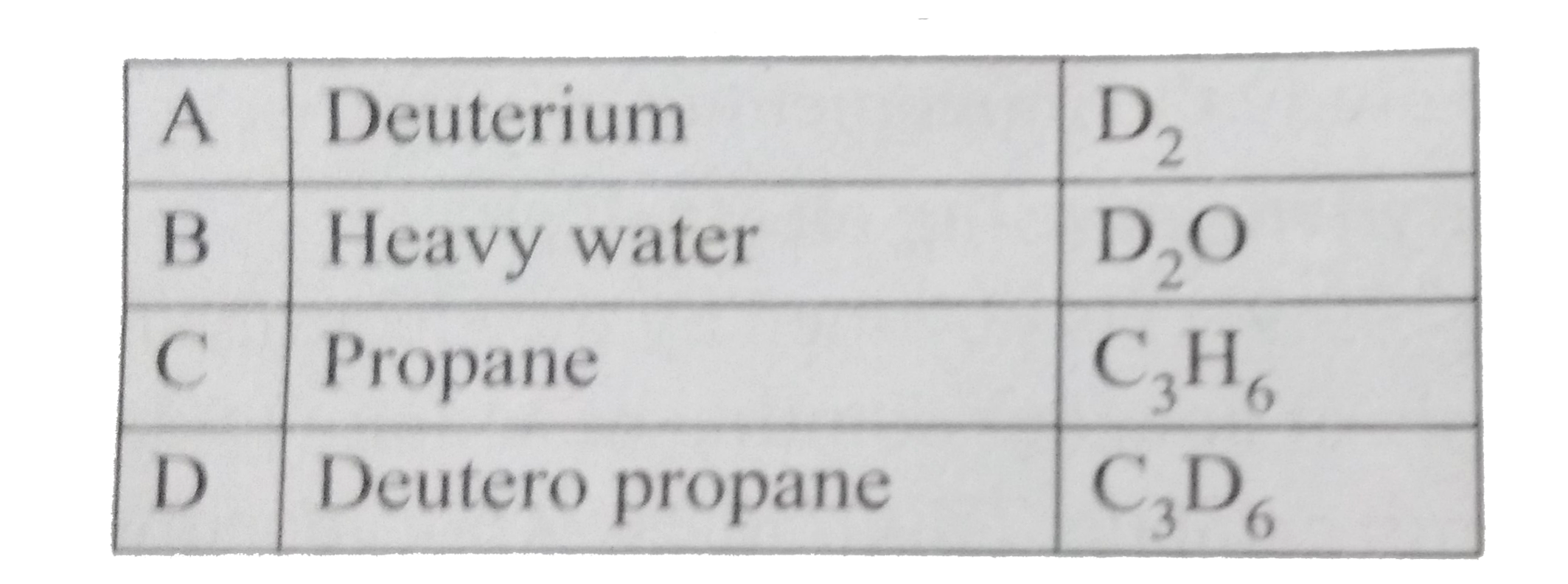
|
|
| 10. |
An isotone of ._32^76Ge is |
|
Answer» `._32^77Ge` =(A-Z) as `._32Ge^76` |
|
| 11. |
An isomer of ethanol is….. |
|
Answer» methanol |
|
| 12. |
An isomer of ethanol is |
|
Answer» Methanol |
|
| 13. |
An isomer of 2-propanol is |
|
Answer» Methanol |
|
| 14. |
An isolated system is that in which: |
|
Answer» There is no EXCHANGE of ENERGY with the surroundings |
|
| 16. |
An isocyanide on reduction with hydrogen in the presence of platinum gives : |
|
Answer» amide |
|
| 17. |
An iron wire is immeresed in a solution containing ZnSO_4 NiSO_4. When the concentration of each salt is 1 M, predict giving reasons which of the following reactions is likely to proceed ? (i) Iron reduced Zn^(2+) ions (ii) Iron reduces Ni^(+) ions . Given E^@(Zn^(2+)|Zn)=-0.76V,E^@(Fe^(2+)|Fe)=-0.44V, and E^@(Ni|Ni)=-0.25V |
|
Answer» |
|
| 18. |
An iron tank contains helium at a pressure of 2.5 atmoshpere at 25^(@)C. The tank can withstand a maximum pressure of 10 atmosphere. The building in which tan has been places cathes. Fire- predict whether, the tank blow up first or melt. (MP o iron= 1535^(@)C). |
|
Answer» Solution :Thus `P_(1)=2*5 ATM"" P_(2) ? T_(1)=25^(@)C=298K` `T_(2)=1535^(@)C =1808K` `(P_(1))/(T_(1))` thus, `P_(2)(P_(1)T_(1))/(T_(1))=(2*5xx1808)/(298)=15*16 "atm"` Since, pressure of the gas in the tank is MUCH more than 10 atm at the melting POINT. Thus, the tan will blow up befor reaching the melting point. |
|
| 19. |
An iron rod is immersed in a solution containing NisO_4 and ZnSO_4 . When the concentration of each salt is 1 M, predict giving reasons which of the following reactions is likely to proceed ? (i) Iron reduces Zn^(2+) ions (ii) Iron reduces Ni^(2+) ions Given : E_((Zn^(2+)|Zn))^@=-0.76V,E_((Fe^(2+)|Fe))^@=0.44V and E_((Ni^(2+)|Ni)^@=-0.25V |
|
Answer» Solution :(i) The reduction potential of IRON is more than that of ZINC. Therefore , iron will be REDUCED . In other words, `ZN^(2+)` will not be reduced by iron. (ii)The reduction potential of `Ni^(2+)` is more than that of iron . Therefore , `Ni^(2+)` will be reduced iron. |
|
| 20. |
An iron rod is immersed in a solution containg 1.0 M NiSO_(4) and 1.0 M ZnSO_(4) predict giving reasons which of the following reaction is likely to proceed ? (i) Fe reduces Zn^(2+)ions (ii) Iron reduces Ni^(2+)ions given E_(Zn^(2+)//Zn)^(@)=-0.76V,E_(Fe^(2+)//Fe)^(@)=-0.44V "and" E_(Ni^(2+)//Ni)^(@)=-0.25V |
|
Answer» Solution :(i) since `E^(@)` of ZN is more negative than that of fe therefore zn will be oxidised to `Zn^(+)` IONS while `Fe^(2+)` ions will be reduced to fe in other words fe wil not reduce `Zn^(2+)` ions (ii) since `E^(@)` of Fe is more negative than that of ni therefore fe will be oxidized to `Fe^(2+)` ions while `Ni^(2+)` ions will be reduced to Ni thus fe reduces `Ni^(2+)` ions |
|
| 21. |
An iron cylinder contains helium at a pressure of 250 k Pa at 300 K. The cylinder can withstand a pressure of 1 xx 10^6Pa. The room in which cylinder is placed catches fire. Predictthe temperature (in K) at which the cylinder will blow up before it melts or not (m.p.t. of the cylinder =1800K).. |
|
Answer» `(P_1V_1)/T_1 = (P_2V_2)/T_2` In the present CASE, `P_1 = 250 k Pa=50 xx 10^3 Pa, T_1 = 300 K` `P_2 = 1 xx 10^6 Pa, T_2` = ? and `V_1 = V_2` (since the cylinder is closed) `:. "" P_1/T_1=P_2/T_2` or`(250 xx 10^3)/300= (1xx10^6)/T_2 or T_2 = 1200K` Thus, the maximum pressure which the cylinder can withstand will be attained at 1200 K which is much less HAN the melting point of IRON `(1530^@C)`. Therefore, the cylinder will burst before melting. |
|
| 22. |
An iron ball has a mass of 35gms and a speed of 50m/s. If the speed can be measured with in accuracy of 2% then the uncertainty in the position |
|
Answer» `1.507 XX 10^(-34)m` |
|
| 23. |
An ionic hydride of an alkali metal has significant covalent character and is almost unreactive towards oxygen and chlorine. This is used in the synthesis of other useful hydrides . Write the formula of this hydride . Write its reaction with Al_(2)Cl_(6). |
|
Answer» SOLUTION :Since an ionic hydride of an alkali metal has significant covalent character, therefore, the hydride will be of the smallest alkali metal (Li) , i.e., LIH, Since LiH is very stable, therefore, it is ALMOST UNREACTIVE towards `O_(2) and Cl_(2)` Itreacts with `Al_(2)Cl_(6)` to form lithium aluminium hydride. `8LiH + Al_(2)Cl_(6) to 2LiAlH_(4) + 6LiCl`. |
|
| 24. |
An ionic compund AB has a rock salt structure with A:B=1:1 . The formula mass of AB is 6.023 y amu and the closest A-B distance is y^(1//3)nm (a)Calculate the density of the lattice. (b)If the observed density of the lattice is found to be 20 kg m^(-3) , then predict the type of defect. |
|
Answer» Solution :(a)As AB has rock salt structure, i.e., it has fcc structure , Z=4 EDGE of the unit cell = `2(r_(A^+)+r_(B^-))=2xxd_(A-B)=2xxy^(1//3) nm =2xxy^(1//3) xx10^(-9)`m Calculated density `(rho)=(ZxxM)/(a^3xxN_0) =(4xx(6.023 y XX 10^(-3) "kg mol"^(-1)))/((2y^(1//3)xx10^(-9) m)^3 (6.023xx10^23 "mol"^(-1)))=5.0 kg m^(-3)` (b)As observed density of AB is `20 "kg m"^(-3)` which is higher than the calculated density `(5.0 "kg m"^(-3))` , this shows that AB has either interstitial impurity defect or substitutional impurity defect. |
|
| 25. |
An ionic hydride of an alkali metal has significant covalent character and is almost unreactive towards oxygen and chlorine. This is used in the synthesis of other useful hydrides. Write the formula of this hydride. Write its reaction withAl_2Cl_6. |
|
Answer» Solution :The comp is LIH. It is a smallest alkali METAL. It has a covalent CHARACTER. Since LiH is very stable there fore it is almost UNREACTIVE TOWARDS `O_2` and `Cl_2`. It reacts with `Al_2Cl_6` to form lithium aluminium hydride. `8LiH + Al_2Cl_6 to 2LiAlH_4 + 6LiCl` |
|
| 26. |
An ionic compound made up of atoms A and B has a face-centred cubic arrangement in which atoms A are at the corners and atoms B are at the face-centres. If one of the atoms is missing from the corner, what is the simplest formula of the compound ? |
|
Answer» SOLUTION :No. of ATOMS of A at the corners=7 (because one A is missing) `therefore` Contribution atoms of A towards unit cell =`7xx1/8=7/8` No. of atoms B at face-centres=6 `therefore` Contribution of ATOM B towards unit cell`=6xx1/2=3` Ratio of A:B=`7/8:3`=7:24 `therefore` FORMULA is `A_7B_24` |
|
| 27. |
An ionic compound is expected ot have tetrahedral structure if r_(+)//r^(-)lies in the range of |
|
Answer» 0.155to0.225 |
|
| 28. |
An ionic compound has a unit cell consisting of A ions at the corners of a cube and B ions on the centres of the faces of the cube. The empirical formula for this compound would be |
|
Answer» AB Number of B ions per unit cell `=(1)/(2)xx6=3` Empirical formula `= AB_(3)`. |
|
| 29. |
An ionic compoundhas a unit cell consisting of A ions at the corners of a cube and B ions on the centres of the faces of the cube. The empitical formula of this compound would be |
|
Answer» Solution :No. of A atoms PER unit CELL=`1/8times8=1` No. of B atoms per unit cell =`6times1/2=3` `therefore`Formula of the compound is `AB_(3)`. |
|
| 30. |
An ionic compound contains 29.08% sodium, 40.56% sulphur and 30.36% oxygen by mass. What is the formular of the sulphur-containing anion in the compound? |
|
Answer» `S_(2)O_(3)`^(2-) |
|
| 31. |
An ionic compound AB has a rock salt structure with A :B = 1:1. the formula mass of AB is 6.023 y amu and the closest A-Bdistance isy^(1//3)nm. (a)Calculate the density of the attice. (b) If the observed density of the lattice is found to be20 " kg m"^(-3). then predict the type of defect. |
|
Answer» Solution :(a) As AB has ROCK salt structure, i.e, has fcc structure , Z =4 Edge of the unit cell =` 2(r_(A+)+ r_(B-)) = 2xx d_(A-B)= 2 x y^(1//3)nm = 2 xx y^( 1//3)xx 10^(-9) ` m Calcualted density `(p)= (Z xxM)/(a^(3)xxN_(0)) = ( 4xx (6.023 y xx10^(-3) " kg mol"^(-1)))/((2y^(1//3) xx10^(-9) m)^(3) (6.023 xx 10^(23)"mol"^(-1)))= 5.0" kg m"^(-3)` (b) As observed density of AB is ` 20 " kg m"^(-3)` which is higher than the calcualted density ` ( 5.0 " kg m"^(-3))` , thisshow that ABhas either interestital impurity defect or substitutional impurity defect. |
|
| 32. |
An ion with mass number 56 contains 3 units of positive charge and 30.4 % more neutrons than electrons. Assign the symbol to this ion |
|
Answer» Solution :Suppose number of electrons in the ION, `M^(3+) = X :.` No. of NEUTRONS `= x + (30.4)/(100) x = 1.304 x` No. of electrons in the nuetral atom `= x + 3 " " :.` No. of protons `= x + 3` Mass no. = No. of protons + No. of neutrons `56 = x + 3 + 1.304 x or 2.304 x = 53 or x = 23 " " :.` No. of protons = Atominc no. `= x + 3 = 23 + 3 = 26` HENCE, the symbol of the ion will be `._(26)^(56)Fe^(3+)` |
|
| 33. |
An ion with mass number 56 contains 3 units of positive charge and 30.45 more neutrons than electrons .Assign symbol to the ion. |
|
Answer» Solution :Let the no.of electrons in the ION=x `therefore`the no. of the protons=x+3(as the ion has three units positive charge) and the no.of NEUTRONS `=x+(30.4x)/(100)=x+0.304x` Now,MASS NUMBER of ion=Number of protons + Number of neutrons =(x+3)+(x+0.304x) `therefore 56=(x+3)+(x+0.304x)or 2.304x=56-3=53` `x=(53)/(2.304)=23` Atomicnumber of the ion (or element)=23+3=26 The element with atomic number 26 is iron(Fe) and the corresponding ion is `Fe^(3+)` |
|
| 34. |
An ion with mass number 37 possesses unit negative charge.If the ion contains 11.1% more neutrons than electrons.Find the symbol of the ion. |
|
Answer» Solution :Let the number of electrons in an ion=x `therefore `Number of neutrons `=n=x+(11.1)/(100)EV` `=1.111x` (As the number of neutrons are 11.1% more than the number of electrons) In the neutral of atom,number of ELECTRON. `e^(-)=x-1`(As the ICON carries-1 charge) Similarly number of protons=P=x-1 Number of protons + number or neutrons=mass number =37 `:.(x-1)+1.111x=37` 2.111x=38 2.111x=38 `x=(38)/(2.111)=18.009=18` `therefore`Number of protons =atomic number-1 =18-1=17 `therefore`the Number symbol of the icon`=UNDERSET(37)OVERSET(17)( Cl)^(-)` |
|
| 35. |
An ion with mass number 37 prossesses unit negative charg. If contains 11.1% more neutrons than electrons. Find the symbol of the ion. |
Answer» Solution : Given that, `y =x + 11.1% of x` `= (x + (11.1)/(100)x) = x + 0.111 x` `y = 1.111 x` mass number = 37 number of protons + number of neutrons = 37 `(x - 1) + 1.111 x = 37` `x + 1.111x = 38` `2.111x = 38` `x = (38)/(2.11) = 18.900` `x = 18` (whole number) `:. "ATOMIC number" = x - 1` `= 18 - 1 = 17` Mass number = 37 SYMBOL of the ion `._(17)^(37)Cl^(-)`. |
|
| 36. |
An ion with mass number 37 possesses one unit of negative charge. If the ion contains 11.1% more neutrons than the electrons, write its symbol. |
|
Answer» Solution :As the ion carries one unit of negative charge, it will have onelectron more than the number of protons Let the number of ELECTRONS `= x` Number of protons `=x-1` Number of NEUTRONS `=x+(x xx11.1)/(100)=x+0.111x=1.111x` Solving for the value of x, `"rotons "+ "neutrons "=" MASS number "` `x-1=1.111x=37""x=(38)/(2.111)=18` Number oflectrons = 18 Number of protons `= 18 - 1 = 17` Number of neutrons `= 37-17 = 20` The ion under discussion is chloride and its SYMBOL is `Cl^(-)` |
|
| 37. |
An ion with mass number 37 posseses one unit of negative charge. If the ion contains 11.1 % more neutrons than the electrons, find the symbol of the ion |
|
Answer» SOLUTION :Suppose number of electrons in the ion = x Then number of neutrons `= x + (11.1)/(100) x = 1.111x` No. of electrons in the neutral ATOM `= x - 1 :.` No. of PROTONS `= x -1` Mass number = No. of neutrons + No. of protons `:. 37 = 1.111 x + x -1 or 2.111x = 38 or x = 18` `:.` No. of protons = Atomic no. `=x -1 = 18 - 1 = 17` Hence, the symbol of the ion will be `._(17)^(37)CL^(-1)` |
|
| 38. |
An ion Mn^(3+) at has the magnetic moment equal to 4.9 BM. What is the value of a ? |
|
Answer» `therefore ` n= 4 (where n is no. of unpaired ELECTRON) THUS `Mn^(a+)` ioin has FOUR unpaired electron,`""_(25)Mn^(3+) : 1 s^2 2s^2 2p^6 3s^2 3p^6 3d^4 therefore a = 3` |
|
| 39. |
An ionhas achargeof -1 . It has eighteenelectrons andtwentyneutronmass numberis |
|
Answer» 17 |
|
| 40. |
An intimate mixture of ferric oxide , Fe_(2)O_(3), and aluminium, Al, is used in solid fuel rockets. Calculatethe fuel value per gram and fuel value per cc. of the mixture . Heats of formation and densities are as follows :- DeltaH_(f) (Al_(2)O_(3))= 399kcal//mol,DeltaH_(f)(Fe_(2)O_(3))= 199kcal//mol Density of Fe_(2)O_(3)= 5.2 g//cc,Density of Al = 2.7 g //cc. |
|
Answer» SOLUTION :We aim at `Fe_(2)O_(3) +2AL rarr 2 Fe+Al_(2)O_(3), DeltaH = ?` `Delta_(r)H= [2 xxDeltaH _(f)(Fe) + DeltaH_(f)(Al_(2)O_(3))]-[DeltaH_(f)(Fe_(2)O_(3))+ 2 xx DeltaH_(f)(Al) ]` `= ( 0 + 399) - ( 199 + 0 ) = 200 kcal` This is the heatchanne thattakes PLACE when 1 moleof `Fe_(2)O_(3)`and 2 moles of Al combinei.e., ` 2 xx 56 + 3 xx 16 ) + 2 xx 27 g = 214 g` of the mixture . HENCE , heat change per gram `= ( 200)/( 214) = 0.9346kcal` Further,`160g Fe_(2)O_(3)= ( 160g)/( 5.2 g // C c ) = 30.77 c c` and `54g Al= ( 54g)/( 2.7 g //c c)= 20 c c` Total volume of the mixture `= 50.77c c ` `:. `Heat change per cc`= ( 200 kcal)/ ( 50.77 c c) ` `= 3.939 kcal` |
|
| 41. |
An intensive property of theromdynamics means a property which depends |
|
Answer» On the amount of the SUBSTANCE only |
|
| 42. |
An insecticide has the following percentage composition by mass. 47.5 % C, 2.54 % H and 50.0% Cl. Determine its empirical formula and molecular formulae. Molar mass of the substance is 354.5 gmol^(-1) |
Answer» Solution :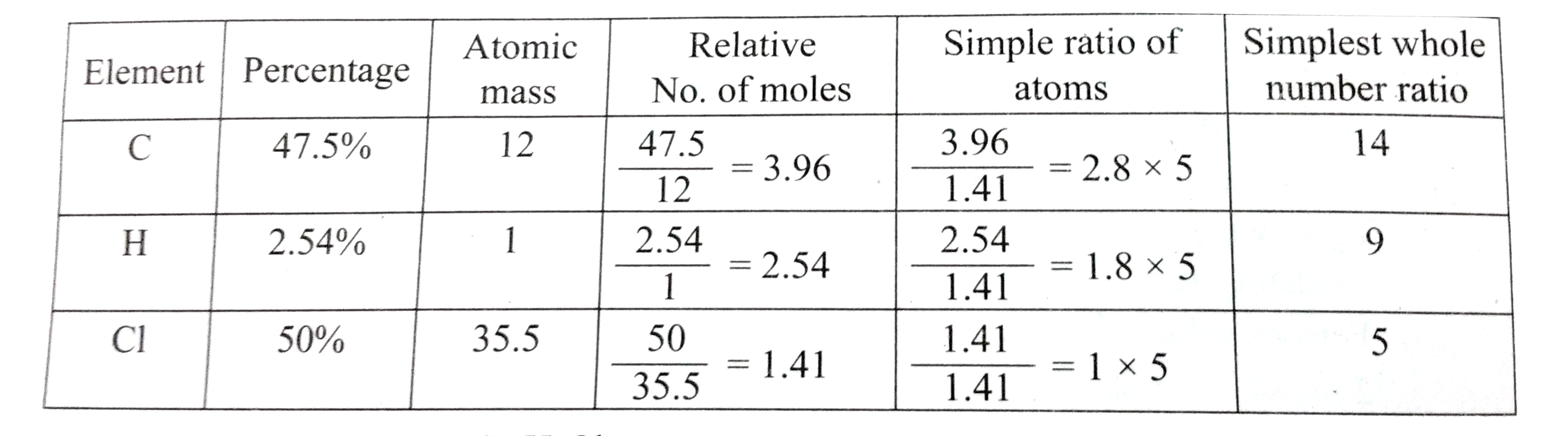 `:.` The EMPIRICAL FORMULA is `C_(14)H_(9)Cl_(5)` Calculation of MOLECULAR formula: The empirical formula MASS `(C_(14)H_(9)Cl_(5))=(14xx12)+(9xx1)+(5xx35.5)` 168+9+177.5=354.5 n = `("Molecular mass")/("Empirical formula mass")=354.5/354.5=1` Molecular formula=`("Empirical formula")_(n)` = `(C_(14)H_(9)Cl_(5))` `:.` Molecular formula = `C_(14)H_(9)Cl_(5)` |
|
| 43. |
An inorganic salt (A) is decomposed on heating ot gvie two products (B) and (C). Compound (C) is a liquidat room temeperture and is neutral to gas. Compounds (A), (B) and (C) are |
|
Answer» `NH_(4)NO_(3),N_(2)O,H_(2)O` |
|
| 44. |
An inorganic compound on analysis was found to have following composition : Mg = 9.76%, S = 13.01%, O = 26.01%, H_2O = 51.22% Calculate the empirical formula of the compound. |
|
Answer» |
|
| 45. |
An inorganic compound liberates O_(2) when heated, turns an acid solution of KI brown and reduces acidified KMnO_(4). The substance is |
|
Answer» `H_(2)O_(2)` `H_(2)O_(2)+KI rarr 2KOH+I_(2)` `2KMnO_(4)+5H_(2)O_(2)+3H_(2)SO_(4) rarr K_(2)SO_(4)+2MnSO_(4)+8H_(2)O+3O_(2)` |
|
| 46. |
An inorganic compound (A) shows the following reactions. It is white solid and exits as dimer(i) gives fumes of (B) with much wet air(ii) It sublimes on 180^(@)C turns forms monomer if heated to 400^(@)C(iii) Its aqueous solution turns blue litmus to red(iv) Adition of NH_(4)OH and NaOH seperately to a solution of (A) gives white precipitate which is however soluble in excess of NaOHB may be |
|
Answer» `AlCl_3` `Al_(2)Cl_(6(s))overset(180^@C) rarr Al_(2)Cl_(6(v)) rarr overset(400^@C) rarr 2AlCl_3` |
|
| 47. |
An inorganic compound (A) is a Lewis acid an d light yellow in colour. It fumes in moist air. The intensity of fumes further increase when a rod dipped in NH_(4)OH is brough near it. The aciedic solution of the compound does not give andy precipitate on passing H_(2)S gas. However, it gives a white precipitate on adding NH_(4)OH solution in the presence of NH_(4)Cl and the white precipitate dissovles on adding NaOH in excess. The solutin formed when white precipitate is dissolved in NaOH is of |
|
Answer» sodium sulphate `Al(OH)_(3)+NaOHrarrNaAlO_(2)+2H_(2)O` |
|
| 48. |
An inorganic compound (A) is a Lewis acid an d light yellow in colour. It fumes in moist air. The intensity of fumes further increase when a rod dipped in NH_(4)OH is brough near it. The aciedic solution of the compound does not give andy precipitate on passing H_(2)S gas. However, it gives a white precipitate on adding NH_(4)OH solution in the presence of NH_(4)Cl and the white precipitate dissovles on adding NaOH in excess. The intensity of fumes increases due to the formation of |
|
Answer» ammonium HYDROXIDE `AlCl_(3)` due to formation of `NH_(4)Cl` . `AlCl_(3)+3NH_($)OHrarrAl(OH)_(3)+3NH_(4)Cl`. |
|
| 49. |
An inorganic compound (3c-2e) and (2c-2e) bonds when reacts with NH_(3) at a certain temperature, gives a compound X which is isostuctrul x with benzene and when reacts at high temperature, forms a substance Y. The substance Y is |
|
Answer» `B_(2)H_(6)` |
|
| 50. |
An inhibitor is described as, |
|
Answer» a SUBSTANCE that slows down or STOPS a reaction |
|