Saved Bookmarks
This section includes 7 InterviewSolutions, each offering curated multiple-choice questions to sharpen your Current Affairs knowledge and support exam preparation. Choose a topic below to get started.
| 1. |
An organic compound (A) with molecularformula C_2H_5Cl reacts with KOH gives compounds (B) and with alcoholic KOH gives compound (C). Identify (A), (B) and (C) |
Answer» Solution : (i) An organic compound (A) of molecular formula `C_2H_5Cl` is identified as Chloroethane with molecular formula `CH_3 - CH_2Cl` from the formula. (ii) Chloroethane reacts with AQUEOUS KOH to GIVE ETHANOL, i.e., Aqueous `C_2H_5OH`as (B) by substitution reaction. `CH_3 - CH_2Cl + KOH to UNDERSET("Ethanol (B)")(CH_3 - CH_2OH) + KCl` (iii) Chloroethane reacts with alcoholic KOH to give ethene `C_2H_4` as (C) by elimination reaction. `CH_3 - CH_2Cl underset(KOH)OVERSET("alcoholic")toCH_2=CH_2 + KCl + H_2O` 
|
|
| 2. |
An organic compound (A) with molecular formula C_(2)H_(5)Cl reacts with KOH gives compound B and with alcoholic KOH gives compound C. Identify A, B and C explain. |
|
Answer» SOLUTION :1. `underset("Ethyl Chloride (A)")(C_(2)H_(5)Cl) OVERSET(KOH(AQ))to underset("Ethanol (B)")(C_(2)H_(5)OH)+KCl `, 2. `C_(2)H_(5)Cl overset(alc." KOH")to underset("ETHYLENE (C)")(CH_(2)=CH_(2))+H_(2)O+KC L` 
|
|
| 3. |
An organic compound (a) reacts with sodium metal and forms. (b) On heating with conc. H_(2)SO_(4) (a) gves diethyl ether. (a) and (b) are respectively |
|
Answer» `C_(2)H_(5)OH` and `C_(2)H_(5)ONa` `2C_(2)H_(5)OH overset(Conc.H_(2)SO_(4))rarrC_(2)H_(5)OC_(2)H_(5)`. |
|
| 4. |
An organic compound A reacts with methyl magensium iodide to form an addition product which on hydrolysis forms the compound B. Compound B give blue colour salt in Victor Meyer's test. The compounds A and B are respectively. |
|
Answer» Acetaldehyde, tertiary BUTYL alcohol |
|
| 5. |
An organic compound (A) reacts with H_(2) to give (B) and ( C) successively. On ozonolysis of (A) , two aldehydes (D) C_(2)H_(4)O and( E)C_(2)H_(2)O_(2) and On ozonolysis of (B) only propanal is formed. Compound (A), (D) & ( E) are |
Answer» SOLUTION :(B),( C),(D)
|
|
| 6. |
An organic compound 'A' on treatment with ethyl alcohol gives a carboxylic acid 'B' and compound 'C'. Hydrolysis of 'C' under acidic conditions gives 'B' and 'D'. Oxidation of'D ' with KMnO_(4) also gives'B' . 'B' on heating withCa(OH)_(2) gives'E' (C_(3)H_(6)O). E does not give Tollen 's test and does not reduce Fehling 's solution but form a 2,4- dinitrophenyl hydrazone . How many carbon are present inproduct (E ). |
Answer» 
|
|
| 7. |
An organic compound (A) on ozonolysis gives only acetaldehyde (A)reacts with Br_(2)//CI_(4) to give compound(B) identify the compound(A)and (B) writethe IUPC name of (A)and (B) given the gemoterica isomers of (A) |
Answer» SOLUTION :2-butane UNDERGO OZONOLYSIS to GIVE ACETALDEHYDE only . 
|
|
| 8. |
An organic compound "A" of molecular weight 120, gives Tollen's reagent test and 2,4-DNP test but no Iodoform with I_(2)/OH^(Theta) . The compound "A" may be |
|
Answer» Benzoic acid |
|
| 9. |
An organic compound A of molecular formula CH_(2)O reacts with methyl magnesium iodide followed by acid hydrolysis to give B of molecular formula C_(2)H_(6)O. B on reaction with PCl_(5) gives C. C on reaction with alcoholic KOH gives D an alkene as the product. Identify A,B,C,D and explain the reactions involved. |
|
Answer» Solution :1. A of molecular formula `CH_(2)O` is identified as `HCHO`, formaldehyde. 2. Formaldehyde reacs with `CH_(3)MgI` followed by hydrolysis to give ethanol, `CH_(3)-CH_(2)OH` B as the product. 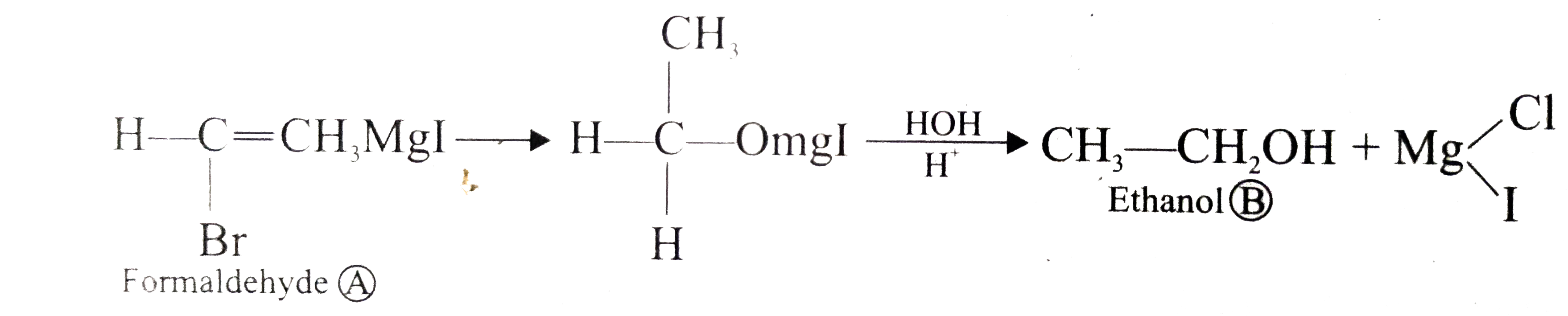 3. Ethanol B reacts with `PCl_(5)` to give `C_(2)H_(5)Cl` Ethyl chloride C as the product. `underset("Ethanol")(CH_(3)-CH_(2)OH)+PCl_(5)overset(HOH)(to)CH_(3)-underset("Ethyl chloride C")(CH_(2)Cl+POCl_(3)+)HCL` 4. `CH_(3)-CH_(2)Cl` C on reaction with alcoholic KOH UNDERGOES dehydrohalogenation to give ethylene `CH_(2)=CH_(2)` D as the product. `CH_(3)-CH_(2)Clunderset("KOH")overset("alcoholic")(to)underset("Ethylene")(CH_(2)=CH_(2)+)HCl` `{:(A,HCHO,"Formaldehyde"),(B,CH_(3)-CH_(2)OH,"Ethanol"),(C,CH_(3)-CH_(2)Cl,"Ethyl chloride"),(D,CH_(2)-CH_(2),"Ethylene"):}` |
|
| 10. |
An organic compound Aof molecular formula CH_2O reacts with methyl magnesium iodide followed by acid hydrolysis to give B of molecular formula C_2H_6O. B on reaction with PCl_4 gives C . C on reaction with alcoholic KOH gives D an alkeneas the product. IdentifyA, B ,C ,D and explain the reactions involved. |
|
Answer» Solution :(i) A of molecular formula `CH_2 O`is identified as HCHO, FORMALDEHYDE . (II) Formaldehyde reacts with `CH_3MgI` followed by hydrolysis to give ethanol, `CH_3 - CH_2 OH` B as the product.  (ii) Ethanol B react with `PCl_5` to give `C_2H_5Cl`, Ethyl CHLORIDE C as the product. `underset("Ethanol")(CH-3-CH_2OH) + PCl_5 overset(KOH)to underset("Ethyl chloride C")(CH_3 - CH_2Cl+ POCl_3 + HCl)` (iv) `CH_3- CH_2 Cl` C on reaction with ALCOHOLIC KOH undergoes dehydrohalogenation to give ethylene `CH_2 = CH_2` D as the product. `CH_3 - CH_2 Cl underset(KOH)overset("alcoholic")to underset("Ethylene")(CH_2 = CH_2) + HCl` 
|
|
| 11. |
An organic compound A of molecular formula C_3 H_6 react with HBr in the presence of peroxide to give C_3H_7Bras B. B on reaction with aqueous KOH given C with molecular formula C_3H_8O. Identify A, B and C. |
|
Answer» Solution :(i) An organic compound A of molecular formula `C_3H_6` is ` CH_3 - CH = CH_2`, propene (ii) Propene A REACTS with HBr in the presence of peroxide to give 1-bromopropane `CH_3-CH_2 -CH_2Br` as B. `{:(CH_3 - CH = CH_2 + HBr underset("Atimarkovnikoff.s")overset("Peroxide")toCH_3- CH_2 - CH_2Br),("RULE""1-bromopropane R"):}` (iii) 1 - Bromopropane on reaction with aqueous KOH undergoes hydrolysis to give Propan - 1- ol, `CH_3- CH_2 - CH_2OH` as C. `CH_3 - CH_2 -CH_2 Br + KOH(AQ.) to underset("Propan- 1-ol C")(CH_3 - CH_2CH_2 OH) + KBR` 
|
|
| 12. |
An organic compoundA of molecular formula C_2H_6O reacts with thionyl chloride in the presence of pyridine gives B C_2H_5Cl. B on reaction with alcoholic KOH gives C. C_2H_4, C on treatment with Cl_2 gives C_2H_4Cl_2 as D. Identify A,B,C,D and explain the reaction. |
|
Answer» Solution :(i) An organic COMPOUND A of molecular formula `C_2H_6O` is Ethanol `CH_3- CH_2OH`. (ii) Ethanol reacts with thionyl chloride in the presence of pyridine to give `CH_3 - CH_2Cl` B as product. `CH_3-CH_2OH underset("Pyridine")overset(SoCl_2)to underset("Ethyl chloride"B)(CH_3 - CH_2Cl)` (iii) Ethyl chloride on treatment with alcoholie KOH, undergoes dehydrohalogenation to give `C_2H_4`, ethylene C as the product. `CH_3 - CH_2Cl underset(KOH)overset("alcoholic")to underset("Ethylene C")(CH_2= CH_2) + KCL + H_2O` (IV) Ethylene on reaction with `Cl_2` yield ethylenedichloride as D as the product. 
|
|
| 13. |
An organic compound (A)of molecular formula C_(2)H_(4) which is a simple alkene reacts withbaeyer reagent to give B of molecular formulaC_(2)H_(6)O_(2) a again reacts with ozone followedby hydrolysis in the presence of zinc c of molecular formula CH_(2)O identify A,B and C explain with reaction |
|
Answer» Solution :(i) A is `CH_(2)=CH` (Ethylene ) (ii) A(ethylene) reacts with baeyer .s REAGENT (cold alkaline `KMnO_(4))` to GIVE ehtylene glycol (ethane 1,2 diol) 
|
|
| 14. |
An organic compound A of molecular formula C_2H_2 reacts with HCI to give C_2H_4Cl_2 as B.B on reaction with aqueous KOH will give C_2H_4O as C. Identify A, B,C,and explain the reaction involved. |
|
Answer» Solution :(i) An organic compoundA of molecular FORMULA `C_2H_2 ` is ` CH -=CH` (Acetylene) (ii) Acetylene A reacts with HCI to give ethylene dichloride B as the PRODUCT. `underset("Acetylene")undersetA(CH-=CH)+ HCl to underset(CL) underset(|)CH_2 = CH overset(HCl)to underset(B)underset("dichloride ")underset("Ethylidene")(CH_3 - CHCl_2)` (III) Ethylidene dichloride on reaction with aqueous KOH will give acetaldehyde, C as the product. 
|
|
| 15. |
An organic compound (A) of a molecular formula C_(6)H_(6) which simple aromatic hydrocarbon. A undergoes hydrogenation to give a cyclic compound (B). A reacts with chlorine in the presence of UV-light to give C which is used insecticide Indentify A,B and C. Explain the reactions with equation. |
|
Answer» Solution :1. Simple aromatic hydrocarbon, `C_(6)H_(6)` is benzene. 2. Benzene (A) reacts with `H_(2)` in the PRESENCE of Pt to give CYCLOHEXANE (B) 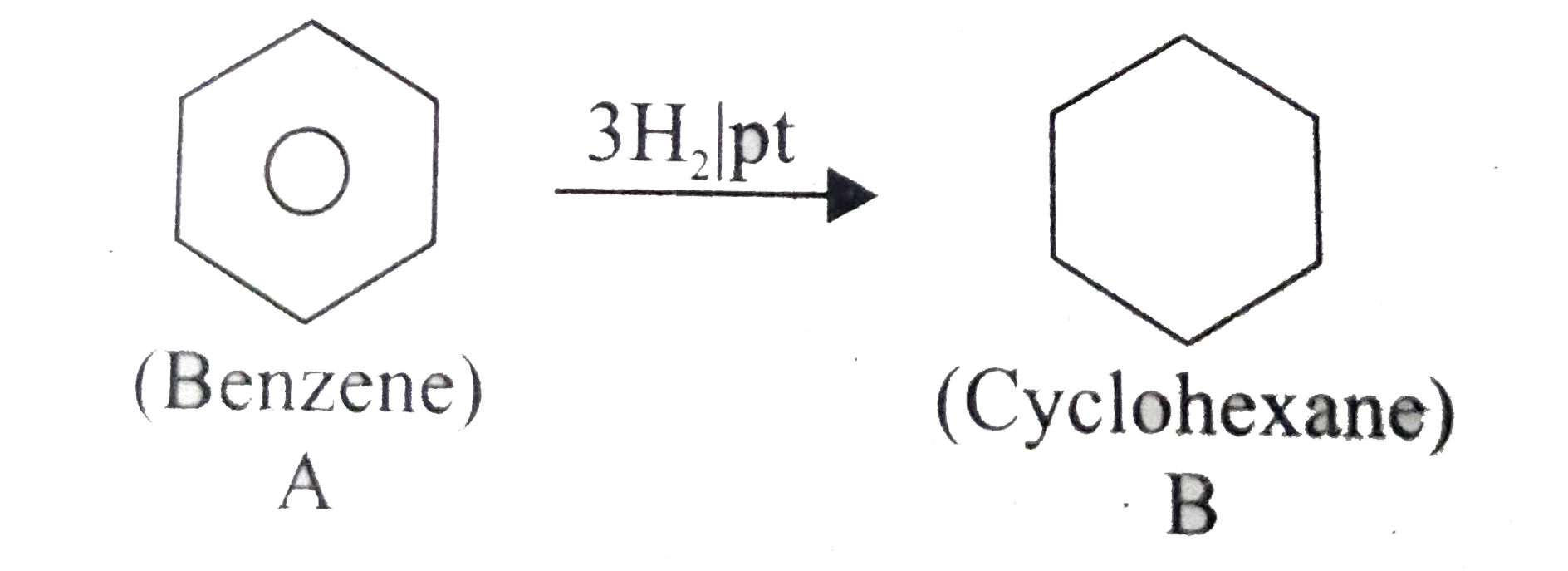 3. Benzene (A) reacts with `Cl_(2)` in presence of UV-light to give benzene hexachloride (C). 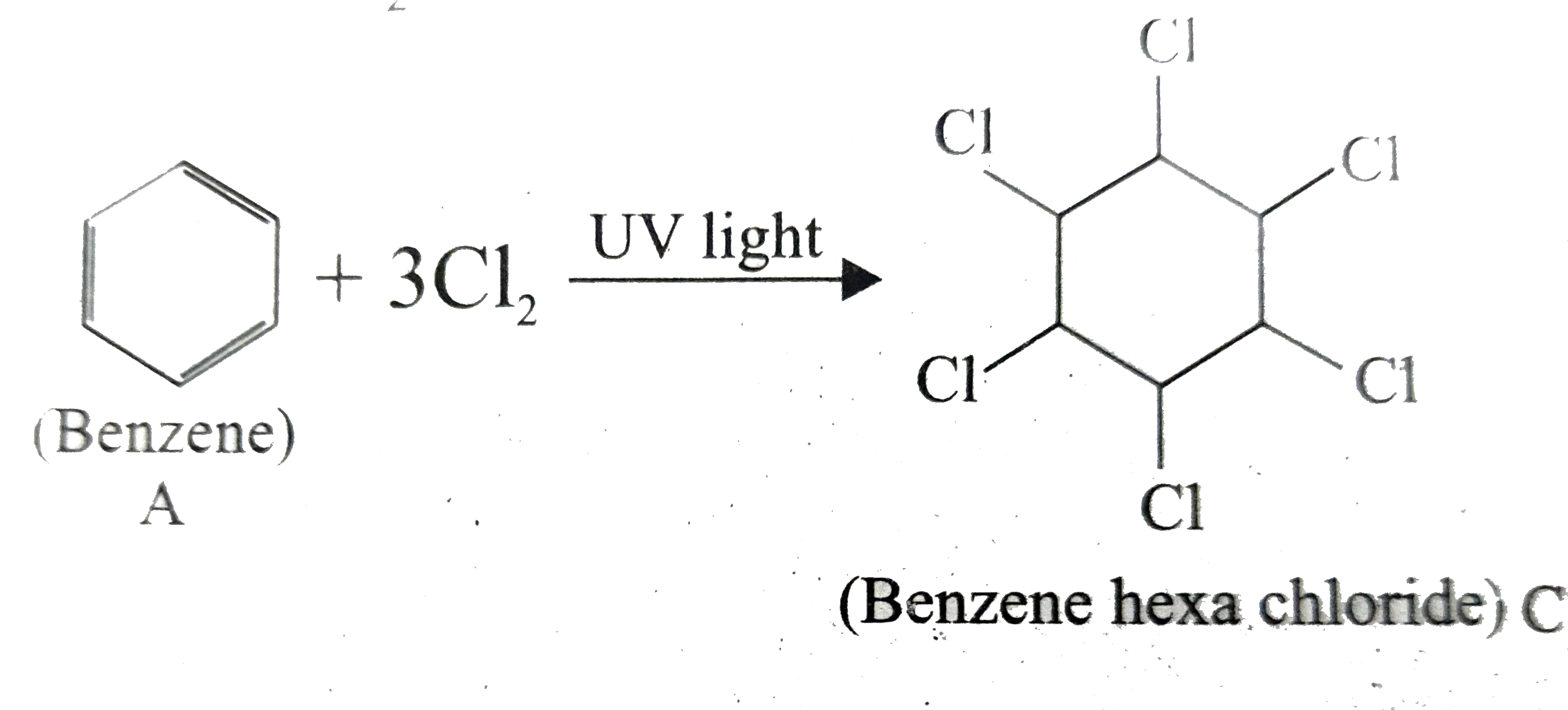 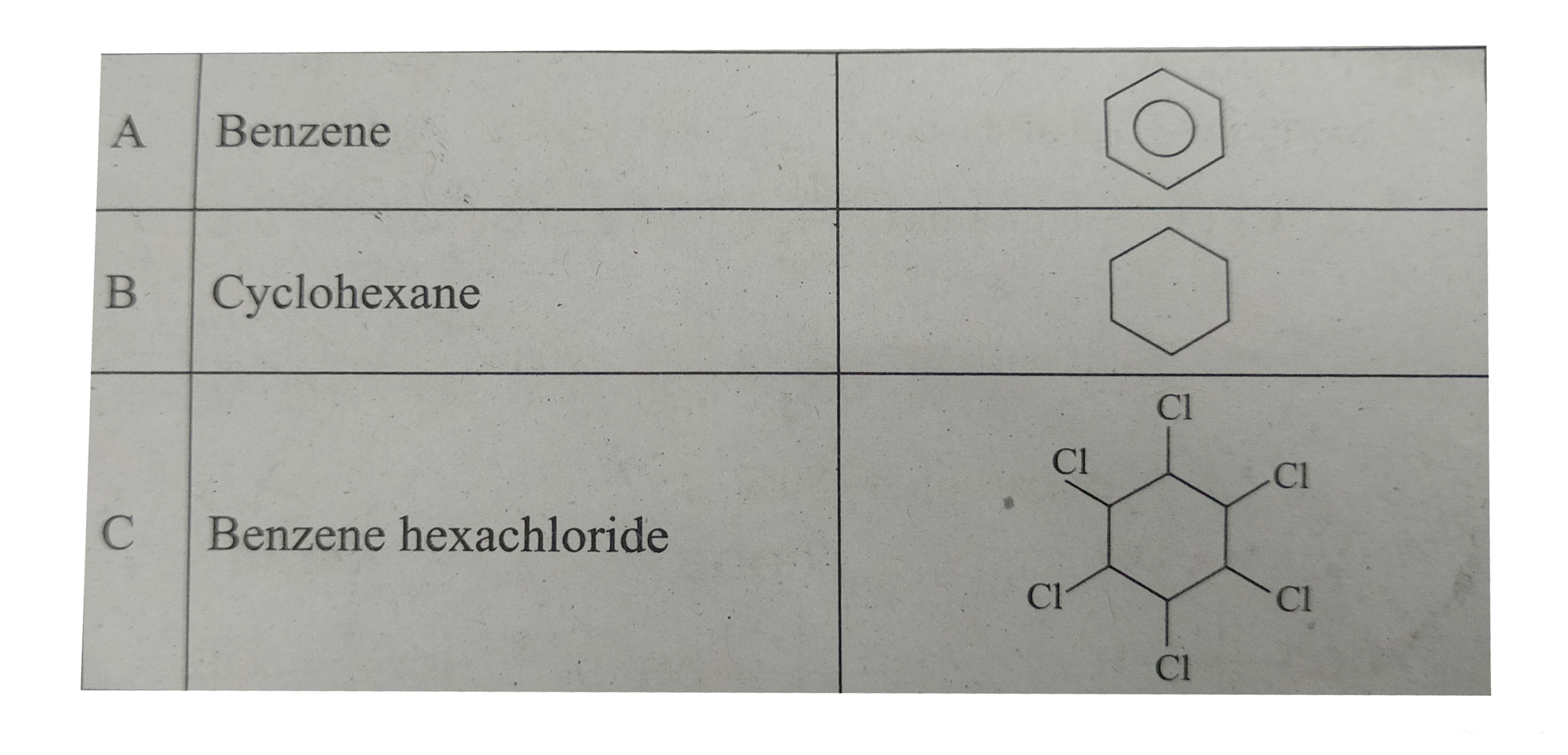
|
|
| 16. |
An organic compound (A) of a molecular formula C_(2)H_(4)which is a simple alkene. A reacts with dil H_(2)SO_(4) to give B.A again reacts with CI_(2) to giveC. Identify A,B and C and write the equations. |
|
Answer» SOLUTION :(i)`C_(2)H_(4)` Iis `CH_(2) = CH_(2)` is a simple alkene. A is ethylene. (ii) Ethylene (A) reacts withdil `H_(2)SO_(4)` to GIVE ethanol (B) `underset("Ethylene (A)") (CH_(2)CH_(2))overset ("dil H_(2)SO_(4)") to CH_(3) - underset ("ethanol(B)") (CH_(2))- OH` (III) Ethylene (A) reacts with `CI_(2)` to give 1,2 dichloro ethane (C) ` (##FM_CHE_XI_V02_C12_E11_009_S01.png" width="80%"> |
|
| 17. |
Anorganic compound (A)of a molecular formula C_(6)H_(6) is a simple aromatic hydrocarbon A reacts with O_(2)in the presence of V_(2)O_(5) at 773 k to give B.A is further treated with sodium and liquidammonia to give C which is a diene compoundidentify A,B and C and explainthe reaction |
|
Answer» Solution :(i)Simplearomatichydrocarbon `C_(6) H_(6)` is BENZENE (ii)Benzene(A)reactswith `h_(2)`in thepresenceof Ptto givecyclohexzne(B)  (III)Benzene(A)react with`CI_(2)`in presencef U-Vlight tobenzenehexachloride(C ) 
|
|
| 18. |
An organic compound (A) of amolecular formulaC_(2) H_(4). Which is a simple alkene . A reactswith dil .H_(2) SO_(4) to give B.A again reacts withCl_(2) to give C . Identify A , B andand write the equation . |
|
Answer» Solution :(i) ` C_(2) H_(4) " is " CH_(2) = CH_(2)` is a simple alkene . A is Ethyene . (ii) Ethylene (A) reacts with dil . ` H_(2) SO_(4)` to GIVE ethanol (B) `underset ((A)) underset (" Ethylene ")(CH_(2) CH_(2)) overset (" dil." H_(2) SO_(4))(to) underset ((B))underset (" Ethanol ")(CH_(3)) -CH_(2)-OH ` (iii) Etheyle (A) reacts with ` Cl_(2) ` to give 1,2 dichloro ethane (C) ` CH_(2) = CH_(2) overset (CL _(2)) (to) underset ((C)) underset (Cl) underset (|) (CH_(2)) - underset (("1,2dichloro ethene ")) underset (Cl) underset(|)( CH_(2) )` |
|
| 19. |
An organic compound (A) of a molecular formula C_(2)H_(4), decolourises brom water. (A) on reacts with Cl_(2) gives (B). (A) reacts with HBr to give (C). (A) rean presence of Ni to give D. Identify A, B, C and D. Explain the reactions. |
|
Answer» Solution :1. `C_2H_4(A)`,decolorise the bromine water . Therefore it contains double bond. Hence (A) is ethylene. 2.`underset("Ethylene"(A))(CH_2)+Cl_2 tounderset(1,2"dichloro ETHANE")underset(Cl)underset(|)(CH_(2))-underset(Cl)underset(|)(CH_(2))-Br` 3. `underset("Ethylene(A)")(CH_(2))=CH_2 +HBR to underset("Ethyl Bromide(C)")(CH_(3))-CH_(2)-Br` `CH_(2)=CH_(2)+H_(2) overset(Ni)underset(298K)to underset("Ethane(D)")(CH_(3))-CH_(3)` 
|
|
| 20. |
An organic compound 'A' having molecular formula C_(6)H_(10)O gives a characteristic colour with aqueous FeCl_(3) solution. When 'A' is treated with CO_(2) and NaOH at 400K under pressure. 'B' is obtained. B on acidification gives C when C treated with CH_(3)COCl gives a popular pain killer D. Deduce the strucutrues of A,B,C and D. |
Answer» SOLUTION :
|
|
| 21. |
An organic compound 'A', containing C,H,N and O, on analysis gives 49.32% carbon 9.59%, hydrogen and 19.18% nitrogen. 'A' on boiling with NaOH gives off NH_(3) and a salt which on acidification gives a monobasic nitrogen free acid, 'B'. The silver salt of 'B' contains 59.67% silver. Structure of 'A' and 'B' are respectively: |
|
Answer» `CH_(3)CH_(2)COOH, CH_(3)CH_(2)CONH_(2)` |
|
| 22. |
Anorganic compound (A) C_(7)H_(6)Ogives positive Tollens test . On treatment with alcoholic CN_(A)yeids compound (B) , C_(14)H_(12)O_(2). Compound ion reduction with Zn-Hg, HCl and dehydration gives an unsaturated compound (C ) ,which adds to one mole of Br_(2)// C Cl_(4) . The compound (B) on heating with HNO_(3) yeids compound (D) C_(14)H_(10)O_(2) . Compound(D) on heating with KOH undergoes rearrgement and subsequent acidification of rearranged products yields an acidic compound (E) ,C_(14)H_(12)O_(3).Based on the above information answer the followingStructure of compound (E)is : |
|
Answer»

|
|
| 23. |
An organic compound (A), C_6H_10 , on reductionfirst gives (B), C_6H_12 , and finally (C ),C_6H_14, (A) on ozonolysis followed by hydrolysis gives two aldehydes (D) , C_2H_4O, and (E) , C_2H_2O_2. Oxidation of (B) with acidified KMnO_4 gives onlythe acid (F), C_3H_6O_2. Determine the structure of the compound (A) to (F) with proper reasoning . |
|
Answer» Solution :(i)Since the aldehyde (E) contains two O atoms , therefore, it must be a DIALDEHYDE. The only dialdehyde having the molecular formula , `C_2H_2O_2` is glyoxal, i.e., O=CH-CH=O . The other aldehyde (D) having the molecular formula , `C_2H_4O` must be acetaldehyde, i.e., `CH_3CHO`. Further since glyoxal is a dialdehyde therefore, two molecules of acetaldehyde must have been FORMED . Thus, the structure of the alkene (A) is `underset"Hexa-2,4-diene(A)"(CH_3CH=CH-CHCH_3)underset((ii)Zn//H_2O)overset((i)O_3//CH_2Cl_2)to underset"Acetaldehyde"(CH_3CH)=O+O = underset"Glyoxal"(CH-CH)=O+O =underset"Acetaldehyde"(CHCH_3)` (ii)Since, (A) on reduction gives (B) which on OXIDATION with alk. `KMnO_4` gives only the acid (F), therefore (B) must be hex-3-ene and (F) must be propanoic acid `underset"[A]"(CH_3CH=CH-CH=CHCH_3)underset"1,4-Addition"overset(H_2//Ni)to underset"Hex-3-ene(B)"(CH_3CH_2CH=CHCH_2CH_3)overset"[O]"to underset"Propanoic acid (F)"(CH_3CH_2COOH)+ underset"Propanoic acid(F)"(CH_3CH_2COOH)` (III)Since (A) on reduction FIRST gives B (hex-3-ene) and finally (C) , therefore , (C) must be n-hexane. `underset"Hex-3-ene"(CH_3CH_2CH=CHCH_2CH_3)overset(H_2//Ni)to underset"n-Hexane(C)"(CH_3CH_2CH_2CH_2CH_2CH_3)` |
|
| 24. |
An organic compound(A)C_(2)H_(4) decolorise water (A) on reactionwith chlorinegives (B) A reacts with HBrto give (C )identify (A),(B) (C ) explain the reactions |
|
Answer» Solution :`(i)C_(2) H_(4) (A)` DECOLOURISES the brominewater.Thereforeitcontainsdoublebond.Hence(A)isethylene. `(ii)CH_(2)=CH_(2) + CI_(2) tounderset(CI) underset(|) (C H_(2))- underset(CI) underset(|)(CH_(2))` (III) `CH_(2)= CH_(2) + HBR to CH_(2) - CH_(2) -Br` 
|
|
| 25. |
An organic compound (A), C_18H_20O on ozonolysis gives (B), C_10H_12O and (C) C_8H_8O_2 . Compound (B) gives iodoform reaction and products an oxime (D), C_10H_13ON on treatment with NH_2OH. Compound (D) reacts with PCI_5 in dry ether to give (E) which on hydrolysis (F), C_8H_11N and acetic gives acid. (F) on treatment with HNO_2 followed by oxidation gives phthalic acid. Compound (C) on mild oxidation gives (G) which gives effervescence with NaHCO_3 . (G) on treatment with HI produces p-hydroxy benzoic acid and CH_3I. Give structures of (A) to (G) with proper reasoning. |
Answer» Solution :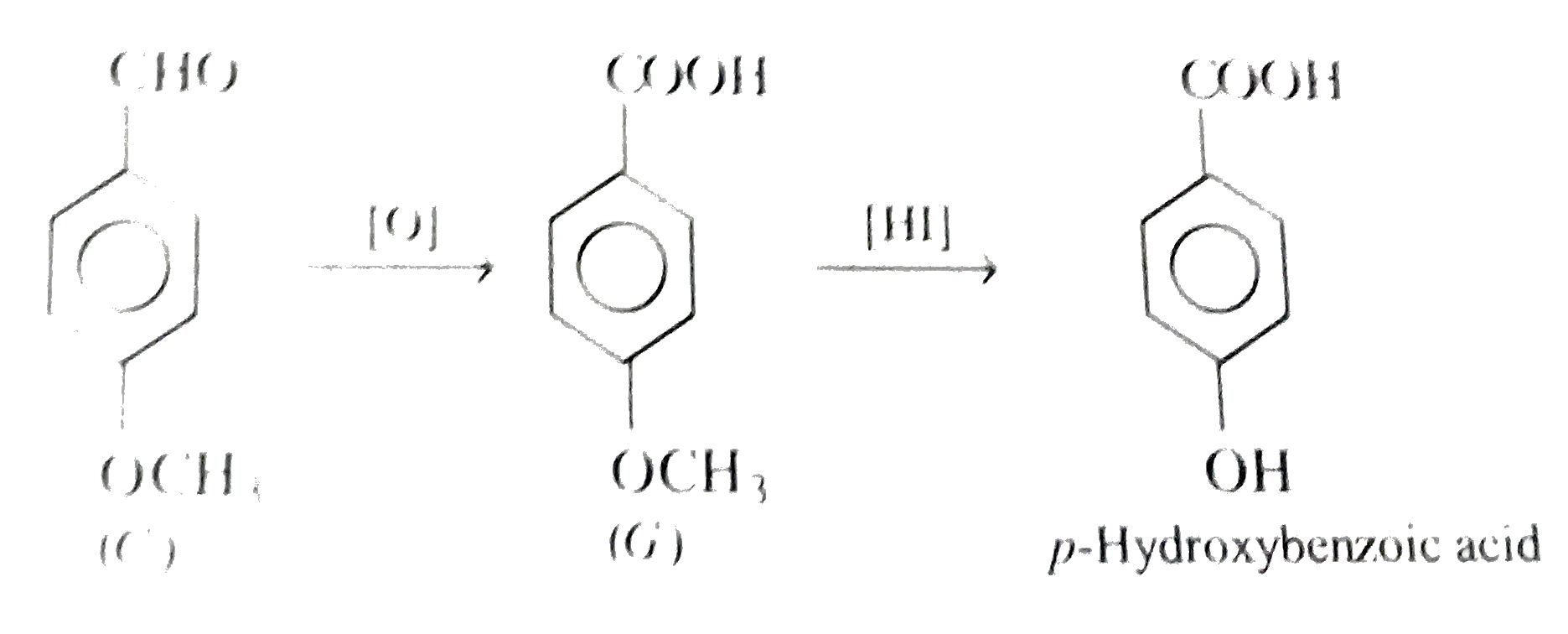 The COMPOUND (B) gives iodoform TEST as it has `-OVERSET(O)overset(||)C-CH_3` group and produces oxime with `NH_2OH`. 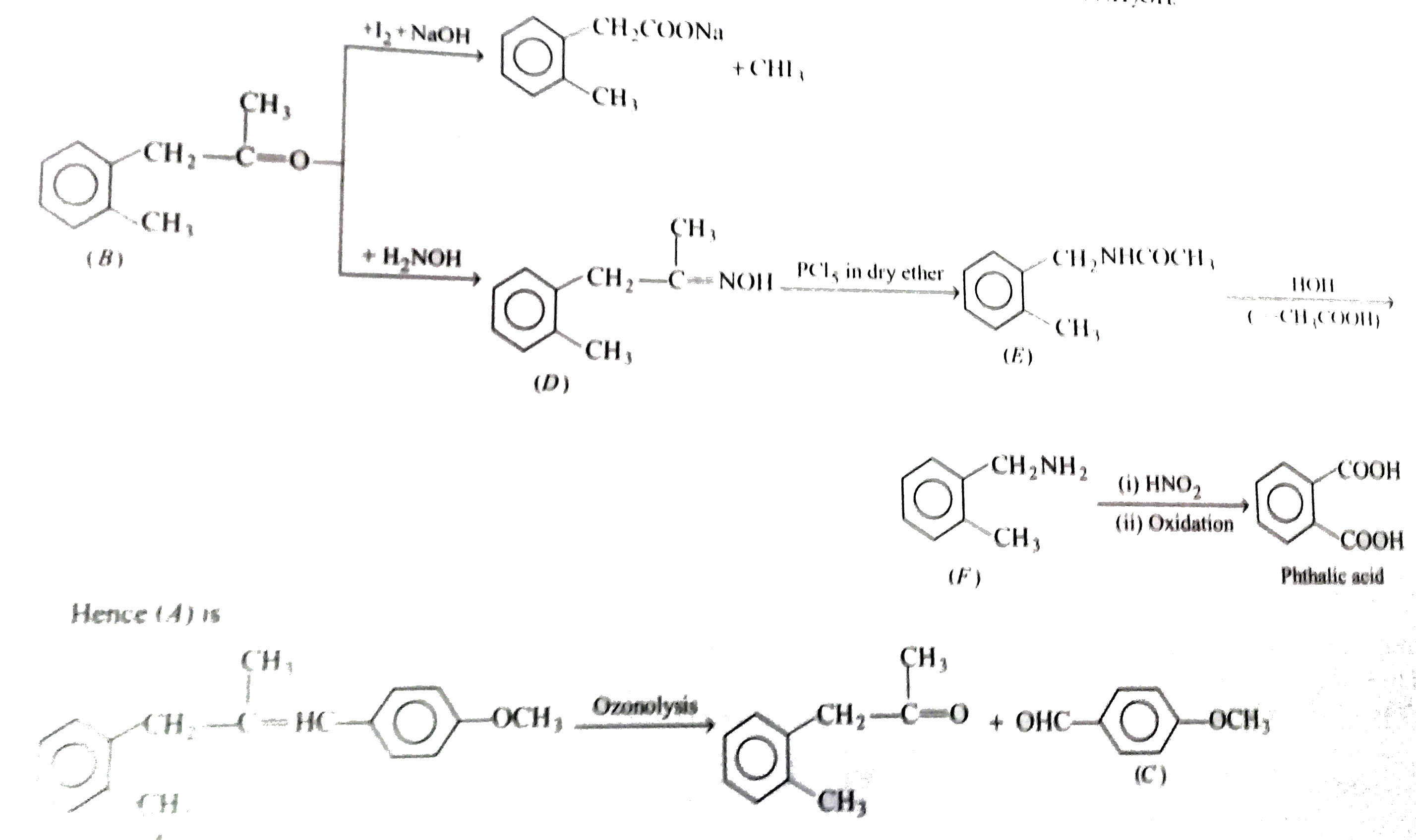
|
|
| 26. |
An organic compound1,1 dichloropropane reacts with alcholic KOHto give molecular formula C_(3)H_(4)a reacts with mercuric sulphate and dil H_(2)SO_(4) at 333 k to give B.A on passing through red hot iron tube at 873 k will givec whichis a cyclic compound identify A,B and C explainthe reaction |
Answer» SOLUTION :1,1-dichloropropane REACTS with alcholic KOH to GIVE PROPYNE (A) . 
|
|
| 27. |
An organic compound1,1 dichloropropane reacts with alcholicKOHot give a of molecular formula C_(3)H_(4)a reacts with mercuricand dil H_(2)SO_(4)at 333 K to give B a on passing through red hotiron tube at 873 k willgive C which is a cyclic compoundidentify A,Band C explain thereaction |
|
Answer» Solution :(i) Ais BENZENE`(C_(6)H_(6))`a simplehydrocarbon (ii) Benzene(A )react with`O_(2)`is thepresenceof `V_(2) O_(5)`at 773 kto givemaleicanhydride(B)  (iii)Benzene(A) istreatedwithsodiumand liquidammoniato give1,4- cyclohexadiene (c ) 
|
|
| 28. |
An organic base (X) reacts with nitrous at 0^(@) to give a clear solution. Heating with KCN and cuprous cyanide followed by continued heating with conc. HCl gives a crystaline solid. Heating this solid with alkaline potassium permangante gives a compound which dehydrates on heating to a crystaline solid. "X". is: |
|
Answer»
|
|
| 29. |
An organic acid having molecular formula C_(2)H_(4)O_(2) is |
|
Answer» FORMIC acid |
|
| 30. |
An organic compound contains carbon, hydrogen, oxygen and nitrogen in the weight ratio 3:1:8:3.5. Calculate its empirical formula. |
|
Answer» SOLUTION :Ratio of atoms, C : H : O : N = `(3)/(12) : (1)/(1) : (8)/(16) : (3.5)/(14) = 0.25 : 1 : 0.5 : 0.25 = 1 : 4 : 2 : 1` The empirical formula is `CH_(4)O_(2)N` |
|
| 31. |
An orgainc compound has 8 percent of sulphur by weight. What is its molecular weight of the compound? |
|
Answer» Solution :8 parts of sulphur = 100 parts of compound 32 parts of sulphur = ? The minimum molecular weight of the compound = `(32)/(8)xx100 = 400` Molecular weight MAY be multiple of 400, like 800 , 1200, 1600, 200 ets., |
|
| 32. |
An orgainc compound contains 43.98% C, 2.09% H, and 37.2% Cl. Calculate its empirical formula. |
|
Answer» Solution :Oxygen `= 100 - 43.98 - 2.09 - 37.2 = 1673`. `{:("Element", "Mole", "Least ratio", "WHOLE NUMBER ratio"),(C , (43.98)/(12) = 3.66, (3.66)/(1.04) = 3.5, 7),(H, (2.09)/(1) = 2.09, (2.09)/(1.04) = 2, 4),(Cl, (37.2)/(35.5) = 1.04, (1.04)/(1.04) = 1, 2),(O, (16.73)/(16) = 1.04, (1.04)/(1.04), 2):}` EMPIRICAL formula `= C_(7) H_(4) Cl_(2) O_(2)` |
|
| 33. |
An ore after levigation is found to have acidic impurities. Which of the following can be used as flux during smelting operation. |
|
Answer» `H_(2)SO_4` |
|
| 34. |
An orbital is designated by certain values of first three quantum numbers (n, l and m) and according to Pauli.s exclusion principle, no two electrons in a atom can have all the for quantum numbers equal. N, l and m denote size, shape and orientation of the orbital. The permissible values of n are 1,2,3.... prop while that of 1 are all possible integral values from 0 to n-n. Orbitals with same values of n and 1 but different values of m (where m can have any integral values from 1 to +1 including zero) are of equal energy and are called degenerate orbitals. However degeneracy is destroyed in homogeneous external magnetic field due to different extent of interaction between the applied field and internal electronic magnet of different orbitals differing in orientations. In octahedral magnetic field external magnetic field as oriented along axes while in tetrahedral field the applied field actas more in between the axes than that on the axes themselves. For 1=0, 1,2,3,...., the states (called sub-shells) are denoted by the symbol s,p,d,f.....respectively. After f, the subshells are denoted by letters alphabetically 1 determines orbital angular motion (L) of electron as L = sqrt(l(l+1))(h)/(2pi) ON the other hand, m determines Z-component of orbital angular momentum as L_(Z) = m((h)/(2pi)) Hund.s rule states that in degenerate orbitals electrons do not pair up unless and until each each orbitals has got an electron with parallesl spins Besides orbital motion,an electron also posses spin-motion. Spin may be clockwise and anticloskwise. Both these spin motions are called two spins states of electrons characterized by spin Q.N (s) : s = +(1)/(2) and = -(1)/(2) respectively The sum of spin Q.N. of all the electrons is called total spin(s) and 2s+1 is called spin multiplicity of the configuration as a whole. The spin angular momentum of an electron is written as L_(s) = sqrt(s(s+1))(h)/(2pi) According to Hund.s rule, the distribution of electron within the various orbitals of a given sub-shell is one which is associated with |
|
Answer» MINIMUM SPIN multiplicity |
|
| 35. |
An orbital is designated by certain values of first three quantum numbers (n, l and m) and according to Pauli.s exclusion principle, no two electrons in a atom can have all the for quantum numbers equal. N, l and m denote size, shape and orientation of the orbital. The permissible values of n are 1,2,3.... prop while that of 1 are all possible integral values from 0 to n-n. Orbitals with same values of n and 1 but different values of m (where m can have any integral values from 1 to +1 including zero) are of equal energy and are called degenerate orbitals. However degeneracy is destroyed in homogeneous external magnetic field due to different extent of interaction between the applied field and internal electronic magnet of different orbitals differing in orientations. In octahedral magnetic field external magnetic field as oriented along axes while in tetrahedral field the applied field actas more in between the axes than that on the axes themselves. For 1=0, 1,2,3,...., the states (called sub-shells) are denoted by the symbol s,p,d,f.....respectively. After f, the subshells are denoted by letters alphabetically 1 determines orbital angular motion (L) of electron as L = sqrt(l(l+1))(h)/(2pi) ON the other hand, m determines Z-component of orbital angular momentum as L_(Z) = m((h)/(2pi)) Hund.s rule states that in degenerate orbitals electrons do not pair up unless and until each each orbitals has got an electron with parallesl spins Besides orbital motion,an electron also posses spin-motion. Spin may be clockwise and anticloskwise. Both these spin motions are called two spins states of electrons characterized by spin Q.N (s) : s = +(1)/(2) and = -(1)/(2) respectively The sum of spin Q.N. of all the electrons is called total spin(s) and 2s+1 is called spin multiplicity of the configuration as a whole. The spin angular momentum of an electron is written as L_(s) = sqrt(s(s+1))(h)/(2pi) The orbital angular momentum of electron (l=1) makes an angles of 45^(@) from Z-axis. The L_(z) of electron will be |
|
Answer» `2((H)/(2PI))` |
|
| 36. |
An optically pure compound X gave an [alpha]_(D)^(25)=+20.0^(@) A mixture of X and its enantiomer Y gave [alpha]_(D)^(25)=+10^(@). The ratio of X to Y in the mixture is : |
|
Answer» `2:1` Hence optical IMPURITY =100 - 50 = 50% 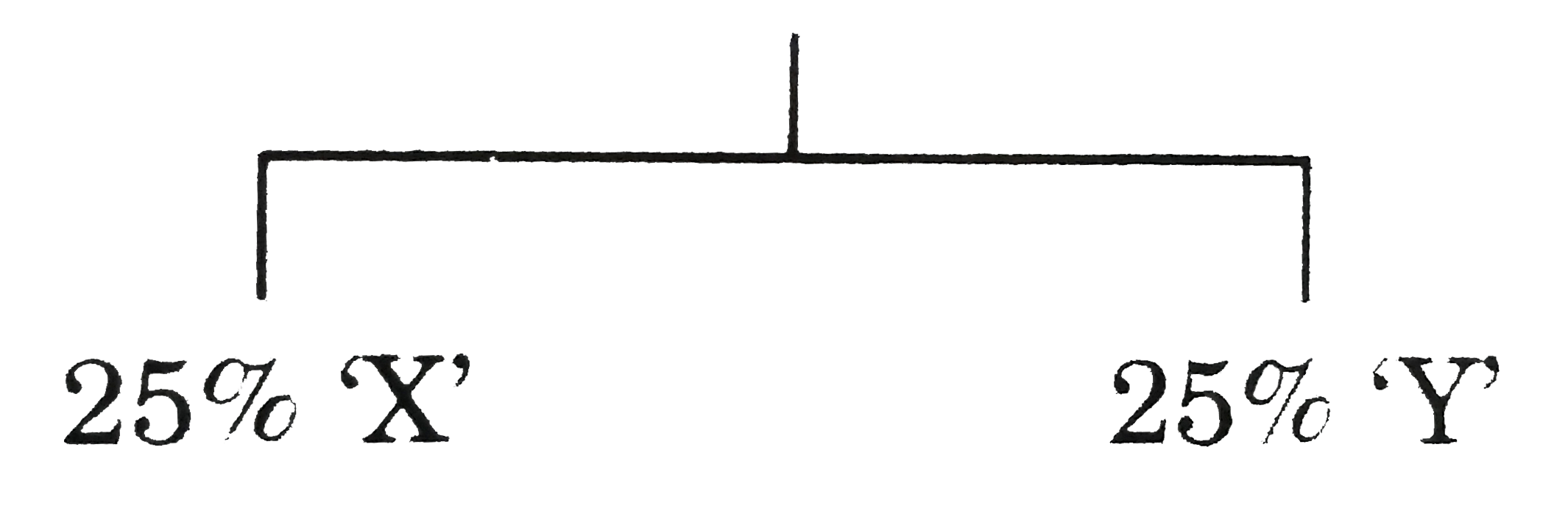 TotalX= 50 +25 =75% TotalY= 25% Hence, ratio of X and Y = 75 : 25 3 : 1 |
|
| 37. |
An open vessel contains air at 27^@C. To what temperature should the vessel be heated so that the number of molecules in the vessel decreases by 25% ? (Neglect the expansion of the container). |
|
Answer» `=(100 - 25)/100xx n_1 = 0.75 n_1` Since the vessel is open and does not expand on heating, the volume of the gas in the container and its pressure remain constant during heating. According to the gas equation, `PV = n_1 RT_1` (before heating) and `PV = 0.75 n_1 RT_2` (after heating) `:. "" n_1 T_1 = 0.75 n_1 T_2` or `T_2 =T_1/(0.75) =(273+27)/(0.75) = 400K(T_1 = 27^@C)` HENCE, the vessel should be heated to `400-273 = 127^@C`. |
|
| 38. |
An open vessel at 27^(@)C is heated untill (3)/(5) parts of the air in it has been expelled. Assuming that thevolume of the vessel remains constant, find the temperature to which the vessel has been heated. |
|
Answer» Solution :As the vessel is open, PRESSURE and volume remain constant. Thus, if `n_(1)` moles are present at `T_(1)` and `n_(2)` moles are present at `T_(2)`, we can WRITE `PV=n_(1)RT_(1)` and also `PV=n_(2)RT_(2)` HENCE, `"" n_(1)RT_(1)=n_(2)RT_(2)"or"n_(1)T_(1)=n_(2)T_(2) "or" (n_(1))/(n_(2))=(T_(2))/(T_(1))` Suppose the no. of moles of air originally present=n After heating, no of moles of air expelled `=(3)/(5)n` `:. `No. of moles left after heating `=n-(3)/(5)n=(2)/(5)n` Thus, `n_(1)=n, T_(1)=300" K ", n_(2)=(2)/(5)n, T_(2)=?` SUBSTITUTING in eqn. (i), we get `(n)/((2)/(5)n)=(T_(2))/(300)"or"(5)/(2)=(T_(2))/(300)"or"T_(2)=750" K"` Alternatively, suppose the volume of the vessel=V, i.e.,Volume of air initially at `27^(@)C=V` Volume of air expelled`=(3)/(5)V":."` Volume of air left at `27^(@)C=(2)/(5)V` However, on heating to `T^(@)K`, it would become=V As pressure remains constant, (vessel being open), `(V_(1))/(T_(1))=(V_(2))/(T_(2)),i.e., (2//5" V")/(300" K")=(V)/(T_(2))"or" T_(2)=750" K"` |
|
| 39. |
An open vessel at 27^@C is heated until three fifth of the air in it has been expelled। Assuming volume of vessel constant find the temperature to which the vessel has been heated |
|
Answer» Solution :When an open vessel is HEATED, its volume and PRESSURE may be regarded as constant। Suppose the pressure and volume in the vessel are P and V respectively। If `n_1` represents the number of moles of the gas in the vessel before heating and `n_2` after heating, we have (according to the ideal gas equation), `PV=n_1 RT_1 "" ...(i)` and `PV = n_2 RT_2"" ...(ii)` where `T_1`is the temperature of the gas before heating and `T_2` after heating. Dividing Eqs. (i) by (ii), we have `1 = (n_1 T_1)/(n_2 T_2) "or" n_2/n_2 = T_1/T_1""..(iii)` In the present case, `T_1= 273 + 27 = 300 K " and " T_2` = ? Since on heating three fifth air is EXPELLED, therefore `n_2 = n_1 - (n_1 xx 3/5 ) = 2/5 n_1` Substituting the values is Eq। (iii), we have `(2/5n_1)/n_1 =300/T_2` `:. "" T_2 = 750K` Hence, the vessel has been heated to `750 - 273 = 477^@C`. |
|
| 40. |
An open vessel at 27^@C is heated until three-fourths mass of the air in it has been expelled. Neglecting the expansion of the vessel, the temperature to which the vessel has been heated is |
|
Answer» `927 ^@ C` |
|
| 41. |
An open vessel at 27^(@) C is heated until 2/5 th of the air in it has expelled . Assuming the volume of the vessel remains constant , the temperature to which the vessel has been heated is |
|
Answer» `477^(@) C` |
|
| 42. |
An open flaskh has Helium gas at 2 atm and 327^@C. The flask is heated to 527^@C at the same pressure. The fraction of original gas remaining in the flask is |
|
Answer» `3//4` |
|
| 43. |
An open flask at 25^@C contains air. Calculate the temperature at which one fifth of air measured at 25^@C escapes. |
| Answer» SOLUTION :`99.5^@C` | |
| 44. |
An open bulb containing air at 19^(@)Cwas cooled to a certain temperature at which the number of moles of the gaseous molecules increased by 25% . The final temperature is |
|
Answer» `-39 .4^@ C ` |
|
| 45. |
An oleum sample has SO_(3) and H_(2)SO_(4) in 2:3 mass ratio. Select the correct statement(s). |
|
Answer» % labelling of sample is 109% |
|
| 46. |
An oleum sample contains 10 g SO_(3) and 15 g H_(2) SO_(4) Answer the following questions on the basis of above information : Find new % labeling of 0.45g of H_(2)O is added to the above oleum sample |
|
Answer» `100%` |
|
| 47. |
An olefin 'X' on ozonolysis gave propanal and propanone. Then IUPAC name of 'X' is |
|
Answer» 2- butene |
|
| 48. |
An olefin may be converted into alcohol by |
|
Answer» `B_2H_6 and H_2O_2` |
|
| 49. |
An octahedral void is _______ times larger than a tetrahedral void |
|
Answer» |
|