

Saved Bookmarks
This section includes 7 InterviewSolutions, each offering curated multiple-choice questions to sharpen your Current Affairs knowledge and support exam preparation. Choose a topic below to get started.
| 1. |
Beryllium and magnesium do not give colour to flame whereas other alkaline earth metals do so, why? |
| Answer» SOLUTION :Due to smaller size Be and MG have relatively HIGHER ionisation energies. | |
| 2. |
Be and Mg are inert because ......... layer is formed on their surface. |
|
Answer» Sulphide |
|
| 3. |
Be and / have following resemblance due to diagonal relationship : |
|
Answer» habe nearly EQUAL electronegatively A) Equal electro negativity B) Both can form amphoteric oxides C) Both have same charge / radius ratio D) Both form dimeric halides |
|
| 4. |
Be and Al exhibit many properties which are similar, but the two elements differ in |
|
Answer» exhibiting amphoteric NATURE in their oxides |
|
| 5. |
Be and Al exhibit diagonal relationship. Which of the following statements about then is//are not true ? (i) Both react with HCl to liberate H_(2) (ii) They are made passive by HNO_(3) (iii) Their carbides gives acetylene on treatment with water (iv) Their oxides are amphoteric |
|
Answer» (iii) and (IV) `Be_(2)C+4H_(2)O to 2Be (OH)_(2)+CH_(4)`, `Al_(4)C_(3)+6H_(2)Oto 2Al_(2)O_(3) +3CH_(4)` |
|
| 6. |
Be and Al exhibit diagonal relationship which of the following statements about them is /are not true ? (i) Both react with HCl to liberate H_(2). (ii) They are made passive by HNO_(3). (iii)Their carbides give acetylene on treatment with water . (iv) Their oxides are amphoteric . |
|
Answer» (III) and (iv) `Al_(4) C_(3) + 12 H_(2)O to 4 Al(OH)_(3) + 3 CH_(4)` |
|
| 7. |
Be and Al exhibit diagonal relationship. Which of the following statements about them is/are not true? (i) both react with HCl to liberate H_(2). (ii) Theey are made passive by HNO_(3). (iii) Their carbides give acetylene on treatment with water. (iv) Their oxides are amphoteric. |
|
Answer» (iii) and (iv) `Be_(2)C+2H_(2)O to 2BeO+CH_(4)` `Al_(4)C_(3)+6H_(2)O to 2Al_(2)O_(3)+3CH_(4)` |
|
| 8. |
Be and Al are diagonally related pair of elements. However, they don't have similarity in the following property. |
|
Answer» METALLIC nature of ELEMENTS |
|
| 9. |
Be^(+3) and a proton are accelerated by the same potenatial, their de-Broglie wavelengths have the ratio (assume mass of proton = mass of neutron) |
|
Answer» `1:2` |
|
| 10. |
BCl_(3)is planar but anhydrous AlCl_(3)is tetrahedral . Explain . |
|
Answer» Solution :In `BCl_(3)`, B atom is `sp^(2)` HYBRIDIZED . The three half-filled HYBRID orbitals overlap with the half-filled orbitals of CL atoms giving a triangular planar structure . Anhydrous `AlCl_(3)`exists as DIMER with the formula `Al_(2) Cl_(6)`whose structure is shown below : 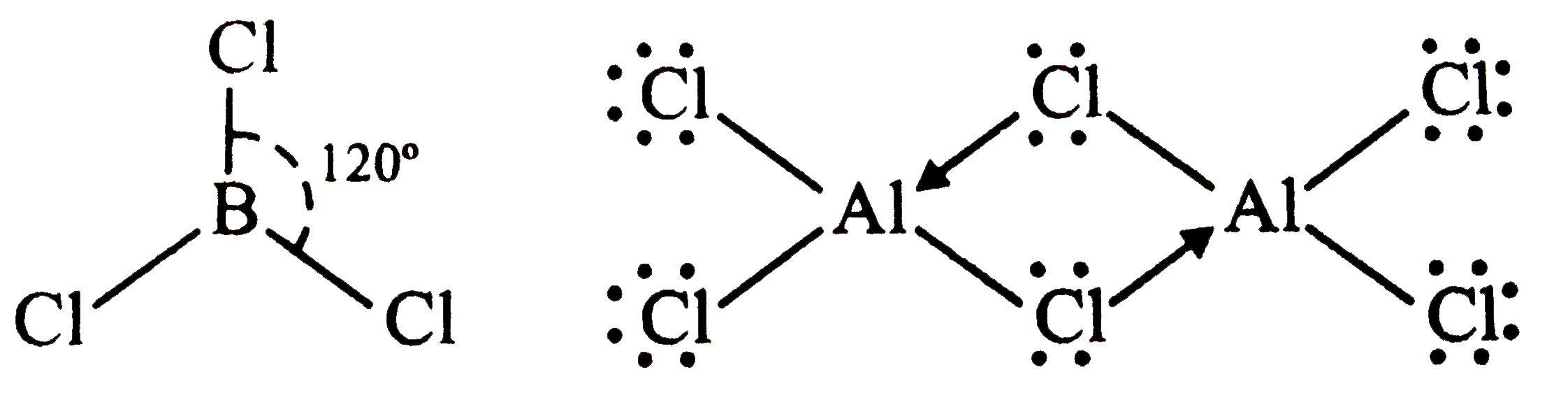 Thus, each Al atom is surrounded by four BOND paris and hence it assumes tetrahedral structure . |
|
| 11. |
BCl_(3)is trigonal planar while AlCl_(3) is tetrahedral in dimeric state. Explain . |
|
Answer» Solution :Both `BCl_(3)` and `AlCl_(3)` ar electrondeficientmolecules havingsix electronin the valenceshell of their respective central atoms.To completetheir octets the central atoms in each case can ACCEPTA pair of electronsfrom the chlorineatoms ofanothermoleculeformingdimeticstrcutures. However,because ofsmall size of B, itcannotaccomodatesfour big sized Cl atoms around it.THEREFORE,`BCl_(3)` refers to exact as a monomeric planarmoleculein which B atom is `sp^(2)` HYBRIDIZED. Onthe other HAND, Al because of it BIGGER size can easilyacommdate fourCl atomos around it. As a result, `AlCl_(3)` existsas a dimer.In this dimer, sincethe covalencyof Al has increasedto 4. Therefore, Al is`sp^(3)`- hybridisedand the four Clatoms are held tetrahedrallyaround it. for strucutre. |
|
| 12. |
What is Z in the following reactions? BCl_(3)+H_(2)underset(450^(@)C)overset(Cu-Al) to X+HCl""X overset("methylation")toZ |
|
Answer» `CH_(3)BH_(2)` |
|
| 13. |
BCl_3 exists as monomer whereas AlCl_3 is dimerized through halogen bridging. Give reason. Explain the structure of the dimer of AlCl_3 also. |
Answer» Solution :`BCl_3` does not dimerize because of its SMALL size. `BCl_3` do not exist as a DIMER. BORON cannot ACCOMMODATE FOUR large sized chloride ions. `AlCl_3` exist as a dimer in which Al uses its vacant 3p-orbital by coordinate with Cl to complete their octet by forming dimer. `AlCl_3` achieves stability by forming a dimer. 
|
|
| 14. |
BCl_(3) exists as monomer whereas AlCl_(3) is dimerised through halogen bridging. Give reason, Explain the structre of the dimer of AlCl_(3) also. |
| Answer» SOLUTION :\ | |
| 15. |
BCl_3 does not exist as dimer but BH_3 exist as dimer because |
|
Answer» Cl is more electropossitive than H |
|
| 16. |
BCl_(3) doesnot exist as dimer but BH_(3) exist as dimer (B_(2)H_(6)) because |
|
Answer» chlorine is more electronagative than hydrogen |
|
| 17. |
BCl_(3) does not exist as a dimer but BH_(3) exists as B_(2)H_(6) because: |
|
Answer» <P>`Cl_(2)` more electronegatve than hydrogen |
|
| 18. |
Bayer's reagent is used for testing ……… |
|
Answer» |
|
| 19. |
Bayer's reagent is : |
|
Answer» ALKALINE PERMANGANATE solution |
|
| 20. |
Bauxite is made up of Al_(2)O_3 + SiO_2 + TiO_2 + Fe_(2)O_3 . This ore is treated with conc. NaOH solution at 500 K and 35 bar pressure for a few hours and filtered hot. In the filtrate the species present are |
|
Answer» `NAAL(OH)_4` only |
|
| 21. |
Bauxite is an ore of |
|
Answer» Zinc |
|
| 22. |
Bauxite has composition |
|
Answer» `Al_(2)O_3` |
|
| 23. |
Basicity of H_3 BO_3 is |
|
Answer» 1 |
|
| 24. |
Basicity of boric acid is |
|
Answer» |
|
| 25. |
Basic strength of H_2"CC"H_3 H_2C= CH_(2) H-C-= C-H |
|
Answer» `(i) gt (III) gt (II)` |
|
| 26. |
Basic principle of hydrogen economy is transportation and storage of energy in the form of liquid or gaseous hydrogen. Which property of hydrogen may be useful for this purpose ? Support your answer with the chemical equation if required. |
| Answer» Solution :Hydrogen is a gas at room temperature. Because of its bulk, it is difficult to transport it either by rail or by road. So by cooling and APPLYING high pressure, GASEOUS `H_2` can be converted into liquid `H_2` which has much smaller volume and hence can be transported EASILY. THUS, the BASIC property of hydrogen which is useful for hydrogen economy is that it can be converted into a liquid by cooling under high pressure. | |
| 27. |
Basic principle of hydrogen economy is transportation and storage of energy in the form of liquid or gaseous hydrogen . Which property of hydrogen may be useful for this purpose ? Suppose your answer with the chemical equation if required. |
| Answer» Solution :Hydrogen is a gas at room temperature . Because of its BULK, it is DIFFICULT to transport it either by rail or by road. However, by cooling and applying high pressure , gaseous `H_(2)` can be converted into liquid `H_(2)` which has much smaller volume and HENCE can be transporated EASILY. Thus, the baseic property of hydrogen which is useful for hydrogen economy is that if can be converted into a liquid by cooling under high pressure. | |
| 28. |
Basic nature of the oxides of a period from left to right |
|
Answer» INCREASES |
|
| 29. |
Explain the structure of water molecule ? |
|
Answer» Solution :ELECTRONIC configuration of `O:1s^(2)2s^(2)2p^(4)` Valence orbital representation. 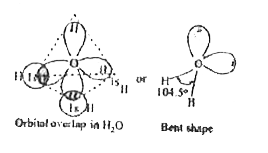 1. When `2s^(2)` orbital hybridised with `2p_(x),2p_(y)` and `2p_(Z)` forms the following `sp^(3)` hybridisation structure. 2. In `2s^(2)` and `2p_(x)^(2)`, the ELECTRONS are paired up hence they arenot involved in bond formation called loan paired of electron (L.P.) 3. When `sp^(3)` hybridised O combines with 2 hydrogen atom forms Bond STRUCTRUE water. |
|
| 30. |
Based on VSERP theor explain the structure of water. |
|
Answer» Solution :Electronic CONFIGURATION of `O, 1s^(2) 2s^(2) 2p^(4)` Valence ORBITAL representation. 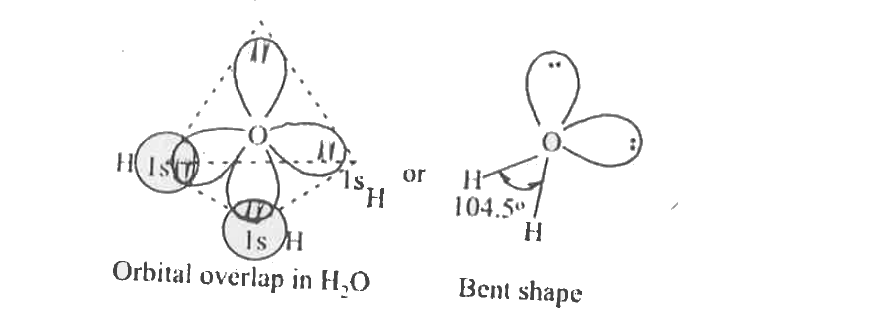 1 When `2s^(2)` orbital hybridised with `2p_(x), 2p_(y) and 2p_(z)` forms the following `sp^(3)` hybridisation structuree. 2In `21s^(2) and 2p_(x)^(2)`, the electrons are paired up hence they are not involved in bond formation called loan paired of electron (L.P) 3. When `sp^(3)` hybridised O combines with 2 hydrogen atom forms Bond structure water. |
|
| 31. |
Based on VSEPR theory , the number of 90 degree F-B angles in BrF_(5) is |
Answer»  DUE to repulsion by the lone pair on the bond PAIRS all the four planar bond anlges DECREASE from ` 90^(@)` to ` 84.8^(@)` . The axial bond ALSO no LONGER remains `90^(@)` with the planar bonda . In other words , there are no `90^(@)FBrF` bonds in `BrF_(5)` |
|
| 32. |
Based on VSEPR theory explain the structure of methane. |
Answer» Solution :In the formation of methane, CARBON utilizes `sp^(3)`hybrid orbitals for BONDING. The four `sp^(3)` hybrid orbitals of carbon atom overlaps axially with a orbitals of four hydrogen atoms to GIVE four `C-H` s bond. The C-H s bond is `sp^(3)`-s bond. H-C-H bond angle is `109^(@)28`. the SHAPE of the molecule is tetrahedral. 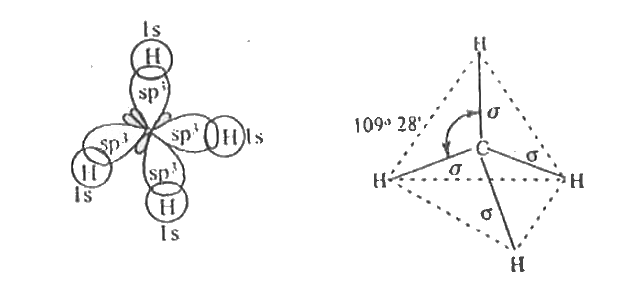
|
|
| 33. |
Based on the values of B.E. given, Delta_(f)H^(0)" of " N_(2)H_(4(g)) is : Given BE of : N- N is 159 kJ mol^(-1), H-H is 436 kJ mol^(-1), N =- N is 941 kJ mol^(-1), N-H is 398 kJ mol^(-1) |
|
Answer» `711 kJ MOL^(-1)` `Delta H_(f) = ((N -= N ) + 2 XX (H - H))- ((N - N) + 4(N - H))` `=((941) + 2 xx (436)) - (159 + 4 xx (398))` = 62 kJ |
|
| 34. |
Based on VSEPR theory explain the structure of ammonia. |
|
Answer» Solution :Ammonia `(NH_(3))` Electronic configuration of `N: 1s^(2)2s^(2)2p^(3)` Valance orbital REPRESENTATION 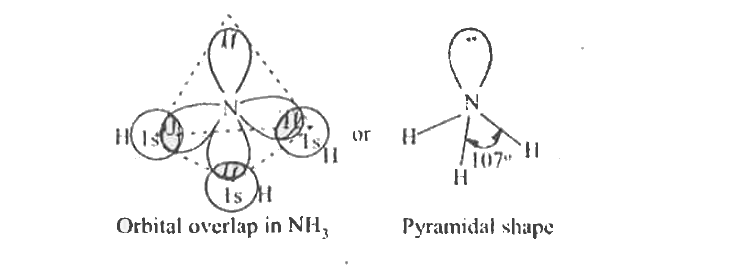 1 When `2s^(2)` orbital hybridised with `2p_(x), 2p_(y) and 2p_(Z)` forms the following `sp^(3)` hybridised structure. 2 in `2s^(2)` orbital, the ELECTRONS are paired up hence they are not involved in bond formation CALLED loan paired of electron (L.P) 3 When `sp^(3)` hybridized N combines with 3 hydrogen atom, forms pyramidal structure of ammonia. Pyramidal structure angle `=107^(@)`. |
|
| 35. |
Based on the third law of themodynamics, the entropy can be obtained using the equation. |
|
Answer» `Delta S = (Delta H)/(T)` |
|
| 36. |
Based on the lattice energy and other consideraction which one of the following alkali metal chloride is expected to have the highest melting point. |
|
Answer» LiCl |
|
| 37. |
Based on the following equilibrium reactions HNO_(2)+HF rarr H_(2)F^(+) +NO_(2)^(-) CH_(3)COOH +HF rarrF + CH_(3)COOH_(2)^(+) H_(2)O+CH_(3)COOH rarr H_(3)O^(+) +CH_(3)COO^(-) Which are the correct order (s) regarding acid strength |
|
Answer» `H_2O LT CH_3 COOH` |
|
| 38. |
Based on the equation E = - 2.178 xx 10^(-18) J ((Z^(2))/(n^(2))) certain conclusions are written. Which of them is not correct ? |
|
Answer» The NEGATIVE sign in equation simply means that the energy of electron bound to the NUCLEUS is lower than it would be if the electrons were at infinite distance from the nucleus. |
|
| 39. |
Based on the above answer the followingoverset(PCl_(5))toIf H is replaced withCH_(3)COO^(-) , ClCH_(2)COO^(-),C_(2)H_(5)COO,PhSO_(3)-then rate of reaction is |
|
Answer» `CH_(3)COO^(-)ltClCH_(2)COO^(-)ltC_(2)H_(5)ltPhSO_(3)^(-)` 
|
|
| 40. |
Based on the above answer the followingWhich of the following statements regarding above sequence is incorrect ? |
|
Answer» The reaction involves nucleophillic addition reaction. 
|
|
| 41. |
Based on the above answer the following overset((1)Sn//HCl(2)KOHBr_(2))underset((3)Br_(2)//C Cl_(4))tomajor product ? |
|
Answer»

|
|
| 42. |
Based on the compounds of group 15 elements, the correct statement(s) is (are) |
|
Answer» `Bi_(2)O_(5)` is more basic than `N_(2)O_(5)` 
|
|
| 43. |
Based on reductive ozonolysis reaction, how do you distinguish between an alkene and alkyne? |
|
Answer» SOLUTION :An alkene, on reductive ozonolysis TWO carbonyl COMPOUNDS are formed. `R-CH=CH-R.underset((ii)H_(2)OZn)overset((i)O_(3))toR-CHO+R.CHO` An alkyne, on reductive ozonolysis, a dicarbonyl COMPOUND is formed. `R-C-=C-R.underset((ii)H_(2)O,Zn)overset((i)O_(3))toR-underset(O)underset(||)C-underset(O)underset(||)C-R.` |
|
| 44. |
Based on lattics energy and the other considerations which one of the following alkali metal chlorides is expected to have the highest melting point ? |
|
Answer» LICL of NaCl but LiCl is covalent in NATURE and NaCl is ionic. After NaCl , lattice energy decreases as the size of the alkali metal ion increases . As MELTING point depends upon lattice energy and ionic/ covalent nature of the compound , NaCl has the highest melting point . |
|
| 45. |
Based on kinetic theory of gases following laws can be proved |
|
Answer» BOYLE's law |
|
| 46. |
Based on first law of thermodynamics , which one of the following is correct ? |
|
Answer» For an isochoric proces`,DeltaU =-q` (b) For an adiabatic process , `q=0`. Hence, `DeltaU =w` (C ) For an isothermal process, `DeltaU =0` Hence, `q=-w` (d) For a cyclic process, `DeltaU =0`. Hence, `q= - w` |
|
| 47. |
Based on his alpha- ray scattering experiment, Rutherford proposed the nuclear model of an atom. The threshold frequency v0 for a metal is 6.2xx10^14s^(-1). Calculate the K.E. emitted for an electron when the radiation of frequency v=8.7xx10^14s^(-1) strikes the metal. |
| Answer» SOLUTION :`K.E=1/2mv^2=hgamma-hgamma_0=h(gamma-gamma_0)=6.626xx10^(-34)(8.7xx10^14-6.2xx10^14)6.626xx10^(-34)xx2.5xx10^14=1.656xx10^(-19)J` | |
| 48. |
Based on equation E=-3.178xx10^(-18)(Z^(2)/(n^(2)))J certain conclusions are written. Which of them is not correct? |
|
Answer» Equation can be used to calculate the energy change when the electron changes orbit. |
|
| 49. |
Based on equation E=-22.178xx10^(-18)J(z^(2))/(n^(2)) certain conclusions are written. |
|
Answer» Equation can be used to calculate the change in ENERGY when the electron changes orbit. <BR>For n=1, The electron has a more negtative then it does for n=6 which means that the electron is more loosely bound in the smallest allowed orbit. |
|
| 50. |
Based on equationE=-2.178xx10^(1-18)J((z^2)/(n^2))certain concluusions are written.Which of them is nnot correct ?(NEET) |
|
Answer» Equation can be used to calculate the change in energy when the ELECTRON CHANGES orbit Correct STATEMENT: For n = 1। the electron has more negative energy than it does for n = 6 which means that the electron is strongly bound in the smallest allowed orbit. |
|


