

Saved Bookmarks
This section includes 7 InterviewSolutions, each offering curated multiple-choice questions to sharpen your Current Affairs knowledge and support exam preparation. Choose a topic below to get started.
| 1. |
Benzene favours ……………. Substitution reaction. |
|
Answer» |
|
| 2. |
Benzene, ethane and ethylene belong to the family of hydrocarbons. Show how the data given below is in consistent with the law of Multiple Proportions. {:("Compound",underset("in 5.0 g of the sample")("Mass of carbon"),underset("in 5.0 g of the sample")("Mass of hydrogen")),("Benzene","4.61 g","0.39 g"),("Ethane","4.00 g","1.00 g"),("Ethylene","4.29 g","0.71 g"):} . |
|
Answer» Solution :Let 1 g of hydrogen be the fixed MASS of hydrogen In benzene : 1.00 g of hydrogen are combined with carbon = 4.61 g 1.00 g of hydrogen are combined with carbon `= ((4.61g))/((0.39g))xx(1.0g)=11.82g` In ethane : 1.00 g of hydrogen are combined with carbon = 4.00 g In ethylene : 0.71 g of hydrogen are combined carbon = 4.29 g 1.00 g of hydrogen are combined with carbon `= ((4.29g))/((0.71g))xx(1g)=6.04g` Ratio by mass of carbon combined with 1 g of hydrogen in the three samples `11 : 82 : : 4.00 : 6.04 ::6 : 2 : 3` Since it is a simple whole number ratio, the LAW of MULTIPLE Proportions is obeyed. |
|
| 3. |
Benzene easily shows |
|
Answer» RING fission reactions SINCE it is unstable |
|
| 4. |
Benzene does not undergo addition reaction easily because |
|
Answer» It has six hydrogen atoms |
|
| 5. |
Benzene does not readily undergo |
|
Answer» halogenation |
|
| 6. |
Benzene burns in oxygen according to the equation 2C_(6)H_(6(l))+15O_(2(g))rarr12CO_(2(g))+6H_(2)O_((l)). How many litres of oxygen are required at STP for the complete combustion of 39g of liquid benzene? |
|
Answer» `11.2` implies VOLUME = `(15)/(4)xx22.4=84` |
|
| 7. |
Benzene burns with sooty flame in burner, because…. |
|
Answer» it is ALIPHATIC compound |
|
| 8. |
Benzene burns with a luminous flame. |
|
Answer» |
|
| 9. |
Benzene burns according to the following equation: 2C_(6)H_(6)(l)+15O_(2)(g)to12CO_(2)(g)+6H_(2)O(l) DeltaH^(@)=-6542 KJ//mol what is the DeltaE^(@) for the combustion of 1.5 mol of benzene? |
| Answer» Answer :d | |
| 10. |
Benzene and nitrobenzene can be separated by using ……………….. |
|
Answer» SIMPLE DISTILLATION |
|
| 11. |
Benzene and aniline are liquids. Their mixture can be sepearated by |
|
Answer» dil - NaOH |
|
| 12. |
Benzamide is subjected to Hoffmann's bromamide reaction, the product formed is |
|
Answer» Benzene |
|
| 13. |
Benzaldoxime can exist in two geometrical isomeric forms known as |
|
Answer» CIS and trans 
|
|
| 14. |
Benzaldehyde and propionaldehyde are the ozonolysis products of |
|
Answer» 2-phenylbut-2-ene |
|
| 16. |
Bent molecule having dipole moment among the following |
|
Answer» `F_2 O` |
|
| 17. |
Liquid benzene burns in oxygen according to 2C_(6)H_(6)(1)+150_(2)(8) to12CO_(2),(g)+6H_(2)O(g). How many litres of oxygen are required for complete combustion of 39g of liquid C_(6)H_(6) (atomic wt.of C=12, 016)? |
|
Answer» 11.2 |
|
| 18. |
Benezene reacts with CI_(2)in the presenece of sunlight to give ……………… |
| Answer» SOLUTION :BHC(BENZENE hexachloride) | |
| 19. |
Benezene reacts with bromine in the presence of AICI_(3)to form bromobenzene and it is an example of ……………….reaction |
| Answer» SOLUTION :ELECTROPHILICSUBSTITUTION | |
| 20. |
Bell metal is an alloy of copper and |
|
Answer» Tin |
|
| 21. |
Bell metal contains 80% copper . The mass of Bell metal which contain 1.5 xx 10^(20) atoms of copper is (Cu = 64) |
|
Answer» 2 mg |
|
| 23. |
BeH_(2)is preparedreducingBeCl_(2) with________. |
|
Answer» `HCI` |
|
| 24. |
BeH_(2) contains three centre two electron bond. |
|
Answer» |
|
| 28. |
Be_((g))toBe^(+) _(g),Delta H=-xKJ//mol. In the reaction of Be(g)to Be^(=2) (g),DeltaH is approximately in KJ/mol |
|
Answer» 2x |
|
| 29. |
BeF_(2) is highly soluble in water, whereas the fluorides of other alkaline earth metals are almost insoluble because |
|
Answer» `BeF_(2)` is ionic in nature |
|
| 30. |
BeF_2has zero dipole moment where as H_2 Ohas a dipole moment because |
|
Answer» ` H_2 O` is a linear molecule |
|
| 31. |
BeF_(2)ispreparedin thepresenceof CO_(2)bythermal decompositionof ___ |
|
Answer» `(NH_(4))BeF_(2)` |
|
| 32. |
Bees wax is |
|
Answer» Myricy palmiate |
|
| 34. |
Beckmann rearrangement of followed by hydrolysis will yield |
|
Answer» BENZOIC ACID and benzlylamine 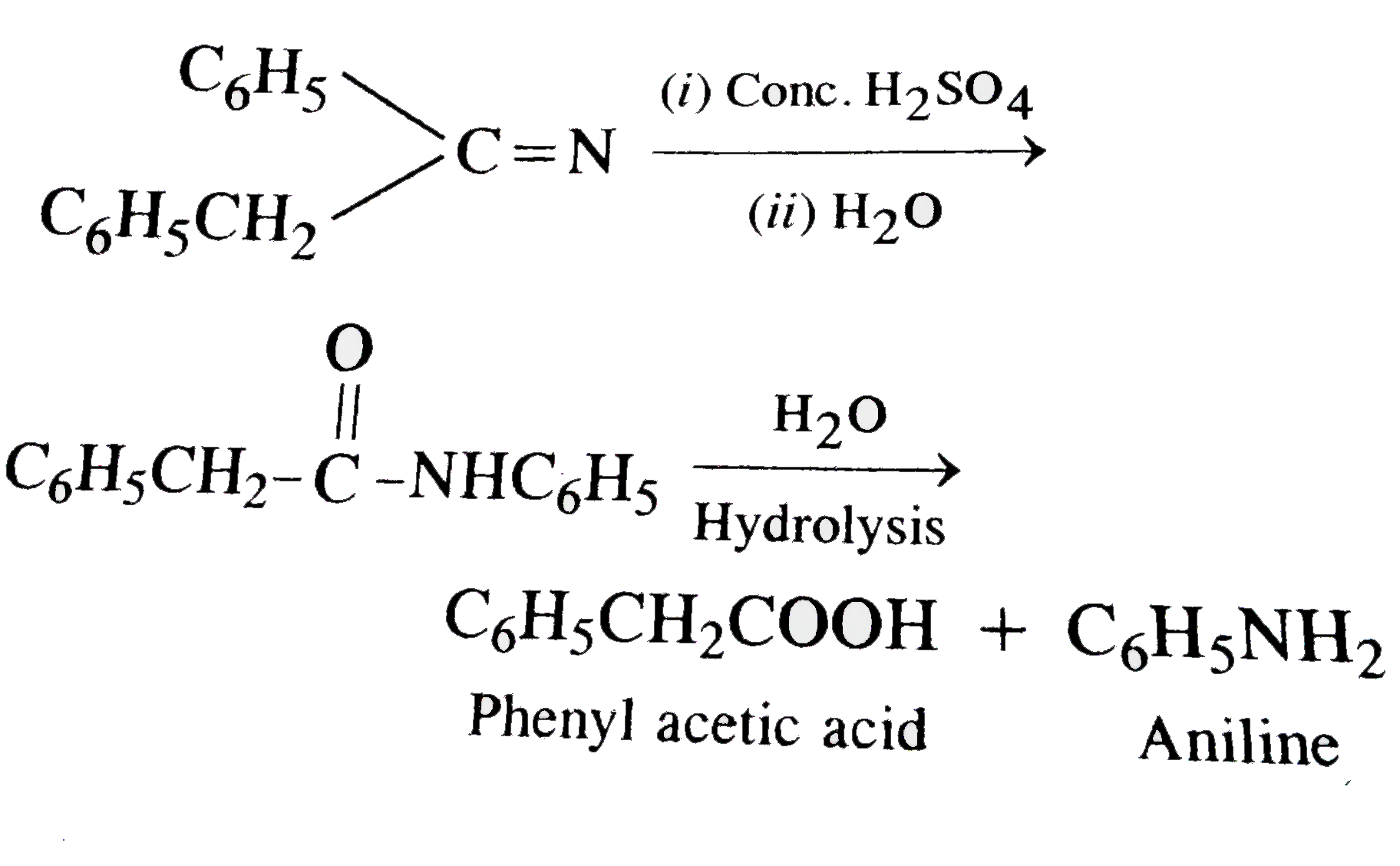
|
|
| 35. |
BeCI_(2)+N_(2)O_(4)rarrAunderset("Vacuumn")overset(50^(@)C)rarrBoverset(125^(@)C)rarrC. The compounds A. B and C are |
|
Answer» `BEO.Be(NO_(2))_(2).Be(NO_(3))_(2)` |
|
| 36. |
BeCI_(2)+LiAIH_(4)rarrX-LiCI +AICI_(3) |
|
Answer» X is LiH |
|
| 37. |
Because of which bond three dimensional structure is formed in ice ? |
|
Answer» COVALENT BOND |
|
| 38. |
BeC_(2)O_(4) and BaC_(2)O_(4) are heated separately with Bunsen burner. The solid residue obtained are respectively: |
|
Answer» `BeO` and `BaO` |
|
| 39. |
BeC+4H_(2)O to Be(OH)_(2)+CH_(4) CaC_(2)+2H_(2)O to Ca(OH)_(2)+X Mg_(2)C_(3)+2H_(2)O to Mg (OH)_(2)+Y The total no. of pi bonds present in X and Y |
|
Answer» `CaC_(2)+2H_(2)OtoCa(OH)_(2)+H-Cunderset(X)(-=)C-H` `Mg_(2)C_(3)+2H_(2)O to mg(OH)_(2)+CH_(2)underset(X)(-)C-=C-H` `ul{:(x"has" 2pi"bonds"),(Y "has" 2pi "bonds"),("TOTAL" 4PI "bonds"):}` |
|
| 40. |
Be_(2)C+H_(2)O to Be(OH)_(2)+[X]X is |
| Answer» Solution :`Be_(2)C+4H_(2)Oto2Be(OH)_(2)+CH_(4)uarr` | |
| 41. |
Be_(2)C+4H_(2)O to 2X+CH_(4) X+2OH^(-)toY (X) and (Y) formed in the above two reactions is |
|
Answer» `BeCO_(3)` and `Be(OH)_(2)` respectively |
|
| 42. |
Be^(2+) is isoelectronic with which of the following ions ? |
|
Answer» `H^(+)` |
|
| 44. |
Be reacts with excess of caustic soda to form |
|
Answer» `Be(OH)_(2)` `Be(OH)_(2)*BeCO_(3)` |
|
| 45. |
Be' has, as compared to "Mg" |
|
Answer» Less electronegativity |
|
| 46. |
"Be" differs from rest of the elements of the IIA group due to |
|
Answer» SMALL SIZE |
|
| 47. |
Beryllium differs from other alkaline earth metals because of |
|
Answer» Small SIZE and high EN |
|
| 48. |
Be and Mg from amongst the p-block elements and most of the d-block elements give metallic or interstitial hydrides on reacting with hydrogen. The density of each compound is less than that of the metal itself and the properties are not much different from that of the metal. They give out hydrogen easily and are strong reducing agents. This suggests that hydrogen is present in the atomic state. these compounds are non-stoichiometric. the f-block elements (i.e., lanthanide and actinides) also form non-stoichiometric hydrides. These hydrides have lower densities than their respective metals. The metals of group 7,8 and 9 do not form hydrides. This region of the periodic table is called 'hydride gap'. Interstitial hydride can not be used as, |
|
Answer» storing `H_(2)` |
|
| 49. |
Be and Mg from amongst the p-block elements and most of the d-block elements give metallic or interstitial hydrides on reacting with hydrogen. The density of each compound is less than that of the metal itself and the properties are not much different from that of the metal. They give out hydrogen easily and are strong reducing agents. This suggests that hydrogen is present in the atomic state. these compounds are non-stoichiometric. the f-block elements (i.e., lanthanide and actinides) also form non-stoichiometric hydrides. These hydrides have lower densities than their respective metals. The metals of group 7,8 and 9 do not form hydrides. This region of the periodic table is called 'hydride gap'. Which of the following has highest electrical conductance? |
|
Answer» `BeH_(2)` |
|
| 50. |
Be and Mg from amongst the p-block elements and most of the d-block elements give metallic or interstitial hydrides on reacting with hydrogen. The density of each compound is less than that of the metal itself and the properties are not much different from that of the metal. They give out hydrogen easily and are strong reducing agents. This suggests that hydrogen is present in the atomic state. these compounds are non-stoichiometric. the f-block elements (i.e., lanthanide and actinides) also form non-stoichiometric hydrides. These hydrides have lower densities than their respective metals. The metals of group 7,8 and 9 do not form hydrides. This region of the periodic table is called 'hydride gap'. Which type of hydride is formed by the element having atomic number, Z=43? |
|
Answer» METALLIC HYDRIDE |
|