Saved Bookmarks
This section includes 7 InterviewSolutions, each offering curated multiple-choice questions to sharpen your Current Affairs knowledge and support exam preparation. Choose a topic below to get started.
| 1. |
Consider the following reactions, H_(2)(g)+I_(2)(g)hArr2HI(g) In each of the above reaction find out whether you have to increase (or) decrease the volume to increase the yield of the product. |
|
Answer» Solution :`H_(2)(g)+I_(2)(g)hArr2HI(g)` ACCORDING to Le Chateliers princple increase in PRESSURE will shift the equilibrium a direction that has lesser number of moles. In the above equilibrium, pressure and volume has no effect, since no of moles of product is equal to no. of moles of REACTANT. |
|
| 2. |
Consider the following reactions, CaCO_(3)(s)iffCaO(s)+CO_(2)(g) In each of the above reaction find out whether you have to increase (or) decrease the volume to increase the yield of the product. |
|
Answer» Solution :`CaCO_(3)(s)iffCaO(s)+CO_(2)(G)` In this EQUILIBRIUM no. of moles of product is greater than no. of moles of reactant. SO increase of pressure will shift the equilibrium towards the backward reaction. To increase the YIELD of product, pressure should be decrease and hence VOLUME increases |
|
| 3. |
Consider the following reactions, CaCO_(3)(s)hArrCaO(s)+CO_(2)(g) In each of the above reaction find out whether you have to increase (or) decrease the volume to increase the yield of the product. |
|
Answer» SOLUTION :`CaCO_(3)(s)hArrCaO(s)+CO_(2)(g)` In this equilibrium no. of moles of product is greater than no. moles of reactant. So increase of PRESSURE will shift the equilibrium towards the backward reaction. To increase the YIELD of product, pressure should be decrease and hence volume increases. |
|
| 4. |
Consider the following reactions. Br_(2)+OH^(-)rarrBrO_(3)^(-)+Br^(-)+H_(2)O (unbalanced). select the correct statement |
|
Answer» EQUIVALENT weight of `Br_(2)` when it is reduced to `BR^(-)` is 80 `E=E_("red")+E_("ox")=(160)/(2)+(160)/(10)=80+16=96` |
|
| 5. |
Consider the following reactions, (a) H_2(g)+ I_2(g)hArr 2HI(g) (b) CaCO_3(s) hArr CaO(s)+ CO_2(g)(c ) S(s) + 3F_2(g) hArr SF_6(g) In each of the above reaction find out whether you have in increase (or)decrease the volume to increase th yield of the product. |
|
Answer» SOLUTION :(a) `H_2(g) + I_2(g) hArr 2HI(g)` In the above equilibrium reaction, volume of gaseous molecules is equal on both sides. So INCREASE or DECREASE the volume will not effect the equilibrium and there will be no change in the yield of product. (b) `underset(0(V))(CaCO_2(s)) hArr underset(0(V))(CaO(s))+ underset(1(V))(CO_2(g))` Volume is greater in product side. By decreasing the PRESSURE, volume willincrease thus, to get more of product `CO_2`, the pressure should be decreased or volumeshould be increased. `S(s) + underset(3V)(3F_2(g)) hArr underset(IV)(SF_6(g))` Volume is lesser in product side. So by increasing the pressure, equilibrium shifts to the product side. |
|
| 6. |
Consider the following reactions: 2Na + 2NH_(3) rightarrow 2NaNH_(2) + H_(2)(g)……………..(i) 2NaNH_(2) + C rightarrow Na_(2)CN_(2) + 2H_(2)(g)…………….(ii) Na_(2)CN_(2) + C rightarrow 2NaCN……………….(iii) 51 gm dry ammonia gas is passed over excess heated sodium to form sodamide NaNH_(2) which is further reacted with carbon (excess) to finally form NaCN. Find the total volume of H_(2)(g) evolved at 0.5 atm, 273 K. |
|
Answer» 201.6 L |
|
| 7. |
Consider the following reactions, (a) H_(2)(g)+(g)+I_(2)(g)harr2HI(g) (b) CaCO_(3)(s)harrCaO(s)+CO_(2)(g) (c) S(s)+3F_(2)(g)harrSF_(6)(g) In each of the above reaction find out whether you have to increase (or) decrease the volume to increase the yield of the product. |
|
Answer» Solution :(a) `H_(2)(g)+I_(2)(g)harr2HI(g)` In the above equilibrium reaction, volume of gaseous molecules is EQUAL on both sides. So increase or decrease the volume will not affect the equilibrium and there will be no CHANGE in the yield of product. (b) `CaCO_(2)(s)harrCaO(s) +CO_(2)(g)` Volume is greater in product side. By decreasing the pressure, volume will increase thus, to get more of product `CO_(2)`, the pressure should be decreased or volume should be increased. (c) `S(s)+underset(3V)(3F_(2)(g))harrunderset(1V)(SF_(6)(g))` Volume is lesser in product side. So by increasing the pressure, equilibrium shifts to the product side. |
|
| 8. |
Consider the following reaction: Zn+Cu^(2+)rarrZn^(2+)+Cu with reference to the above which one of the following is the correct statement ? |
|
Answer» ZN is reduced to`Zn^(2+)`ions `ZnrarrZn^(2+)+32e^(-)` |
|
| 9. |
Consider the following reaction, xMnO_(4)^(-)+yC_(2)O_(4)^(2-)+zH^(+)toxMn^(2+)+2yCO_(2)+(z)/(2)H_(2)O The values of x,y and z in the reactions are, respectively |
|
Answer» 5, 2 and 16 |
|
| 10. |
Consider the following reaction xMnO_(4)^(-) +yC_(2)O_(4)^(2-) +zH^(-) rarr xMn^(2+) +2yCO_(2) +(z)/(2)H_(2)O |
|
Answer» `2,5 and 16` |
|
| 11. |
Consider the following reaction xMnO_(4)^(-)+yC_(2)IO_(4)^(2-)+zH^(+)rarrxMn^(2+)+2yCO_(2)+z//2H_(2)O the value of x,y and z in the reaction are respectively |
|
Answer» 5,2 and 8 `MnO_(4)^(-)+8H^()+5e^(-)rarrMn^(2+)+4H_(2)O` Oxidation half reaction `C_(2)^(+3)O_(4)^(2-)rarrCO_(2)` balance C ATOMS `C_(2)O_(4)^(2-)rarr2CO_(2)` balance O.N by adding `2e^(-)` to R.H.S of Eq (II) we have `C_(2)O_(4)^(21-)rarr2CO_(2)+2e^(-)` charge is automically balanced to cancel eletrons multily eq (i) by 2 and eq (iii) by 5 and adding we have `2MnO_(4)^(-)+5C_(2)O_(4)^(2-)+16H^(+)rarr2Mn^(2+)+10CO_(2)+8H_(2)O` |
|
| 12. |
Consider the following reaction : xMnO_(4)^(-)+yC_(2)O_(4)^(2-)+H^(+)toxMn^(2+)+2yCO_(2)+z/2H_(2)O The values of x, y and z in the reaction are, respectively : |
| Answer» Solution :`2MnO_(4)^(-)+5C_(2)O_(4)^(2-)+16H^(+)to2Mn^(2+)+10CO_(2)+8H_(2)O` | |
| 13. |
Consider the following reaction x MnO_(4)^(-) + C_(2)O_(4)^(2-) + zH^(+) rarr x Mn^(2+) + 2y CO_(2) + (z)/(2)H_(2)O The value of x, y and z in the reaction are respectively |
|
Answer» 5,2 and 8 |
|
| 14. |
Consider the following reaction Which of the following base will give best yield of the alkene II as the major product? |
|
Answer» `CH_3 O^(-)` |
|
| 15. |
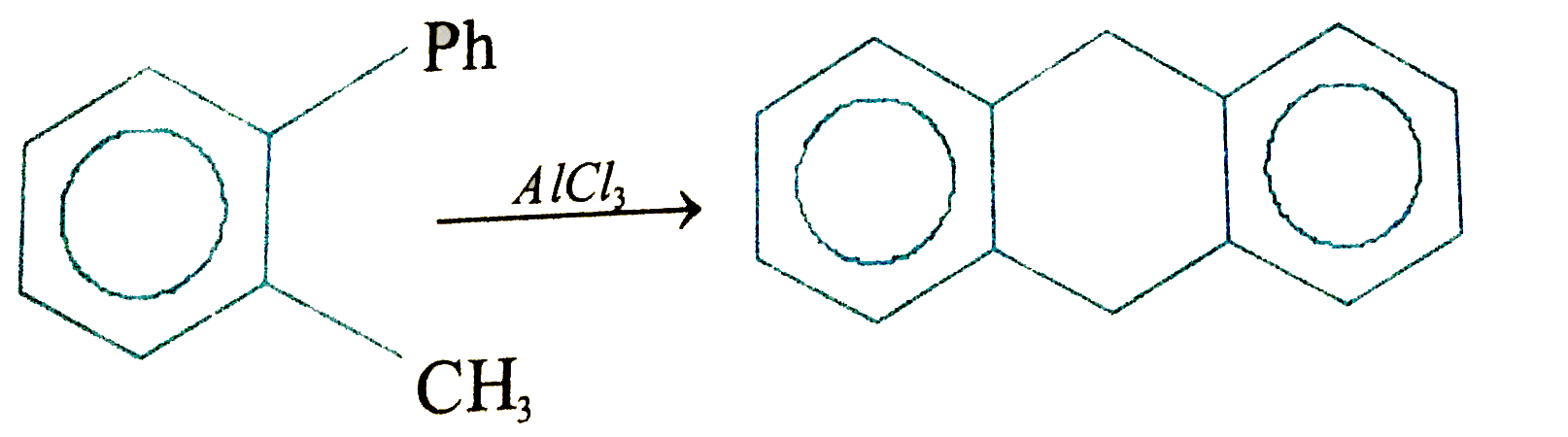
Consider the following reaction to answer the next three equestions. Q. If the product 'X' is treated with AlCl_(3) it undergoes an interamolecular friedel-craft reaction. The expected product P is |
|
Answer»
|
|
| 16. |
Consider the following reaction, PCl_(5) (g) hArr PCl_(3) (g) + Cl_(2)(g) the forward reaction at constant temperature is favoured by |
|
Answer» INTRODUCING an inert GAS at constant VOLUME |
|
| 17. |
Consider the following reaction, (i) CO_(3)^(2-)+H_(2)OhArrHCO_(3)^(-)+OH^(-) (ii) CO_(2)+H_(2)OhArrH_(2)CO_(3) (iii) NH_(3)+H_(2)OhArrNH_(4)OH (iv) HCl+H_(2)OhArrCl^(-)+H_(3)O^(+) Which of the pairs of reaction proves that water is amphoteric in character? |
|
Answer» (i) and (II) |
|
| 18. |
Consider the following reaction How many different products (including stereoisomers) would be formed ? |
Answer» 
|
|
| 19. |
Consider the following reaction , H_3C-undersetundersetD|CH-undersetunderset(CH_3)|CH-CH_3+oversetdot(Br) to 'X' + HBr Identify the structure of the major product 'X' |
|
Answer» `CH_3-undersetundersetD|CH-undersetunderset(CH_3)|CH-oversetdot(CH_2)` |
|
| 20. |
Consider the following reaction H_3C-undersetunderset(D)(|)CH-undersetunderset(CH_3)(|)CH-CH_3+overset(.)(Br)to'X'+HBr Identify the structure of the major product 'X'. |
|
Answer» `H_3C-undersetunderset(D)(|)CH-undersetunderset(CH_3)(|)CH-OVERSET(.)CH_2` |
|
| 21. |
Consider the following reaction , Fe^(3+) (aq) + SCN^(-) (aq) hArr [Fe (SCN)]^(2+) (aq) A solution is made with initial Fe^(3+) , SCN^(-) concentration of 1 xx 10^(-3) M and 8 xx 10^(-4) M respectively . At equilibrium [Fe(SCN)]^(2-) concentration is 2 xx 10^(-4) M . Calculate the value of equilibrium constant. |
Answer» SOLUTION :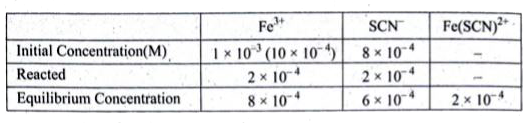 `K_(eq) = ([FE (SCN)]^(2+))/([Fe^(3+)] [SCN^(-)]) = (2 xx 10^(-4) M)/(8 xx 10^(-4) M xx 6 xx 10^(-4) M) = 0.0416 xx 10^(4)` `K_(eq) = 4.16 xx 10^(2) M^(-1)` |
|
| 22. |
Consider the following reaction : CO_((g)) + 2H_(2(g)) hArr CH_(3)OH_((g)) Given : Delta_(r) H^(@) (CH_(3)OH, g) = -201 kJ/mol, Delta_(r) H^(@) (CO, g) = -114 kJ/mol S^(@) (CH_(3)OOH, g) = 240 J/K-mol , S^(@) (H_(2), g) = 29 JK^(-1)mol^(-1) S^(@) (CO, g) = 198 J/mol-K , C^(@)_(p,m) (H_(2)) = 28.8 J/mol-K C^(@)_(p,m) (CO) = 29.4 J/mol-K , C^(@)_(p,m) (CH_(3)OH) = 44 J/mol-K and ln ((320)/(300)) = 0.06, all data at 300 K Delta_(r) S^(@) at 320 K is : |
|
Answer» 155.18 J/mol-K `Delta_(r ) H^(0) = Delta_(f) H^(0) (CH_(3)OH) - Delta_(f)H^(0) (CO) - 2. Delta_(f)H^(0) (H_(2))` `= -87kJ//mol` `Delta_(r) S-(320)^(0) - Delta_(r) S_(300)^(0) = Delta_(r)C_(P) [T_(2) - T_(1)]` where `Delta_(r) C_(P)^(0) = 44-29.4 -2 xx 28.8 = -43J//K - mol` `Delta_(r) S_(320)^(0) = - 16 + (-43) "ln "(320)/(320) = - 18.58` `Delta_(r)H_(320)^(0) = Delta_(r)H_(300)^(0) + Delta_(r) C_(P)^(0) [T_(2) - T_(1)]` `= - 87 + ((-43) xx 20)/(1000) = - 87.86` kJ/mol `Delta_(r) G_(320)^(0) = Delta_(r) H_(320)^(0) - T. Delta_(r) S_(320)^(0)` `= -87.86 - (320 xx (-18.58))/(1000) = - 81.91 kJ//mol` |
|
| 23. |
Consider the following reaction : CO_((g)) + 2H_(2(g)) hArr CH_(3)OH_((g)) Given : Delta_(r) H^(@) (CH_(3)OOH, g) = -201 kJ/mol, Delta_(r) H^(@) (CO, g) = -114 kJ/mol S^(@) (CH_(3)OOH, g) = 240 J/K-mol , S^(@) (H_(2), g) = 29 JK^(-1)mol^(-1) S^(@) (CO, g) = 198 J/mol-K , C^(@)_(p,m) (H_(2)) = 28.8 J/mol-K C^(@)_(p,m) (CO) = 29.4 J/mol-K , C^(@)_(p,m) (CH_(3)OH) = 44 J/mol-K and ln ((320)/(300)) = 0.06, all data at 300 K Delta_(r) H^(@) at 300 K for the reaction is : |
|
Answer» `-87` kJ/mol `Delta_(r ) H^(0) = Delta_(F) H^(0) (CH_(3)OH) - Delta_(f)H^(0) (CO) - 2. Delta_(f)H^(0) (H_(2))` `= -87kJ//mol` `Delta_(r) S-(320)^(0) - Delta_(r) S_(300)^(0) = Delta_(r)C_(P) [T_(2) - T_(1)]` where `Delta_(r) C_(P)^(0) = 44-29.4 -2 xx 28.8 = -43J//K - mol` `Delta_(r) S_(320)^(0) = - 16 + (-43) "ln "(320)/(320) = - 18.58` `Delta_(r)H_(320)^(0) = Delta_(r)H_(300)^(0) + Delta_(r) C_(P)^(0) [T_(2) - T_(1)]` `= - 87 + ((-43) xx 20)/(1000) = - 87.86` kJ/mol `Delta_(r) G_(320)^(0) = Delta_(r) H_(320)^(0) - T. Delta_(r) S_(320)^(0)` `= -87.86 - (320 xx (-18.58))/(1000) = - 81.91 kJ//mol` |
|
| 24. |
Consider the following reaction : CO_((g)) + 2H_(2(g)) hArr CH_(3)OH_((g)) Given : Delta_(r) H^(@) (CH_(3)OOH, g) = -201 kJ/mol, Delta_(r) H^(@) (CO, g) = -114 kJ/mol S^(@) (CH_(3)OOH, g) = 240 J/K-mol , S^(@) (H_(2), g) = 29 JK^(-1)mol^(-1) S^(@) (CO, g) = 198 J/mol-K , C^(@)_(p,m) (H_(2)) = 28.8 J/mol-K C^(@)_(p,m) (CO) = 29.4 J/mol-K , C^(@)_(p,m) (CH_(3)OH) = 44 J/mol-K and ln ((320)/(300)) = 0.06, all data at 300 K Delta_(r) S^(@) at 300 K for the reaction is : |
|
Answer» 152.6 J/K - mol `Delta_(r ) H^(0) = Delta_(f) H^(0) (CH_(3)OH) - Delta_(f)H^(0) (CO) - 2. Delta_(f)H^(0) (H_(2))` `= -87kJ//mol` `Delta_(r) S-(320)^(0) - Delta_(r) S_(300)^(0) = Delta_(r)C_(P) [T_(2) - T_(1)]` where `Delta_(r) C_(P)^(0) = 44-29.4 -2 xx 28.8 = -43J//K - mol` `Delta_(r) S_(320)^(0) = - 16 + (-43) "ln "(320)/(320) = - 18.58` `Delta_(r)H_(320)^(0) = Delta_(r)H_(300)^(0) + Delta_(r) C_(P)^(0) [T_(2) - T_(1)]` `= - 87 + ((-43) xx 20)/(1000) = - 87.86` kJ/mol `Delta_(r) G_(320)^(0) = Delta_(r) H_(320)^(0) - T. Delta_(r) S_(320)^(0)` `= -87.86 - (320 xx (-18.58))/(1000) = - 81.91 kJ//mol` |
|
| 25. |
Consider the following reaction: (CN_(2)) rarr CN^(-) +CNO^(-) The correct statement(s) is/are about the reaction |
|
Answer» It is disproportionation `UNDERSET(+3-3)((CN)_(2)) rarr underset(+2-3)(CN^(-)) +underset(+4-3-2)(CNO^(-))` |
|
| 26. |
Consider the following reaction, {:(CHO""COO^(-)),("|"+OH^(-) rarr "|"),(CHO""CH_(2)OH):} Select the incorrect statement. |
|
Answer» It is not a DISPROPORTIONATION reaction. Thus, it is not a disproportionation reaction. It isintramolecular redox reaction. Thus, options (a) and (b) are TRUEAND `{:(CHO),("|"),(CHO):}` isreducingas well as oxidising agent. Thus, (d) is also true.Thus, (c) isincorrect. |
|
| 27. |
Consider the following reaction CH_3- underset(D)underset(|)CH-underset(CH_3)underset(|)CH-CH_3 + Br to X + HBr Identify the structure of the major product 'x' |
|
Answer» `CH_3 - UNDERSET(D)underset(|)CH-underset(CH_3)underset(|)CH-CH_(2)^(*)` |
|
| 28. |
Consider the following reaction: CH_(3)-underset(D)underset(|)(CH)-underset(CH_(3))underset(|)(CH)-CH_(3)-Br rarr X+HBr Identify the structrue of the major product X |
|
Answer» `H_(3)C-underset(D)underset(|)(CH)-underset(CH_(3))underset(|)(CH_(3))-overset(.)(C )H_(2)`<BR>`H_(3)C-underset(D)underset(|)(CH)-underset(CH_(3))underset(|)overset(.)(C)-CH_(3)` |
|
| 29. |
Consider the following reaction . C_6H_4 Cl_2 (X) + CH_3Cl overset(AlCl_3)to C_6H_3Cl(CH_3)(Y)" Single isomer" The correct statement (s) concerning X and Y is /are |
|
Answer» X is a non-polar dichloride isomer 
|
|
| 30. |
Consider the following reaction between zinc and oxygen and choose the corret options out of the options given below : 2Zn (s) + O_(2)(g)rarr 2ZnO(s), DeltaH= - 693.8 kJ mol^(-1) |
|
Answer» The enthalpy of two molesof ZnO is less than the TOTAL enthalpyof two moles of Zn and one mole of oxygen by 693.8kJ |
|
| 31. |
Consider the following reaction between zinc and oxygen and choose the correct options out of the options given below : 2Zn_((s)) + O_(2(g)) to 2 ZnO_((s)) , Delta H = -693.8 "kJ mol"^(-1) |
|
Answer» The enthalpy of two moles of ZnO is less than the total enthalpy of two moles of Zn and one mole of oxygen by 693.8 kJ. `2Zn_((s)) + O_(2(g)) to 2ZnO_((g)) , Delta H = - 693.8 "kJ mol"^(-1) Delta H = H_(P) - H_(R) ` A -ve value of `Delta H` shows that `H_R gt H_P "or" H_P lt H_R` i.e., enthalpy of two moles of ZnO is less than the enthalpy of two moles of zinc and one mole of oxygen by 693.8kJ. As `H_R gt H_P, 693.8 "kJ mol"^(-1)` of energy is evolved in the reaction. |
|
| 32. |
Consider the following reaction at 1000^(@)C . (A) Zn(s) + 1/2 O_2(g) rarr ZnO(s) deltaG^(o) = -360 kJ mol^(-1) (B) C(gr) + 1/2 O_2(g) rarr CO(g) deltaG^(o) = -460 kJ mol^(-1) Choose the correct statement at 1000^(@)C . |
|
Answer» ZINC can be OXIDIZED by CARBON monoxide |
|
| 33. |
Consider the following reaction :Ag^(+ ) (aq)+Cl^(-)(aq) rarrAgCl(s) When 10.0mLof 1.0 MAgNO_(3) solution is added to 10 mL of 1.0 mL NaCl solution at 25^(@)C in a calorimeter , a white ppt. of AgCl is formed and the temperature of the aqueous mixture mixture risesto 32.6^(@)C. Assuming that the specificheatof the aqueous mixture is 4.18 J //g//^(@)C, thatthe density of the mixture is 1.0 g mL^(-1) and that the calorimeter itself absorbsa negligible amountofheat, calculate the value of enthalpy change accompanying the processin kJ mol^(-1) ofAgCl. |
|
Answer» Solution :Mass of the mixture solution`=`VOLUME `xx` Density `= 20 mL xx1 g mL^(-1) =20g` Riseis temperature`= 32.6 -25 = 7.6^(@)C` Heat evolved `= m xxC xx Delta t = 20xx 4.18 xx 7.6 =640J` Moles of`Ag^(+) =( 1)/( 1000) xx 10 =10^(-2)` `:. ` Moles ofAgCl `= 10^(-2)` `:. ` Heat evolved per MOLE of AgCl ` ( 640 )/( 10^(-2)) = 64000 J MOL^(-1) = 64kJ mol^(-1)` |
|
| 34. |
Consider the following reaction A + 2B rArr C +D If W_(A)/W_(B) = 0.5, which condition will make B a limiting reagent and A to be present in excess? |
|
Answer» `(M_(B)/M_(A)) LT 1` |
|
| 35. |
Consider the followingreaction2Fe_(2)O_(3) + 3C(s) to 4Fe(s) + 3Co_(2)(g) DeltaH^(@) ofFe_(2)O_(3)andCO_(2) are -820kJ//"mol" and-390 kJ//"mol" respectively The reaction respectively . |
|
Answer» endothermic |
|
| 36. |
Consider the following reactioin, 2Al(s) + 6HCl(aq) to 2Al^(3+)(aq) + 6Cl^(-)(aq) + 3H_(2)(g) Which of the following statements is incorrect? |
|
Answer» 6 L HCl (AQ) is consumed for EVERY `3LH_(2)`(g) produced `therefore`1 mole of Al will produce `=(3xx22.4)/(2)=33.62L` of `H_(2)` gas |
|
| 37. |
Consider the following processes : {:(,DeltaH(kJ //mol) ),(1//2A rarr B ,+ 150 ),(3 B rarr 2C + D,-125),(E+Ararr2D ,+ 350 ):} For B +D rarrE +2C , DeltaHwill be |
|
Answer» `525 kJ //mol` `:. DetlaH =2( 150) + ( - 125) -350 =- 175 kJ //` mol. |
|
| 38. |
Consider the following process of decay, ._(92)^(234)U rarr ._(90)^(230)Th + ._(2)^(4)He, t_(1//2) = 250000 yr ._(90)^(230)Th rarr ._(88)^(226)Ra + ._(2)(4)He, r_(1//2) = 80000 yr ._(88)^(226)Ra rarr ._(86)^(222)Rn + ._(2)^(4)He, t_(1//2) = 1600 yr After the above process has occurred for a long tiem, a state is reached where for every two thorium atoms formed form ._(92)^(234)U one decomposes to from ._(88)^(226)Ra and for every two ._(88)^(226)Raformed, one decomposes. The ratio of ._(90)^(230)Th to ._(88)^(226)Ra will be: |
|
Answer» `(25000)/(80000)` `(N_(A))/(N_(B)) = (t_((1//2)A))/ (t_((1//2)B))` |
|
| 39. |
Consider the following process : {:((1)/(2)A to B , Delta H =+ 150(kJ //mol)), (3 B to 2 C +D, Delta H= -125(kJ//mol)), (E +A to 2 D, Delta H = + 350(kJ//mol)):} For B + D to E + 2C, Delta Hwill be |
|
Answer» 525 kJ/mol |
|
| 40. |
Consider the following points : (a) Cs is the strongest reducing agent is IA group element (B)" "Be(OH)_(2) is amphoteric (c ) The density of potassium is less than sodium (d) In alkali metals Li,Na,K and Rb, lithium has the minimum value of M.P. Correct statements are : |
|
Answer» `(a)& (G)` are correct |
|
| 41. |
Consider the following pairs of ions A) Sc^(+3) and Ti^(+4) B) Mn^(+4) and Fe^(+2) C) Fe^(+2) and Co^(+3) D) Cu^(+) and Zn^(+2) Among these pairs of ions, isoelectronic pairs would include |
|
Answer» ii, iii and iv |
|
| 42. |
Consider the following orders : i) HF gtHCl gt HBr gt HI : Lewis basic character ii) CH_(4) lt "CCl"_(4) lt CF_(4) : Electronegativity of central 'C' -atom iii) Mg^(2+) lt K^(+) lt S^(2-) lt Se^(2-) : Ionic radius iv) Ni gt Pb gt Pt : Ionisation energy v) As^(5+) gt Sb^(5+) gt Bi^(5+) : Stable oxidation state vi) LiF gt NaF gt KF gt RbF : Lattice energy vii) F_(aq)^(-) gt Cl_(aq)^(-) gt Br_(aq)^(-) gt I_(aq)^(-) : Electrical consuctance viii) Li^(+) lt Mg^(2+) gt Al^(3+): Hydration energy ix) Cl gt Br gt F gt I : Electron affinity x) BeCl_(2) lt AlCl_(3) lt SiCl_(4): Lewis acidic character Then calculate value of |x-y|, where x and y are correct and incorrrect orders respectively. |
|
Answer» |
|
| 43. |
Consider the following order : (a) CH_(4)lt"C"Cl_(4)ltCF_(4):E.N. of central atom C (b) Mg^(2+)ltK^(+)ltS^(-2)ltSe^(-2): Ionic radius (c) Be_((aq))^(+2)gtMg_((aq.))^(+2)gtCa_((aq))^(+2): Ionic mobility (d) Be^(+2)gtLi^(+)gtAl^(3+): Hydrated size BegtLigtCs: Reducing power Fe_((aq))^(Θ)gtCl_((aq))^(Θ)gtBr_((aq))^(Θ): Electrical conductance at infinite dilute solution Then calculate value of |x-y|^(2), where x and y are correct and incorrect orders respectively. |
|
Answer» INCORRECT`rArr(c), (d),(e),(F)rArry=4 |x-y|^(2)=4` |
|
| 44. |
Consider the following nine phase transformations. H_(2)O(s,1atm,273 K)rarr H_(2)O(l,1 atm, 3273 K) H_(2)O(s,1atm,300K)rarr H_(2)O(l,1 atm, 300 K) H_(2)O(s,1 atm,200 K)rarrH_(2)O(l,1 atm, 200 K) H_(2)O (s,0.5 atm, 273 K)rarrH_(2)O(l,0.5 atm 273 K) H_(2)O(s,2 atm, 273 K)rarrH_(2)O (l,2 atm,273 K) H_(2)O(l, 1 atm, 400 K)rarrC_(6)H_(6)(g),1atm, 353K) C_(6)H_(6)(l,1 atm, 400 K)rarrC_(6)H_(6)(g,1atm,400 K) C_(6)H_(6)(l,1atm,300 K)rarrC_(6)H_(6)(g,1atm,300K) C_(6)H_(6)(l,2atm,327 K)rarrC_(6)H_(6)(g,2atm,323 K) Given : T_(nbp)of C_(6)H_(6)(l)=353 K Now a four digit number abcd is fined as follows: Digit a It is number of phase transformations for which DeltaS_(total)=0 Digit b It is number of phase transformations for which DeltaS_(total)lt0 Digit c It is number of phase transfprmation for which DeltaS_(total)gt0 Digit d It is number of phase transformation for which DeltaHgt0 Determine the number abcd [Note:If a =1, b=2,c=3 and d=4, then answeris 1234] |
|
Answer» |
|
| 45. |
Consider the following molecules underset(I)(O_(2)),O_(2)underset(II)(("AsF"_(6))),underset(III)(KO_(2)) Choose the correct answer. |
|
Answer» The correctdecreasing bond ORDER is`II gt I gt III`. `O_(2)` has bond order 2.0 . In `KO_(2), O_(2)^(-)` has bond order 1.5 Higher the bond order, smaller is the bond length. HENCE, the order is `O_(2)(AsF_(6)) gt O_(2) gt KO_(2)`. |
|
| 46. |
Consider the following molecules or ions : (i) CH_(2) Cl_(2)(ii) NH_(4)^(+) (iii) SO_(4)^(2-) (iv) ClO_(4)^(-) (v) NH_(3) sp^(3) hybridisation is involved in the formation of |
|
Answer» (i), (II), (v) only |
|
| 47. |
Consider the following list or reagents: Acidified K_(2)Cr_(2)O_(7), alkaline KMnO_(4),CuSO_(4),H_(2)O_(2),CI_(2),O_(3),FeCI_(3),HNO_(3) and Na_(2)S_(2)O_(3). The total number of reagents that can oxidise aqueous iodide to iodine is: |
|
Answer» |
|
| 48. |
Consider the following liquid - vapour equilibrium. Liquid hArr Vapour Which of the following relations is correct ? |
|
Answer» `(dlnP)/(DT)=-(DeltaH_V)/(RT)` |
|
| 49. |
Consider the following liquid -vapour equilibrium Liquid hArrVapour Which of the following relations is correct. |
|
Answer» `(dlnP)/( DT^(2))= - ( DeltaH _(v))/( T^(2))` |
|