

Saved Bookmarks
This section includes 7 InterviewSolutions, each offering curated multiple-choice questions to sharpen your Current Affairs knowledge and support exam preparation. Choose a topic below to get started.
| 1. |
Describe about the fire works of alkaline earth metals. |
|
Answer» Solution :Combined with the element of chlorine, BARIUM sends up a GREEN spark . (ii) STRONTIUM chloride flashes red. (iii) Copper and chlorine compound MAKES a BLUE firework (iv) Magnalium - A mixture of the alkaline earth metal magnesium and aluminium boosts all fire works colours, particularly makes the blue brighter. |
|
| 2. |
Describe about the causes of water pollution. |
|
Answer» Solution :Causes of WATER pollution- (i) Microbiological pollutants:. (a) Disease causing microorganisms LIKE bacteria, viruses and protozoa are most serious water pollutants. They come from domestie sewage and animal EXCRETA. (b) Fish and shellfish can become contaminated from them and people who eat them will also become ill. (c) Dysentery and cholera are water borne diseases. (d) Human excreta contain bacteria such as Escherichia coli and Streptococcus faecal is which causes gastrointestinal diseases. (ii) Organic wastes: Organic matter such as leaves, grass, trash can also pollute water. Water polution is cause by excessive phytoplankton growth within water. (iii) Chemical wastes: A whole variety of chemicals from industries such as metals and SOLVENTS are poisonous to fish and other aquatic life. Detergents and oils float spoils the water bodies. Acids from MINE drainage and salts form various sources can also contaminate water sources. |
|
| 3. |
Describe about the biological importance of sodium and potassium. |
|
Answer» Solution :(i) Monovalent sodium and potassium ions are found in LARGE proportions in biological fluids. (ii) These ions perform important biological functions such as maintenance of ion balance and nerve impulse conduction. (iii) Sodium - Potassium play an important role in transmitting nerve signals. (iv) A typical 70 kg man has 90 g of Na and 170 g of K. (v) Sodium ions are found on the outside of cells, being located in blood plasma and in the interstitial fluid which SURROUNDS the cells. These ions PARTICIPATE in the transmission of nerve signals, in regulating the flow of WATER across cell membranes and in the transport of sugars and amino acids into cells. (v) Potassium ions are the most abundant cations within cell fluids, where they activate many enzymes, participate in the oxidation of glucose to PRODUCE ATP and with sodium, are responsible for the transmission of nerve signals. |
|
| 4. |
Describe about the biological important of sodium and potassium. |
|
Answer» Solution : MONOVALENT sodium and potassium ions are found in large proportions in biological fluids. (ii) These ions perform important biological functions such as maintenance of ion balance and nerve impulse conduction. (III) Sodium - Potassium play an important role in transmitting nerve signals. (iv) A typical 70 kg man has 90 g of NA and 170 g of K. (v) Sodium ions are found on the outside of cells, being located in BLOOD plasma and in the interstitial fluid which surrounds the cells. These ions participate in the transmission of nerve signals, in regulating the flow of WATER across cell membranes and in the transportof sugars and amino acids into cells. (vi) Potassium ions are the most abundant cations within cell fluids, where they activate many enzymes, participate in the oxidation of glucose to produce ATP and with sodium, are responsible for the transmission of nerve signals |
|
| 5. |
Describe about ion exchange method of softening water (or) Explain Zeolite (or) Permutit process. |
|
Answer» Solution :(i) Hardness can be REMOVED by passing through an ion-exchange BED like zeolites or resin containing COLUMN. Thus, the zeolites work as water softener. (ii) Zeolites are hydrated sodium alumino-silicates with a general formula, `NaO.AI_(3)O_(3).xSiO_(2^(3))H_(2)O` (x = 2-10, y = 2-6). They have high ion exchange capacity (iii) The complex structure can represented as `Na_(2)`-Z with sodium as exchangeable cations This method is called zeolite or permutit process. (iv) Zeolites have porous structure in which the monovalent sodium IONS are loosely held and can be exchanged with hardness producing divalent metal ions (Ca or Mg) in water. `Na_(2)-Z_((s))+M_((aq))^(2+)M-Z_(s)+2Na_((aq))^(+)` (v) When exhausted, the materials can be regenerated by treating with aqueous sodium chloride. Hard minerals caught in the zeolite are released and they get replenished with sodium ions.`M-Z_((s))+2NaCI_((aq))to2Na_(2)-Z_((s))+MCI_(2(aq))` |
|
| 6. |
Describe about Gibbs energy change and equilibrium. |
|
Answer» Solution :When the reactions in both the DIRECTIONS proceed, a dynamic equilibrium is established. It is possible only if at equilibrium the free energy of the system is minimum. So, the criterion for equilibrium `A+ B hArr C+ D` is , `Delta_(r) G =0` Gibbs energy for a reaction in which all REACTANTS and PRODUCTS are in standard state, `Delta_(r) G^( Theta )` is related to the equilibrium constant of the reaction as follows : 
|
|
| 7. |
Describe about Bohr atom model. |
|
Answer» Solution :Assumptions of Bohr atom model. 1. The energies of electrons are quantised 2.The ELECTRON is revolving around the nucleus in a certain FIXED circular path called stationary orbit। 3. Electron can revolve only in those orbits in which the angular momentum (mvr) of the electron must be equal to an integral multiple of `h/2pi` `mvr=(nh)/(2pi)` Where n=1,2,3,.....ETC. 4.As long as an electron revolves in a fixed stationary orbit,it doesn.t lose its energy.But if an electron jumps from higher energy state`(E_2)` to a lower energy state`(E_1)` the excess energy is emitted as radiation.The frequency of the emitted radiation is `E_2-E_1=hv` `:.v=(E_2-E_1)/(h)` Conversely,When suitable energy is supplied to an electron,it will jump from lower energy orbit to a higher energy orbit. 5 Bohr.s postulates are APPLIED to a hydrogen like atom`(H,He^(+) and Li^(2+) etc....)` the radius of the `n^(th)` orbit and the energy of the electron revolving in the `n^(th)` orbit were derived. `r_n=((0.529)n^(2))/(Z)=A` `E_n=((-13.6)Z^(2))/(n^(2))eV "atom"^(-1)`(or) `E_n=((-1312.8)Z^(2))/(n^(2))kJmol^(-1)` |
|
| 8. |
Describe about adsorption chromatography. |
|
Answer» Solution :(i) The PRINCIPLE INVOLVED is different compounds are adsorbed on an adsorbent to different degree (ii) SILICA GEL and alumina are the commonly used adsorbent. The components of the mixture move by varying distances over the stationary phase. |
|
| 9. |
Describe a method to distinguish ethane, ethene and ethyne. |
| Answer» Solution :Ethane does not decolourise the purple COLOUR of Baeyer.s REAGENT and can be DISTINGUISHED from ethene and ethyne. Among ethene and ethyne, only ethyne GIVES a RED precipitate with ammoniacal cuprous chloride. | |
| 10. |
Descibe the industrial use of dihydogen which depends upon its ability to unite with nitrogen. |
|
Answer» Solution :AMMONIA is FORMED in the reaction and the industrial process in known as Haber's process. `N_(2)(g)+3H_(2)(g) underset(673K200atm)overset(Fe(Mo))LEFTRIGHTARROW 2NH_(3)(g)` |
|
| 11. |
Descibe the industrial use of dihydogen which depends upon heat liberated when it burns? |
|
Answer» Solution :In the oxygen HYDROGEN flame for welding PURPOSES. `H_(2)(g)+1//2O_(2)(g) to H_(2)O(g)+"heat"` |
|
| 12. |
Derive van der Waal.s equations. |
|
Answer» Solution :Molecules of gases interact with each other this type of attraction ..changes pressure and REPULSION can change volume... Interaction attraction process at higher temperature and correction in pressure : At HIGH pressures molecules of gases are very close to each other. Molecular interactions START operating. At high pressure, molecules do not strike the walls of the container with full impact because these are dragged back by other molecules due to molecular attractive forces. This affects the pressure exerted by the molecules on the walls of the container. Thus, the pressure exerted by the gas is lower than the pressure exerted by the ideal gas. `therefore p_("ideal")=(p_("real"))+((an^(2))/(V^(2)))""`....(Eq. - i) `= (("Experimental observed"),("Pressure"))+(("Correction in pressure of"),("interactive molecules"))` where, a = constant + (Van der Waals constant as correction of pressure.) = magnitude of measurement of Alteraction force of gas. `therefore` Value of a is independent to pressure. Value of a is independent to temperature and pressure. Interaction repulsive forces and correction of volume high pressure : Repulsive forces also become significant. Repulsive interacrtions are short - range interactions and are significant when molecules are almost in contact. This is the SITUATION at high pressure. The repulsive forces cause the molecules to behave as small but impenetrable spheres. The volume occupied by the molecules also becomes significant because instead of moving in volume V, these are now restricted to volume (V - nb) where (nb) is approximately the total volume occupied by the molecules themselves. Effect volume of gas = (V - nb).....(Eq. - ii) (real volume) (correction of volume) Van der Waals equation : Equation of common ideal gas pV = nRT For equation of pressure (i) and volume (ii), put in ideal gas equation then equation can be written as under, `(p+(an^(2))/(V^(2)))(v-nb)=nRT ""`.....(Eq. - iii) This equation is known as van der Waals equation. Where, p = real pressure, V = real volume a, b = van der Waal.s constant. Value of a, b is DEPEND upon characteristics of gas. Value of a, b are magnitude of measurement of intermolecular attraction and repulsive force respectively. They are independent to temperature and pressure. |
|
| 13. |
Derive the various mathematical statements of the first law. |
|
Answer» Solution :Mathematical STATEMENT of the First law of Thermodynamics is `DeltaU=q+w` Case 1: For a cyclic process involving isothermal EXPANSION of an ideal gas `DeltaU=0` `therefore` q=-w In other words, during a cyclic process, the amount of heatabsorbed by the system is equal work done by the system. Case 2: For an isochoric process (no change in volume) there is no work of expansion `DeltaV=0` w=0 `DeltaU=q_v` In other words, during isochoric process, the amount of HEAT supplied to the system is converted to its internal energy. Case 3: For an adiabatic process there is no change in heat i.e.q=0. Hence q=0 `DeltaU=w` In other words, in an adiabatic process, the decrease in internal energy is exactly equal to the work done by the system on its surroundings. Case 4 : For an isobaric process. There is no change in the pressure. REMAINS constant. Hence `DeltaU=q+w` `DeltaU=q-PDeltaV` In other words, in an isobaric process a part of heat absorbed by the system.is used for PV expansion work and the remaining is added to the internal energy of the system |
|
| 14. |
Derive the values of critical constants in terms of van der Waals constants. |
|
Answer» Solution :Derivation of critical constants from van DER Waals constant : The van der Waals equation for n moles is `(P+(an^(2))/(V^(2)))(V-nb)=nRT"".......(1)` For 1 mole `(P+(a^(2))/(V^(2)))(V-B)=RT"".......(2)` From the equation we can derive the values of critical canstants `P_(e),V_(e)` and `T_(e)` in TERMS of a and b, the van der Waals constants, On expanding the above equation `PV+(a)/(V)-Pb-(ab)/(V^(2))-RT=0""......(3)` Multiply equation (3) by `V^(2)//P` `(V^(2))/(P)(PV+(a)/(V)-Pb-(ab)/(V^(2))-RT)=0` `V^(3)+(aV)/(P)+""-bV^(2)-( ab)/(V^(2))-(RTV^(2))/(P)""......(4)` When the above equation is rearranged in powers of V. `V^(3)-[(RT)/(P)+b]V^(2)+[(a)/(P)]V-[(ab)/(P)]=0""......(5)` The equation (5) is a cubic equation in V. On solving this equation, we will get three solutions. At the critical point all these three solutions of V are equal to the critical volume `V_(C)`. The pressure and temperature becomes `P_(e)andT_(e)` respectively i.e., `V=V_(C)` `V-V_(C)=0` `(V-V_(C))^(3)=0` `V^(3)-3V_(C)V^(2)+3V_(C)""^(2)V-V_(C)^(3)=0"".......(6)` As equation (5) is identical with equation (6), we can equate the coefficients of `V_(2)`, V and constant terms in (5) and (6). `-3V_(C)V^(2)=-[(RT_(C))/P_(C)+b]V^(2)` `3V_(C)=(RT_(C))/(P_(C))+b""......(7)` `3V_(C)^(2)=(a)/(P_(C))"".......(8)` `3V_(C)^(2)=(ab)/(P_(C))"".......(9)` Divide equation (9) by equation (8) `(V_(C)^(3))/(3V_(C)^(2))=(ab//P_(C))/(a//P_(C))` `(V_(C))/(3)=b` i.e. `V_(C)=3b"".......(10)` When equation (10) is substituted in (8) `3V_(C)^(2)=(a)/(P_(C))` `P_(C)=(a)/(3V_(C)^(2))=(a)/(3(3b^(2)))=(a)/(3xx9b^(2))=(a)/(3xx9b^(2))=(a)/(27b^(2))` `P_(C)=(a)/(27b^(2))""......(11)` substituting the values of `V_(C)andP_(C)` in equation (7), `3VC=b+(RT_(C))/(P)` `3(3b)=b+(RT_(C))/((a/(27b^(2))))` `9b-b=((RT_(C))/a)=27b^(2)` `9b-b=((RT_(C))/a)=27b^(2)` `8b=(T_(C)R27b^(2))/(a)` `:.T_(C)=(8ab)/(27Rb^(2))=(8a)/(27Rb)` `T_(C)=(8a)/(27Rb)"".......(12)` The critical constants can be calculated using the values of van der waals constant of a gas and vice versa. `a=3V_(C)^(2)P_(C)ANDB=(V_(C))/(3)`. |
|
| 15. |
Derive the values of K_(p) and K_(C) for dissociation of PCl_(5) . |
|
Answer» Solution :Consider that .a. moles of `PCl_(5)` is TAKEN in container of volume .V. Let x moles of `PCl_(5)` be dissociated into x moles of `PCl_(3)` and x moles of `Cl_(2)` 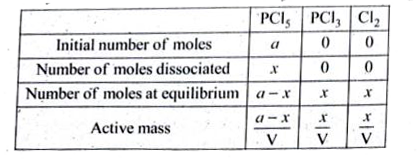 Applying law of mass ACTION `K_(C) = ([PCl_(3)] [Cl_(2)])/([PCl_(5)]) = (((x)/(V)) ((x)/(V)))/((a - x)/(V)) = (x^(2))/(( a- x) V)` `K_(p)` calculation : `K_(P)= K_(C) . RT ^(Deltan_(g))` `Deltan_(g) = 2 - 1 = 1` We KNOW that `PV = nRT` `RT = (PV)/(n)` Where .n. is the TOTAL number of moles at equilibrium `n = a - x + x + x = a + x` `K_(P) = (x^(2))/((a - x) V) * (PV)/(n)` `K_(p) = (x^(2) xx PV)/((a - x) V ( a + x))` `K_(p) = (x^(2) P)/((a - x) (a + x))` |
|
| 16. |
Derive the values of K_(C) and K_(P) for the synthesis of HI. |
|
Answer» Solution :`H_(2) (g) + I_(2) (g) HARR 2 HI (g)` Let US consider the formation of HI in which .a. moles of hydrogen , .b. moles of iodine GAS are allowed to react in an container of volume .V. . Let .x. moles of each of `H_(2)` and `I_(2)` react together to form 2X moles of HI. 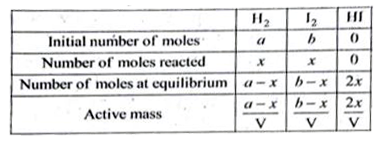 Applying law of MASS action, `K_(C) = ([HI]^(2))/([H_(2)][I_(2)])` `K_(C) = (((2x)/(V))^(2))/(((a - x))/(V) ((b- x))/(V)) = (4x^(2))/((a - x) (b - x))` Calculation of `K_(p) , K_(P) = K_(C) . RT^(Deltan_(g))` Here`Deltan_(g) = n_(p) - n_(r) = 2 - 2 = 0` Hence , `"" K_(P) = K_(C)` `K_(P) = (4x^(2))/((a - x) (b - x))` |
|
| 17. |
Molar heat capacity at constant volume is ……………. |
|
Answer» Solution :According to the FIRST law of thermodynamics, dy = dU + PdV Dividing both sides by dT , we have `(dq)/(dT)="(dU+PdV)"/(dT)` At constant VOLUME dV=0 , then `(dq)/(dT)=((dU)/(dT))_(v)` `C_V=((dU)/(dT))_V` THUS the heat capacity at constant volume `(C_V)` is DEFINED as the rate of CHANGE of inter energy with respect to temperature at constant volume. |
|
| 18. |
Derive the value of K_(P and K_(C) for dissociation of PCI_(5). |
|
Answer» <P> Solution :Consider that .a. moles of `PCl_(5)` is taken in container of volume .V.LET X moles of `PCl_(5)` be dissociated into x moles of `PCl_(3)` and x moles of `Cl_(2)`.  Applying law of mass action `K_(C) = ([PCl_(3) ][Cl_(2)])/([PCl_(5)]) = (((x)/(V))((x)/(V)))/((a-x)/(V)) = (x^(2))/((a-x) V)` `K_(P)` Calculation `K_(P) = K_(C) .RT^(Delta n_(g)) , Delta n_(g)= 2-1=1` We know that PV= nRT `RT= (PV)/(n)` Where .n. is the TOTAL number of moles at equilibrium `n= a-x + x+x= a+x` `K_(P) = (x^(2))/((a-x) V) .(PV)/(n) rArr K_(P) = (x^(2) xx PV)/((a-x) V(a+x))` `K_(P) = (x^(2)P)/((a-x) (a+x))` |
|
| 19. |
Derive the value of K_(C) and K_(P) for the synthesis of HI. |
|
Answer» Solution :Let us consider the formation of HI in which, 'a' moles of hydrogen and 'B' moles of iodine gas are allowed to react in a container of valume V. Let 'x' moles of each of `H_(2)` and `I_(2)` react TOGETHER to from 2x moles of HI. `H_(2(g))+I_(2(g))hArr2HI(g)`  Applying law of mass action, `K_(c)=([HI]^(2))/([H_(2)][I_(2)])=(((2x)/(V))^(2))/(((a-x)/(V))((b-x)/(V)))=(4x^(2))/((a-x)(b-x))` The EQUILIBRIUM constant `K_(P)` can also be CALCULATED as FOLLOWS : We know the relationship between the `K_(c)` and `K_(P)` `K_(P)=K_(C)(RT)^((Deltan_(g))` Here the, `Deltan_((g))=n_(P)-n_(r)=2-2=0` Hence `K_(P)=K_(C),K_(P)=(4x^(2))/((a-x)(b-x))` |
|
| 20. |
Derive the value of equilibrium constants K_p and K_c for a general reaction xA + y B hArr lC +mD |
|
Answer» SOLUTION :Let us consider a reversible reaction `xA + YB hArr lC + m D` where, A, B are the reactants C and D are the product and x, y l and m are the stoichiometic coefficients of A, B, C and D respectively. Applying the law of mass action the RATE of forward reaction. `r_f prop[A]^(x)[B]^(y)or r_f[A]^(x)[B]^(y)` Similarly the rate of backward reaction `r_b prop [C]^l [D]^m or r_b = K_b [ C]^l[D]^m` where `K_f` and `K_b` are PROPORTIONALITY constants. At equilibrium . Rate of forward reaction `(r_f)` = Rate of backward reactoin `(r_b)` `thereforeK_(f)[A]^(x). [B]^(y) = K_b[C]^(l) [D]^m` or `(K_f)/(K_b) = ([C]^l [D]^m)/([A]^l. [B]^y)=K_C` where `K_C` is the equilibrium constant in terms of concentration. At a given temperature, the ratio of the product of active masses of reaction products raised. to the respective STOICHIOMETRIC coefficients in the balanced chemical equation to that of the reactants is a constant known as equilibrium constant. If the reactants and products of the above reaction are in gas phase, then the equilibrium constant can be written in terms of partial pressures. `K_p = (p_c^(i) xx p_D^m)/(p_A^x xx p_B^y)` where `P_(A),P_(B),P_(C) " and " P_D` are the partial pressure of gases A,B,C and D respectively. |
|
| 21. |
Definespecificheatcapacityatconstantprossure. |
|
Answer» Solution :We know, H=U+PV Differentiating the above equation with respect to temperature at CONSTANTPRESSURE we GET `((dH)/(dT))_P =((dU)/(dT))_P + P((dV)/(dT))_P` `C=(dq)/(dT)` But at constant PRESSURE dq=dH Hence we get , `C_P=((dH)/(dT))_P` Thus HEAT capacity at constant pressure `(C_P)`is defined as the rate of change of enthalpy we respect to temperature at constant pressure |
|
| 22. |
Derive the value of critical constants the Van der Waals constants. |
|
Answer» Solution :Derivation of critical constants from the Van der Waals constant: Van der Waals equation is, `(P + (an^(2))/(V^(2))) (V-nb) = nRT` for 1mole From this equation, the values of critical constant `P_(C), V_(C)` and `T_(C)` are derived in terms of a and b the Van der Waals constants. `(P + (a)/(V^(2))) (V-b) = RT` ...(1) On expanding the equation (1) `PV + (a)/(V) -Pb-(ab)/(V^(2)) - RT=0`...(2) Multiplying equation (2) by `V^(2)/P`, `(V^(2))/(P) (PV + (a)/(V)- Pb- (ab)/(V^(2)) - RT)=0` `V^(3) + (aV)/(P) -bV^(2) - (ab)/(P) - (RTV^(2))/(P) = 0` ...(3) Equation (3) is rearranged in the powers of V. `V^(3) - [(RT)/(P) +b] V^(2) + (aV)/(P) - (ab)/(P) = 0` ...(4) The above equation (4) is an cubic equation of V, which can have three roots. At the critical POINT, all the three values of V are equal to the critical volume `V_(C)`. i.e. `V= V_(C)` `V-V_(C) = 0`...(5) `(V-V_(C))^(3) = 0`...(6) `(V^(3) - 3V_(C) V^(2)) + 3V_(C)^(2) V-V_(C)^(3) = 0` ...(7) As the equation (4) is identical with equation (7), comparing the .V. terms in (4) and (7), `-3V_(C) V^(2) = -[(RT_(C))/(P_(C)) + b] V^(2)` ...(8) `3V_(C) = b + (RT_(C))/(P_(C))` ...(9) `3V_(C)^(2) = (a)/(P_(C))` ...(10) `V_(C)^(3) = (ab)/(P_(C))` ...(11) Divide equation (11) by (10) `(V_(C)^(3))/(3V_(C)^(2)) = (ab//P_(C))/(a//P_(C))` `(V_(C))/(3) = b` `:. V_(C) = 3b`...(12) When equation (12) is substituted in (10) `3V_(C) = b+ (RT_(C))/(P_(C))` `3 xx 3b =b + (RT_(C))/(a//27b^(2))` `9b-b= (RT_(C))/(a) xx 27b^(2)` `8b= (T_(C).R 27b^(2))/(a)` `:. T_(C) = (8ab)/(27Rb^(2)) = (8a)/(27Rb)` `:. T_(C) = (8a)/(27Rb)` ...(14) Substituting the values of `V_(C)` and `P_(C)` in equation (9) Critical constants a and b can be calculated using Van der Waals constants as follows:  ..(5) ..(5)
|
|
| 23. |
Derive the value for 1 litre- atmosphere in terms of joules. |
| Answer» SOLUTION :1 Latm `= ( 1 DM^(3)) ( 101325 N m^(-1)) = ( 10^(-3) m^(3))( 101325Nm^(-2)) = 101.325Nm=101.325 J`. | |
| 24. |
Derive the structure of (i) 2-chlorohexane, (ii) pent-4-en-2-ol(iii) 3-nitro-cyclohexene, (iv) cyclohex-2-en-1-ol, (v) 6-hydroxyheptanal. |
|
Answer» Solution :(i) Step 1. The word root 'hex' indicates the presence of six carbon. Atoms in the chain and the primary suffix 'ane' suggests that the chain is saturated. `C-C-C-C-C-C` Step 2. Number the carbon atoms of the chain as indicated`overset(1)(C)-overset(2)(C)-overset(3)(C)-overset(4)(C)-overset(5)(C)-overset(6)(C)` Step 3. The secondary prefix chloro and the numerical prefix 2 before it suggests that there is a chorine atom at position 2 as shown `{:(overset(1)(C)-overset(2)(C)-overset(3)(C)-overset(4)(C)-overset(5)(C)-overset(6)(C)),("|"),(""Cl):}` Step 4. Satisfy the TETRACOVALENCY of each carbon with required number of HYDROGEN atoms. Thus, the structural formula of 2-chlorohexane is `{:(CH_(3)-CH-CH_(2)-CH_(2)-CH_(2)-CH_(2)),("|"),(""Cl):}` (ii) Step 1. The word root 'pent' indicates that the longest carbon chain contains five carbon atoms.C-C-C-C-C Step 2. Number the carbon chain as indicated.`overset(1)(C)-overset(2)(C)-overset(3)(C)-overset(4)(C)-overset(5)(C)` Step 3. The secondary suffix-ol and the numerical prefix 2 before it suggests that there is a hydroxyl group at position 2. Therefore, fix a hydroxyl group at position 2 as shown `{:(overset(1)(C)-overset(2)(C)-overset(3)(C)-overset(4)(C)-overset(5)(C)),("|"),(""OH):}` Step 4. The primary suffix 'en' and the numerical prefix 4 before it suggests that there is a double bond at position 4. Therefore, put a double bond between positions 4 and 5 as shown. Step 5. Satisy the tetracovalency of each carbon with the required number of hydrogen atoms. Thus, the structural formula of pent-4-en-2-ol is `{:(overset(1)(C)H_(3)-overset(2)(C)H-overset(3)(C)H_(2)-overset(4)(C)H=overset(5)(C)H_(2)),("|"),(""OH):}` (iii) Step 1. The primary prefix 'cyclo' and the word root 'hex' means that the given compound contains a six-numbered ring. Therefore, DRAW a cyclohexane ring as shown :  Step 2. Number the carbon atoms of the cyclohexane ring as indicated. 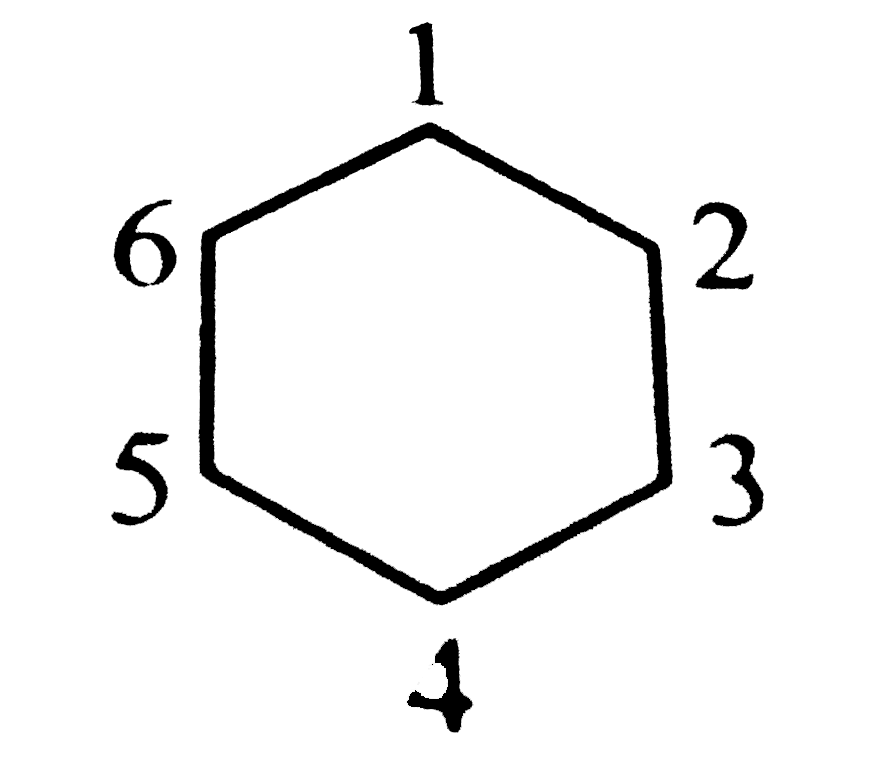 Step 3. The primary suffix 'en' without any numerical prefix indicates there is a double bond at position 1. Therefore, put a double bond between positions 1 and 2 as shown : 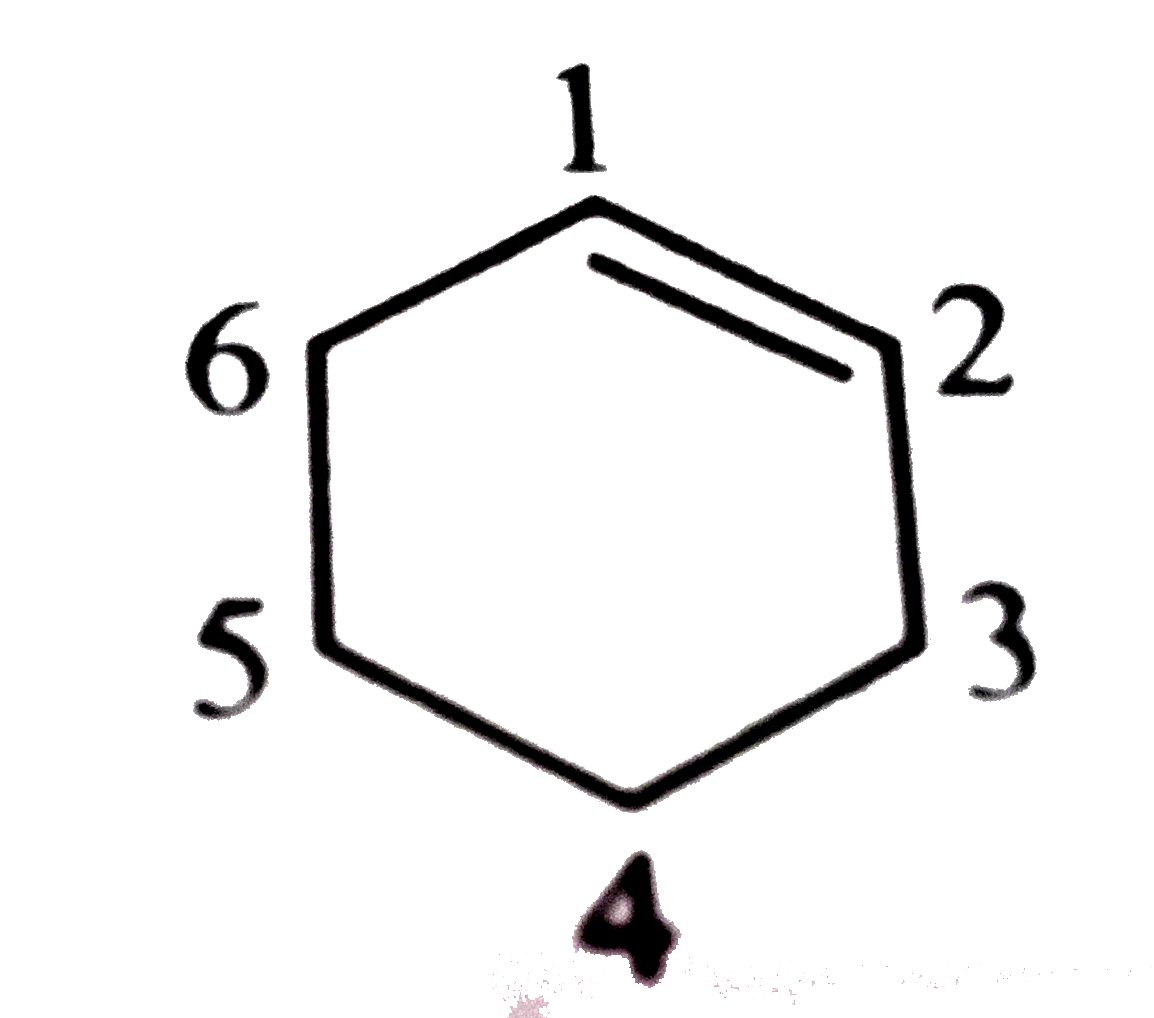 Step 4. The secondary prefix 'nitro' and the numerical prefix 3 before suggests that free is a nitro group at position 3. Therefore, place a nitro group at position 3. 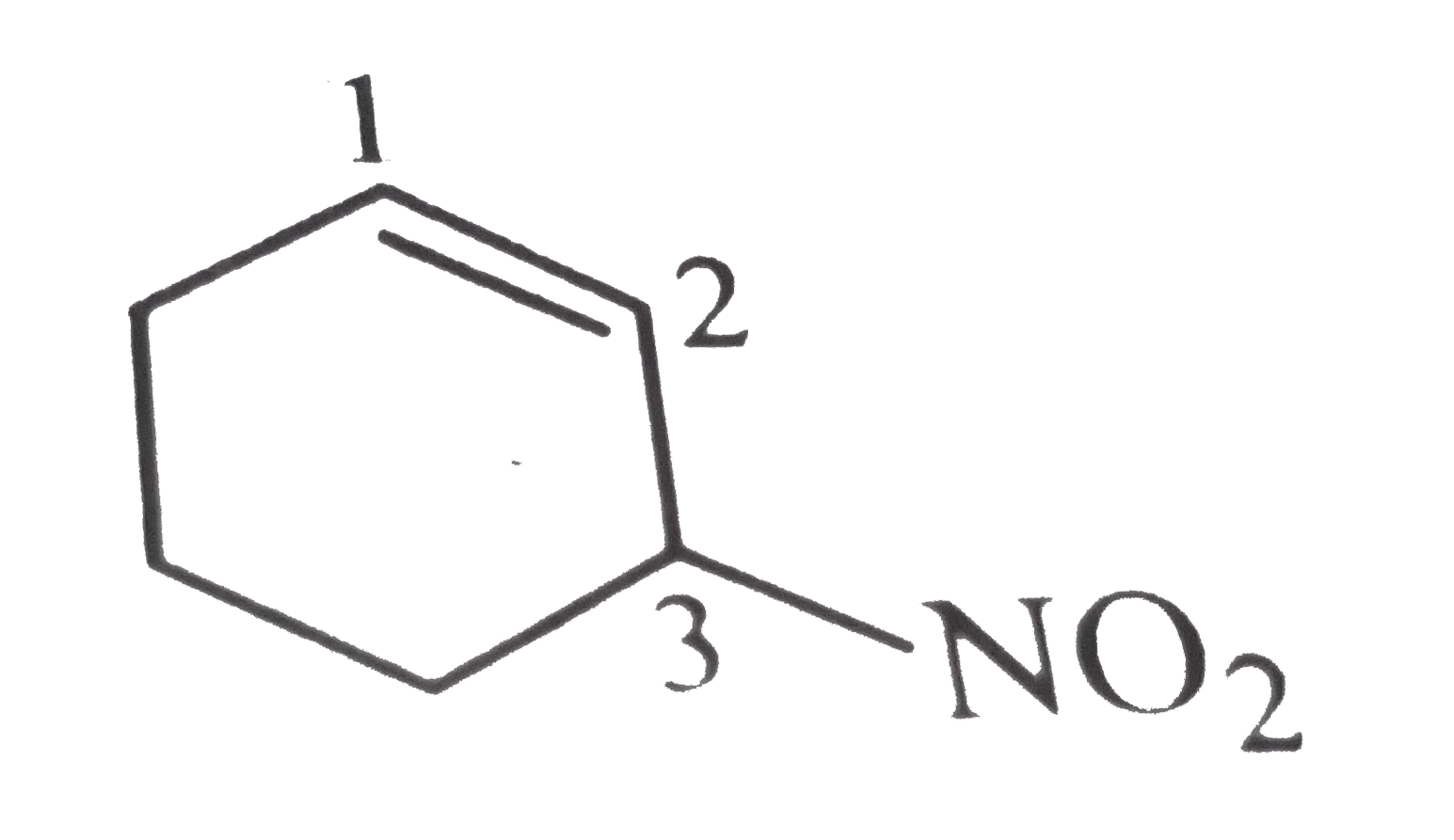 This represents complete structure of 3-nitrocyclohexene. (iv) Step 1. The primary suffix 'cyclo' and the word root hex means that the given compound contains a six-membered ring. Therefore, draw a cyclohexane ring  Step 2. Number the carbon atoms of the cyclohexane ring as indicated 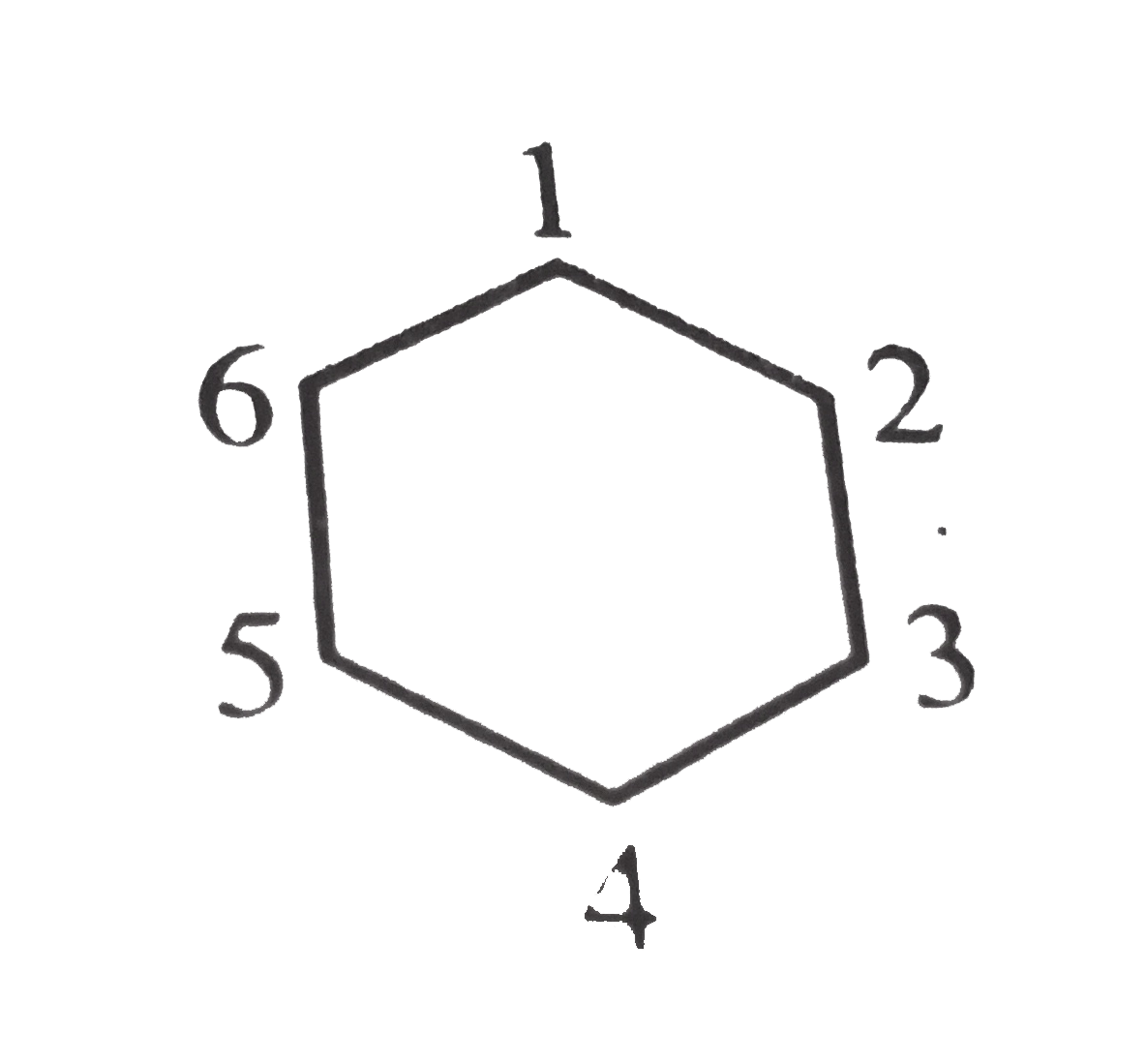 Step 3. The primary suffix 2-en and the secondary suffix 1-ol indicates that there is a double bond at position 2 and an OH group at position 1. Thus, the structure of the compound cyclohex-2-en-1-ol is 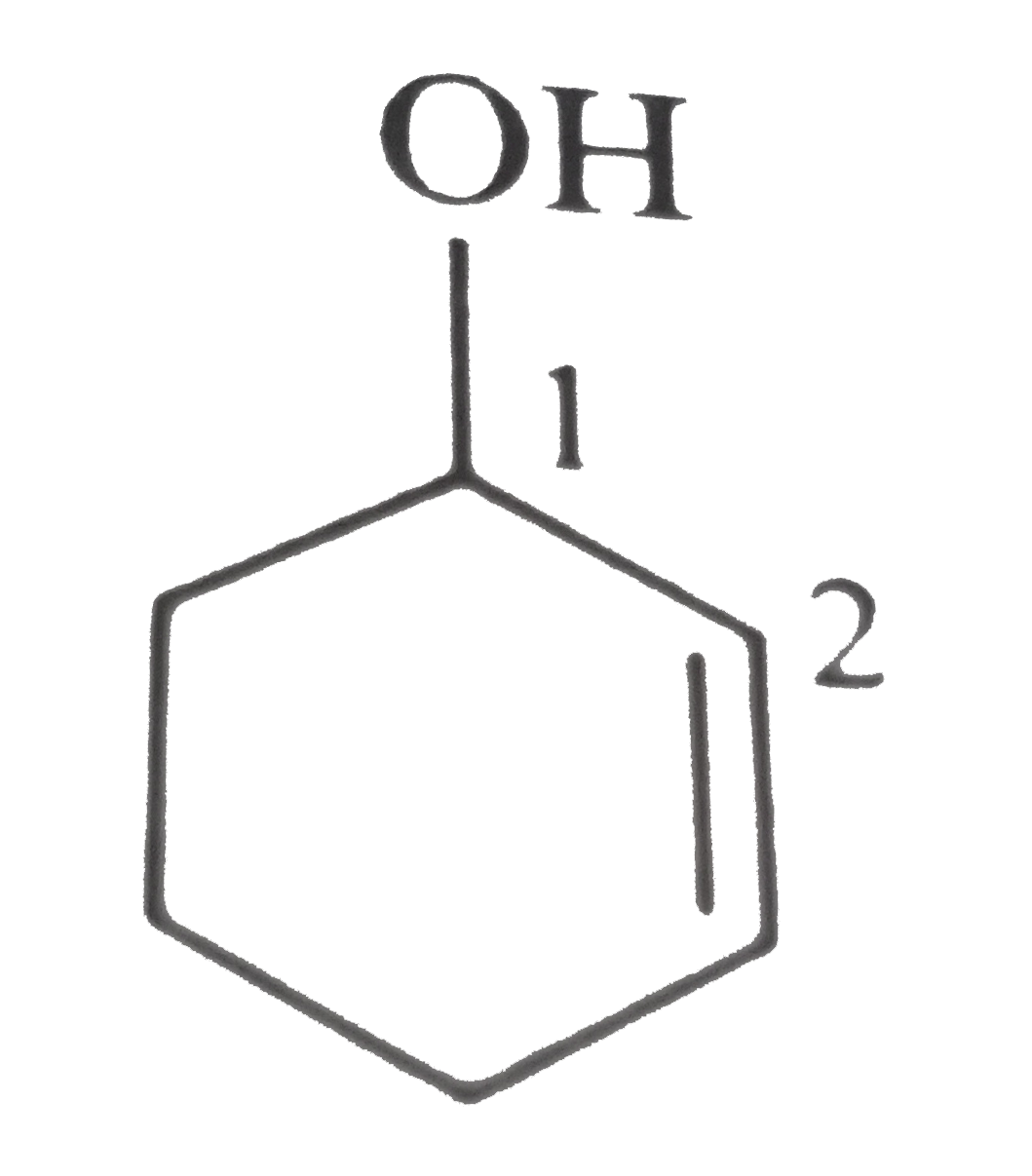 (v) Step 1. The name heptanal is made up of three parts, i.e., hepi (word root) + an (primary suffix) + al (secondary suffix). This means that the given compound is an aldehyde containing 7 carbon atoms including the carbon atom of aldehyde group. C-C-C-C-C-C-C Step 2. Number the carbon atoms of the carbon chain is follow.`overset(7)(C)-overset(6)(C)-overset(5)(C)-overset(4)(C)-overset(3)(C)-overset(2)(C)-overset(1)(C)` Step 3. Since aldehyde group is a chain terminating group, therefore, convert carbon at position 1 into aldehyde group as shown. `underset(7)(C)-underset(6)(C)-underset(5)(C)-underset(4)(C)-underset(3)(C)-underset(2)(C)-underset(1)overset(O)overset(||)(C)-H` Step 4. The secondary prefic hydroxy and the numerical prefix 6 before it indicates that there is an OH group at position 6 as shown. `{:(""OH""O),("|""||"),(underset(7)(C)-underset(6)(C)-underset(5)(C)-underset(3)(C)-underset(2)(C)-underset(1)(C)-H):}` Step 5. Satisfy the tetracovalency of each carbon with the required number of hydrogen atoms. Thus, the structural formula of 6-hydroxyheptanal is `{:(""OH""O),("|""||"),(CH_(3)-CH-CH_(2)-CH_(2)-CH_(2)-CH_(2)-C-H):}` |
|
| 25. |
Derive the units of the vanderwaal's constants. |
|
Answer» Solution :Units for VANDERWAAL's constant : The dimensions of the vanderwaal's constant a and b depend UPON the units of P and V resetively. `a=("Pressure"("Volume")^(2))/("mole"^(2))` `a=atm * dm^(6)*"MOL"^(-2) (1 "litre"= 1 dm^(3))` If volume is EXPRESSED in `dm^(3)`. then b is expressed as, `(Vol)/(n)=(dm^(3))/("mol")` `(V)/(n)= dm^(3)"mol"^(-1)` unit of `b=dm^(3)"mol"^(-1)` |
|
| 26. |
Derive the relation between Density and Molar mass of a gaseous substancefrom ideal gas equation. |
|
Answer» SOLUTION :WKT PV= nRT is IDEAL gas equation rerranging `N=(PV)/(RT)` [ but `N=("mass")/("MOLECULAR mass")=(m)/(M)]` `:. (m)/(M)=(PV)/(RT)` `(m)/(V)*(1)/(M)=(P)/(RT)` [ but `(m)/(v)` density (d)] `(d)/(M)=(P)/(RT)` `:. M=(dRT)/(P)` |
|
| 27. |
Derive the relationship betweenDeltaH andDeltaU fro an idealgas. Explaineach terms involved in the equation. |
| Answer» SOLUTION :REFER to ART, PAGE | |
| 28. |
Derive the relationship between the relative lowering of vapour pressure and mole fraction of the solute |
|
Answer» <P> SOLUTION :`P_("solution") prop x_(A)` by Raoult.s LAWwhere `x_A` is the mole fraction of the solvent . 
|
|
| 29. |
Write the relationship between Permutation and Combination? |
|
Answer» Solution :(i)During expansion, work is done by the system, since `V_f > V_i`, the sign obtained for work will be negative (ii) During compression, work is done on the system, since `V_f > V_i`the sign obtained for work will be positive (iii) If the pressure is not constant, but changes during the process such that it is alwaysinfinitesimally greater than the pressure of the gas, then, at each stage of compression, the volume decreases by an infinitesimal AMOUNT, dV. (iv)We can calculate the work done on the gas by the relation, `w=-int_(V_i)^(V_f)PdV`...(1) (v)In a compression process, `P_(ext)` the external pressure is ALWAYS greater than the pressure of the system. i.e... `P_"ext"=(P_"int"+dp)`. In an expansion process, the external pressure is always less than the pressure of the system i.e., `P_"ext"-=(P_"int"-dp)` (v) In general case, we can write, `P_"ext"=(P_"int" pm dp)` . Such processes are called reversible processes.For a compression process, work can be related to internal pressure of the system under reversible CONDITIONS by writing equation . `w="rev"=-int_(V_i)^(V_f) P_"ex"dV=-int_(V_i)^(V_f) (P_"int"pm dP) dV` ....(2) Since dp. dv is very small , we can write `w_"rev"=-int_(V_i)^(V_f)P_"int"dV`....(3) For a given system, `P_"int"V=nRT` `P_"int"V=(nRT)//V` `w_"rev"=-int_(V_i)^(V_f) (nRT)/V dv` ...(4) `w_"rev"=-nRT int_(V_i)^(V_f) (dV)/V` `w_"rev"=-nRT ln (V_f_/V_i)` `w_"rev"=-2.303 nRT log (V_f/V_i)`....(5) (viii) If `V_f > V_i)` (expansion ) , the sign to work done by the process is negative. If `V_f LT V_i` (compression ) , the sign to work done by the process is positive . |
|
| 30. |
Derive the relationship between the elevation of boiling point and molar mass of non-volatile solute. |
|
Answer» Solution :`P _("solution") prop x_(A)` by Raoult.s law where `x _(A)` is the mole fraction of the solvent ` P _("solution") = k x_(A)` `p _("solvent"_^(0)=` partial pressure of pure solvent. `P _("solution")=` partial pressure of pure solvent. `P_("solution") = P_("solvent")^(0) x _(A)` `(P _("solution"))/(P _("solvent")^(0)) =x_(A)` ` 1- (P _("solution")/(P _("solvent")^(0)) =1-x_(A)` `THEREFORE (P_("solvent"^(0) -P_("solution"))/(P_(solvent"^(0))=x _(B)` where ` x _(B)=` mole fraction of the SOLUTE `x _(A) + x _(B) =1` `therefore x _(B) =1-x_(A)` `(P ^(@) -P)/(P^(@)) =x_(B)` |
|
| 31. |
The standard free energy change (DeltaG^0) is related to equilibrium constant (K ) as ____ |
|
Answer» Solution :(i)In a reversible process, SYSTEM is at all times in perfect equilibrium with its surroundings . (ii) A reversible CHEMICAL reaction can proceed in either direction simultaneously, DYNAMIC equilibrium is set up. (III)This means that the reactions in both the directions should proceed with decrease in free energy, which is impossible. (iv)It is possible only if at equilibrium, the free energy of a system minimum (v) LETS consider a general equilibrium reaction, A+B `hArr` C+D The free energy change of the above reaction in any state (`DeltaG`) is related to the standard free energy change of the reaction (`DeltaG^0`) according to the following equation. `DeltaG=DeltaG^0+RT ln Q`....(1) where Q is reaction quotient and is defined as the ratio of concentration of the products to the concentration of the reactants under non-equilibrium condition. (vi)When equilibrium is attained, there is no further free energy change i.e. `DeltaG=0` and Q becomes equal to equilibrium constant.Hence the above equation becomes , `DeltaG^0=-RT ln K_(eq)` ...(2 ) This equation is known as Van.t Hoff equation. `DeltaG^0`=-2.303 RT log `K_(eq)`...(3) We also know that , `DeltaG^0=DeltaH^0 -TDeltaS^0=-RT ln K_(eq)` ....(4) |
|
| 32. |
Derive the relatioshhip between K_p and K_c |
|
Answer» Solution :Consider a gaseous reaction `aA+aBhArrcC+dD` `K_(p)=(P_(C)^(c)P_(D)^(d))/(P_(A)^(a)P_(B)^(b))""...(1)` where `P_(A),P_(B),P_(C)andP_(D)` represent the PARTIAL pressure of A, B, C and D in the equilibrium mixture. For an ideal gas, PV = nRT or `P=(n/V)RT,n/V=("NUMBER of moles")/("Volume in litre")` represents molar concentrations. `thereforeP_(A)=[A]RT,P_(B)=[B]RT,P_(C)=[C]RT,P_(D)=[D]RT` EQ(1) becomes `K_(p)=({[C]RT}^(c){[D]RT}^(d))/({[A]RT}^(a){[B]RT}^(b))=([C]^(c)[D]^(d))/([A]^(a)[B]^(b))xx(RT)^((c+d)-(a+b))` `K_(p)=K_(c)(RT)^(Deltan)` where `Deltan=(c+d)-(a+b)orDeltan` = Number of moles of products - Number of moles of reactants in that gaseous reaction. |
|
| 33. |
Derive the relationship between partial pressure of gas and its mole fraction. |
|
Answer» <P> SOLUTION :Consider a mixture of THREE gases containing `n_(1)` mole of gas A and `n_(2)` mole of gas B and `n_(3)` mole of gas C in a vessel of volume V let individual partial pressure be `P_(A), P_(B) and p_(C)` and total pressure be P.`wkt PV= nRT or P=(nRT)/(V)` `P_(A)=(n_(1)RT)/(V) ""...(1)` `P_(B)=(n_(2)RT)/(V) ""...(2)` `P_(C)=(n_(3)RT)/(V) ""...(3)` According to Dalton.s law, `P=P_(A)+P_(B)+P_(C)` `P\=(n_(1)RT)/(V)+(n_(2)RT)/(V)+(n_(3)RT)/(V)` `P=(n_(1)+n_(2)+n_(3))(RV)/(V) ""...(4)` From eqatuin (1) and (4) `(p_(A))/(P)=(n_(1))/(n_(1)+n_(2)+n_(3)) or p_(A)=[ (n_(1))/(n_(1)+n_(2)+n_(3))]p` From and (2) and (4) `(p_(B))/(P)=(n_(2))/(n_(1)+n_(2)+n_(3)) or p_(A)=[ (n_(2))/(n_(1)+n_(2)+n_(3))]p` From and (3) and (4) `(p_(C))/(P)=(n_(3))/(n_(1)+n_(2)+n_(3)) or p_(A)=[ (n_(3))/(n_(1)+n_(2)+n_(3))]p` `:.` Partial pressure = mole fraction `xx` total pressure |
|
| 34. |
Derive the relationship between Delta H and Delta U for an ideal gas. Explain each term involved in the equation. |
|
Answer» <P> Solution :From the first law of thermodynamics, `q= Delta U + p DeltaV` If the process carried out at constant volume, `Delta V= 0`Hence, `q_(v) = Delta U` [Here, `q_V,=` Heat absorbed at constant volume, `Delta U =` CHANGE in internal energy] Similarly, `q_p = Delta H` Here, `q_p =` heat absorbed at constant pressure `Delta H =` enthalpy change of the system. Enthalpy change of a system is equal to the heat absorbed or evolved by the system at constant pressure. As we know that at constant pressure, `Delta H = Delta U + p Delta V` where, `Delta V` is the change in volume. This equation can be rewritten as `Delta H = Delta U + p(V_f - V_i) = Delta U + ) p V_f - pV_i)""...(i)` where, `V_i=` INITIAL volume of the system `V_f=` final volume of the system But for the ideal gases, `pV=n RT` So that `pV_1 = n_(1) RT` and `pV_(2) = n_(2) RT` where, `n_(1) =` number of moles of the gaseous reactants `n_(2) =` number of moles of the gaseous products. Substituting these values in Eq. (i), we get `Delta H = Delta U + (n_(2) RT - n_(1) RT)` `Delta H = Delta U + (n_(2) - n_(1) ) RT` OR `Delta H = Delta U + Deltan_(g) RT` where `Delta n_(g) = n_(2) - n_(1)` is the difference between the number of moles of the gaseous products and gaseous reactants. Putting the values of ` Delta H and Delta U` we get `q_p = q_v, + Delta n_(g) "RT"` Note: Conditions under which `q_(p) = q_(v) "or" Delta H = Delta U` (i) When reaction is carried out in a closed vessel the volume remains constant i.e., `Delta V =0` (II) When reaction involves only solids or liquids or solutions but no gaseous reactant or product. This is because the volume CHANGES of the solids and liquids during a chemical reaction are negligible. (iii) When reaction involves gaseous reactants and products but their number of moles are equal (i.e., `n_(p) = n_(r) )` e.g., `H_(2) (g) + CI_(2)(g) to 2HCI(g)` `C(s) + O_(2) (g) to CO_(2) (g)` Since, `q_p` is different from `q_v` only in those reactions which involves gaseous reactants and products and `(n_p)` gaseous `ne (n_r)` gaseous. |
|
| 35. |
Derive the relation of value of K_p and K_c of the following balance reaction. H_(2(g)) + I_(2(g)) hArr 2HI_((g)) |
|
Answer» Solution :In this `H_(2(g))+ I_(2(g))hArr 2HI_((g))`EQUILIBRIUM reaction all is in gases phase so to take partial pressure in `K_p`. At given temperature, `p_(H_2)` = Partial pressure of `H_2` `p_(I_2)`= Partial pressure of `I_2` `P_(HI)` = Partial pressure of HI `K_p =(p_(HI))^2/((p_(H_2))(p_(I_2)))` but `p_(HI)=[HI]RT` because, p=cRT `p_(H_2)=[H_2]RT` where c=mol `L^(-1)` concen. `p_(I_2)` =[I]RT This value put in `K_p`, `K_p = ([HI]RT)^2/([H_2](RT)[I_2]RT)` `therefore K_p=[HI]^2/([H_2][I_2])=K_c` THUS, `K_p=K_c`, so the value of both CONSTANT equal, because `Deltan`=zero. |
|
| 36. |
Derive the relationship between C_(p) and C_(v)for an ideal gas. |
|
Answer» SOLUTION :Relation between Cp and Cv for an ideal gas .From the definition of enthalpy `H = U + PV "" . . . . (1)` For 1 mole of an ideal gas `PV = NRT "" . . . . (2)` By substituting (1) in (2) `H = U + nRT "" . . . . (3)` DIFFERENTIATING the above equation with respect to ` T , (del H)/(delT) = (delU)/(delT) + "nR"(delT)/(delT)` ` [ :' ((delH)/(delT))_(p)=D_(p)and ((delU)/(delT))_(v)=C_(V)]` `C_(p) = C_(v) +nR` `C_(p) - C_(v) = nR` |
|
| 37. |
Derive the relation between K_(P) and K_(C'). |
|
Answer» Solution :Let us consider the reaction in which all reactants and products are ideal gases. `xA+yBhArrIC+mD` The equilibrium constant, `K_(C)` is `K_(C)=([C]^(1)[D]^(m))/([A]^(X)[B]^(y))`. . . (1) and `K_(P)` is, `K_(P)=(P_(C)^(1)xxP_(D)^(m))/(P_(A)^(x)xxP_(B)^(y))`. . .(2) The ideal GAS EQUATION is `PV=nRT` or `P=n/VRT` Since Active mass = molar concentration `=n//V` P = active mass `xx` RT Based on the above expression the partial pressure of the reactants and products can be expressed as, `P_(A)^(x)=[A]^(x)[RT]^(x)` `P_(B)^(y)=[B]^(y)[RT]^(y)` `P_(C)^(1)=[C]^(1)[RT]^(1)` `P_(D)^(m)=[D]^(m)[RT]^(m)` On substitution in eqn. 2, `K_(P)=([C]^(1)[RT]^(1)[D]^(m)[RT]^(m))/([A]^(x)[RT]^(x)[B]^(y)[RT]^(y))`. . . (3) `K_(P)=([C]^(1)[D]^(m)[RT]^(l+m))/([A]^(x)[B]^(y)[RT]^(x+y))` `K_(P)=([C]^(1)[D]^(m))/([A]^(x)[B]^(y))[RT]^((l+m)-(x+y)`. . .(4) By comparing equation (1) and (4), we get `K_(P)=K_(C)(RT)^(Deltan_(s))`. . . (5) where, `Deltan_(g)` is the difference between the SUM of number of moles of products and the sum of number of moles of reactants in the gas phase. |
|
| 38. |
Derive the reaction between K_pand K_c in these three reactions.(a)N_(2(g)) + 3H_(2(g)) hArr 2NH_(3(g)) (b)2SO_(2(g)) + O_(2(g)) hArr 2SO_(3(g)) (c) N_2O_(4(g)) hArr 2NO_(2(g)) |
|
Answer» Solution :(a)`Deltan_((g))`=2-1-3=-2 therefore `K_p=K_c (RT)^(-2)` THUS, `Deltan_((g))` = negative number So, `K_p LT K_c` (b)`Deltan_((g))`=2-2-1=-1 therefore `K_p=K_c(RT)^(-1)` Thus, `Deltan_((g))`=negative number So, `K_p lt K_c` (c) `Deltan_((g))`=(2-1)=1 therefore `K_p =K_c (RT)^(+1)` Thus, `Deltan_((g))`=POSITIVE number So, `K_p gt K_c` |
|
| 39. |
Derive the relation between DeltaH and DeltaU for an ideal gas. |
|
Answer» SOLUTION :1. When the system at constant pressure undergoes changes from an initial state with `H_1 U_1 V_1` and P parameters to a final state with `H_2 U_2 V_2` and P parameters, the CHANGE enthalpy `DeltaH`, is GIVEN by `DeltaH=U+PV` (2) At initial state `H_1=U_1+PV_1`......(1) At final state `H_2 =U_2+PV_2`.........(2) `(2)-(1)implies(H_2-H_1)=(U_2-U_1)+P(V_2-V_1)` ……(3) Considering `DeltaU=q+w, w=-PDeltaV` `DeltaH=q+w+PDeltaV` `DeltaH=q_(p)-PDeltaV+PDeltaV` `DeltaH=q_(p)` ……..(4) `q_p` is the HEAT absorbed at constant pressure and is considered as heat content. (3)Considered a closed system of glass which are chemically reacting to produce product gases at contant temperature and pressure with `V_1` and `V_f` as the total volumeof the reactant and product gases respectively and `n_1` and `n_f` are the number of mole of gaseous reactant and product. Then For reactant `PV_(i)= n_(i)RT` For product: `PV_(f)=n_(f)RT` Then considering reactant as initial state and product as final state. `P(V_(f)-V_(i))=(n_(f)-n_(i))RT` `PDeltaV=Deltan_(g)RT` We KNOW `DeltaH=DeltaU+PDeltaV` `:.DeltaH=DeltaU+Deltan_(g) RT` ………(5) |
|
| 40. |
Give the relation between DeltaU and DeltaH. |
|
Answer» Solution :(i)When the system at constant pressure undergoes CHANGES from an initial state with `H_1,U_1,V_1` and P parameters to a final state with `H_2,U_2,V_2`and P parameters, the change in enthalpy `DeltaH`, is given by `DeltaH=U+PV` (ii)At initial state `H_1=U_1+PV_1`...(1) (ii)At final state `H_2=U_2+PV_2` ...(2) (2) -(1) `RARR(H_2-H_1) = (U_2-U_1) +P(V_2-V_1)` `DeltaH=DeltaU+PDeltaV` ....(3) Considering `DeltaH=q+w , w=-P DeltaV` `DeltaH=q+w+PDeltaV` `DeltaH=q_P - PDeltaV+ PDeltaV` `DeltaH=q_P` ....(4) `q_P` is the heat absorbed at constant pressure and is CONSIDERED as heat content. (iii) Consider a closed system of gases which are chemically REACTING to produce product gases at constant temperature and pressure with `V_i` and `V_f` as the TOTAL volumes of the reactant and product gases respectively, and `n_i` and `n_f` are the number of moles of gaseous reactants and products . Then , For reactants : `PV_i =n_i RT` For products : `PV_f =n_f RT` Then considering reactants as initial state and products as final state , `P(V_f-V_i)=(n-f-n_i)RT` `PDeltaV=Deltan_g RT` We know `DeltaH=DeltaU+PDeltaV` `therefore DeltaH=DeltaU +Deltan_g RT` ....(5) |
|
| 41. |
Derive the ralation between K_P and K_C. |
|
Answer» SOLUTION :Consider a general reaction in which all reactants and PRODUCTS are ideal gases. `xA + yB HARR lC +m D` The equilibrium constant `K_C` is `K_C = ([C]^L[D]^m)/([A]^x[B]^y)`…(1) `K_P = (p_C^lxxp_D^m)/(p_A^x xx p_B^y)`…(2) The ideal gas EQUATION is `PV= nRT or P = n/VRT` Since, Active mass =molar concentration `= n/V` P = Active mass `xx RT` Based on the above expression, the partial pressure of the reactant andproducts can beexpressed as, `p_A^x = [A]^x. [RT]^x` `p_B^y = [B]^y. [RT]^y` `p_C^l = [C]^l.[RT]^l` `p_D^m = [D]^m . [RT]^m` On substitution in equation(2), `K_P = ([C]^l[RT]^l[D]^m[RT]^m)/([A]^x[RT]^x[B]^y[RT]^y)` `K_P = ([C]^l[D]^m)/([A]^x[B]^y) xx RT^((1+m)-(x+y))` By comparing equation (1) and (4), we get `K_P = K_C (RT)^((Deltan_g))` where `Deltan_g` is the difference between the sum of number of moles of products and the sum of number of moles of reactans in the gas phase. (i) If `Deltan_g =0, K_P = K_C(RT)^0` `K_P = K_C` Example : `H_2(g)+ I_2(g) hArr 2HI(g)` (ii) When `Deltan_(g) = +ve` `K_P= K_C(RT)^(+ve)` `K_P = K_C` Example : `2NH_3(g) hArr N_2(g)+ 3H_2(g)` (iii) When`Deltan_g = -ve` `K_P = K_C (RT)^(-ve)` `K_P lt K_C` Example : `2SO_2(g)+ O_2(g) hArr 2SO_3(g)` |
|
| 42. |
Derive the K_(P) and K_(c) for the following equilibrium reaction. H_(2(g))+I_(2(g))hArr2HI_((g)) |
|
Answer» Solution :Let us consider the formation of HI in which, 'a' moles of hydrogen and 'b' moles of iodine gas are allowed to REACT in a container of valume V. Let 'x' moles of each of `H_(2)` and `I_(2)` react together to from 2X moles of HI. `H_(2(g))+I_(2(g))hArr2HI(g)`  Applying law of mass action, `K_(c)=([HI]^(2))/([H_(2)][I_(2)])=(((2x)/(V))^(2))/(((a-x)/(V))((b-x)/(V)))=(4x^(2))/((a-x)(b-x))` The equilibrium CONSTANT `K_(P)` can also be calculated as follows : We KNOW the RELATIONSHIP between the `K_(c)` and `K_(P)` `K_(P)=K_(C)(RT)^((Deltan_(g))` Here the, `Deltan_((g))=n_(P)-n_(r)=2-2=0` Hence `K_(P)=K_(C),K_(P)=(4x^(2))/((a-x)(b-x))` |
|
| 43. |
Derive the ionic product of water and giveits value at 25^(@)C. |
|
Answer» Solution :Consider the Ionisation of WATER as a WEAK electroyte. `H_(2)O_((l))+H_(2)O_((l))hArrH_(3)O_((aq))^(+)+OH_((aq))^(-)K=([H_(3)O^(+)]+[OH^(-)])/([H_(2)O])` By convention `[H_(2)O]` is taken as CONSTANT `K_(w)=[H^(+)][OH^(-)]` Where `K_(w)=` Ionic product of waterand its valule is `1XX10^(-14)` |
|
| 44. |
Derive the ideal gas equation by combining the empirical gas laws. |
|
Answer» Solution :(i) Boyle's law `V prop (1)/(p)` (ii) Charles law `V prop T` (iii) AVOGADRO's law `V alpha n` By combining 1,2,3 `V prop (nT)/(P) "".....(4)` `V=(nRT)/(P)""....(5)` where, R is the proportionality constant called UNIVERSAL gas constant. The above equation can be REARRANGED to GIVE the ideal gas eqation `VP=nRT ""....(6)` |
|
| 45. |
Derive the Henderson-Hasselbalch equation. |
|
Answer» Solution :Acetic ACID and sodium ACETATE mixture act as acidic buffer solution. And its pH is approximate 4.75 The relation between pH, `K_a` , HA and `A^-` is given as follows : The equilibrium of ionization of WEAK acid HA in water. `HA+H_2O hArr H_3O^(+) + A^(-)` `K_a=([H_3O^+][A^-])/([HA])` `therefore [H_3O^+]=K_a ([HA])/([A^-])` taking log both the side log `[H_3O^+]=log K_a+ "log" "[HA]"/([A^-])` taking minus sign both the side, `-log [H_3O^+]=-log K_a-log ([HA])/([A^-])` `therefore pH=pK_a + "log" ([A^-])/([HA])`....(Eq.-i) `pH=pK_a + "log" "[Conjugate base]"/"[Acid [HA]]"`....(Eq.-ii) This equation -(ii) is called Hendrson-Hasselbalch equation In this equation of value : (i)`([A^-])/([HA])` is the ratio of concentration of conjugate base concentration of weak acid (NEGATIVE ion). (ii)[HA] is weak acid . So, it undergo very LESS ionization so the concentration of [HA] is negligible compare to initial concentration . (iii) The around of conjugate base is due to ionization of salt . So the concentration of conjugate base is also differ from of initial concentration . So equation can be , pH=`pK_a+"log" "[Salt]"/"[Acid]"`.....(Eq.-iii) |
|
| 46. |
Derive the equation of solubility and solubility product of sparingly soluble salt M_x^(p+) X_y^(q-) |
|
Answer» <P> Solution :`M_x^(p+) X_y^(q-)` is a sparingly soluble salt and solubility is S mol `L^(-1)`. The amount of this salt is dissolve in solution is totally in the FORM of ions. In solution 1 molecule `XM^(p+)` positive ion and `yX^(q-)` negative ion and form , from this salt and ionic equation is as follows .`M_x^(p+) X_(y(s))^q hArr xM_((aq))^(p+) +yX_((aq))^(q-)` ...(Eq.-i) Where `(x xx p^(+) = yxxq^(-))` The concentration of solid salt mix with `K_(SP)`, So solubility product is as follows . `K_(sp)=[M^(p+)]^x [X^(q-)]^y` But APPLYING stoichiometry and S `K_(sp)=(x S)^x (S)^y` `=x^x xx y^y (S)^((x+y))`...(Eq.-ii) `therefore (S)^((x+y)) = K_(sp)/(x^x y^y)` `therefore S=K_(sp)/((x^x xx y^y)^(1//x+y))`....(Eq.-iii) |
|
| 47. |
Derive the equation of relation of solubility (S) of zirconium phosphate Zr_3(PO_4)_4 and K_(sp) solubility product. |
|
Answer» SOLUTION :In concentrated salt solution the ionic equilibrium established between `Zr^(4+)` positive ion, `PO_4^(3-)`negative ion and insoluble MOLECULE `Zr_3(PO_4)_4`is as under `{:(Zr_3(PO_4)_"4(s)" HARR , 3Zr_((aq))^(4+) +, 4PO_(4(aq))^(3-)),(,3 S M, 4S M):}` `K=([Zr^(4+)]^3[PO_4^(3-)]^4)/([Zr_3(PO_4)_4])` But `[Zr_3(PO_4)_4]` = constant = `K^1` , because it is SOLID so concentration will be constant. `therefore K xx K^1` = Solubility product of sparingly soluble salt `K_(sp)` `therefore K_(sp)=[Zr^(4+)]^3 [PO_4^(3-)]^4` `=(3S)^3 (4S)^4` `=6912 S^7` `therefore S=(K_(sp)/6912)^(1/7)` |
|
| 48. |
Derive the equation of relation between weak base ionization constant K_b and its conjugate acid ionization constant K_a. |
|
Answer» Solution :`NH_3` (ammonia) is a WEAK base and conjugate acid of `NH_3` is `NH_4^+` . Following equilibrium is ESTABLISHED in `NH_3`. (i)`NH_(3(aq)) + H_2O_((l)) HARR NH_(4(aq))^(+) + OH_((aq))^(-)` `K_b=([NH_4^+][OH^-])/([NH_3])` (Suppose `K_b=1.8xx10^(-5)` ) `NH_4^+` is a conjugate acid of `NH_3`.Its equilibrium in AQUEOUS solution act as acid is following (ii)`NH_(4(aq))^(+) + H_2O_((l)) hArr H_3O_((aq))^(+) + NH_(3(aq))` Take ionization CONSTANT of weak acid `NH_4^+` is `K_a`, `K_a=([H_3O^+][NH_3])/([NH_4^+])` (Suppose `K_a=5.6xx10^(-10)`) Addition of reaction (i) and (ii) and net reactionis, (i)+(ii) = `2H_2O_((l)) hArr H_3O_((aq))^(+) + OH_((aq))^(-)` This reaction is self equilibrium of water, `K_w=[H_3O^+][OH^-]=1.0xx10^(-14)` `K_b` reaction of (i) x `K_a` reaction of (ii) , `therefore K_axxK_b=([H_3O^+][NH_3])/([NH_4^+])xx([NH_4^+][OH^-])/([NH_3])` `therefore K_a xx K_b= [H_3O^+] [OH^-]= K_w` ....(Eq.-i) e.g., `(5.8xx10^(-10))(1.8xx10^(-5))= 1.0xx10^(-14)` This can be extended to make a generalisation . Thus, one reaction equilibrium constant =`K_1` and second reaction equilibrium constant = `K_2` and reaction (1) + reaction (2) = reaction (3) So, Reaction (iii) `K_3=K_1xxK_2`....(Eq.-ii) |
|
| 49. |
Derive the equation of following sparingly soluble salt. (a)Two ions having MX formula (b)Three ions having MX_2 or M_2X types salts (c) Four ions having AX_3 or A_3X type salts . (d)Five ions A_2X_3 or A_3X_2 type salts. |
|
Answer» Solution :(a)Examples of salts form by two ions and its `K_(sp)` : Example :`AgBr , AgCl , BaSO_4 , SrSO_4 , AlPO_4 , AgI, CaCO_3 , CaC_2O_4 , CaSO_4 ,SrSO_4, CdS, CuS , CuBr , CuCO_3 , FeCO_3 , FeO, CuO, ZnS , FES, HgSO_4, HgS, MgCO_3,MnCO_3, MnS, ZnCO_3 , NiS, PbCO_3, PbSO_4` etc. MX salts . `MX_((s))hArr M_((AQ))^(n+) + X_((aq))^(n-)` ....(Eq.-i) `K_(sp)=S^2`, where , n=1,2,3,..... (b)Example of sperigly soluble salts form by three ions and `K_(sp)`: `MX_2` type : `Mg(OH)_2 , BaF_2, Ca(OH)_2 , Zn(OH)_2 , SN(OH)_2 , Cd(OH)_2 , Fe(OH)_2 , MgF_2, Ni(OH)_2 , Pb(OH)_2` `M_2X` type : `Ag_2CO_3 , Ag_2CrO_4 , Ag_2Cr_2O_7, Ag_2SO_4 , Hg_2SO_4 , Hg_2S` etc. `{:("Equilibrium",MX_(2(s)) hArr, underset"SM"(M_((aq))^(2+))+,underset"2S M"(2X_((aq))^(-))),("Equilibrium",M_2X_((aq)) hArr, underset"2S"(2M_((aq))^(+))+, underset"S"(X_((aq))^(2-))):}}`...(Eq-ii) (c)Example of salts form by four ions and its `K_(sp)` : `MX_3 :Cr(OH)_3 , Al(OH)_3 , Fe(OH)_3, Bi(OH)_3 ` `M_3X : Ag_3PO_4 , Hg_3PO_4` `{:(MX_(3(s))hArr, underset"SM"(M_((aq))^(3+))+,underset"3SM"(3X_((aq))^(-))),(M_3X_((s)) hArr, underset"3S"(3M^+) +, underset"S"(X_(aq)^(3-))),(K_(sp)=,(3S)^3,(S)=27S^4):}}` ....(Eq.-iii) (d)Example of sparingly soluble salt form by five ions and its `K_(sp)` : `M_2X_3: Bi_2S_3 , Cr_2S_3 , Fe_2 S_3` `M_3X_2 : Zn_3(PO_4)_2, Cd_3(PO_4)_2 , Cu_3(PO_4)_2 , Mn_3(AsO_4)_2` `{:(M_2X_(3(s)) hArr, underset"2S"(2M_((aq))^(3+))+,underset"3S"(3X_((aq))^(2-))),(M_3X_(2(s)) hArr , underset"3S"(3M_((aq))^(2+))+,underset"2S"(2X_((aq))^(3-))),(K_(sp)= , (3S)^3 (2S)^2,=108S^5):}` |
|
| 50. |
Derive the equation of ionization constants K_a of weak acids HX. |
|
Answer» Solution :A weak acid HX that is partially ionized in the aqueous solution. The equilibrium can be expressed by : `{:("Equilibrium:", HX_((aq)) +H_2O_((l))hArr, H_3O_((aq))^(+)+, X_((aq))^(-)),("Concentration M :", C,0,0),("Change in conc.:", -Calpha,(0+Calpha), (0+Calpha)),("Concentration at Equili. in molarity:",(C-Calpha),Calpha,Calpha),(,=C(1-alpha),=Calpha,=Calpha):}` Where, `alpha`= Extent UPTO which HX is ionized into IONS. SUPPOSE , initial concentration of undissociated acid HX = `Calpha` M `therefore` Ionized HX= `Calpha M` At equilibrium `[HX]=(C-Calpha)=C(1-alpha)` `[H_3O^+]=[X^-] =C alpha M` The equilibrium CONSTANT for the above DISCUSSED acid-dissociation equilibrium: `K=([H_3O^+][X^-])/([HX][H_2O]) therefore K[H_2O]=([H_3O^+][X^-])/([HX])` In `[H_2O]` = constant = K. So, `K[H_2O]`= K x K. new constant `K_a` where, `K_a`=Ionization constant of weak acid. `therefore K_a=([H_3O^+][X^-])/([HX])=([H_3O^+]^2)/([HX])` ....(Eq.-i) `therefore K_a=((Calpha)(Calpha))/(C-(1-alpha))=(Calpha^2)/((1-alpha^2))`....(Eq.-ii) Above equation -(ii) is used for calculation of ionization constant of weak acid HX. |
|