

Saved Bookmarks
This section includes 7 InterviewSolutions, each offering curated multiple-choice questions to sharpen your Current Affairs knowledge and support exam preparation. Choose a topic below to get started.
| 1. |
Describe the general trends in the following properties of the elements in Groups-14 Metallic character |
| Answer» Solution :METALLIC CHARACTER In group-14, on MOVING down the metallic character INCREASES. Carbon is non-metal, Si and Ge are metalloid and Sn and Pb are METALS. | |
| 2. |
Describe the general trends in the following properties of the elements in Groups-14 Ionization enthalpy |
| Answer» Solution :Ionization Enthalpy : On moving down in the group-14 as the atomic number increases, the ORDER of change one notices in ionisation enthalpy is `C gt Si gt Ge gt Sn lt Pb`. From C to Sn as the atomic number increases the atomic SIZE also increases and hence the ionisation enthalpy DECREASES but instead of decreasing the ionisation enthalpy of Pb slightly increases because of the intervening of d and f- both types of orbitals in electronic configuration of Pb. So the force of attraction TOWARDS the NUCLEUS increases due to poor shielding effect of that orbital and hence, ionisation enthalpy decreases. | |
| 3. |
Describe the general trends in the following properties of the elements in Groups-14 Atomic size |
|
Answer» Solution :Atomic SIZE: In group 14 atomic radius is referred as covalent radius. There is a considerable increase in covalent radius from C to Si, there after from Si to Pb a small increase in radius is observed. This is DUE to the PRESENCE of completely FILLED d and f-orbitals in heavier members due to screening effect |
|
| 4. |
Describe the general trends in the following properties of the elements in Groups-13 Oxidation states |
|
Answer» Solution :Oxidation states: In the electronic configurations of elements of group-13 they have two electrons in s-type orbital and one electron in p-type orbitals, so total three electrons in outermost orbital, hence it possesses +3 oxidation state. The oxidation state of boron and aluminium is +3 while Ga, In and TL have both +1 and +3 oxidation states. As the atomic number is increasing the stability of +3 oxidation state decreases and stability of +1 oxidation state INCREASES because on going down the group as the atomic number is increasing the tendency of s-electron to PARTICIPATE in bond FORMATION decreases which means `ns^2` electron of Ga, In and Tl remain paired because of INTERVENING of d and f-orbitals. The screening effect of `ns^2` orbitals becomes poor and inert pair effect becomes more predominant as atomic number increases and so the `ns^2` orbital electrons are more strongly attracted towards the nucleus and therefore, it is difficult to remove that electron, so the stability of oxidation state +1 increases and that of +3 oxidation state decreases. |
|
| 5. |
Describe the general trends in the following properties of the elements in Groups-13 Nature of halides |
|
Answer» Solution :NATURE of Halides : These ELEMENTS react with halogens to form trihalides (EXCEPT : `TI, I_3`) `2E_((s)) + 3X_(2(g)) to 2EX_(3(s))` [X=F, Cl,Br,I] Halides of Boron and Aluminum are electron deficient and act as Lewis acids. Lewis acidic character of halides of boron decreases in the following order. `BI_3 gt B Br_3 gt BCl_3 gt BF_3` |
|
| 6. |
Describe the general trends in the following properties of the elements in Groups-13 Metallic character |
|
Answer» Solution :Metallic character : The elements of group-13 SHOW variation in metallic character. The metallic character is higher in AL than that of B. So Al is good conductor of heat and electricity. The reduction potential VALUES go on increasing from Al to Tl, so the values of ELECTROPOSITIVITY decreases as a result, metallic character decreases. Thus, B is non-metal, while Al is metal and in Indium, GA and TI the metallic character decreases successively. So Tl possesses non metallic character. |
|
| 7. |
Describe the general trends in the following properties of the elements in Groups 13 and 14. (i) Atomic size (ii) Ionisation enthalpy (iii)Metallic character (iv) Oxidation states (v) Nature of halides |
| Answer» SOLUTION :For ANSWER, CONSULT SECTION 11.1 and 11.6 | |
| 8. |
Describe the general trends in the following properties of the elements in Groups-13 Ionization enthalpy |
|
Answer» Solution :Ionization enthalpy : The order of first ionisation enthalpy for boron group elements is `B gt Al lt Ga gt In lt Tl`. The first ionisation enthalpy of Al is less than that of B because in Al the new valence shell is added and so the atomic size of Al increases which in turn increases the screening effect in Al that results in decreasing attractive forces towards the nucleus by the outermost ORBITAL electrons. So first ionisation enthalpy is less than that of B, but the first ionisation enthalpy of Ga is little more compared to Al because in Ga the addition of new valence shell and also presence of 3d-orbital, which DECREASES the screening effect. This means it does not remain more effective so in Ga the attractive forces of ELECTRON towards the nucleus increases and hence, the first ionisation enthalpy is little more. In the same way Indium possesses 4d orbital, which reduces the magnitude of screening effect and increase in nuclear CHARGE (49 - 31 =18 units) which is over weighing the screening effect towards nucleus by the electron arranged in outermost orbital is less compared to Ga. Hence, the first ionisation enthalpy of Induim is less compared to that of Ga. Now, the first ionisation enthalpy of TI is higher than that of Induim because in Tl as the nuclear charge increases (81 - 49 = 32 units) and also presence of 4f and 5d-orbitals still the decreases in reactivity of screening effect is over weighed by nuclear charge. As a result force of attraction towards nucleus by the outermost orbital electrons increases. So, the first ionisation enthalpy increases. |
|
| 9. |
Describe the general characteristics of transition elements with special reference to the following: (i) catalytic behaviour. (ii). Complex formation, (iii) intersitital compounds. |
|
Answer» Solution :(i) The transition metals form reaction intermediates due to the presence of vacant orbitals or their tendency to form variable oxidaiton state. These intermediates give reaction paths of lower activation energy and, thereofre, increase the rate of the reaction. these reaction intermediates readily decompose YIELDING the products and regenerating the original substance. (ii) the transition elements form a large number of coordination complexes. The transition metal ions bind to a number of anions or neutral molecules in these complexes. the great tendency of transition metal ions to form complexes is due to (i) small size of the atoms and ions. (ii) high nuclear charge and (iii) availability of vacant d-orbitals of suitable energy to accept lone pairs of electrons donated by ligands. (iii) Transition metals form interstitial compounds with elements such as hydrogen, boron, carbon and nitrogen. the small atoms of these non-metallic elements (H,B,C,N etc.) get trapped in vacant spaces of the lattices of the transition metal atoms. As a result of the fi lling up of the interstitial spaces. the transition metals become RIGID and hard. these interstitial compounds have similar chemical PROPERTIES as the paraent metals but differ significantly in their PHYSICAL properties particularly, DENSITY, hardness and conductivity. |
|
| 10. |
Describe the general trends in the following properties of the elements in groups 13 (a) Atomic size (b) Metallic character (c) Oxidation states |
|
Answer» Solution :For Group 13 (a) Atomic size On moving down the group for each successive member, one extra shell of electrons is added and therefore, atomic RADIUS is expected to increase. However, a deviation can be seen Atomic radius of Ga is less than that of AL due to presence of additional 10d- electrons, which OFFER poor screening effect to the outer electron (b) METALLIC or Electropositive Character Boron is semi-metal (melalloid) due to very high ionisation enthalpy. All others are metals and metallic character first increases from B to Al as size increases. From Al to Tl DECREASE due to poor shielding of d- and f-electrons (c ) Oxidation States As we move down the group, the stability of +3 oxidation state decreases while that of +1 oxidation progressivelyincreases. In other words, the order of stability of +1 oxidation state increase in the order. `Al lt Ga lt ln lt Tl`. Infact, in Ga, ln and Tl, both +1 and +3 oxidation states are observed. |
|
| 11. |
Describe the general trends in the following properties of the elements in Groups-13 Atomic size |
|
Answer» Solution :Atomic size : In elements of group 13, as the atomic NUMBER increases, new electron shell gets added and so the distance between the nucleus and outermost orbital having electron increases. Anyhow, there is exception in atomic radius of Al and Ga, the atomic radius of Al (143 pm) is more than atomic radius of Ga (135 pm) because there is no d-orbital in ELECTRONIC configuration of Al while there is d-orbital in electronic configuration of Ga. As the d-orbitals are large in size, hence the magnitude of screening effect decreases with nucleus by electrons present in them. Now the nuclear CHARGE of Gallium is high, as a result the attraction towards the nucleus by outermost electron increases. Hence, atomic radius of Ga is less than that of Al. |
|
| 12. |
Describe the electron distribution in the Mos of the cyclopentadienyl anion. Strategy: Use the polygon-and-circle method for deriving the relative energies of the pi Mos |
Answer» Solution : It has SIX (Huckel NUMBER) delocalized `PI` electrons Thus, the electrons DISTRIBUTION is: |
|
| 13. |
Describe the effect of removal of CH_(3)OH on the equilibrium of the reaction, 2H_(2(g))+CO_((g))hArrCH_(3)OH_((g)) |
|
Answer» Solution :`2H_(2(G))+CO_((g))hArrCH_(3)OH_((g))` According to Le-Chatelier's principle, remova of `CH_(3)OH` shifts the equilibrium in FORWARD direction. |
|
| 14. |
Describe the effect of : (a) addition of H_(2)(b) addition of CH_(3)OH © removed of CO(d) removal of CH_(3)OH, on the equilibrium of he reaction : 2 H_(2) (g) + CO (g) hArr CH_(3) OH (g) |
|
Answer» SOLUTION :(a) Equilibrium will shift in the FORWARD DIRECTION (b) Equilibrium will shift in the backward direction ( c)Equilibrium will shift in the backward direction(d)Equilibrium will shift in the forward direction Explain on the basis of LE Chatelier's principlein each case. |
|
| 15. |
Describe the effect of: (a) addition of H_2 (b) addition of CH_3OH (c) removal of CO (d) removal of CH_3OH on the equilibrium of the reaction : 2H_(2(g)) + CO_((g)) hArr CH_3OH_((g)) |
|
Answer» Solution :Reaction : `2H_(2(g)) +CO_((g)) HARR CH_3OH_((g))` (a)`H_2` is reactant, so to DECREASES the effect of added `H_2` the forward reaction occurs and the product `CH_3OH` is increases. (b) `CH_3OH` is added : Reaction CONSUME `CH_3OH` so moves in reverse direction. (c) CO is removed : CO is reactant so if the CO is removed than reaction moves in reverse direction and product `CH_3OH` decreases. (d) `CH_3OH` is removed : Than reaction try to FORM `CH_3OH`so move in forward direction. |
|
| 16. |
Describe the conseuences of high bond enthalpy of H-H bond in terms of chemical reactivity of digydrogen. |
| Answer» Solution :The bond enthalpy or bond dissociation enthalpy of DIHYDROGEN `(H_(2))` is very HIGH `(DeltaH=435.9kJ mol^(-1))`. This is on account of its small atomic SIZE and also samall bond length (74cm) of H-H bond. Conseqentely, the bond cleavage is extremely difficult and molecular hydrogen or dihydrogen takes PART in chemical reaction only under sepcific conditions. | |
| 17. |
Describe the conformers of n butane |
|
Answer» SOLUTION :n-butanemay beconsidedas aderivativeof ethaneas onehydrogenon eachcarbonatomisreplacedby amethylgroup. Edipsedconformation :in thisconformationthe distancebetweenthe twomethylgroupisminimumso there ismaximumrepulsionbetweenthem ANDIT is the LEST stablecoformaer Antior staggeredform:in thisconformationthe distancebetweenthe twomethylgroupsismaximumand so THEREIS minimumrepulsionbetweenthem it is the most stableconformarethe followingpotentiallyenergy diagramshowsthe relativestabilityofvariousconformerof n-butane .  
|
|
| 18. |
Describe the conformers of n-butane. |
|
Answer» Solution :Conformaions of `n`-Butane : `n`-Butane may be CONSIDERED as a derivative of ethane, as ONE hydrogen on each carbon is replaced by a methyl group Eclipsed conformation : In this conformation, the distance between the two methyl group is minimum. So there is maximum REPULSION between them and it is the least stable conformer. Antil or staggered FORM : In this conformation, the distance between the two methyl groups is maximum and so there is minimum repulsion between them and it is the most stable conformer. 
|
|
| 19. |
Describe the conformers of n - butane. |
|
Answer» Solution :Conformations of n-Butane : n-Butane may be considered as a derivative of ethane, as one hydrogen on each carbon is replaced by a methyl group Eclipsed conformation : In this conformation, the DISTANCE between the two methyl group is MINIMUM. So there is MAXIMUM repulsion between them and it is the LEAST stable conformer. Anti or STAGGERED form : In this conformation, the distance between the two methyl groups is maximum and so there is minimum repulsion betweem them. And it is the most stable conformer. |
|
| 20. |
Describe the classification of organic compounds based on their structure. |
Answer» SOLUTION :CLASSIFICATION of organic compounds BASED on the STRUCTURE 
|
|
| 22. |
Describe the chemistry of Lassaigne's test used for the detection of nitrogen. |
| Answer» SOLUTION : For ANSWER, CONSULT SECTION 12.43 | |
| 23. |
Describe the characteristics due to different physical state of mater. |
|
Answer» These three states of matter are interconvertible by changing the conditions of TEMPERATURE and pressure. `"Solid" underset("cool")overset("heat")hArr "Liqid" underset("cool")overset("heat")hArr "Gas"` On heating a solid usually changes to a liquid and the liquid on further heating changes to the gaseous ( or vapour) state. In the REVERSE process, a gas on cooling liquifies to the liquid and the liquid on further cooling freezing to the solid. |
|
| 24. |
Describe the change in hybridization (if any) of the Al atom in the following reaction. AlCl_(3) + Cl^(-) rarr AlCl_(4)^(-1) |
|
Answer» Solution :No CHANGE in hybridization of AL. In monomolecular `AlCl_(3)` Al has `sp^(2)` hybridization which change `sp^(3)` in `AlCl_(4)^(-1)` but `AlCl_(3)` EXIST as timer `Al_(2)Cl_(6)` molecule so Al has hybridization `sp^(3)`. In `AlCl_(4)^(-1)` Al has `sp^(3)` hybridization. So no change. |
|
| 25. |
Describe the change in hydridization (if any) of the Al atom in the following reaction :AlCl_(3)P Cl^(-) to AlCl_(4)^(-) |
| Answer» Solution :E.C. of `._(13)Al = 1s^(2) 2s^(2) 2p^(6) 3S^(2) 3p_(x)^(1)` (Ground state ) or=`1s^(2) 2s^(2) 2p^(6) 3s^(1) 3p_(x)^(1) p_(y)^(1)`(EXCITED state ). | |
| 26. |
Describe the change in hybridisation (if any) of the Al in the following reaction. AlCl_(3)+Cl^(-) to AlCl_(4)^(-) |
|
Answer» SOLUTION :USING the equation, `H=(1)/(2)[V+X-C+A]` In `AlCl_(3),H=(1)/(2)(3+3-0+0)=3` `therefore `Hybrid state of Al=`sp^(2)` In `[AlCl_(4)]^(-),H=(1)/(2)(3+4-0+1)=4` `therefore` Hybrid state of Al=`sp^(3)` |
|
| 27. |
Describe the bulk preparation of hydrogen by electrolytic method.What is the role of an electrolyte in this process ? |
| Answer» Solution :The role of the ELECTROLYTE is to make WATER conducting. | |
| 28. |
Describe the bulk preparation of dihydrogen by electrolytic method what is the role of an electrolyte in this process ? |
|
Answer» Solution :(i) Electrolysis of acidified water using platinum ELECTRODES gives hydrogen. `2H_2O_((l)) underset"Traces of acid/base"overset"Electrolysis"to 2H_(2(g)) + O_(2(g))` (ii) High purity (`GT`99.95 %) dihydrogen is obtained by electrolysing warm AQUEOUS barium hydroxide solution between nickel electrodes. (iii) It is obtained as a byproduct in the manufacture of sodium hydroxide and chlorine by the electrolysis of brine solution. During electrolysis, the reactions that take place are : at anode : `2Cl_((aq))^(-) to Cl_(2(g)) + 2e^(-)` at cathode : `2H_2O_((l)) + 2e^(-) to H_(2(g)) + 2OH_((aq))^(-)` The overall reaction is : `{:(2Na_((aq))^(+)+ 2Cl_((aq))^(-) + 2H_2O_((l))),(""darr),(Cl_(2(g)) + H_(2(g)) + 2Na_((aq))^(+) + 2OH_((aq))^(-)):}` (iv) Reaction of steam on hydrocarbons or coke at high temperatures in the presence of catalyst yields hydrogen. `C_n H_(2n+2) + nH_2O underset"Ni"overset"1270 K"to nCO+(2n+1)H_2` e.g. , `CH_(4(g)) + H_2O_((g)) underset"Ni"overset"1270 K"to ubrace(CO_((g))+3H_(2(g)))_("water gas ")` The mixture of CO and `H_2` is called water gas. As this mixture of CO and `H_2` is used for the synthesis of methanol and a number of hydrocarbons, it is also called synthesis gas or .syngas.. Nowadays .syngas. is produced from sewage, saw-dust, scrap wood, newspapers etc. The process of producing .syngas. from coal is called .coal gasification.. `C_((s))+H_2O_((g)) overset"1270 K"to CO_((g)) + H_(2(g))` The production of dihydrogen can be increased by reacting carbon MONOXIDE of syngas mixtures with steam in the presence of iron chromate as catalyst. `CO_((g))+ H_2O_((g)) underset"catalyst"overset"673 K"to CO_(2(g)) + H_(2(g))` This is called water-gas shift reaction. Carbon DIOXIDE is removed by scrubbing with sodium arsenite solution. Presently - 77% of the industrial dihydrogen is produced from petrochemicals, 18% from coal, 4% from electrolysis of aqueous solutions and 1% from other sources. |
|
| 29. |
Describe the bulk preparation of dihydrogen by electrolytic method. What is the role of an electrolyte in the processgt |
| Answer» Solution :DIHYDROGEN is FORMED mainly from water by carrying its elecrolysis in the presence of suitable ELECTROLYTES i.e., small amount of an acid or ALKALI. Acutally, water as such is a poor conductor of electricity. Addition of small amount of electrolyte INCREASES its conductivity. For more details, consult Section 9.3 | |
| 30. |
describe the Aufbau principle. |
| Answer» Solution :The work Aufbau is German means 'building up'. In the ground STATE of the ATOMS, the orbitals are filled in the order of their increasing energies. That is the electrons first occupy the lowest energy orbital available to them. Once the lower energy orbitals are completely filled, then the electrons enter the NEXT higher energy orbitals. The order of filling of various orbitals as per the Aufbau principle which is in accordance with `(n+l)` RULE. The lower the VALUE of `(n+l)` for an orbital, the lower is its energy. If two orbitals have the same `(n+l)` value, the orbital with lower value of n has the lower energy. | |
| 31. |
Describe the Aufbau principal . |
|
Answer» Solution :The word Aufbau is German means .building up.. In the ground state of the atoms, the orbitals are FILLED in the order of their increasing energies. That is the ELECTRONS first occupy the lowest energy orbital available to them. Once the lower energy orbitals are completely filled, then the electrons enter the next higher energy orbitals. The order of filling of various orbitals as PER the Aufbau principle which is in accordance with (n + l) rule. The lower the value of `(n + l)` for an orbital, the lower is its energy. If TWO orbitals have the same (n + l) value, the orbital with lower value of n has the lower energy.  . .
|
|
| 32. |
Describe the absolute entropy and third law of thermodynamics. |
|
Answer» Solution :When temperature of the system rises these motions become more vigorous and entropy increases. On the other hand when temperature is LOWERED, the entropy decreases. The entropy of any pure CRYSTALLINE substance approaches zero. This is called third law of thermodynamics. There is perfect order in a crystal at absolute zero. The statement is confined to pure crystalline solids because of THEORETICAL argument and practical EVIDENCES. The entropy of solution and super cooled liquids is not zero at 0 K. For a pure substance this can be done by SUMMING `(q_("rev") ) /( T)` increments from 0 K to 289 K. |
|
| 33. |
Describe solvay process (or) how is washing soda ( or) sodium carbonate prepared in industries? |
|
Answer» Solution :Salvay PROCESS - in this process ammonia is converted to ammonium carbonate, which e then converted to ammonium BICARBONATE by passing excess carbon dioxide in sodium chloride solution saturated with ammonia. The ammonium bicarbonate formed REACTS with sodium chloride to give sodium bicarbonate.As sodium bicarbonate has poor solubility, it gets precipitated. The sodium bicarbonate is isolated and is heated to give sodium carbonate. (iv) The equations involved in this process is as below: (i)`2NH_(3) + H_(2)O + CO_(2) tounderset("Ammonium carbonate") ((NH_(4))_(2)CO_(3))` `(NH_(4))_(2)CO_(3)+H_(2)O+CO_(2)tounderset("Ammonium bicarbonate")(2NH_(4)HCO_(3))` (iii)`NH_(4)HCO_(3) + NaCl to underset("Ammonium chloride")(NH_(4)Cl + NaHCO_(3))` `2NaHCO_(3)OVERSET(/_\)tounderset("Sodium carbonate")(Na_(2)CO_(3)+)CO_(2)+H_(2)O` |
|
| 34. |
Describe simple distillation method for purification of compounds |
|
Answer» Solution :(A) Limitation of useses of SIMPLE distillation: If the liquid compound is volatile then the distillation method must be used. By distillation method, the impure liquid compounds are purify. With the help of this method, to separate two liquids having different boiling point. e.g Chloroform (b.p 334 K) and aniline (b.p. 457K) are easily separated by teh technique of distillation (B) Principle: The liquid mixture is heated. On boiling the VAPOURS of lower boiling component are formed first. The vapours are condensed by in definite temperature period and it convert in pure liquid  (C ) Procedure: According to figure. The liquid mixture is TAKEN in a round bottom flask. This flask is fit with (i) Thermometer containing corks (ii) Condenser (iii) Water inlet. Conical flask arrange under the open end of condenser and seal with plaster of pairs. This flask heated carefully on boiling the vapours of lower boiling component are formed first. The vapour are condensed by using a condenser and the liquid is collected in receiver. The high boiling containing liquid remain in R.B. Flask and temperature by GIVING high heat, this liquid BECOMES pure at high temperature. 
|
|
| 35. |
Describe methods to remove the temporary Hardness of water (i) Boiling (ii) Clark.s is method. |
|
Answer» Solution :(i)Boiling : During boiling, the soluble `Mg(HCO_3)_2` is converted into insoluble `Mg(OH)_2` and `Ca(HCO_3)_2` is changed to insoluble `CaCO_3`. It is because of HIGH solubility product of `Mg(OH)_2` as compared to that of `MgCO_3`, that `Mg(OH)_2` is PRECIPITATED. These precipitates can be removed by filtration. Filtrate thus obtained will be soft water. `Mg(HCO_3)_2 overset"HEATING"to Mg(OH)_2 darr + 2CO_2 uarr` `Ca (HCO_3)_2 overset"heating" to CaCO_3 darr + H_2O + CO_2 uarr` (ii) Clark.s method : In this method calculated amount of lime is added to hard water. It precipitates out CALCIUM carbonate and magnesium hydroxide which can be filtered off. `Ca(HCO_3)_2 + Ca(OH)_2 to 2CaCO_3 darr + 2H_2O` `Mg(HCO_3)_2 + 2CA(OH)_2 darr to 2CaCO_3darr + Mg(OH)_2 darr + 2H_2O` |
|
| 36. |
Describe method to remove the permanent hardness of water. |
|
Answer» Solution :Permanent hardness is due to the presence of soluble salts of magnesium and calcium in the form of chlorides and sulphates in water. Permanent hardness is not removed by boiling. It can be removed by the following methods. (i) Treatment with washing soda (sodium carbonate) : Washing soda reacts with soluble calcium and magnesium chlorides and sulphates in hard water to form insoluble carbonates. `MCl_2 + Na_2CO_3 to MCO_3 darr + 2NaCl (M=Mg,Ca)` `MSO_4 + Na_2CO_3 to MCO_3 darr + Na_2SO_4` (ii) Calgon.s method: Sodium hexametaphosphate `(Na_6P_6O_18)` , commercially called .calgon., when added to hard water, the following reactions take place. `Na_6P_6O_18 to 2Na^(+)+ Na_4 P_6O_18^(2-)` `M^(2+) + Na_4P_6O_18^(2-) to [Na_2MP_6O_18]^(2-) + 2Na^(+)` (M=Mg, Ca) The complex anion KEEPS the `Mg^(2+)` and `Ca^(2+)` ions in solution. (iii) Ion-exchange method : This method is also called zeolite/permutit process. Hydrated sodium aluminium silicate is zeolite/permutit. For the sake of simplicity, sodium aluminium silicate `(NaAlSiO_2)` can be written as NaZ. When this is added in hard water, exchange reactions take place. `2NaZ_((s)) + M_((aq))^(2+) to MZ_(2+(aq)) to NZ_(2(s)) + 2Na_((aq))^(+)` (M=Mg, Ca) Permutit/zeolite is said to be exhausted when all the sodium in it is used up. It is regenerated for further use by treating with an aqueous sodium chloride solution. `MZ_(2(s)) + 2NaCl_((aq)) to 2NaZ_((s)) + MCl_(2(aq))` (iv) Synthetic resins method : Nowadays hard water is SOFTENED by using synthetic cation exchangers. This method is more efficient than zeolite process. Cation exchange resins It contain large organic molecule with -`SO_3H` group and are water insoluble. Ion exchange resin `(RSO_3H)` is changed to RNa by treating it with NaCl. The resin exchanges `Na^+` ions with `Ca^(2+)` and `Mg^(2+)` ions present in hard water to make the water soft. Here R is resin anion. `2RNa_((s))+ M_((aq))^(2+) to R_2M_((s)) + 2Na_((aq))^(+)` The resin can be regenerated by adding aqueous NaCl solution. Pure de-mineralised (de-ionized) water free from all soluble mineral salts is obtained by passing water successively through a cation exchange in the `H^+` form) and an anion exchange in the `OH^-` form) resins. `2RH_((s)) + M_((aq))^(2+) hArr MR_(2(s)) + 2H_((aq))^(+)` In this cation exchange process, H+ exchanges for `Na^(+), Ca^(2+), Mg^(2+)` and other cations present in water. This process results in proton release and thus makes the water acidic. Anion exchange process : `RNH_(2(s)) + H_2O_((l)) hArr RNH_(3)^(+) . OH_((s))^(-)` `RNH_3^(+). OH_((s))^(-) + X_((aq))^(+) hArr RNH_(3)^(+) . X_((s))^(-) + OH_((aq))^(+)` `OH^-` exchanges for ANIONS like `Cl^(-), HCO_3^(-), SO_4^(2-)`etc. present in water. `OH^-` ions, thus, liberated neutralise the `H^+` ions set free in the cation exchange. `H_((aq))^(+) + OH_((aq))^(-) to H_2O_((l))` The exhausted cation and anion exchange resin beds are regenerated by treatment with dilute acid and alkali solutions respectively. |
|
| 37. |
Describe measuring equilibrium vapour pressure of water at a constant temperature. |
|
Answer» Solution :Process : We consider the example of a transparent box carrying a U-tube with mercury (manometer). Drying agent like anhydrous calcium chloride (or phosphorus penta-oxide) is placed for a few hours in the box. By doing this air in the box is free from vapour (moisture). (see fig.) Now, after removing the drying agent by TILTING the box on one side, a watch glass (or petri dish) containing water is quickly placed inside the box.  Observation : It will be observed that the mercury LEVEL in the right limb of the manometer slowly increases and finally attains a constant value. Assumption : The observation shows that (i) In the beginning the pressure inside the box increases. (ii) After some time pressure inside the box becomes constant. (iii) The volume of water in the watch glass decreases.  Description : Initially there was no water vapour (or very less) inside the box. As water evaporated the pressure in the box increased due to addition of water molecules into the gaseous phase inside the box, [`H_2O to H_2O_"(vapour)"`] So, the rate of evaporation is constant. The rate of increase in pressure decreases with time due to condensation of vapour into water.`[H_2O_((G)) to H_2O_((l))]`While water is CONVERTING from gases to liquid form, atoms are increasing. After some time pressure become constant. There is equilibrium in box as rate of evaporation and rate of condensation become equal. Rate of evaporation `(H_2O_((l)) to H_2O_((g)))` = Rate of condensation `(H_2O_((g)) to H_2O_((l)))`.....(i) `therefore` at the equilibrium stage `H_2O_((l)) hArr H_2O_"(vapour)"` At equilibrium the pressure exerted by the water molecules at a given temperature remains constant and is called the equilibrium vapour pressure of water (or just vapour pressure of water), vapour pressure of water increases with temperature. Water and water vapour are in equilibrium position at atmospheric pressure (1.013 bar) and at `100^@C` in a close vessel. The boiling point of water is `100^@C` at 1.013 bar pressure. For any pure liquid at one atmospheric pressure the temperature at which the liquid and vapours are at equilibrium is called normal boiling point. |
|
| 38. |
Describe mathamatically the formation of molecular orbitals in nomonuclear diamtomc hydrogen molecule by LCAO method. |
|
Answer» |
|
| 39. |
Describe LCAO method for the formation molecular orbitals of Hydrogen. Write the energy level diagram for these orbitals. |
Answer» Solution :The FORMATION of boding molecular orbital when two atomic orbtials of hydrogen atosm (1s orbital) combine the addition of their wire functions is shown below. 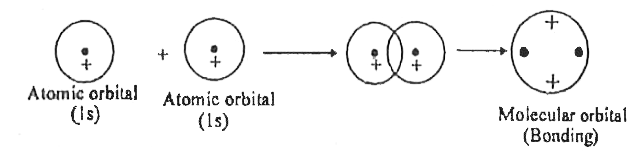 The atomic orbitals of these atoms may be represented by the wave function `Phi_(A), Phi_(B)` mathematically, the formation of molecular orbitals may de described by the linear combination of atomic orbitals that can TAKE place by addition and by substraction of wave functions of INDIVIDUAL atomic orbitals as shown below. `Phi_(mo)=Phi_(A)+-Phi_(B)` Therefore the two molecular orbitals `sigma` and are `sigma.` formed as `sigma=Phi_(A)=Phi_(B)` `sigma.=Phi_(A)=Phi_(B)` The Mo `sigma` formed by the addition of atomic orbitals is called the bonding molecular orbital while the molecular orbital `sigma.` formed by the substractioof atomic orbital is KNOWN as antibonding molecular orbitals. 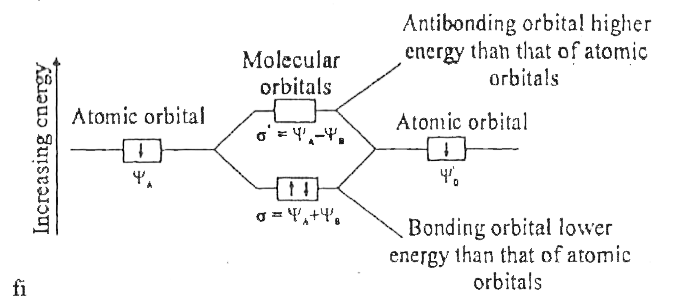
|
|
| 40. |
Describe hybridization in the case of PCl_(5), and SF_(6) . The axial bonds are longer as compared to equatorial bonds in PCl_(5) whereas in SF_(6) both axial bonds and equatorial bonds have the same bond length Explain. |
|
Answer» Solution :Formation of `PCl_(5)` Electronic configuration of `""_(15)P` (ground state) Electronic configuration of `""_(15)P`( excited state )  In `PCl`, phosphorus is `sp^(3)`d hybridised to produce a set of FIVE `sp^(3)` d hybrid orbitals which are directed towards the five comers of trigonal bipyramidal . These five `sp^(3)` d hybrid orbitals. overlap with singly occupied p-orbitals of CL -atoms to form five P - Cl sigma bonds. Three P - Cl bonds are in one plane and make an angle of `120^(@)` with each other. These bonds are called equatorial bonds.  The remaining TWO P - Cl bonds one lying above and other lying below the plane make an angle of `90^(@)` with the equatorial plane. These bonds are called axial bonds. Axial bonds are slightly longer than equatorial bonds because axial bond pairs SUFFER more repulsive interaction from the equatorial bond pairs. Formation of `SF_(6)` : Electronic configuration of `""_(16)S`(ground state)s(excitedstate)  In `SF_(6)`. sulphur is `sp^(3) d^(2)` hybridised to produce a set of six `sp^(3) d^(2)` hybrid orbitals which are directed towards the six comers of a regular octahedron. These six `sp^(3) d^(2)` hybrid orbitals overlap with singly occupied orbitals of fluorine atoms to form six S - F sigma bonds. Thus, `SF_(6)` molecule has a regular octahedral geometry and all S - F bonds have same bond LENGTH. |
|
| 41. |
Describe in brief the manufacture of caustic soda using the castner-kellner cell. |
|
Answer» Solution :The castner-keller cell consists of large rectangular trough divided into three compartments with partition short of reaching the bottom of the tank. Thus mercury in one compartment can flow into another but solution cannot mix. Graphic anodes are used in outer compartments filled with NaCI solution. The middle compartment contains very dilute solution of caustic and filled with iron rods as cathode. On passing electric current `CI_(2)` is liberated in outer compartment and sodium liberated at cathode. mercury forms amalgam which is passed into middle compartment in which mercury acts as anode (having induced + ve potential). At anode `NA^(+ ) to e^(-) to Na` At eathode `Na+ Hg to Na - Hg` `2(Na - Hg) + 2H_(2) O to 2NAOH + Hg + H_(2)` The concentration of NaOH GOES on increasing in the middle compartment. When the concentration of NaOH reaches 20% the solution is replaced by dilute solution. |
|
| 42. |
Describe how the following polymers are synthesised? (i) Nylon-6,6 (ii) Thiokol (iii) Buna-S (iv) Baketite (v) Terylene (vi) Melamine (vii) Nylon-6 |
Answer» SOLUTION :Heamethylene diamine `[H_(2)N(CH_(2))_(4)NH_(2)]` and adipic acid `[HOOC(CH_(2))_(4)COOH]` (ii) Ethylene chloride `[ClCH_(2)-CH_(2)CL]` and sodium polysulphide `[Na-S-S-Na]` (iii) Buta-1,3-dience `[H_(2)C=CH-CH=CH_(2)]` and styrene `[C_(6)H_(5)CH=CH_(2)]` (iv) Formaldehyde `[HCHO]` and phenol `[C_(6)H_(5)OH]` (v) Ethylene glycol `[HOCH_(2)-CH_(2)OH]` and dimethyl terephthalate `[H_(3)COOC(C_(6)H_(4))COOCH_(3)]` (VI) Formaldehyde [HCHO] and melamine 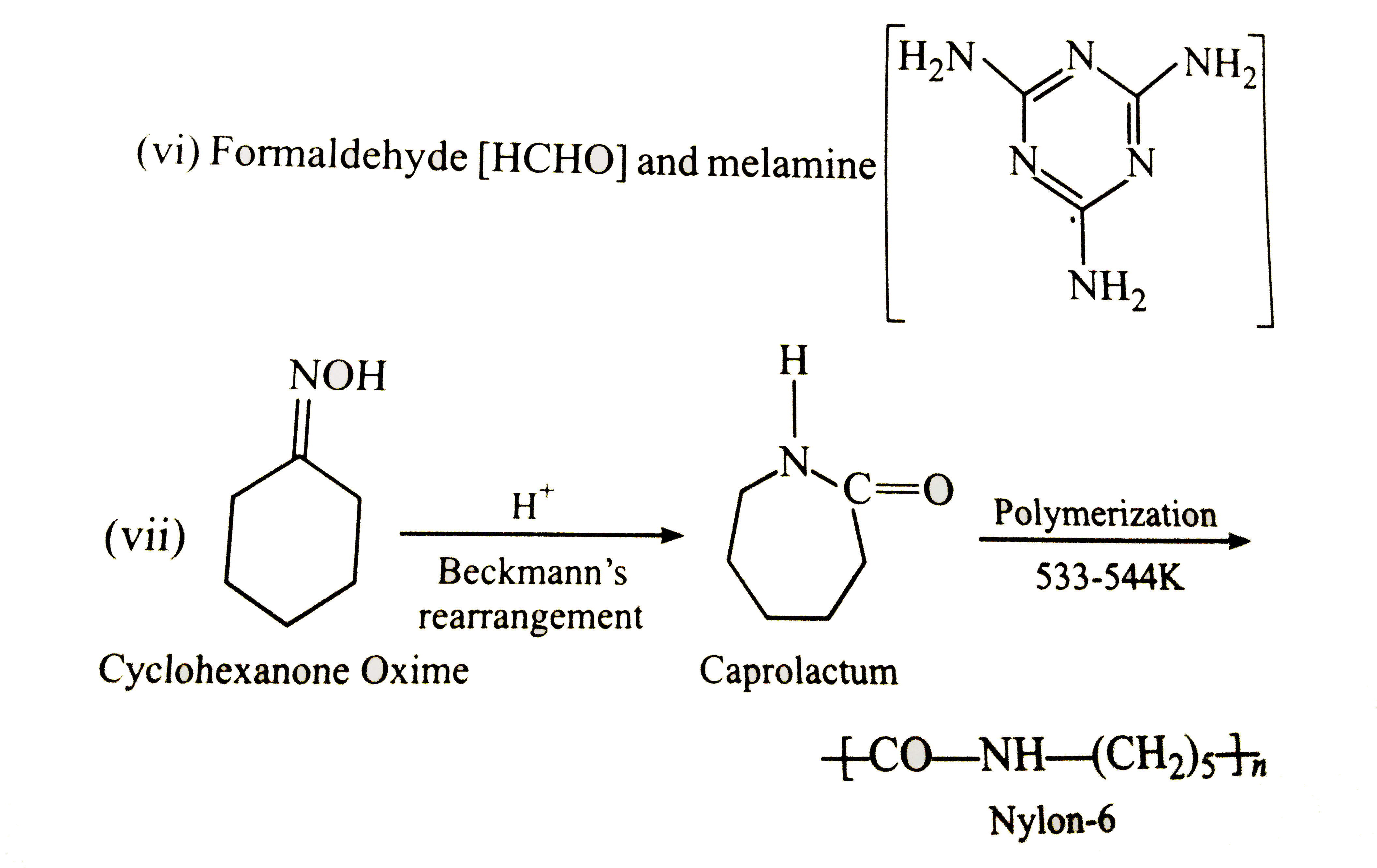
|
|
| 43. |
Describe how would you prepare the following solution from pure solute and solvent (a) 1 L of aqueous solution of 1. 5 M Co Cl _(2). (b) 500 mL of 6.0 % (v //v) aqueous methanol solution. |
|
Answer» Solution :(a) mass of `1.5` moles of `CoCl _(2) = 1. 5 xx 129.9 = 194 . 85g` (B) `194.85` g anhydrous cobalt CHLORIDE is dissolved in WATER and the solution is make up to one |
|
| 44. |
Describe in drief Lother Meyer's classification of elements. |
|
Answer» Solution :Lther Meyer's plotted the physical PROPERTIES such as atomic volume ,melting point and boiling point againts atomic weight and obtained a periodically repeated pattern. Lother Meyer observed a change in length of that REPEATING pattern. In 1868 , Lothar Meyer had developed a table of the elements that closely RESEMBLES the modern periodic table. |
|
| 45. |
Describe Gibbs energy and spontaneity. |
|
Answer» Solution :In Gibbs FUNCTION, G is an extensive property . `G=H-TS` The change in Gibbs ENERGY for the system, `DeltaG_("sys")` can be written as `DeltaG_("sys") = DeltaH_("sys") - TDeltaS_("sys") - S_("sys") Delta T` (constant temperature, `DeltaT=0` ) `therefore DeltaG_("sys") = Delta H_("sys") - T Delta S_("sys")` `Delta G= DeltaH- T DeltaS` It is referred to as the gibbs equation. Here, `DeltaH and T Delta S` are energy TERMS. Therefore `Delta G` is unit of energy. If the system is in thermal equilibrium with the surrounding, then the temperature of the surrounding is same as that of the system. Also, increase in enthalpy of the surrounding is equal to decrease in the enthalpy of the system. Therefore, entropy change of surroundings, `DeltaS_("surr")= (Delta H_("surr") )/( T) = (- DeltaH_("sys") )/( T)` `DeltaS_("total") = DeltaS_("sys") = ((-DeltaH)/( T) "sys")` Rearranging the above equation : `T Delta S_("total") = T DeltaS_("sys") - Delta H_(sys)` For spontaneous PROCESS, `DeltaS_("total") GT 0` So, `T Delta S_("sys") - Delta H_("sys") gt 0` `- ( Delta H_("sys") - T DeltaS_("sys") ) gt 0` `therefore - Delta G gt 0` `therefore Delta G = Delta H- T Delta S lt 0` `DeltaH_("sys")` is the enthalpy change of a reaction, `T Delta S_("sys")` is the energy which is not available to do useful work. So `DeltaG` is the net energy available to do useful work and is thus a measure of the .free energy.. For this reason, it is also known as the free energy of the reaction. (i) If `Delta G` is negative `( lt G)`, the process is spontaneous. (ii) If `DeltaG` is positive `( gt 0)`, the process is non spontaneous. |
|
| 46. |
Describe fajan's rule. |
|
Answer» Solution :(i) He ability of a cation to polarise an anion is called its polarising ability and the tendene of an anion to get polarised is called its polarisibility. The extent of polarisation in an ionie compound is given by the Fajans rule. (ii) he ability of a cation to polarise an anion is called its polarising ability and the tendeney of an anion to get polarised is called its polarisibility. The extent of polarisation in an ionie compound is given by the Fajans rule cloud of the anion. Similarly higher the magnitude of NEGATIVE charge on anion, greater is its polarisability. For example, `Na^(+) lt Mg^(2+) lt Al^(3+),`the covalent character also FOLLOWS the order: `NaCl lt MgCl_(2)lt AlCl_(3)` (iii) The smaller cation and larger anion show greater covalent character due to the greater extent of polarisation. e.g.. LiCI is more covalent than NaCI. Cation having `ns^(2)np^(6)nd^(10)` configuration shows greater polarising power than the cations with `ns^(2)np^(6)` configuration. e.g.. CuCl is more covalent than NaCl. |
|
| 47. |
Describe electrophilic substitution reaction of chlorobenzene with equations. |
Answer» SOLUTION :
|
|
| 48. |
Describe E, reaction mechanism with a suitable example. |
|
Answer» SOLUTION :(i) `E_1` stands for unimolecular elimination reaction of first order. (ii) rtiary alkyl halides undergoes elimination reaction in the presence of alcoholic KOH. (iii) It takes place in two steps. (iv) STEP 1. Heterolytic fission to yield a carbocation:  (v) Step 2. Elimination of a proton from the `beta` -carbon to PRODUCE an ALKENE: 
|
|
| 49. |
Describe briefly the biological importance of calcium and magnesium. |
|
Answer» Solution :An adult BODY contains about 25 g of Mg and 1200 g of Ca. The daily requirement in the human body has been estimated to be 200-300 mg. (ii) Magnesium is the co-factor of all enzymes that utilize ATP in phosphate transfer and energy release. The main pigment for the absorption of light in plants is chlorophyll which contains magnesium (iv) About 99% of body calcium is present in bones and teeth. (v) Calcium plays important roles in neuromuscular function, interneuronal transmission, cell membrane integrity and blood coagulation. (vi) The calcium concentration in plasma is regulated at about 100 mg `L^(-I)`. It is maintained by two hormones: calcitonin and parathyroid hormone. lt (VII) DEFICIENCY of magnesium results into convulsion and neuromuscular irritation. (viii) 2% of adult weight is made up of calcium. Calcium phosphate is present in teeth and Calcium carbonate is present in bones. They make the teeth and bone HARD. (ix) Water in the human body such as inside the cell and in the blood contain dissolved calcium ions. These ions are involved in making muscles move and in sending electricity around the brain and along the nerves. (x) Magnesium is an essential element in both plant and animal life |
|
| 50. |
Describe Aufbau principle . Write the electronic configuration for Ni^(2+) using Aufbau principle. |
|
Answer» Solution : (a) AUFBAU principle: The word Aufbau in German means building up in the ground state of the Atmos the orbitals are filled in the order of their increasing energy orbital available to them. Once the lower energy orbitals . The order of FILLING of VARIOUS orbitals as per the Aufbau principle which is in accordance with (n+1) RULE. The lower the VALUE of (n+1)for an orbitalthe lower is it's energy. If two orbitalhave the same (n+1) value , the orbital with lower value of n has the lower energy.  `Ni-1s^(2)2s^(2)2p^(2)3s^(2)3p^(2)4s^(2)3d^(8)` `:.Ni-1s^(2)2s^(2)2p^(6)3s^(2)3p^(6)4s^(0)3d^(8)` |
|