

Saved Bookmarks
This section includes 7 InterviewSolutions, each offering curated multiple-choice questions to sharpen your Current Affairs knowledge and support exam preparation. Choose a topic below to get started.
| 1. |
Determine the degree of ionizationand pH of a 0.05 M of ammonia solution .The ionization constant of ammonia can be taken fromK_b=1.77xx10^(-5) . Also, calculate the ionizationconstant of the conjugate acid of ammonia . |
|
Answer» Solution :Dissociated degree of weak base `NH_3= alpha` `THEREFORE` Ionised `[NH_3]=C alpha =0.05 alphaM` [Ionised `[NH_3]`] = `0.05 alpha` = [ Formed `[NH_4^+]` ] = [Formed `[OH^-]` ] And at equilibrium `[NH_3]=(0.05 - 0.05 alpha)` `=0.05 (1-alpha)M` `{:(,NH_(3(aq)) + H_2O hArr , NH_(4(aq))^(+)+, OH_((aq))^(-)),("Equili.M:",0.05(1-alpha),0.05 alpha,0.05 alpha):}` `therefore K_b=([NH_4^+][OH^-])/([NH_3])=1.77xx10^(-5)` `therefore ((0.05alpha)(0.05 alpha))/(0.05 (1-alpha))=1.77xx10^(-5)` `therefore (0.05 alpha^2)/(1-alpha)=1.77xx10^(-5)` `therefore alpha^2=(1.77xx10^(-5))/0.05 = 3.54xx10^(-4)` (`because 1 gt gt gt alpha`, So `(1-alpha)=1`) `therefore alpha=(3.54xx10^(-4))^(1/2)=1.8814xx10^(-2)` `[OH^-]=alpha=0.05xx1.88xx10^(-2) = 9.4xx10^(-4)` M pOH=-log `(9.4xx10^(-4))` = 3.0269 and pH=14-3.0269 = 10.97 `NH_4^+` is CONJUGATE acid of `NH_3`. `K_w=K_a xx K_b` `therefore K_a = K_w/K_b = (1.0xx10^(-14))/(1.77xx10^(-5))=5.65xx10^(-10)` |
|
| 2. |
Determine the degree of hardness of a sample of water containing 30 ppm of MgSO_(4). |
|
Answer» Solution :`1 MgSO_(4)-=1CaCO_(3)` `120 ppm=100ppm` `THEREFORE 30ppm=25ppm` |
|
| 3. |
Determine the concentration of NH_(3) solution whose one litre can dissolve 0.10 mole AgCl. K_(sp) of AgCl and K_(f)of Ag(NH_(3))_(2)^(+) are 1.0xx10^(-10)M^(2) and 1.6xx10^(7)M^(-2) respectively . |
|
Answer» Solution :`AgCl rarr Ag^(+) + Cl^(-)` `:. 0.1 ` mole AgCl on dissolution will GIVE 0.1 mole `Ag^(+) and 0.1` mole `Cl^(-) ` ions . `Ag^(+)` ions will COMBINE with `NH_(3)` as follows : `Ag^(+) + 2 NH_(3) hArr Ag(NH_(3))_(2)^(+)` Hence, `[Ag^(+)] + [Ag(NH_(3))_(2)^(+)] = 0.1` mole...(i) Also for the above formation reaction, we are given `K_(f) = 1.6xx10^(7) = ([Ag(NH_(3))_(2)^(+)])/([Ag^(+)][NH_(3)]^(2))`...(II) Further, `[Ag^(+) ] [ Cl^(-)]= K_(sp) = 10^(-10) or [Ag^(+)](0.1) = 10^(-10) or [Ag^(+) ] = 10^(-9)` Neglecting this conc. in eqn. (i) , we get `[Ag(NH_(3))_(2)^(+)]=0.1` Putting these values in eqn. (ii) , we get `(0.1)/(10^(-9)xx[NH_(3)]^(2))=1.6xx10^(7)` or `[NH_(3)]^(2) = (0.1)/(10^(-9)xx1.6xx10^(7))=(1)/(16xx10^(-2)) or [NH_(3)] = (1)/(4XX10^(-1))=2.5 M` Also 0.2 M ` NH_(3)` is needed to dissolve 0.1 M `Ag^(+)` ions. Thus, Total `[NH_(3)]=2.5+0.2 = 2.7 M` |
|
| 4. |
Determine the degree of association (polymerisation) for the reaction in aqueous solution . 6 HCHO hArr C_(6) H_(12) O_(6). If observed molar mass of HCHO and C_(6) H_(12) O_(6) is 150 : |
|
Answer» 0.5  `("observed mole CONC")/("Theoretical mole conc")=(M_(c))/(M_(0))` `(C(1-alpha)+(Calpha)/(6))/(C)=(30)/(150)=alpha=0.96` |
|
| 5. |
Determine the concentration of CO_(2) " which will be in equilibrium with "2* 5 xx 10^(-2) mol L^(-1) " ofCOat "100^(@)C " for the reaction, " FeO(s) + CO (g) hArrFe (s) + CO_(2) (g) , K_(c) = 5*0 |
| Answer» SOLUTION :`K_(c) = ([CO_(2)])/([CO]) , i.e.,5 = ([CO_(2)])/(2*5 xx 10^(-2)) or [CO_(2)] = 5 xx 2*5 xx 10^(-2) = 12*5 xx 10^(-2) mol L^(-1)` | |
| 6. |
Determine the change in the oxidation number of S in H_2S and SO_2 in the following industrial reaction: 2H_2S(g)+SO_2(g) to 3S (g) + 2H_2 O (g) |
| Answer» Solution :OXIDATION NUMBER of S changes from -2 in `H_2S` and +4 in `SO_2` to zero in ELEMENTAL sulphur. | |
| 7. |
Determine the change in the oxidation number of S in H_(2)S and SO_(2) in the following industrial reaction : 2H_(2)S(g)+SO_(2)(g) to 3S(s)+2H_(2)O(g) |
| Answer» Solution :The O.N of S in `S_(2)CI_(2)` is +1 as shown : `overset(-1)CI-overset(+1)S-overset(+1)S-overset(-1)CI` | |
| 8. |
Determine the change in the oxidation number of S in H_(2)S and SO_(2) in the following reaction : 2H_(2)S(g)+SO_(2)(g)to3S(s)+2H_(2)O(g). |
|
Answer» Solution :`underset(O.N-2)(2H_(2)S(g))tounderset(+4)(SO_(2)(g))tounderset(O)(3S(s))+2H_(2)O(g)` O.N. of S Changes from -2 in `H_(2)S` and +4 in `SO_(2)` to 0 in elemental sulphur. |
|
| 9. |
Determine enthalpy change for the following polymerizartion reaction per mole of N_(2)(g) consumed nN_(2)(g)+nH_(2)(g)to(NH-NH)_(n)(g) Given : bond enthalpy : n-=N=942KJ//mole, N-N=163Kj//mole H-H=436KJ//mole N-H=390Kj//mole |
|
Answer» 272Kj/MOLE |
|
| 10. |
Detemine the oxidation no. of the folliwing elements given in bold letters: (a) KmnO_(4), (b) H_(2)SO_(5) (c) H_(2)S_(2)O_(8)m (d) NH_(4)NO_(3) (e) K_(4)Fe(CN)_(6), (f) OsO_(4) (g) HCN, (h) HNC (i) HNO_(3), (j) KO_(2) (k) Fe_(3)O_(4), (l) KI_(3) (m) N_(3)H, (n) Fe(CO)_(5) (o) Fe_(0.94)O, (p) NH_(2) NH_(2) (q) FeSO.(4).(NH_(4))_(2)SO_(4) 6H_(2)O (r) Na_(2)[Fe(CN)_(5)NO], (u)[Fe(NO)(H_(2)O)_(5)]SO_(4) (v) Na_(2)S_(4)O_(6) (v) Na_(2)S_(2)O_(3) (w) Dimethyl sulphoxide or (CH_(3))_(2) SO (x) Na_(2)S_(2)O_(3), (y) CrO_(5) or CrO(O_(2))_(2) (z) CaOCl_(2) |
|
Answer» |
|
| 11. |
Destructive distillation of coal does not give |
|
Answer» coke |
|
| 12. |
Destabiliser of hydrogen peroxide is |
|
Answer» Mn |
|
| 13. |
Despite their -I effect, halogens are o-and p-directing in haloarenes. Explain. |
Answer» SOLUTION :Halogens present on benzene ring have I and +R effect, -I effect DEACTIVATES the ring but +R effect increases the electron density on ortho and para POSITIONS. Hence, halogens are orhto and para positions. Hence, halogens are ortho and para directing. 
|
|
| 14. |
Mention of causes for the deviation of ral gas from ideal behaviour. |
Answer» Solution :For an ideal gas, `PV=RT` 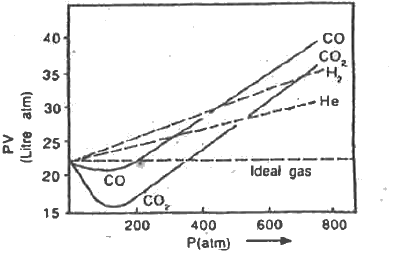 However, the value of pressure `xx` volume is not constant for real gases. A graph of pressure along X-axis and PV along y-axis straight line parallel to X-axis for an ideal gas. PV versus P graph shows deviation in CASE of real gases. These graphs are CALLED .. Amagat. s curve.s ... Ex: Easily liquegiable gases like `CO_(2) and NH_(2)` SHOW a greater deviation from ideal behaviour but gases like H and He deviate deviate to smaller extent. At low pressure : For gases except `H_(2)` and He, the value of PV DECREASES gradually with increases 1n pressure. At high pressure : As pressure is increased the PV value decreases and BECOMES a minimu. `:.` it gradually increases with increases in pressure. The deviation becomes greater at high pressure. |
|
| 15. |
Describlethe theoryassociated with theradiusof anatom as it (a)gainsan electron( b)loses an electron. |
Answer» Solution :(a) Gain of electron. Whena neutralatomgainsoneelectronto forman anion its radiusincreaeses.Thereason beingthat THENUMBEROF electronsin the anionincreaseswhileits nuclearchargeremainsthe sameas theparentatom.Sincethesamenuclear chargenowattractsgreaternumberof electrons thereforeforce of ATTRACTION of thenucleus on THEELECTRONS of theshellsdecreases(i.e.,effective nuclearchargedecreases) and hencethe electron cloudexpands.In otherwordsthe distancebetweenthe centre of thenucleusand the last shellthatcontainselectronsincreasesthereby INCREASING theionicradius. Thus 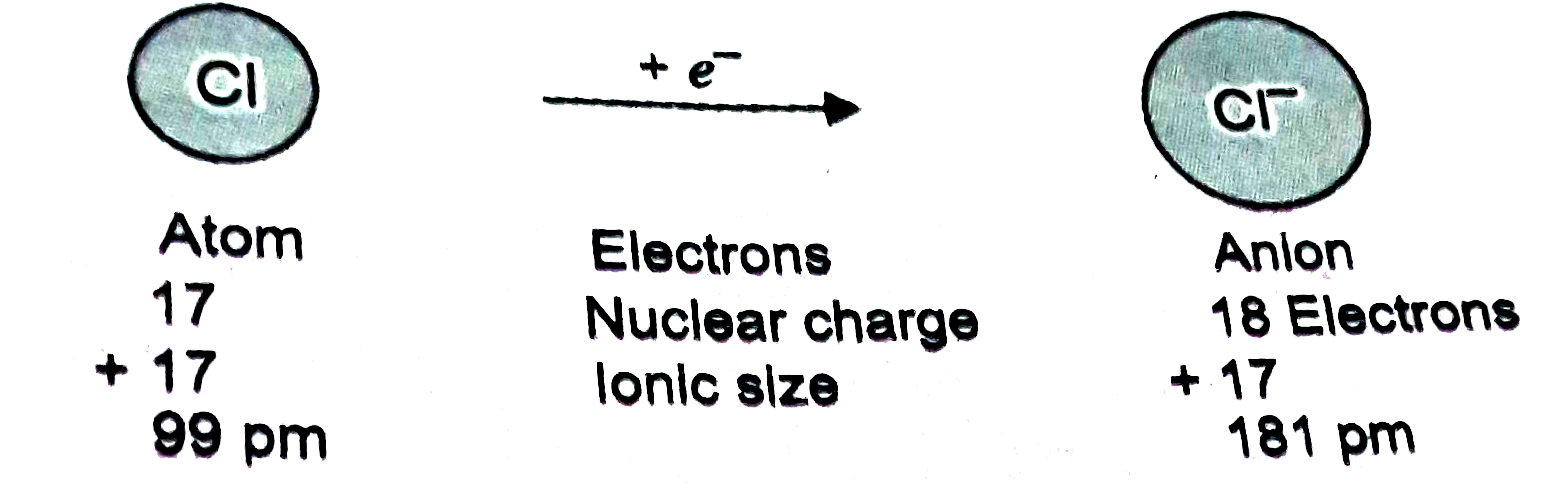 ( b)Loss of electrons. When a neutralatomloses one electron toforma cationitsatomicradiusdecreases. The reasonbeingthat thenumberof electrons in thecationdecreases while itsnuclear chargeremainsthe sameas the parentatom. Sincethe samenuclearchargenowattractslessernumberof electronsthereforethe FORCE ofattractionof thenucleus ofelectronsof all theshells- increases (i.e.,effectivenuclear chargesincreases ) and hencethe sizeof cationdecreases.Thus 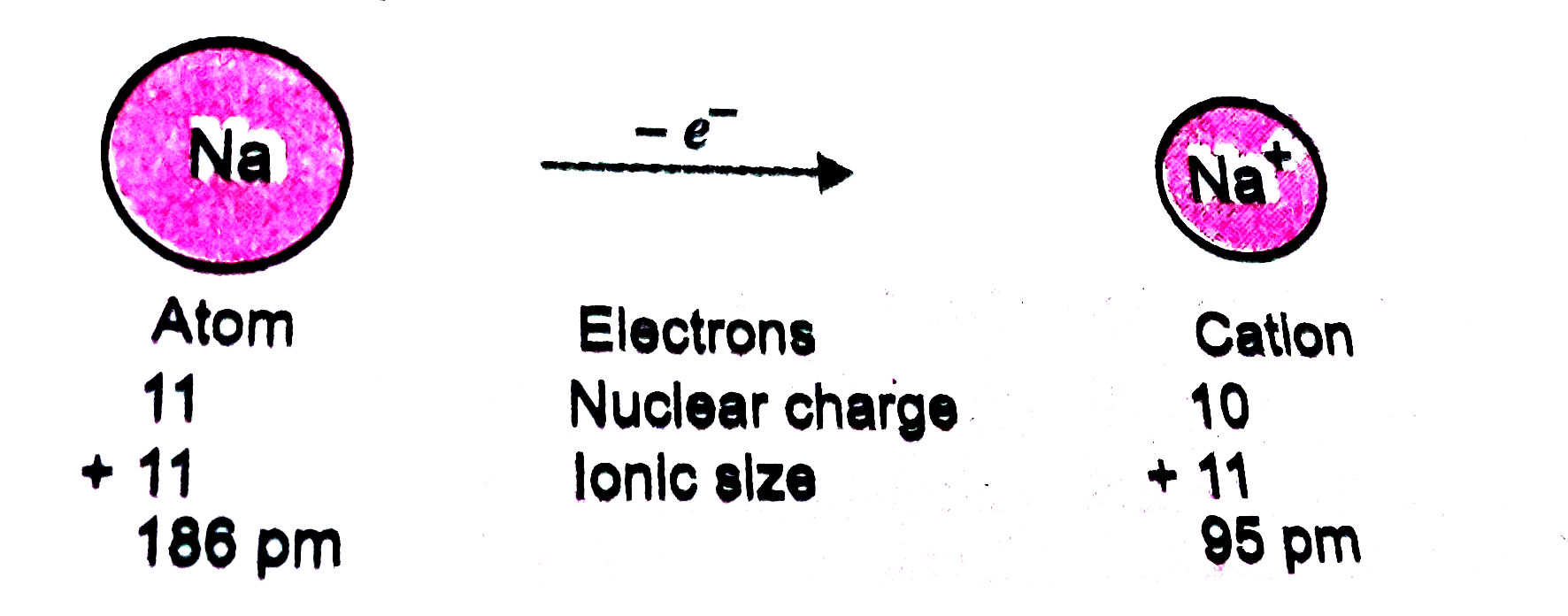
|
|
| 16. |
Describes the structure of common form of ice. |
| Answer» SOLUTION :For ANSWER, CONSULT SECTION 9.7 | |
| 17. |
Describe two important uses of each of the following a. Caustic soda b. Sodium carbonate c. Quicklime |
|
Answer» Solution :Important uses of (i). Caustic SODA: (a). Used in the manufacture of soap, paper, artificial silk and a number of chemicals. (b).Used in PETROLEUM refining and purification of BAUXITE. (ii). Sodium carbonate: (a). Used for the manufacture of soap, glass, paper, BORAX, caustic soda etc. (b). Used in textile industry and also in petroleum refining. (iii) Quiclime: (a). Used in the manufacturing of dye STUFFS. (b). Used in the manufacture of sodium carbonate from caustic soda. |
|
| 18. |
Describe two important uses of each of the following : (i) caustic soda , (ii) sodium carbonate (iii) quick lime . |
|
Answer» Solution :1. Caustic soda . (i) It is used in the manufacture of soap , paper , artificial silk , etc. and in petroleum REFINING and purification of bauxite . (ii) It is used in the textile industries for mercerising COTTON fabrics. 2 . Sodium carbonate , (i) It is used in water SOFTENING , laundaring and cleaning . (ii) It is used in the manufacture of glass, soap , borax , etc. and in paper , paints and textile industries . 3. Quick lime . (i) It is used in the manufacture of sodium carbonate from caustic soda . (ii) It is employed in the purification of sugar and in the manufacture of DYESTUFFS. |
|
| 19. |
Describe the usefulness of water in biosphere and biological systems. |
| Answer» SOLUTION :Water is essential for all FORMS of life. It contitutes about 65-70% of the body weight of animals and plants. In comparison to other liquids, water has a high specific heat, thermal conductivity , surface TENSION, dipole MOMENT and dielectric constant , etc. These propertiesallow water to play a key role in biosphere. The high heat of vaporisation and heat capacity are responsible for moderation of the climate and body temperature of living beings. It is an excellent solvent for transportation of minerals and other nutrients for plant nad animal metabolism. What is also required for photosynthesis in plants which releases `O_(2)` into theatmosphere. | |
| 20. |
Describe the usefulness of water in biosphere and biological system. |
|
Answer» Solution :A MAJOR part of all living organisms is made up of water. Human body has about 65% and some plants have as nuch as 95% water. It is a crucial compound for the SURVIVAL of all life forms. It is a solvent of great importance. The distribution of water over the earth.s surface is not uniform. The estimated world water supply is given in FOLLOWING Table. The high heat of VAPORISATION and heat capacity are responsible for moderation of the climate and body temperature of living beings. It is an excellent solvent for transportation of IONS and molecules required for plant and animal metabolism. 
|
|
| 21. |
Describe the theory associated with the radius of an atom as it (a) Gains an electron (b) Loses an electron |
|
Answer» Solution :In reality for metal and non-metal having. metalic radius and covalent radius respectively which is half distance between centre of atoms which is obtained by X-ray. <BR> (a) When atom RECIEVED electron at that time atomic radius : Atom received electron from negative ion. Volume of negative ion is more than parental atom. Because, One or more electrons are added in, electron-electron REPULSION increases and effective nuclear charge decreases. In group, volume of negative decreases with Z. e.g. : `F^(-) lt Cl^(-) lt Br^(-) lt I^(-)` (b) When atom lose electron at that time atomic radius : When atom lose electron, then ion became positive. The volume of positive ions is small than it.s parental atom. Because, it has less electrons then its nuclear change is same as parental atom volume of positive ion increases in group and decreases in period. In isoelectronic SPECIES, radius of positive ion `lt`radius of neutral atom `lt`radius of negative ion. |
|
| 22. |
Describe the term ' amorphous'. Give a few examples of amorphous solids. |
|
Answer» Solution :Amorphous solids, are those solids in which the constituent PARTICELS MAT have a short range order but do not have a long range order. They have irregular SHAPES and are isotroic in nature. They do not undergo a clean clevage.They do not have share melting points or definite heats of fusion. Examples. Glass, RUBBER and plastics. |
|
| 23. |
Describe the term 'amorphous'. Give a few examples of amorphous solids. |
|
Answer» SOLUTION :Amorphous SOLIDS are those solids in which the constituent particles MAY have a short range order but do not have a long range order. They have irregular shapes and are isotropic in nature. They do not undergo a clean cleavage. They do not have sharp MELTING points or definite heats of fusion Examples. Glass, rubber and plastics |
|
| 24. |
Describe the structure of the common form of ice. |
|
Answer» Solution :Ice has a highly ordered three dimensional hydrogen bonded structure as shown in figure. Examination of ice CRYSTALS with X-rays shows that each oxygen atom is surrounded tetrahedrally by four other oxygen atoms at a distance of 276 pm. Hydrogen BONDING GIVES ice a rather OPEN type structure with wide holes. These holes can HOLD some other molecules of appropriate size interstitially. 
|
|
| 25. |
Describe the structure of common from of ice. |
Answer» Solution :In the NORMAL HEXAGONAL ice, each oxygen atom is tetrahedrally surroundanded by four other oxygen atoms, there being an hydrogen atom in between each PAIR of oxygen. Each hydrogen is covalent bonded to one oxygen and linked to the other oxygen by a covalent bond. Such an arrangement leads to packing having large open spaces. The DENSITY of ice is THEREFORE less than liquid water. 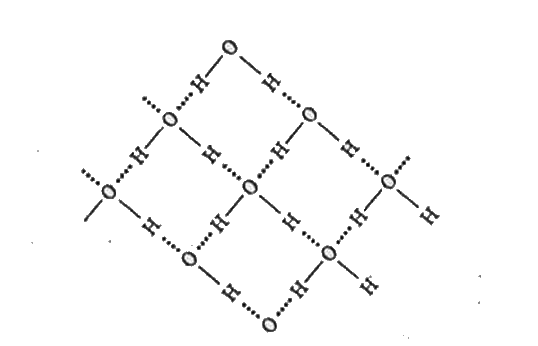
|
|
| 26. |
Describe the shapes of BF_(3) and [BH_(4)]^(-) . Assignthe hybridization of boron in these species. |
Answer» Solution :In `BF_(3)`, boron is `sp^(2)` -hybridized and, THEREFORE , `BF_(3)` is a PLANAR molecule. On the other hand, in `[BH_(4)]`, boron is `sp^(3)`-hybridizedand hence `[BH_(4)]^(-)` is a tetrahedralspecies.
|
|
| 27. |
Describe the shapes of BF_(3)" and "BH_(4)^(-). Assign the hybridisation of boron in these species. |
Answer» Solution :In `BF_3`, boron ATOM is in a STATE of `sp^2` hybridisation. Therefore, `BF_3` is a trigonal planar molecule. In `BH_4^-`, boron atom is in a state of `sp^3` hybridisation. Therefore, `BH_4^-` has TETRAHEDRAL GEOMETRY. 
|
|
| 28. |
Describe the shapes of BF_3 and BH_4^- . Assign the hybridisation of boron in these species. |
Answer» Solution :(i)`BF_3`: As a result of its small size and high electro-negativity, boron TENDS to form monomeric covalent halides.  These halides have a planar triangular geometry. This triangular shape is FORMED by the overlap of THREE `sp^2` hybridised orbitals of boron with the sp orbitals of three halogen atoms. Boron is `sp^2` hybridised in `BF_3`. (ii) `BH_4^-` : Boron-hydride ION `(BH_4^-)` is formed by the `sp^3` hybridisation of boron orbitals. Therefore, it is TETRAHEDRAL in structure. 
|
|
| 29. |
Describe the reactions involved in the detection of nitrogen in an organic compound by Lassaigne method. |
|
Answer» SOLUTION :Detection of Nitrogen: The following reactions are INVOLVED in the detection of nitrogen with formation of PRUSSIAN BLUE PRECIPITATE conforming the presence of nitrogen in an organic compound. (i) `underset("Sodium")(Na)+underset("From organic Compound")(underset(ubrac)C+N) rarr underset("Sodium cyanide")(NaCN)` (ii) `underset("Ferrous sulphate")(FeSO_(4))+underset("Sodium hydroxide")(2NaOH) rarr underset("Ferrous hydroxide")(Fe(OH)_(2))+Na_(2)SO_(4)` (iii) `6NaCN + Fe(OH)_(2) rarr underset("Sodium ferrocyanide")(Na_(4)[Fe(CN)_(6)])+2NaOH` (iv) `3Na_(4)[Fe(CN)_(6)]+4FeCl_(3) rarr underset("Ferric ferrocyanide(Prussian blue precipitate)")(Fe_(4)[Fe(CN)_(6)]darr+12NaCl)` |
|
| 30. |
Describe the reaction involved in the detection of Nitrogen in an organic compound by Lassaigne Method |
|
Answer» Solution :DETECTION of Nitrogen: The following reactions art: involved in the detection of nitrogen with formation of PRUSSIAN blue precipitate conforming the presence of nitrogen in an organic compound `(i) underset("sodium")Na+underset("From organic Compund")"C+N" rarr underset("Sodium eyanide")"NaCN"` `underset("FERROUS sulphate")(FeSO_(4))+underset("Sodium hydrox")"2NaOH" rarr underset("Ferrous hydroxide")(FE(OH)_(2))+Na_(2)SO_(4)` `(iii)6 NaCN + Fe (OH)_(2) rarr underset("Sodium hydroxide")(Na_(4)[Fe(CN)_6] )+2NaOH` `(iv) 3Na_(4)[Fe(CN)_(6)]+4FeCl_(3) rarr underset(underset("(Prussian blue precipitate)")"Ferric ferrcyanide")(Fe_(4) [ Fe(CN)_(6)]darr+12NaCl` |
|
| 31. |
Describe the process of water softening and purification. |
|
Answer» Solution : (i) An idealised image of water softening process INVOLVES REPLACEMENT of cations such as Mg, Ca and Fe in water with sodium ions by a cation exchange zeolite. The ion exchange zeolites or resins are used to replace the Mg and Ca ions found in HARD water with sodium ions. (ii) They can be recharged by washing it with a solution containing a high concentration of sodium ions. (iii) The calcium and magnesium ions migrate from the zeolite or resin being replaced by sodium ions from the solution until a new equilibrium is reached. That is, the salt is used to recharge an ion exchange medium, which itself is used to soften the water. (iv) A couple of other METHODS, namely chelating method and reverse osmosis are also used to soften hard water. Chelating method employs a polydentate ligand such as EDTA, while reserve osmosis uses high pressure to force the water through a semi-p.0.. permeable membrane. (v) In the case of water purification application, ion exchange zeolites or resins are used to remove toxic (e.g., copper) and heavy METAL (e.g., cadmium or lead) ions from solution, replacing them with harmless sodium or potassium ions. |
|
| 32. |
Describe the reaction involved in the detection of Nitrogen in an organic compound by LassaigneMethod. |
|
Answer» Solution :`Na +ubrace(C+N)to NaCN` from organic compounds `underset(("from excess of sodium"))(FeSO_(4)+2NAOH to Fe (OH)_(2)+Na_(2)SO_(2))` `6NaCN + fe (OH)_(2)to underset("Sod.ferroeyanide")(Na_(4)[Fe(CN)_(6)])+2NaOH` `3Na_(4)[Fe(CN)_(6)]+4FeCl_(3)underset("ferric ferrocyanide prussian BLUE or green ppt")(toFe_(4)[Fe(CN)_(6)]_(3)+)12NACl` |
|
| 33. |
Describe the principle of Solvay process used for the manufacture of sodium carbonate. |
| Answer» SOLUTION :DUE to its HIGH THERMAL CONDUCTIVITY | |
| 34. |
Describe the principle of estimation of halogens, sulphur and phosphorus present in an organic compound. |
| Answer» SOLUTION :For ANSWER, CONSULT SECTION 12.50. | |
| 35. |
Describe the orbital with following quantum numbers using s,p,d or f notations. (i) when n=2, l=0 (ii) when n=4, l=2 |
|
Answer» (II)`n=4,l=3` orbital is 4F |
|
| 36. |
Describe the method, which can be used to separate two compounds with different solubilities in a solvent S. |
|
Answer» Solution :The fractional crystallisation method is used to separate two compounds with different solubilities in a solvent. Both COMPOUND dissolve in solvent and FORM hot SATURATED solution. Cool these solution. The compound which is less soluble is crystallise first. By filtration, separate the crystal which are of compound having less SOLUBILITY. Mother liquor solution contain more soluble compound. By concentratin of these solution convent it into saturated solution. Now cool the solution. So, crystallisation will take place and the crystal of less soluble compound will obtain. By filtration, separation. (Two compounds + solute) `overset(Delta)rarr` saturated solution 
|
|
| 37. |
Describe the method which can be used to separate two compounds with different solubilities in the solvent S. |
| Answer» SOLUTION :The separation can be done with the help of FRACTIONAL CRYSTALLISATION. For detail, CONSULT Section 12.33. | |
| 38. |
Describe the method to separate two compounds with different solubilities in a solvent S. |
| Answer» Solution :TWO compounds having different solubilities in a solvent S can be separated from each other by fractional crystallisation. The process involves a serie of repeated srystallisation. The MIXTURE of the two compounds in the solvent S is heated so as to make it saturated. When the hot solution is allowed to cool, the less soluble SUBSTANCE crystallises out first while the more soluble substance remains in the solution. The crystals of the first compound are separated from the mother liquior and the mother liquor is again CONCENTRATED and allowed to cool when the crystals of the SECOND compound are obtained. | |
| 39. |
Describe the method, which can be used to separate two compounds with different solubilities a solvent S. |
| Answer» Solution :Two compounds with different solubilities in a SOLVENT be separated by fractional crystallisation. When a hot saturatedlution of these two compounds is allowed to cool, the less soluble COMPOUND crystallises out FIRST while the more soluble remains in the solution. The crystals are separated from the MOTHER liquor and the mother liquor is again concentrated and the hot solution again allowed to cool when the crystals of the second (i.e., more soluble) compound are obtained. These are again filtered and dried. | |
| 40. |
How is sodium hydroxide prepared commercially from brine solution? |
|
Answer» Solution :Sodium hydroxide is prepared commercially by the electrolysis of brine solution in Castner Kellner cell using a MERCURY cathode and a carbon anode (b) Sodium metal is discharged at the cathode and combines with mercury to form sodium amalgam. c) Chlorine GAS is evolved at the cathode (d) The sodium amalgam THUS obtained is treated with water to GIVE sodium hydroxide. At cathode: `Na^(+)` +etoNa (amalgam) At anode: `CI^(-)to1//2CI_(2)uarr+e^(-)` `2Na ("amalgam") + 2H_(2)Otounderset("Sodium hydroxide")(2NaOH + 2Hg + H_(2)uarr)` |
|
| 41. |
Describe the mechanism of Nitration of benzene. |
|
Answer» |
|
| 42. |
Describe the mechanismof sulphonation of benezene |
|
Answer» Solution :Step 1:Generatin of `SO_(4)`electrophile `2H_(4) SO_(4) toH_(3) o^(@) +SO_(3)+ HSO_(4)^(2)` Step :2Attackof theelectrophilicon benzenering toformareniumion :  Step :3rearomatisationof ARENIUMION : 
|
|
| 43. |
Describe the mechanism of nitratin of benzene |
|
Answer» Solution :Step - 1Generationof `NO_(2)+ HSO_(4)+ H_(2)O` StepAttackof the electrohileon BENZENERINGTO formareniumion.  Step -3 Rearomatisationof ARENIUMION. 
|
|
| 44. |
Describethe mechanism of freidel craft alkylation |
|
Answer» SOLUTION :Step :1Generationof `H^(@) CH_(3)`electrphile Step :2Attackof theelectrohilicon benzenering toformareniumion  Step : Rearomatisatinof areniumion: 
|
|
| 45. |
Describe the mcchanism of addition of HBr to propene, |
Answer» SOLUTION :Mechanism of addition of HBr - to PROPENE : Addition of HBr to propene FOLLOWS markownikoff rule. This can be explained as follows.  Mechanism : Step : 1 Formation of electrophile : In H - Br, Br is more electronegative than H. therefore it BREAKS to give `H^(+)` ion and `Br^(-)` ions. The `H^(+)` ions are ATTRACTED towards the doubled bond to form carbocation. Step : 2 Secondary carbocation is more stable than primary carbocation and it predominates over the primary carbocation. Step : 3 The `Br^(-)` ion attack the `2^(@)` carbocation to from 2 - Bromobutane, the major product. 
|
|
| 46. |
Describe the importance of the following : (i) limestone (ii) cement (iii) plaster of Paris . |
|
Answer» Solution :(i) Limestone . Specially precipitated `CaCO_(3)` is extensively used in the manufacture of high quality paper . It is also used as an antacid , mild abrasive in toothpaste , a constituent of chewing GUM and as a filler in cosmetics. (ii) Cement . It is an important building material . it is used in concrete and reinforced concrete , in plastering and in the construction of bridges , dams and buildings . (iii) Plaster of Paris . It is extensively used in the building INDUSTRY as well as in plasters. It is used in dentistry , in ORNAMENTAL work and for making casts of statues and busts . It is also used in surgical bandages known as plasters of immoblising the affected part of ORGAN where there is bone fracture or sprain. |
|
| 47. |
Describe the hybridization in case of Pci_(5) Why are the axial bonds longer as compared to equtiorial bonds ? OR Explain sp^(3)dhybridization by suitable example. Discuss about hybridization and shape of PCl_(5) . |
|
Answer» Solution :Electron CONFIGURATION of phosphorus [Ne] `3s^(2) 3p^(3)` : Electron configuration of ground and exicted state (P = 15).  Hybridization in Phosphorous: In excited state of phoshorous one 3s, and three3p orbitals and one 3d orbitals having less DIFFERENCE in their energies mix together and form `sp^(3)`d HYBRID orbitals forms. Five new `sp^(3)`d hybride orbitals forms. All these five orbitals. has trigonal bipyamidal geometr which has `120^(@) and 90^(@)` bond angle.  Corners of pentagonal bipyramidal ARRANGEMENT. Bond formation in `PCl_(5)` : Each `sp^(3)` d hybrid orbital overlap with half filled p orbital of chlorine and form five P-Cl covalent bond.  Shape : In `PCl_(5)` like `sp^(3)` d hybridization all five bonding orbitals are arrange in trigonal bipyramidal shape.  Bond angle : From five P - Cl bonds three P - Cl bond are in same plane remain in planar trigonal & bond angle between them is `120^(@)`. All these three bonds are equational. Remaining two P- Cl one bond is above the plane and other is below the plane. So these two P-CI bond from `90^(@)` angle with plane. these two bonds are called axial bonds. Bond length : P - Cl axial bonds elector pair experiences more repulsion than equatorial bonds. So these are slightly longer them equatorial bonds. As the bond length of axial bonds is more so these bonds are WEAK and hence those bonds are highly reacitve. |
|
| 49. |
Describe the general trends in the following properties of the elements in Groups-14 Oxidation states |
|
Answer» Solution :Oxidation STATES : The common oxidation states exhibited by these elements are +4 and +2. Carbon also exhibits negative oxidation states. Since, the sum of the first four ionization enthalpies is very high, compounds in +4 oxidation state are generally covalent in nature. In heavier members, the tendency to show +2 oxidation state increases in the sequence `Ge lt Sn lt Pb`. It is due to the INABILITY of `ns^2` electrons of valence SHELL to participate in bonding. The relative stabilities of these two oxidation states VARY down the group. Carbon and silicon MOSTLY show +4 oxidation state. Germanium forms stable compounds in +4 state and only few compounds in +2 state. |
|
| 50. |
Describe the general trends in the following properties of the elements in Groups-14 Nature of halides |
|
Answer» Solution :Nature of HALIDES : These elements can form halides of formula `MX_2` and `MX_4` (X = F, CI, Br, I). Except carbon, all other members react directly with halogen under SUITABLE conditions to make halides. Most of the compounds `(MX_4)` are covalent in nature. The central metal atom in these halides undergoes `sp^3` hybridization and the molecule is tetrahedral in shape. Exceptions are `SnF_4` and `PbF_1` which are IONIC in nature. `PbI_4` does not exist because Pb-I bond initially formed during the reaction does not release enough energy to unpair `6s^2` electrons and excite one of them to higher orbital to have four unpaired electrons around lead atom. Heavier members Ge to Pb are able to make halides of formula `MX_2`. |
|