Saved Bookmarks
This section includes 7 InterviewSolutions, each offering curated multiple-choice questions to sharpen your Current Affairs knowledge and support exam preparation. Choose a topic below to get started.
| 1. |
Determine which of the following reactions at constant pressure represent systems that do work on the surrounding environment I. Ag^(+) (aq) + Cl^(-) (aq) rarr AgCl(s) II. NH_(4)Cl(s) rarr NH_(3) (g) + HCl (g) III. 2NH_(3)(g) rarr N_(2)(g) + 3H_(2)(g) |
|
Answer» I |
|
| 2. |
Determines the Miller indices of the shaded plane. Coordinates of the corners of the plane |
|
Answer» SOLUTION :A PLANE parallel to the plane between (0,0,0) , (1,1,0) and (0,1,1) will intersect the AXES at x=a, y=-b and z=c Thus, WEISS indices are 1,-1, 1 Reciprocals of Weiss indice are 1,-1, 1 Hence, Miller indices are `(1bar1 1)` or `(bar1 1 bar1)` 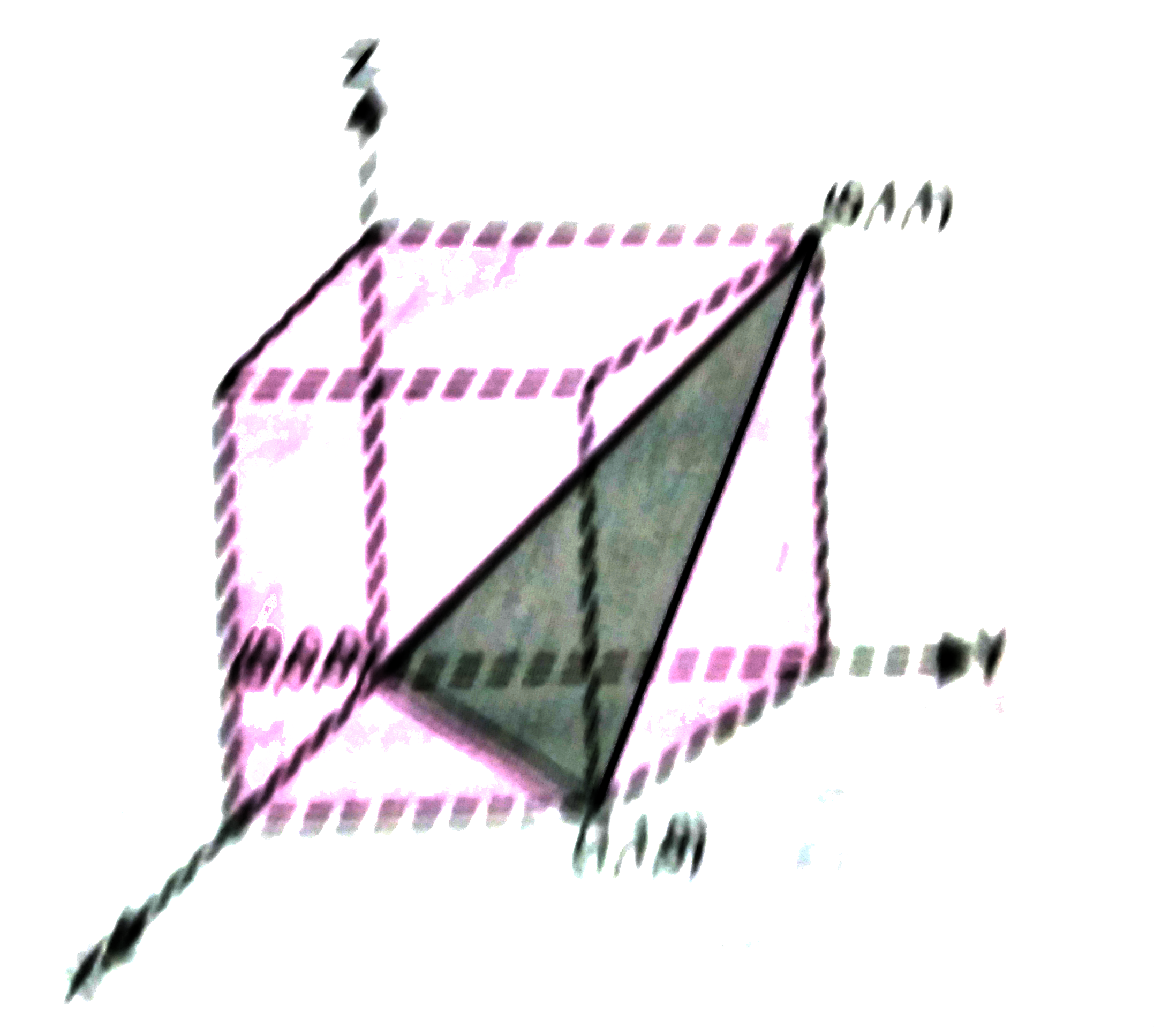
|
|
| 3. |
Determine which of the following compounds is a trans isomer. |
|
Answer»
|
|
| 4. |
Determine which of the following compounds is a trans isomer ? |
|
Answer»

|
|
| 5. |
Determine whether each of the followings compounds is a cis isomer or a trans isomer. |
|
Answer» |
|
| 6. |
Determine whether each of the followings compounds is a cis isomer or a trans isomer. |
|
Answer» |
|
| 7. |
Determine whether each of the following alkenes can exist ac c is trans isotmers (a) 1 chloropropene (b) 2-chloropropene |
Answer» Solution : in 2- chloropropeneit DEVIATES fromthe rulethat is`At ` LEASTONE samegroupis presenton the twobondedcarbonatom "Therefore-2-chloropropenecannotexistas CIS- trainsisomers. |
|
| 8. |
Determine the volume of M//8 KMnO_(4) solution required to react completely with 25.0 cm^(3) of M//4 FesO_(4) solution in acidic medium |
|
Answer» Solution :The balanced ionic equation for the reaction is `MnO_(4)^(-)+5Fe^(2+)+8 H^(+) rarr Mn^(2+)+5Fe^(3+)+4 H_(2)O` From the balced equation it is evident that 1 mole of `KmnO_(4)=5` moles of `FeSO_(4)` Applying molarity eqaution to the balced redox equation we have `(M_(1)V_(1))/(n_(1))(KMnO_(4))=(M_(2)V_(2))/(n_(2))(FeSO_(4)) or (1xxV)/(8xx1)=1/4xxx25/5 or V_(1)=(1xx25xx8)/(4xx5)=10.0 cm^(3)` THUS th volume of `M/8 KnnO_(74)` solution required =10.0 ML |
|
| 9. |
Determine the volume (in mL) of dilute nitric acid (d=1.08 g mL^(-1), 19% HNO_(3) by wt.) that can be prepared by diluting 48 mL of conc. HNO_(3) (d=1.44 g mL^(-1), 76% by wt.). |
|
Answer» |
|
| 10. |
Determine the volume of M/10 KMnO_4 solution required to react completely with 25.0 mL of M/5 oxalic acid solution. |
|
Answer» SOLUTION :The balanced CHEMICAL equation is `2KMnO_4+5(COOH)_2+3H_2SO_4rarr K_2SO_4+2MnSO_4+10CO_2+8H_2O` From the balanced equation , it is CLEAR that 2 mol of `KMnO_4 = 5 "mol of "(COOH)_2` `[(M_1V_1)/n_1]_(KMnO_4)=[(M_2V_2)/n_2]_((COOH)_2)` `1/10xxV_1/2=1/5xx(25.0)/5` or `V_1=(25.0xx10xx2)/(5xx5)=20.0mL` |
|
| 11. |
Determine the values of all the four quantum numbers of the 8^(th) electron in o-atom and 15^(th) electron in Cl atom. |
|
Answer» Solution :(i) `o(Z=8)1s^(2)2s^(2)2p_(x)^(2)2p_(y)^(1)2p_(z)^(1)` Four quantum numbers for `2o_(z)^(1)` electron in or=xygen ATOM. n=principal quantum number=2 l=azimuthal quantum number =1 m=magnetic quantum number=+1 s=spin quantum number`=-(1/2)` (ii)` Cl(Z+17)1s^(2)2s^(2)2p_(x)^(2)2p_(y)^(1)2p_(z)^(1)` Four quantum numbers for `15^(TH)`electron in CHLORINE atom: `n=3,l=1,m=+1,s=+(1/2)` |
|
| 12. |
Determinethe value of DeltaH and DeltaU for the reversible isothermal evaporationof 90.0 gof water at 100^(@)C . Assume that water vapour behave as an ideal gas and heatof evaporationof water is 540 cal g^(-1)( R = 2.0 cal mol^(-1)K^(-1)) |
|
Answer» `90 g H_(2) O = 5 ` MOLES , `Deltan_(g) = 5 ` for MOLESOF `H_(2)O(l) rarr 5` moles of `H_(2)O(g)` |
|
| 13. |
Determine the values of all the four quantum numbers of the 8^(th) electron in O-atom and 15^(th) electron in CI atom . |
Answer» SOLUTION :Electronic configuration of oxygen=  `:. 8^(th)` electron PRESENT in `2p_(x)` ORBITAL and the quantum number are `n = 2, l = 1 , m_1 = "either" + 1 "or" - 1 and s = -1//2` Electronic configuration of chlorine =  `15^(th)` electron present in `3P_z` orbital and the quantum numbers are `n = 3, l = 1, m_1= ` either + 1or - 1 and ms = + 1//2. |
|
| 14. |
Determine the solubilities of silver chromate, barium chromate, ferric, hydroxide, lead, chloride and mercurous iodide at 298 K. Given K_(sp) values : Ag_(2)CrO_(4)=1.1xx10^(-12), BaCrO_(4)=1.2xx10^(-10), Fe(OH)_(3)=1.0xx10^(-38), PbCl_(2)=1.6xx10^(-5), Hg_(2)I_(2)=4.5xx10^(-29) Determine also the molarities of individual ions. |
|
Answer» `:. 3 log s = log (2.75xx 10^(-13))=-13+0.4393=-12.5607` or` log s = - 4.1869 = bar(5).8131` `:. s= 6.5xx10^(-5) ` mol `L^(-1)` `[Ag^(+)]=2xx6.5xx10(-5)=13.0xx10^(-5)M = 1.30 xx 10^(-4)M` `[CrO_(4)^(2-)] = 6.5xx10^(-5)M` For other salts, PROCEED exactly in similar manner . |
|
| 15. |
Determine the solubilities of silver chromate , barium chromate , ferric hydroxide , lead chloride and mercurous constants given in Table 7.9 . Determine also the molarities of individual ions. (i)K_(sp)(Ag_2CrO_4)=1.1xx10^(-12) (ii)K_(sp)(BaCrO_4)=1.2xx10^(-10) (iii)K_(sp)(Fe(OH)_3) = 1.0xx10^(-38) (iv)K_(sp) (PbCl_2) = 1.6xx10^(-5) (v) K_(sp) (Hg_2Cl_2)=1.3xx10^(-18) (vi)K_(sp) (Hg_2I_2)=4.5xx10^(-29) |
|
Answer» Solution :(i)Solubilities of `Ag_2CrO_4` : `{:(,Ag_2CrO_(4(s)) to , 2Ag_((aq))^(+) + , CrO_4^(2-)),("Molarity of equili. :",S,2S,S):}` `K_(sp)=[Ag^+]^2[CrO_4^(2-)]` `therefore 1.1xx10^(-12) = (2S)^2 (S) =4S^3` `therefore S=((1.1xx10^(-12))/4)^(1/3)` `=0.6503xx10^4 "MOL L"^(-1)` `=6.503xx10^(-5) "mol L"^(-1)` So, `[Ag^+]=2S=2 (6.503xx10^(-5))=1.3xx10^(-4)` M `[CrO_4^(2-)]=S=6.503xx10^(-5) "mol L"^(-1)` (ii)Solubilities of `BaCrO_4` : `{:(BaCrO_(4(s)) to , Ba_((aq))^(2+)+, CrO_(4(aq))^(2-)),("Molarity at equilibrium",S,S):}` `K_(sp)=[Ba^(2+)]=[CrO_4^(2-)]=(S)(S)=S^2` `therefore S=sqrtK_(sp)=sqrt(1.2xx10^(-10))=1.095xx10^(-5)` M `therefore [Ba^(2+)]=[CrO_4^(2-)] =S=1.095xx10^(-5)` M (iii) Solubilities of `Fe(OH)_3` : `{:("Equilibrium", Fe(OH)_(3(s)) hArr, Fe_((aq))^(3+) + , 3OH_((aq))^(-)),("Solubility/ At equilibrium M", "S M","S M","3 S M"):}` `K_(sp)=[Fe^(3+)][OH^-]^3 = (S)(3S)^3` `therefore 1.0xx10^(-38) = 27S^4 = 100xx10^(-40)` `therefore S=((100xx10^(-40))/27)^(1/4)` `=(3.704xx10^(-40))^(1/4)` `=1.3872xx10^(-10) approx 1.39xx10^(-10) "mol L"^(-1)` So, `[Fe^(3+)]=S=1.39xx10^(-10) "mol L"^(-1)` `[OH^-]=3S=3(1.39xx10^(-10))` `=4.17xx10^(-10) "mol L"^(-1)` (iv) Solubilities of `PbCl_2` : `{:(PbCl_2 hArr, Pb_((aq))^(2+) + , 2Cl_((aq))^(-)),("S M", "S M" , "2S M"):}` `K_(sp)=[Pb^(2+)][Cl^-]^2 = (S) (2S^2)=4S^3` `therefore S=(K_(sp)/4)^(1/3) = ((1.6xx10^(-5))/4)^(1/3)= (16/4 xx 10^(-6))^(1/3)` `therefore S=1.5874xx10^(-2)` M So, `[Pb^(2+)]=S=1.5874xx10^(-2) "mol L"^(-1)` `[Cl^-] = 2S=2 (1.5874xx10^(-2))` `= 3.1748xx10^(-2) "mol L"^(-1)` (v)Solubilities of `Hg_2Cl_2` : `{:(Hg_2Cl_(2(s)) hArr, Hg_(2(aq))^(2+) + , 2Cl_((aq))^(-)),(S, "S M", "2S M"):}` `therefore S=(K_(sp)/4)^(1/3) = (1.3/4 xx 10^(-18))^(1/3)` `=0.6876xx10^(-6) M = 6.876xx10^(-5)` So, `[Hg_2^(2+)]=S=6.876xx10^(-5)` M `[Cl^-]=2S=2(6.876xx10^(-5))` `=1.375xx10^(-4)` M (vi) Solubilities of `Hg_2I_2` : `{:(Hg_2I_(2(s)) hArr , Hg_(2(aq))^(2+) + , 2I_((aq))^(-)),(S, "S M", "2S M"):}` `K_(sp)=[Hg_2^(2+)][I^-]^2 = (S)(2S)^2 =4S^3` `therefore S=root3(K_(sp)/4)=((4.5xx10^(-29))/4)^(1/3)=(11.25xx10^(-30))^(1/3)` `=2.241xx10^(-10) "mol L"^(-1)` `therefore [Hg_2^(2+)]=(S)=2.241xx10^(-10) "mol L"^(-1)` `[I^-]^2 =2(S)=2(2.41xx10^(-10))` `= 4.82xx10^(-10) "mol L"^(-1)` |
|
| 16. |
Determine the shapes of the given molecules or ions: (1) POCl_(3) (2) CH_(3)^(-) |
|
Answer» SOLUTION :(1) P-atom in `POCl_(3)` molecule is attached to the O-atom by a double bond and to three Cl-atoms by three SINGLE bonds. The number of electrons in the valence shell of P-atom =5+2+1+1+1=10. out of these 10 electrons or 5 electron pairs, 1 electron pair is involved in formation of a `pi`-bond which have no role in determining the SHAPE of the molecule. according to VSEPR theory, four electron pairs are oriented tetrahedraly, i.e., shape of the molecule is tetrahedral. (2) C-atom in `CH_(3)^(-)` ion is bonded to three H-atoms by three single bonds. the number of electrons in the valence shell of C-atom =4+3+1 (for the negative CHARGE)=8. out of these 8 electrons or 4 electron pairs, there are three bond-pairs and one lone-pair. According to VSEPR theory, the ion is pyramidal. |
|
| 17. |
Determine the probable formula of an acid salt which is an oxidising agent from the following data.Its equivalent weight as an acid is 390 and as an oxidising agent is 32.5. It contains 10% of potassium and 65% of iodine. |
|
Answer» Solution :The acid salt has an equivalent weight `=390` `10%` of this is `39g-=1` mole of potassium. Hence the simplest formula contains one K and one H. Also 390 g Contains `65%` of iodine i.e., `(390xx65)/(100)g=253.5g` Since the atomic weight of iodine is 127, the simplest formula is `KHI_(2)O_(x).nH_(2)O`. Further. `390 g` correspond to `(390)/(32.5)=12`, equivalents of oxidising AGENT since `IO_(3)^(ɵ)+6H^(o+)+6e^(-)I^(ɵ)+3H_(2)O`, one `IO_(3)^(ɵ)-=6` equivalents The formula is `KHI_(2)O_(6).nH_(2)O` molar mass `=[390+18n]=390impliesn=0` Therefore, the probeble formula`=KH(IO_(3))_(2)` |
|
| 18. |
Determine the precentage of water of crystallisation in pure sample of green vitriol (FeSO_(4).7H_(2)O) |
|
Answer» `:.` Percentage of WATER of CRYSTALLISATION `= ((126u))/((278u))xx100=45.32%`. |
|
| 19. |
Determine the pH of the solution that results from the addition of 20.00 mL of 0.01 M Ca (OH)_(2)to 30.00 mL of 0.01 M HCl |
|
Answer» `11.30` `=20xx0.01` MILLIMOLES = 0.2 millimole `:. OH^(-)` ions present `=2xx0.2` millimole `=0.4` millimole 30.0 mL of 0.01 M HCl has HCl `=30xx0.01` millimoles = 0.3 millimole `:. H^(+)` ions present = 0.3 millimole 0.3 millimole `H^(+)` will neutralize 0.3 millimoe of `OH^(-)`. Hence, `OH^(-)` ions present after mixing = 0.1 millimole Volume of solution = 20 +30 = 50 mL Hence, molarity of `OH^(-)` ions `=(0.1)/(50)=2xx10^(-3)M` `pOH = - LOG (2xx10^(-3))=3-0.30=2.70` `:. pH = 14 - 2.70 = 11.30` |
|
| 20. |
Determine the oxidtion number of O in the following : OF_(2),Na_(2)O_(2),Na_(2)O,KO_(2),KO_(2),KO_(3) and O_(2)F_(2) |
| Answer» SOLUTION :O.N ofO=+2 in `OF_(2)-1 in Na_(2)O_(2)-2 in Na_(2)O,-1//2 in KO_(2),-1//3 in KO_(3) and +1 in O_(2)F_(2)` | |
| 21. |
Determinethe oxidation number of followingelements given in bodl letters. (i)CuH, (ii) Na_(2)S_(3)O_(6) (iii) N_(2)O, (iv) Ba_(2)XeO_(6) (v) C_93)O_(2), (vi) V(BrO_(2))_(2) (vii) Ca(clO_(2))_(2), (viii) Cs_(4)Na(HV_(10)O_(28)) (ix) LiAlH_(4) (x) K[Co(C_(2)O_(4))_(2)(NH_(3))_(2)] (xi) [Ni(CN)_(4)]^(2), (xii) Na_(2)S_(2) (xiii) Fe(CO)_(5), (xiv) [OCN]^(-) (xv) S_(2)O_(4)^(2-), (xvi) S_(2)O_(8)^(2-) |
|
Answer» |
|
| 22. |
Determine the oxidation number of following underline elements: a. HCulN b. Hul(N)C c. Hul(N)O_(3) d. KulO_(2) e. ul(Fe_(3))O_(4) f. Kul(I_(3)) g. ul(N_(3))Hh. ul(Fe)(CO)_(5) i. ul(Fe_(0.94))O j. ul(N)H_(2)NH_(2) k. ul(Fe)SO_(4)(NH_(4))_(2)SO_(4)6H_(2)O l. ul(N)OCI m. NOul(Cl)O_(4) n. Na_(2)[ul(Fe)(CN)_(5)NO] o. [ul(Fe)(NO)(H_(2)O)_(5)]SO_(4) p. Na_(ul(2S_(4))O_(6) q. (CH_(3))_(2)ul(SO) r. Naul(S_(2))O_(3) s. CaOul(Cl_(2)). |
|
Answer» Solution :a. `HCN`: The evaluation cannot be made directly in some cases, e.g., `HCN`, by using rules proposed EARLIER as we have no rule for the evaluation of oxidation number of both `N` and `C`. In all such cases, evaluation of oxidation number should be made using indirect concept or using fundamentals by which following rules have been formed: i. Each covalently bond contribures one unit of oxidation number. ii. Covalently bonded atoms with less electronegativity acquire positive oxidation number whereas other atoms with more electronegativity acquire negative oxidation number. iii.In case of coordinate bond, give `+2` value for oxidation number to the atom from which coordinate bond is directed to a more electronegative atom. If coordinate bond is directed from a more electronegative to a less electronegative atom, then neglect the contribution of coordinate bond of both atoms in which coordinate bond exists. Thus, `H-C-=N` Three bond `N` atom implies more electronegative `1+a+3(-1)=0` Oxidation number of `N=3(-1)= -3` Oxidation number of `C, a= +2` b. `Hul(N)C: H-C-=N` Oxidation number of `H= +1` Oxidation number of `N` `{:("[=-2","+(-1)" ,"+0]=-3"),({:("[For covalent"),("bond with C]"):},{:("[For covalent"),("bond with H"):},{:("[No contribution"),("for coordinate"),("bond]"):}):}` According to fundamental concept `= -3` `:. 1 + (-3) +a = 0 rArr a = +2` c. `underline(N)O_(3)` : By rules , `1 + a + 3(-2) = 0 rArr a=+5` By fundamental approach `+N3` Oxidation number of `H = +1` Oxidation number of `N` `{:("=+1","+(+2)" ,"+(+2)=+5"),({:("[ covalent"),("bond with O]"):},{:("[Two covalent"),("bond with O,"),("N being less"),("electronegative"),("than O]"):},{:("[coordinate"),("bond]"):}):}` d. `Kunderline(O_(2))`: A superoxide of `K` Oxidation number of `K = +1` Oxidation number of `O = a` `1+2(a) = 0` and `a = -1//2` e. `underline(Fe_(3))O_(4)`: `3(a) + 4(-2) = 0 rArr a = +8//3` `Fe_(3)O_(4)` is a mixed oxide of `FeO.Fe_(2)O_(3)`. Therefore, `Fe` has two oxidation numbers `+2` and`+3`, respectively. However, factually speaking, oxidation number in `Fe_(3)O_(4)` is an average of two values, i.e., `+2` and `+3`. Therefore, average oxidation number `= (+2+(xx3))/(3) = +(8)/(3)` `underline(I_(3))`: `1+3(a) = a rArr a = -1//3` Since `KI_(3)` is `KI + I_(2)`, therefore, `I` has two oxidation numbers `-1` and `0`, respectively. However, oxidation number of `I` and `KI_(3)` is an average of two values `-1` and `0`. Therefore, average oxidation number `= (-1 + 2(0))/(3) = -(1)/(3)` g.`underline(N_(3))H`:`3(a) + 1 = 0 rArr a = -1//3` h. `underline(Fe)(CO)_(5)`: Sum of oxidation number of `CO = 0` `:. a+5(0) = 0 rArr a = 0` i. `underline(Fe_(0.94))O`: `0.94(a) + (-2) = 0 rArr a = 200//94` j. `underline(N)H_(2)underline(N)H_(2)`: Both `N` have same nature, therefore each `n` has oxidation number `-2`. `underline(Fe)SO_(4)(NH_(4))_(2)SO_(4).6H_(2)O`: Oxidation number of `Fe = a` Sum of oxidation number for `(NH_(4))_(2)SO_(4) = 0` Sum of oxidation number of `H_(2)O = 0` Sum of oxidation number of `SO_(4)^(2-) = -2` `:. a + (-2) + 0 + 6(0) = 0 rArr a = +2` l. `underline(N)OCl`: `Cl-N=O` or use `NO^(o+)Cl^(Ө)` Oxidation number of `N =- +1` (for covalent bonds with `Cl`) Oxidation number of `N = +2` (for two covalent bonds with `O`) Therefore, oxidation number of `N` in `NOCl = +3` m. `NOunderline(Cl)O_(4)`: The COMPOUND may be written as `NO^(+)ClO_(4)^(Ө)` for `ClO_(4)^(Ө)`. For `ClO_(4)^(Ө)`, let the oxidation number of `Cl =a`. `:. a + 4(-2) = -1rArr a = +7` n. `Na_(2)[underline(Fe)(CN)_(5)NO]` : `NO`in ion complex has `H^(o+)` nature `:. 2 xx 1 + [a + 5(-1) + (+1)] = 0` `:. a = +2` o. `[underline(Fe)(NO)(H_(2)O)_(5)]SO_(4)`: `a + 1 + 5 xx 0 + (-2) = 0` `rArr a = +1` p. `Na_2S_(4)O_(6)`: `2(+1) + 4a + 6(-2) = 0` `:. a = +5//2` Here also, this value is the average oxidation number of `S`. The structure of `Na_(2)S_(4)O_(6)` is `Na-O-underset(O)underset(darr)overset(O)overset(uarr)(S)-S-S-underset(O)underset(darr)overset(O)overset(uarr)(S)-O-Na` Thus, oxidation nuber of each `S` atom formingcoordiante bond is `+5`, whereas oxidation number of each `S` atom involved in pure covalent bonding is zero. Therefore, average oxidation number `= (+5+5+0+0)/(4) = +(5)/(2)` q. Dimethyl sulphoxide or `(CH_(3))_(2)underline(S)O`: Oxidation number of `CH_(3) = +1` Oxidation number of `O = -2` `:. 2(+1) + a+(-2) = 0 rArr a = 0` r. `Na_(2)underline(S_(2))O_(3)`: `2 xx 1 + 2 xx a + 3(-2) = 0 rArr a = +2` Here too, it is the average oxidation number. The sturcture of `Na_(2)S_(2)O_(3)` is `Na-S-underset(O)underset(darr)overset(O)overset(uarr)(S)-O-Na` The oxidation number of `S` involved in coordinate bond, i.e., DONOR `S` atom, is `+5`. The oxidation number of other `S` atom is `-1`. s. `Caunderline(Cl_(2))`: In bleachingpowder, two `Cl` atoms are as `Ca(Cl)Cl`, i.e., one as `Cl^(Ө)` having oxidation number `-1` and other as `OCl^(Ө)` having oxidation number `+1`. 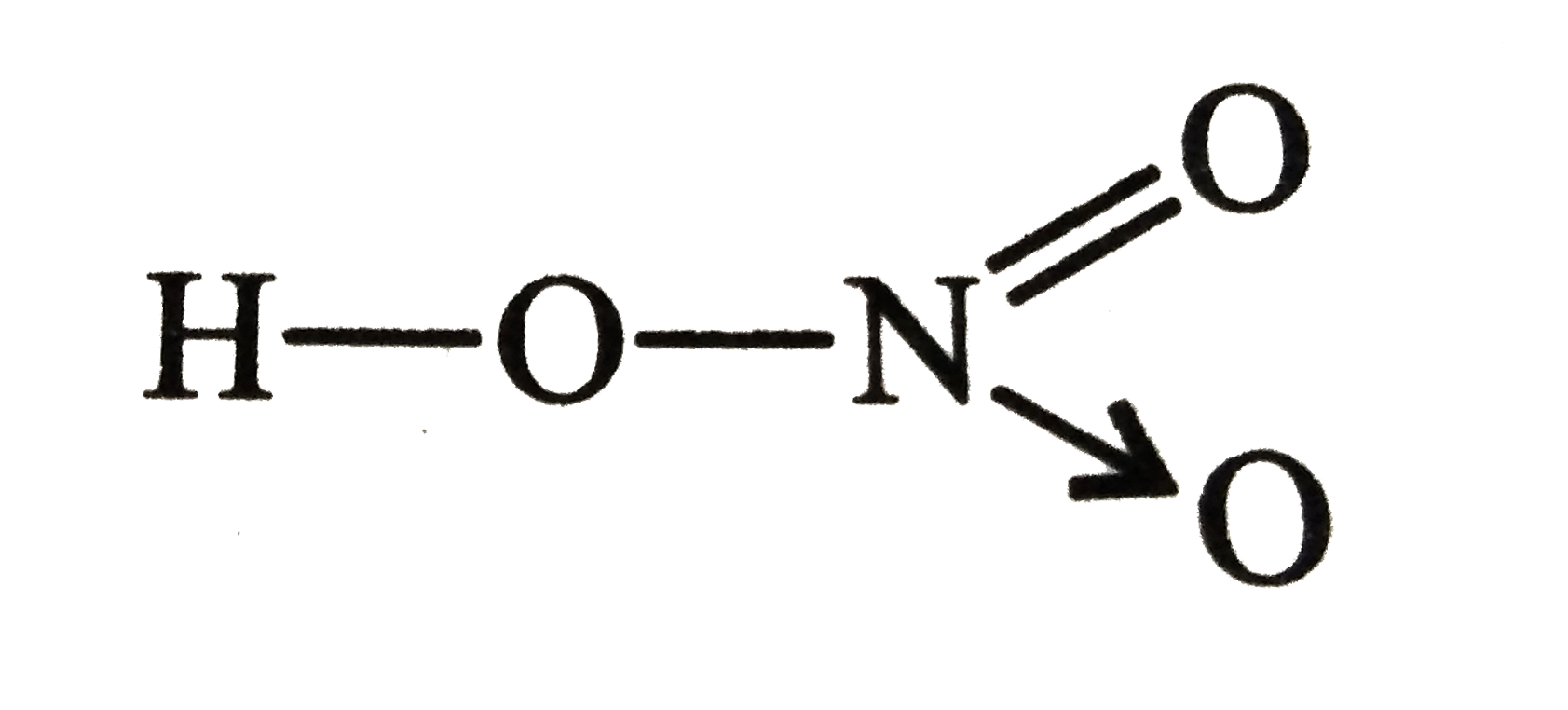
|
|
| 23. |
Determine the oxidation number of the underlined elements in the following species. ul(Si)H_(4),ul(B)H_(3),ul(B)F_(3),ul(Br)O_(4)^(-) and Hul(P)O_(4)^(2-) |
| Answer» SOLUTION :`-4,-3,+3,+,7,+5` | |
| 24. |
Determine the oxidation numbr of C in the following : C_(2)H_(6),C_(4)H_(10),CO,cO_(2)and HCO_(3)^(-) |
| Answer» Solution :O.N of C =-3 in `C_(2)H_(6)-2.5 in C_(4)H_(10)+2 in CO+4 in 4 in CO_(2) and +4 in HCO_(3)^(-)` | |
| 25. |
Determine the oxidation number of the element in the bold in the following species (i)SiH_(4),(ii)BH_(3),(iii)Bf_(3),(iv)S_(2)O_(3)(2-),(v)BrO_(4)^(-),(vi)HPO_(4)^(2-) |
|
Answer» SOLUTION :`(i) SiH_(4) :overset(x)Sioverset(+1)H_(4) X+4(+1)=0or x=-4` `(II)BH_(3) :overset(x)Boverset(+1)H_(3) X+3(+1)=0or x=-3` `(iii)Bf_(3) : overset(x)Boverset(-1)F_(3)X+3(-1)=0 or X=+3 ` `(iv)S_(2)O_(3)^(2-) : overset(x)S_(2)overset(-2)O_(3)2(x)+(-2)=-2OR X=+7` `(v) BrO_(4)^(-): overset(x)Broverset(-2)O_(4)X=4(-2)=-1or X=+7` `(vi)HPO_(4)^(2-) : overset(+1)Hoverset(x)Poverset(-2)O_(4)(+1)+X+4(-2)=-2 or X=+5` |
|
| 26. |
Determine the oxidation number of the atom in bold in the following species : BH_3,BF_3,BrO_4^(-) , HPO_4^(2-),S_2O_3^(2-),SiH_4 |
|
Answer» |
|
| 27. |
Determine the oxidation number of O in the following: OF_(2),Na_(2)O_(2) and CH_(3)COOH. |
| Answer» SOLUTION :`+2,-1,0` | |
| 28. |
Determine the oxidation number of O in the following: Na_2O_2 and CH_3COOH |
| Answer» SOLUTION :OXIDATION NUMBER of O=+1 in `Na_2O_2` and -2 in `CH_2 COOH`. | |
| 29. |
Determine the oxidation number of Cl in HCl , HClO, ClO_4^(-) and Ca (OCl) Cland ClO_2 . |
|
Answer» |
|
| 30. |
Determine the oxidation number of all the atoms in the following well known oxidants KMnO_(4),K_(2)Cr_(2)O_(7) and LiAIH_(4) |
| Answer» Solution :O.N OFS CHANGES FORM -2 in `H_(2)S` and +4 in `SO_(2)` to ZERO in elemental suphur | |
| 31. |
Determine the oxidation number of C in the following: CO,CO_(2),HCO_(3)^(-),C_(2)H_(6),C_(4)H_(10). |
| Answer» SOLUTION :`+2,+4,+4,-3,-2.5` | |
| 32. |
Determine the oxidation number of C in the following : C_2H_6,C_4 H_10,CO,CO_2 and HCO_3 |
| Answer» Solution :OXIDATION number of C=-3 in `C_2H_6,-2.5 i N C_4H_10+2 i n CO,+4 i n CO_2and+4i n HCO_3^-` | |
| 33. |
Determine the oxidation number of all the atoms in KClO_4. |
| Answer» SOLUTION :K=+1, Cl=+7, O= -2. | |
| 34. |
Determine the number of moles of Agl which may be dissolved in 1.0 litre of 1.0M CN^(-)solution ,K_(sp)for Agl and K_ffor [ Ag (CN)_2]^(-)" are "1.2 xx 10 ^(-17)M^(2) and 7. 1 xx 10 ^(-19)respectively. If answer is 4.9 xx 10 ^(x)then x =__________? |
|
Answer» ` (Ag^(+) +2CN^(-)hArr [Ag(CN)_2]^(-),K_f)/( underset( 1-2s) (Agl)+2CN^(-)hArr [Ag(CN)_2]^(-)+I^(-),K =KspK_f) ` ` ((s)/(1-2s) )^(2)=Ksp, K_f =1.2 xx 10^(-17)xx 7.1 xx 10 ^(19) ` ` rArr (s)/( 1-2s)=SQRT(8.52 xx 10 ^(2)) =29` ` 59S =29 rArr S =0.49 rArr S = 4.9 xx 10 ^(-1) ` |
|
| 35. |
Determine the number of moles of AgI which may be dissolved in 1.0 M CN^(-) solution. K_(sp) for AgI and K_(c)for Ag(CN)_(2)^(-) are 1.2xx10^(-7) M^(2) and 7.1xx10^(19) M^(-2) respectively. |
|
Answer» Solution :Suppose number of moles of AGI which may be dissolved in 1.0 litre of 1.0 M `CN^(-)` solution = x. Then `{:(,AgI (s) ,+ ,2CN^(-) (AQ) ,HARR,[Ag(CN)_(2)]^(-),+,I^(-)),("Initial moles " ,x,,1,," "0,,0),("Moles after reaction",0,,1-2x,," "x,,x),(,,,,,,,),(,,,,,,,):}` `K_(eq)=([Ag(CN)_(2)]^(-)[I^(-)])/([CN^(-1)]^(2))=(x^(2))/((1-2x)^(2))`...(i) Further,`AgI (s) hArr Ag^(+) (aq) + (Aq) + I^(-) (aq)` `K_(sp) = [Ag^(+)][I^(-)] = 1.2xx10^(-17) ` (Given)...(ii) `Ag^(+) (aq) + 2 (CN^(-) (aq)) hArr [Ag(CN)_(2)]^(-)` `K_(c)=([Ag(CN)_(2)]^(-))/([Ag^(+) ] [ CN^(-) ] ^(2) ) = 7.1xx10^(19) ` (Given) From eqn. (i) , (ii) and (iii) `K_(eq)=K_(sp)xxK_(c)=(1.2xx10^(-17))xx(7.1xx10^(19))= 8.52xx10^(2)` `:. (x^(2))/((1-2x)^(2)) = 8. 52xx10^(2) or (x)/(1-2x) = 29.2 or x = 29.2- 58.4x or x = 0.49 ` mole |
|
| 36. |
The simultaneous solubility of Ag CN (K_(f)=2.5 xx 10^(-16)) and AgCl (Ksp =1.6 xx 10^(-10 ) )in 1. 0M NH_3 (aq)are respectively :[Given ,K_f [Ag(NH_3)_2^(+) ]= 10^(7) ] |
|
Answer» ` (Ag^(+) +2CN^(-)hArr [Ag(CN)_2]^(-),K_f)/( underset( 1-2s) (Agl)+2CN^(-)hArr [Ag(CN)_2]^(-)+I^(-),K =KspK_f) ` ` ((s)/(1-2s) )^(2)=Ksp, K_f =1.2 XX 10^(-17)xx 7.1 xx 10 ^(19) ` ` rArr (s)/( 1-2s)=sqrt(8.52 xx 10 ^(2)) =29` ` 59S =29 rArr S =0.49 rArr S = 4.9 xx 10 ^(-1) ` |
|
| 37. |
Determine the molecular formula of the compound which contains H = 6.67 %, C = 40 % and the rest is oxygen. 0.6 g of the compound occupy 224 cc at N.T.P |
|
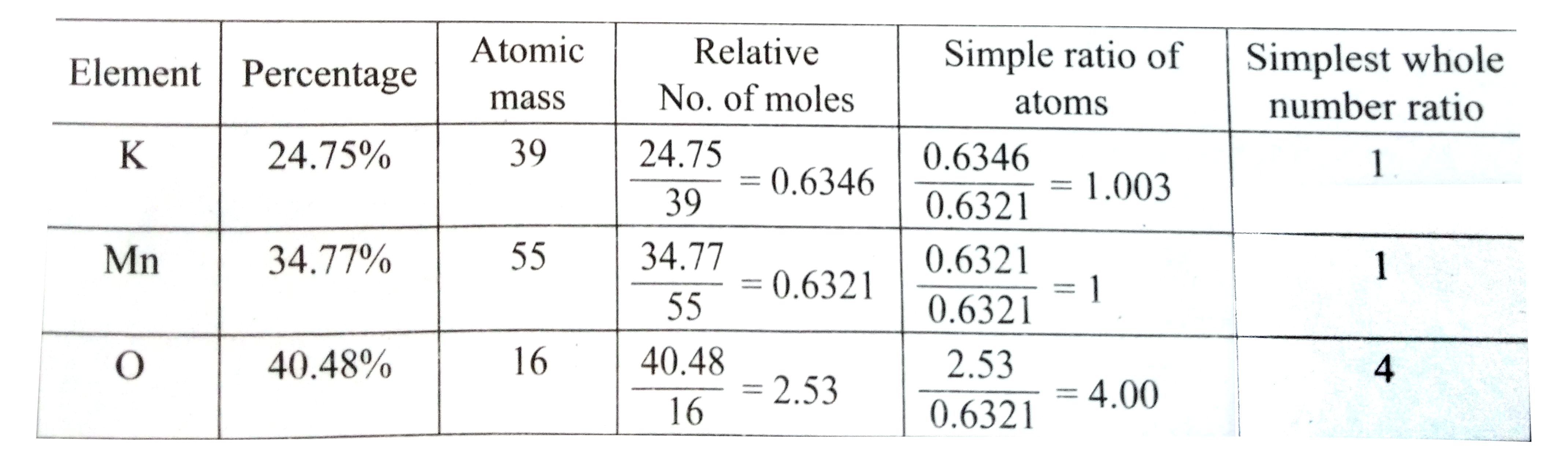
Answer» Step II. Empirical formula of the compound `{:("Element","Percentage","Atomic mass","Gram atoms (Moles)","Atomic ratio (Molar ratio)","SIMPLEST WHOLE no. ratio"),("C",40.00,12,(40.0)/(12)=3.33,(3.33)/(3.33)=1.0,1),("H",6.67,1,(6.67)/(1)=6.67,(6.67)/(3.33)=2.0,2),("O",53.33,16,(53.33)/(16)=3.33,(3.33)/(3.33)=1.0,1):}` Empirical formula of the compound `= CH_(2)O` Step III. Molecular formula of the compound 224 cc of the vapours of the compound at N.T.P occupy mass = 0.6 g 22400 cc of the vapours of the compound at N.T.P occupy mass `= 0.6//224 xx 22400 = 60.0 g` `:.` Molecular mass of the compound = 60 g = 60 u Empirical formula mass `= 12 + 2 xx 1 + 16 = 30 u , n = ("Molecular mass")/("Empirical formula mass")=((60u))/((30u))=2` `:.` Molecular formula `= 2 xx CH_(2)O=C_(2)H_(4)O_(2)`. |
|
| 38. |
Determine the molecular formula of an oxide of iron in which the mass per cent of iron and oxygen are 69.9 and 30.1 respectively. |
|
Answer»  Empirical formula `=Fe_(2)O_(3)` `=2xx56+3xx16` `=160` `n=("MOLECULAR mass")/("Empirical formula mass")` `=(160)/(160)=1` Molecular formula `=n xx ` emplirical formula Molecular formula `= n xx` emplirical formula `=1xx(Fe_(2)O_(3))` `=Fe_(2)O_(3)` |
|
| 39. |
Determine the molecular formula of an oxide of iron in which the mass per cent of iron and oxygen are 69.9 and 30.1 respectively. Given that the molar mass of the oxide is 159.8 g mol^(-1). |
|
Answer» Solution :For calculation of empirical FORMULA, Empirical formula (`Fe_2O_3`) mass = (`2 XX 55.85) + (3 xx 16.00) = 159.7 g mol^(-1)` `N=("Molar mass")/("Empirical formula mass") = 159.8/159.7=1` Here, MOLECULAR formula of the given OXIDE = `Fe_(2)O_(3)`. |
|
| 40. |
Determine the miller indices of the shaded plane. Coordinates of the corner of the plane |
|
Answer» SOLUTION :A PLANE parallel to the plane between ( 0,0,0) , ( 1,1,0) and ( 0,1,1)will interest the axes at X =a, y = -b , and c =cthus, wesis indics are 1, -1 and 1 . Resciprocals of Weiss indices are 1,-1 and 1, Hence, MILLER indices are `( 1 bar1 1 ) or (bar1 1 bar1) ` 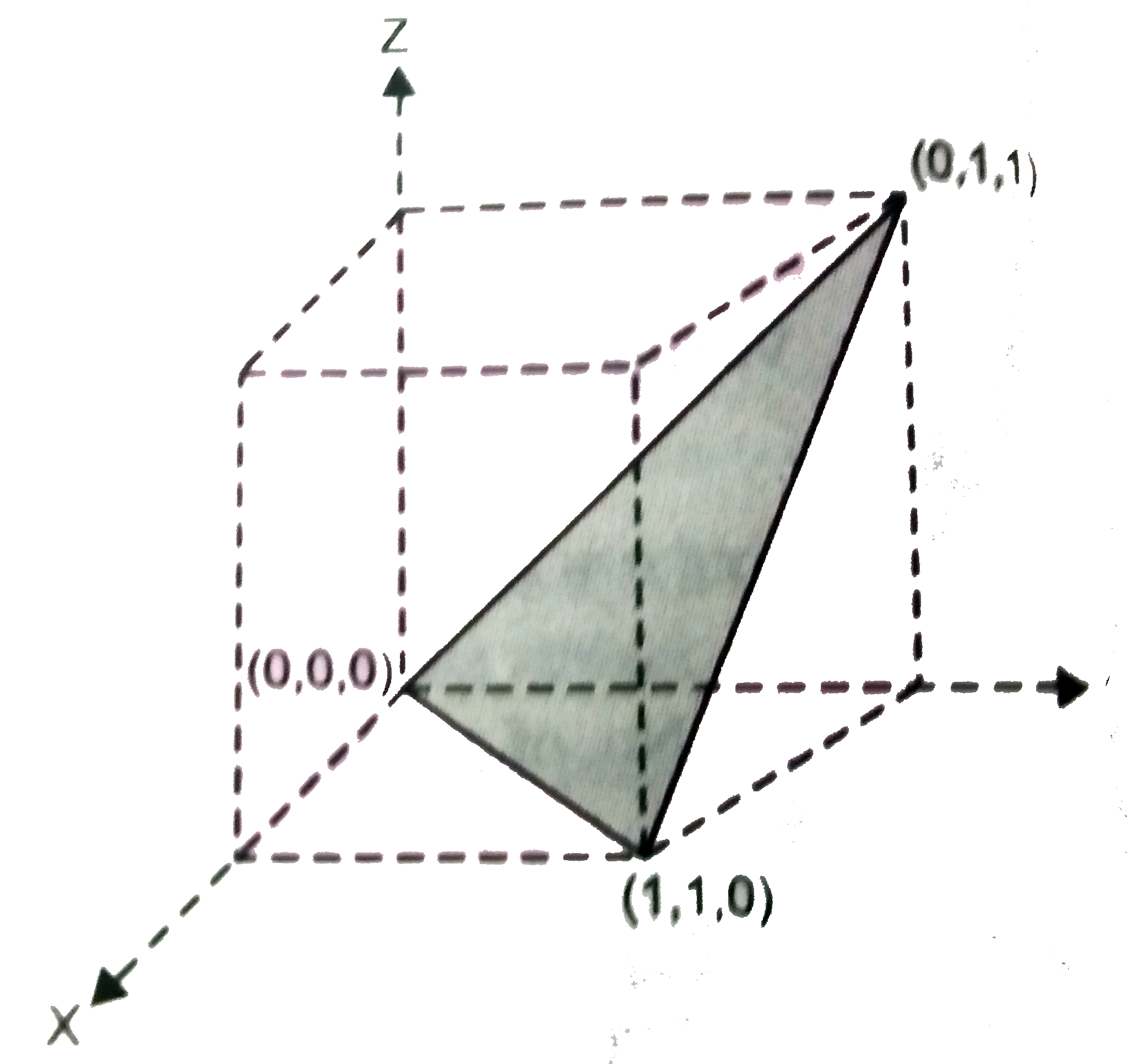
|
|
| 41. |
Determine the following for the fourth shell of an atom. (d) The maximum number of electrons that can be contaied in each subshell. |
|
Answer» Solution :Each orbital can contain a maximum of two electrons. 4s - 1 orbital - 2 electrons 4p - 3 orbital - 6 electrons 4d - 5 orbital - 10 electrons 4s - 7 orbital- 14 electrons. |
|
| 42. |
Determine the following for the fourth shell of an atom. (c ) The number of orbitals in each subshell. |
|
Answer» <P> Solution :The number of ORBITALS in s,p, d and F subshell is 1,3,5 and 7 respectively. |
|
| 43. |
Determine the following for the fourth shell of an atom. (a) The number of subshells. |
| Answer» Solution :The number of SUBSHELLS is the same as the number USED to designate the SHELL ie., n = 4 so contains 4 SUB shells. | |
| 44. |
Determine the following for the fourth shell of an atom. (b) The designation for each subshell. |
| Answer» SOLUTION :The subshells in the FOURTH SHELL are designated as 4s. 4P . 4d and 4f. | |
| 45. |
Determine the empirical formula of an oxide of iron which has 69.9% iron and 30.1% oxygen by mass. |
Answer» Solution :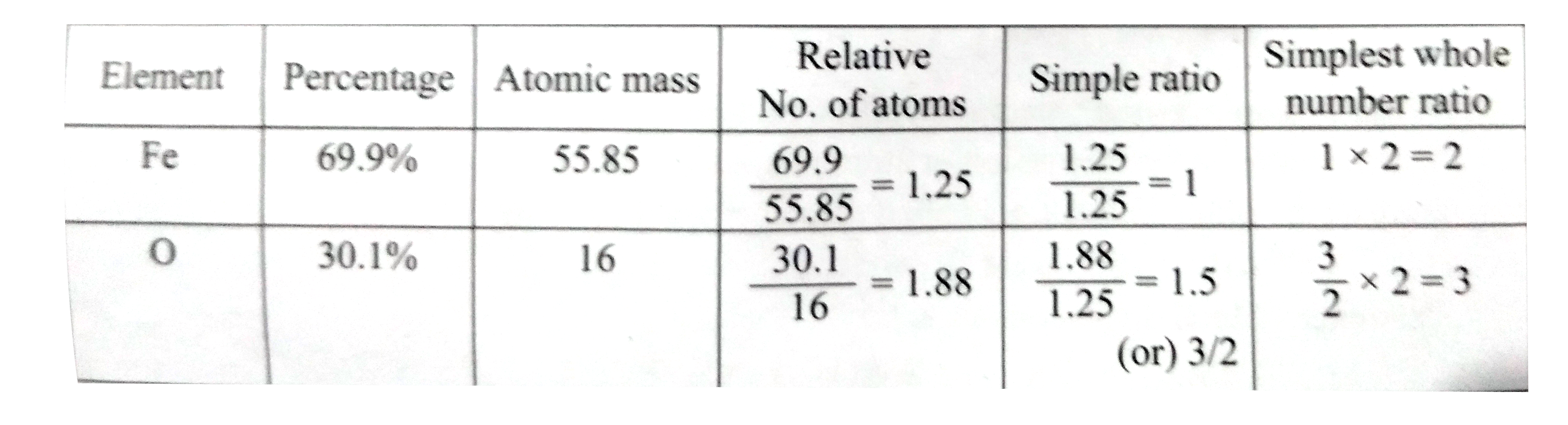 `:.` The EMPIRICAL FORMULA is `Fe_(2)O_(3)` . |
|
| 46. |
Determine the empirical formula of an oxide of iron, which has 69.9% iron and 30.1% dioxygen by mass. |
Answer» SOLUTION :CALCULATION of EMPIRICAL formula:  `THEREFORE` Empirical formula `=Fe_(2)O_(3)`. |
|
| 47. |
Determine the empirical formula of an oxide of Iron which has 69.9% Iron and 30.1% dioxygen by mass. [Atomic mass of Fe=56, O=16] |
Answer» SOLUTION :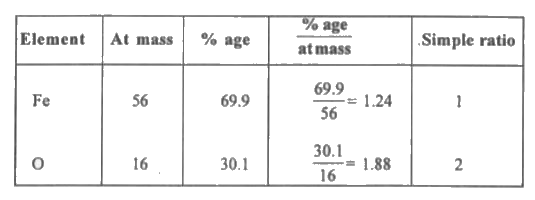
|
|
| 48. |
Determine the empirical formula of an oxide of iron which has 69.9% iron and 30.1% dioxygen by mass. |
|
Answer»  EMPIRICAL formula `=Fe_(2)O_(3)` |
|
| 49. |
Determine the empirical formula of an oxide of iron which contains 69.9%iron and 30.1% oxygen by mass. |
Answer» SOLUTION : EMPIRICAL FORMULA =`Fe_2O_2` EMPIRICAL FORMULA =`Fe_2O_2`
|
|