

Saved Bookmarks
This section includes 7 InterviewSolutions, each offering curated multiple-choice questions to sharpen your Current Affairs knowledge and support exam preparation. Choose a topic below to get started.
| 1. |
Fluorine is more electronegative than either boron or phosphorus. Whatconclusion can be drawn from the fact that BF_(3) has no dipole moment nut PF_(3) does ? |
|
Answer» `BF_(3)` is not spherically SYMMETRICAL but `PF_(3)` is |
|
| 2. |
Fluorine exhibits only -1 oxidation state, while iodine exhibits oxidation states of -1, +1, +3, +5 and+7. This is due to |
|
Answer» FLUORINE being a GAS |
|
| 3. |
Fluorine does not undergo disproportiona tion because |
|
Answer» FLUORINE is always exhibit - 1 OXIDATION state |
|
| 4. |
Fluorine decomposes cold water to give |
|
Answer» `4H^(+) + 4F^(-)` and `O_(2)` |
|
| 5. |
Fluorination of alkenes takes place ................ and may result in the rupture of ................ bond. |
| Answer» SOLUTION :EXPLOSIVELY, C-H | |
| 6. |
Flsh do not grow as well in warm water as in cold water. Why? |
| Answer» SOLUTION :The AMOUNT of DISSOLVED oxygen in WARM water is LESS than in cold water | |
| 7. |
Fluoride can not be removed by ion-exchange method. Why? |
|
Answer» SOLUTION :Fluoride is an anion. It can be removed by using anion EXCHANGE resin. However, DUE to the small size of Fions, the exchange is not EFFICIENT. |
|
| 10. |
Flagpole interaction is present in |
|
Answer» CHAIR form of cyclohexane 
|
|
| 11. |
Sino-atrial node is present in |
|
Answer» CHAIR FORM of cyclohexane 
|
|
| 12. |
Five isomeric para-disubstituted aromatic compounds A to E with molecular formula C_(8)H_(8)O_(2) were given for identification. Based on the following observations, give structures of the compounds. (I) Both A and B form a silver mirror with Tollen's reagent, also B gives a positive test with FeCl_(3) solution. (II) C gives positive iodoform test. (III) D is readily extracted in aqueous NaHCO_(3) solution. (IV) E on acid hydrolysis gives 1, 4-dihydroxybenzene. |
|
Answer» |
|
| 13. |
Five gram of copper alloy was dissolved in one litre of dilute H_(2)SO_(4). 20 mL of this solution was titrated iodometrically and it required 20 mL of a hypo solution. 20 mL of K_(2)Cr_(2)O_(7) which contained 2.4 g per litre, in presence of H_(2)SO_(4) and excess of KI, required 30 mL of the same hypo solution. Calculate the % purity of copper in the alloy. |
|
Answer» |
|
| 14. |
Fishes are more comfortable in cold water than in hot water. Justify. |
| Answer» Solution :Cold WATER contains more DISSOLVED oxygen than hot water and hence fishes can breathe more EASILY and COMFORTABLY in cold water. | |
| 15. |
First law of thermodynamics does not tell about |
|
Answer» Law of conservatin of energy |
|
| 16. |
Fish die in water bodies polluted by sewage due to |
|
Answer» Pathogens |
|
| 17. |
Firstmember of thegroup ofrepresentativeelements(i.e.,s andp- blockelementshowsanomalousbehavious . Illustrate withtwoexamples. |
|
Answer» Solution :The firstmemberof each groupof therepresentativeelements(i.e.,s- andp- blockelements ) showanomalousbehaviourfrom rest ofmembers of thesamegroupbecauseof the followingreasons. (i)small size(ii)highionizationenthalpy(III) highelectronegativityand (iv)absenceof d-orbitalss- BlockElements. Someexampleof anomalousbehaviour of Lifrom rest of the alkali metalsand Befrom restof teh alkaline earthmetalsare discussedbelow . (i) Lithium unlikeotheralkalimetalsand beryllium unlike otheralkalineearthmetalsformcompound whichhavesignificantcovalentcharacterwhileothermembers ofeach of thethesegroupsformcompoundwhicharepredominantlyionic. (ii) Lithiumcombineswithnitrogento formlithiumnitridewhile allotheralkali metalsdo notformnitrides .Similarly , lithiumcarbonatedecomposes togive `CO_(2)`1 whileall otheralkalimetalscarbonatesdo not. `6 Li+ N_(2)overset(Heat)(to) underset("Lithium nitride ")(2Li_(3)N)` ` Li_(2) CO_(3)overset(Heat)(to) Li_(2)O+ CO_(2),Na_(2) CO_(3)overset(Heat)(to) No` action SimilarlyBe differs from all otheralkalineearth metals as shown below , (i) Beryllium carbidereacts withwater toproduce methane gaswhilecarbides ofotheralkalineearthmetalsgive acetylene gas. `Be_(2) C+ 4 H_(2) Oto 2 Be(OH)_(2) + CH_(4) ,CaC_(2)+ 2H_(2) O toCa (OH)_(2) +HC -= CH` (ii) Beryllium shows acoordination number of 4 due tothepresenceof ones-and three p-ORBITALS invalenceshellbut otheralkalineearthmetalssuchas `Mg^(2+) ` and `Ca^(2+)` show acoordinationnumberofmakinguse ofd- orbitalsin additionto s- andp- orbitals .Forexample `BeF_(2)+ Ftp]BeF_(4)]^(2-) -` fourcoordinate complex `Ca^(2+) + Na_(2)[H_(2)EDTA]^(2-) to [Ca (EDTA)]^(2-) +2 Na^(+) +2 H^(+) -Six` coordinatecomplex  Disodium saltof ethylenediaminetetraacetic and The EDTA(ethylenediaminetetraacetic acid ) Complexes of `Mg^(2+)` and `Ca^(2+)` are used todeterminethe hardness water by titrationmethod. p- blockelement. Someexamplesof anomalousbehaviour of firstelementof eachgroup ofp- blockelementfromthe rest of themember of thesame groupare discussed below : maximumcovalency offour. the firstmember of each groupof THEP- blockelements has fourorbitals(one 2sand three2p- orbitals) in thevalenceshell forbondingand hencecanaccommodate4 pairsor 8ELECTRONS . In other words , theseelements show amaximumcovalencyof four. Incontrast, othermember of the samegroup or different froup of p - blockelement have vacentd- orbitalsandhence canaccommodate moreelectronsand thuscan expand their covalencybeyondfour . for example, (a)boron forms `[BF_(4)]^(-)` or `[BH_(4)]^(-)` ion whileA1 gives`[A1F_(6)]^(3-)` ion. ( b)Carbonforms onlytetrahalites`(CX_(4), X =F, C1 , Br, I)` whileothermemberformhexahalides , i.e.,`[SiF_(6)]^(2-) , [GeC1_(6)]^(2-), [SiC1_(6)]^(2-) , [PbC1_(6)]^(2-),` etc ( c)Nitrogenformsonlytrihalidessuch as `NF_(3)` (havingan octer of electronsin thevalenceshell) while Pand Asformbothtrihalites `(PF_(3), "As" C1_(3)` etc )and pentahalides`(PF_(3), "As" C1_(5))` having10electronsinvalenceshell. (d ) Fluorinedoes notform `FC1_(3)` (having 10 valenceelectrons )whilechlorineforms `C1F_(3)` (having 10 valence electrons ) |
|
| 18. |
First member of each group of representative elements (i.e., s and p-block elements) shows anomalous behaviour. Illustrate with two examples. |
|
Answer» Solution :First member of each group of representative ELEMENTS (i.e., s- and p-block elements) shows anomalous behaviour due to (i) small size (II) high ionisation enthalpy (iii) high electronegativity and (iv) ABSENCE of d-ORBITALS. e.g., in s-block elements, LITHIUM shows anomalous behaviour from rest of the alkali metals. (a) Compounds of lithium have significant covalent character. While compounds of other alkali metals are predominantly ionic. (b) Lithium reacts with nitrogen to form lithium nitride while other alkali metals do not form nitrides. In p-block elements, first member of each group has four orbitals, one 2s-orbital and three 2porbitals in their valence shell. So, these elements show a maximum covalency of four while other members of the same group or different group show a maximum covalency beyond four due to availability of vacant d-orbitals. 3 |
|
| 19. |
First line of Paschen series has wave number (R_(H)=109700//cm) |
|
Answer» `2854xx10^(8)(Å)^(-1)` `1/lambda=109677[1/n_(i)^(2)-1/n_(f)^(2)]=6856xx10^(8)(Å)^(-1)` |
|
| 20. |
First ionization potential of C-atom is greater than that of B-atom, where as the reverse is true for second ionization potential. |
|
Answer» <P> Solution :`C(Z=6)1s^(2)2s^(2)2p_(x)^(1)2p_(y)^(1)`. The electron removal from p orbital is very difficult. So carbon has highest first IONIZATION potential.`B(Z=5)1s^(2)2s^(2)2p^(1)`. In boron nuclear charge is less that that of carbon, so boron has lowest first ionization potential. `I.E_(1)CgtI.E_(1)B` But it is reverse in the case of second ionization energy. Because in case `B^(+)` the electronic configuration is `1s^(2)2s^(2)`, which is completely FILLED and it has high ionization energy. But `C^(+)` the electronic configuration is `1s^(2)2s^(2)2p^(1)`, one electron removal is easy so it has ionization energy. `I.E_(2)BgtI.E_(2)C` |
|
| 21. |
Why first ionisation potential of aluminium is less than that of magnesium? |
|
Answer» Aluminium ATOM is very large when compared to MG |
|
| 22. |
First ionisation potential of C- atom is greater than that of B atom , where as the revers is true is for second ionisation potential. |
|
Answer» Solution :Electron configuration of carbon `(Z=6)1s^(2)2s^(2)2p^(2)` Electron configuration of Boron `(Z=5)1s^(2)2s^(2)2p^(1)`. The size of a carbon atom is SMALLER than boron. So the valence electron of carbon has greater nuclear charge than that of boron . Hence the first I.E of carbon is greater than that of boron. However , the second IONIZATION enthalphy of boron is higher than that of carbon . This is because after losing 1 electron , Boron has a fully FILLED orbital so greater amount of energy will be needed to REMOVE an electron from boron . So in this case , the second I.E of boron is higher than that of carbon. |
|
| 23. |
First ionisation potential for copper is higher than that for potassium. The second ionisation potential of copper is |
|
Answer» Equal to the 2nd ionisation POTENTIAL of potasium `K(Z=19): 1s^(2)2s^(2)2p^(6)3s^(2)3p^(6)4s^(1)` `Cu^(+): 1s^(2)2s^(2)2p^(6)3s^(2)3p^(6)3d^(10)` `K^(+) : 1s^(2)2s^(2)2p^(6)3s^(2)3p^(6)` Clearly second ionisation ENERGY of K will be more than Cu because in case of K the second electron is to be removed from fully filled 3rd shell. |
|
| 24. |
First four ionisation energy values of an element are 191, 578, 872 and 5972 K.Cals The number of valence electrons in the element is |
|
Answer» 4 |
|
| 25. |
First and second Ionisation energies of Mg are 740 and 1450 KJ/mol . If 1 g of Mg(g) absorbed 50 KJ energy will be no. of moles of Mg^(+) in the formed mixtureis 'x' then 100x value is |
|
Answer» |
|
| 28. |
Find total number of conditions is which oxidation of Fe^(+2)(aq) ions to iron (III) takes places: (a) On exposure to air. (b) On addition of conc. HNO_(3) (c) On reaction with SnCI_(2) (d) On reaction with H_(2)O_(2) (e) On reaction with MnO_(4)^(-)//H^(+) (f) On reaction with KI (g) On reaction with Cr_(2)O_(7)^(2-)//H^(+) |
|
Answer» |
|
| 29. |
Find totalnumberof electronprotonand neutronin 0.192 kg ._(16)^(32)S |
| Answer» SOLUTION :5.781 `XX 10^(22)` | |
| 30. |
Find total no. of orbitals in nickel which have abs(m)le1 and at least one electron is present, where 'm' is magnetic quantum number. |
|
Answer» |
|
| 31. |
Find the wrong statement |
|
Answer» Sodium METAL is USED in ORGANIC qualitative analysis |
|
| 32. |
Find the weight of H_(3)PO_(4) in its 3N aqueos solution at25""^(@)C. Molecular mass of H_(3)PO_(4)=98 g/mole. |
|
Answer» 98 `= 3 xx (98)/(3) = 98 g//L` |
|
| 33. |
Find the wavelengthof electromagneticradiationhavingfrequency 1368KHz. |
| Answer» SOLUTION :1.33 `XX 10^(6) m^(-1)` | |
| 35. |
find thewavenumberof shortestwavelength In Balmer series(Note n_(1) : =2 n_(2)= prop) |
| Answer» SOLUTION :`2.7419 xx 10^(4) cm^(-1)2.7419 xx 10^(6) m^(-1)` | |
| 36. |
Find the volume strength of 1.6 N H_(2)O_(2) solution. |
|
Answer» SOLUTION :We know thatstrength =Normality `xx` Eq. wt. and Eq. wt. of `H_(2)O_(2)=17` Strength of 1.6 N `H_(2)O_(2)` solution =`1.6xx17` g/l Now 68 g of `H_(2)O_(2)` GIVES 22400 mL `O_(2)` at N.T.P. `THEREFORE 1.6 xx17g` of `H_(2)O_(2)` will give `(22400)/(68)xx1.6xx17=8960 `mL of `O_(2)` at N.T.P. But `1.6xx17 g` of `H_(2)O_(2)` are present in 1000 mL of`H_(2)O_(2)` solution Hence, 1000 mL of `H_(2)O_(2)` solution gives 8960 mL of `O_(2)` at N.T.P. `therefore ` 1 mL of `H_(2)O_(2)` solution will give `=(8960)/(1000)=8.96` mL of `O_(2)` at N.T.P. Hence, the VOLUME strength of 1.6 `N H_(2)O_(2)` solution =8.96 volume |
|
| 38. |
Find the volume at STP and mass of 6.022xx10^(23) molecules of O_(2). (Molar volume = 22.4 L) |
|
Answer» |
|
| 39. |
Find the volume of 8g of oxygen gas at 27^@C and 1 atmosphere prressure. If the volume of each molecule is 3.4 xx 10^(-24)c ccalculate the vacant space in the gas. |
| Answer» SOLUTION :6158cc, 5646cc | |
| 40. |
Find the velocity (in m s^(-1)) of electron in first Bohr orbit of radius a_(0). Also find the de Broglie wavelength (in m). Find the orbital angular momentum of 2p orbital of hydrogen atom in units of h//2pi. |
|
Answer» Solution :For H and H-like particles, velocity in the nth orbit `v_(n) = 2.188 xx 10^(6) xx (Z)/(n) ms^(-1)` For H-atom, Z = 1 and for 1st orbit n = 1 `:. v = 2.188 xx 10^(6) ms^(-1)` DE Broglie wavelength, `lamda = (h)/(mv) = (6.626 xx 10^(-34) kg m^(2) s^(-1))/(9.1 xx 10^(-31) kg xx 2.188 xx 10^(6) ms^(-1)) = 3.33 xx 10^(-10) m` Orbital angular momentum `= sqrt(L(l + 1)) (h)/(2PI)` For 2p orbital, `l = 1` `:.` Orbital angular momentum `= sqrt(1(l + 1)) (h)/(2pi) = sqrt2 (h)/(2pi)` |
|
| 42. |
Find the value of the reaction H_2 (g) +I_2 (g) hArr2HI(g) at an instant where concentration of H_2I_2 and 'HI are found to be 0.2 mol L^(-1), 0.2 mol L^(-1), and 0.6 mol L^(-1) respectively. |
|
Answer» 48 solution : ` q= ([ HI]^2)/([H_2] [I_2]) = ( 0.6 XX 0.6 )/( 0.2 xx 0.2)=9` |
|
| 43. |
Find the value of K_(c) for each of the following equilibria from the value of K_(p) (a) 2 NOCl (g) hArr 2 NO(g) + Cl_(2) (g) , K_(P) = 1.8 xx 10^(-2) atm at 500 K (b) CaCO_(3) (s) hArr CaO(s) + CO_(2) (g) , K_(P) = 167 atm at 1073 K |
|
Answer» Solution :(a) `2 NOCl (g) hArr 2 NO (g) + Cl_(2)` `K_(p) = 1.8 xx 10^(-2)` atm `Delta n_(g) = 3 - 2 = 1 , R = 0.0821` litre `atm K^(-1) mol^(-1) , T = 500` K `therefore "" K_(C) = (K_(P))/((RT)^(Delta n_(g))) = ((1.8 xx 10^(-2) atm))/((0.0821 L atm K^(-1) mol^(-1) xx 500 K)^(1))` `= 4.4 xx 10^(-4) mol L^(-1)` (b) ` CaCO_(3) (g) hArr CaO (s) + CO_(2) (g)` `K_(p) = 167` atm , `Delta n_g = 1` `R = 0.0821` litre and atm `K^(-1) mol^(-1) , T = 1073` K `K_(C) = (K_(P))/((RT)^(Deltan_(g))) = ((1.8 xx 10^(-2) "atm"))/((0.0821 L atm K^(-1) mol^(-1) xx 1073 K)^(1))` `1.9 mol L^(-1)` |
|
| 44. |
Find the total number of metals, which makes a thin protective layer of its oxide on treatment with conc. HNO_(3) Al,Zn,Sn,Cu,Pt,Cr,Au,Ag |
|
Answer» |
|
| 45. |
Find the temperature in ""^(@)C for a 6.4 gm O_(2) gas filled in a 200 mL vessel having pressure 50 bar. [R=8.314xx10^(-2)" bar "L K^(-1)mol^(-1)] |
|
Answer» |
|
| 46. |
Find the temperature at which one mole of SO_3 will occupy 10 lit at 5 atm. (correction constants 'a' = 6.71 atm L^2 mol^(-2) and 'b' = 0.0504 L mol^(-1) |
|
Answer» |
|
| 47. |
Find the sum of number of p pi - p pi and p pi - d pi bonds in trimer of C. |
Answer» 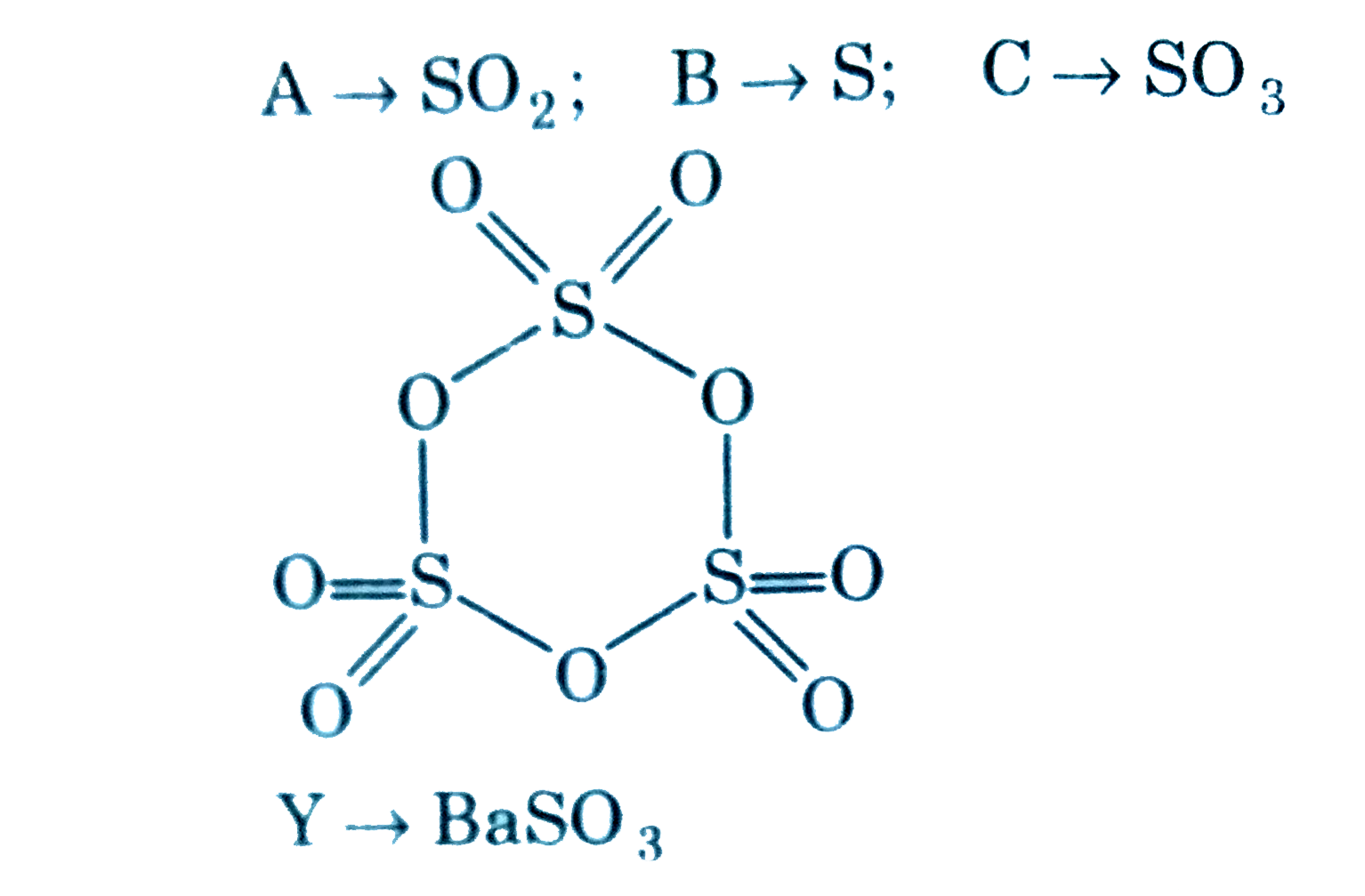
|
|
| 49. |
Find the rms speed of an argon molecule at 27^(@)C (Molecular weight of argon = 40 gm/mol) |
|
Answer» `234.2 m//s` |
|
| 50. |
Find the relative rates of diffusion of CO_2 and Cl_2 gases. |
|
Answer» |
|