

Saved Bookmarks
This section includes 7 InterviewSolutions, each offering curated multiple-choice questions to sharpen your Current Affairs knowledge and support exam preparation. Choose a topic below to get started.
| 1. |
For the given reaction: N_(2)(g) + 3H_2(g) hArr 2NH_3(g) Equilibrium constant K_c=[NH_3]^2/([N_2][H_2])^3 Some reactions are written below in Column-I and their equilibrium constants in terms of K_c are written in Column-II. Match the following reactions with the corresponding equilibrium constant |
|
Answer» Equilibrium `K_c=[NH_3]^2/([N_2][H_2]^3)` (A) The GIVEN reaction `[2N_(2(g)) + 6H_(2(g)) hArr 4NH_(3(g))]` is twice the above reaction. Hence `K=K_c^2` (B) The reaction `[2NH_(3(g)) hArr N_(2(g)) + 3H_(2(g))]` is REVERSE of the above reaction. hence, `K=1/K_c` (C) The reaction `[1/2N_(2(g)) +3/2 H_(2(g)) hArr NH_(3(g))]` is half of the above reaction Hence, `K=sqrtK_c=K_c^(1/2)` |
|
| 2. |
For the given reaction CH_(4(g))+2O_(2(g)) rarr CO_(2(g)) + 2H_(2)O_((l)) If 64 g of O_(2)is used, then 44 g ofCO_(2) is formed. 8 g of CH_(4)reacts to form 36 g of product. 22 g of CO_(2)is formed from 3.011xx10^(23)molecules of CH_(4). At STP, if 22.4 litres of O_(2(g)) is used, then 11.2 litres ofCO_(2) is formed. Which of the above statements are correct ? |
|
Answer» `2, 3, 4` (1) Reaction : `CH_(4(g)) + 2O_(2(g)) rarr CO_(2(g)) +2H_(2)O_((l))` `64 g O_(2)` produces 44 gram `CO_(2)` `:.` 64 gram produces `:.` (1) is CORRECT (2) Reaction : `CH_(4(g))+2O_(2(g)) rarr CO_(2(g))+2H_(2)O_((l))` `:.` 16 gram `CH_(4)` react to form `(44+36)` `=80` gram product `(80xx8)/(16)` gram product `=40` gram product `:.` (2) is not correct (3)Reaction : `CH_(4(g))+2O_(2(g)) rarr CO_(2(g)) + 2H_(2)O_((l))` `:.` 1 mole `CH_(4)` form 1 mole `CO_(2)` gas `:.6.022 xx 10^(23)` molecules of `CH_(4)` form 44 g `CO_(2)`gas and `:.3.011xx10^(23)` molecules of `CH_(4)` form `=(3.011xx10^(23)xx44)/(6.022xx10^(23))=22g` of `CO_(2)` (3) is correct (4) Reaction : `CH_(4(g))+2O_(2(g)) rarr CO_(2(g))+2H_(2)O_((l))` `:.` At STP USED `2 (22.4L) O_(2)` form `22.4 L CO_(2)` `:.` At STP used `22.4L O_(2)` form `=(22.4Lxx22.4L)/(2xx22.4 L) CO_(2) = 11.2 ` of `CO_(2)` (4) is correct Thus, (1) , (3) and (4) are correct statements |
|
| 3. |
For the given reaction how many products are optically active (all isomers) : CH_3-undersetunderset(CH_3)(|)oversetoverset(CH_3)(|)C-CH_2-oversetoverset(CH_3)(|)CH-CH_3overset(Br_2//h upsilon)to |
|
Answer» |
|
| 4. |
For the given reaction 2A(g)+ B(g) hArrC(g) , DeltaH = x kJ which of the following favour the reactants ? |
|
Answer» LOW pressure |
|
| 5. |
For the given of which molecule resonance is possible ? Why ? CO_(2), NO_(2) , O_(3), CH_(4) |
| Answer» SOLUTION :For `CO_(2), NO_(2) , O_(3)` has RESONANCE as they have non BONDING electrons in atoms. | |
| 6. |
For the given equation in closed vessel. NH_4HS_((s)) overset"dissociation"undersetlarrto NH_(3(g)) +H_2S_((g)) What will be the value of K_p ?(P=total pressure ) |
|
Answer» `P^3/27` |
|
| 7. |
For the given equation 4NH_(3(g)) + 50_(2(g)) hArr 4NO_((g)) + 6H_(2) O_((l)) Select the correct option for change in Enthalpy. |
|
Answer» `Delta U + RT` `Deltan_((g)) = 4-9 = (-5) therefore Delta H = Delta U - 5 RT` |
|
| 8. |
For the give reaction how many products will obtain (all isomers)? |
|
Answer» 1 |
|
| 9. |
For the gaseous reaction involving the complete combustion of isobutane |
|
Answer» `DELTAH = DeltaE` |
|
| 10. |
For the gaseous reaction, at 300 K temperature, value of Delta H - Delta U= - 4.98 KJ., Then Delta n_((g))= ….. |
|
Answer» 1 |
|
| 11. |
In a ten litre vessel, the total pressure of a gaseous mixture containing H_(2), N_(2)and CO_(2)is 9.8atm. The partial pressures of H_(2)and N_(2)are 3.7 and 4.2 atm respectively. Then the partial pressure of CO_(2)is |
|
Answer» 50 `implies P_(NH_(3))=1.6, K_(P)=(P_(NH_(3))^(2))/(P_(N_(2)).P_(H_(2))^(3))` |
|
| 12. |
For the gaseous phase reaction 2A+B harr 2C+D, initially there are 2 mole each of A & B. If 0.4 mol of D is present at equilibrium at a given T & P, in-correct relationship is |
|
Answer» `P_A LT P_B & P_D lt P_C`  but no. of moles of D at equlibrium (x)=0.4 `1.2""1.6""0.8""0.4` partial pressure of a GAS `ALPHA` its no. of moles |
|
| 13. |
For the reaction PCl_(5(g)) harr PCl_(3(g)) + Cl_(2(g)). Which of the graph "is"//"are" correct? |
|
Answer» `DELTA H lt 0 and Delta S lt 0` |
|
| 14. |
For the gas phase reaction, PCI_(5(g)) hArr PCI_(3(g)) + CI_(2(g)) Which of the following conditions are correct ? |
|
Answer» `Delta H= 0 and Delta S lt 0` The reaction given is an example of decomposition reaction and we know that decomposition reaction are endothermic in nature, i.e. `Delta H gt0`. Further, `Delta N = (1+1)-1=+1` Hence, more number of molecules are PRESENT in PRODUCTS which shows more randomness i.e. `Delta S gt 0 (Delta S` is positive `)` |
|
| 15. |
For the gas-phase reaction, 2NOhArr N_(2) + O_(2) : Delta H = -43.5keal. Which one of the following is false for the reactionN_(2) (g) + O_(2) (g) hArr 2NO(g) |
|
Answer» `K_c` is INDEPENDENT of temperature |
|
| 16. |
For the gas phase exothermic reaction. A_(2)+B_(2)hArrC_(2), carried out in a closed vessel, the equilibrium moles of a_(2) can be increased by: |
|
Answer» increasing the temperature |
|
| 17. |
For the four gases A,B,E and D the value of the excluded volume per mole is same. If the order of the critical temperature is T_(B)gtT_(C)gtT_(A)gtT_(E) then the order of their liquefaction pressure at a temperature T(TltT_(E)) will be: |
|
Answer» <P>`P_(A)ltP_(B)ltP_(E)ltP_(D)` |
|
| 18. |
For the formation of two moles of SO_3(g) from SO_2 and O_2 the equilibrium constant is K_1. The equilibrium constant for the dissociation of one mole of SO_3 " into " SO_2 and O_2is ……………. . |
|
Answer» `1/K_1` `K_1 = ([SO_3]^2)/([SO_2]^2[O_2])` DISSOCIATION of 1 mole of `SO_3` `SO_3 hArr SO_2 + 1/2 O_2` `K_2 =([SO_2][O_2]^(1/2))/([SO_3])` `:. K_2 = 1/sqrt(K_1)` |
|
| 19. |
For the formation of two moles of SO_(3)(g) from SO_(2) and O_(2), the equalibrium constant is K_(1). The equilibrium constant for the dissociation of one mole of SO_(3) into SO_(2) and O_(2) is |
|
Answer» `(1)/(K_(1))` |
|
| 20. |
For the formation of two different organic compounds the only correct combination is |
|
Answer» <P>(I),(II),(R) |
|
| 21. |
For the formation of silver mirror the only correct combination is : |
|
Answer» (IV), (II) ,(R) |
|
| 22. |
The value of Delta_fG^(Theta)for formation of Cr_2 O_3is – 540 kJ "mol"^(-1)and that of Al_2 O_3is – 827 kJ "mol"^(-1) . Is the reduction of Cr_2 O_3possible with Al ? |
|
Answer» REDUCTION of `Cr_2O_3` by AL will TAKE place |
|
| 23. |
For the formation of an ionic bond between two atoms, one atom should have ……………..And the other atom should have ………… |
| Answer» SOLUTION :IONIZATION ENTHALPY , high eletron gain enthalpy | |
| 24. |
For the following three reactions (i), (ii) and (iii) equilibrium constants are given (i)CO_((g)) + H_2O_((g)) hArr CO_(2(g)) + H_(2(g)) , K_1 (ii)CO_(4(g)) + H_2O_((g)) hArr CO_((g)) + 3H_(2(g)) , K_2 (iii)CO_(4(g)) +2H_2O_((g))hArr CO_(2(g)) + 4H_(2(g)) , K_3 Which of the following relation is correct ? |
|
Answer» `K_3. K_2^3 = K_1^2` `K_1=([CO_2][H_2])/([CO][H_2O])`….(1) `CH_(4(g)) +H2O_((g)) hArr CO_((g)) + 3H_(2(g))` |
|
| 25. |
For the following gases equilibrium N_(2) O_(4(g)) hArr 2NO_(2(g)), K_(p)is found to be equal to K_(c)This is attained when temperature is |
|
Answer» EQUILIBRIUM is possible only in a closed system at a given temperature |
|
| 26. |
For the following three reactions a, b and c equilibrium constant are given a) CO_((g))+H_2O_((g)) harr CO_(2(g))+H_(2(g)) , K_1 b) CH_(4(g))+H_2O_((g)) harr CO_((g))+3H_(2(g)) , K_2 c) CH_(4(g))+2H_2O_((g)) harr CO_(2(g))+4H_(2(g)) , K_3 Which of the following relations is correct? |
|
Answer» `K_2K_3=K_1` |
|
| 27. |
For the following reactions the major products are shown: H_(2)C=CH-CH=CH_(2) overset(HBr)underset(0^(@)C) to H_(2)C =CH-underset(Br)underset(|)(CH)-CH_(3)-overset(+25^(@)C) to underset(Br)underset(|)(CH_(2))CH=CHCH_(3) These provide an example of overset(1)(_) control at low temperature and overset(2)(_) control at higher temperature. |
|
Answer» `{:(1,2),("KINETIC","thermodynamic"):}` |
|
| 28. |
For the following sequential reaction, A overset(K_(1))(rarr)B overset(K_(2))(rarr)C Find out the concentraion of C at tiem t = 1day. Given that K_(1) = 1.8xx10^(-5) s^(-1) and K_(2) = 1.1xx10^(-2) s^(-1)and initial molar concentration of A is 1.8 |
|
Answer» |
|
| 29. |
For the following reaction NH_(4)HS_((s)) harr NH_(3(g))+H_(2)S_((g)) the total pressure at equilibrium is 30 atm. The value of K_(P) is |
|
Answer» 15 `ATM^(2)` 
|
|
| 30. |
For the following reaction N_(2)+3H_(2)to2NH_(3) equivalent mass of N_(2)=("molar mass of" N_(2))/X What is the value of x. |
|
Answer» |
|
| 31. |
For the following reaction N_(2)+3H_(2) rarr 2HN_(3) Identify the compostions which will produce same amount of NH_(3) |
|
Answer» 140 gm `N_(2)` and 35 g `H_(2)` |
|
| 32. |
For the following reaction if equal mass of A and B are taken : A+2Bto C Which of the following is/are correct ? (M_A and M_B are molar mass of A and B respectively ) |
|
Answer» If `M_A=2M_B` , then NONE of the REACTANT will be left. |
|
| 33. |
For the following reaction H_((aq))^(+) + OH_((aq))^(-) rarr H_(2)O_((l)) , Delta H = -Q, where Delta H represents |
|
Answer» HEAT of formation |
|
| 34. |
For the following reaction, formation of the prodcuts is favoured by : Ag(g) +4B_(2)(g) hArr2AB_(4)(g)DeltaH lt 0 |
|
Answer» low TEMPERATURE and HIGH PRESSURE |
|
| 35. |
For the following question , enter the correct numerical value, ( in decimal - notation , truncated / rounded - off to the second decimal place , e.g., 6*25, 7*00 -0*33, 30*27, -127*30) using the mouse and theonscreenvirtual nemeric keypad in the placedesigned to enter the answer. The approach of the following equilibrium was observed kinetically from both direction : PtCl_(4)^(2-) + H_(2)O hArr Pt (H_(2)O) hArr Pt (H_(2)O) Cl_(3)^(-) + Cl^(-) At25^(@)C , it was found that(d[PtCl_(4)^(-)])/dt=(3*90 xx10^(-5)s^(-1) ) [PtCl_(4)^(2-)] - (2*1 xx 10^(-3) mol^(-1)s^(-1)) [Pt(H_(2)O ) Cl_(3)^(-)] The value of the equilibrium constant when fourth Cl^(-) ion is complexed , i.e., for the step involving backward reaction will be .......... |
|
Answer» For backward reaction, `((dx)/(dt))_(B) = k_(b) [ Pt (H_(2)O)Cl_(3)^(-)][Cl^(-)]` NET ` (dx)/(dt) = k_(f) [ Pt Cl_(4)^(2-)] -k_(b) [Pt (H_(2)O)Cl_(3)^(-)][Cl^(-)]` Comparingwith the given expression ` k_(f) = 3*90 xx 10^(-5) s^(-1)` and `k_(b) = 2*1 xx 10^(-3) L " mol "^(-1)s^(-1)` ` :. K_("forward ") =1/K_("forward") = 1/(1*86 xx 10^(-2))=53*85` |
|
| 36. |
For thefollowingquestionsenterthe correctnumericalvalue(in decimal -notation , truncated // rounded - offto the seconddecimalplace e.g.,6.25 , 7.00 -0.33,- 30,30.27 , - 127 .30 ) usingthe mouseand theon- screen virtualnumerickeypadin theplacedesignatedto enterthe answer. The amountof energyreleasedwhen 1 xx 10^(10) atoms ofchlorinein vapour stateare convertedto C1^(-) ionsaccordingto theequation, C1 (g) + e^(-)to C1^(-)( g) " is" 57.86 xx10^(-1) J Calculate theelectron gainenthalpyof chlorineatom intermsof eV peratom. |
|
Answer» `C1 (g) E^(-) toC1^(-)( g)" is"57. 86 xx10^(-1) J` `:. ` The electrongain enthalpyof chlorinei.e.,the amountof energyreleasedwhen 1mole`(6.023 XX 10^(23))` atomsof chlorineare convertedinto `C1^(-)` ionsaccordingto theaboveequation willbe `= (57. 86 xx 10^(-10))/(1 xx 10^(10))xx 6. 023xx 10^(23)` `=- 348 .49 xx 10^(3)j// mol = - 348 .49 kJ// mol` Now1 EV `//` atom = 96 .49 kJ `mol^(-1)` `:. ` Electron gainenthalpyof chlorine`= - (348 .49)/( 96. 49) ` `=- 3.61eV // atom` |
|
| 37. |
For the following question, enter the correct numerical value, ( in decimal - notation , truncated //rounded - offto the second decimal place, e.g., 6.50, 7.00, - 0.33, 30.27, - 127.30 )using the mouse and the onscreen virtual numeric keypadin the place designated to enter the answer. |
|
Answer» `2Cu(s) + H_(2)O(g) rarrCu_(2)O(s) + H_(2)(g)` `p_(H_(2))` is the minimumpartal pressure of `H_(2)` ( in bar) NEEDED to prevent the oxidation at 1250 K. The value of In `(p_(H_(2))` is `"................"` ( Given `:` TOTAL pressure `= 1 ` bar, R ( universal gas constant `) = 8 JK^(-1) , mol^(-1)` In `( 100 = 2.3, Cu(s)` and `Cu_(2)O(s)` are MUTUALLY immiscible At `1250 K: 2 Cu(s) + (1)/(2) O_(2)(g) rarr Cu_(2)O(s), DeltaG^(@) = - 78000 J mol^(-1)` `H_(2)(g) + (1)/(2) O_(2)(g) rarr H_(2)O(g) , DeltaG^(@) = - 178000 J mol^(-1)` G is the Gibb's energy ) |
|
| 38. |
For the following isomerisation reaction cis-butene-2hArrtrans-butene-2 K_(p)=732 Which of the following statement is true at point A? |
|
Answer» <P>`QGT(p)` `Q=1.732` `THEREFORE Q=K=1.732` |
|
| 39. |
For the following isomerisation reaction : "Cyclohexane" harr "hexene-1", K = 1.732 Which of the following statements holds good at point "A"? |
|
Answer» `Q GT K` i.e., `(P_("hexene")-1)/(P_("cyclohexane"))=1.732` |
|
| 40. |
For the following gaseous phase eqilibrium PCl_(5(s)) hArrPCg_(3(g))+Cl_(2(g))Kp is found to be equal to K_(x) K_(x) is equilibrium constant when concentratiion are taken in interms of mole fraction). This attained when |
| Answer» Solution :`K_(P)=K_(X)(P)^(Delta n_((G)))` | |
| 41. |
For the following equilibrium,K_c=6.3xx10^14 at 1000 K NO(g)+O_3(g)iffNO_2(g)+O_2(g) What is K_c for the reverse reactions? |
| Answer» SOLUTION :`K_c` for the REVERSE REACTION =`1/K_c=1/(6.3xx10^4)=0.159xx10^-14=1.59xx10^-15` | |
| 42. |
For the following equilibrium N_(2)O_(4) hArr 2NO_(2) K_(c)=0.67. If we start with 3 moles of NO_(2) and 1 mole of N_(2)O in1L flask, then NO_(2)present at equilibrium is : |
|
Answer» 1.5 mol `K_(c)=((3+2x)^(2))/(1-x)=0.67` `(3+2x)^(2)=0.67(1-x)` `4x^(2)+9+12x=0.67-0.67x` `4x^(2)+12.67x+8.33=0` `x=(-12.67+-sqrt((12.67)^(2)-16xx8.33))/(8)` `=(-12.67+-sqrt(160.53-133.28))/(8)` `=(-12.67+-sqrt(27.25))/(8)` `=(-12.67+-5.22)/(8)` Taking `+ve` SIGN `x=(-17.89)/(8)=-2.24` Taking `+ve` sign `x=-0.93` As `x CANCEL(=)-2.24"":.x=-0.93` `:. `Moles of `N_(2)O_(4)` at eqm `=1-x` `=1+0.93=2("Approx.")` |
|
| 43. |
For the following equilibrium , K_(c)= 6.3 xx 10^(14) at 1000 K NO(g)+O_(3)(g) hArr NO_(2)(g) + O_(2)(g) Both the forward and reverse reactions in the equilbrium are elementary bimolecular reactions what is K_C for the reverse reaction? |
| Answer» Solution :For the REVERSE reaction `K_(C)= (1)/(K_C)= (1)/(6.3xx 10^(14)) = 1.59 xx 10^(-15)` | |
| 44. |
For the following equilibrium , K_(c) = 6*3 xx 10^(14)" at "1000 K NO(g) +O_(3) (g) hArr NO_(2) (g) + O_(2) (g) Both the forward and reverse reactions in the equilibrium in the equilibrium are elementry bimolecular reactions. What is K_(c) for the reverse reaction ? |
| Answer» SOLUTION :For the REVERSE REACTION , ` K' _(c) = 1/K_(c) = 1/(6*3 XX 10^(14) )= 1*59 xx 10^(-15) ` | |
| 45. |
For the following equilibrium, K_c = 6.3 xx 10^14 at1000 K. NO_((g)) + O_(3(g)) = NO_(2(g)) + O_(2(g)) Both the forward and reverse reactions in the equilibrium are elementary bimolecular reactions. What is K_c for the reverse reaction ? |
|
Answer» SOLUTION :(`K_c` of reverse REACTION of any reaction )= `1/(K_c "of forward reaction")` `THEREFORE K._c=1/(6.3xx10^14)=1.587xx10^(-15)` |
|
| 46. |
For the following equilibrium, H_(2) O(l) hArr H_(2) O(g)the increase in the pressure causes |
|
Answer» FORMATION of more `H_(2)O_((l))` |
|
| 47. |
for the following conversionthe product formed is |
|
Answer»

|
|
| 48. |
For the following compounds, write structural formulas and IUPAC names for all possible isomers having the number of double or triple bond is indicated : (a)C_4H_8 (one double bond ) (b) C_5H_8 (one triple bond ) |
|
Answer» SOLUTION :(a)Isomers of `C_4H_8` having ONE double bond are : (i)`underset"But-1-ene"(overset4CH_3overset3CH_2-overset2CH=overset1CH_2)` 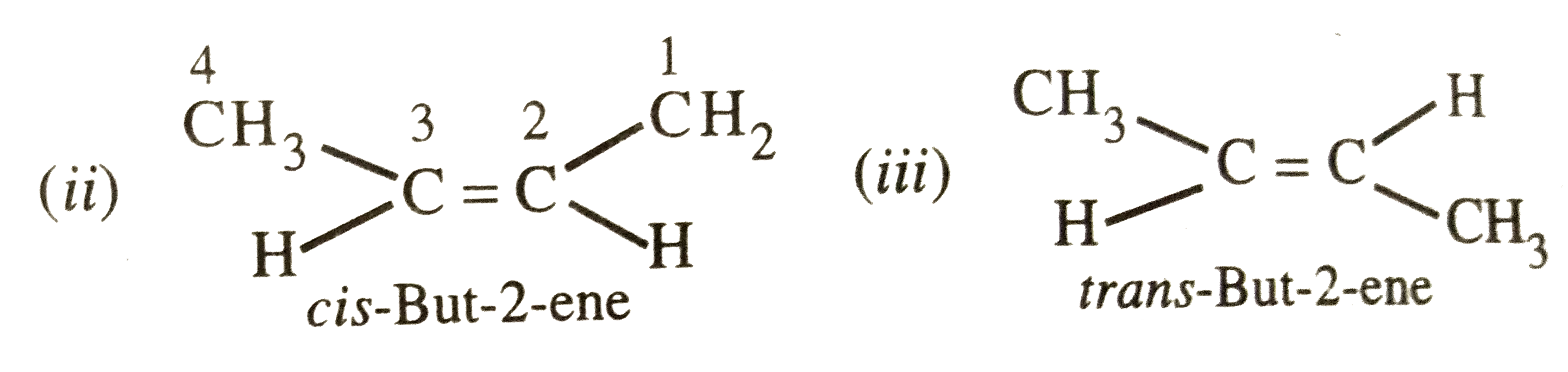 (iv)`underset"2-Methylprop-1-ene"(CH_3-oversetoverset(CH_3)|C=CH_2)` (B)(i)`underset"Pent-1-yne"(CH_3CH_2CH_2overset2C-=overset1CH)` , (ii)`underset"Pent-2-yne"(CH_3CH_2-C-=overset2C-overset1CH_3)` , (iii)`underset"3-Methylbut-1-yne"(CH_3overset3- oversetoverset(CH_3)|(CH)-overset2C-=overset1CH)` |
|
| 49. |
For the following compounds, write structural formulas and IUPAC names for all possible isomers having the number of double or triple bond as indicated: (a)C_(4)H_(8)(one double bond) (b) C_(5)H_(8) (one triple bond) |
Answer» SOLUTION :
|
|
| 50. |
For the following bond cleavages, use curved arrows to show the electron flow and classify each as homolysis or heterolysis. Identify the reactive intermediates produced in gtC=O+hatOH rarr C=O+H_2O |
|
Answer» |
|


