Saved Bookmarks
This section includes 7 InterviewSolutions, each offering curated multiple-choice questions to sharpen your Current Affairs knowledge and support exam preparation. Choose a topic below to get started.
| 1. |
For the following bond cleavages, use curved arrows to show the electron flow and classify each as homolysis or heterolysis. Identify the reactive intermediates produced in CH_3-O-O-CH_3 rarr CH_3-O+CH_3O |
|
Answer» |
|
| 2. |
For the following balanced redox reaction: 2MnO_(4)^(ɵ)+8H^(o+)+Br_(2)to2Mn^(2+)+2BrO_(3)^(ɵ)+2H_(2)O if the molecular weight of MnO_(4)^(ɵ):Br_(2) and Br_(2) be M_(1)M_(2) respectively, then |
|
Answer» equivalent weight of `MnO_(4)^(ɵ)` is `(M_(1))/(5)` (ii). `Br_(2)to2BrO_(3)^(ɵ)+10e^(-)` (iii). `2MnO_(4)^(ɵ)+Br_(2)+8H^(o+)to2Mn^(2+)+2BrO_(3)^(ɵ)+2H_(2)O` `Ew(MnO_(4)^(ɵ))=(M_(1))/(5)(n=5)` `Ew(Br_(2))=(M_(2))/(10)(n=6)` (c). N-factor ratio `((MnO_(4)^(ɵ))/(Br_(2))=(5)/(6)` |
|
| 3. |
For the following bond cleavages, use curved arrows to show the electron flow and classify each as homolysis or heterolysis. Identify reactive intermediate produced as free radical, carbocation and carbanion (a) CH_(3)O- OCH_(3) rarr CH_(3) overset(.)(O) + overset(.)(O)CH_(3) |
Answer» Solution :(a) Type of bond fission: Homolytic  The one-one `e^(-)` Form free radicals of O-O bond transfer on O. The one-one `e^(-)` Form free radicals of O-O bond transfer on O. is `CH_(3)-overset(overset(O)(||))(C )-CH_(3)`. In it the carbanion `-CH_(2)COCH_(3)` is from by heterolytic fission of C-H bond. The transfer of electron pair is as under is `CH_(3)-overset(overset(O)(||))(C )-CH_(3)`. In it the carbanion `-CH_(2)COCH_(3)` is from by heterolytic fission of C-H bond. The transfer of electron pair is as under  (c ) In it, the carbocation `(CH_(3)) C^(+)` is formed by heterolytic fission of C-Br bond and or get the electron pair of C-Br bond  The electron pair of C-Br bond transfer on Br and form corbocation and `Br^(-)`. (d) The heterolytic fission of `pi` bond in C=C and `E^(+)` get electron pair of `pi`-bond and form carbocation `(C_(6)H_(6)E)^(+)` 
|
|
| 4. |
For the exothermic reaction : 4NH_(3)(g)+7O_(2)(g) hArr 4NO_(2)(g)+6H_(2)O(l) Which change will increase the quantity of NO_(2) in the mixture? |
|
Answer» INCREASING temperature |
|
| 5. |
for the exothermic formation of sulphur trioxide from sulphur dioxide. And oxygen in the gas phase: 2SO_(2)(g) + O_(2)(g)hArr 2SO_(3) (g) K_(p) =40 .5 atm^(-1) at 900 K and Delta H =- 198 kJ (i) Write the expression for the equilibrium constant for the reaction. (ii) At room temperature (~~300 K) will K_(p) be greater than less than or equal to K_(p) at 900 K . (iii) How will the equilibrium be affected if the volume of the vessel contaning the three gases is reduced, keeping the termperature constant ? What happens ? (iv) What is the effect of adding 1 mole of He (g) to a flask containing SO_(2),O_(2) and SO_(3) at equilibrium at constant temperatrue ? |
|
Answer» Solution :(i) The expression for the equilibrium constant `(K_(p))` for the reaction is : `K_(p) =(P_(SO_3)^(2)(G))/(P_(SO_2)^(2)(g)xxP_(O_(2)))=40.5 ATM^(-1)` (ii) the forwardreaction is exothermic and the backward reaction is endothermic in nature. Therefore ,the increase in temperature favour the backward reaction. This means that the `K_(p)` at 300 K will be GREATER than the value at 900K. |
|
| 6. |
For the estimation of nitrogen, 1.4 g of an organic compound was digested by Kjeldahl method and the evolved ammonia was absorbed in 60 mL of M/10 sulphuric acid. The unreacted acid required 20 Ml of M/10 sodium hydroxide for completeneutralization. The percentage of nitrogen in the compound is |
|
Answer» 0.05 Let the acid left unused = v mL of M/10 `H_(2)SO_(4)` Volume of M/10 NaOH used to neutralize the unreacted acid = 20mL Applying MOLARITY equation, `underset("(Acid)")(n_(a)M_(a)V_(a)) = underset("(Base)")(n_(b)M_(b)V_(b))` where `n_(a), M_(a)` and `V_(a)` are the basicity, molarity and volume of the acid and `n_(b), M_(b)` and `V_(b)` are the acidity, molarity and volume of the base or `2 xx (1)/(10) xx v = 1 xx (1)/(10) xx 20` `:. v = 10 mL` `:.` Volume of the acid used = 60 - 10 = 50 mL of M/10 `H_(2)SO_(4)` Now % of N `= (1.4 xx "Molarity" xx "Volume" xx "Basicity of the acid used")/("Weight of the SUBSTANCE taken")` `= (1.4 xx 1 xx 50 xx 2)/(10 xx 1.4) = 10.0` |
|
| 7. |
For the equilibrium system FeO(s)CO(g)hArrFe(s)+CO_(2)(g)(Exothermic) How many of the following changes in condition will cause the equilibrium to shift to the right? (1) Add CO_(2) (2) Add FeO (3) Add CO (4) Add positive catalyst (5) Increase temperature |
|
Answer» |
|
| 8. |
For the equilibrium system, 2NOCI_((g)) Leftrightarrow 2NO_((g))+Cl_(2)(g) the value of DeltaG^@ is 28.4 KJ.Calculate the value of equilibrium constant, K_(e). |
|
Answer» |
|
| 9. |
For the equilibrium , 2NOCl(g)hArr2NO(g)+Cl_(2)(g) the value of the equilibrium constant, K_(c) is 3.75xx10^(-6) at 1069K. Calculate the K_(p) for the reaction at this temperature ? |
|
Answer» |
|
| 10. |
For the equilibrium SO_(2)Cl_(2(g)) hArr SO_(2(g))+ Cl_(2(g)). What is the temperature at which (K_(p)(atm))/(K_(c)(M)) = 3? |
|
Answer» 0.027 K `(Kp)/(Kc)=(RT)^(1), 3 = 0.0821 xx T` `IMPLIES T=(3)/(0.0821)=36.5 k` |
|
| 11. |
For the equilibrium reaction : 2H_(2)(g) + O_(2)(g) iff 2H_(2)O(l) at 298 K, DeltaG^(@) = - 474.78 kJ"mol"^(-1). Calculate log K for it. (R = 8.314 J K^(-1) "mol"^(-1)). |
|
Answer» or `log K = -(DeltaG^(@))/(2.303 RT)` `DeltaG^(@) = -474.78 kJ "mol"^(-1), R = 8.314 J K^(-1) "mol"^(-1)` T = 298 K `therefore log K = (-474.78 xx 10^(3)J"mol"^(-1))/(2..3030 xx 8.314 xx 298)` ` = 83.21` . |
|
| 12. |
For the equilibrium reaction,3Fe_((s)) + 4H_(2) O_((g))hArr Fe_(3)O_(4(s)) + 4 H_(2(g))the relation between K_(p) and K_(c) is |
|
Answer» <P>`K_p GT K_c` `Delta ng =0 IMPLIES K_(P)=K_(C)` |
|
| 13. |
For the equilibrium, PCl_(5(g))iffPCl_(3(g))+Cl_(2(g)) at 298K. K_(C)=1.8xx10^(-7) what is DeltaG^(0) for the reaction? (R=8.314JK^(-1)mol^(-1)) |
|
Answer» Solution :`K_(P)=K_(C)(RT)^(Deltan)Deltan=n_(p)-n_(r)=2-1=1` `T=298KR=8.314JK^(-1)mol^(-1)` `K_(P)=(1.8xx10^(-7))(8.314xx298)=4.46xx10^(-4)` `Delta_(r)G^(0)=-2.303RTlogK_(P)` `=2-2.303xx8.314xx298xxlog(4.46xx10^(-4))` `=19118.6Jmol^(-1)=19.12KJmol^(-1)` |
|
| 14. |
For the equilibrium PCI_(5(g)) harr PCI_(3(g)) + CI_(2(g)) , K_c=(alpha^2)/((1-alpha)V) temperature remaining constant, |
|
Answer» `K_c` will increase with increase in volume |
|
| 15. |
For the equilibrium of the reaction NH_(4) Cl(s) hArr NH_(3) (g) + HCl (g)Kp = 81 atm^(2). Total pressure at equilibrium will be x times the pressure of NH_(3). The value of x will be ........ |
|
Answer» <P>  `K_(P)=PNH_(3).PHCL=P^(2)NH_(3)` (`:. PNH_(3)=PHCl`) `PNH_(3)=sqrt(K_(P))=9` atm = PHCl TOTAL pressure = `PHN_(3)+PHCl=18` atm `=2 XX PNH_(3)` `=PNH_(3)=9` atm = x Total pressure of equilibrium `=PNH_(3)+PHCl=9+9=18` atm `=2 xx "partial pressure of" NH_(3)` |
|
| 16. |
For the equilibrium N_2O_4(g)+heathArr2NO_2(g), which of the following will increase degree of dissociation (alpha) of N_2O_4(g)? |
|
Answer» Increasing temperature at constant volume |
|
| 17. |
For the equilibrium N_(2(g))+3H_(2(g))hArr2NH_(3(g)) Write K_(P) and K_(C) relationship. |
|
Answer» SOLUTION :`N_(2(G))+3H_(2(g))hArr2NH_(3(g))` `Deltan=np-np=2-4=-2` `K_(P)=K_(C)(RT)^(DeltaN)""KP=KC(RT)^(-2)""K_(P)=(K_(C))/((RT)^(2))` |
|
| 18. |
For the equilibrium LiCl.3NH_(3(s))harrLiCl.NH_(3(s))+2NH_(3(g)) [K_(p)=9atm^(2)]. At 0^(@)C. A 44.8 litre vessel contains 1 mole of LiCl.3NH_(3). How many mole of NH_(3) shoul be added to the flask at this temperature to drive the backward reaction to almost completion? |
|
Answer» |
|
| 19. |
For the cqiuilibrium LiCI 3NH_(3(s)) LiCI NH_(3(s)) + 2NH_(3(g)),Kp = 9 atm^(2) "at" 37^(@)C. A 5 lires vesel contains 0. 1 mole of LiCI NH_(3). How many moles of NH_(3) should be added to the llask at this temperature to derive the backward reaction for completion ? |
|
Answer» <P>0.2 `K_(P) =9 implies P_(NH_(3)) = 3 implies n_(NH_(3)) = 0.59` `:.` TOTAL moles to be added = 0.2 + 0.59 = 0.79 |
|
| 20. |
For the equilibrium in gaseous phase in 2 lit flask we start with 2 moles of SO_(2) and 1 mole of O_(2) at 3 atm, 2SO_(2(g)) + O_(2(g)) hArr 2SO_(3(g)). When equilibrium is attained, pressure changes to 2.5 atm. Hence, equilibrium constant K_(c)is : |
|
Answer» Moles at equilibrium = 3-x At equilibrium pressure becomes 2.5 atm since pv= NRT Hence `p alpha n` Thus `(3-x)/(3)=(2-5)/(3)`, x=0.5 `[SO_(2)]=(2-2x)/(2)=0.5M` `[O_(2)]=(1-x)/(2)=0.25M, (SO_(3))=(2x)/(2)=0.5M` `K_(c)=([SO_(3)]^(2))/([SO_(2)]^(2)[O_(2)])=((0.5)^(2))/((0.5)^(2) xx 0.25)=4` |
|
| 21. |
For the equilibrium BaCo_(3)(s)hArrBaO(s)+CO_(2)(g) What is the effect of increase in pressure on the above equilibrium? |
| Answer» SOLUTION :Increase in pressure SHIFTS the equilibrium to left or BACKWARD reaction is FAVOURED. | |
| 22. |
For the equilibrium BaCo_(3)(s)hArrbaO(s)+CO_(2)(g) (i) Write the expression of Kp. |
|
Answer» <P> SOLUTION :`K_(p)=P_(CO_(2))` |
|
| 23. |
For the equilibrium at 2.0 bar N_(2(g)) + 3H_(2(g)) harr 2NH_(3(g)) [(del)/(del p) log K_(x)] = ? |
|
Answer» `Kp=K_(x)(p)^(Delta n_(g))` `log Kp=Delta n_(g)log+log K_(x)` `logK_(x)=logKp-Delta ng logp` `(DEL)/(del p)logK_(x)=0-(Delta ng)/(p)=(0-(-2))/(2)=1` |
|
| 24. |
For the equilibrium A_((g)) + B_((g)) + C_((g)) , K_(p) = 0.82 atm at 27^(@)C. At the same temperature its K_(C) in mol li^(-1) is (R = 0.082 lit atm mol^(-1) K^(-1)) |
|
Answer» `0.033` |
|
| 25. |
For the equilibrium AB_((g)) harr A_((g)) +B_((g)), at a given temperaturer (1)/(3)rd of AB is dissociated then (P)/(K_(P)) will be numerically equal to ____ |
|
Answer» <P>  `P_(AB)=(2//3)/(4//3)P, P_(A)=P_(B)=(1//3)/(4//3)P=(1)/(4)P=(1)/(2)P` `K_(P)=(P//4 XX P//4)/(P//2)=(P)/(8)` |
|
| 26. |
For the equilibrium, 2SO_2(g)+O_2(g)hArr2SO_3(g),DeltaH=-198kJ the equilibrium concentration of SO_3 will be affected by |
|
Answer» doubling the volume of the reaction vessel |
|
| 27. |
For the equilibrium 2NOCl_((g)) hArr 2NO_((g)) + Cl_(2(g)) the value of the equilibrium constant, K_c is 3.75 xx 10^(-6) at 1069 K. Calculate the K_p for the reaction at this temperature ? |
|
Answer» Solution :`{:("Reaction equilibrium:", 2NOCl hArr , 2NO_((G)) + , Cl_(2(g)) ), ("Stoichiometric :", 2,2,1):}` `therefore Deltan_((g))= sumn_("(g)product")-sumn_("(g)REACTANT")` =(2+1)-2 =+1 At given temperature equilibrium at gas phase, the reaction between `K_p` and `K_c`. `K_p=K_c (RT)^(Deltan)` where , `K_c=3.75xx10^(-6), Deltan = +1 , T=1069 K` R=0.0831 BAR L `"mol"^(-1) K^(-1)` `therefore K_p=(3.75xx10^(-6))(1069xx0.0831)` =`333.1 xx 10^(-6)=3.331xx10^(-4)` bar |
|
| 28. |
For the equilibrium, 2 NOCl (g) hArr 2 N O (g) + Cl_(2) (g), the value of the equilibrium constant, K_(c)" is " 3.75 xx 10^(-6)" at " 1069 K." Calculate " K_(p) for the reaction at this temperature. |
|
Answer» Solution :For the given reaction , `Delta n = (2+1) - 2 = 1` `K_(p) = K_(c)(RT)^(Delta n) = (3. 75 XX 10^(-6)) ( 0.0831 xx 1069)` `= 3.33 xx 10^(-4)`. |
|
| 29. |
For the equilibirum, PCl_(5)(g) hArr PCl_(3)(g) + Cl_(2)(g) at 298 K, K = 1.8 xx 10^(-7). Calculate Delta G^(@) for the reaction (R = 8.314 JK^(-1) mol^(-1)). |
|
Answer» Solution :`PCl_(5)(g) HARR PCl_(3)(g) + Cl_(2)(g), ""K = 1.8 xx 10^(-7)` `Delta G^(@) = -2.303 RT log K = -2.303 xx 8.314 JK^(-1) mol^(-1) xx 298 K xx log(1.8 xx 10^(-7))` `= -2.303 xx 8.314 xx 298[log 1.8 + log10^(-7)] = -19.147 xx 298[0.2553 - 7.000]` `Delta G^(@) = (-19.147 xx 298 xx (-6.7447))/(1000) = +34.48 KJ mol^(-1)` |
|
| 30. |
For the equations C("diamond")+2H_(2)(g)toCH_(4)(g)""DeltaH_(1), C(g)+4H(g)toCH_(4)(g)""DeltaH_(2) Predict whether |
|
Answer» `C(g)+4H(g)toCH_(4)(g)""DeltaH_(2),` |
|
| 31. |
For the energy levels in an atom, which one of the following statement(s) is (are) correct ? |
|
Answer» There are seven principal electron energy levels b) is wrong because for m = 2. l=0 ,1(two sub-energy levels). c) is wrong because M shell means N =3 . Maximum electrons it can have = `2n^2= 2 xx 3^2 = 18` |
|
| 32. |
For the energy levels in an ato which one of the following statements is/are correct? |
|
Answer» There are seven principal electron ENERGY LEVELS. |
|
| 33. |
For the Element with atomic number 24: (i) Write the electron configuration (ii) Write the valeu of u and I for its electron in the valence shell. (iii) How many unpaired electrons are pasent in it? |
|
Answer» SOLUTION :a. (i) `1S^(2) 2S^(2)2sp^(5)3S^(2)3p^(6),4s^(1)3d^(5)` (B) `n=4, 1=0` (c) Six or 6 |
|
| 34. |
For the electrophilic substitution reaction sulphonation which of the following sequence regarding the rate of the reaction is true |
|
Answer» `KC_(6)H_(6) gt KC_(6)D_(6) gt KC_(6)T_(6)` |
|
| 35. |
For the electrophilic substitution reaction involving nitration, which of the following sequence regarding the rate of the reaction is true? |
|
Answer» `KC_(6)H_(6) GT KC_(6)D_(6) gt KC_(6)T_(6)` |
|
| 36. |
For the electrons of oxygen atom, which of the following statements is correct ? |
|
Answer» `Z_("eff")` for an electron in a 2s orbital is the same as `Z_("eff")` for an electron in a 2p orbital |
|
| 37. |
For the electrolyte of type ,A_2B, K_(sp)is given. Then its solubility is calculated by |
|
Answer» `K_(sp)//4` ` KsP =(2s)^(2) (S) =4S^(3) RARR S= 3sqrt((KsP)/(4))` |
|
| 39. |
For the dissociation of MgCO_(3) as MgCO_(3)(s) hArr MgO(s)+CO_(2)(g). Identify the correct option regarding extent of dissociation of MgCO_(3). |
|
Answer» As temperature is INCREASED, extent of dissociation decreases. |
|
| 40. |
For the diffusion of a gas at pressure P, the rate of diffusion is expressed by |
|
Answer» `R alpha P/(sqrtM)` |
|
| 41. |
For the decomposition reaction NH_(2)COONH_(4)(s)hArr2NH_(3)(g) + CO_(2)(g) The value of K_(c) at this temperature will be |
|
Answer» `0.0194` atm 121 `K_(p) = 2.9xx10^(-5)atm^(3)` If the P is the total PRESSURE at EQUILIBRIUM `K_(p) = ((2P)/(3))^(2) ((p)/(3))` `:. P^(3) = (27xx2.9xx10^(-5))/(4) = 1.9575` `P = 3sqrt(1.9575) = 1.9575` `P = 3sqrt(1.9575) = 0.058` |
|
| 42. |
For the decolorisation of 1 mole of KMnO_(4), the number of moles of H_(2)O_(2) required is : |
|
Answer» `1//2` |
|
| 43. |
For the configuration 1s^(2)2s^(1), the quantum numbers for the outermost electron are |
|
Answer» 2,1,0,-1/2 |
|
| 44. |
For the compound with molecular, formula C_(3)H_(5)Br_(3). The number of optically active stereo isomers and total number of isomer are respectively |
| Answer» Solution :2 and 6 | |
| 45. |
For the compound CH-=C-CH=CH-CH_(3) (i) Write the bond line formula for the compound. (ii) Identify the number of Sigma and Pi-bonds. |
Answer» Solution :(i) 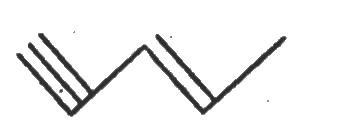 (ii) `SIGMA` BONDS `=10, pi`- bonds -3 |
|
| 46. |
For the complete combustion of ethanol, C_(2)H_(5)OH(l)+3O_(2)(g)rarr 2CO_(2)(g)+3H_(2)O(l) the amount of heatproduced, as measured in bomb calorimeter,is1364.47 kJ mol^(-1) at25^(@)C. Assuming idealty the enthalpy of combustion , Delta_(c) H, for the reaction will be ( R = 8.314JK^(-1) mol^(-1)) |
|
Answer» `-1350.50 kJ MOL^(-1)` `Deltan_(g) = ( n_(p) -n_(r))_("GASEOUS") = 2-3= -1` `T = 25+273= 198 K` `DeltaH = DeltaU + Deltan_(g) RT` `= - 1364.47kJ + ( -1)` `( 8.314 XX 10^(-3) kJ K^(-1) mol^(-1))( 298K)` `= - 1364 .47 - 1 xx 8.314 xx 10^(-3) xx 298K` `= - 1364.47 -2477.57 xx 10^(-3)` `= - 1364.47 - 2.477 = - 1366.95kJ mol^(-1)` |
|
| 47. |
For the Chemical reaction A_(2(g)) + B_(2(g)) hArr2 AB(g) the amount of AB at equilibrium is affected by |
|
Answer» TEMPERATURE and PRESSURE |
|
| 48. |
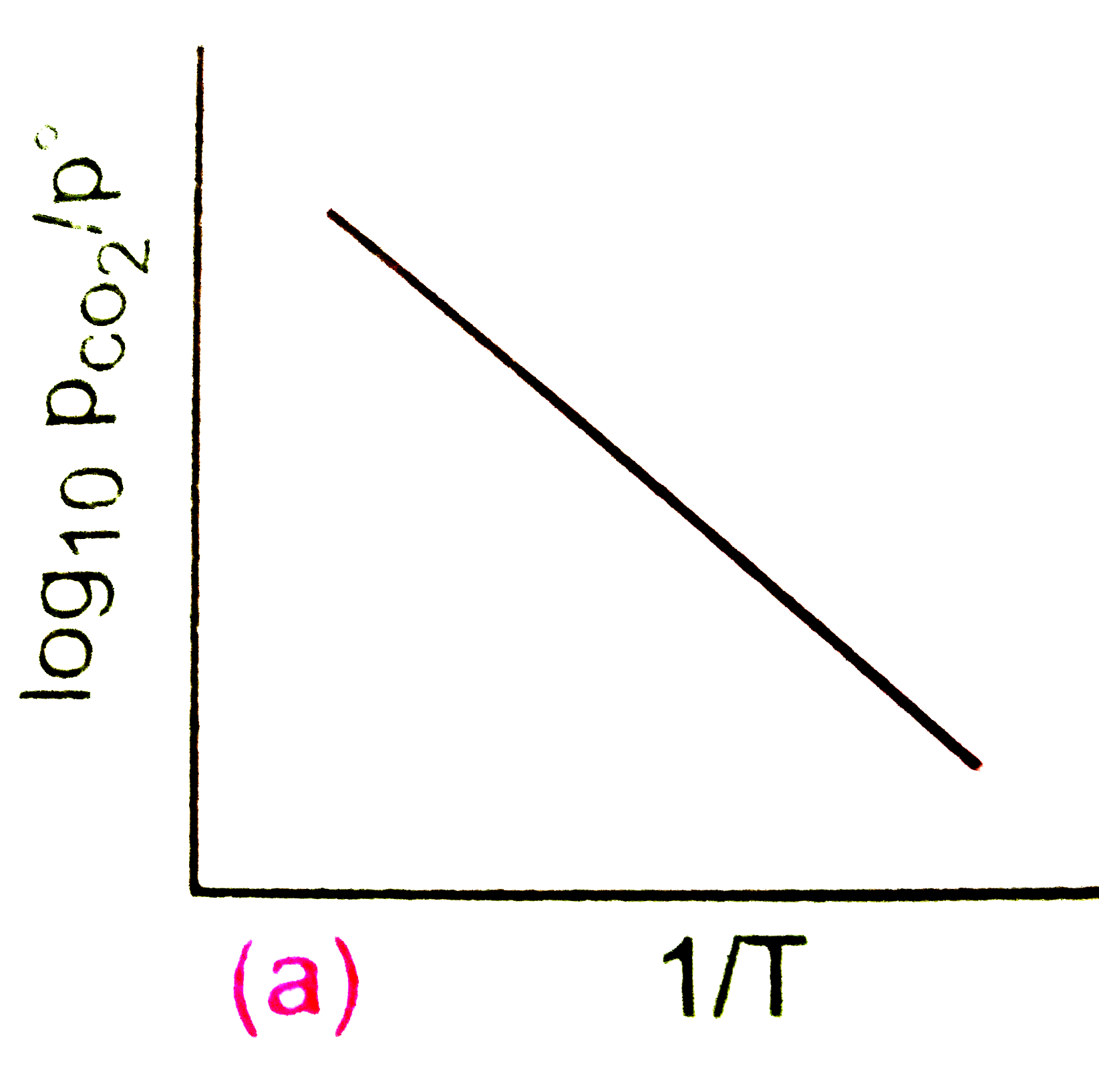
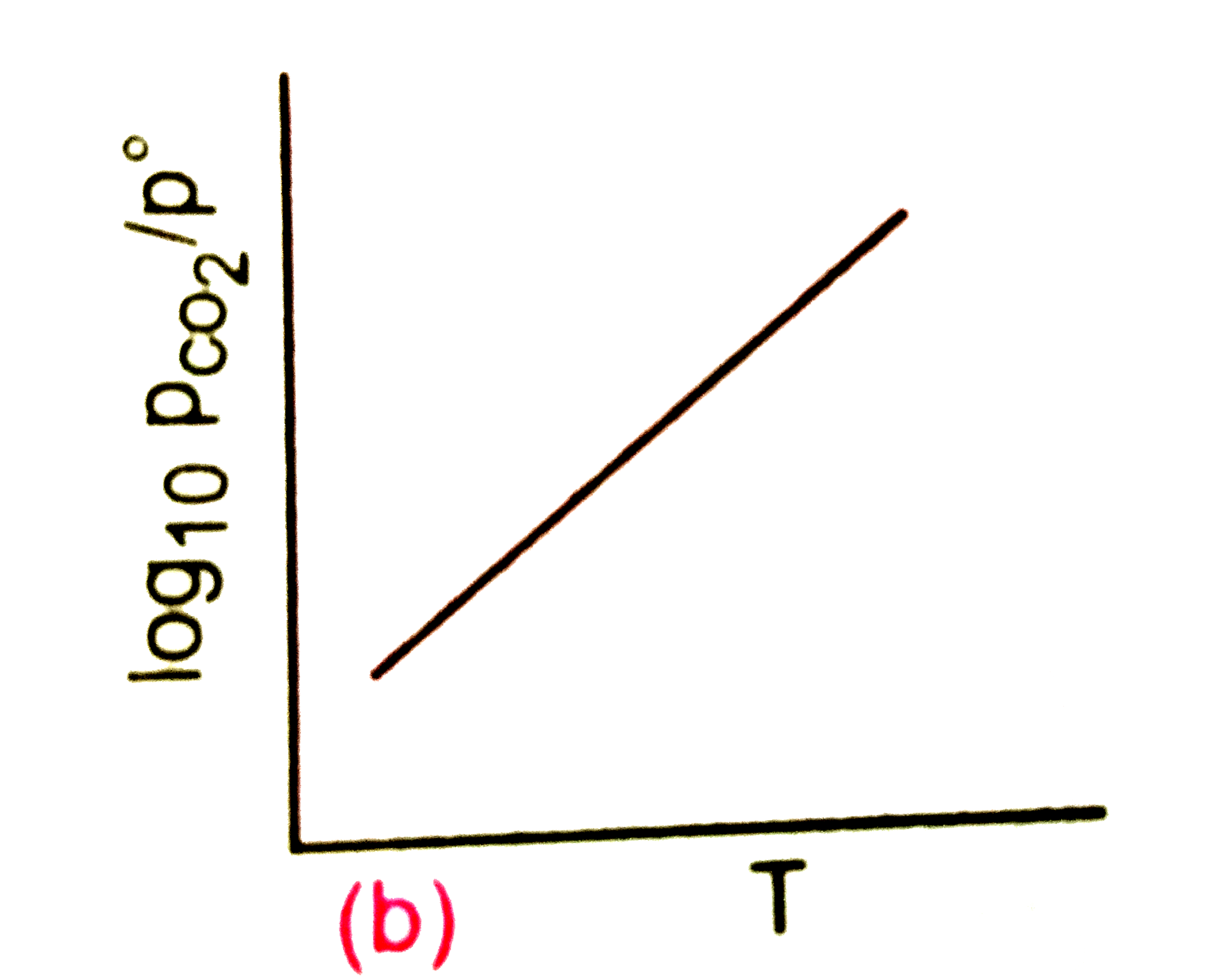
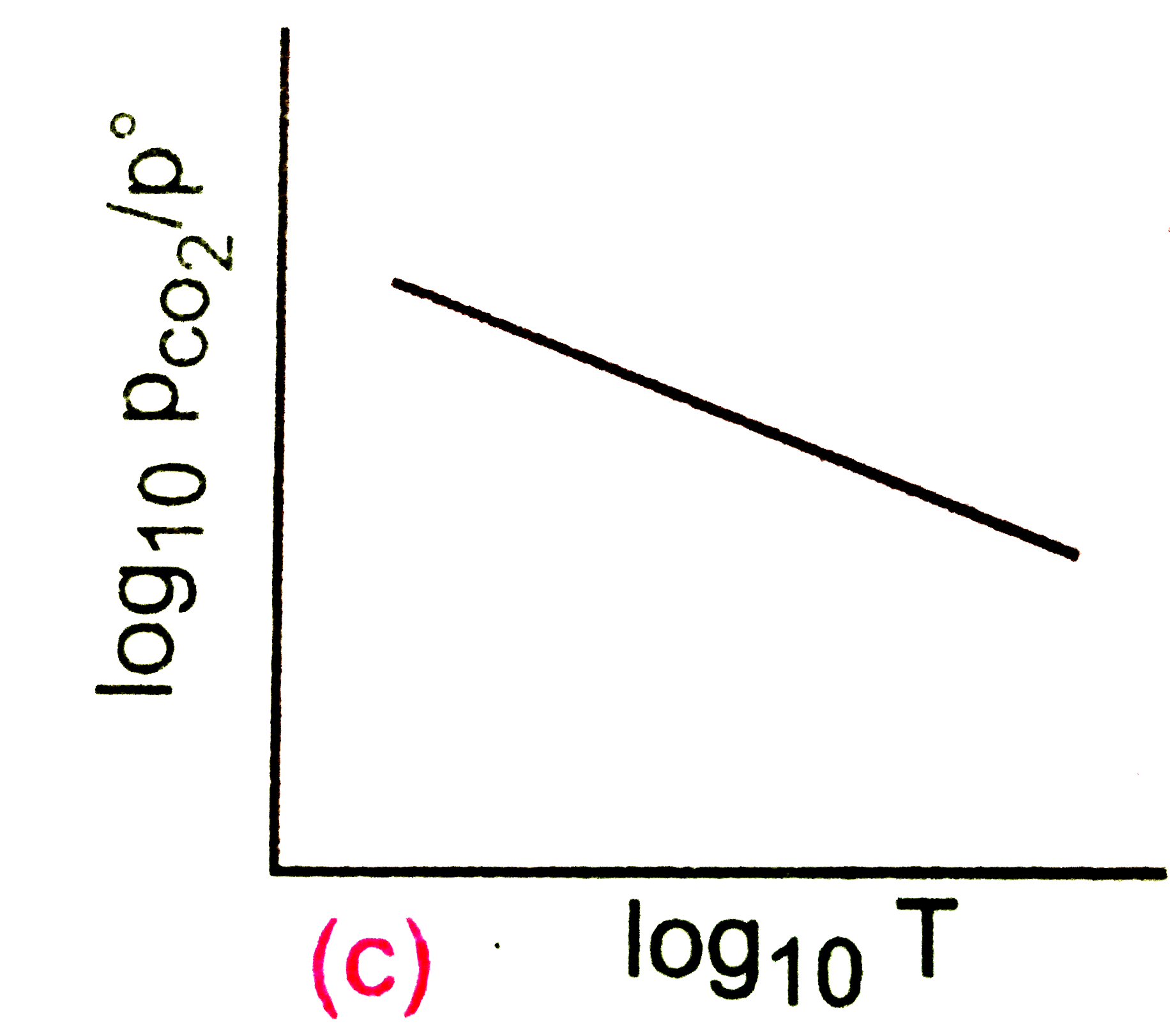
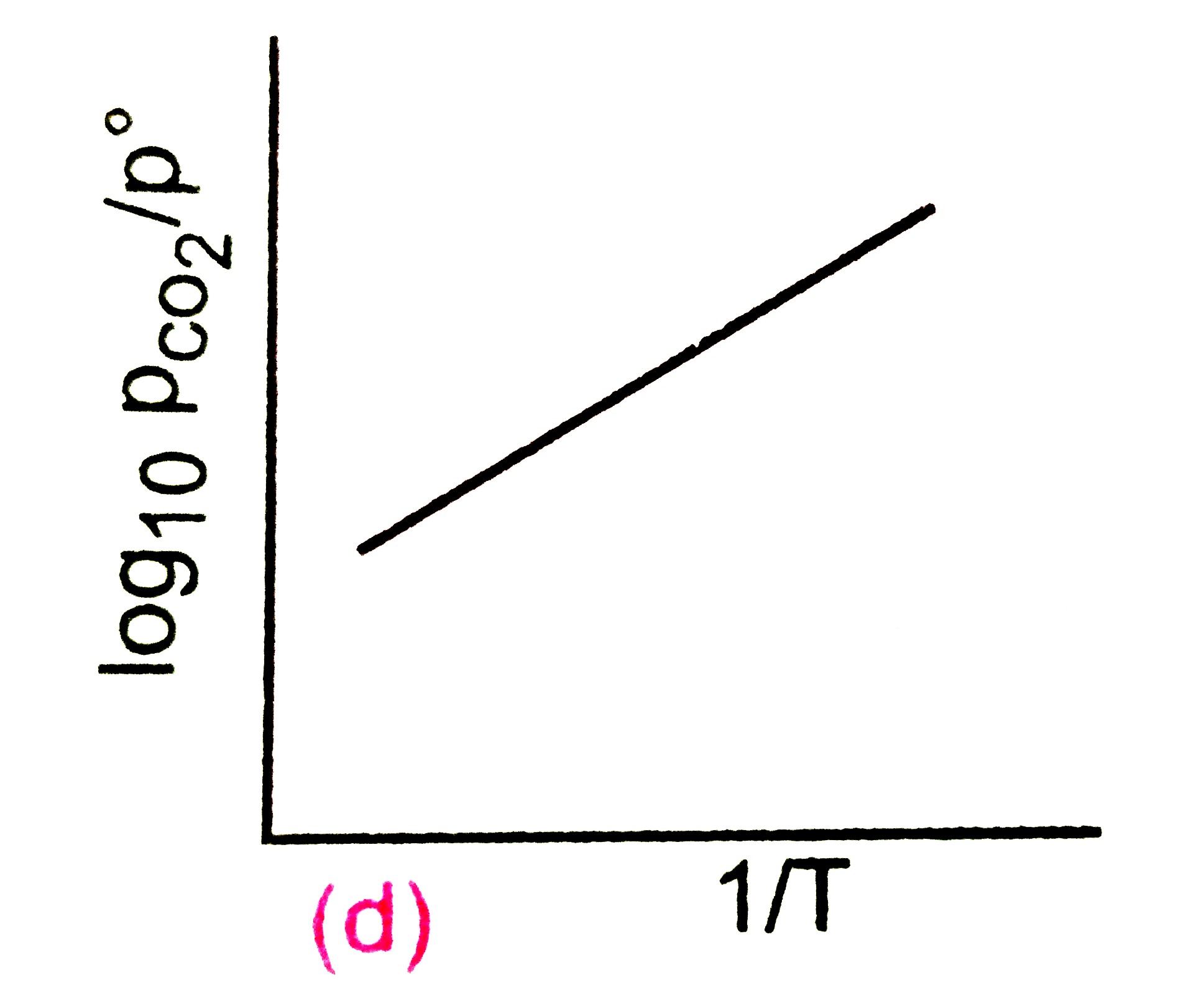
For the chemical equilibrium , CaCO_3 (s) hArr CaO (s) + CO_(2) (g) , Delta_(r) H^(@) can be determined from which of the following plots ? |
|
Answer»
`(p^(@) " = Reference PRESSURE of 1 atm )` According to van't Hoff equation , ` (d 1n K_(p))/(DT)= (Delta H^(@))/(RT)+2` ` :.1n K_(p) = -(Delta H)^(@)/(RT)+ I` ` (2*303 log p_(CO_(2)))/P^(@) = -(DeltaH^(@))/(RT) + I` HENCE , plot of log `p_(CO_(2))//p^(@)` versus 1/Twill be a stright line with a negative SLOPE . |
|
| 49. |
For the change N_(2)O_(4) hArr 2NO_(2) what are the slope and intercept constants respectively of plot of degrece D of dissociation a (Y - axis) and (D)/(d) (density before dissociation : density after dissociation) |
|
Answer» 1, -1 |
|
| 50. |
For the cell reaction , |Cu| Cu^(2+)(aq)|Ag^(+)|Ag is E^(@) Cu^(2)|Cu=+0.34 V adb nE^(@) Ag^(+) |Ag=0.80 V and [Cu^(+2)]=0.01 and [Ag^(+)] = 1.0 "mol dm"^(-3) the emf of the cell is |
|
Answer» 0.34 V `=0.80-0.34+(0.059)/(2)"log"((1.0)^(2))/(0.01)` `=0.46 +(0.059)/(2) xx 2=0.46+0.059` =0.52 V |
|