

Saved Bookmarks
This section includes 7 InterviewSolutions, each offering curated multiple-choice questions to sharpen your Current Affairs knowledge and support exam preparation. Choose a topic below to get started.
| 1. |
Hydrogen peroxide can be preapared bythe action of dil. H_(2)SO_(4) or H_(3)PO_(4) on barium peroxide or by bubbling peroxide . On an industrial scale, it can be prepared by hydrolysis of peroxodisulphuric acid obtained by electrolysis of 50% H_(2)SO_(4) or an equimolar mixture of H_(2)SO_(4) and ammonium sulphate . The strength of H_(2)O_(2) solution can be expressed in a number of ways namely normality , molarity , percentage strength and volume strength . Volume strength refers to the volume of O_(2) produced at N.T.P. by decomposition of 1 mL of H_(2)O_(2) solution. H_(2)O_(2) acts as an oxidising as well as reducing agent both in acidic and basic media. The volume of 10 volume H_(2)O_(2) solution that decolourises 200 mL of 2N KMnO_(4) solution in acidic medium is : |
|
Answer» 112 mL |
|
| 2. |
Hydrogen peroxide can be preapared bythe action of dil. H_(2)SO_(4) or H_(3)PO_(4) on barium peroxide or by bubbling peroxide . On an industrial scale, it can be prepared by hydrolysis of peroxodisulphuric acid obtained by electrolysis of 50% H_(2)SO_(4) or an equimolar mixture of H_(2)SO_(4) and ammonium sulphate . The strength of H_(2)O_(2) solution can be expressed in a number of ways namely normality , molarity , percentage strength and volume strength . Volume strength refers to the volume of O_(2) produced at N.T.P. by decomposition of 1 mL of H_(2)O_(2) solution. H_(2)O_(2) acts as an oxidising as well as reducing agent both in acidic and basic media. The correct increasing order of the acidity of CO_(2), H_(2)O and H_(2)O_(2) is |
|
Answer» `CO_(2) lt H_(2)O_(2) lt H_(2)O` `BaO_(2) + underset("Stronger acid")ubrace (H_(2)O+CO_(2))to BaCO_(2) + underset("Weaker acid")(H_(2)O_(2))` i.e. `CO_(2)` is a stronger acid from `H_(2)O_(2)` `therefore ` option (b) is correct |
|
| 3. |
Hydrogen peroxide can be preapared bythe action of dil. H_(2)SO_(4) or H_(3)PO_(4) on barium peroxide or by bubbling peroxide . On an industrial scale, it can be prepared by hydrolysis of peroxodisulphuric acid obtained by electrolysis of 50% H_(2)SO_(4) or an equimolar mixture of H_(2)SO_(4) and ammonium sulphate . The strength of H_(2)O_(2) solution can be expressed in a number of ways namely normality , molarity , percentage strength and volume strength . Volume strength refers to the volume of O_(2) produced at N.T.P. by decomposition of 1 mL of H_(2)O_(2) solution. H_(2)O_(2) acts as an oxidising as well as reducing agent both in acidic and basic media. Hydrolysis of one mole of peroxodisulphuric acid produces |
|
Answer» two MOLES of sulphuric ACID |
|
| 4. |
Hydrogen peroxide can act both as an oxidising as well as reducing agent. Expalin. |
Answer» SOLUTION :The change in oxidation number accompanyin the DECOMPOSITION of `H_(2)O_(2)` is as FOLLOWS: 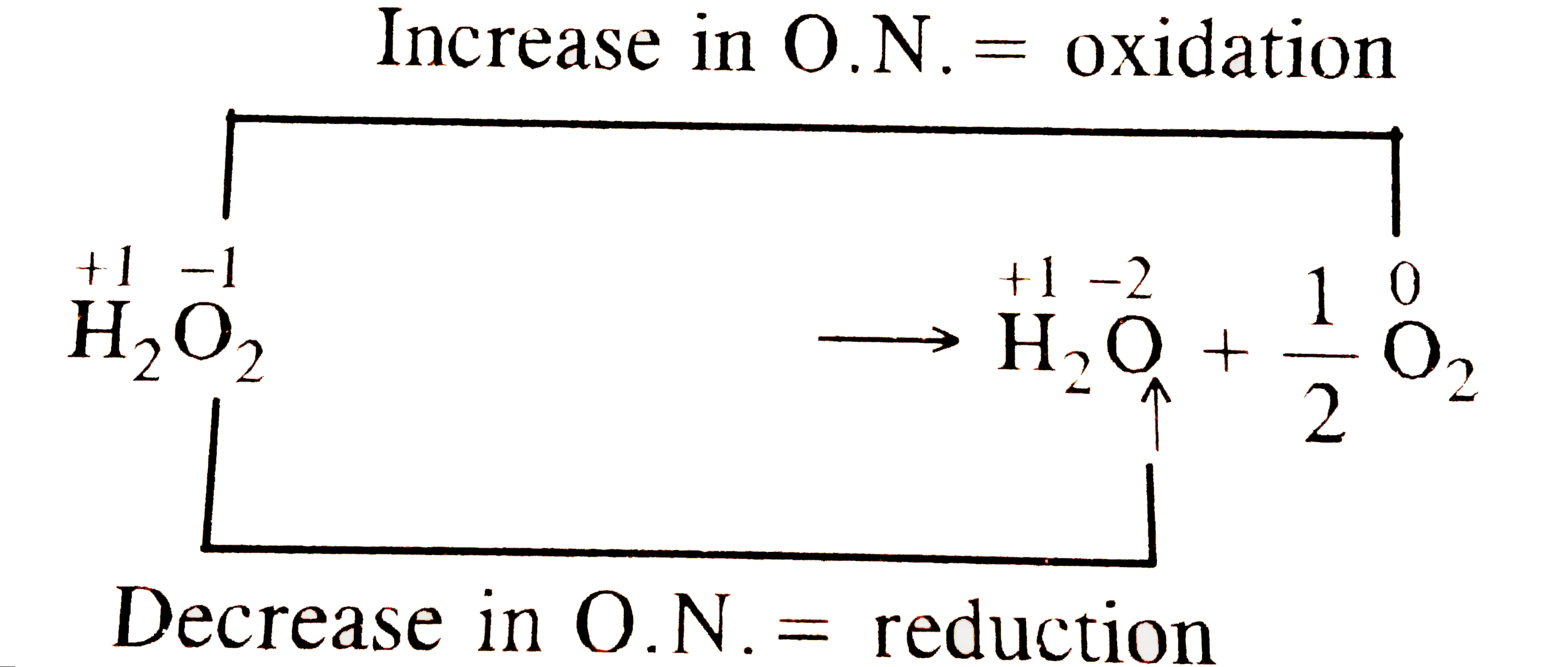 Since oxygen atom in `H_(2)O_(2)` can undergo an increase as well as decrease in oxidation number therefore, it can act both as reducing as well as OXIDISING agent. This is supported by the following reactions. As reducing agent: `"" overset(+1)(AgO)+underset("Reducing agent")(H_(2)overset(-1)(O_(2))) to 2overset(0)(Ag)+H_(2)O+overset(0)O_(2)` In this reaction, `H_(2)O_(2)` actsas reducing agent and has reduced `Ag_(2)O` to metallic Ag. As oxidising agent: `"" Pboverset(+2)S+underset("Oxidising agent")(4H_(2)overset(-1)(O_(2))) to Pboverset(+6)(SO_(4))+4H_(2)O^(-2)` |
|
| 5. |
Hydrogen peroxide and water contain 5.93 % and 11.2 % of hydrogen respectively. Show that the data illustrates the law of multiple proportions. |
|
Answer» Solution :In `H_(2)O_(2)` Percentage of `H = 5.93` Percentage of `O = 100 - 5.93 = 94.07` 5.93 g of hydrogen are combined with oxygen = 94.07 g 1.0 g of hydrogen is combined with oxygen `= (94.07)/(5.93) g = 15.86 g` In `H_(2)O` Percentage of `H = 11.2` Percentage of `O = 100 - 11.2 = 88.8 ` 11.2 g of hydrogen are combined with oxygen = 88.8 g 1.0 g of hydrogen is combined with oxygen `= (88.8)/(11.2)g =7.93 g` RATIO by weights of oxygen combining with 1.0gram of hydrogen in thetwo oxides is 15.86 : 7.93 or 2 : 1 Since it is a SIMPLE WHOLE number ratio, the data is according to Law of Multiple PROPORTIONS. |
|
| 6. |
Hydrogen peroxide acts both as an oxidizing agent as a reducing agent in alkaline solution towards certain first row transition metal ions. Illustrate both these properties of H_(2)O_(2) using chemical equations. |
|
Answer» Solution :Oxidising agent : `2Cr(OH)_(3)+4NaOH+3H_(2)O_(2)to2Na_(2)CrO_(4)+8H_(2)O` Here, `Cr^(3+)"gets oxidized to"Cr^(6+)` Reducing : `2K_(3)[FE(CN)_(6)]+2KOH+H_(2)O_(2)to2K_(4)[Fe(CN)_(4)]+2H_(2)O+O_(2)` Here , `Fe^(3+)` gets reduced to `Fe^(2+).` |
|
| 7. |
Hydrogen peroxide acts as: |
|
Answer» An oxidising AGENT |
|
| 8. |
Hydrogen perioxde is obtained and hydrogen peroxide |
|
Answer» water |
|
| 9. |
Hydrogen molecule (H_(2)) can be dissociated into hydrogen atoms (H) . Which one of the following changes will not increase the number of atoms present at equilibrium ? |
|
Answer» adding H atoms |
|
| 10. |
Hydrogen molecule differs from chlorine molecule in the following respect |
|
Answer» HYDROGEN molecule can TAKE part in the formation if INTER MOLECULAR hydrogen bond while chlorine molecule does not |
|
| 11. |
Hydrogen mainly resembles halogens in the property |
|
Answer» It FORMS `H^+(AQ)` ion |
|
| 12. |
Hydrogen is the first element in the perodic table and is also the highest element known. Molecular hydrogen is best prepared by the electrolysis of water containing a small amount of acid or alkali. It is also a constituent of water gas (CO+H_(2)) known as syn gas. Hydrogen is releatively inert at room temperatrure due very high bond dissociatin enthalpy (430.0kJ mol^(-1)) of H-H bond. (i) Why does hydrogen act as a powerful reducing agent? (ii) How does hydrogen cause of unsaturatedhydrocarbons? (iii) Hydrogen- oxygen fuel are used for generating electrical energy. How are those cells better than the conventional fuels? |
|
Answer» Solution :(i) Hydrogen atom(H) can part the only with only electron which it has and therefore. Acts as a reducing agent. (ii) Molecular hydrogen adds on the compounds having multiple bonds `(C-=C and C=C "bonds")` and converts them into SATURATED hydrocarbons. `underset("Ethyne")(HC)-=CH+2H_(2) overset(Ni//573K) to underset("Ethyne")(CH_(3))-CH_(3)` (III) The followingelectrode REACTIONS take place in hydrogen oxygen fuel cell At anode:`2H_(2)(g)+4OH^(-)(aq) to 4H_(2)O(l)+4e^(-)` At cathode: `O_(2)(g)+2H_(2)O(l)+4e^(-) to OH^(-)(aq)` `2H_(2)(g)+O_(2)(g) to 2H_(2)O(l)` Step III Calcination of volume strength of `H_(2)O_(2)` `5 cm^(2) of H_(2)O_(2) "solution gives"=22.4cm^(3) "of oxygen at N.T.P."` `1cm^(3) "of" H_(2)O_(2) "solution will give"=(22.4)/(5)=4.48cm^(3) "of oxygen at N.T.P."` `"Volume strength of" H_(2)O_(2)=4.48` |
|
| 13. |
Hydrogen is used as reducing agent in metallurgy for the reduction of ... oxide |
|
Answer» Zinc |
|
| 14. |
Hydrogen is not obtained when zinc reacts with |
|
Answer» COLD WATER |
|
| 15. |
Ethanamine can be obtained from methyl iodide by the action of alc. KCN followed by |
| Answer» Solution :`Mn and Mn + "cold and dil "HNO_3 to Mg(NO_3)_2 + H_2Mn(NO_3)_2` | |
| 17. |
hydrogen is an enormousy attractive fuel because it is enviromently clean.'Hydrogen economy' isa newfield in which it is thought that our energy needs can be met by gaaseous, liquid and solid hydrogen. Since hydrogen is not a naturally occuring substance like coal, oil or natural gas, energy must be expended to produce hydrogen before it can be used. Current researches are therefore, on finding cheaper methods for extracting hydrogen. Liquid H_(2) has been used as a rocket fuel because of |
|
Answer» High thrust |
|
| 18. |
hydrogen is an enormousy attractive fuel because it is enviromently clean.'Hydrogen economy' isa newfield in which it is thought that our energy needs can be met by gaaseous, liquid and solid hydrogen. Since hydrogen is not a naturally occuring substance like coal, oil or natural gas, energy must be expended to produce hydrogen before it can be used. Current researches are therefore, on finding cheaper methods for extracting hydrogen. Which isotope of hydrogen is radioactive in nature? |
|
Answer» PROTIUM only |
|
| 19. |
hydrogen is an enormousy attractive fuel because it is enviromently clean.'Hydrogen economy' isa newfield in which it is thought that our energy needs can be met by gaaseous, liquid and solid hydrogen. Since hydrogen is not a naturally occuring substance like coal, oil or natural gas, energy must be expended to produce hydrogen before it can be used. Current researches are therefore, on finding cheaper methods for extracting hydrogen. Which of the following gas is lightest? |
|
Answer» OXYGEN |
|
| 20. |
hydrogen is an enormousy attractive fuel because it is enviromently clean.'Hydrogen economy' isa newfield in which it is thought that our energy needs can be met by gaaseous, liquid and solid hydrogen. Since hydrogen is not a naturally occuring substance like coal, oil or natural gas, energy must be expended to produce hydrogen before it can be used. Current researches are therefore, on finding cheaper methods for extracting hydrogen. If an isotope of hydrogen has two neutrons in its atoms, its atomic number and atomic mass number will respectively by: |
| Answer» Solution :(d) It is called tritutum and is represented as `(._(1)^(3)H)` | |
| 21. |
hydrogen is an enormousy attractive fuel because it is enviromently clean.'Hydrogen economy' isa newfield in which it is thought that our energy needs can be met by gaaseous, liquid and solid hydrogen. Since hydrogen is not a naturally occuring substance like coal, oil or natural gas, energy must be expended to produce hydrogen before it can be used. Current researches are therefore, on finding cheaper methods for extracting hydrogen. Which fuel does produce least enviormental pollution? |
|
Answer» KEROSENE oil |
|
| 22. |
Hydrogen ion concentration of a solution is 2.5xx10^(-4)"mol "dm^(-3)" at "25^(@)C. Calculate its OH^(-) ion concentration. |
|
Answer» Solution :We know that `[H_(3)O^(+)][OH^(-)]=10^(-14)" at "25^(@)C` `therefore[OH^(-)]=(10^(-4))/([H_(3)O^(+)])=(10^(-14))/(2.5xx10^(-4))=4xx10^(-11)"MOL"//dm^(3)` |
|
| 23. |
Hydrogen as the tendency to gain one electron to acquire bellum configuration in this respect, it resembles |
|
Answer» ALKALI metals |
|
| 24. |
Hydrogen has similarity with alkali metals in |
|
Answer» NATURE of oxide |
|
| 25. |
Hydrogen generally forms covalent compounds. Give reason. |
|
Answer» Solution :HYDROGEN has one electron which it can either LOSE or gain or share to acquire NOBLE GAS, i.e. helium gas CONFIGURATION. So, in principle, it can form either ionic or covalent bonds. But the ionisation enthalpy of hydrogen is very high (1312 kJ `"mol"^(-1)`) and its electron gain enthalpy is only slightly negative (-73 kJ `"mol"^(-1)` ). As a result, it does not have a high tendency to form ionic bonds but rather prefers to form only covalent bonds. |
|
| 26. |
Hydrogen gas is perpared in the laboratory by reacting dilute HCl withgranulated zinc. Following reaction takes place. Zn+2HCl rarr ZnCl_(2) +H_(2) Calculate the volume of hydrogen gas liberated at STP when 32.65 g of zinc reacts with HCl. 1 mol of a gas occupies 22.7 L volume at STP, atomic mass of Zn= 65.3 u. |
|
Answer» Solution :Mass of `Zn= 32.65 g` (given) 1 mole of gas `= 22.7` L volume at STP Atomic mass of `Zn= 65.3u` The given EQUATION is `{:(Zn+2HClrarrZnCl_(2)+H_(2)),(65.3g"1 mol "= 22.7 L " at STP"):}` from the above equation 65.3 g Zn, when reacts with HCL, produces `=22.7 L` of `H_(2)` at STP. `:.` 32.65 g Zn, when reacts with HCl, will produce `=(22.7xx32.65)/(65.3) = 11.35L` of `H_(2)` at STP. |
|
| 27. |
Hydrogen gas is prepared in the laboratory by |
|
Answer» electrolysis of ACIDIFIED WATER USING platinum electrodes |
|
| 28. |
Hydrogen gas is not liberated when the following metals added to dil. HCI |
| Answer» Solution :Mg, Sn, Zn on reaction with dil. HCL LIBERATE HCl | |
| 29. |
Hydrogen gas is diatomic where as inert gases are monoatomic - explain on the basis of MO theory. |
Answer» Solution :(i) Hydrogen gas is diatomic. ACCORDING to MO theory, which is based on quantum mechanics `H_(2)` molecule can be represented in terms of the following diagram CALLED M.O. diagram. 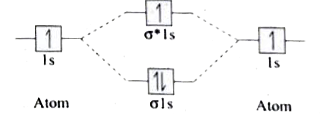 H H. i.e., `H_(2)` molecule has two atoms which are connected by 1 `sigma` bond. So it is diatomic. (ii) But in the case of inert gases, the valence shell is fully filled i.e., an octet (8 ELECTRONS) (or) duplet (2 electrons) in case of Helium, due to which they are in monoatomie state and remain stable. So they do not COMBINE with any atom (neither of same or of DIFFERENT elements). Due to this they do no exist in diatomic state and always exist in mono- atomic state. |
|
| 30. |
Hydrogen gas is liberated by the action of aluminium with concentrated solution of ………… . |
|
Answer» |
|
| 31. |
Hydrogen gas is generally prepared by the reaction of ......... |
| Answer» SOLUTION :granulated zinc with dilute `H_(2)SO_(4)` | |
| 32. |
Hydrogen forms comound with elements having atomic number 9,11,12 and 17. Write their chemicalformulate. |
| Answer» SOLUTION :HF,NAH,`MgH_(2)` and HCL | |
| 33. |
Hydrogen forms compounds with elements having atomic numbers : 9,11,12, 17 and 20 . What are their chemical formulae ? Compare their chemical behaviour. |
| Answer» Solution :HF,NaH, `MgH_(2) HCL and CaH_(2)` | |
| 34. |
Hydrogen forms hydride (H^-negative ions) by accepting one electron. This property is similar to ……… |
| Answer» ANSWER :D | |
| 35. |
Hydrogen forms a strochiometric hydride with which of the following metal |
|
Answer» LANTHANUM |
|
| 36. |
Hydrogen form stable diatomic molecule like which elements ? |
| Answer» Solution :Hydrogen form stable DIATOMIC MOLECULE LIKE halogen elements. | |
| 37. |
How many significant figures are present in the followings? 0.0025 |
| Answer» SOLUTION :0.0025-2significant FIGURES | |
| 38. |
How many significant figures are present in the followings?285 |
| Answer» SOLUTION :285-3 SIGNIFICANT FIGURES | |
| 39. |
Hydrogen combines with oxygen to form two different compounds, namely, water (H_2O) and hydrogen peroxide (H_2O_2) State the law |
| Answer» Solution :It STATES that if two elements combine to form more than one COMPOUND, the masses of one element that COMBINES with a fixed MASS of the other element, are in the ratio of SIMPLE . whole numbers. | |
| 40. |
Hydrogen combines with oxygen to form two different compounds, namely, water (H_2O) and hydrogen peroxide (H_2O_2) Which law is obeyed by this combination? |
| Answer» SOLUTION :LAW of MULTIPLE PROPORTIONS | |
| 41. |
Hydrogen combines with oxygen to form H_(2)O in which 16 g of oxygen combine with 2g of hydrogen . Hydrogen also combines with carbon to form CH_(4) in which 2 g of hydrogen combine with 6 g of carbon . If carbon and oxygen combine together then they will do show in the ratio of |
|
Answer» `6 :16` or `12 : 32` |
|
| 42. |
Hydrogen combines with chlorine to form HC. It also combines with sodium to form NaH. IF sodium and chlorine also combine with each other, they will do so in the ratio of their mass as :- |
|
Answer» `23:35.5` |
|
| 43. |
Hydrogen combines with other elements by |
|
Answer» Losing an electron |
|
| 44. |
Hydrogen combines with carbon monoxide in the presence of copper catalyst will synthesise….. |
| Answer» SOLUTION :METHANOL | |
| 45. |
Hydrogen chrolide gas is sent into a 100 metre tube from one end 'A and ammonia gas from the other end 'B', under similar conditions. At what distant from 'A' will be the two gases meet. |
| Answer» SOLUTION :40.48 METRES | |
| 46. |
Which of the following cannot be obtained on basal medium? |
|
Answer» `Zn + dil. H_2SO_4` |
|
| 47. |
Hydrogen can react with the following even in dark |
|
Answer» `I_2` |
|
| 48. |
Hydrogen can be prepared by the action of dil H_(2)SO_(4) on |
|
Answer» copper lie above `H_(2)` in the ELECTROCHEMICAL series and hence do not react with dil. `H_(2)SO_(4)` to evolve `H_(2)` gas . Although `PB(E_(Pb^(2+)//Pb)^(@)=-0.13V)` lies below `H_(2)` in the electrochemical series, it reacts with dil. `H_(2)SO_(4)` in the begining to EVOLVES `H_(2)` gas but `PbSO_(4)` produced during the reaction forms a `Pb+ H_(2)SO_(4)("dil.") to underset("In soluble")(PbSO_(4))(s) + H_(2)(g)` protective layer around the unreacted Pb and the reaction stops. Only iron `(E_(Fe^(2+)//Fe)^(@)==0.44V)` reacts readily with dil. `H_(2)SO_(4)` to evolve `H_(2)` gas. |
|
| 49. |
Hydrogen can have "____________" oxidation number ( s) . |
| Answer» ANSWER :D | |
| 50. |
Hydrogen can be prepared by the action of dil.H_2SO_4 on |
|
Answer» Copper |
|