

Saved Bookmarks
This section includes 7 InterviewSolutions, each offering curated multiple-choice questions to sharpen your Current Affairs knowledge and support exam preparation. Choose a topic below to get started.
| 1. |
Five cards are drawn successively with replacement from a well-shuffled deck of 52 cards . What is the probability that i. all the five cards are spades? ii only 3 cards are spades? iii. none is a spade? |
|
Answer» |
|
| 2. |
Obtain the following integrals : int sqrt(ax-x^(2))dx |
|
Answer» |
|
| 3. |
(1)/(3)-(1)/(2).(1)/(9)+(1)/(3).(1)/(27)-(1)/(4).(1)/(81)+….oo= |
|
Answer» `log_(E ) (2//3)` |
|
| 4. |
If cos alpha+2cos beta+3cos gamma=sinalpha+2sinbeta+3singamma=0 then sin 3alpha+8sin3 beta+27sin 3gamma= |
|
Answer» `18COS(alpha+beta+gamma)` |
|
| 5. |
Draw the graph of followin function {:((i), y=4x^(3)-30x^(2)+72x-55,(ii), y=x^(3)+x^(2)+x-3),((iii), y=x^(4)-8x^(3)+22x^(2)-24x+8.5, (iv), y=x^(4)-6x^(2)-8x+13),((v),y=x^(4)-4x^(3)+8x^(2)-8x-21,(vi),y=x^(4)+2x^(2)+4x+1):} |
|
Answer» |
|
| 6. |
Find the number of proper divisors of 38808 which are not divisible by 7. Also find their sum. |
|
Answer» |
|
| 7. |
A bag contains 2 white and 1 red balls. One ball is drawn at random and then put back in the box after noting its colour. The process is repeated again. If X denotes the number of red balls recorded in the two draws, describe X. |
|
Answer» |
|
| 8. |
The straight line (x)/(4)+(y)/(3) =1 intersects the ellipse (x^(2))/(16)+(y^(2))/(9) =1 at two points A and B, there is a point P on this ellipse such that the area of DeltaPAB is equal to 6(sqrt(2)-1). Then the number of such points (P) is/are |
|
Answer» 0 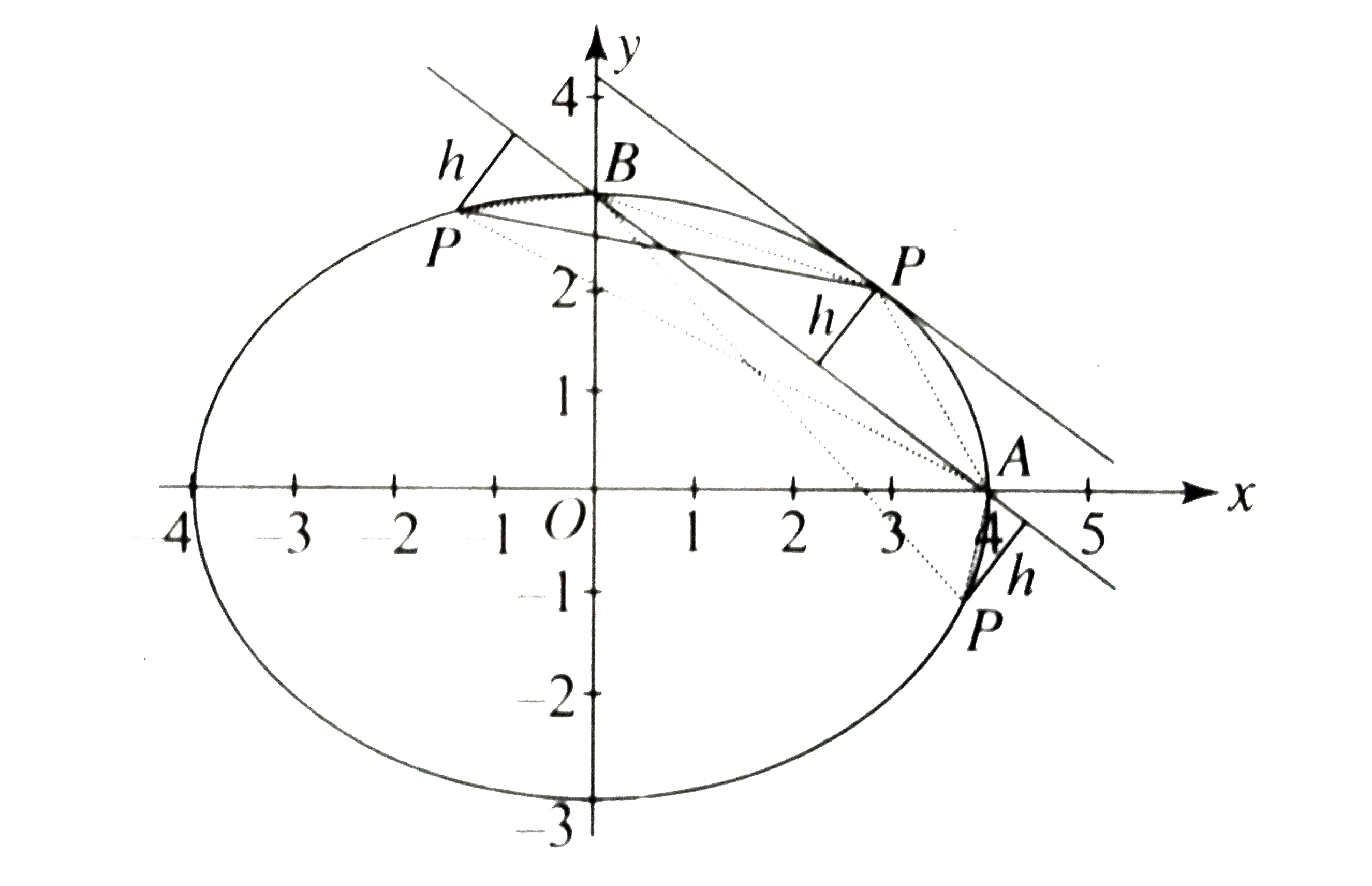 `:. (1)/(2) xx h xx 5 = 6 (sqrt(2)-1)` `:. h = (12)/(5) (sqrt(2)-1)` Also tangent parallel to the given line is `4y + 3X = 12 sqrt(2)` Its distance from the line `4y +3x = 12` is `h =(12)/(5) (sqrt(2)-1)` HENCE there are three points as shown in the figure. |
|
| 9. |
Show that the angle between the circles x^2+y^2=a^2, x^2+y^2=ax+ay is (3pi)/4 |
|
Answer» |
|
| 10. |
Let R be relation defined on the set of natural number N as follows : R = {(x,y) : x in N, y in N , 2x + y =41}. Find the domian and range of the relation R . Also verify whether R is reflexive, symmetric and transitive. |
|
Answer» |
|
| 11. |
Arithmetic mean of the series2,-2,2,-2,…….., up to 100times is ___________ |
|
Answer» |
|
| 12. |
Given that veca*vecb=0andvecaxxvecb=vec0 . Whatcan you conclude about thevectors vecaandvecb? |
|
Answer» |
|
| 14. |
If A = (2, 3), B = (-2, -5), C =(-4, 6) and if P is a point on BC such that AP bisects the angle A, then P = |
|
Answer» `(-(22)/(7), (9)/(7))` |
|
| 15. |
(Diet problem) A dietician has to develop a special diet using two foods P and Q. Each packet (containing 30 g) of food P contains 12 units of calcium, 4units of iron, 6 units of cholesterol and 6 units of vitamin A. Each packet of the same quantity of food Q contains 3 units of calcium, 20 units of iron, 4 units of cholestrol and 3 units of vitamin A. The diet requires atleast 240 units of calcium, atleast 460 units of iron and at most 300 units of cholestrol. How many packets of each food should be used to minimise the amount of vitamin A in the diet ? What is the minimum amount of vitamin A ? |
|
Answer» |
|
| 16. |
Evaluate the following integrals inttan^(-1)((2x)/(1-x^(2)))dx |
|
Answer» |
|
| 17. |
Evaluateint(sin^(2)x)/(1+cosx)dx |
|
Answer» |
|
| 18. |
If the three lines x-3y=p.ax+2y=q and ax+y=r from a right - angled triangle then. |
|
Answer» `a^(2)-6a-12=0` `:.` value of `a=3` satisfy the equation `a^(2)-9a+18=0` |
|
| 19. |
A person stands at a point A due south of a tower and observes that its elevation is 60^(@). He then walks westwards towards B, where the elevation is 45^(@). At a point C on AB produced, he finds it to be 30^(@). Then AB/BC is equal to |
|
Answer» `1//2` |
|
| 20. |
If alpha, beta, gamma are the roots of the cubic equation x^(3)+qx+r=0 then the find equation whose roots are (alpha-beta)^(2),(beta-gamma)^(2),(gamma-alpha)^(2). |
|
Answer» Solution :`:' alpha, beta, gamma` are the roots of the cubic EQUATION `x^(3)+qx+r=0`………i Then `SUM alpha=0, sum alpha beta=q, alpha beta gamma =-r`……..ii If y is a root of the REQUIRED equation, then `y=(alpha-beta)^(2)=(alpha+beta)^(2)-4 alpha beta` `=(alpha+beta+gamma-gamma)^(2)-(4 alpha beta gamma)/(gamma)` `=(0-gamma)^(2)+(4r)/(gamma)` [from Eq. (ii) ]` `impliesy=gamma^(2)+(4r)/(gamma)` [replacing `gamma` by `x` which is a root of Eq. (i) ] `:.y=x^(2)+(4r)/x` Or `x^(3)-yx+4r=0`..........iii The required equation is obatained by eliminating `x` between Eqs (i) and (iii) Now, subtracting Eq. (iii) from Eq. (i) we get `(q+y)x-3r=0` or `x=(3r)/(q+y)` On substituting the value of `x` in Eq. (i) we get `((3r)/(q+y))^(3)+q((3r)/(q+y))+r=0` Thus, `y^(3)+6qy^(2)+9q^(2)y+(4q^(3)+27r^(2))=0` which is the required equation. |
|
| 21. |
When the axes are rotated through an angle 45^@, the transformed equation of a curve is 17x^2-16xy+17y^2=225. Find the original equation of the curve. |
|
Answer» |
|
| 22. |
1 +(1)/(4) +(1.3)/(4.8)+(1.3.5)/(4.8.12)+… isequalto |
|
Answer» `SQRT2` `(1 +X ) ^n =1+nx+(n (n- 1 ))/(2!)x^ 2` ` + (n(n - 1 )(n - 2 ))/(3!)x ^ 3+… ` On comparingtheaboveexpansion, we get, `thereforenx = (1)/(4) ""`...(1) ` (n(n - 1 ))/(2!) x ^ 2 = (1.3)/(4.8) ""`...(2) ` (n (n - 1 )(n -2))/(3!)x ^ 3=(1.3.5 ) /(4.8.12)"" `...(3) (2) `div`(1) `((n-1))/(2)x = (3)/(2XX 4 )` `(n - 1 )x =(3)/(4) "" `...(4) From(3)` div `(2) ` ((n-2))/(3)x =(5)/(3)XX (1)/(4)""`...(5) From(4)and(5) , `x =( - 1 ) /(2), n =( - 1 ) /(2) ` `therefore1 +(1)/(4)+(1.3)/(4.8)+ (1.3.5 )/(4.8.12)+... = (1 -(1)/(2) ) ^( -1/2)` `= ((1)/(2))^( -1/2)= sqrt2 ` |
|
| 23. |
The mid-points of the sides of a triangle are (2,3,-1),(0,8,5)and(5,7,11). The distance of the origin from the vertex of the triangle which is farthest from it is |
| Answer» Answer :D | |
| 24. |
A tangent to x^(2)=32y meets xy=c^(2)at P & Q. The locus of mid-point of PQ is a parabola whose latus rectum is- |
|
Answer» 3 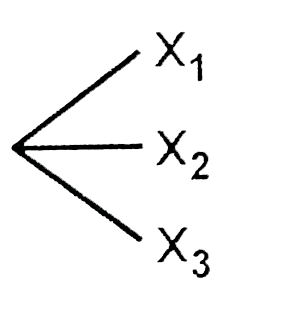 `therefore` Sum of roots `(x_(1)+x_(2)+x_(3))=0` Also we have `Sigmay_(i)=(12-Sigmax_(i))/(4)` 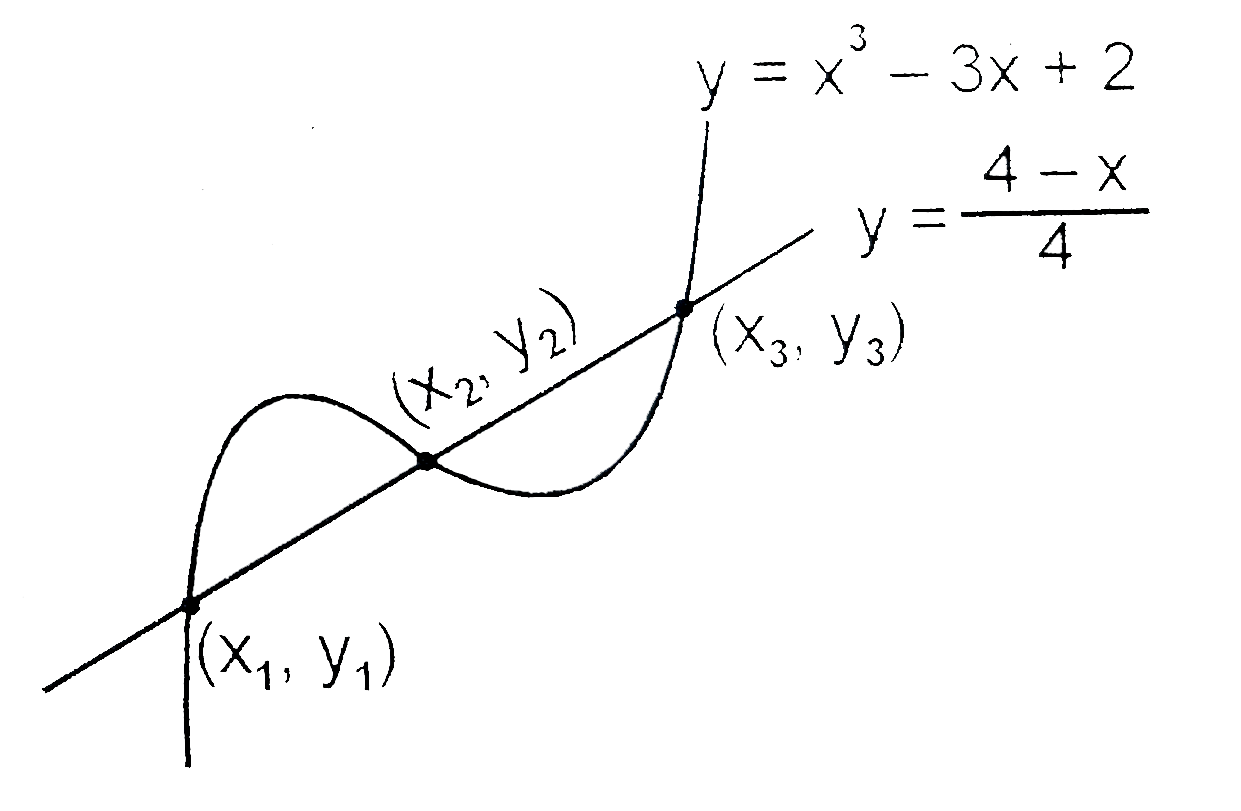
|
|
| 25. |
Let D, E and F be the middle points of the sides BC,CA and AB respectively of a triangle ABC. Then, AD + BE + CF equals to |
|
Answer» Solution :LET the position vectors A, B, C be a, b and c respectively . Then the position vectors of mid-points D, E and F are ` (b+c)/(2)`,(c+a)/( 2) and(a+b) /(2)`repectively . Now `AD +BE +CF` `={(b+c)/(2)-a}+{(c+a)/(2)-b}+{(a+b)/(2)-c )}=0` |
|
| 26. |
Solvedy/dx+(2xy)/(1+x^(2))=(4x^(2))/(1+x^(2)) |
|
Answer» |
|
| 27. |
Let f:[0,1] rarr R be a function.such thatf(0)=f(1)=0 and f''(x)+f(x) ge e^x for all x in [0,1].If the fucntion f(x)e^(-x) assumes its minimum in the interval [0,1] at x=1/4 which of the following is true ? |
|
Answer» `f(x)lt 0 f (x) " for " 1/4 lt x lt 3/4` `phi(x) LE FOR0 ltx lt 1/4 and phi (x) gt 0" for " 1/4 lt x lt 1` `rArre^(-x)(f'(x) -f(x)) gt 0" for " lt x lt 1/4` and, `e^(-x)(f'(x) -f(x)) gt 0 for 1//4 lt x lt 1 ` `rArr f(x)lt f(x)for lt x lt 1/4 and f(x) gt f(x)for 1/4 lt x lt 1` Hence ,option (C ) is correct |
|
| 28. |
Match the locus of the points in List-I with the curves in List-II (Here, p.4 and r are constants andt, theta and lamdaare parameters) The correct match is |
|
Answer» `A to (IV) , B to (I), C to (II) ` |
|
| 29. |
int_(0)^(pi//2) (Cos x)/(1+Sin x) dx= |
|
Answer» 1 |
|
| 30. |
(A - B) cup (B - A) = |
|
Answer» `(A CAP B) - (A CUP B)` |
|
| 31. |
Choose the correct answer. Area lying between the curves y^2=4x and y=2x is : |
|
Answer» `2/3` |
|
| 32. |
Integrate the functions (6x+2)/(1+2x+3x^(2)) |
|
Answer» |
|
| 33. |
Draw the graph of the function f(x) = (1/x)^(x) |
|
Answer» Solution :We have `f(x) = (1/x)^(x)` Clearly, DOMAIN of the function is `x gt 0` DIFFERENTIATING we get, `f^(')(x)=(1/x)^(x)(log1/x-1)` `f^(')(x) =0 rArr log1/x=1 = log_(e)e rArr 1/x=e rArr x=1/e` Also for `x lt 1//e, f^(')(x)` is positive and for `x gt 1//e, f^(')(x)` is negative. Therefore, the maximum value of the function is `e^(1//e)`. Also, `UNDERSET(x to 0)"lim"(1/x)^(x) = e^(underset(xto0)"lim"xlog(1/x))=e^(underset(xto0)"-lim"xlogx)=e^(underset(xto0)-"lim"(logx)/(1/x))=e^(underset(xto0)-"lim"(1/x)/(-1/x^(2)))=e^(0)=1` `underset(xto infty)"lim"(1/x)^(x)=0` From the above discussion, the graph of the function is as shown in the following figure. 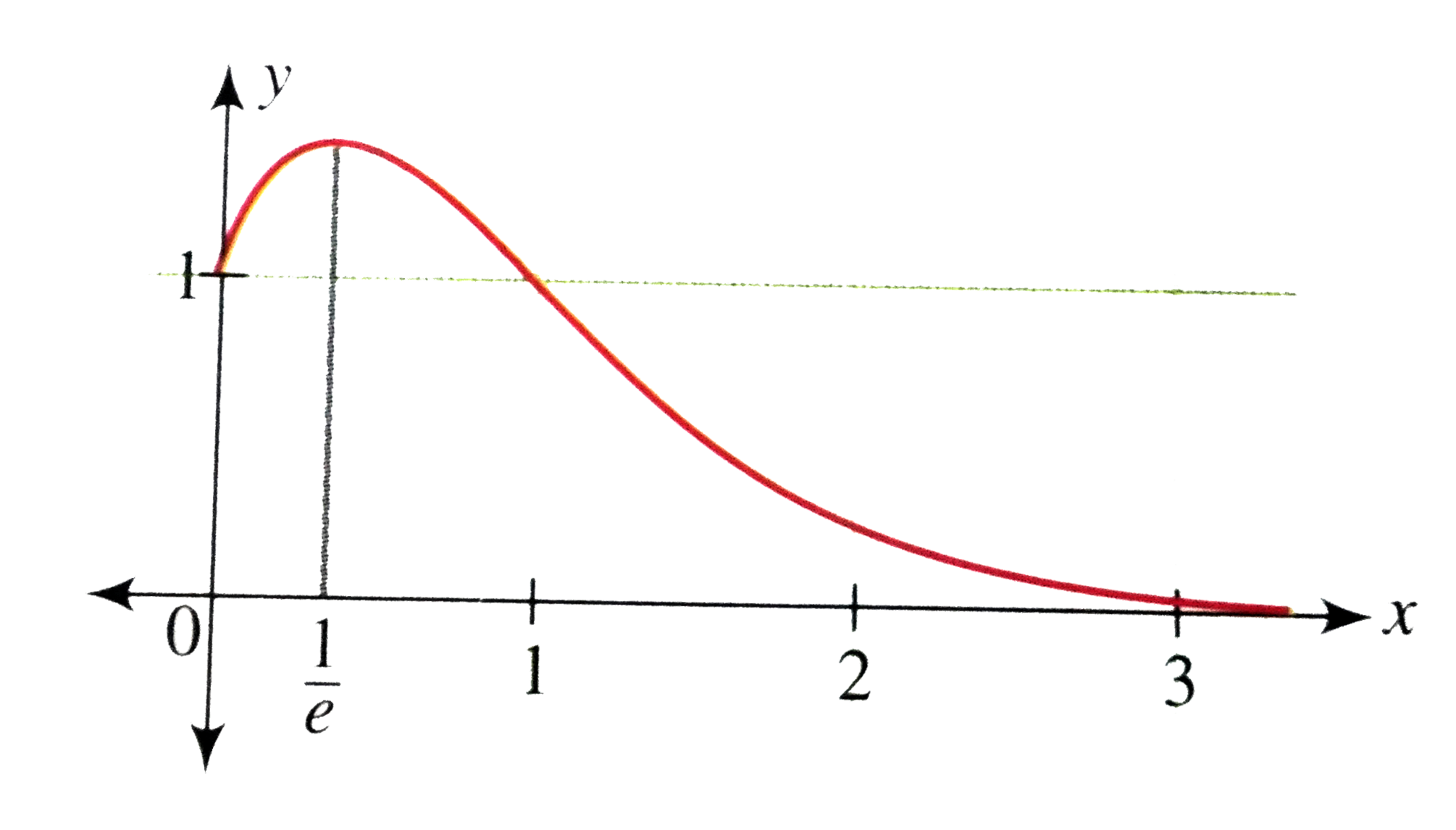
|
|
| 34. |
If [x] denotes the greatest integer function. Draw a rough sketch of the portions of the curvesx^(2) = 4[sqrt(x)] y and y^(2) = 4[sqrt(y)] x that lie within the sqaure {(x,y)|1le x le 4, 1 ley le 4} Find the area of the part of the square that is enclosessd by the two curves and the line x + y = 3 |
|
Answer» |
|
| 35. |
A circle of area 20 sq. units is enteredat the point O. Suppose DeltaABC is inscribed in that circle and has area 8 sq. units. The central angles alpha, beta and gamma are as shown in the figure. The value of(sin alpha+sin beta+sin gamma) is equal to : |
| Answer» Answer :A | |
| 36. |
If alpha, beta are the roots of x^(2)- p(x+1)-c=0 then (alpha^(2)+2alpha+a)/(alpha^(2)+2alpha+c)+ (beta^(2)+2beta+1)/(beta^(2)+2beta+1)= |
|
Answer» 3 |
|
| 37. |
If alpha, betaare the roots of the quadratic equation x^(2)+ax +b=0, (b ne 0), then the quadratic equation whose roots are alpha -(1)/(beta), beta-(1)/(alpha) is |
|
Answer» `AX^(2)+a(b-1)X +(a-1)^(2)=0` |
|
| 38. |
Find the principal value of sin^-1(-1) |
|
Answer» |
|
| 39. |
A straight line is drawn through the point P(1,4) Find the least value of the sum of intercepts made by line on the coordinates axes. Also find the equation of the line. |
|
Answer» |
|
| 40. |
The value of the integral int(0)^(pi//2)(dx)/(1+(1)/(6)sin^(2)x) is |
|
Answer» `pi/2 SQRT((6)/(7))` |
|
| 41. |
A farmer sells vegetables to 180 different customers. Of these, 90 of them purchase zucchni and 115 of them purchase cauliflower. {:("Quantity A","Quantity B"),("The number of customers who","The number of customers that"),("purchased both zucchini and","purchased neither zucchini nor"),("cauliflower","cauliflower"):} |
|
Answer» |
|
| 42. |
Find the area of the region enclosed between curves y = |x-1| and y=3-|x|. |
|
Answer» |
|
| 43. |
A=[{:(0,0,-1),(0,-1,0),(-1,0,0):}],the correct statement is ...... |
|
Answer» `A^(-1)` does not EXIST |
|
| 45. |
Simplify : costheta[{:(costheta,sintheta),(-sintheta,costheta):}]+sintheta[{:(sintheta,-costheta),(costheta,sintheta):}] |
|
Answer» |
|
| 46. |
Passage 1 is adapted from a speech given by Senator Robert Y. hayne in 1830. Passage 2 is adapted from a speech given in response by Sanator Daniel Webster on the following day. Passage 1. If I could, by a mere act of my will put at the disposal of the Federal Government any amount of treasur which I might think proper to name, I should limit the amount to the means necessary for the legitimate purpose of Government. Sir, an immense national treasuring would be a fund for corruption. It would enable Congress and the Executive to exercise a control over States, as well as over great intersts in teh country, nay even over corporations and individuals-utterly destructive of the purity, and fatal to the duration of our institutions. It would be equally fatal to the sovereignty and independence of the States. Sir, I am one of those who believe that the very life of our system is the independence of teh States, and there is no evil more to be deprecated than the consolidation of this Government. It is only by a strict adherence to the limitations imp[osed by the constitution on the Federal Government, that this system works well, and can answer the great ends for which it was instituted. i am opposed, therefore, in any shape, to all unnecessary extension of the powers, or the influence of the Legislature of Exective of influence of the Legislature of Executive of the Union over the States, or the people of the States, and, most of all, I am opposed to those partial distibutions of favors, whether by legislation or appropriation, which has a direct and powerful tendency to spread corruption through the land, to create and abject spirit of dependence, to sow the seeds of dissolution, to produce jealousy among the different portions of teh Union, and finally to sap the very foundations of the Government itself. Passage 2 As a reason for sishing to get rid of the public lands as soon as we could, and as we might, the honorable gentlmeman said, he wanted no permanent sources of income. He wished to see the time when the Government should not possess a shilling of permanent revenue. If he could speak a magical word, and by that word convert the whole capital into gold, the work should not be spoken. The administration of a fixed revenue, [he said] only consolidates the Government, and corrupts the people! Sir, I confess I heard these sentiments uttered on this floor with deep regret and pain. I am aware that these, and similar opinions, are espoused by certain persons out of the capinions, are espoused by certain persons out of the capitol, and out of this Government, but I did non expect so soon to find them here. Consolidation!-that perpetual cry, both of terror and delusion- consolidation! Sir, when gentelmen speak of the effects of a common fund, belonging to all the States, as having a tendency to consolidation, what do they mesn? Do they mean, ior can they mean, anything more than that the Union of the States will be strenghened, by whatever continues or furnishes inducements to the people of the States to hold together? If they mean merely this, then, no doubt, the public lands as well as everyhing else in which we have a common interest, tends to consolidation, and to this idea of consolidation every true American ought to be attached, it is neiher more nor less than strengthening the Union itself. This is the sense in which the framers of teh constitution use the would consolidation, and in which sense I adopt and cherish i.... This,sir, is General Washington's consolidation. This is the ture constitutional consolidation. I wish to see no new powers drawn to the General Government, but I confess I rejoice in whatever tends to strengthen the bond that unites us, and encourages the hope that our Union may be perpetual. And, therefore, I cannot but feel regret at teh expression of such opinions as teh gentleman has ovowed, because I think their obvious tendency is to weaken the bond of our connection. In passage 2, Webster most likely refers to General Washington in order to |
|
Answer» make a colorful analogy. |
|
| 47. |
Integrate the following : intx^31dx |
| Answer» SOLUTION :`intx^31dx`=`x^32/32+C` | |
| 48. |
An urn contains r red balls and b black balls. Now, match the following lists: |
|
Answer» a. `(""^(r)C_(2))/(""^(r+b)C_(2))=1/2(r-1)=(r-b)(r+b-1)` `=2r(r-1)=(r+b)(r+b-1)` `or 2r^(2)-2r=r^(2)+(2b-1)r+b^(2)-1` `or r^(2)-(1+2b)+1-b^(2)=0` `or b^(2)+2br+r-r^(2)-1=0` `or b=(-2r+-sqrt(4r^(2)-4(r-r^(2)-1)))/(2)` `=-r+-sqrt(2r^(2)-r+1)` Since b is integer, POSSIBLE values of r are 3 and 8. b. `""^(4)C_(2)((r)/(r+10))((10)/(r+10))^(2)=3/8` c. `((r)/(r+10))^(2)((10)/(r+10))=1/16impliesr=10` d. Probability of GETTING n red balls in 2n draws in always equal to probability of getting EXACTLY n black blalls in 2 n draws for any value of r and b, HENCE the ratio r/b can be `10,3,8,2.` |
|
| 49. |
lim_(xto0)[x] |
|
Answer» Solution :L.H.L.`=lim_(xto0-)[X]=lim_(hto0)[0-h]` `=lim_(hto0)[-h]=-1` R.H.L.`=lim_(xto0+)[x]=lim_(hto0)[0+h]` `=lim_(hto0)[h]=0` |
|