

Saved Bookmarks
This section includes 7 InterviewSolutions, each offering curated multiple-choice questions to sharpen your Current Affairs knowledge and support exam preparation. Choose a topic below to get started.
| 1. |
In a book-stall, there are 4 copies of one book, 5 copies of another and single copy of 5 other different books. Then the no. of ways that a person can purchase one or more books is |
|
Answer» 340 |
|
| 2. |
The sum of an infinite geometirc progression is 2 and the sum of the geometric progression made from the cubes of this infinite series is 24. Then find its first term and common ratio :- |
|
Answer» |
|
| 3. |
Find the area enclosed by the astroid ((x)/(a))^((2)/(3)) + ((y)/(a))^((2)/(3))=1 |
|
Answer» |
|
| 4. |
Show that int _(0) ^(pi) (dx)/((a - cos x )) = (pi)/(sqrt((a ^(2) -1))). Hence or otherwise evaluate int_(0)^(pi) (dx)/((sqrt5)- cos x )^(3). |
|
Answer» |
|
| 5. |
Evaluate the definite integrals int_(0)^(2)(6x)/(x^(2)+4)dx |
| Answer» | |
| 7. |
Let a, b, c such that (1)/((1-x)(1-2x)(1-3x))+(a)/(1-x)+(b)/(1-2x)+(c)/(1-3x), a/1+b/3+c/5= |
|
Answer» `1/15` |
|
| 8. |
If abs(z_(1))=2,abs(z_(2))=3 then abs(z_(1)+z_(2)+5+12i) is less then |
|
Answer» 8 |
|
| 9. |
Find the derivativeof y, with respect to x, of the function represented parametrically : x = int_(1)^(t^(3)) 3 sqrt(x) " In dx, y"= int_(sqrt(t))^(3) z^(2) I nzdz |
|
Answer» |
|
| 10. |
The solution of sin^(-1)((dy)/(dx)) = y + x is |
|
Answer» `Tan (x+y) - SEC(x + y) = x + C` |
|
| 11. |
If the vectors hat(i)-3hat(j)+2hat(k), -hat(i)+2hat(j) represent the diagonals of a parallelogram, then its area will be |
|
Answer» `sqrt(21)` Now, `axxb=|{:(hati,hatj,HATK),(1,-3,2),(-1,2,0):}|=-4hati-2hatj-hatk` `:.""` AREA of parallelogram `=1/2|axxb|=1/2sqrt(16+4+1)=sqrt(21)/2` |
|
| 12. |
12 persons attend a dinner party round a table. Out of them 2 are ladies. Find the probability that three are 3 men between the ladies. |
|
Answer» |
|
| 13. |
Find a particular solution of the differential equation (x-y)(dx+dy)=dx-dy. Given that y=-1, when x=0. |
|
Answer» |
|
| 14. |
int (x + 1)/(x (1 + xe^(x)))dx = |
|
Answer» `log | (1 + XE^(x))/(xe^(x))| + C ` |
|
| 15. |
If |vec(a)| = 3, |vec(b)| = 4, then the value 'lambda'for which vec(a) + lambda vec(b) is perpendicular to vec(a) - lambda vec(b), is |
|
Answer» `(9)/(16)` |
|
| 16. |
If f(x) = {{:(((pi)/(2)-sin^(-1)(1-{x}^(2))sin^(-1)(1-{x}))/(sqrt(2) ({x} - {x}^(3)))",",x gt 0),(k",",x = 0),((A sin^(-1)(1-{x})cos^(-1)(1-{x}))/(sqrt(2{x})(1-{x}))",",x lt 0):} is continuous at x = 0, then the value of sin^(2) k + cos^(2) ((Api)/(sqrt(2))), is..... (where {.} denotes fractional part of x). |
|
Answer» |
|
| 17. |
Find the point on the curve y = x^(3) - 6x + 3 at which equation of tangent is3x + y - 1 =0 |
|
Answer» |
|
| 18. |
If p has truth value T, what can be said about the truth values of p vv q rarr ~~ p ^^ q. |
Answer» SOLUTION :
|
|
| 19. |
The abscissae of two points A and B are the roots of the equation x^(2)+2ax-b^(2)=0 and their ordinate are the roots fo the equations y^(2)+2py-q^(2)=0 then the radius of the circle with AB as diameter is |
|
Answer» `X^(2)+y^(2)+2ax+2py-b^(2)-Q^(2)=0` |
|
| 20. |
If the difference between the mean and variance of a Binomial variae is 5/9 then find the probability for the event of 2 successes when the experiment is conducted 5 times. |
|
Answer» |
|
| 21. |
Check weather the following function/functions is/are periodic or not? Find the period in case the function is periodic. (##CEN_GRA_C01_S01_013_Q01.png" width="80%"> |
Answer» SOLUTION : CLEARLY, the function is non-periodic as due to the CHANGE in PATTERN at x = 0. |
|
| 22. |
Some standard forms of integration : intsqrt(1-4x-x^(2))dx=.......+c |
|
Answer» `(x+2)/(2)SQRT(1-4x-x^(2))+(sqrt5)/(2)SIN^(-1)((x+2)/(5))` |
|
| 23. |
Check weather the following function/functions is/are periodic or not? Find the period in case the function is periodic. |
|
Answer» Solution :(a)PERIODIC. Period = 3 (B) Non - periodic as CHANGE in pattern at x = 0 (c) Peridic. Period = ` 2 PI` |
|
| 24. |
Which of the following is equivalent to(z^2+7z-3)/(z+2)? |
|
Answer» `z+5-13/(z+2)` |
|
| 25. |
Inverse of the matrix of ((1,2),(3,4)) is |
|
Answer» `(1)/(10)((1,-2),(3,4))` |
|
| 26. |
Verify that |P({a,b,c})|=2^3 |
|
Answer» <P> SOLUTION :LET `A={a,b,c} :.P(A)={{a},{b},{b,c},A,PHI}``:.P(A)=4=2^3` |
|
| 28. |
If |vec(a)| = 2, |vec(b)| = 7 and vec(a) xx vec(b) = 3hat(i) + 2hat(j) + 6hat(k), find the angle between vec(a) and vec(b). |
|
Answer» |
|
| 29. |
If x and y are angles such that cos x + cos y = 3/2 and sin x + sin y = 3/4, then sin (x +y) equals to |
|
Answer» `2/5` |
|
| 30. |
A point R with x-coordinate 4 lies on the line segment joining the points P(2,-3,4) and Q(8,0,10). Find the coordinates of the point R. |
|
Answer» |
|
| 32. |
If f(x)=k^(3)x+k^(3)-2 cuts the curve g(x)=1/2Inx^(2) at exactly one point 'k' may lie in the interval |
|
Answer» `(1/(SQRT(e)),e)` So, `F(x)=k^(3)+3"In"k-1` `f(1/sqrt(e))f(e)lt0` 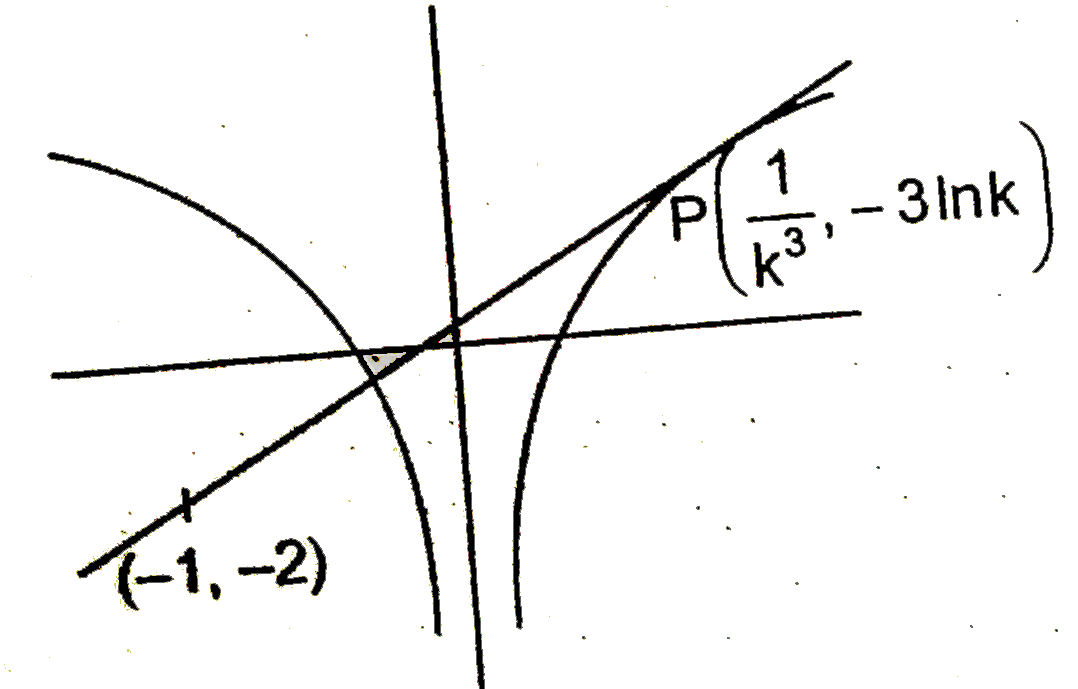
|
|
| 33. |
Evaluate int (1)/(1 - x-x^(2)) dx |
|
Answer» |
|
| 34. |
The locus of the point whose distance from the origin is twice its distance from the plane 2x + 3y – 6z = 0 is |
|
Answer» `33x^2 - y^2 – 5z^2 – 16XY + 112x – 56y + 196 = 0` |
|
| 35. |
Ifa _ kisthecoefficientofx ^kintheexpansion of(1 + x+ x ^ 2 ) ^ nfork = 0, 1, 2, …, 2n, thena _ 1+ 2a _ 2 +3a _ 3 +… +2na _ (2n )isequalto |
|
Answer» ` -a _ 0 ` Differentiating(1)withrespectto .x. `n(1 + x+ x ^ 2 )^(n -1)( 1 + 2x)= a _ 1+2a _ 2x+3a _ 3x ^ 2+ ... +2NA ^(an) x ^( 2n - 1 ) ""`...(2) Put`x= 1` in (2) ` 3N (3) ^(n - 1 )= a _ 1 +2a _ 2+3a _ 3+... +2n a _(2n )` ` thereforea _ 1+2 a _ 2+3a _ 3+ ... +2n a _ (2n)= n.3^(n) ` |
|
| 36. |
((1+costheta+isintheta)/(1+costheta-isintheta))^(n) |
|
Answer» `CIS" "ntheta` |
|
| 37. |
The negation of the statement given by "He is rich and happy" is |
|
Answer» NEITHER I will become a TEACHER nor I will OPEN a school |
|
| 38. |
The remainder obtained when the polynomial x^(4)-3x^(3)+9x^(2)-27x+81 is divided by x-3 is |
|
Answer» 81 |
|
| 39. |
Prove the following : Express 4cosA.cosB.cosC as the sum of four cosines. |
|
Answer» SOLUTION :4cosAcosBcosC = 2(2cosAcosB)COSC = 2[COS(A+B)+cos(A-B)]cosC = 2COS(A+B)cosC+2cos(A-B)cosC cos(A+B+C)+cos(A+B-C)+cos(A-B+C)+cos(A-B-C) |
|
| 40. |
IfA= cos^(2) 10^(@) + cos^(2) 50^(@) + cos^(2) 70^(@) , B= sin^4"" (3pi)/8 - cos^(4)""(3pi)/8 ,C=cos^(2)""(pi)/(10)+ cos^(2)""(2pi)/5+cos^(2)""(3pi)/5+cos^(2)""(9pi)/(10) then the descending order is |
|
Answer» C,A,B |
|
| 41. |
The solution set of the inequation (x+11)/(x-3) gt 0 is |
|
Answer» `(-oo, -11) uu (3,oo)` |
|
| 42. |
Determine the sine of the angle between the vectors hat-3hatj+hatk, hati+hatj+hatk |
Answer» Solution : `|vecaxxvecb| = SQRT(16+16) = 4sqrt2` `|veca| = sqrt(1+9+1) = sqrt(11)` `|vecb| = sqrt3` If `THETA` is the angle between `veca` and `vecb` then `SINTHETA = |vecaxxvecb|/(|veca||vecb|) = (4sqrt2)/(sqrt(11)sqrt3) = (4sqrt2)/sqrt(33)`. |
|
| 43. |
If y=x+[x], then Statement I (dy)/(dx)=1 for all x"inR Statement II(d([x]))/(dx)={(""0","""x cancelin "Integer"),("does not exist"""x.in"integer"):} |
|
Answer» Both STATEMENT I and Statement II are CORRECT and Statement II is the correct EXPLANATION of Statement I |
|
| 44. |
Consider the ellipse C:(x^(2))/(a^(2))+(y^(2))/(b^(2))=1 having its centre at the origin O and eccentricity e. Statement-1: If the normal at an end L of a Latusrectum of the ellipse C meets the major axis at G, then OG=ae^(3) Statement-2 : the normal at a point on the ellipse (x^(2))/(a^(2))+(y^(2))/(b^(2))=1 never passes through its foci. |
|
Answer» STATEMENT-1 is True, Statement-2 is True, Statement-2 is a correct explanation for Statement-1 Then, `alex_(1)leand -bley_(1)ltb`. The equation of the normal at `(x_(1),y_(2))" is "(a^(2)x)/(x_(1))-(b^(2)y)/(y_(1))=a^(2)-b^(2)` It cutsx-axis at `(e^(2)x_(1),0)`. If the normal at `(x_(1),y_(1))` passes through the focus (AE, 0), then `e^(1)x_(1)=aerArrx_(1)=a` Clearly, there is alsopoint on the ellipse WHOSE x-coordinates is more than a. Hence, the normal at any point does not pass through the focus The coordinates of L are `(ae,b^(2)//a)`. Replacing `x_(1)` by ae, we obtain that the normal at L cuts x-axis at `G(ae^(2),0)` `therefore OG=ae^(3)` Thus,both the statements are true and statement-2 is a correct explanation for statement-1. |
|
| 45. |
Match the following Lists. {:("List - I ","List - II "),((A)The (n+1)^(th)" term in the",(1) (2^(14))/(14!)),("expansioin of " e^5,),((B) 15^(th) "term in the ",(2) (9)/2e^2),("expansioin of " e^-2,),((C)" Cofficient of " x^8 " in",(3) (3^8)/(8!)),("expansioin of " e^(3x),),((C)" Cofficient of " x^2 " in",(3) (5^n)/(n!)),("expansioin of " e^(3x+2),) :} The correct match is |
|
Answer» `{:(A,B,C,D),(1,4,3,2):}` |
|
| 46. |
3 fair dice are rolled and given that atleast two of them show the same number. Find the probability that atleast one die show 4. |
|
Answer» |
|
| 47. |
If x gt 3, which of the following is equivalent |
|
Answer» `(1)/((1)/(X+2)+(1)/(x+3))`? |
|
| 48. |
Let [t] denote the greatest integer le t and lim_(xto0)x[4/x]=A. Then the function, f(x)=[x^(2)]sin(pix) is discontinuous, when x is equal to : |
|
Answer» `SQRT(A+1)` |
|
| 49. |
Which of the following sentences are propositions and which are not ? Write with reason : Ram is a friend of Hari. |
| Answer» SOLUTION :RAM is a friend of HARI. It is a statement as it is or false. | |
| 50. |
In three boxes numbers of balls are 3 white & 1 black, 2 white and 2 black, 1 white and 3 black balls respectively. One ball is drawn from each box randomly. Then .......... is the probability of event that selected balls are 2 white and 1 black. |
|
Answer» `(13)/(32)` |
|