

Saved Bookmarks
This section includes 7 InterviewSolutions, each offering curated multiple-choice questions to sharpen your Current Affairs knowledge and support exam preparation. Choose a topic below to get started.
| 1. |
After perfectly inelastic collision between two identical particles moving with same speed in different directions, the speed of the particles become half the initial speed. The angle between the velocities of the two before collision is: |
|
Answer» `60^(@)` |
|
| 2. |
What is the magnitude and direction of total linears acceleration of a particle moving in a circular path of radius 0.7 m having an instantaneous angular velocity of 3.5 rad s^(-1) and angular acceleration of 4.2 rad s^(-2). |
|
Answer» Solution :`r = 0.7m, OMEGA = 3.5 rad s^(-1), PROP = 4.2 rad s^(-2)` `a_(r) = romega^(2) = 0.7 xx 3.5^(2) = 8.57 MS^(-2)` `a_(L) = r prop = 0.4 xx 4.2 = 1.68 ms^(-2)` Linear ACCELERATION `=a = sqrt(a_(r)^(2) + a_(l)^(2)) = sqrt(8.57^(2) + 1.68^(2)) = 8.73 ms^(-2)` Let `theta` be the angle made by a with the direction of tangential acceleration. Then, `tan theta = a_(r)/a_(l) = 8.57/1.68 = 5.1 theta = tan^(-1) 5.1 = 78.9^(@)` |
|
| 3. |
The potential energy of a body of mass 'm' is given by U= px+qy+rz. The magnitude of the acceleration of the body will be |
|
Answer» <P>`(p+q+r)/(m)` |
|
| 4. |
In a planet a sucrose solution of coefficient of viscocity 0.0015 N- Sm^(-2) is driven at a velocity of 10^(-3) ms^(-1) through xylem vessels of radius 2mu and lengths 5mu m. Find the hydrostatic pressure difference across the length of xylem vessels. |
| Answer» SOLUTION :`15 NM^(-2)` | |
| 5. |
What is buckling? |
| Answer» Solution :To reduce depression in the beam of given length and material is to MAKE depth of the beam LARGE as compared to its breadth. But on increasing the depth too much, the beam may BEND. This bending is CALLED buckling. | |
| 6. |
The mass of a body is 200g. Keeping 9/17 part of its volume exposed to air, the body is floating in mercury. If the specific gravity of mercury is 13.6, then what will be the specific gravity of the body? |
|
Answer» |
|
| 7. |
(A): Mean free path of gas molecules, varies inversely as density of the gas. (R): Mean free path of gas molecules is defined as the average distance travelled by a molecule between two successive collisions. |
|
Answer» Both (A) and ( R) are true and (R ) is the CORRECT explanation of (A) |
|
| 8. |
In the formula, X = 3 YZ^(2),X has dimensions of capacitance and Z has dimensions of magnetic induction. The dimensions of Y are |
|
Answer» `[M^(-3)L^(-2)T^(-2)A^(4)]` `:. C= (Q)/(V)= (q^(2))/(W)` [as `V= (W)/(q)`] `:. [X]= [C]= [(A^(2)T^(2))/(ML^(2)T^(-2))]= [M^(-1)L^(-2)T^(4)A^(2)]` As `F= BIIsintheta :. B= (F)/(II sintheta)` `:. [Z]= [B]= [(MLT^(-2))/(AL)]= [ML^(0)T^(-2)A^(-1)]` GIVEN : `X= 3YZ^(2)` or `Y= (X)/(3Z^(2))` `:. [Y]= ([X])/([Z]^(2))= ([M^(-1)L^(-2)T^(4)A^(2)])/([ML^(0)T^(-2)A^(-1)]^(2))= [M^(-3)L^(-2)T^(8)A^(4)]` |
|
| 9. |
A body of mass 15 g oscillates about a fixed point with a SHM of amplitude 8cm . If the body is attracted towards the fixed point, when at a distance of 4 cm from it with a force equal to the weight of 10 g , the period of oscillation of the mass about the fixed point is |
|
Answer» 0.297sec |
|
| 10. |
"Politics is the art of the possible . " Similarly, "Science is the art of the soluble." Explain this beautiful aphorism on the nature and practice of science . |
| Answer» Solution :Science is a systematised study of observations. A scientist patiently ANALYSES these observation and comes out with certain laws. As an illustration, Tycho Brahe worked for twenty long years to make observations on planetary MOTIONS. It is from this huge reservoir of observations that Kepler FORMULATED his three famous laws of planetary motion. Thus, science is the art of the SOLUBLE just as politics is the art of the possible. | |
| 11. |
A steam engine delivers 5.4 xx 10^(8) J of work per minute and service 3.6 xx 10^(9) J of heat per minute from its boiler. The efficiency of the engine and the loss of heat per minute are |
|
Answer» `30%, 9 xx 10^(9)` J |
|
| 12. |
A body is projected into air with a velocity (3hat(i) + 4hat(j) + 5hat(k)) m//s. Taking X-Y plane as base and Z axis as vertical, the range of projectile (g = 10 m//s^(2)). |
|
Answer» 10 m |
|
| 13. |
Does the escape speed of a body from the earth depend on (a) the mass of the body, (b) the location from where it is projected, (c) the direction of projection, (d) the height of the location from where the body is launched? |
|
Answer» Solution :(a)No, (b) No,(c) No , (d) YES [The escape velocity is independent of mass of the body and the direction of PROJECTION. It DEPENDS uponthe gravitational potential at the point from where the body is launched. Since this potential depends (slightly) on the latitude and HEIGHT of the point, the escape velocity (speed) depends (slightly) on these factors.] |
|
| 14. |
Which statement is incorrect? |
|
Answer» All REVERSIBLE cycles have same EFFICIENCY. |
|
| 15. |
A skater standing on a perfectly floor holds on the nearby railing and then pushes himself away from the railing. By the time his arms are fully stretched and are about to leave the railing the gains velocity by 10 m//s. If his armlength is 0.9 m, what is the work done by the force of the railing on him ? Is any pseudo work done by it ? Find the exerted by the railing on the skater. Assume skater's mass 70 kg. |
|
Answer» |
|
| 16. |
(A) : Work - energy theorem is an intergral form of Newton.s second law.(R ) : Newton.s second law is a relation between acceleration and force at any instant of time. |
|
Answer» Both (A) and (R ) are TRUE and (R ) is the correct EXPLANATION of (A) |
|
| 17. |
Amotor pump of power 1H.P is discharging water with a velocity of 10 ms^(-1). In order to discharge water with a velocity of 20 ms^(-1), the power of the motor should be |
| Answer» ANSWER :C | |
| 18. |
A molecule in a gas container hits a horizontal wall with speed 200 ms^(-1) and " angle " 30^(@) with the normal , and rebounds with the same speed . Is momentum conserved in the collision ? Is the collision elastic or inelastic ? |
| Answer» Solution :YES, momentum of the molecule + WALL system is conserved. The wall has a recoll momentum such that the momentum of the wall + momentum of the outgoing molecule equals momentum of the incoming molecule, assuming the wall to be stationary initially. However, the recoll momentum produces negligible velocity because of the LARGE mass of the wall. Since kinetic energy is ALSO conserved, the collision is elastic. | |
| 19. |
Obtain an equation of orbital time period ofsatellite revolves around the earth. |
|
Answer» Solution :`implies`The period of a satellite is the time it takes to make one full orbit around the earth is known as period or ORBITAL period of satellite. `implies` Orbital period of satellite `v_(0) = sqrt((GM_(E))/((R_(E)+h)))""...(1)` circumference of orbit `implies` Orbital velocity = `("of satellite ")/("period of orbit ")` `:. v_0 =(2pi(R_(E)+h))/T""...(2)` `implies`Comparing equation (1) and (2), `sqrt((GM_(E))/((R_(E)+h)))=(2pi(R_(E)+h))/T` `:. T = (2pi(R_E+h))/(sqrt((GM_E)/((R_E+h))))` `:. T = 2pi sqrt((R_(E)+h)^3/(GM_E))""...(3)` `:. T^(2) =(4pi^2)/(GM_E)(R_E+h)^3""...(4)` `:. T = 2pi sqrt((R_(E)+h)^3/(GM_E))""...(5)` but `(GM_E)/((R_(E)+h)^(2) )=G` `:. T = (2pi )sqrt(((R_(E)+h))/g)""...(6)` `implies` From equation (4) , `T^(2) = Kr^(3) ""....(7)` `:. T^(2) alpha r^3""...(8)` (where `K=(4pi^2)/(GM_E)and ` take `R_E+h=r` ) This is Kepler.s third law for PLANETARY motion. `implies` For a satellite very close to the surface of earth h can be neglected in comparison to `R_E`equation (6) will be, `:. T = 2pisqrt((R_E)/g)""...(9)` `implies`Taking `g = 9.8 m//s^(2) , R_(E) = 6400 xx 10 ^(3) m//s` `T = 2pi sqrt((6.4xx10^6)/(9.8))` `T = 5078 s ~~ 85` minutes |
|
| 20. |
Decrease in temperature is noticed by sprinkling water in closed room. Because, |
|
Answer» temperature of water is less than room |
|
| 21. |
Figure shows the top view of a cylindrical can mounted on a turntable. The can is filled with water. At a depth h below the water surface are two horizontal tubes of length l and cross-sectional area a, with right-angle bends at their ends. Show that, as the water jets emerge from the tubes, there is atorque tau exerted on the system given by the expression t = 4 rho gh (r+l)a, where rho is the density of the water. |
| Answer» | |
| 22. |
The water equivalent of a block of solid mass 200 g and of specific heat 0.4 cal g^-1 (°C)^- is |
|
Answer» 800 CAL`(°C)^-1` |
|
| 23. |
Two objects of masses 200g and 500g possess velocities 10veci ms^(-1) and 3veci+5vecjms^(-1). respectively. The velocity of their centre of mass in ms^(-1) is |
|
Answer» `5veci-25vecj` |
|
| 24. |
A ball is bouncing elastically with a speed 1 m/s between walls of a railway compartment of size 10 m in a direction perpendicular to walls. The train is moving at a constant velocity of 10 m/s parallel to the direction of motion of the ball. As seen from the ground. |
|
Answer» The direction of motion of the ball changes EVERY 10. (Opposite direction) Relative speed after collision with side of train = 10- 1 = 9 m/s. (Same direction) As speed is changing after travelling 10 m and speed is 1 m/s hence, time duration of the changing speed is 10. SINCE, the collision of the ball is perfectly elastic there is no dissipation of energy hence, total MOMENTUM and kinetic energy are conserved. Since, the train is moving with constant velocity hence, it will act as inertial frame of reference as that of Earth and acceleration will be same in both frames. We should not confuse with non-inertial and inertial frame of reference. A frame of reference that is not accelerating will be inertial. |
|
| 25. |
Find the expression for kinetic energy, potential energy and total energy in simple harmonic motion. Show the variation of kinetic energy, potential energy and total energy with (i) time and (ii) displacement graphically. |
Answer» Solution :The displacement is `x=acosomegat`, this means that the MOTION starts at one end of the path, comes to the MEAN position at `T/4` (T = time period), goes to the other end at `T/2`, then again comes to the mean position at `(3T)/4`, and FINALLY comes back to the starting point at time T, thus completing a COMPLETE oscillation.  The variation of the KE, the PE and the total energy (i) with time t is shown in the graph of Fig. 1.44(a), (ii) with displacement x is shown in the graph of Fig. 1.44(b). |
|
| 26. |
A hall has the dimensions 10 m xx 12m xx 14 m . A fly starting at one corner ends up at a diametrically opposite corner, what is the magnitude of its displacement ? |
|
Answer» 17m |
|
| 27. |
(A) : For projection angle tan^(-1) (4), the horizontal range and the maximum height of a projectile are equal. ( R) : The maximum range of projectile is directly proportional to square of velocity and inversely proportional to acceleration due to gravity. |
|
Answer» Both (A) and ( R) are ture and ( R) is the correct explanation of (A) |
|
| 28. |
A system of two particles is having masses m_(1) and m_(2). If the particle of mass m_(1) is pushed towards the center of mass of particles through a distance d. by what distance the particle of mass m_(2) should be moved so as to keep the centre of mass of particles at the original position ? |
|
Answer» `(m_(1))/(m_(1)+m_(2))d` |
|
| 29. |
Formation of bubble are in Column-I and pressure difference between them are given in Column -II Match them appropriately. |
|
Answer» |
|
| 30. |
An observer A is moving directly towards a stationary sound source while another observer B is moviing away from the source with the same velocity . Which of the following conclusions are correct ? |
|
Answer» AVERAGE of frequencies recorded by A and B is EQUAL to natural frequency of the source . |
|
| 31. |
A fly wheel rotates with a uniform angular acceleration. If its angular velocity increases form 20 pi rad/s to 40 pi rad/s in 10 seconds. Find the number of rotations in that period. |
|
Answer» Solution :Initial angular velocity `omega_0` = `20 pi ` rad/sec FINAL angular velocity `omega`= `40pi` rad/sec Time (t) = 10 SECONDS Angular acceleration `alpha = (omega-omega_0)/(t)=( 40 pi - 20 pi)/(10)` `alpha = 2pi` rad/`sec^2` |
|
| 32. |
A bullet is firedwith a speed of 670 ms^(-1). Find the angle made by the shock wave with the line of motion of the bullet. What is the Match number of the wave? (Velocity of sound in air =335 m s^(-1)) [Hint : sin theta = V//V_(s)] |
|
Answer» |
|
| 33. |
A time dependent force F = 6t acts on a particle of mass 1 kg . If the particle starts from rest , the work done by the force during the first 1 sec , will be ………. |
|
Answer» 9 J ` :. "ma = 6t` ` :. A = (6t)/m = (6t)/m = 1 = 6t` ` :. (dv)/(DT) = 6t` ` :."dv = 6t dt"` ` :. Int_(0)^(v) dv - 6 int_(0)^(1) " t dt "` ` = 6 xx1/2[ :. t = 1 ] ` = 3 m/s ` W = 1/2 MV^(2) - 1/2 mv_(0)^(2)` ` = 1/2 xx1xx9-0` `= 4.5 J ` |
|
| 34. |
See Fig. A mass of 6 kg is suspended by aropeoflength 2 m from the ceiling.A force of 50 N in the horizontal direction isappliedatthe mid- point P of the rope, as shown. What is the angle the rope makes with the vertical in equilibrium ?(Take g = 10 m s^(-2) ). Neglect the mass of the rope. |
|
Answer» <P> Solution :Figures (b) and (c) are known as free-body DIAGRAMS. Figure (b) is the free-body diagram of W and Fig. (c) is the free-body diagram of point P. Consider the equilibrium of the weight W.CLEARLY `T_2 = 6 xx 10 = 60 N` Consider the equilibrium of the point P under the action of three forces - the tensions `T_1` and `T_2`, and the horizontal force 50 N.The horizontal and vertical components of the resultant force must vanish SEPARATELY : `T_1 cos theta = T_2 = 60 N` `T_1 sin theta = 50 N` which gives that `TAN theta = 5/6 ortheta = tan^(-1) (5/6) = 40^@` |
|
| 35. |
A stick of length L is dropped from a high tower. An ant sitting at the lower end of the stick begins to crawl up at the instant the stick is released. Velocity of the ant relative to the stick remains constant and is equal to u. Assume that the stick remains vertical during its fall, and length of the stick is sufficiently long. (a) Calculate the maximum height attained by the ant measured from its initial position. (b) What time after the start the ant will be at the same height from where it started? |
|
Answer» |
|
| 36. |
Find the constraint relation between a_(1),a_(2) "and" a_(3). |
|
Answer» Solution :Points 1,2,3 and 4 are movable . Let their dis-placements from a fixed line be` x_(1), x_(2) , x_(3) and x_(4)` We have `x_(1)+x_(4)=l_(1)`(LENGTH of first string )…(i) and` (x_(2)-x_(4))+(x_(3)-x_(4))=l_(2)` (length of second string) or `x_(2)+x_(3)-2x_(4)=l_(2)`...(ii) On double , DIFFERENTIATING with respect to time , we get `a_(1)+a_(4)=0`...(iii) and `a_(2)+a_(3)-2a_(4)=0`...(iv) But since `a_(4)=-a_(1) a_(4)=-a_(1)` [From equation (iii)] We have , a_(2)+a_(3)+2a_(1)=0` This is the required constraint RELATION between `a_(1),a_(2)" and " a_(3)` 
|
|
| 37. |
Three identical spheres each of radius R are placed touching each other on a horizontal table. The centre of mass of the system is located |
|
Answer» at one of the centres of the spheres |
|
| 38. |
The density of water in SI units is 10^3kg//m^3. What is its value in g/cc? |
|
Answer» `1g//cc` |
|
| 39. |
A vector perpendicular to the vector (hat(i) + 2hat(j)) and having magnitude 3 sqrt5 units is |
|
Answer» `3 hat(i) + 6hat(J)` |
|
| 40. |
The door of an automobile is open and perpendicular to the body. The automobile stats with an acceleration of 2ft//sec^(2), and the width of the door is 30 inches. Treat the door as a uniform rectangle, and neglect friction to find the speed of its outside edge a seen by the driver when the door closes. |
Answer» 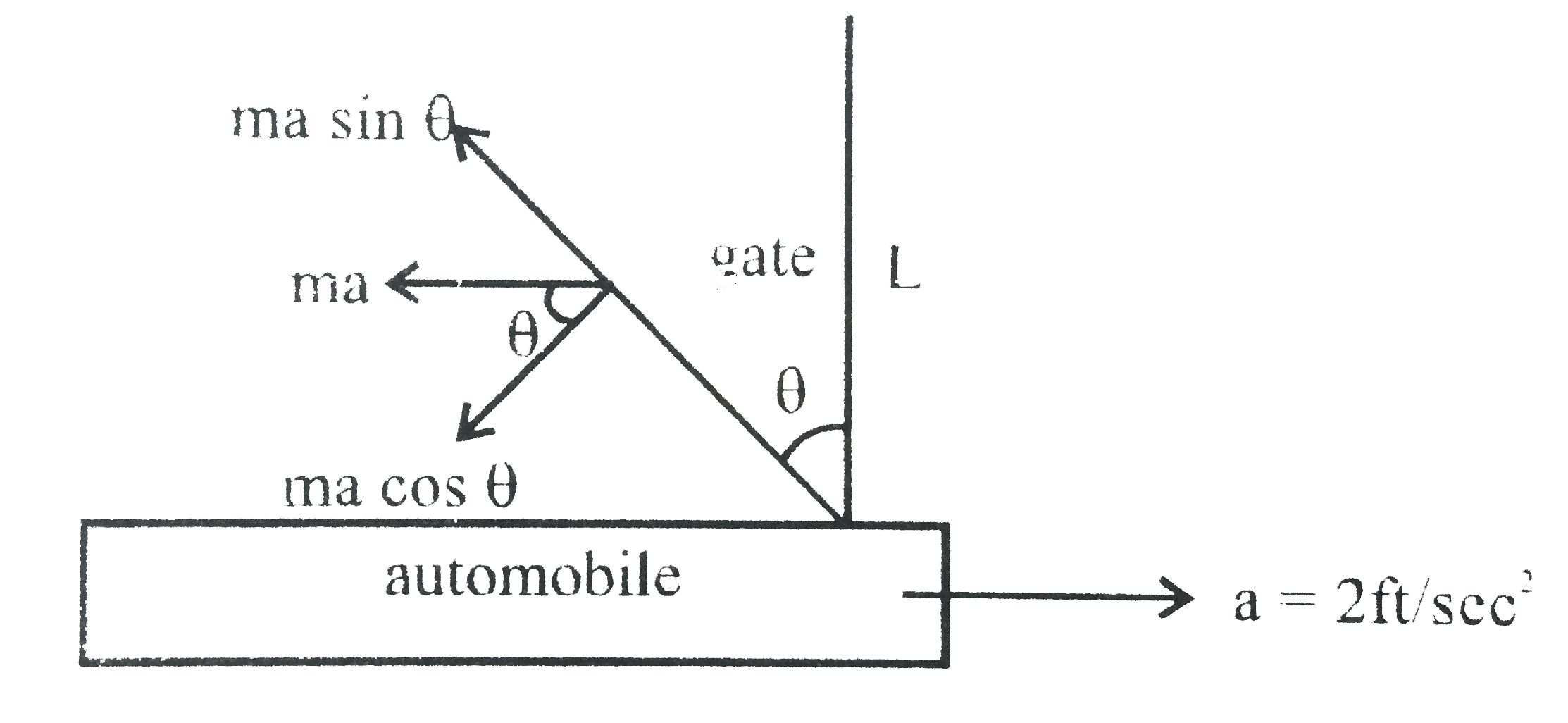 `ma cos theta xx (L)/(2) = I ALPHA` `ma cos theta xx (L)/(2) = ((1)/(3) mL^(2)) alpha` `alpha = (3a cos theta)/(2 L)` `(OMEGA d omega)/(d theta) = (3acos theta)/(2L) RARR int_(0) ^(omega) d omega = (3a)/(2L) [sin theta]_(0)^(pi//2)` `omega = sqrt((3a)/(L))` `V = L omega =rArr V = L sqrt((3a)/(L)) rArr V =sqrt(3aL)` `V = sqrt(3 xx 2 xx 2.5) = sqrt(15) ft//s^(2)`. |
|
| 41. |
The work done on a gas when it is compressed isothermally at 27^(@)C to half of the initial volume is (nearly) |
|
Answer» 3436J |
|
| 42. |
A block is pushed up a rough inclined plane of 45^@ with a velocity u. The block rises up and then comes down sliding to have a velocity u/2 at the bottom. The coefficient of sliding friction between block and the plane is |
|
Answer» 0.5 |
|
| 43. |
The electrical resistance in ohms of a certain thermometer varies with temperature according to the approximate law: R= R_(0) [1 + alpha (T - T_(0))] The resistance is 101.6 Omegaat the triple-point of water 273.16 K , " and " 165.5 Omegaat the normal melting point of lead (600.5 K). What is the temperature when the resistance is 123.4 Omega? |
|
Answer» |
|
| 44. |
The acceleration due to gravity on the surface of moon is 1.7 ms^(-2) . What is the time period of a simple pendulum on the moon if its time period on the earth is 3.5 s ? (g on earth = 9.8 ms^(-2)) |
|
Answer» Solution :`T=2pisqrt(l/g)` Period on the moon = T On EARTH, `3.5 =2pisqrt(l/(9.8))""...(1)` On moon , `T. = 2PI SQRT(l/(1.7))""...(2)` EQUATION (2) `DIV` (1) `(T.)/(3.5) = sqrt((9.8)/(1.7))=2.4` `T. = 3.5 xx2.4 =8.4 s` |
|
| 45. |
A body of mass m moving with a uniform velocity of 40 m s^(-1) collides with another body of mass m, at rest and then the two together begin to move with a uniform velocity of 30 m s^(-1) The ratio of their masses ((m_1)/(m_2)) is |
|
Answer» 0.75 `m_1 XX 40 + m_2 xx 0 = (m_1 + m_2) 30` `:. 40/30 = (m_1 + m_3)/(m_1) = 1 + (m_2)/(m_1)` `:. (m_2)/(m_1) = 40/30 - 1 = 10/30 = 1/3 "or" (m_1)/(m_2) = 3/1`. |
|
| 46. |
Give definition, SI unit and dimensional formula of time period, angular frequency and frequency of wave. |
|
Answer» Solution :Time period: "The time taken by any string element to MOVE through one complete oscillation is CALLED Time period (T)". In equation of displacement of wave, `y (x,t)=a sin (kx - omega t + phi) if phi =0,` then if we observed motion of element at `x=0.` `y(0,t) =a sin (-omega)`  `therefore - a sin omega t =- a sin [omega (t +T)]` `=- a sin (omega t + omega T)` but as since function is repeating at `2pi` interval, `omega T=2pi` `therefore omega = (2pi)/(T)` where `omega` is called ANGULAR frequency of wave. Angular frequency of oscillations of frequency of wave. Its symbol is `omega ` and SI unit is `rad s ^(-1)` and dimensional formula is `[M^(0) L ^(0) T ^(-1)].` Frequency : The number of oscillations performed by the particle of medium in one second is know as the frequency of oscillation of particle. Its symbol is .v. of .f. Sometime it is also written as `eta.` If 1 wave is obtained in T time, then in 1 SEC . (f) waves re obtained, `v or f = 1/T = (omega)/(2pi)` `therefore` SI unit of frequency is `s ^(-1) or .Hz.` and its dimensionalformula is `[M^(0) L ^(0) T ^(-1)].` |
|
| 47. |
Two identical rods are joined to form an .X.. The smaller angle between the rods is .theta.. The moment of inertia of the system about and axis passing through the point of intersection of the rods and perpendicular to their plane is |
|
Answer» `ALPHA theta` |
|
| 48. |
A rod of length L and uniform cross-sectional area has varying thermal conductivity which changes linearly from 2K at end A to K at the other end B. The ends A and B of the rod are maintained at constant temperature 100^(@)C, and 0^(@)C, respectively. At steady state, the graph of temperature : T = T(x) , where x = distance from end A will be |
|
Answer»
|
|
| 49. |
A projective is fired with a velocity 'u' at right angles to an inlined plane which is at an angle 'theta' with horizontal |
|
Answer» Range on inclined plane is `(2u^(2))/(g) Tan THETA SEC theta` |
|


