

Saved Bookmarks
This section includes 7 InterviewSolutions, each offering curated multiple-choice questions to sharpen your Current Affairs knowledge and support exam preparation. Choose a topic below to get started.
| 1. |
Water is flowing out from a tap of diameter 1.32 cm at a rate of 0.52 lt/min. After some time the flow rate is increased to 2 lt/min. Discuss the nature of flow in two cases if coefficient of viscosity of water is 10^(-3) "Pa s". |
|
Answer» |
|
| 2. |
Two particles connected by a rigid light rod AB, lying on a smooth horizontal table. An impulse J is applied at A in the plane of thetable and perpendicular at AB. Then the velocity of particle at A is |
|
Answer» `(J)/(2M)` |
|
| 3. |
What is the minimum speed with which a bucket of water can be whirled in a vertical circle of diameter 250 cm so that water does not fall ? |
| Answer» SOLUTION :`mv^(2)//r = mg, v = SQRT(rg) = sqrt(1.25 xx 9.8) = 3.5 m//s` | |
| 4. |
Two satellites A & B move round the earth in the same orbit. The mass of B is twice the mass of A. For these two satellites mark the correct statement (s) |
|
Answer» SPEED of A and B are equal |
|
| 5. |
If two objects of masses 25 kg and 100 kg experience the same force 5 N, what is theacceleration experienced by each of them? |
|
Answer» Solution :From Newton.s second LAW (in magnitude form), F = ma. For the object of mass 2.5 KG, the acceleration is a `= F/m = (5)/(2.5) = 2MS^(-2)` For the object of mass 100 kg, the acceleration is` a = F/m = 5/100 = 0.05 ms^(-2)` |
|
| 6. |
To estimate 'g' [from g=4pi^(2)((L)/(T^(2)))], error in measurement of L is + 2% and error in measurement of T is + 3%. If the error estimated in 'g' is pm x %, then the value of x is |
|
Answer» |
|
| 7. |
A simple pendulum of length l and having a bob of mass M is suspended in a car. The car is moving on a circular track of radius R with a uniform speed v. If the pendulum makes small oscillations in a radial direction about its equilibrium position, what will be its time period ? |
| Answer» Solution :`T=2pisqrt(l/(SQRT(g^(2)+v^(4)//R^(2))))` Hint: Effective acceleration DUE to gravity will get reduced due to radial acceleration `v^(2)//R` ACTING in the horizontal PLANE. | |
| 8. |
The time of flight of a projectile is related to its horizontal range by the equation gT^2 = 2R. The angle of projection is |
| Answer» Answer :D | |
| 9. |
How will you determine the velocity of sound using resonance air column apparatus ? |
Answer» Solution :Resonance air column apparatus :The resonance air column apparatus is one of the simplest techniques to measurethe speed of SOUND in air at room TEMPERATURE. It consists of a cylindrical glasstube of one meter length whose one END A is open and another end B isconnected to the water reservoir R through a rubber tube as shown in figure. This cylindrical glass tube ismounted on a vertical stand with a scale attached to it. The tube ispartially filled with water and the water level can be adjusted by raising or lowering the water in the reservoir R. The surface of the water will act as a closed end and other as the open end. Therefore, it behaves like ·a closed organ pip·c, forming nodes at the surface of water and antinodes at the closed end. When a VIBRATING tuning fork is brought near the open end of the rubelongitudinal waves are formed inside the air column. These waves move downward as shown in Figure, and reach the surfaces of water and get reflected and produce standing waves. The length of the· air column is varied by changing the water leveluntil a loud sound is produced in the air column. At this particular length the frequency of waves in the air column resonates with the frequency of the tuning fork (natural frequency of the tuning fork). At resonance, the frequency of sound waves produced is. equal to the frequency of the tuning fork. This will occur only when the length of air column is proportional to `(1/4)`thof the wavelength of the sound waves produced . Let the first resonance occur at length `L_1` , then  `1/4 lamda= L_1` But since the antinodes are not exactly formed at the open end, we have to include a correction, called end correction e·, by assuming that the antinode is formed at some small distance above the open end. Including this end correction, the first resonance is `1/4 lamda = L_1 +e` Now the length of the air column is increased to get the second resonance. Let `L_2`be the length at which the second resonance occurs. Again taking end correction into account, we have `3/4 lamda = L_2 + e` In order to avoid end correction, let us take the difference of equation (2) and equation (1) , we get ` 3/4 lamda - 1/4 lamda = (L_2 + e) - (L_1 + e) rArr 1/2 lamda= L_2 - L_1 = Delta L rArr lamda= 2 Delta L` The speed of the sound in air at room temperature can be computed by using the formula ` v = f lamda = 2 Delta L` Further, to COMPUTE the end connection, we use equation (2) and equation (3 ), we get ` e = (L_2 - 3l_1)/(2)` |
|
| 10. |
Water coming out of a horizontal tube at a speed y strikes normally a vertical wall close to the mouth of the tube and falls down vertically after impact. When the speed of water is increased to 2v, |
|
Answer» the THRUST exerted by the water on the wall will be doubled |
|
| 11. |
The velocities of three particles of masses 20g, 30g and 50g are 101, 10j and 10k respectively. The velocity of the centre of mass of the three particles is |
|
Answer» `2 veci+3 vecj+5 VECK` |
|
| 13. |
A block of mass m = 0.1 kg is released from a height of 4 m on a curved smooth surface. On the horizontal surface, path AB is smooth and path BC offers coefficient of friction = 0.1. If the impact of block with the vertical wall at C be perfectely elastic, the total distance covered by the block on the horizontal surface before coming to rest will be (take g = 10 ms–2) - |
|
Answer» 29m |
|
| 14. |
A solid sphere of mass 2 kg and radius 1 m is free to rotate about an axis passing through its centre. Find a constant tangential force F requird to rotate the sphere I that tim interval. |
|
Answer» Solution :Since, the force is constant the torque produced by it and the angular ACCELERATION will be constant. HENCE, we can apply `omega=omega_(0)+alphatimplies10=0+(alpha)(2)impliesalpha=5rad//s^(2)` Further, the force is tangential. Therefore, the PERPENDICULAR distance from the axis of rotation will be equal to the radius of the sphere, `thereforealpha=(tau)/(I)=(F.R)/((2)/(5)mR^(2))=(5F)/(2mR)` or `F=(2mRalpha)/(5)` LTBR Substituting the value, we have `F=((2)(3)(1)(5))/((5))=4N` Further, angle rotated `theta=(1)/(2)alphat^(2)=(1)/(2)(5)(2)^(2)=10rad` `therefore` number of rotations `n=(theta)/(2pi)=(10)/(2pi)=(5)/(pi)` |
|
| 15. |
In the question number of 93, what is the velocity of a monkey running on the roof of the train A against its motion with a velocity of 18 km h^(-1) with repect to the train A as observed by a man standing on the ground? |
|
Answer» `5 m s^(-1)` `v_(MA) = -18 km h^(-1) = -18 xx 5/18 m s^(-1) = -5 m s^(-1)` `v_(MG) = v_(MA) + v_(AG) = -5 m s^(-1) + 15 m s^(-1) = 10 m s^(-1)` |
|
| 16. |
The centre of mass of three particles of masses 1kg, 2kg, 3kg is at (2, 2, 2). The position of fourth mass of 4kg to be placed in the system so that new centre of mass is at (0, 0, 0) is |
|
Answer» (-3, -3, -3) |
|
| 17. |
The distance between two moving particles P and Q at any time is a. If v_rbe their relative velocity and if u and v be the components of v_r , along and perpendicular to PQ, The closest distance between P and Q and time that elapses before they arrive at their nearest distance is |
|
Answer» `(a(v+v_r))/(v) ,a (1+(v_r)/(u))^2` |
|
| 18. |
An elastic string carrying a body of mass.m. extends by .e.. The body rotates in a vertical circle with critical velocity. The extension in the string at the lowest position is |
|
Answer» 2e |
|
| 19. |
A body moves over a plane surface, starting from rest. The frictional force is constant. The attractive force is (P-Kt) in gravitational units. The maximum velocity is attained after t seconds. What is the distance covered before it attains the maximum speed if the mass of body is m |
|
Answer» |
|
| 20. |
A particle of mass m is free to move along x axis under the influence of a conservative force. The potential energy of the particle is given byU=-ax^(x) e^(-bx) [a and b are positive constants] Find the frequency of small oscillations of the particle about its equilibrium position |
|
Answer» |
|
| 21. |
what is fundamental unit and derived unit ? |
|
Answer» Solution : Comparison with certain basic internationally accepted reference standard is called unit. Measurement of physical quantity is expressed by NUMBER accompanied by a unit. Although number of physical QUANTITIES are very large we NEED only LIMITED no. of units for expressing all physical quantities. Since they are interrelated with one another. The unit for fundamental or base quantities are called fundamental or base unit. Physical quantities which are expressed as combination of fundamental quantities are called derived quantities and their unit are called derived unit. |
|
| 22. |
Consider a disc rotating in the horizontal plane with a constant angular speed omega about its center O. The disc has a shaded region on one side of the diameter and an unshaded region on the other side as shown in figure. When the disc is in the orientation as shown, two pebbles P and Q are simultaneously projected at an angle towards R. The velocity of projection in the y-z plane and is same for both pebbles with respect to the disc. Assume that (i) they land back on the disc before the disc has completed 1//8 rotation, (ii) their range is less than half the disc radius, and (iii) omega remains constant throughout. Then |
|
Answer» P lands in the SHADED region and Q in the UNSHADED region. x-coordinate of `P = omegaR (pi/(4omega))` `= (piR)/4gtR COS 45^@` Therefore, both particles P and Q land in unshaded region. 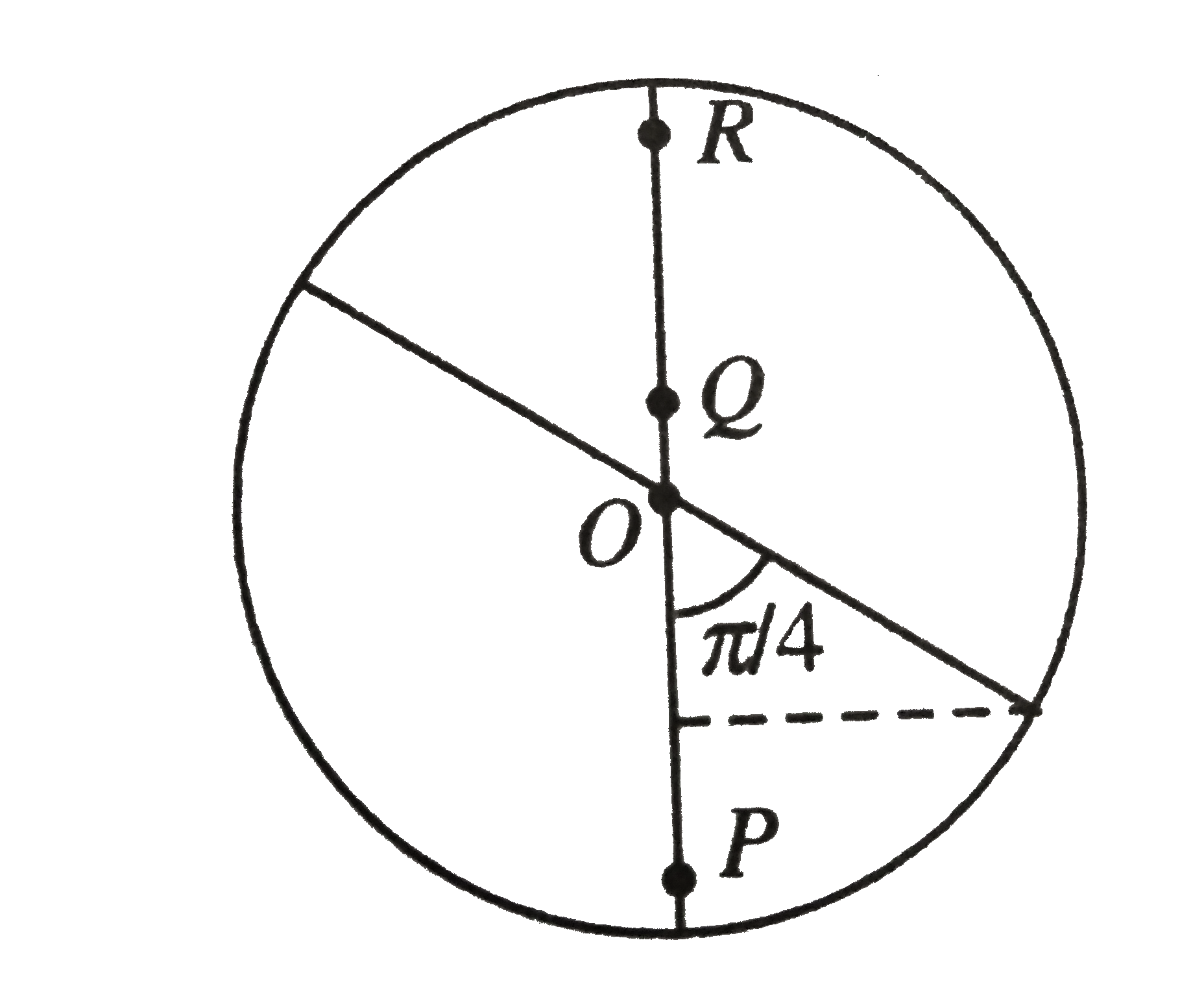
|
|
| 23. |
The volume of 1 kg of hydrogen gas at N.T.P is 11.2 m^(3). Specific heat of hydrogen at constant volume is 10046J kg^(-1)K^(-1). Find the specific heat at constant pressure J kg^(-1)K^(-1). |
|
Answer» 12020 |
|
| 24. |
A man spinning in free space change the moment of inertia of his body (I) by changing his shape. In this process. |
|
Answer» he will to EXPEND some energy to increase I |
|
| 25. |
A second pendulum is taken into a mine of depth 640 m and oscillated. What is its time period ? |
|
Answer» Solution :The time period of a SIMPLE pendulum is `T=2pisqrt((l)/(g))` When a second pendulum is taken into a mine, .g. CHANGES (l constant) The ratio of its time periods is `(T_(1))/(T_(2))= SQRT((g_(2))/(g_(1))` On the surface of the earth `g_(1)= g` and in the mine `g_(2)= g(1-(d)/(R)) (T_(1))/(T_(2))= sqrt((g(1-(d)/(R))/(g))` or`(T_(1))/(T_(2))= sqrt(1-(d)/(R))` Here `T_(1)=2s, d= 640m= 0.6400 KM` R= Radius of the earth = 6400 km, `T_(2)`= ? `(2)/(T_(2))= sqrt((1-(0.640)/(6400)))= sqrt(1-0.0001)` `:. T_(2)= (2)/(sqrt(1-0.0001))= 2.0001s` |
|
| 26. |
If two lengths a and b are given as: a = 25.4 cm +- 0.1 cm and b= 16.5 cm +- 0.4 cm. Then find a +b. |
|
Answer» SOLUTION : Let Q = a + b Average value of Q = 25.4 + 16.5 = 41.9 cm Also, MAXIMUM value of Q = (25.4 + 0.1)+ (16.5 + 0.4) 42.4 cm . `:.`Magnitude of maximum ERROR in Q = 42.4 - 41.9 = 0.5 cm Q = a + b =(`41.9 +- 0.5`) cm |
|
| 27. |
A simple pendulum is oscillating with out damping when the displacement of the bob is less than maximum its acceleration vector 'a' is correctly shown is |
|
Answer»
|
|
| 28. |
Mass of the earth has been determined through |
|
Answer» USE of Kepler's `(T^(2))/(R^(3))` constancy law Cavendish determined the VALUE of G. |
|
| 29. |
A rod of steel is 5 m long and 3 cm diameter at a temperature of 20^(@)C. Find the free expansion of the rod when the temperature is raised to 65^(@)C. Determine the stress and pull exerted if (i) the ends do not yield and (ii) the ends yield by 0.12 cm. Take Y=2xx10^(5" MN")//m^(2) and alpha=12xx10^(-6)" per "^(@)C |
|
Answer» SOLUTION :GIVEN DATA : Diameter of the rod, d = 3 CM = 30 mm Area of the rod, `A=(pi)/(4)xx30^(2)=706.86"mm"^(2)` , Length of the rod, L=5m=5000 mm Initial temperature, `T_(1)=20^(2)C` , Final temperature `T_(2)=65^(@)C` `therefore ` Rise in temperature, `(T)=65-20=45^(@)C , Y=2xx10^(5 N)//mm^(2)` Coefficient of linear expansion `alpha=12xx10^(-6)//""^(@)C` (i) When the ends do not yield The stress is `=alpha. T.Y=12xx10^(-6) xx 45xx2xx10^(5)=108 N//mm^(2)` (tensile) Pull in the rod = Stress `xx` Area `=108xx706.86=76340.88N=76.34kN.` (II) When the ends yield by 0.12cm, `delta=0.12cm=1.2mm` The stress when the ends yield is Stress `=((alpha TL-delta))/(L)xxY=((12xx10^(-6)xx45xx5000-1.2))/(5000)xx2xx10^(5)=60N//mm^(2)` Pull in the rod = Stress `xx` Area `=60xx706.86=42411.6=42.41`kN |
|
| 30. |
An aluminium sphere is dipped into water which of the following is true ? |
|
Answer» BUOYANCY will be less in water at `0^(@)C` than that in water at `4^(@)C`. `:.` Mass of sphere `m=Vrho` Bouyant force `F=mg` `F=Vrhog""[becausem=Vxxrho]` `Fprop rho""[because" V and "rho" are constant"]` `:.(F_(4^(@)C))/(F_(0^(@)C))=(rho_(4^(@)C))/(rho_(0^(@)C))` But density of `4^(@)C` temperature water is maximum, `:.rho_(4^(@)C)gtrho_(0^(@)C)rArr(rho_(4^(@)C))/(rho_(0^(@)C))gt1` `:.F_(4^(@)C)/(F_(0^(@)C))gt` `:.F_(4^(@)C)gtF_(0^(@)C)` Hence, Buoyant force in `0^(@)C` water is less than that in `4^(@)C`. |
|
| 31. |
Derive the equation of motion, range andmaximum height reached by the particle thrown at an oblique angle thetawith respect to the horizontal direction. |
|
Answer» Solution :This projectile motion takes place when the initial velocity is not horizontal, but at some angle with the vertical, as shown in Figure. (Oblique projectile)  Examples: Water ejected out of a hose pipe held obliquely. Cannon fired in a battle ground. Consider an object thrown with initial velocity `vecu` at an angle with the horizontal Then, `vecu=u_(x)hati+u_(y)hatj` where `u_(x)=costheta` isis the horizontal component and `u_(y)=usintheta` the vertical component of velocity. Since the acceleration due to gravity is in the direction opposite to the direction of vertical component `u_(y)`, this component will gradually reduce to zero at the maximum height of the projectile. At this maximum height, the same gravitational force will push the projectile to move downward and fall to the ground. There is no acceleration ALONG the x direction throughout the motion. So, the horizontal component of the velocity `(u_(x)=ucostheta)` remains the same till the object reaches the ground. Hence after the time 1, the velocity along horizontal motion `v_(x)=u_(x)+a_(x)t=ucostheta` The horizontal distance travelled by projectile in time t is `s_(x)=u_(x)t+(1)/(2)a_(x)t^(2)` Here, `s_(x)=x,u_(x)=ucostheta,a_(x)=0`  Thus, `x=ucostheta.t` or `t=(x)/(ucostheta)""(1)` NEXT, for the vertical motion `v_(y)=u_(y)+a_(y)t` Here, `u_(y)=usintheta,a_(y)=g` (acceleration due to gravity acts opposite to the motion). Thus, `v_(y)=usintheta-"gt"""......(2)` The vertical distance travelled by the projectile in the same time is `s_(y)=u_(y)^(t)+(1)/(2)a_(y)t^(2)` Here, `s_(y)=y,u_(y)=usintheta,a_(x)=-g`. Then `y=usinthetat-(1)/(2)"gt"^(2)"".......(3)` Substitute the value of from equation (l) in equation (2). we have `y=usintheta(x)/(ucostheta)-(1)/(2)g""(x^(2))/(u^(2)cos^(2)theta)` `y=xtantheta-(1)/(2)g""(x^(2))/(u^(2)cos^(2)theta)"".......(4)` Thus the path followed by the projectile is an inverted parabola. Maximum height `(h_(max))`: The maximum vertical distance fravelled by the projectile during the journey is called maximum height. This is determined as follows: For the vertical PART of the motion, `v_(y)^(2)=u_(y)^(2)+2a_(y)s` Here, `u_(y)=usintheta,a_(y)=-g,s=h_(max)`, and at the maximum height `v_(y)=0` Hence, `0=u^(2)sin^(2)theta=2gh_(max)` or `h_(max)=(u^(2)sin^(2)theta)/(2g)"".....(5)` Time of flight `(T_(f))`: The total time taken by the projectile from the point of projection till it hits the horizontal plane is called time of flight. This time of flight is the time taken by the projectile to GO from point to B via point A as shown in figure We know that `s_(y)=u_(y)t+(1)/(2)a_(y)t^(2)` Here, `s_(y)=y=0`(net displacement in y-direction is zero), `u_(y)=usintheta,a_(y)=-g,t=T_(f)` Then `0=usinthetaT_(f)-(1)/(2)gT_(f)^(2)` `T_(f)=2u(sintheta)/(g)` Horizontal range (R): The maximum horizontal distance between the point of projection and the point on the horizontal plane where the projectile hits the ground is called horizontal range (R). This is found easily since the horizontal component of initial velocity remains the same. We can write Range R - Horizontal component of velocity x time of flight `=ucosthetaxxT_(f)` `R=ucosthetaxx(2usintheta)/(g)=(2u^(2)sinthetacostheta)/(g)` `R=(u^(2)sin2theta)/(g)"".......(6)` The horizontal range directly depends on the initial speed (w) and the sine of angle of projection `(theta)`. It inversely depends on acceleration due to gravity .g. For a given initial speed, the maximum possible range is reached when `sin2theta` is maximum, `sin2theta=1`. This implies `2theta=pi//2` or `theta=(pi)/(4)` Thismeans that if the particle is projected at 45 degrees with respect to horizontal, it attains maximum range, given by. `R_(max)=(u^(2))/(g)` |
|
| 32. |
A solid floats in a liquid in a partially dipped position. a) The solid exerts a force equal to its weight on the liquid b) The liquid exerts a force of buoyancy on the solid which is equal to the weight of the solid c) The weight of the displaced liquid equals the weight of the solid d) The weight of the dipped part of the solid is equal to the weight of the displaced liquid. |
|
Answer» a, B and C are CORRECT |
|
| 33. |
A meter rod made of steel is correct at 0^(@)C and other meter rod of same material is correct at 30^(@)C. If alpha=12xx10^(-6)//""^(@)C, the difference between their lengths at 20^(@)C is |
|
Answer» `0.024` CM |
|
| 34. |
Two blocks of masses 10 kg and 30 kg are placed on x - axis. The first mass is moved on the axis by a distance of 2 cm right. By what distance should the second mass be moved to keep the position of centre of mass unchanged. |
|
Answer» Solution :mass of the first BLOCK, `m_(1)=10` kg mass of the second block, `m_(2)=30` kg Let `x_(1)` and `x_(1)` are positions of `m_(1)` `x_(2)` and `x_(1)` are positions of `m_(2)` intially and LATER respectively  In this case if `x_(cm)`is the POSITION of centre of mass then `x_(cm)=(m_(1)x_(1)+m_(2)x_(2))/(m_(1)+m_(2))` then the new position of CM when blocks are SHIFTED `x._(cm)-x_(cm)=(m_(1)(x._(1)-x_(1))+m_(2)(x._(2)-x_(2)))/(m_(1)+m_(2))` `Deltax_(cm)=(m_(1)Deltax_(1)+m_(2)Deltax_(2))/(m_(1)+m_(2))` `0=(10xx2+30Deltax_(2))/(40)"":.Deltax_(2)=-2//3` Therefore the sccond block should be moved left`(2)/(3)` cm to KEEP the position of centre of mass unchanged. |
|
| 35. |
A body is projected with a certain speed at angles of projection of theta and 90-theta, the maximum height attained in the two cases are 20 mand 10 m respectively. The range for angle of projection theta is |
|
Answer» `40sqrt(2)m` |
|
| 36. |
An object is thrown vertically downward. What is the acceleration experienced by the object? |
|
Answer» Solution :We know that when the object falls towards the Earth, it experiences acceleration DUE to GRAVITY `g=9.8ms^(-2)` downward. We can choose the COORDINATE system as shown in Ground the FIGURE. The acceleration is along the NEGATIVE y direction `veca=g(-hatj)=-ghatj` 
|
|
| 37. |
The figure shows a Carnot cycle for an ideal gas on a P-V diagram. Which of the areas A_(1) or A_(2) is larger? |
|
Answer» |
|
| 38. |
A plane progessive wave of frequency 25 Hz, amplitude 2.5 xx 10^-5 m and initial phase zero propagates along the negative x-direction with a velocity of 300 m//s. At any instant, the phase difference between the oscillations at two points 6 m apart the line of propagation is _____ and the corresponding amplitude difference is _____ m. |
|
Answer» Solution :`u = 300 m//s` and `N = 25` `:. LAMDA = (u)/(n) =(300)/(25) = 12 m` For a path difference of `lamda`, the PHASE difference is `2 pi`. For a path difference of `6 m`, the phase difference is `(2 pi xx 6)/(lamda) = pi rad` The amplitude is same at both POINTS, HENCE amplitude different is zero. |
|
| 39. |
Weight of a body of mass .m. decreases by 1% when its is raised to a height .h. above the earth.s surface. If the body is taken to a depth in a mine. The change in its weight is |
|
Answer» DECREASES by 2% |
|
| 40. |
The reaction time for an automobile driver is 0.7 sec. If the automobile can be decelerated at 5 "m/s"^2 calculate the total distance travelled in coming to stop from an initial velocity of 8.33 m/s after a signal is observed. |
|
Answer» 12.77m |
|
| 41. |
Body A of mass 4 m moving with speed u collides with another body B of mass 2m, at rest. The collision is head on and elastic in nature. After the collision the fraction of energy lost by the colliding body A is |
|
Answer» `5//9` `4 m u_1 = 4 mv_1 + 2 mv_2` `implies 2(u_1 - v_1) = v_1 "" ….(i)` From conservation of energy, `1/2(4m)u_1^2 = 1/2 (4m)v_1^2 + 1/2 (2m)v_2^2` `implies 2(u_1^2 - v_1^2) = v_2^2 "" ……(ii)` From (i) and (ii) `2(u_1^2 - v_1^2) = 4(u_1 - v_1)^2` `3v_1 = u_1 "" .......(iii)` Now, FRACTION of loss in kinetic energy for MASS 4 m, `(DeltaK)/(K_i) = (K_i - K_f)/(K_i) = (1//2 (4m) u_1^2 - 1/2 (4m)v_1^2)/(1/2 (4m)u_1^2) ""........(IV)` Substituting (iii) in (iv), we get `(DeltaK)/(K_i) = 8/9` |
|
| 42. |
If is given thatvec(A) = 2 hat(i) + 3 hat(j) + hat(k) and vec(B) = 6 hat(i) + 9 hat(j) + 3hat(k)which of the following statements is correct ? |
|
Answer» `vec(A) and vec(B)`are equal vectors |
|
| 43. |
1 cm on the main scale of a vernier callipers if divided into 10 equal parts. If 10 divisions on the vernier scale coincides with 8 small divisions the main scale, then the least count of the callipers is |
|
Answer» 0.01 CM |
|
| 44. |
Two sinusoidal wave having the same frequency and travelling in the same direction are combined. What is the amplitude of the resultant motion if their amplitudes are 3cm and 4cm and they differ in phase by pi//2 radian? |
|
Answer» SOLUTION :Amplitude of first SHM `= a_1 =4` cm Amplitude of second shm `= a_2=7 cm` Phase `= phi=pi/2` The resultant amplitude =`A=SQRT(a_1^2+a_2^2+2a_1a_2cosphi)` `sqrt(4^2+7^2+2xx4xx7xx cos pi//2)` `= sqrt(65) = 08.06 ` cm = 0.0806 m The phase of the resultant is `theta` `tan theta= (a_2sinphi)/(a_1+a_2cosphi)` `= (7 sinpi//2)/(4+7cospi//2)=7/4=1.75` `= theta = 60^@15.` |
|
| 45. |
A faulty thermometer reads 5^@C and 99^@Cin ice and steam, respectively. If this thermometer reads 62^@C , find the correct temperature in ""^@C . |
|
Answer» Solution :`(T_C - 0)/(100 - 0) = ("Temperature of faulty SCALE - LOWER fixed point")/("Upper fixed point - Lower fixed point")` ` rArr (T_C - 0)/(100) = (62 - 5)/(99 - 5) = 57/94` ` rArr T_C=(57 xx 100)/(94)= 60.64^@C` |
|
| 46. |
The ratio of molar volume to atomic volume for 1 mole of hydrogen is (Take size of hydrogen molecule to be 1Ã…) |
|
Answer» `7.1xx10^(4)` `THEREFORE` Molar volume `=22.4`litre `=22.4xx10^(-3)m^(3)` Radius of hydrogen atom is `r=0.5`Ã… `=0.5xx10^(-10)m` `therefore`Atomic volume `=(4)/(3)PIR^(3)N_(A)` `=(4)/(3)xx(22)/(7)xx(0.5xx10^(-10))^(3)xx6.023xx10^(23)` `=3.15xx10^(-7)m^(3)` their corresponding ratio is `("Molar volume")/("Atomic volume")=(22.4xx10^(-3)m^(3))/(3.15xx10^(-7)m^(3))=7.1xx10^(4)` |
|
| 47. |
How do youclassifythe physical quantities on thebasis ofdimension? |
|
Answer» Solution :(1) Dimensional variables: Physical quantities, which POSSESS dimensions and have variable values are called dimensional variables. EXAMPLES are length, velocity, and acceleration etc. (2) Dimensionless variables: Physical quantities which have no dimensions, but have variable values are called dimensionless variables. Examples are specific gravity, strain, REFRACTIVE index etc. (3) Dimensional Constant: Physical quantities which possess dimensions and have constant values are called dimensional constants. Examples are Gravitational constant, Planck.s constant etc. (4) Dimensionless Constant: Quantities which have constant values and ALSO have no dimensions are called dimensionless constants. Examples are `pi` , e, numbers etc. |
|
| 48. |
A gas with specific heat ratio gamma = 5/3 is compressed suddenly to 1/8 of its initial volume. If the pressure is P, then the final pressure is : |
|
Answer» 16 P `P_1/P_2=(1/8)^(5//3)=1/(2^(3xx5//3))=1/32` or FINAL pressure , `P_2 = 32P_1 = 32P` |
|
| 49. |
The gravitational field in a region is bar(E) = (2hat(i) + 3hat(j)) N kg^(-1). The equation for equipotential line is |
| Answer» Answer :A | |
| 50. |
A round table is rotated with an angular velocity of 10 radcdot s^(-1) about its axis. Two blocks of mass m_(1) = 10kg and m_(2) = 5 kg , connected to each other by a weightless inextensible string of length 0.3 m, are placed along a diameter of the table. the coefficient of friction between the table and m_(1) is 0.5, while there is no frication between m_(2) and the table. Mass m_(1) is at a distance of 0.124 m from the centre of the table. The masses are at rest with respect to the table. (i) Calculate the frictional force on m_(1). (ii) What should be the minimum angular speed of the table so that masses will slip from the table? (iii) how should these masses be kept so that the string remains taut but no frictional force acts on m_(1) ? |
|
Answer» SOLUTION :The TOP VIEW of the table is shown in according to the problem, AB = 0.3 m: OA = 0.124 m So, `""` OB = 0.3 - 0.124 = 0.176 m Centrifugal force acting on mass `m_(1)` along the direction OA, `m_(1) omega^(2) r = 10 xx (10)^(2) xx 0.124 = 124` N Again, centrifugal force acting on mass `m_(2)` along the direction OB, `m_(2) omega^(2) r = 5 xx (10)^(2) xx 0.176 = 88` N So, the resultant force along the direction OA = 124 - 88 = 36 N In spite of this resultant force, the TWO masses remain stationary with respect to the table. Hence, the frictional with respect to the table. Hence, the frictional force is equal and opposite to this force. (ii) Reaction force of the table on mass `m_(1)` = weight of the mass = `m_(1) g = 10 xx 9.8 = 98`N As the coefficient of friction is 0.5 , the limiting frictional force = 0.5`xx`98 49 N. If the minimum angular velocity of the table is `omega`, the resultant of the two opposite centrifugal forces acting on the two masses = `m_(1) omega^(2) r_(1) - m_(2) omega^(2) r_(2) = omega^(2) (10 xx 0.124 - 5 xx 0.176) ` `= omega^(2)( 1.124 - 0.88) = 0.36 omega^(2)` N According to the problem, resultant of the two centrifugal forces = limiting frictional force `therefore"" 0.36 omega^(2) = 49 "" or, omega^(2) = (4900)/(36)` or, `omega = (70)/(6) = 11.67 "rad"cdot s^(-1)` If there is no frictional force acting on the masses, the resultant of the two centrifugal forces should be zero. In that case, if mass `m_(1)` is placed at a distance r from the centre, then the distance of `m_(2)` becomes (0.3 - r). So, for any value of `omega`. `m_(1)omega^(2) r = m_(2) omega^(2)(0.3 - r) "" or, 0.3 - r = (m_(1))/(m_(2))`r or,0.3 - r = 2ror, 3R = 0.3or,r = 0.1 m 
|
|


