

Saved Bookmarks
This section includes 7 InterviewSolutions, each offering curated multiple-choice questions to sharpen your Current Affairs knowledge and support exam preparation. Choose a topic below to get started.
| 1. |
A body is projected into air at an angle 0 with, the horizontal. What is. the trajectory followed by this projectile? |
|
Answer» Ellipse |
|
| 2. |
A vector has both magnitude and direaction . Does it mean that anything that has magnitude and direction is necessarily a vector ? Therotation of a body can be specified by the direction of the axis of rotation , and the angle of rotation about the axis . Does that make any rotation a vector ? |
|
Answer» |
|
| 3. |
Fill in the blanks : (i) Maximum ……… error in product of quantites is ……. Of ……. Errors in the individual quantities. (ii) Maximum…… error in a quantity reised to power (n) is ……. The …… error in the individual quantity. |
|
Answer» Solution :(i) FRACTIONAL , sum , fractional. (II) fractional , n TIMES , fractional. |
|
| 4. |
An ideal gas is subjected to a cyclic process involving four thermodynamic states, the amounts of heat (Q) and work (W) involved in each of these states are Q_1= 6000J, Q_2= - 5500 J, Q_3 = - 3000 J, Q_4 = 3500J, W_1= 2500 J, W_2 = - 1000 J, W_3 = - 1200 J, W_4 = x J. The ratio of the net work done by the gas to the total heat absorbed by the gas is 'eta'.The values of x and 'eta' respectively are |
|
Answer» `500, 7.5%` |
|
| 5. |
Explain why is it easy to cut an apple with a sharp knife than with a blunt knife . |
| Answer» Solution :Cross section of BLUNT knife is more HENCE PRESSURE EXERTED from this knife is less than sharp knife. | |
| 6. |
A cubical block of mass M and edge a slides down a rough inclined plane of inclination theta with a uniform velocity. The torque of the normal force on the block about its centre has a magnitude |
|
Answer» zero |
|
| 7. |
Iftwo circular discs of same weight and thickness are made from metals having different densities, which disc will have large MI about its central axis? |
|
Answer» Solution :The MI of circulardisc I = `1/2MR^2`, and its MASS M=`piR^2 times dx times RHO`, where R=radius, dx= thickness and `rho` = DENSITY. As M and dx are same , DISC with smaller density will have LARGER R and hence larger MI. |
|
| 8. |
A uniform disc of radius R rolls without sliding on a horizontal surface. The velocity of centre of mass of the disc is V. Att = 0, the point of contact (P) of the edge of the disc is at origin. Take the fixed horizontal surface as X-axis. Now find (a) the co-ordinates of Pas function of time. (b) nature of path traced by P.(c) velocity of P. (d) distance covered by P during one period of rotation relative to the fixed surface. |
| Answer» Solution :(a)X=(Vt-R SIN`theta`),y=R(I-cos `theta`),(b)cycloid ,(C )`V_(P)=2Vsin (theta)/(2)`,(d)8R | |
| 9. |
A weight of 200 kg is repeatedly dropped freely from a height of 10 m, on the head of a pole of mass 50 kg, to push it into the ground. For every impact, the pole penetrates 7 cm into the ground. Find the average resistance of the ground. |
|
Answer» |
|
| 10. |
To measure gravitational acceleration by using simple pendulum, length of pendulum (0.8pm0.01) m and periodic time (2.5pm0.12) s. Find percentage error in measurement of g. |
|
Answer» 10.85 `:.T^(2)=(4pi^(2)l)/(g)` `:.g=(4pi^(2)l)/(T^(2))` `[:.4pi^(2)` = constant] `:.` % ERROR in measurement of g, `(DELTAG)/(g)xx100%=(Deltal)/(l)xx100%+2(DeltaT)/(T)xx100%` `=(0.01)/(0.8)xx100%+2XX(0.12xx100)/(2.5)` `=1.25%+9.6%` `=10.85%` |
|
| 11. |
A piece of wood is floating in water kept in a bottle. The bottle is connected to an air pump. Neglect the compressibility of water. When more air is pushed into the bottlefrom the pump, the piece of wood will float with (CH) |
|
Answer» LARGER PART in the water |
|
| 12. |
What is buoyant force ? |
| Answer» Solution :Buoyancy is an UPWARD FORCE EXERTED by a fluid. This force is known as buoyant force .This PROPERTY of fluid is known as bouyancy. | |
| 13. |
Show graphically that the total energy of a body falling freely under gravity is constant. |
|
Answer» SOLUTION :The above diagram illustrates that, if an object starts from rest at height h, then the total energy is PURELY POTENTIAL energy `U=mgh`. Its kinetic energy KE is ZERO at h. When the object falls at some distance (height) y, the potential energy and the kinetic energy are not zero whereas, the total energy remains same as measured at height h. When the object is about to touch the ground, the potential energy is zero and total energy is purely kinetic. 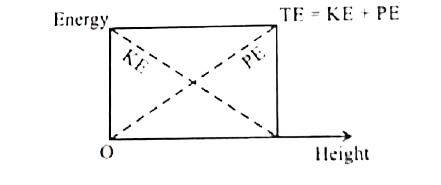
|
|
| 14. |
The angular velocities of three bodies in SHM are w_(1) w_(2) w_(3) with their respective amplitudes as A_(1) A_(2) A_(3). If all three bodies have same mass and velocity then |
|
Answer» `A_(1)w_(1) = A_(2)w_(2) = A_(3)w_(3)` |
|
| 15. |
The P-V diagram of a system undergoing thermodynamic transformation is shown in figure. The work done on the system in going from ArarrBrarrC is 50 J and 20 cal heat is given to the system. The change in internal energy between A and C is |
|
Answer» 34 J |
|
| 16. |
A cricket bowler releases the ball in two different ways (a) giving it only horizontal velocity, and (b) giving it horizontal velocity and a small downward velocity. The speed Vs at the time of release is the same. Both are released at a height H from the ground. Which one will have greater speed when the ball hits the ground ? Neglect air resistance |
|
Answer» Solution :Inprojectile horizontalcomponentis notaffected by gravityitremainconstant . a smalldownwardvelocity  Let the ballbe givena smalldownwardvelocity inverticaldirection or`v_(y)= SQRT(U^(2) + 2G H)` `V= sqrt(v_(X)^(2)+ v_(y)^(2)) = sqrt(v_(s)^(2) + u^(2) + 2g H)` (b )when ball isgivenonlyhorizontalvelocityhorizontalvelocityat the timeofrelease. `(u_(x))= v_(s)` Duringprojecticlemotionhorizontalvelocityremainsunchanged inverticaldirection`v_(y)^(2)= u_(y)^(2)+ 2gH`  Resultantspeedof theballat bottom `v= sqrt(v_(x)^(2)+ v_(y)^(2))` `=sqrt(v_(s)^(2) + 2gH)` |
|
| 17. |
Define the quasi-static process. |
| Answer» SOLUTION :A quasi-static process is an infinitely slow process in which the SYSTEM changes its variables (P,V,T) so slowly such that it remains in THERMAL, MECHANICAL and chemical EQUILIBRIUM with its surroundings throughout. | |
| 18. |
A lift is ascending with a retardation of 1.4m*s^(-2). If a seconds pendulum from the ground is brought inside that lift, what will be its time period? |
|
Answer» |
|
| 19. |
Consider the decay of a freee neutron at rest :nrarrp+e^(-).. Show that the two body decay of this type must necessarily give an electron of fixed energy, and therefore, cannot account for the observedcontinuous energydistribution ini the beta- decay of a neutron in a nucleus, figure. |
|
Answer» Solution :In the DECAY process, `nrarr p+e` energy of electron is equal to `(DELTA m)c^(2)` where`Deltam=` mass defect `=` mass of neutron `-` mass of proton and electron , which is FIXED. Therefore, two body decay of this type cannot explain the observed continuous energy distribution in the `beta-` decay of a neutron in a nucleus. |
|
| 20. |
The value of 124.2 - 52.487 with due regard to significant places is |
|
Answer» `71.7` |
|
| 21. |
Two objects X and Y are thrown upwards simultaneously with the same speed. The mass of X is greater than that of Y. The air exerts equal resistive force on two objects, then |
|
Answer» X REACHES maximum HEIGHT than Y |
|
| 22. |
A liquid drop of diameter D breaks up into 27 tiny drops. Find the resulting change in energy. Take surface tension of the liquid as sigma |
|
Answer» SOLUTION :Radius of larger drop = `(D)/(2)` Radius of each small drop= r `27xx(4)/(3)pir^(3)=(4)/(3)pi((D)/(2))^(2) IMPLIES r=(D)/(6)` Initial surface area of large drop `4pi((D)/(2))^(2)=piD^(2)` Final surface area of 27 small drop `=27xx4pir^(2)=27xx4pi(D^(2))/(36)=3piD^(2)` `:.` CHANGE in energy = Increase in area `xx rho` `=2piD^(2) rho` |
|
| 23. |
State the important points to be remembered in gravitational field. |
|
Answer» Solution :(i) The magnitude of `vec(E)` decreases as the distance r increases. (II) To calculate gravitational interaction. It carries energy and MOMENTUM in SPACE. (iii) The CONCEPT of field is inevitable in understanding the behaviour of CHARGES. |
|
| 24. |
Two identical solid balls, one of ivory and the other of wet-clay, are dropped from the same height on the floor. Which one will rise to a greater height after striking the floor and why? |
| Answer» Solution :We know that ivory ball is more elastic than WET clay ball. Therefore, the ivory ball will tend to REGAIN its original shpae in a very SHORT time after the collision. Due to this, there will be LARGE energy and momentum transfer to the ivory ball incomparison to the wet clay ball. As a result of it, the ivory ball will rise higher after the collision. | |
| 25. |
The sprinkling of water reduces the temperature of a closed room because |
|
Answer» the temperature of water is LESS than that of the room |
|
| 26. |
The uniform speed of a body is the same as seen from any point in the body. A light cord is wrapped around the rim of the disc and mass of 1 kg is tied to the free end. If it is released from rest, |
|
Answer» the TENSION in the cord is `5 N` `mg-T=ma`………i By `FBD` of the disc `TR=Ialpha=Ia/Rimplies T=(mR^2)/2a/R^2` `T=(ma)/2=a`  By eqn i and ii we GET the following results `a. a=5 m//s^(2)` and `T=5N` and `alpha=a/5=5rad//s^(2)` b. For angular displacement of disc `theta=omegat+1/2alphat^(2)` `=1/2xx5xx4^2=40 rad` c. Work done by torque is `inttau d theta=tau int d theta=5xx40=200J` d. `/_\KE=/_\W=200J` `k_(2)-k_(1)=200J` |
|
| 27. |
In projectile motion velocity vector is always perpendicular to acceleration. |
|
Answer» |
|
| 28. |
A particle of mass 100 g is thrown vertically upwards with a speed of 5 m/s. The work done by the force of gravity during the time the particle goes up is |
|
Answer» ` 0.5J` `:. ` (- work done) = Kinetic energy = `1/2 mv^2` or (-work done) `= 1/2 xx ((100)/(1000))(5)^(2) = (5 xx 5)/(2 xx 10) = 1.25 J` `:.` Work done by force of gravity = `-1.25`. |
|
| 29. |
The range of time scale is of the order of |
|
Answer» `10^(-24)s` to `10^17`s |
|
| 30. |
The speed of a motor increases from 1200 rpm to 1800 rpm in 20 S. How many revolutions does it make in this period of time? |
|
Answer» 400 |
|
| 31. |
Masses m_(A) and m_(B) hanging from the ends of strings of lengths l_(A) and l_(B) are executing. Simple harmonic motions. If their frequencies are related as f_(A)=2f_(B), then…………… |
|
Answer» `l_(A)=2l_(B) and m_(A)=m_(B)?` |
|
| 32. |
What do you mean by reverberation ? what is reverberation time? |
| Answer» SOLUTION :The phenomenon of persistence or persistence or prolongation of sound aftre the SORCE has stoped emitting sound is CALLED reverberation. the TIME for which the sound persists until it become INAUDIBLE is called the reverberation time. | |
| 33. |
Two rods of thickness d and of length l are riveted. If the temperature is increased by theta, what will be the average radius of curvature of the combination? Coefficient of linear expansion of the materials of the two rods are alpha_(1) " and " alpha_(2). |
|
Answer» |
|
| 34. |
A uniform force of ( 3hat(i)+hat(j)) N acts on an particle of mass 2 kg . Hence the particleis displacedfrom position (2hat(i)+hat(k))m to position (4hat(i)+3hat(j)-hat(k))m . Thework done by the force on the particle is |
|
Answer» Solution :`Delta vec(r ) = vec(r_(2)) -vec(r_(1))` ` = 4hat(i) +3hat(j) +hat(k) -2hat(i) - hat(k) = 2hat(i) +2hat(j) ` ` :. ` WORK W ` = vec(F). Delta vec(r )` ` = ( 3hat(i) +hat(j)) . (2hat(i)+3hat(j))` `= 6+3 ` ` :. W = 9 J ` |
|
| 35. |
A particle of mass 2gm is initially displaced through 2cm and then released. The frictional force due to air on it is 2 xx 10^(-3)N. The restoring force constant is 50 xx 10^(-3) N//m.If it is in oscillatory motion, its time period is |
|
Answer» `pi` sec |
|
| 36. |
Two bodies begin to fall freely from the same height. The second body begins to fall 'tau' s after the first. After what time from the beginning of first body does the distance between the bodies equal to l? |
|
Answer» Solution :LET the time of fall of the 1st body be t SECONDS. Time of fall of second body = `t=tau`. Distance of FREE fall of the bodies in the above time intervals respectively are `H_(1)=(g t^(2))/(2),H_(2)=(g(t-tau)^(2))/(2)` THEREFORE `L=H_(1)-H_(2)=g t tau-(1)/(2)g tau^(2)` `therefore t=(l)/(g tau)+(tau)/(2)` |
|
| 37. |
A racing car travels on a track (without banking)ABCDEFAABC is a circular are of radius2 R.CD and FA are strainght paths of length R and DEF is a circular are of radius R=100m The co- efficient of friction on the road is mu = 0.1 The maximum speed of ther car is 50ms^(-1) Find the minimum time for completing one round . |
|
Answer» SOLUTION :As the track is unbanked the necessary centripetal FORCE is provided by force of friction `(m upsilon^(2))/(r) = F = mu R = mu mg :. upsilon= sqrt(mu r g)` For path ABC : length `= (3)/(4) (2pi2R) = 3 pi R = 3 pi xx 100 = 300 pi m` `upsilon_(1)=sqrt(mu 2 Rg) = sqrt( 0.1 xx 2 xx 100 xx 10) = 14.14 m//s` `:. t_(1) = (300 pi)/(14.14) = 66.6s` For path DEF: length `= (1)/(4) (2pi R) = (pi xx 100)/(2) = 50pi` `upsilon_(2)=sqrt(muRg) = sqrt(0.1 xx 100 xx 10 )= 10 m//s` `t_(2) = (50pi)/(10) = 5 pi sec = 15.7 s` For paths `CD` and `FA` length `=R + R =2 R = 200 m` `t_(3) = (200)/(50) = 4.0 s` `:.` Total time for completing one round `t = t_(1) + t_(2) + t_(3) = 66.6 + 15.7 + 4.0 = 86.3 s`. |
|
| 38. |
A moving sphere P collides another sphere Q at rest. If the collision takes place along the line joining their centres of mass such that their total kinetic energy is conserved and the fraction of K.E transferred by the colliding particle is 8/9, the ratio of mass of P and the mass of Q is: |
| Answer» ANSWER :D | |
| 39. |
What are the limitations of dimensional analysis? |
|
Answer» Solution :Limitations of Dimensional analysis 1. This method gives no information about the dimensionless constants in the formula like 1, 2, ......`PI`,e, etc 2. This method is not suitable to derive relations INVOLVING trigonometric, exponential and logarithmie functions 3. It can only check on whether a physical relation is dimensionally correct but not the correctness of the relation. For example, using dimensional analysis, `s = ut + (1)/(3)at^(2)` is dimensionally correct WHEREAS the correct relation is`s = ut + (1)/(2)at^(2)` |
|
| 40. |
Two satellites are at heights h_1, h_2. The ratio of their orbital angular speeds is |
|
Answer» `(h_1/h_2)^(3//2)` |
|
| 41. |
Find the number of degree of freedom (to the nearest integer) of molecule of gas, whose molar heat capacity is C = 29 J/mol/K in the process PT = constant) |
|
Answer» |
|
| 42. |
Two identical adiabatic vessels A and B each contain n mole of a monoatomic and diatomic gas respectively. Both the vessels are connected by a rod of length 1 and cross-sectional area A. Thermal conductivity of rod material is k and lateral surface of the rod is insulated. At any time capacity of the rod and the vessels, find the time when the temperature difference of the vessels becomes half the initial temperature difference. |
| Answer» Solution :`t=(15n RL)/(16 KA) In (2)` | |
| 43. |
A body is projected with velocity 24 ms^(1) making an angle 30^(@) with thehorizontal. The vertical component of its velocity of its velocity after 2s is (g = 10ms^(-1)) |
|
Answer» `8 MS^(-1)` upward |
|
| 44. |
(A): Vibrational energy of diatomic molecule corresponding to cach degree of freedom is k,(R): For every molecule, vibrational degree of freedom is 2. |
|
Answer» Both (A) and ( R) are TRUE and (R ) is the correct EXPLANATION of (A) |
|
| 45. |
A body is moving at a distance parallel to X-axis with a constant velocity. Its angular momentum about the origin |
| Answer» Answer :A | |
| 46. |
Classial Physics doen not include subjects like |
|
Answer» MECHANICS |
|
| 47. |
The position vector of a particle is given byvecr= 3 t hati+ 5t^2 hatj + 7 hatk Find the direction in which the particle experiences net force? |
|
Answer» SOLUTION :Velocity of the particle, ` VECV = (d vecr)/(DT) = (d)/(dt) (3t) hati + (d)/(dt) (5t^2) hatj + (d)/(dt) hatk ` `(dvecr)/(dt) = 3 hati + 10T hatj ` Acceleration of the particle `vec a = (dvecv)/(dt) = (d^2 vecr)/(dt^2) = 10 hatj` Here, the particle has acceleration only along positive y direction. According to Newtons second LAW, net force must also act along positive y direction. Ir addition, the particle has constant velocity in positive x direction and no velocity in z direction. Hence, there are no net force along x or z-direction. |
|
| 48. |
Unsing components method, sbtract the following vectors .bar(A) = A_(x) hat(i) + A_(y) hat(j) + A_(z) hat(k)bar(B) = B_(x) hat(i) + B_(y) hat(j) + B_(z) hat(k) |
|
Answer» Solution :The subtraction of two vectors is equivalent to subtracting the corresponding X, y and z components . `vec(A) - vec(B) = (A_(x) - B_(x)) hat(i) + (A_(y) _ B_(y)) hat(j) + (A_(z) - B_(z)) hat(K)` |
|
| 49. |
The amount of work done to convert 1 g ice at 0^(@)C into steam at 100^(@)C is |
|
Answer» 756 J |
|
| 50. |
A cannon fires successively two shells with velocity v_(0)=250m//s, the first at the angle theta_(1)=60^(@) and the second at the angle q_(2)=45^(@) to the horizontal the azimuth being the same. Neglecting the air drag, find the time interval between firings leading to the collision of the shells. |
|
Answer» Solution :Let the first shell travel for TIME `t_(1)` and second fortime `t_(2)` before they collide. Both the shells must travel equal horizontal and VERTICAL DISTANCES to collide. For horizontal motion, `v_(0)cos theta_(1).t_(1)=v_(0)cos theta_(2).t_(2)` i.e. `(t_(1))/(t_(2))=(cos theta_(2))/(cos theta_(1)),(t_(1))/(t_(2))=(cos 45^(@))/(cos 60^(@))=(1//sqrt(2))/(1//2)t_(2)` i.e. `t_(1)=sqrt(2)t_(2)` For vertical motion `v_(0)SIN theta_(1).t_(1)-1/2"gt"_(1)^(2)=v_(2)sin theta_(2). t_(2)-1/2 "gt"_(2)^(2)` (or)`v_(0)sin 60^(@) . t_(1)-1/2"gt"_(1)^(2)=v_(0)sin 45^(@). t_(2)-1/2"gt"_(2)^(2)` or `v_(0)(sin 60^(@)t_(1)-sin 45^(@)t_(2))=t/2(t_(1)^(2)-t_(2)^(2))` Puttingvalues `250-((sqrt(3))/2sqrt(2)t_(2)-1/(sqrt(2))t_(2))=9.8/2(2t_(2)^(2)-t_(2)^(2))implies250((sqrt(6)-sqrt(2))/2)t_(2)=4.9t_(2)^(2)` `t_(2)=(250(2.45-1.41))/(2xx4.9)` or `t_(2)=(250xx1.04)/9.8=26.7simpliest_(1)=sqrt(2)t_(2)=1.414xx26.7=37.8s` Time interval `t_(1)-t_(2)=37.8s-26.7s=11.1s` |
|