

Saved Bookmarks
This section includes 7 InterviewSolutions, each offering curated multiple-choice questions to sharpen your Current Affairs knowledge and support exam preparation. Choose a topic below to get started.
| 1. |
A railway flat car, whose mass together with the artillery gun is M, moves at a speed V. The gun barrel makes an angle a with the horizontal. A shell of mass m leaves the barrel at a speed v, relative to the barrel. The speed of the flat car in order that it may stop after the firing is |
|
Answer» `(MV COS ALPHA)/(M-m)` |
|
| 2. |
A cyclic process is shown in the figure. Work done during the cyclic process ABCDA is |
|
Answer» 160 J `= ((AB + CD)/(2)) xx AD` `= ((2 +1)/(2)) xx 10^(2) = 150 J` 
|
|
| 3. |
In a system of three particles, the linear momenta of the three particles are (1,2,3), (4,5,6) and (5,6,7). These components are in kgms^(-1). If the velocity of centre of mass of the system is (30,39,48)ms^(-1), then find the total mass of the system. |
|
Answer» Solution :Here `vec(p_(1))=(1,2,3)kgms^(-1)` `vec(p_(2))=(4,5,6)kgms^(-1)` `vec(p_(3))=(5,6,7)kgms^(-1)` `vec(v_(cm))=(30,39,48)MS^(-1)` `Mvecv_(cm)=vecp` `therefore Mvecv_(cm)=vec(p_(1))+vec(p_(2))+vec(p_(3))` `therefore M(30,39,48)=(1,2,3)+(4,5,6)+(5,6,7)` `M(30,39,38)=(1+4+5, 2+5+6,3+6+7)` `M(30,39,48)=(10,13,16)` Comparing respective co-efficients on both sides. `M(30)=10,""M(39)=13,""M(48)=16` `therefore M=(1)/(3)KG,M=(1)/(3)kg,M=(1)/(3)kg` `therefore M=(1)/(3)kg` Thus the total mass of the system is `(1)/(3)kg`, |
|
| 4. |
A hot body placed in a surrounding of temperature theta_(0) obeys Newtons's law of cooling d theta // dt = - k (theta - theta_(0)). Its temperature at t = 0 is theta_(1). The specific heat capacity of the body is s and its mass ism. Find (a) the maximum heat that the body can lose and (b) the time starting from t = 0 in which it will lose 90% of this maximum heat. |
|
Answer» Solution :(a) The body will lose heat until its TEMPERATURE equals that of surrounding `(Delta Q)_(max) = mx (theta_(1) - theta_(0))` (b) Let in TIME `t`, body LOSES `90%` of `(Delta Q)_(max)`. It will lose `10%` of `(Delta Q)_(max)` further. `(1)/(10) (Delta Q)_(max) = ms (theta - theta_(0))` `(1)/(10) (theta_(1) - theta_(0))_(max) = ms (theta - theta_(0))` `(theta - theta_(0)) = (1)/(10) (theta_(1) - theta_(0))` The temperatuure DIFFERENCE of body and surrouding after time `t` `(theta - theta_(0)) = (theta_(1) - theta_(0)) e^(-kt)` `(1)/(10) (theta_(1) - theta_(0)) = (theta_(1) - theta_(0)) e^(-kt)` `e^(kt) = 10` `kt 1n e = 10` `t = (1n 10)/(K)` 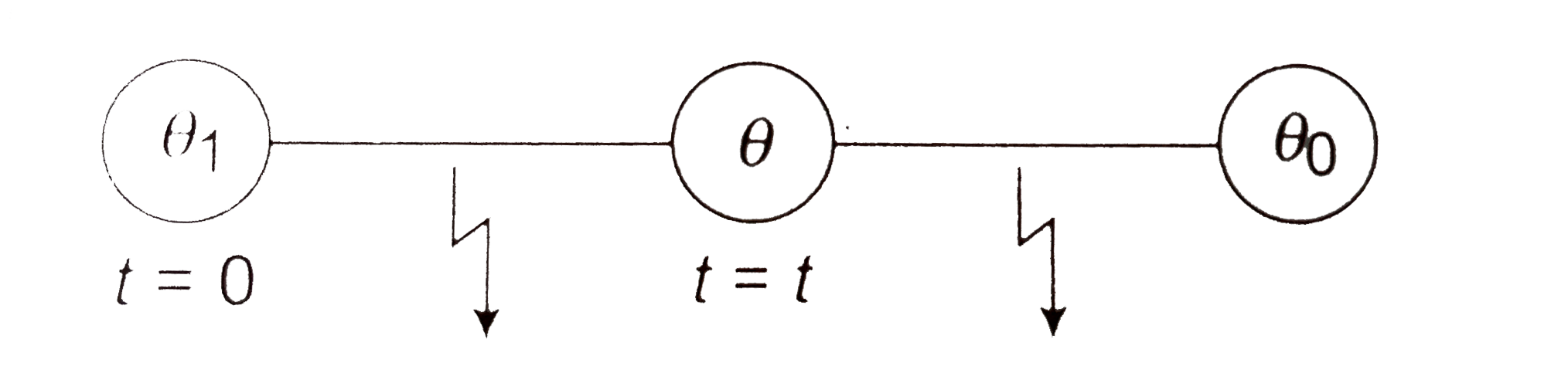
|
|
| 5. |
The kinetic energy and the potential energy of a particle executing S.H.M. are equal. The ratio of its displacement and amplitude will be |
|
Answer» `1/(SQRT2)` |
|
| 6. |
A steel ball of mass 0.1 kg falls from a height of 10 m and bounces to a height of 5.4 m from the ground. If the dissipated energy in this process is absorbed by the ball, find the rise in temperature of the ball ? (specific heat of steel = 460 JKg^(-1)K^(+) , g = 10 ms^(-2)) |
|
Answer» Solution :Loss in gravitational PE = HEAT energy , `0.1 XX 10(10 - 5.4) = 0.1 xx 460 xx Delta theta` `IMPLIES Deltatheta = 0.1^(0)C` (rise in temperature) |
|
| 7. |
A satellite is revolving very close to a planet of density rho. The period of revolution of satellite is |
|
Answer» `SQRT((3pi rho)/(G))` |
|
| 8. |
A stone is projected vertically up from the ground with velocityy 40ms^(-1). The interval of time between the two instants at which the stone is at a height of 60 m above the ground is (g=10ms^(-2)) |
|
Answer» 4 s |
|
| 9. |
Dimensions of resistance are same as (where his Planck's constant and e is charge) |
|
Answer» `(h)/(e)` `"Resistance"= ("Potential difference (V)")/("current (I)")= [ML^(2)T^(-3)A^(-1)]/[A]= [ML^(2)T^(-3)A^(-2)]` Dimensions of Planck.s CONSTANT h= `[ML^(2)T^(-3)A^(-2)]` `:. (h)/(e^(2))= ([ML^(2)T^(-1)])/([AT]^(2))= [ML^(2)T^(-3)A^(-2)]` |
|
| 10. |
Heat energy absorbed by a system in going through a cyclic process shown in figure is |
|
Answer» `10^(7)piJ` |
|
| 11. |
A sphere of mass 10 kg and radius 0.5 m rotates about a tangent. The moment of inertia of the sphere is |
|
Answer» 5 kg `m^(2)` |
|
| 12. |
A disc of mass 100g and radius 10cm has a projection on its circumference. The mass of projection is negligible. A 20g bit of putty moving tangential to the disc with a velocity of 5ms strikes the projection and sticks to it. The angular velocity of disc is |
|
Answer» `14.29 RADS^(-1)` |
|
| 13. |
Four particles each of mass.m. are located at the four corners of a square of side .a.. If the system is revolving in a uniform circle due to their is mutual force if attraction, then the angular velocity of each particle is: |
|
Answer» `SQRT((GM(2sqrt(2)+1))/a^(3))` |
|
| 14. |
A thermal conductor is heated at one end. What is the theoretical value of its thermal conductivity in order that the other end also attains the same temperature? |
| Answer» SOLUTION :THERMAL CONDUCTIVITY should be INFINITY. | |
| 15. |
Electron volt is the unit of |
|
Answer» power |
|
| 16. |
A body executing SHM at a displacement 'x' 25J. The PE at a displacement (x+y) is |
| Answer» Answer :C | |
| 17. |
A spherical air bubble of radius r is formed in water. If T be the surface tension of water, the excess pressure inside the bubble is |
|
Answer» `(4T)/(R )` |
|
| 18. |
A glass cube of edge 1cm and mu=1.5 has a spot at the centre. The area of the cube face that must be covered to prevent the spot from being seen is |
|
Answer» `SQRT5 PI` |
|
| 19. |
Two bodies of masses 2 kg and 4 kg are moving with velocities 2 m s^(-1) and 10 m s^(-1) towards each other due to mutual gravitational attraction. What is the velocity of their centre of mass? |
|
Answer» `5.3 m s^(-1)` |
|
| 20. |
If a stone dropped from the top of a tower travels half of the height of the tower during last second of its fall, the time of fall is (in seconds) |
|
Answer» `3 + SQRT2` |
|
| 21. |
Dimensional formula of self - inductance is |
|
Answer» `[MLT^(-2) A^(-2) ]` |
|
| 22. |
A system is taken from a given initial state to a given final state along various paths represented on a P-V diagram. The quantity that is independent of the path is |
|
Answer» Amount of heat transferred Q |
|
| 23. |
If mass of the fissionable material is less than the critical mass, then |
|
Answer» FISSION and CHAIN REACTION both are IMPOSSIBLE |
|
| 24. |
A solid sphere is in rolling motion . In rolling motion a body possesses translational kinetic energy (K_(t)) aswell as rotational kinetic energy (K_(r)) simultaneously . The ratio K_(t) : (K_(t) + K_(r)) for the sphere is |
|
Answer» `7 : 10` Rotational kinetic energy `K_(R) = (1)/(2) I omega^(2)` `therefore K_(t) + K_(r) = (1)/(2) m v^(2) + (1)/(2) I omega^(2) = (1)/(2) mv^(2) + (1)/(2) ((2)/(5) mr^(2)) ((v)/(r))^(2)` `therefore K_(t) + K_(r) = (7)/(10) mv^(2) [ because I = (2)/(5) mr^(2)` (for SPHERE)] So , `(K_(t))/(K_(t) + K_(r)) = (5)/(7)` |
|
| 25. |
A ball falls on an inclined plane of inclinatioin theta from a height h above the pontof impact and makes a perfectly elastic collision. Where will it hit the plane again? |
|
Answer» `y=v_(iy)t+1/2w_yt^2` `0=v-0costhetast-1/2gcosthetat^2` where t is th same time of motion of ball in air which moving from orign to P. `As t!=0 , so t=(2v_0)/g` 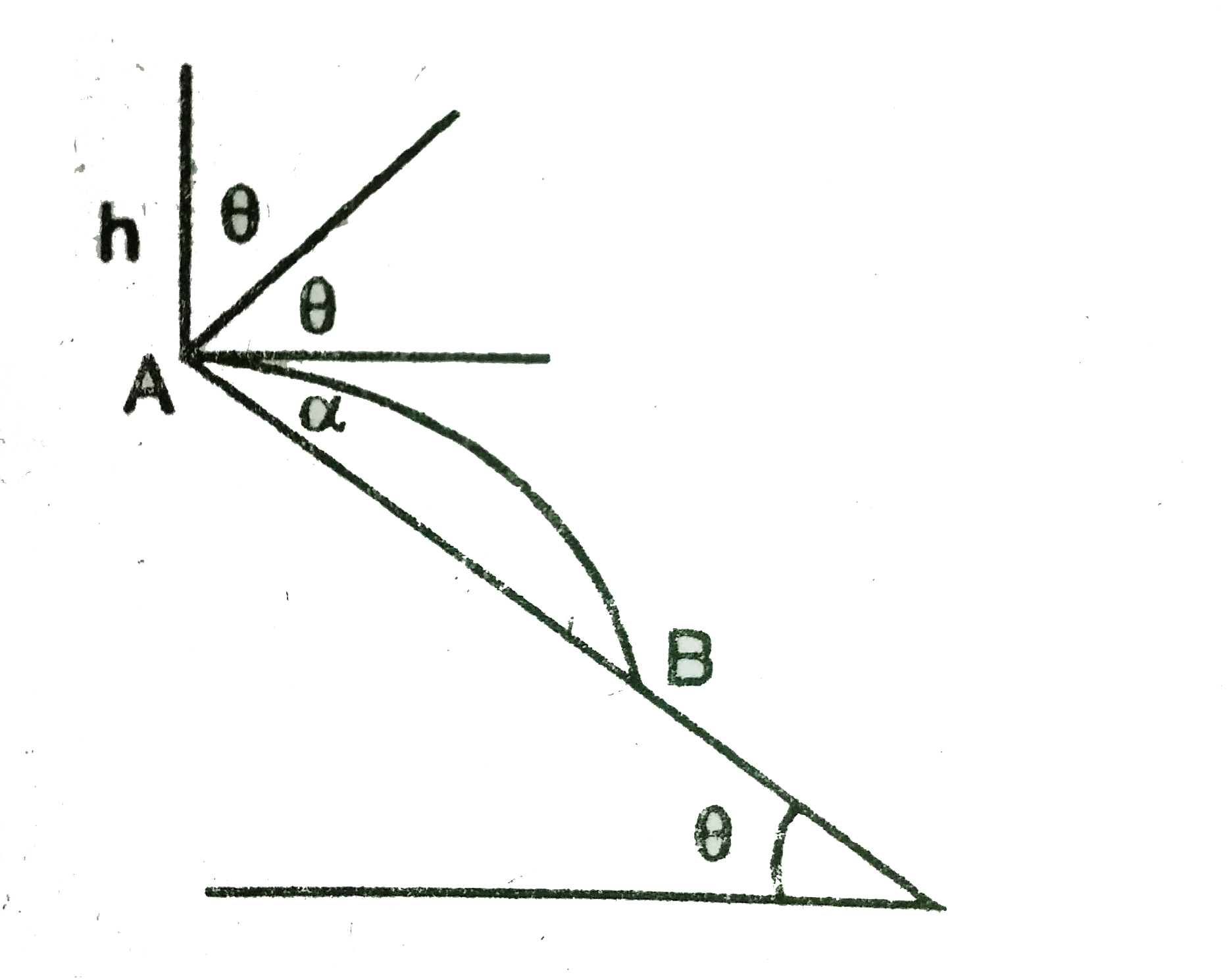 Now from the equation ltbr. `x+v_(0x)t+1/2w_xt^2` l=v_0sinthetat+1/2gsinthetat^2` so, `l=v_0sintheta((2v_0)/g)+1/2gsintheta((2v_0)/g)^2` `=(2v_0^2sintheta)/g` Hence the plane will HIT again ata distance. |
|
| 26. |
What is turbulent flow? |
| Answer» Solution :When the velocity of a LIQUID EXCEEDS the critical velocity, the PATH and velocities of the liquid become disorderly. At the stage, the flow LOSES all its orderliness and is CALLED turbulent flow. | |
| 27. |
A bullet of mass 0.04 kg moving with a speed of 90 m s^(-1)enters a heavy wooden block and is stopped after a distance of 60 cm. What is the average resistive force exerted by the block onthe bullet? |
|
Answer» Solution :The RETARDATION ‘a’ of the bullet (assumed constant) is GIVEN by `a= ( -u^2)/(2s)= (-90 xx 90)/(2 xx 0.6) ms^(-2) = - 6750 ms^(-2)` The retarding force, by the second law of motion, is `= 0.04 kg xx 6750 m s^(-2) = 270 N ` The actual resistive force, and THEREFORE, retardation of the bullet may not be uniform.The answer therefore, only indicates the average resistive force. |
|
| 28. |
Two identical loudspeakers are located at point A & B, 2 m apart. The loudspeakers are driven by the same amplifier (coherent and are in phase). A small detector is moved out from point B along a line frequency below which there will be no position |
|
Answer» |
|
| 29. |
A thick spherical shell has an inner radius R_(1) and an outer radius R_(2). It has mass m and a uniform density. If r is the distance from the centre, then gravitational field E_(g) for R_(1) lt r lt R_(2) is E = (KGm)/(r^(2)) ((r^(3)-R_(1)^(3))/(R_(2)^(3) - R_(1)^(3))). Find the value of K |
|
Answer» |
|
| 30. |
For a particle executing SHM, the kinetic energy (K) is given by K = K_(0) cos^(2) omega t, the equation of its displacement can be |
|
Answer» `((K_0)/(m omega^(2)))^(1/2) SIN omega t` |
|
| 31. |
If the speed of a vehicle increases by 2ms^(-1), its kinetic energy is doubled, then original speed of the vehicle is |
|
Answer» `(SQRT(2)+1)ms^(-1)` |
|
| 32. |
A monkey sitting on a tree at a height of 19.6 m, drop a 10 g seed of rose apple on a crocodile, at rest below the tree. If the seed falls in the mouth of the crocodile in 2 s time and becomes stationary, then the momentum gained by the crocodile (in addition to the seed) is........... kg m/s. (g=9.8ms^(-2)) |
|
Answer» `0.196` `{:(p=mv,|,"Where "v=V_(0)+"gt"),(=10xx10^(-3)xx19.6,=0+9.8xx2,),(THEREFORE p=0.196kgm//s,=19.6m//s,):}` |
|
| 33. |
A uniformly moving cricket ball is turned back by hitting it with a bat for a very short time interval. Show the variation of its acceleration with time. (Take acceleration in the backward direction as positive) |
|
Answer»
|
|
| 34. |
The equation for the displacement of a particle executing SHM is y={5 sin pi t}cm. Find the velocity at 3cm from the mean position, acceleration after 0.5 s after leaving the mean position. |
|
Answer» `3PI CM s^(-1)` ZERO |
|
| 35. |
A hemisphere of radius R and of mass 4m is free to Slide with its base on a smooth horizontal table. A particle mass m is placed on the top of the hemisphere. Find the angular velocity of the particle relative to hemisphere at an angular displacement theta when velocity of hemisphere has become v. |
|
Answer» Solution :Actual velocilty of ball is `v_(1)` is horizontal direction. ` :. v_(1)-(-v)=v_(rel)costheta` `:. v_(1)+v=v_(rel) costheta`……….i  Applying conservation PRINCIPLE of momentum in horizotal direction. `P_(ix)=P_(fx)` `0=mv_(1)-4mv` `:. v_(1)=4V`.......ii Applying mechanic energy conservation principle. Loss in `PE=` gain in `KE` `mg(r-rcostheta)=1/2m[sqrt(v_(1)^(2)+(v_(rel)sitheta)^(2))]^(2)+1/24mv^(2)`.........IIII after solving eqn i , ii , iii `v_(rel)=(5v)/(costheta)` `:. omega_(rel)=v_(rel)/R=(5v)/(Rcostheta)` |
|
| 36. |
A jet plane starts from rest as S=0 and it is subjected to the acceleration shown |
|
Answer» VELOCITY at `S=60m` is 46.47m/s |
|
| 37. |
An ideal gas undergoes cyclic process ABCDA as shown in given P - V diagram. The amount of work done by the gas is___ |
|
Answer» `6P_0V_0` `=(3V_0-V_0)(P_0-2P_0)` `=2V_0xx(-P_0)` `=-2P_0V_0` `THEREFORE` The work done by GAS = `~ 2P_0V_0` |
|
| 38. |
The following are the P-V diagrams for cyclicprocess for a gas. Then the heat is absorbed by the gas in the process |
| Answer» Answer :D | |
| 39. |
A particle of unit mass undergoes one dimensional motion such that its velocity varies according to v(x) = = beta x ^(-2n)where B and n are constants and x is the position of the particle. The acceleraion of the particle as a function of x, is given by : |
|
Answer» `-2n BETA ^(2) n ^(- 4n-1)` `So (DV )/(dx) = - 2n beta x ^(-2n -1)` Now `a = v (dv)/(dx) = (beta x ^(-2n)) (-2n beta x ^(-2n -1))` `implies a =- 2 n beta ^(2) x ^(-n -1)` |
|
| 40. |
A car is moving with a speed of 72 km . h^(-1) towards a roadside source that emits sound at a frequency of 850 Hz. The car driver listens to the sound while approaching the source and again while moving away from the source after crossing it. If the velocity of sound is 340 m . s^(-1), the difference of the two frequencies, the driver hears is |
|
Answer» 50 Hz When the car is approaching the source, then apparent frequency is, `n_(1) = ((V+u_(o))/V)n=((340+20)/340)850=900" Hz " ` When the car moves away from the source, then apparent frequency is, `n_(2) = ((V+u_(o))/V)n=((340+20)/340)850=800" Hz " ` `therefore n_(1) - n_(2) =900-800=100` Hz the option © is CORRECT. |
|
| 41. |
Steel rod at 40°C is observed to be 1 m long when measured by a brass scale which is correct at 0^(@) C. correct length of the steel rod at 0°C is( alpha_( "steel") = 12 xx 10^(-6) //1^(0) C and alpha_("Brass")= 19 xx 10^(-6)//1^(0) C ) |
|
Answer» `99.89` CM |
|
| 42. |
A body is swinging on a swing such that his lowest and highest positions are at heights of 2m and 4.5 m respectively. His velocity at the lowest position is, |
|
Answer» `2.5 ms^(-1)` |
|
| 43. |
A massless inextensible string connects two masses m_1 = 3kg and m_2 = 1kg. Mass m_1 is lifted until mass me touches the floor and then released. The initial height of mass m_1 is h =1m. What height above the floor will the mass m_2 rise after mass m_1 falls on to the floor. |
|
Answer» |
|
| 44. |
A thin circular metal disc of radius 500mm is set rotating about a central axis normal to its plane upon raising its temperature gradually, the radius increases to 507.5 mm, the percentage change in the rotational KE will be ___ |
|
Answer» `1.5%` |
|
| 45. |
Three point masses, each of mass m, are placed at the corner of an equilateral triangle of side 1. Then the moment of inertia of this system about an axis along one side of the triangle is |
|
Answer» `3ml^2`  Moment of inertia about BC is `I_(BC) = m(0)^(2) + m(0)^(2) + m(AD)^(2)` Since `AD = SQRT(AB^2 - ((BC)/(2))^(2)) = sqrt(l^2 - (l^2)/(4) ) = (SQRT3)/(2) l` `THEREFORE I_(BC) = m ((sqrt3)/(2) l)^(2) = (3)/(4) ml^(2)` SIMILARLY , we find the moment of inertia about AB is `I_(AB) = m (0)^(2) + m(0)^(2) + m (CE)^(2)` In right angle `Delta BEC` `sin 60^(@) = (CE)/(BC) = (CE)/(l) or CE = l sin 60^(@) = (sqrt3)/(2) l` `therefore I_(AB) = m ((sqrt3)/(2) l)^(2) = (3)/(4) ml^(2)` Moment of inertia along AC is `I_(AC) = m(0)^(2) + m(0)^(2) + m(BF)^(2)` In right angle `Delta BFC` `sin 60^(@) = (BF)/(BC) = (BF)/(l)` or `BF = l sin 60^(@) = l ""(sqrt3)/(2)` `therefore I_(AC) = m ((sqrt3)/(2)""l )^(2) = (3)/(4) ml^(2)` |
|
| 46. |
A disc with linear velocity v and angular velocity omega is placed on rough ground. Suppose a " and " alpha be the magnitudes of linear and angular acceleration due to friction. |
|
Answer» |
|
| 47. |
Name three factir affecting the energy radiated by a not body. |
|
Answer» (ii) TEMPERATURE (ii) Surface AREA. |
|
| 48. |
Accorrding to Kepler, the period of revolution of a planet (T) and its mean distance from the Sun ® related by the equation. |
|
Answer» `T^(3)a^(3)` = CONSTANT |
|
| 49. |
If the density of oxygen is 16 times that of hydrogen , what will be the ratio of the velocities of sound in them ? |
| Answer» Solution :Using eq. `(v_(1))/(v_(2)) = sqrt((rho_(2))/(rho_(1))) (V_(O_(2)))/(V_(H_(2))) = sqrt((rho_(H_(2)))/(rho_(O_(2)))) = sqrt((1)/(16)) = (1)/(4)` | |
| 50. |
The velocity with which a projectile must be fired so that it escapes earth's gravitation, does not depend on .......... |
|
Answer» MASS of the earth `V = sqrt((2GMe)/r)`According this V DEPEND on G, `M_e`and r but on mass of the body m |
|


