

Saved Bookmarks
This section includes 7 InterviewSolutions, each offering curated multiple-choice questions to sharpen your Current Affairs knowledge and support exam preparation. Choose a topic below to get started.
| 1. |
An ideal gas is enclosed in a gas bottle at 0^(@)C and 1 atmospheric pressure. The bottle bursts at a pressure just greater than 2 atmospheres. To which temperature the gas can be heated without breaking the bottle ? |
|
Answer» |
|
| 2. |
Why do we feel lighter and heavier at the highest and lowest points of a Ferris wheel? Suppose, the Ferris wheel is revolving with a constant angular velocity. |
|
Answer» Solution :At the highest point of the WHEEL, we have, MG - n = `(mv^(2))/(r )` where m = mass of the PASSENGER, v = linear velocity of the passenger at the ROTATING Ferris wheel, r = radius fo curvature of the Ferris wheel and n is the normal reaction. `therefore "" n = mg - (mv^(2))/(r )` So, we FEEL lighter at the highest point. At the lowest point of the trajectory, n - mg = `(mv^(2))/(r)"" or, n = mg + (mv^(2))/(r)` Hence, we feel heavier at the lowest point of the Ferris wheel. |
|
| 3. |
In a S.H.M when the displacement is one half of the amplitude, what fraction of the total energy is potential energy? |
|
Answer» `1//4` |
|
| 4. |
Two wires are arranged as shown in the figure. The elongations in upper and lower wires are respectively |
|
Answer» `((m_(1)+m_(2))gl_(1))/(AY_(1)), (m_(2)gl_(2))/(AY_(2))` |
|
| 5. |
Why are springs made of steel and not of copper? |
| Answer» Solution :DUE to its HIGH modulus of ELASTICITY STEEL is generally preferred. | |
| 6. |
An insect trapped in a circular groove of radius 12 cm moves along the groove steadily and completes 7 revolutions in 100s. (a) What is the angular speed, and the linear speed of the motion ? (b) Is the acceleration vector a constant vector ? What is its magnitude ? |
|
Answer» Solution :This is an example of uniform circular motion. Here R = 12 cm. The angular speed `omega` is given by `omega = 2PI//T = 2pi xx 7//100 = 0.44` rad/s The LINEAR speed v is : `upsilon = omega R = 0.44 S^(-1) xx 12 cm = 5.3 cm S^(-1)` The direction of velocity v is along the tangent to the circle at EVERY point. The acceleration is directed TOWARDS the centre of the circle. Since this direction CHANGES continuously, acceleration here is not a constant vector. However, the magnitude of acceleration is constant : `a = omega^(2)R = (0.44 S^(-1))^(2)(12 cm) = 2.3 cm s^(-2)` |
|
| 7. |
A body of mass 1 kg is suspended from a spring balance calibrated for acceleration due to gravity of 10 mcdot s^(-2). What is the reading on the spring balance when the system (i) is ascending with an acceleration of 5 mcdot s^(-2) and (ii) is descending with the same acceleration? [ g = 10 m cdot s^(-2)] |
|
Answer» Solution :Reaction force on the balance when it ascends, R = m(g + a ) = 1(10 + 5) = 15 N. `therefore` In this CASE, the reading of the spring balance ` = (15)/(10) = 1.5` kg. (ii)Reaction force when the system descends, R = m(g - a) = 1(10 - 5) = 5 N. `therefore` In this case, the reading of the spring balance `= (5)/(10)` = 0.5 kg, |
|
| 8. |
Two blocks of masses 10 kg and 30 kg are placed on x - axis. The first mass is moved on the axis by a distance of 2 cm. By what distance should the second mass be moved to keep the position of centre of mass unchanged. |
|
Answer» Solution :mass of the first block, `m_(1)`= 10kg , mass of the second block, `m_2` = 30 kg `m_(1)(Deltax_(1)) =-m_(2)(Deltax_(2)) , Deltax_(2) = -m_(1)/m_(2) (Deltax_(1)) =-10/30(2) =-2/3 cm` Therefore the second block should be moved in opposite direction to the first mass through a DISTANCE of `2/3` cm to keep the POSITION of CENTRE of mass UNCHANGED. |
|
| 9. |
A stone of mass 1 kg is tied to one end of a string of length 0.5 m. It is whirled in a vertical circle. If the maximum tension in the string is 58.8 N, the velocity at the top is |
|
Answer» `1.82 MS^(-1)` |
|
| 10. |
Read each statement below carefully and state , with reasons , if it is true or false :(a)The net acceleration of a particle in circular motion is always along the radiusof the circle towards the centre(b)The velocity vector of a particle at point is always along the tangent to the path of the particle at that point (c )The acceleration vector of a particle in uniform circular motion averaged over one cycle is a nul vector |
|
Answer» (B) True , (c ) True. |
|
| 11. |
Derive the equations of uniformaly accelerated motion by graphical method. |
Answer» Solution :Now at `t=0` the velocity of the particle be `v_(0)` and at t =t the velocity of the particle be v.  `therefore` Acceleration a = SLOP of line AB `= (v-v _(0))/( t -0)` `therefore a = (v - v _(0))/(t )` `therefore v = v _(0) + at ""...(1)` Now displacement of a particle during time t is equal to the area of region OABCD in `v to t` graph. `therefore x =` Area of RECTANGLE OACD + Area of `Delta ACB` `=v_(0) t + 1/2 (v - v _(0)) t` `therefore x = v _(0) t + 1/2 at ^(2) ""...(2)` but AVERAGE velocity, ` x = ((v + v _(0))/( 2 )) t ""...(3)` For, EQUATION (3) and equatin (1), `t = (v-v_(0))/(a)` `therefore x = ((v + v _(0))/(z )) ((v - v _(0))/(a ))` `therefore v ^(2) -v _(0) ^(2) = 2ax` Above equation can be written as follows : `v = v _(0) + at` `x =x _(0) +v_(0) t + 1/2 at ^(2)` `2a (x -x_(0)) =v^(2) -v_(0) ^(2)` |
|
| 12. |
A projectile is fired vertically upward from the surface of earth with a velocity K v_(e) where v_(e) is the escape velocity and K lt 1. Neglecting air resistance, show that the maximum height to which it will rise measured from te centre of earth is R//(1-K^(2)) where R is the radius of the earth. |
|
Answer» Solution :If a BODY is projected from the surface of EARTH with a velocity v and reaches a height h, by conservation of energy `-(GMm)/(R) + (1)/(2) mv^(2) = -(GMm)/(R+h) therefore h = (R)/(1-K^(2))` |
|
| 13. |
Two identical particles move towards each other with velocity 2V and V respectively. The velocity of centre of mass is |
|
Answer» V |
|
| 14. |
Calculate the efficiency of a cycle consisting of two isobaric and two adiabtic lines, if the pressure changes n=10 times within the cycle. The working substances is an ideal gas of adiabatic exponent gamma=1.5. |
|
Answer» |
|
| 15. |
If a large number of water droplets coalesce to form a single large drop, then state whether the total surface energy increases or decreases. Explain. |
|
Answer» Solution :In this case, the surface energy decreases. The total surface area of the SMALL DROPLETS is greater than the surface area of the large drop FORMED. So, when a large number of water droplets coalesce to FORM a single large drop, the surface area decreases. Hence, it indicates a decreases in surface energy, because decreases in surface energy = decreases in surface area `XX` surface tension. |
|
| 16. |
A particle of weight W rests on a rough inclined plane which makes an angle alpha with thehorizontal . If the coefficient of static friction mu = 2 "tan" alpha, find the horizontal force H acting transverse tothe slope of the plane when the particle is about to slip : |
|
Answer» W `sqrt3 cos ALPHA`  W sin `alpha + H cos alpha = mu H "" …. (i)` `H sin alpha+ H = W cos alpha "" …… (ii)` By SOLVING Eqns. (i) and (ii) , we get H . |
|
| 17. |
Assuming that the car in problem 12 is initially at rest and holds n men, each of mass m, prove that if the men run with relative velocity v_(rel) and jump in succession they can impart to the car a greater velocity than if they all run and jump simultaneously. [Hint : When the men run together, the effect is the same as for one man of mass nm. :.Delta v=(nm)/(M+nm)v_(rel.) When they run and jump in succession, Deltav = sum_(i=1)^(i=n) =(mv_(rel))/(M+im)=mv_(rel)((1)/(M+m)+(1)/(M+2m)+(1)/(M+3m)+...+(1)/(M+nm))] |
|
Answer» |
|
| 18. |
The densities of two substances are in the ratio 5 : 6 and the specific heats are in the ratio 3 : 5 respectively. The ratio of their thermal capacities per unit volume is |
| Answer» ANSWER :B | |
| 19. |
A ball is dropped from some height towards the ground : Which one of the following represents the correct motion of the ball ? |
|
Answer»
|
|
| 20. |
A fast moving neutron collides elastically and head on with a nucleus of N_(7)^(14). The percentage of energy lost by the neutron during elastic collision is nearly |
|
Answer» 0.2 |
|
| 21. |
If the unit of force were 10N, that of power were 1 MW and that of time were 1 millisecond then the unit of length would be |
| Answer» ANSWER :B | |
| 22. |
A liquid is filled into a semielliptical cross - section with a as semi major axis and bas semi minor axis. The ratio of the surface tension forces on the curved part and the plane part of the tube in vertical position will be |
|
Answer» `( PI ( a+B) )/( 4B)` |
|
| 23. |
Obtain an expression for the critical vertical of a body revolving in a vertical circle. |
Answer» Solution :  Imagine that a body of mass (m) attached to one end of a massless and inextensible string executes circular motion ir a vertical plane with the other end of the string fixed. The length of the string becomes the radius (F) of the circular path (See figure). LET us discuss the motion of the body by taking the free body diagram (FBD) at a position where the position vector (7) makes an angle with the vertically downward direction and the instantaneous velocity is as shown in Figure. There are two forces acting on the mass. 1. Gravitational force which acts downward. 2. Tension along the string. Applying Newton.s second law on the mass, in the tangential direction, `mg sin theta =ma_t` `mg sin theta=-m ((dv)/(dt))` where, `a+(t)=-(dv)/(dt)` is tangential retardation. In the radial direction, `T-mg cos theta = ma_r` `T-mg cos theta = (mv^(2))/(r)` where, `a_(r)=v^(2)/r` is the centripetal acceleration. The circle can be divided into four sections A, B, C and D for better understanding of the motion. The four important facts to be understood from the two equations are as follows: (1) The mass is having tangential acceleration (g sine) for all values of 0 (except 0 = 0), it CLEAR that this vertical circular motion is not a uniform circular motion. (ii) From the equations (ii) and (i) it is understood that as the magnitude of velocity is not constant in the course of motion, the tension in the string is also not constant. (iii) The equation (ii), `T=mg cos theta=(mv^(2))/(r)` highlight that in sections A and D of the circles, `("for "-pi/2 lt theta lt pi/2, cos theta " is positive")`, the term `mg cos theta` is always greatest than zero. Hence the tension cannot vanish even when the velocity vanishes. (iv) The equation (ii), `(mv^(2))/r=T-mg cos theta` further highlights that in sections B and C of the circles `("for "pi/2 lt theta lt (3pi)/(2), cos theta" is negative")`, the second term is always greater than zero. Hence velocity cannot vanish, even when the tension vanisher These points are to be KEPT in mind while solving problems related to motion in vanishes. To start with let us consider only two positions, say the lowest point 1 and the highest point 2 as shown in Figure for further analysis. Let the velocity of the body at the lowest point 1 be `vecv_(1)` at the highest point be and v at any other point. The direction of velocity is tangential to the circular path at all points. Let `vecT_(1)` The the tension in the string at the lowest point and `vecT_(2)`be the tension at the highest point and `vecT`be the tensionat any other point. Tension at cach point acts towards the center. The tensions and velocities at these two points can be found by applying the law of conservation of Motion in vertical dels hown for energy. For the lowest point (1) When the body is at the lowest point (1), the gravitational force `m vecg` me which acts on the body (vertically downwards) and ANOTHER one is the tension `vecT_1` noting vertically upwards, i.e., towards the center. From the equation (b), we get `T_(1)-mg=(mv_(1)^(2))/(r)` .........(1) `T_(1)=(mv_(1)^(2))/(r)+mg` ....(2) For the highest point (2) At the highest point 2, both the gravitational force `m vecg` on the body and the tensiondownwards, i.e., towards the center again. `T_(2)+mg =(mv_(2)^(2))/(r_(2))` ........(3) `T_(2)=(mv^(2))/(r_(2))-mg` ..........(4) From equations (4) and (2), it is understood that `T_(1) gt T_(2)` The difference in tension `T_(1)-T_(2)` is obtained by subtracting equation (4) from equation (2) `T_(1)-T_(2)=(mv_(1)^(2))/(r)+mg-((mv_(2)^(2))/(r)-mg) =(mv_(1)^(2))/(r)+mg-(mv_(2)^(2))/(r)+mg` `T_(1)-T_(2)=m/r [v_(1)^(2)-v_(2)^(2)]+2mg ........(5)` The term `[v_(1)^(2)-v_(2)^(2)]` can be found easily by applying law of conservation of energy at point 1 and also at point 2. NOTE: The tension will not do any work on the mass as the tension and the direction of motion is always perpendicular. The gravitational force is doing work on the mass, as it is a conservative force the total energy of the mass is conserved throughout the motion. Total energy at pointl `1 (E_1)` is same as the total energy at a point `2 (E_2)` `E_1= E_2` Potential energy at point 1, `U_(1)=0` (by taking reference as point 1) Kinetic energy at point 1, `KE_1 = mv_(1)^(2)` Total Energy at point `1, E_(1)=U_(1)+KE_(1)=0+1/2 mv_(1)^(2)=1/2 mv_(1)^(2)` Similarly, Potential energy at point 2, `U_2= mg (2r) `(h is 2r from point 1) Kinetic Energy at point `2, KE=1/2 mv_(2)^(2)` Total energy at point `2, E_(2)=U_(2)+KE_(2)=2mgr+1/2 mv_(2)^(2)` From the law of conservation of energy given in equation (6), we get `1/2 mv_(1)^(2)=2mgr+1/2 mv_(2)^(2)` After rearranging `1/2 m(v_(1)^(2)-v_(2)^(2))=2mgr ` `v_(1)^(2)-v_(2)^(2)=4gr ......(7)` Substituting equation in in equations `T_(1)-T_(2)=m/r [4gr] +2mg` Therefore, the difference in tension is `T_(1)-T_(2)=6mg ........(8)` Minimum speed at the highest point (2) The body must have a minimum speed upon the wind reaching point and the body will not loop het take the tension `T_2=0` in equation) (4) `0=(mv_(2)^(2))/(r)-mg` `(mv_(2)^(2))/(r)=mg` `v_(2)^(2)=mg` `v_(2)^(2)=rg` `v_(2)=sqrt(gr)` ......(9) The body must have a speed at point, `2, v_(2) sqrtgr` to stay in the circular path. Maximum speed at the lowest point 1. To have this minimum speed `(v_(2)=sqrt(gr))` pin the band we have also of point By making use of equation (7) we can find them the minimum speed at point 1. `v_(1)^(2)-v_(2)^(2)=4gr` Substituting equation (9) in (7), `v_(1)^(2)-gr=4gr` `v_(1)^(2)=5gr` `v_(1)=sqrt5(gr) ........(10)` The body must have a speed at point to say the work From equations (9) and (10), it is clear that the minimum speed at the lowest point 1 should be v 5 times more than the minimum speed at the highest point 2, so that the body loops without leaving the circle. 
|
|
| 24. |
A wave travelling along a string is discribed by. y(x,t) = 0.005 sin (80.0 x - 3.0 t). in which the numerical constants are in SI units (0.005 m, 80.0 rad m^(-1), and 3.-0 rad s^(-1)). Calculate (a) the amplitude, (b) the wavelength, and (c ) the period and frequency of the wave. Also, calculate the displacement y of the wave at a distance x = 30.0 cm and t = 20 s ? |
|
Answer» Solution :On comparing this displacement equation with EQ. (15.2). `y(x,t) = a sin (kx - omega t)`. we find (a) the amplitude of the wave is `0.005 m = 5 mm`. (b) the angular wave number k and angular frequency `omega` are `k = 80.0 m^(-1)` and `omega = 3.0 s^(-1)` We, then relate the wavelength `lamda` to k through Eg. (15.6). `lamda = 2 pi//k` `= (2 pi)/(80.0 m^(-1))` `= 7.85 cm` (C ) Now, we relate T to `omega` by the relation `T = 2 pi//omega` `= (2 pi)/(3.0 s^(-1))` `= 2.09 s` and frequency , `V = 1//T = 0.48 Hz` The displacement y at x = 30.0 cm and time t = 20 s is given by `y = (0.0005 m) sin (80.0 XX 0.3 - 3.0 xx 2.0)` `= (0.005 m) sin (-36 + 12 pi)` `= (0.005 m) sin (1.699)` `= (0.005 m) sin (97^(@)) ~= 5 mm` |
|
| 25. |
Define unit vector . |
|
Answer» SOLUTION :A vector DIVIDED by its magnitde is UNIT vector . it has amagnitude EQUAL to unity or one .`hat(A) = (vec(A))/(A)` . |
|
| 26. |
A bullet going with speed 350 m/s enters in a concrete wall and penetrates a distance of 5 cm before coming to rest . Find the deceleration ? |
|
Answer» Solution :Given :Speed of the bullet= 350 m/s i.e., u = 350 m/s s = 5 cm v = 0 m/s a = ? Formula :`v^(2) = u^(2) + 2AS` `RARR 0 = u^(2) + 2as` `(or) u^(2) = - 2as` `a = (-u^(2))/(2s)` Deceleration ` a = (-350 XX 350)/(2 xx 0.5)` `= - 12.25 xx 10 ^(5) m//sec^(2)` Negative ANSWER represents retardation. 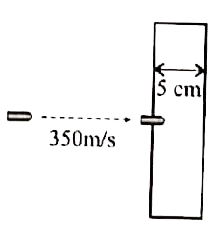
|
|
| 27. |
In variation of specific heat capcity of a substance with temperature is given by C =A + BT ^(2) ,where A and B are constnts and T is the temperature, Calculate the mean specific heat in a temperature range T = 0 to T =T and the specific heat at the mid-point T//2. |
|
Answer» |
|
| 28. |
The efficiency of a heat engine working between 27^(@)C and 127^(@)C is: |
|
Answer» `50%` `T_(2)=27^(@)C = 300 K` EFFICIENCY, ` n= 1- (T_(2))/(T_(1))= 1- (300)/(400)= 1-(3)/(4)= (1)/(4)= 0.25` n= 25 % |
|
| 29. |
A moving sphere P collides another sphere Q at rest. If the collision takes place along the line joining their centres of mass such that their total kinetic energy is conserved and the fraction of K.E transferred by the colliding particle is 8/9, the ratio of mass of P and the mass of Q is |
| Answer» ANSWER :D | |
| 30. |
Pressure P, voluume V and temperature T for a certain gas are related by P = (AT - BT^(2))/(V) where A and B are constant. The work done by the gas as its temperature change from T_(1) to T_(2) with pressure remaining constant is |
|
Answer» `A - (B)/(2)(T_(2) - T_(1))` Since P is a constant `:. PdV = (A-2BT)DT` As `dW = PdV = (A-2BT)dT :. W = underset(T_(1))overset(T_(2))int (A-2Bt)dT` `= [At - BT^(2)]_(T_(1))^(T_(2)) = A(T_(2) - T_(1)) - B(T_(2)^(2) - T_(1)^(2))` |
|
| 31. |
The planet mercury is revolving in an Elliptical orbit around the sun as shown in the figure.The kinetic energy of mercury will be greatest at |
|
Answer» A |
|
| 32. |
A motorist travelling due north with a velocity of Ukmph, turns a corner and then travels due west with a velocity of Vkmph. He observer on turning the corner that in directions it seems now to come from exactly the opposite point of the compas to when he was travelling north. The true direction of wind and its true velocity are tan^(-1)((pu)/(v)) and q/2 sqrt(V^(2)+U^(2)) kmph. The value of p and q are |
|
Answer» |
|
| 33. |
The surface temperature of a hot body is 1227^(@)C. Find the wavelength at which it radiates maximum energy. Given Wien's constant = 0.2892 cm.K. |
|
Answer» |
|
| 34. |
A wire can support a load Mg without breaking. It is cut into two equal parts. The maximum load that each part can support is |
| Answer» ANSWER :3 | |
| 35. |
Answer the following questions based on the P-T phase diagram of carbon dioxide: What is the effect of decrease of pressure on the fusion and boiling point of CO_(2) ? |
| Answer» Solution :Both the BOILING point and freezing point of `CO_(2)` decrease if pressure DECREASES. | |
| 36. |
Dimensional formulae are used A) to convert one system of units into another (B) to find proportionality constants C) to cheak the correctness of an equation |
| Answer» Answer :D | |
| 37. |
The current velocity of a river grown in proportion to the distance from its bank and reaches the maximum value V_(0) in the middle. Near the banks the velocity is zero. A boat is moving along theriver in such a manner that it is always perpendicular to the current with respect to river and the speed of the boat in still water is U. Width of the river is C. Time taken by the boat to cross the river: |
|
Answer» C/U |
|
| 38. |
The current velocity of a river grown in proportion to the distance from its bank and reaches the maximum value V_(0) in the middle. Near the banks the velocity is zero. A boat is moving along theriver in such a manner that it is always perpendicular to the current with respect to river and the speed of the boat in still water is U. Width of the river is C. Drift along the river in crossing the river: |
| Answer» Answer :B | |
| 39. |
Average kinetic energy of molecules is |
|
Answer» Directly PROPORTIONAL to square ROOT of TEMPERATURE |
|
| 40. |
Following gases are kept at the same temperature. Which gas possesses maximum r.m.s. speed? |
|
Answer» o |
|
| 41. |
An object of mass 3 kg is at rest . Now a force F=6t^(2)hati+2thatj is applied on the object . Find the velocity of the object at t=3 sec. |
|
Answer» SOLUTION :Impulse `=int_(0)^(3) Fdt =int_(0)^(3) (6t^(2)hati+2thatj) dt =[2t^(3)hati+t^(2)hatj]_(0)^(3) =54hati+9hatj` Impulse= change in LINEAR MOMENTUM `54hati+9hatj=(vecv-vecu), 54hati+9hatj=3(vecv-vec0), vecv=(18hati+3hatj)m//s` |
|
| 42. |
A particle starts from rest and accelerates as shown in the graph. Determine (a) the particle's speed at t=10"and"t=20and (b) the distance travelled in the first 20s |
|
Answer» |
|
| 43. |
The rate of steady volume flow of water through a capilary tube of length 'l' and radius 'r' under a pressure difference of P is V. This tube is connected with another tube of the same length but half the radius in series. Then the rate of steady volume flow through them is (The pressure difference across the combination is P) |
| Answer» Answer :B | |
| 44. |
A solid cylinder is rolling down the inclined plane without slipping. On which factor does the velocity of a cylinder at the bottom of an inclined plane depend? |
|
Answer» Length of the CYLINDER |
|
| 45. |
A glass plate of 0.2 m^(2) in area is pulled with a velocity of 0.1 m/s over a larger glass plate that is at rest. What force is necessary to pull the upper plate if the space between them is 0.003 m and is filled with oil of eta 0.01 Ns/m^(2). |
|
Answer» SOLUTION :`F=etaA(DV)/(DY)` `=0.01xx0.2xx(0.1)/(0.003)=66.7xx10^(-3)N` |
|
| 46. |
A transverse wave propagating on a stretched string of linear density 3 xx 10^(-4) kg m^(-1) is represented by the equation y = 0.2 sin (1.5 x + 60 t) Where x is in metres and t is in seconds . The tension in the string (in newtons) is : |
|
Answer» 0.24 |
|
| 47. |
Theabsoultetemperature of airin a region linearly increases from T_1 to T_2 in a space of width d. Find thetime taken by a sound wave to go through the regionin terms of T_1, T_2d and the speed upsilon of sound at 273 K. Evalute this time for T_1 = 280 K, T_2 = 310 K, d 33m and upsilon = 330 m s^(-1) |
|
Answer» `T = T_1 + ((T_2-T_1))/(d) x …. (i)` We know that, `V prop sqrtT` `rArr (VT)/(V) = sqr((T)/(273))` `rArr VT = V sqrt((T)/(273))` `rArr DT = (dx)/(VT) = (du)/(V) XX ((273)/(T))` `t = (sqrt273)/(V) int_0^d (dx)/([T_1 + ((T_2 - T_1))/(d) x]` `= (sqrt273)/(V) xx (2d)/(T_2 - T_1) (sqrt barT_2 - sqrtT_1))` ` = ((2d)/(V)) ((sqrt273)/(T_2 - T_1)) sqrtT_2 - sqrtT_1` `T = (2d)/(V) (sqrt273)/(sqrtT_2 + sqrt T_1)` `[ Since T_1 - T_2 = (sqrtT_2 + sqrtT_1) (sqrtT_2 - sqrtT_1)]` Putting the given value we GET `(2xx33)/(330) . (sqrt273)/(sqrt280 + sqrt 310) = 96 ms` |
|
| 48. |
The absolute temperature (Kelvin scale) T is related to the temperaturet_(c) on the Celsius scale by t_(c) = T - 273.15 Why do we have 273.15 in this relation, and not 273.16 ? |
| Answer» SOLUTION :TRIPLE -POINT is `0.01^(@) C ," not " 0 ^(@) C` . | |
| 49. |
If an orbiting satellite comes to stand still suddenly |
|
Answer» The satellite will MOVE along the TANGENT |
|
| 50. |
A drop of water of volume 0.05cm^3 is pressed between two glass plates, as a consequence of which it spreads and occupies an area of 40cm^2. If the surface tension of water is 70 dyne/cm, then the normal force required to separate out the two glass plates will be in newton) |
|
Answer» 90 |
|


