

Saved Bookmarks
This section includes 7 InterviewSolutions, each offering curated multiple-choice questions to sharpen your Current Affairs knowledge and support exam preparation. Choose a topic below to get started.
| 1. |
An orbiting satellite will escape if |
|
Answer» its SPEED is increased by 41% |
|
| 2. |
When a fluid passes through a constricted part of a pipe ,what happens to its velocity and pressure ? |
|
Answer» <P> Solution :When a FLUID passes through a CONSTRICTED part then according to `vprop(1)/(A)` its velocity increases and according to Bernoulli.s equation`P_(1)+(1)/(2)rhov_(1)^(2)=P_(2)+(1)/(2)rhov_(2)^(2)` PRESSURE decreases . |
|
| 3. |
"Soldiers are not allowed to march on a bridge". Give reason. |
| Answer» Solution :While crossing a bridge, if the PERIOD of stepping on the ground by marching soldiers be equal to the NATURAL frequency of the bridge, it may be thrown into RESONANCE vibration and the VIBRATIONS may be so large that the bridge may COLLAPSE. Thus to avoid resonant vibration of the bridge. Soldiers are ordered to break steps | |
| 4. |
A body is projected with a velocity 2/3rd of escape velocity from the surface of the earth in order to orbit the earth. Its orbital radius will be (R_(e) is radius of the earth) |
|
Answer» `(9/8)R_(E)` |
|
| 5. |
1 m ……….ly |
|
Answer» SOLUTION :1 light year (LY)`=9.46xx10^(15) m` `:.1m=(1)/(9.46xx10^(15)) ly` `:.1m=1.057xx10^(-16 ly` |
|
| 6. |
A particle performs a SHM with amplitude of 0.01m and the frequency of its oscillation is 60 Hz. Find the maximum acceleration of a particle. |
|
Answer» `144 pi^(2) m"/"sec^(2)` `= A xx 4pi^(2) F^(2)` `=0.01xx 4 (pi)^(2)xx (60)^(2)` `= 144 pi^(2) m"/"s^(2)`. |
|
| 7. |
A ball is thrown vertically upward at a speed of 10 m/s. When it has reached one half of its maximum height. How high does the ball rise? (g=10ms^(-2)) |
|
Answer» 5M |
|
| 8. |
A car moving along a straight highway with speed of 126 km h^(-1) is brought to a stop within a distance of 200 m. What is the retardation of the car (assumed uniform), and how long does it take for the car to stop ? |
| Answer» SOLUTION :`3.06 MS^(-2), 11.4 s` | |
| 9. |
An open rectangular tank 5mxx4mxx3m in dimension is containing water up to a height of 2m the tank is accelerated horizontally along the longer side. Assuming water to be and ideal liquid find- (a) the maximum acceleration with which the tank can be moved so that water does not fall from the rear side. (b) the gauge pressureat the bottom of the front and back of the tank (points A and B) if the tank is closed at the top and is then acclerated horizontally at 9 m//s^(2). Assume that the top cover has a small hole at the right side of the tank so taht pressure of air inside the tank is maintained at atmospheric pressure. Gauge pressure at a point is difference in absolute pressure at the point and atmospheric pressure. |
|
Answer» (B) `P_(A)=0,P_(B)=0.44` atm |
|
| 10. |
Is the measure of an angle dependent upon the unit of length? |
|
Answer» SOLUTION :`THETA "(RADIAN)"=("Arc")/("Radius")` As an angle is the RATIO of the length of an arc and the radius i.e., it is the ratio of two lengths, so that measure of an angle does not DEPEND upon the units of length. |
|
| 11. |
Radius of a star acting like perfect black body is R, then at what temperature the rate of radiation will be Q ? (Where sigma= Stefun - Boltzman constant) |
|
Answer» `(Q)/(4piR^(2)SIGMA)` Here, Q is taken in place of P. `:.Q=AsigmaeT^(4)` `:.Q=4pir^(2)sigmaT^(4)""(because e=1)` `:.T=((Q)/(4pir^(2)sigma))^(1/4)` |
|
| 12. |
P-V diagram of an ideal gas is shown in the figure. Work done by the gas in the process ABCD is |
|
Answer» <P>`3P_(0)V_(0)` |
|
| 13. |
Two waves of length 50 cm and 51 cm produced 12 beas per second. The velocity of sound is : |
|
Answer» 331 m/s `=v_(1)-v_(2)=(v)/(lambda_(1))-(v)/(lambda_(2))` `:.12=v((1)/(50)-(1)/(51))` (or) `v=12xx50xx51 cm//s` `=3060 cm//s= 306 m//s` |
|
| 14. |
The phase difference between two particles executing SHM of the same amplitudes and frequency along same straight line while passing one another when going in opposite directions with equal displacement from their respective starting point is 2pi//3. If the phase of one particle is pi//6, find the displacement at this instant, if amplitude is A: |
|
Answer» `A//3` |
|
| 15. |
Discuss the completely inelastic collision in one dimension . |
|
Answer» Solution :Here particle of mass `m_(1)` is moving speed `v_(1f)` in x direction . ` :. theta_(1)=theta_(2) = 0 ` From the law of CONSERVATION of momentum , momentum before collision and momentum after collision is same . ` :. M_(1)v_(1f)=(m_(1)+m_(2))v_(1f) ""...(1)` Energy is dissipated during collision , `DELTAK` = kinetic energy before collision- kinetic energy after collision ` 1/2 m_(1)v_(1)^(2)i - 1/2 (m_(1)+m_(2))v_(f)^(2) "" [:. v_(2i)=0] ` Substituting the value of EQUATION (1) , `DeltaK = 1/2m_(1)v_(1i)^(2)-1/2(m_(1)+m_(2))xx(m_(1)/(m_(1)+m_(2)))^(2)v_(1i)^(2)` `=1/2m_(1)v_(1i)^(2)[1-(m_(1))/(m_(1)+m_(2))] ` ` :. DeltaK= 1/2 m_(1)m_(2)v_(1i)^(2)` is positive . Note Ifparticles moves in the same direction and speed of particle of mass `m_(1) v_(1i)` and if `v_(1i) gt v_(2i)` them , after inelastic both having speed `v_(f)` `v_(f) = (m_(1)v_(1i)+m_(2)v_(2i))/(m_(1)+m_(2))` Kinetic energybefore collision , ` K_(i) = 1/2 m_(1)v_(1i)^(2) +1/2 m_(2)v_(2i)^(2)` Kinetic energy after collision , `K_(f) =1/2 (m_(1)+m_(2))v_(f)^(2)` ` :. K_(f) = 1/2(m_(1)+m_(2))((m_(1)v_(1i)+m_(2)v_(2i))^(2))/((m_(1)+m_(2))^(2))` `= 1/2((m_(1)v_(1i)+m_(2)v_(2i))^(2))/((m_(1)+m_(2)))` ` :. ` Energy dissipated after collision , `K_(i)-K_(f) =1/2 m_(1)v_(1i)^(2)+1/2m_(2)v_(2i)^(2)` `-1/2(-m_(1)v_(1i)+m_(2)v_(2i))^(2)/(m_(1)+m_(2))` `{m_(1)^(2)v_(1i)^(2)+m_(1)m_(2)v_(2i)^(2)+m_(1)m_(2)v_(1i)^(2)+m_(2)^(2)v_(2i)^(2)=1/2} (-(m_(1)^(2)v_(1i)^(2)+2m_(1)m_(2)v_(1i)v_(2i)+m_(2)^(2)v_(2i)^(2))/((m_(1)+m_(2))))` `m_(1)m_(2)v_(2i)^(2)+m_(1)m_(2)v_(1i)^(2)=1/2((-2m_(1)m_(2)v_(1i)v_(2i)+v_(2i)^(2)))/(m_(1)+m_(2))` `=(m_(1)m_(2))/(2(m_(1)+m_(2)))(v_(1i)^(2)-2v_(1i)^(2)-2v_(1i)v_(2i)+v_(2i)^(2))` `=(m_(1)m_(2))/(2(m_(1)+m_(2)))(v_(1i)^(2)-2v_(1i)v_(2i)+v_(2i)^(2))` `=(m_(1)m_(2))/(2(m_(1)+m_(2)))[v_(1i)-v_(2i)]^(2)`. Hence ,kineticenergy is conserved in inelastic collision . |
|
| 16. |
The time period of a particle performing linear SHM is 12s. What is the time taken by it to make a displacement equal to half its amplitude ? |
|
Answer» 1 sec |
|
| 17. |
At sections, where a river is narrow and shallow, the current will be faster while at sections where the river is wide and deep, the current will be slower. Explain. |
|
Answer» Solution :According to principle of CONTINUITY for an incompressible fluid,`A_(1)v_(1)=A_(2)v_(2)` It means that, at sections where the area of cross section (TAKEN NORMAL to flow) is SMALLER, the velocity is HIGHER and vice versa. |
|
| 18. |
Is the motion of earth around sun oscillatory? Why? |
| Answer» Solution :(i) at the EQUILIBRIUM POSITION (II) at the extreme positions | |
| 19. |
An object is released from rest. The time it takes to final through a distance h and the speed of the object as it falls through this distance are measured with a pendulum clock. The entire apparatus is taken on the moon and the experiment is repeated (a) the measured times are same (b) the mesured speed are same (c) the actual time in the fall are equal (d) the actual speeds are equal |
|
Answer» a, B are TRUE |
|
| 20. |
A fly wheel starts rotating from rest and acquires rotational speed of 360 revolution s^(-1) in 3 minutes. The average angular acceleration is………….. |
|
Answer» `3("revolution")/(("second")^(2))` |
|
| 21. |
The body of mass 5kg is attached to a wire 0.2m long its breaking strength is 5 xx 10^(7)Nm^(-2) It can be rotated in a horizontal circle with maximum angular velocity 5 rads ""^(-1) then the area of cross-section of the wire is |
|
Answer» `5 xx 10^(-7) m^(2)` |
|
| 22. |
The dimension of co - efficient of viscocity is |
|
Answer» `ML^-2T^-1` |
|
| 23. |
Under what condition does a sudden phase reversal of waves on reflection take place ? |
| Answer» SOLUTION :On reflection from a denser MEDIUM, a wave suffers a sudden phase REVERSAL. | |
| 24. |
Two balls are dropped to the ground from different heights . One ball is dropped 2.0s after the other , but both strike the ground at same time 5.0s after the 1 st is dropped . (a) What is the diference in the heights from which they were dropped ?(b) From what height was the first ball dropped ? |
|
Answer» SOLUTION :(a)For the first ball `s=h_(1),v=0,t=5 SEC ` `s=ut+1/2at^(2),h_(1)=0xx5+1/29.8xx5^(2)=122.5m` For the second ball `s=h_(2),u=0, t=3sec:. H_(2)=1/2gt^(2)=1/2xx9.8xx9=4.9xx9=44.1m` Difference in HEIGHTS `H=h_(2)-h_(1)=122.5-44.1=78.4m` The first ball was dropped from a height of `h_(1)=122.5m`. |
|
| 25. |
Round off the following numbers as indicated (i) 18.35 upto 3 digits(ii) 19.45 upto 3 digits (iii) 101.55 xx 10^(6) upto 4 digits (iv) 248337 upto digits 3 digits (v) 12.653 upto 3 digits. |
| Answer» SOLUTION :(i) 18.4 (II) 19.4 (iii) `101.6 xx 10^(6)` (IV) 248000 (V) 12.7 | |
| 26. |
the speed of the block at point C, immediately before it leaves the second incline is |
|
Answer» `sqrt120` m/s `v_C^2=v_B^2+2gh` or `v_C^2=45+2xx10xx3 IMPLIES v_C=sqrt105` m/s |
|
| 27. |
A drum of radius R and mass M, rolls down without slipping along an inclined plane of angle theta. The frictional force- |
|
Answer» dissipartes ENERGY as heat |
|
| 28. |
Mark out the correct option |
|
Answer» The internal ENERGY of a SYSTEM necessarily increases if heat is added to it. |
|
| 29. |
The ratio of rotational kinetic energy to the total kinetic energy of a diatomic molecule is : |
|
Answer» `3/5` Rotational K.E =`2 XX(1/2kT)` = KT TOTAL number of degrees of freedom = 5 `:.` Total K.E `=5(1/2kT) =5/2kT` `:.("RotationalK.E")/("Total K.E")=(kT)/(5//2kT) =2/5` |
|
| 30. |
A body is performing SHM, then its |
|
Answer» Average total energy per cycle is equal to its maximum kinetic energy. `E= (1)/(2) ka^(2)` where A= amplitude and maximum kinetic energy obtained at mean position due to maximum kinetic energy. Maximum kinetic energy, `K_("MAX")= (1)/(2)m(v_("max"))^(2)` `=(1)/(2)m A^(2) omega^(2)` `=(1)/(2) kA^(2) ""[therefore m omega^(2) = k]` Option A is correct. Average kinetic energy of a body performing SHM at any time `lt K gt = (0+ K_("max"))/(2)` `= ((1)/(2)KA^(2))/(2)= (1)/(4) KA^(2)` and half value of maximum kinetic energy `= (K_("max"))/(2)` `=((1)/(2)KA^(2))/(2)` `=(1)/(4)KA^(2)` hence, option B is correct. Average velocity in one cycle `lt v gt = (0+v_("max"))/(2)= v(A omega^(2))/(2)` Maximum velocity, `v_("max")= A omega` `therefore (2)/(pi)" times "v_("max")= (A omega xx pi)/(2)` hence, option C is incorrect. Root mean square speed `v_("max")= (v_("max"))/(sqrt(2))` and hence, option D is correct. |
|
| 31. |
Two clocks are being tested against a standard clock located in a national laboratory . At 12:00:00 noon by the standard clock, the regarding of the two clocks are : If you are doing an experiment that requires precision time interval measurements, which of the two clocks will you prefer ? |
| Answer» Solution :The range of VARIATION over the SEVEN days of observations is 162 s for CLOCK 1, and 31s for clock 2. The average reading of clock 1 is much closer to the STANDARD time than the average reading of clock 2. The important point is that a clock.s zero error is not as significant for precision WORK as its variation, because a .zero-error. can always be easily corrected . Hence clock 2 is to be preferred to clock 1. | |
| 32. |
A particle of mass 5kg strikes a body of mass 2.5 kg atrest elastically. The 2.5 kg mass after collision moves with a kinetic energy of 5J. The kinetic energy of 5 kg mass before collision is |
|
Answer» 0.62 J |
|
| 33. |
Angular momentum of a body is defined as the product of |
|
Answer» mass and angular velocity |
|
| 34. |
Four particles have velocity 1,0, 2 and 3 ms^(-1)The root mean square velocity of the particles is ...... |
|
Answer» `3.5 ms^(-1)` ` V_(rms) = sqrt( (1^2 + 0^2 + 2^2 + 3^2)/(4) )= sqrt(14/4) = sqrt(3.5) ms^(-1)` |
|
| 35. |
Assume that you are sitting in a car at rest. You see a person in the rear view mirror of radius of curvature 2m running towards you at t=0. if person is running with velocity 5m/s and it is at 9m distance from mirror at this instant, the average velocity (in mm/sec) of image of man in first second is found to be 20x. find the value of x |
|
Answer» |
|
| 38. |
A satellite is launched tangentially from a height h above earth's surface as shown. I. Find v_(min) so that it just touches the earth's surface II. If h = R and satellite is launched tangentially with speed = sqrt((3GM)/(5R)) find the maximum distance of satellite from earth's centre . |
|
Answer» SOLUTION :(I) Satellite just Grazes surface of earth when `2a = 2R+h` `a = (R+(h)/(2))` Total energy `(E )= -(GMm)/(2a)=-(GMm)/((2R+h))` `(1)/(2)mV_(0 min)^(2)-(GMm)/(R+h)=-(GMm)/(2R+h)` `V_(0 min)^(2) = 2GMm[(1)/(R+h)-(1)/(2R+h)]` `= (2GMR)/((R+h)(2R+h)) = (2GMR)/(r(R+r))` `V_(0 min) =sqrt((2GMR)/(r(R+r)))` where `r = h+R` 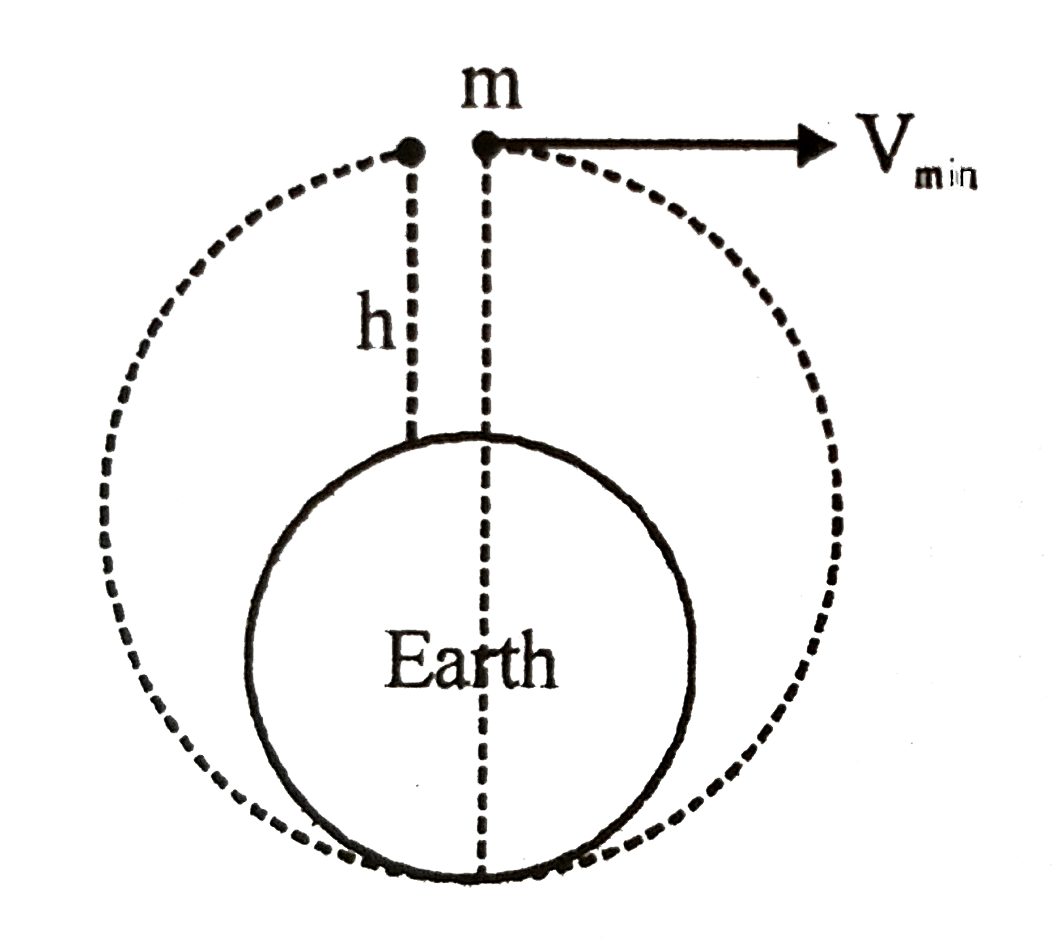 (II) To find maximum distance from CENTRE. `E = - (GMm)/(2a) = (1)/(2)mv_(0)^(2) - (GMm)/(2R)` `= (1)/(2)m. (3GM)/(5R)-(GMm)/(2R)` `-(1)/(2a)=(3)/(10R)-(1)/(2R) = -(2)/(10R)` `2a = 5R =` Major axis Required distance = 3R 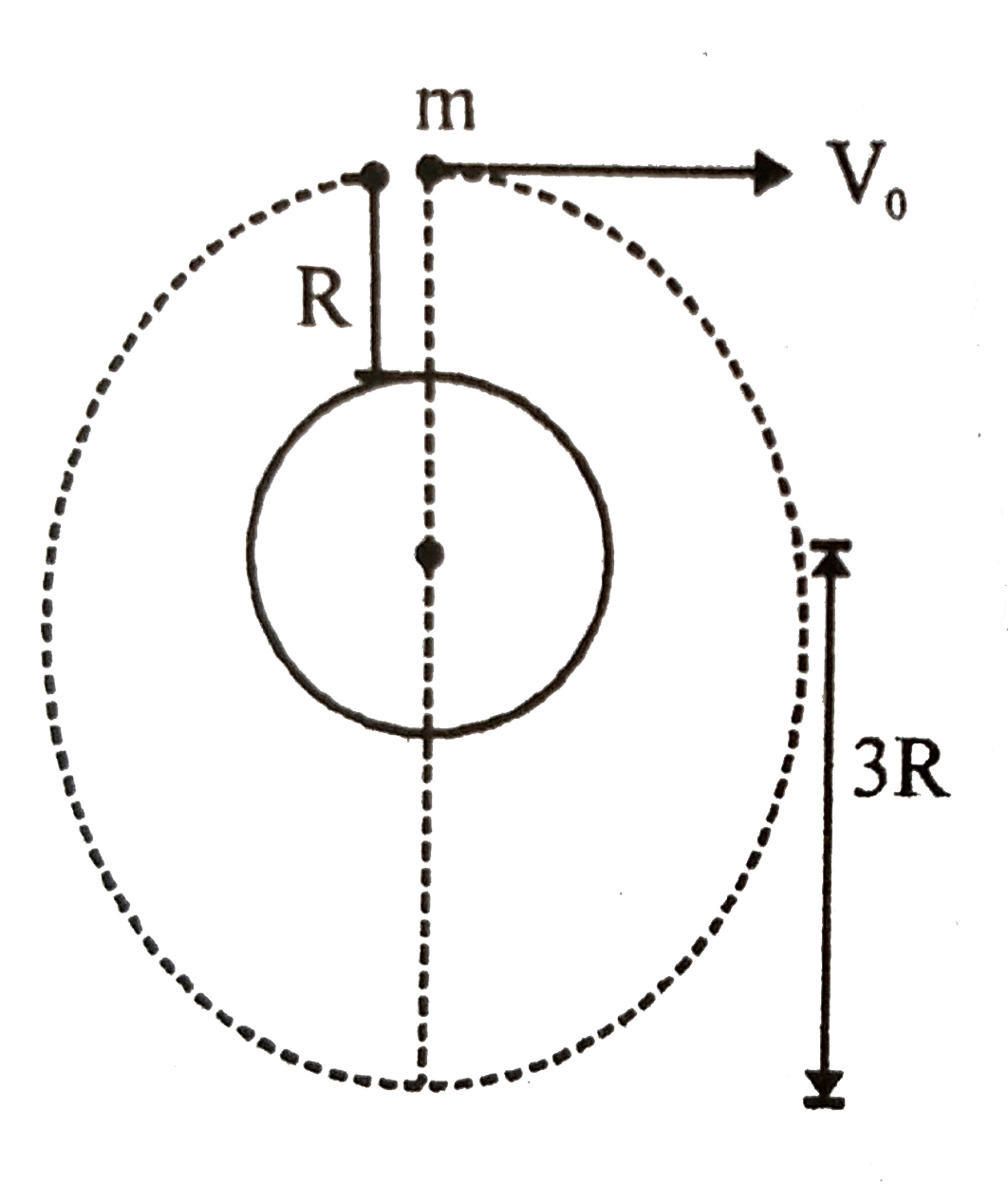
|
|
| 39. |
A sound travelling along a string is described by y = 0.005 sin (80.0x - 3.0t) calculate wavelength , |
| Answer» SOLUTION :`2pi/lemda` = `80RAD m^-1`,`lemda` = `7.85xx10^-2m` | |
| 40. |
In a simple pendulum the period of oscillation (T) is related to the length of the pendulum (L) as |
|
Answer» `(L)/(T)="CONSTANT"` |
|
| 41. |
In an explosion, a body breaks up into two pieces of unequal masses. In this case which one of the following statements is correct? |
|
Answer» `3v COS theta` MOMENTUM of shell before explosion `= mv cos theta ` Momentum of two pieces after explosion = ` m/2 (-v cos theta ) + m/2 v ` Law of CONSERVATION of momentum `mv cos theta = - (mv)/(2) cos theta + m/2 v ` ` therefore V = 3V cos theta ` |
|
| 42. |
A man in a boat crosses a river from point A. if the rows perpendicu lar to the bank he reaches point C(BC=120m) in 10 minutes. If the the man heads at a certain angle alpha to the straight line AB(AB is perpendicualr to the banks) against the current be reaches point B in12.5 minutes. |
|
Answer» the width of the river is 300M  Solving these FOUR EQUATIONS with proper substituing , we get=200m, u=20 m/min, v=12m/min and `alpha=37^(@)` |
|
| 43. |
A spaceship while flyting inspace, splits up into three equal parts, due to an explosion. One fragment keeps moving in the same direction, the other two fly of at 60^@ to the original direction , on either side. If the energy released due to the explosion is twice the kinetic energy of the spaceship, find the kinetic energy of each of the fragment. |
|
Answer» Solution :Letthe mass of thespaceship be 3m and initial speed be U. Hence,mass of eachfragment =m . LET their VELOCITY be `v_1,v_2 and v_3` after the explosion [Fig.1.46].  Applying the CONSERVATION of momentum law along the direction perpendicular to the original direction of motion, `0= mv_2 sin 60^@=mv_3 sin 60^@` `or, mv_2sin 60^@ =mv_3 sin 60^@` `or, v_2=v_3=v` (say) Applying the law of conservation of linear momentum along the original direction of motion , `3mu=mv_1+2mv cos 60^@` `or, 3u=v_1+v` KINETIC energy of the spaceship before explosion `E=1/2xx3mu^2` Energy released during the explosion, `E_r=1/2 m(v_1^2+2v^2)-1/2*3mu^2` According to the problem, `E_r=2E or, 1/2m(v_1^2+2v_^2)-1/2*3mu^2=2xx1/2*3mu^2` `or, v_1^2+2v^2-3u^2=6u^2` ` or, v_1^2+2v^2=9u^2`......(2) Solving (1) and (2) ,`v_1=u and v=2u` Hence, kinetic energy of the first fragment after explosion `=1/2 mv_1^2=1/2mu_2=1/2*2/3*E=1/3E` Kinetic energy of each of the other two fragement `=1/2 mv^2=1/2 m(2u)^2=2mu^2=2*2/3E=4/3E` |
|
| 44. |
One mole of O_2 gas having a volume equal to 22.4 litres at 0^@Cand 1 atmospheric pressure in compressed isothermally so that its volume reduces to 11.2 litres. The work done in this process is |
|
Answer» 1672.5J |
|
| 45. |
Area of a parallelogram formed by vectors (3hati-2hatj+hatk)m and (hati+2hatj+3hatk) m is |
|
Answer» `3sqrt(8)m^(2)` |
|
| 46. |
Instentenous power delivered by engine of a car of mass 18 kg moving on +x-axis is given as p=(2x+5) watt, where x is (in meter) position of car. Car starts from origin from rest (choose the correct statement(s). |
|
Answer» Power increases with time. |
|
| 47. |
A uniform metallic disc of radius r and mass m is spinning with angular speed omega_(0) about an axis passing through its centre and perpendicular to plane. If its temperature is increased (slightly) byDeltaT its new angular speed is (The coefficient of linear expansion of the metal is alpha) |
|
Answer» `omega_(0)(1+2alphaDeltaT)` |
|
| 48. |
In forced oscillations of a particle, the amplitude is maximum for a frequency omega_(1) of the force, while the energy is maximum for a frequency omega_(2) of the force. Then……………. |
|
Answer» `omega_(1)ltomega_(2)` |
|
| 49. |
The pitch of the siren of a fire engine increses as it approaches a boy standing at a bus stop.the phenamenon behind it is due to_____. |
| Answer» SOLUTION :DOPPLER EFFECT | |