

Saved Bookmarks
This section includes 7 InterviewSolutions, each offering curated multiple-choice questions to sharpen your Current Affairs knowledge and support exam preparation. Choose a topic below to get started.
| 1. |
If a monoatomic ideal gas of volume 1 litre at N.T.P is compressed adiabatically to half of its volume, find the work done on the gas. Also find the work done if the compression is isothermal. (gamma=5//3) |
|
Answer» Solution : During an adiabatic process `T_(1)V_(1)=T_(2)V_(2)` Here, `T_(1)=273K, V_(2)=(V_(1))/(2), gamma=(5)/(3)` `:.273 xx V_(1)^((5)/(3)-1)=T_(2)((V_(1))/(2))^((5)/(3)-1)` `T_(2)=(2)^(2//3) xx 273 =431.6K` number of moles, `n=("1 LITRE")/("22.4 litre")=(1)/(22.4)` Work done `=(NR)/(gamma-1) (T_(1)-T_(2))` `=(8.314)/(22.4((5)/(3)-1))(273-431.6)` `=8.34 xx 3)/(22.4xx2) (-158.6)= -89J` (ii) Work done during isothermal compression is `W=2.3026nRT log_(10) ((V_(2))/(V_(1)))` n = number of moles `=(1)/(22.4)`, `T=273K, R=8.314J mol^(-1)K^(-1) rArr (V_(2))/(V_(1)) =(1)/(2)=0.5` `:.W=(2.306xx8.314xx273 log_(10) (0.5))/(22.4) rArr W= -70J` |
|
| 2. |
The diameters of the two arms of U-tube are 1 mm and 2 mm. The tube is filled partly with water and is kept vertical. If the surface tension of water is 70 dyn. cm^-1, then find the difference in the level of water in the two arms of the U-tube . [Angle of contact=8^@] |
|
Answer» Solution :Suppose DUE to capillary action , the water level RISES in one arm of the U-TUBE of `h_1` and in the other arm to `h_2`. `therefore h_1=(2Tcostheta)/( rho G r_1)=(2xx70xxcos8^@)/(1xx980xx0.05)` and `h_2=(2Tcos theta)/(rho g r_2)=(2xx70xxcos8^@)/(1xx980xx0.1)` `therefore` The difference in the level of water in two arms of U tube is `h_1-h_2=(2xx70xxcos8^@)/(1xx980)XX((1)/(0.05)-(1)/(0.1))` `=1.415 cm.` |
|
| 3. |
The angular frequency of n fan increases from 30 rpm to 60 rpm in pi s. A dust particle is present on the blades at a distance of 20 m from axis of rotation. The net acceleration of dust particle at the end of pi s is |
|
Answer» `2.8 MS^(-2)` |
|
| 4. |
The bob of a simple pendulum of period T is given a negative charge. If it is allowed to oscillate with an identical charge at the point of suspension. The new time period will be |
|
Answer» EQUAL T |
|
| 5. |
As shown in figure 10 N force is applied at two ends of a rod. Calculate tensile stress and searing stress for section PR, Area of cross section PQ is 10 cm^(2). |
Answer» Solution :Suppose cross section PQ having area A and PR having A. 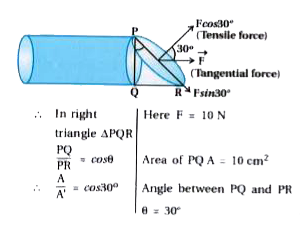 `therefore A. =(A)/(cos 30 ^(@)) = (10 xx 10 ^(-4))/( sqrt 3 // 2 ) ` `therefore A. = ( 2 xx 10 ^(-3))/( sqrt3) m ^(2) ""...(1)` Here, angle between force `vecF` and ara of A. cross-section PR is `30^(@).` Force `vecF` has two component `(i) F cos theta,` PARALLEL component to A. which provides tension `therefore F_(l) = F cos 30^(@)` `=10 xx (sqrt3)/( 2)` `= 5 sqrt3 N ""...(2)` (II) `F sin theta,` perpendicular component to A., it is tangential `therefore F _(t) = F sin 30^(@)` `=10 xx 1/2` `therefore F_(t) = 5 N ""...(3)` Tensile stress `SIGMA _(1) = ("Tensile force "(F _(t)))/(A.)` `= ( 5 sqrt3 xxsqrt3)/(2xx10 ^(-3)` (From equation (1) and (2)) `therefore sigma _(l ) = 7.5 xx 10 ^(+3) N //m ^(2)` Tangential (shear) stress ` sigma _(t) = ("Tangential Force" (F _(t)))/(A.)` `= ( 5 xx sqrt3)/( 2 xx 10 ^(3)) ` (From equation (1) and (3)) `therefore sigma _(t) = ( 5 sqrt3 xx 10 ^(3))/( 2) = 4.33 xx 10 ^(3) N//m ^(2)` |
|
| 6. |
The ratio of specific to molar heat capacity of a body |
|
Answer» Solution :Monoatomic molecule : Average kinetic energy of a molecule `=[3/2kT]` (i) Total energy of a mole of gas `=3/2 kT xxN_A = 3/2 RT` (ii) For one mole , the molar specific heat at constant volume `C_V = (DU)/(dT) =d/(dT) [3/2RT]` `C_V = [3/2R]` `C_P = C_V + R =3/2 R+R` `=5/2R` (iii) The ratio of specific HEATS, `gamma=C_P/C_V=(5//2R)/(3//2R)=5/3=1.67` Diatomic molecule : Average kinetic energy of a diatomic molecule at low temperature `5/2kT`. (i) Total energy of one mole of gas `=5/2kT xxN_A = 5/2RT` (Here, the total energy is purely kinetic) (ii) For one mole specific heat at constant volume `C_V=(dU)/(dT)=[5/2RT]=5/2R` But, `C_P = C_V + R = 5/2R + R = 7/2R` `:. gamma=C_P/C_V=(7//2R)/(5//2R)=7/5=1.40` (iii) Energy of a diatomic molecule at high temperature is equal to `7/2` RT. `C_V=(dU)/(dT)=[7/2RT]=7/2R` `:. C_P = C_v + R = 7/2 R+R` `C_P=9/2R` It is noted that the `C_V and C_P` are higher for diatomic molecules than the monoatomic molecules. It is implied that to increase the temperature of diatomic gas molecules by `1^@C` it require more heat energy than monoatomic molecules. `:.gamma=C_P/C_V=(9//2R)/(7//2R)=9/7=1.28` Triatomic molecule : (i) Linear molecule : Energy of one mole `=7/2 kTxxN_A = 7/2RT` `C_V=(dU)/(dT)=d/(dT)[7/2RT]` `C_V=[7/2R]` `C_P=C_V+R=7/2R+R` `=9/2R` `gamma=C_P/C_V=(9//2R)/(7//2R)=9/7=1.28` (ii) Non - Linear molecule : Energy of one mole `=6/2kTxxN_A=6/2RT=3RT` `C_V=(dU)/(dT)=3R` `C_P=C_V+R` `=3R+R =4R` `gamma=C_P/C_V=(4R)/(3R)=4/3=1.33` |
|
| 7. |
Two blocks A and B of masses m and 2m, respectively are connected by a spring of force constant k. The masses are moving to the right with uniform velocity v each, the heavier mass leading the lighter one. The spring is in the natural length during this motion. Block B collides head on with a third block C of mass m, at rest, the collision being completely inelastic. Calculate the maximum compression of the spring. |
|
Answer» `2mv(m+2m)v_(B)` `v_(B)=2/3v` VELOCITY of (`B` and `C`) Then velocity of centre of MASS during MAXIMUM compression `v_(CM)=(3MV)/(4m)=3/4v` 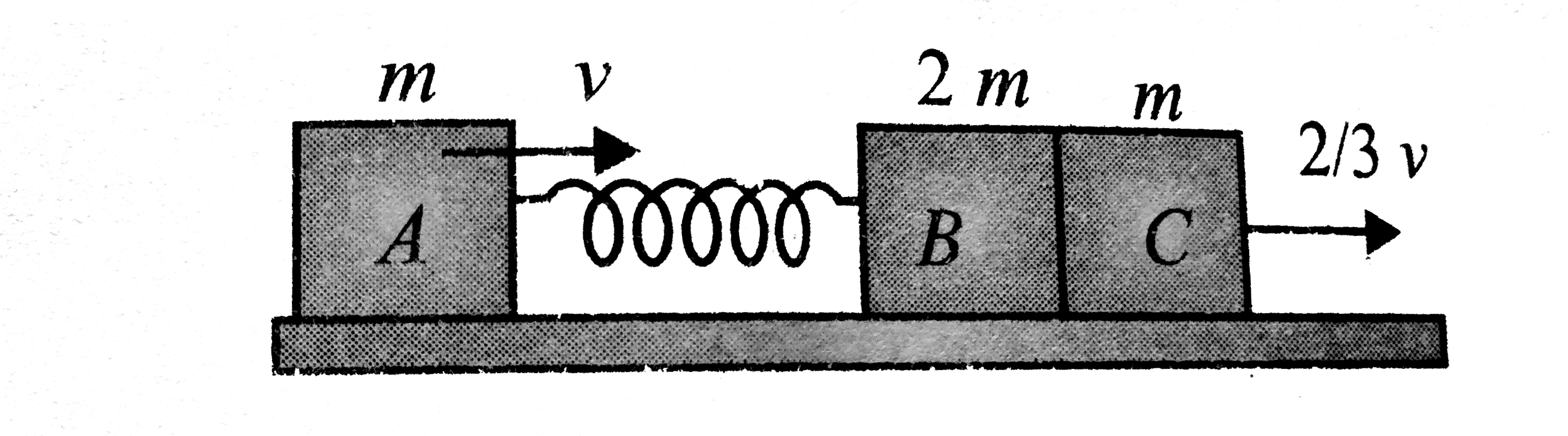 `1/2mv_(4)^(2)+1/23mv_((b+c))^(2)=1/24mv_(CM)^(2)+1/2kx^(2)` Then substituting the value `x=sqrt((MV^(2))/(12k))` |
|
| 8. |
. During head on elastic collision, two bodies of masses m_(1) and m_(2)completely exchange their velocities when |
|
Answer» `m_(1) lt lt m_(2)` |
|
| 9. |
Compare the final images formed by different optical instruments |
|
Answer» `a to g, b to H, C to F, d to E` |
|
| 10. |
If mass of an atom is M and it is moving with speed v, what be its speed after the emission of an alpha - particle if speed of alpha - particle is zero ? |
|
Answer» `(MV)/(M+2)` |
|
| 11. |
Consider a perdulum consisting of a mssless string with a mass at one end. The mass is held with the string horizontal and then released. The mass swings down, and on its way back up, the string is cut at point P when it makes an angle of with theta the vertical. Find the angle for theta which horizontal range .R. is maximum. |
Answer» SOLUTION :The speed at ANGLE is given by conservation of energy.  `(1)/(2)mv^(2)=mghrArr(1)/(2)mv^(2)=mglcostheta` `v=sqrt(2glcostheta)` When string is cut particle MOVES as a PROJECTILE with velocity component. `v_(x)=vcosthetav_(y)=vsintheta` The time of flight is `t=2((v_(y))/(g))` Range is, R = `v_(x)t = v_(x) ((2y_(y))/(g))` `=(2v_(x)v_(y))/(g)=(2(vcostheta)(vsintheta))/(g)=(2v^(2)sin thetacostheta)/(g)` `=(2(2glcostheta)sinthetacostheta)/(g)=4lcos^(2)thetasintheta` Differentiating .R. with respect to `.theta.` and equatingit to zero we get `0=4l(-2costhetasintheta)sintheta+cos^(2)thetacostheta` or `,sin^(2) theta cos theta = cos^(3) theta or, TAN theta = 1 // sqrt(2)` |
|
| 12. |
The radius in kilometers to which the present radius of the earth (R=6400 km) is to be compressed so that the escape velocity is increases to ten times is |
|
Answer» 6.4 |
|
| 13. |
A pendulum that beats seconds on the surface of the earth were taken to a depth of (1//4)th the radius of the earth. What will be its time period of oscillation? |
|
Answer» 5.107 SEC |
|
| 14. |
At what temperature r.m.s velocity of H_2 molecules is equal to that of oxygen molecule at 47^0C? |
| Answer» Answer :D | |
| 15. |
A smooth-walled tunnel is made along the straight line connecting any two points on the earth's surface. A body is released at one end of the tunnel. Considering the earth to be a sphere of uniform density, calculate the time period of oscillation of the particle for its simple harmonic motion. |
Answer» Solution :Let a body of mass m be dropped into the tunnel AB and after some time, suppose the body reaches C. Force of attraction on the body at C.  `F=(G*4/3pir^(3)rhom)/R^(2)" "[rho="AVERAGE density of the earth"]` = `4/3piGrho*mr=g/Rmr` `""[becauserho=(3g)/(4piRG)" "(R="radius of the earth")]` F acts along CO.. So component of F along CO, `Fcostheta=(mgr)/Rxxx/r=(mg)/Rx` `therefore` Acceleration of the body `a=(Fcostheta)/m=g/Rx""...(1)` Hence, `apropx" "[becauseg//R" is a CONSTANT"]` Therefore, (1) the acceleration of the body is DIRECTLY proportional to its distance from O and (2) this acceleration is always directed towards the centre O of the tunnel. Hence, it executes a simple harmonic motion and its time period `T=2pisqrt(x/a)""...(2)` From (1) and (2), `T=2pisqrt(R/g)` |
|
| 16. |
There are two identical small holes, each of area of cross section a on the opposite sides of a tank containing a liquid of density rho. The difference in height betwene the boles is h. Tank is resting on a smooth horizontal surface. Find the horizontal force which will have to be applied on the tank to keep it is equilirbium. |
|
Answer» Solution :`F=F_(1)-F_(2)=rhoav_(1)^(2)-rhoav_(2)^(2)` `=rhoa(2gh_(1))-rhoa(2gh_(2))` `2rhoag(h_(1)-h_(2))=2RHO AGH` 
|
|
| 17. |
The pressure of a gas is 80 cm Hg. Now additional 25% of the same gas is introduced in the same vessel. If the process is done at the same temperature, find the final pressure of the gas. |
|
Answer» Solution :INITIAL pressure of gas `(P_(1))=80` cm of Hg , Initial mass of the gas `(m_(1))=m` Final mass of the gas `(P_(2))=?` At constant VOLUME and temperature, According to Boyle.s law `P_(1)/m_(1)=P_(2)/m_(2)` `RARR P_(2)=m_(2)/m_(1)P_(1)=(5m//4)/m times 80=5/4 times 80=100` cm of Hg `therefore P_(2)=100cm` of Hg |
|
| 18. |
The thickness of ice on a Jake is 6 cm and the temperature of air is - 10^(@) C. At what rate is the thickness of ice increasing ? Thermal conductivity of ice = 2 "Wm"^(-1) "K"^(-1). Density of ice = 920 "kg m"^(3), specific latent heat of ice = 336 "KJ kg"^(-1) |
|
Answer» |
|
| 19. |
n' moles of an ideal gas, undergo a process V(V-a)^(2) = bT - cV. What is the minimum pressure attained during the process? Also find the corresponding temperature. What are the S.I. units of the constants a, b and c? |
| Answer» Answer :A | |
| 20. |
(A): A room can not be cooled by opening the door of a refrigerator in a closed room. (R ): Heat flows from lower temperature (refri-gerator) to higher temperature (room) . |
|
Answer» Both (A) and(R ) are TRUE and (R ) is the CORRECT explanation of (A) |
|
| 21. |
A body is moving under the expense of a constant power. If 'X' is the displacement in time 't', then 'x' is proportional to |
|
Answer» `t^(2/3)` |
|
| 22. |
A body of mass 1 kg initially at rest explodes and breaks into three fragments of masses in the ration 1 : 1 : 3. The two pieces of equal mass fly off perpendicular to each other with a speed of 30 m/s each. What is the velocity of the heavier fragment? |
|
Answer» |
|
| 23. |
Under a constant pressure head, the rate of flow of liquid through a capillary tube is v. if the length of the capillary is doubled and the diameter of the bore is halved. The rate of flow would become |
|
Answer» `V//4` |
|
| 24. |
Consider two sound waves with wavelengths 5 m and 6 m . If these two waves propagate in a gas with velocity 330 ms^(-1) . Calculate the number of beats per second . |
|
Answer» SOLUTION :Given `lambda_(1) = 5m` and `lambda_(2) = 6` m Velocity of sound waves in a gasis v = `330 MS^(-1)` The relation between wavelength and velocity is `v = lambda F implies f = (v)/(lambda)` The frequency corresponding to wavelength `lambda_(1)` is `f_(1) = (v)/(lambda_(1)) = (330)/(5) = 66` Hz The frequency corresponding to wavelength `lambda_(1)` is `f_(2) = (v)/(lambda_(2))= (330)/(6) = 55` Hz The number of beats per second is `|f_(1) - f_(2) | = |66- 55| = 11` beats per sec |
|
| 25. |
2 litre of liquid 10^@Cis mixed with 7 litre of same liquid at 20^@C Consider the linear increase in volume of liquid with increase in temperature and neglect all kinds of heat losses from liqid to surrounding. After thermal equilibrium is reached, find the net volume of liquid (in litre). (Tempera ture coefficient of volume expansion of liquid = 0.000035^@C^(-1)) |
|
Answer» |
|
| 26. |
A bullet of mass m moving with velocity u just grazes the top of a solid cylinder of mass M and radius R resting on a rough horizontal surface as shown in the figure. Assume that the cylinder rolls without slipping. The angular velocity of the cylinder is omega and the final velocity of the bullet is V, then omega=(4"mu")/((8m+aM)R),V=("8mu")/((8m+bM)) then ab is |
|
Answer» |
|
| 27. |
What is the direction of rotation of polar satellite ? |
| Answer» SOLUTION :`IMPLIES`It ROTATES from north-south about EARTH. | |
| 28. |
If a liquid is heated in weightlessness, the heat is tramsmitted thruogh |
|
Answer» CONDUCTION |
|
| 29. |
Two absolute scales A and B have triple points of water defined to be 200 A and 350 B. What is the relation between T_(A)" and " T_(B) ? |
| Answer» SOLUTION :`T_(LAMBDA) = (4//7) T_(B)` | |
| 30. |
An ideal diatomic gas is heated at constant pressure. If the fraction of heat energy supplied which increases the internal energy of the gas is 5/N then N is equal to |
|
Answer» |
|
| 31. |
A car moving on a straight road accelerates from a speed of 4.1 m/s to a speed of 6.9 m/s in 5.0 s. What was its average acceleration? |
|
Answer» `0.56m//s^(2)` |
|
| 32. |
A body is projected horizontally from the top of a tower with a velocity of 10m/s. If it hits the ground at an angle of 45^@ , the vertical component of velocity when it hits ground in m/s is |
| Answer» Answer :D | |
| 33. |
A ball moving with a velocity v hits a massive wall moving towards the ball with a velcocity u. An elastic impact lasts for a time Delta t. |
|
Answer» The average elastic FORCE acting on the ball `(m(U+v))/(Delta t)` |
|
| 34. |
An ideal gas is allowed to expand at constant temperature in a quasi-static process. Can you reverse theprocess? |
| Answer» SOLUTION :YES, it is a REVERSIBLE PROCESS. | |
| 35. |
A rifle with a muzzle velocity of 100ms^(-1) shots a bullet at a small target 30 m away in the same horizontal line. How much height above the target must the rifle be aimed so that the bullet will hit the target? |
|
Answer» Solution :LET `THETA` is the ANGLE of projection of bullet. Let the rifle bet a tO target at T. As OT is HORIZONTAL range =30m. `implies((u^(2))/g)sin 2 theta=30impliessin 2 theta =0.03` As `sin 2 theta` is SMALL, so take `sin 2 theta =2 theta` `2 theta =0.03impliestheta=0.015` 
|
|
| 36. |
A disc of radius 2 m and mass 100 kg rolls on a horizontal floor . Its centre of mass has speed of 20 cm/s . How much work is needed to stop it ? |
|
Answer» Solution :Required work DONE = `- (K_(f) - K_(i)) = 0 + K_(i) = K_(i)` `= (1)/(2) I omega^(2) + (1)/(2) mv^(2) = (1)/(2) ((1)/(2) mR^(2)) omega^(2) + (1)/(2) mv^(2)` `= (3)/(4) mv^(2) = (3)/(4) xx 100 xx (20 xx 10^(-2))^(2) = 3J` |
|
| 37. |
What is the value of acceleration due to gravity and the weight of a body at the centre of the earth ? |
| Answer» Solution :Both acceleration DUE to GRAVITY and the WEIGHT of the BODY at the centre of the earth are ZERO. | |
| 38. |
Equation of SHM is x=10sin10pit. Find the distance between the two points where speed is 50picm/s. x is in cm and t is in seconds. |
|
Answer» 10cm |
|
| 39. |
Two bodies of masses 10 kg and 5 kg are revolving along two concentric circular path of radii R and r , respectively, in such a manner that the time periods of revolution for both of them are equal. Determine the ratio of the centripetal acceleration of the two bodies. |
|
Answer» |
|
| 40. |
A rocket is fired with a speed upsilon=2sqrt(gR) near the earth.s surface and directed upwards. (a) Show that it will escape from the earth. (b) Show that in interstellar space its speed is upsilon=sqrt(2gR). |
|
Answer» Solution :(a) As PE of the rocket at the surface of earth is (-GMm/R) and at `oo`, zero, so energy required for escaping from earth `=0-((GMm)/R)=mgR[as g=(GM)/R^2]` And as initial KE of the rocket `1/2m upsilon^2=2mgR` is greater than the energy required for escaping (= mg R), the rocket will escape. (b) If `upsilon` isthe velocity of the rocket in interstellar SPACE (free from gravitational effects) then by CONSERVATION of energy, `1/2mn(2sqrt(gR))^2 -1/2m(sqrt(2gR))=1/2m upsilon^2` `upsilon^2=4gR to 2gR` or `upsilon=sqrt(2gR)` |
|
| 41. |
A bus of mass 6 metric tons is pulled at a speed of 18 KMPH on a smooth incline of inclination 1 in 20. Power of the engine is, (g=10 m^(-2)) |
| Answer» Answer :A | |
| 42. |
The time period of stiffer spring as compared to that of a soft spring is |
| Answer» Answer :A | |
| 43. |
For a satellite to be geostationary, which of the following are essential conditions ? (a) It must always be stationed above the equator (b) It must rotate from west to east (c) It must be about 36, 000 km above the earth (d) its orbit must be circular, and not elliptical |
| Answer» Answer :D | |
| 44. |
At N.T.P. one mole of diatomic gas is compressed adiabatically to half of its volume (gamma=1.41). The work done on gas will be [2^(0.4)=1.32] |
|
Answer» 1280 J |
|
| 45. |
Water flows at the rate of 2ms^(-1) through a pipe of radius 2 cm and emerges from a nozzle of radius 1 cm. If the nozzle is directed vertically upwards, water rises to a maximum height of ( g= 10 ms^(-2)) |
|
Answer» 3.2 m |
|
| 46. |
Linear momenta of a proton and an electron are equal. Relative to an electron |
|
Answer» KINETIC energy of photon is more |
|
| 47. |
What is elastic collision ? Derive an expression for final velocities of two bodies which undergo elastic in one dimension. |
Answer» Solution :Consider two elastic bodies of masses m, and m, moving in a straight line (along positive x direction) on a frictionless horizontal surface as shown in figure. From the LAW of conservation of linear momentum, Total momentum before collision `(P_i)` = Total momentum after collision `(P_f)` `m_1u_1 + m_2u_2 = m_1v_1 + m_2v_1 `...(1) `m_1(u_1 - v_1) - m_2(v_2 - u_2)`......(2) further  For elastic collision, Total KINETIC energy before collision `KE_i`= Total kinetic energy after collision `KE_f` `1/2 m_1u_1^2 + 1/2 m_2u_2^2 = 1/2 m_1v_1^2+ 1/2 m_2v_2^2`....(3) After simplifying and rearranging the terms, `m_1 (u_1^2 -v_1^2) = m_2 (v_2^2 - u_2^2)` Using the formula ` a^2 -b^2 = (a + b) (a- b) ` ,we can rewrite the above equation as `m_1 (u_1 + v_1) (u_1- v_1) = m_2 (v_1 + u_2) (v_2 - u_2)`....(4) Dividing equation (4) by (2) gives, ` (m_1(u_1 + v_1)(u_1 - v_1) )/(m_1 (u_1 - v_1)) = (m_2(v_2 + u_2)(v_2-u_2) )/(m_2(v_2 - u_2) )` `u_1 + v_1 = v_2+u_1` Rearranging `u_1 - u_2 =v_2 - v_1`.....(5) Equation (5) can be rewritten as `u_1 - u_2 = - (v_1 - v_2)` This means that for any elastic head on collision, the relative speed of the two elastic bodies after the collision has the same magnitude as before collision but in opposite direction. Further note that this result is independent of mass. Rewriting the above equation for `v_1` and `v_2` `v_1 = v_2 + u_2 -u_1`....(6) or `v_2 = u_1 + v_1 - u_1`.....(7) To find the final velocities `v_1`and `v_2` : Substituting equation (5) in equation (2) gives the velocity of `m_1`as `m_1 (u_1 - v_1)= m_2 (u_1 + v_1 - u_2 - u_2)` `m_1 (u_1 - v_1) = m_2 (u_1 + v_1 - 2u_2)` `m_1u_1 - m_1v_1 = m_2u_1 + m_2v_1 + 2m_2u_2` `m_1u_1 - m_2u_1 + 2m_2u_2 = m_1 v_1 + m_2v_1` (`m_1 - m_2) u_1 + 2m_2u_2 = (m_1 + m_2) v_1` or` v_1= ( (m_1 - m_2)/(m_1 + m_2) ) u_1 + ( (2m_2)/(m_1 + m_2) ) u_2` SIMILARLY, by substituting (6) in equation (2) or substituting equation (8) in equation (7), we get the final velocity of `m_2`as ` v_2= ( (2m_1)/(m_1 + m_2)) u_1 + ((m_2 - m_1)/(m_1 + m_2) ) u_2`.....(9) |
|
| 48. |
A particle is placed in a field characterized by a value of gravitational potential given by V= -kxy, where 'k' is a constant. If barE_(g) is the gravitational field then |
|
Answer» `barF_(G)= k(x hati+y HATJ)` and is conservative in nature |
|
| 49. |
Passage - III : A long horizontal plank of mass 'm' is lying on a smooth horizontal surface. A sphere of same mass 'm' and radius 'r' is spinned about its own axis with angular velocity omega_(0) and gently placed on the plank at t=0. The coefficient of friction between the plank and the sphere is mu. After some time the pure rolling of the sphere on the plank will start. Find the time t at which the pure rolling starts. |
|
Answer» `(omega_(0)R)/(9mug)` |
|
| 50. |
In a leveled circular road, skidding mainly depends on |
|
Answer» `mu_s ` |
|