

Saved Bookmarks
This section includes 7 InterviewSolutions, each offering curated multiple-choice questions to sharpen your Current Affairs knowledge and support exam preparation. Choose a topic below to get started.
| 1. |
A wheel of radius R rolls on the ground with a uniform velocity v. The velocity of topmost point relative to the bottommost point is |
|
Answer» <P>v 
|
|
| 2. |
Choose the correct statement/statements related to uniform circular motion. The velocity in uniform circular motion has constant magnitude. |
| Answer» SOLUTION :are TRUE | |
| 3. |
Is the real coefficient of expansion of water between 0^(@)C and 4^(@)C positive or negative? Explain. |
| Answer» Solution :It is negative since the volume DECREASES as TEMPERATURE increases from `0^(@)C` to` 4^(@)C.` | |
| 4. |
A force of 10 N acts on a body of mass 1 kg at rest for 10 s and the body acquire a kinetic energy K_(1) . A force of 10 N acts on a body of mass 1 kg at rest through a distance of 10 m and the body acquires a kinetic energy K_(2). The ratio of K_(1) to K_(2) is |
|
Answer» `1:1` |
|
| 5. |
In the above problem, the minimum force required to pull the body up the inclined plane |
|
Answer» 66.6 N |
|
| 6. |
Different heads are in Column -I and its formulas are given in Column -II.Match them appropriately . |
|
Answer» |
|
| 7. |
What is the nature of the forces involved in an elastic collision ? |
| Answer» SOLUTION :CONSERVATIVE in NATURE. | |
| 8. |
Air is filled in amotor tube at 27^(@)Cand at apressure of 8 atmospheres. The tube suddenly bursts, then temperature of air is [Given gammaof air = 1.5] |
|
Answer» `27.5^(@)C` |
|
| 9. |
For abody is SHM the velocity is given by the relation v=sqrt(144-16x^(2)) m/sec. The maximum acceleration is |
|
Answer» `12m//sec^(2)` |
|
| 10. |
It is easy to catch a table tennis ball than a cricket ball even when both are moving with the same velocity. Why ? |
| Answer» Solution :Due to its, smaller mass the MOMENTUM of the table TENNIS is much smaller. So less FORCE is required to STOP it `(F trianglet= triangleP)`. | |
| 11. |
Pick the odd. one out among the following forces: |
|
Answer» GRAVITATIONAL force |
|
| 12. |
An isolated particle of mass m is moving in horizontal plane along the x - axis at a certain height above the ground. It suddenly explodes into two fragments of masses (m)/(4) and (3m)/(4). At an instant the smaller fragment is at y=+15 cm. The larger fragment, at this instant is at. |
Answer» Solution :As `VEC(F)_(y)=0 "" Delta vec(P)_(y)=0 " " vec(P)_(YI)=vec(P)_(YF)` `vec(P)_(yi)=0 "" therefore m_(1)vec(V)_(y_(1))+m_(2)vec(V)_(y_(2))=0, m_(1)vec(y)_(1)=-m_(2)vec(y)_(2)` `y_(2)=-((CANCEL(m))/(4)xx15)/((3cancel(m))/(4))"" y_(2)=-5 cm`. |
|
| 13. |
What is the order of mean free path of an aire molecule ? |
| Answer» Solution :MEAN free PATH of an AIR MOLECULE is of the order of `10^(-6)m.` | |
| 14. |
Define velocity in SHM. |
|
Answer» SOLUTION :Velocity: The RATE of change of displacement is velocity. `V=(dy)/(DT)=(d)/(dt)(Asinomegat)` `v=(dy)/(dt)=Aomegacosomegat` |
|
| 15. |
A uniform disc of radius R is put over another uniform disc of radius 2R of same thickness and density. The peripheres of the two discs touch eachother. The position of their centre of mass is |
|
Answer» at `(R )/(3)` from the centre of the bigger DISC towards the centre of the smaller disc |
|
| 16. |
A sphere collides with another sphere of identical mass. After collision, the two spheres move. The collision is inelastic. Then the angle between the directions of the two spheres is |
|
Answer» `90^(@)` |
|
| 17. |
In the question number 5, if the maiximum pressure is P then what is the pressur at the point 5? (in P-T diagram) |
|
Answer» <P>`(2P)/(3)` Since `1rarr2 and 3rarr4` are isobaric porcesses `THEREFORE` HEAT received = `nC_(P)(T_(F)-T_(i))` Accrording to question, `C_(P)(T_(2)-T_(0))=C_(P)(T_(0)-T_(3))` For process `2rarr3` i.e isochoric process `(P_(2))/(t_(2))=(P_(5))/(t_(5))=(P_(3))/(T_(3))` `therefore (P)/(T_(2))=(P_(5))/(T_(0))=(P//2)/(T_(3))`(From eqn(i)) or `T_(2)=2T_(3)` and `P_(5)=(P)/(2)(T_(0))/(t_(3))` soliving eqn (ii) using eqn (iii) we get `P_(5)=(3)/(4)P` `therefore` pressure at point 5 is `(3P)/(4)` |
|
| 18. |
A car is left in Sunlight on a hot day with all the window closed. After sometime, it is found that she inside of a car is considerably warmer than the air outside. Why? |
| Answer» SOLUTION :Glass transmits the part of the HEAT radiation from the sun into the car, because it has the property of selective absorption. The inside of the car is at a low temperature and heat trapped do not pass back through its window. This is bacause glass is SOMEWHAT OPAQUE to heat radiation from BODIES at moderate temperature. | |
| 19. |
Water rises in a capillary tube to a height of 4 cm. If the area of cross-section is one-fourth, the water will rise to a height of |
|
Answer» 2 cm |
|
| 20. |
A glass tube open at both ends is immersed vertically in mercuryin such a way that 13 cm length of the tube remains above the mercury surface. Now closing the upper end of the tube,it is raised through a further 35 cm. Determine the length of the air column above mercury in the closed tube. Atmospheric pressure =76 cmHg. |
|
Answer» |
|
| 21. |
Passage-II : A student uses a constant volume gas thermometer measures the triple point of water at 0.01°C to be 4.5 xx 10^(4) xx Nm^(-2) and the pressure at the boiling temperature of water at 100! to be 6 xx 10^(4) "Nm"^(-2). Using this information and assuming that the pressure varies linearly with temperature, answer the following questions. So as to observe the nature of the gas, the student performs measurements with thermometers having different gases. The student finds that: |
|
Answer» MEASUREMENTS are almost INDEPENDENT of the nature of the GAS, if the gas PRESSURE is low and the temperature is well above the temperature at which the gas liquefies. |
|
| 22. |
We can shield a charge from electric fields by putting it inside a hollow conductor. Can we shield a body from the gravitational influence of nearby matter by putting it inside a hollow sphere or by some other means ? |
| Answer» Solution :`IMPLIES` No, we can.t. Because, GRAVITATIONAL FORCE DEPENDS on masses of two bodies not on theshield. | |
| 23. |
Which physical quantity is conserved in any type of collision ? |
| Answer» SOLUTION :LINEAR MOMENTUM. | |
| 24. |
What will be the speed rocket when the rate of consumption of fuel is 10 kg s^(-1) after the entire fuel is consumed ? (given, n 10 = 2.302) |
|
Answer» `4164 MS^(-1)` |
|
| 25. |
Passage-II : A student uses a constant volume gas thermometer measures the triple point of water at 0.01°C to be 4.5 xx 10^(4) xx Nm^(-2) and the pressure at the boiling temperature of water at 100! to be 6 xx 10^(4) "Nm"^(-2). Using this information and assuming that the pressure varies linearly with temperature, answer the following questions. Which of the following statements is/are correct |
|
Answer» The Celsius temperature at which the pressure of the gas will be ZERO is nearly -300°C |
|
| 26. |
Passage-II : A student uses a constant volume gas thermometer measures the triple point of water at 0.01°C to be 4.5 xx 10^(4) xx Nm^(-2) and the pressure at the boiling temperature of water at 100! to be 6 xx 10^(4) "Nm"^(-2). Using this information and assuming that the pressure varies linearly with temperature, answer the following questions. Pressure of a given gas is directly proportional to the temperature on the Kelvin scale. Which of the following is correct? |
|
Answer» This STATEMENT is strictly VALID for the gas in the THERMOMETER being used by the student |
|
| 27. |
(A) : Physical relations involving addition and subtraction cannot be derived by dimensional analysis. (R) : Numerical constants cannot be deduced by the method of dimensions. |
|
Answer» Both (A) and (R) are TRUE and (R) is the correct explanation of (A) |
|
| 28. |
Figure shows a horizontal cylindrical container of length 30 cm, which is partitioned by a tight fitting separator. The separator is diathermic but conducts heat very slowly. Initially the separator is in the state shown in figure. The temperature of left part of cylinder is 100K and that on right part is 400K. Initially the separator is in equilibrium. As heat is conducted from right to left part, separator displaces to the right. Find the displacement of separator after a long time when gases on the two parts of cylinder are in thermal equilibrium. |
|
Answer» <P> Solution :It is given that initially the separator is in equilibrium thus pressure in both sides of GAS are equal say, it is `P_(1)`,. If A be the area of cross-section of cylinder, number of moles of gas in left and right part `n_(1)" and "n_(2)` can be given as`n_(1)=(P_(i)(10A))/(R(100))" and "n_(2)=(P_(i)(20A))/(R(400))` Finally if separator is displaced to right by a distance x, we have `n_(1)=(P_(f)(10+x)A)/(RT_(f))" and "n_(2)=(P_(f)(20-x)A)/(RT_(f))` If `P_(f)" and "T_(f)` be the final pressure and temperature on both sides after a LONG time. Now if we equate the ratio of moles `n_(1)/n_(2)` in initially and final state we GET `n_(1)/n_(2)=((10A//100))/((20A//400))=((10+x)A)/((20-x)A)" or "2(20-x)=10+x" (or) "x=10cm` Thus in final state when gases in both parts are in thermal equilibrium, the piston is displaced to 10 cm right from its initial position. |
|
| 29. |
A particle is placed at rest inside a hollow hemisphere of radius 'R'. The co-efficient of friction between the particle and the hemisphere is mu =(1)/(sqrt(3)). The maximum height upto which the particle can remain stationary is |
|
Answer» `(R )/(2)` |
|
| 30. |
In steady state, rate of heat flow through rod of variable thermal conductivity shown in the figure is Q = 6000 W. Area of cross section of rod in m^(2) varies with x according as A(x)=(1-x), while temperature in Kelvin of rod is T(x)=300(1-4x-x^(3)). Find thermal conductivity (in watt/m-K) of rod at x = 0. (Thermal conductivity depends only on x). ltbbrgt |
| Answer» | |
| 31. |
A pump of 200 W power is lifting 2 kg water per second from an average depth of 10m. The velocity with which water comes out of the pump (g=9.8ms^(-2)) |
|
Answer» `2MS^(-1)` |
|
| 32. |
A solid sphered rolls down without slipping on an inclined plane of angle of inclination sin^(-1)((21)/(50)). If the acceleration due to gravity is 10ms^(-2) the acceleration of the rolling sphere |
|
Answer» `3 MS^(-2)` |
|
| 33. |
Two particles are projected with speed 4 m/s and 3 m/s simultaneously from same point as shown in the figure. Then: |
|
Answer» Their RELATIVE velocity is along VERTICAL direction |
|
| 34. |
(A) : When height of a tube is less than liquid rise in the capillary tube, the liquid does not over flow. (R ) : Product of radius of meniscus and height of liquid in the capillary tube always remain constant. |
|
Answer» Both (A) and (R ) are true and (R ) is the CORRECT explanation of (A) |
|
| 35. |
By what percentage should the pressure of a given mass of a gas be increased so as to decrease its volume by 10% at a constant temperature? |
|
Answer» <P> SOLUTION :According to Boyle.s law,`(P+DELTAP)(V-DeltaV)=PV` `(P+DeltaP)(V-0.1V)=PV` `PV+V DeltaP-0.1PV-0.1VDeltaP=PV` `0.9V DeltaP=0.1PV` `(DeltaP)/(P)=(1)/(9)` `"Percentage increase"=(DeltaP)/(P)xx100=(100)/(9)=11.1` Percentage increase `=11.1%` |
|
| 36. |
A point size body is moving along a circle at an angular velocity 2.8rads^(-1). If centripetal acceleration of body is 7ms^(-2) then its speed is |
|
Answer» `1.25 MS^(-1)` |
|
| 37. |
Find the ratio of time periods of two satellites at heights 3600 km, 13600 km from the surface of the earth. |
| Answer» SOLUTION :`1:2.828` | |
| 38. |
If the displacement of simple pendulum at any time is 0.02 m and acceleration is 2m//s^(2), then in this time angular velocity will be |
|
Answer» 100 rad/s or `omega=sqrt(alpha)/(x)` `=sqrt((2)/(0.002))=10rad//s` |
|
| 39. |
Water is introduced into the vacuum in a Fortin's barometer at 20^(@)C. What mass of vapour will collect in the space? (Volume of the space =50xx10^(-6)m^(3), Saturated vapour pressure at 20^(@)C=2.2xx10^(3)Nm^(-2),R=8.3mol^(-1)K^(-1) and molecular weight of vapour =18 |
|
Answer» |
|
| 40. |
A vertically oriented uniform rod of mass M and length l can rotate about its upper end. A horizontally flying bullet of mass m strikes the lower end of the rod and gets stuck in it as a result the rod swings through an angle alpha. Assuming that mlt ltM. find a. the velocity of the flying bullet: b. the moment change in the system bullet rod during the impact: what causes that change of momentum. |
Answer» SOLUTION :The impulse acting on the rod -bullet system during the impact is shown in figure. `J_(1)` is the impulse acting on the rod by the hinge. Here the role of `J_(1)` is a little intersecting force. `J` could be greater than zero `J_(1)gt0, F_(1)` could be EQUAL to zero, `J_(1)=0`, and `F_(1)` could be less than zero `J_(1)lt0`. And as a consequence the linear momentum of the system may increase, may remain constant or may decrease. 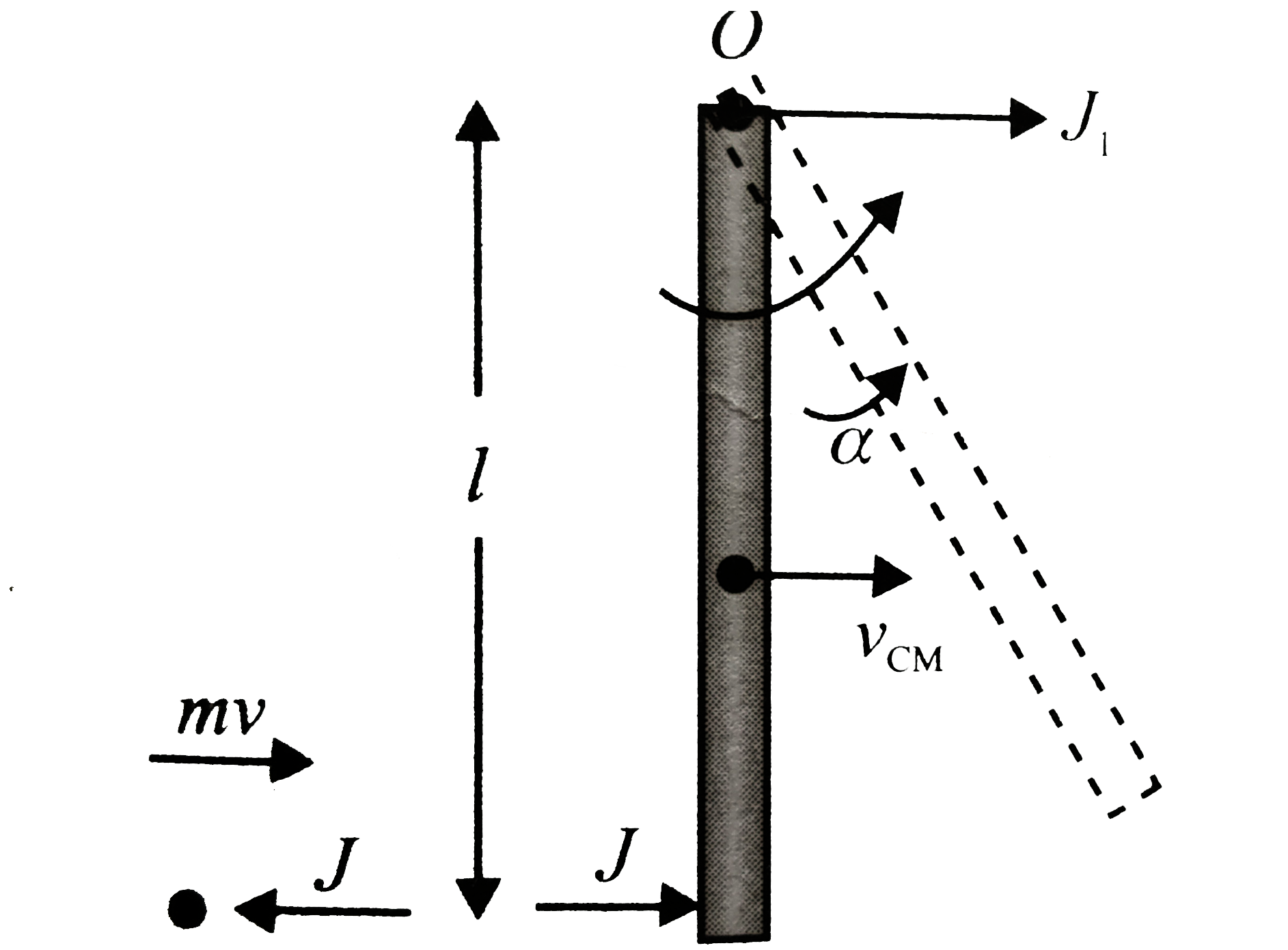 a. During the impact, the moment ofimpulse acting o the rod bullet system ahout the hinge is zero. Angular momentum about the hine will remain constant. Let `omega` be the angular velocity of the system about the hinge. `["Angular momentum of the system"]_("initial")=["Angular momentum of the system"]_("final") ` `implies mvxxl=I_(0)xxomega`......i Where `I_(0)` is the moment of inertia of the rod bullet system after COLLISION about `O` `I_(0)=I_("rod")+I_("bullet")=1/3Ml^(2)+ml^(2)`.....ii `mvl=(1/3Ml^(2)+ml^(2))omega`..............iii As the system swings about hinge, the mechanical energy of the system will remain constant `/_\k+/_\U=0` `[1/2(1/3Ml^(2)+ml^(2))omega^(2)-0]` `=mgl/2(1-cosalpha)+mg(1-cosalpha)` From eqn iii `omega=(3mv)/(l(M+3m))`............iv Substituting this value of `omega` in eqn`v` we get `1/2(1/3Ml^(2)+ml^(2))((3mv)/(l(M+3m)))^(2)` `implies 1/2xx1/2l^(2)(M+3m)(9m^(2)v^(2))/(l^(2)(M+3m)^(2))` `=gl(1-cosalpha)/2(M+2m)` `implies v^(2)=(2gl)/3((M+2m)(M+3m))/m^(2)SIN^(2)alpha/2` Now for `mltltm, (M+3m)(M+3m)~~M^(2)` Thus `v^2=2/3gl(M^(2))/(m^(2))sin^(2)alpha/2impliesv=M/msqrt(2/3gl)sinalpha/2` b. Change in linear momentum during the impact `implies /_\p=p_(f)-p_(i)` `={M(l/2omega)+m(lomega)}-mv` `=kl((M+2m)/2)omega-mv`.........v From eqn iv and i `=l((M+2m)/2)(3mv)/(l(M+3m))-mv` `=3/2mv-mv=1/2mv` `=1/2m M/msqrt(1/2)gl sinalpha/2` `=Msqrt(1/6)glsinalpha/2` what causes linear momentum to change? Obviously, impulse `J_(1)` at hinge. Here `/_\p` is positive, linear momentum increase so `J_(1)` must be towards the right. |
|
| 41. |
A body of mass m, accelerates uniformly from rest to v_1 in time t_1. Find the instantaneous power delivered to the body as a function of time t. |
|
Answer» <P> Solution :Acceleration , `a = (v_1)/(t_1)``:. ` VELOCITY , `(V) = 0 + at = (v_1)/(t_1) t` `:.` Power , `P = "Force" XX "velocity" = MAV` or `P = m ((v_1)/(t_1)) xx ((v_1t)/(t_1)) = (mv_1^2t)/(t_1^2))` |
|
| 42. |
Statement 1 represent assertion And statement 2 represents reason which one of the following is correct Statement 1 The driver in a car moving with a constant speed on a straight road is non inertial frame of reference Statement 2 A frame of reference in which newton 's laws of motion are applicable is a non inertial frame |
|
Answer» STATEMENT 1is true and statement2 isfalse |
|
| 43. |
A solid cylinder of mass M and radius R rolls without slipping down an inclined plane of length L and height h. What is the speed of its centre of mass when the cylinder reaches its bottom? |
|
Answer» `sqrt(4gh)` `(("Total potential energy"),("of CYLINDER at the top"),("of inclined plane"))=(("Rotational KINETIC"),("energy at the bottom"),("of inclined plane"))+(("The linear kinetic energy"),("of centre of mass of cylinder"),("at the bottom of inclined plane"))` `therefore mgh=(1)/(2)Iomega^(2)+(1)/(2)mv^(2)` putting `omega=(v)/(R )` in this FORMULA, `mgh=(1)/(2)I(v^(2))/(R^(2))+(1)/(2)mv^(2)` Now Moment of inertia of SOLID cylinder `I=(mR^(2))/(2)` `therefore mgh=(1)/(2).(mR^(2))/(2).(v^(2))/(R^(2))+(1)/(2)mv^(2)` `therefore gh=(1)/(4)v^(2)+(1)/(2)v^(2)` `gh=(3)/(4)v^(2)` `therefore v=sqrt((4)/(3)gh)` |
|
| 44. |
A small object stuck on the surface of glass sphere (mu=1.5) is viewed from the diametrically opposite position. Find tranverse magnification. |
|
Answer» SOLUTION :Refraction will take place at side II on the surface. `mu_2/v-mu_1/mu= (mu_2-mu_1)/R` Here `mu_1=1.5 mu_2=1` and u=-2R `1/v-1.5/((-2R))=(1-1.5)/(-R) implies 1/v=0.5/R-1.5/(2R)=(-0.5)/(2R) or v=-4R` NEGATIVE sign indicates that the image is formed to the left of REFRACTING surface as shown. MAGNIFICATION. `m=(mu_1v)/(mu_2v)=(1.5(-4R))/(1(-2R)) therefore m=3ans` 
|
|
| 45. |
A body of density 'rho' is let force in a liquid of density d (P>d). What is the downward acceleration of the body while shaking in the liquid ? |
| Answer» SOLUTION :`[I-(d)/(RHO)]G` | |
| 46. |
y_(1) = 4 sin (omega t + kx), y_(2) =-4 cos(omega t + kx), the phase difference is |
| Answer» Answer :B | |
| 47. |
Four particles of masses 1 kg, 2kg, 3kg and 4kg are placed the four vertices A,B,C and D, respectively, of a square of side 1m. Find the position of centre of mass of the particles. |
|
Answer» Solution :Assuming `D` as the origin, `DC` as `X`-axis and `DA` as `y`-axis, we have `m_(1)=1kg, (x_(1), y_(1))=(0,1m)` `m_(2)=2KG, (x_(2),y_(2))=(1m,1m)` `m_(3)=3kg, (x_(3),y_(3))=(1m,0)` `m_(4)=3kg, (x_(4),y_(4))=(0,0)` COORDINATES of their `CM` are calculted as follows `x_(CM)=(m_(1)x_(1)+m_(2)x_(2)+m_(3)x_(3)+m_(4)x_(4))/(m_(1)+m_(2)+m_(3)+m_(4))`  `=((1)(0)+2(1)+3(1)+4(0))/(1+2+3+4)` `=5/10=1/2m=0.5m` Similarly `y_(CM)=(m_(1)y_(1)+m_(2)y_(2)+m_(3)y_(3)+m_(4)y_(4))/(m_(1)+m_(2)+m_(3)+m_(4))` `=((1)(1)+2(1)+3(0)+4(0))/(1+2+3+4)=3/10m=0.3m` `:. x_(CM), y_(CM)=(0.5m, 0.3m)` |
|
| 48. |
Velocity of sound in a medium is given by A^(1//2) d^(-1//2), where 'd' is density of medium. Then A represents |
|
Answer» ELASTIC constant |
|
| 50. |
A ladder weighing 20kg wt rests with its one end against a smooth vertically wall and the other end against the smooth floor. If the inclination of the ladder to the horizontal is 60^(@) then calculate the horizonatl force required at the lower end so that is does not slip. |
Answer» SOLUTION : `BE=AE=L/2` `cos60^(@)=(AB)/(AC)` `:. Bar(AC)=bar(AB)costheta^(@)=L/2` `sin60^(@)=BC//AB` i.e., `bar(BC)=bar(AB)sin60^(@)` `bar(BC)=0.866L` `cos60^(@)=(AD)/(AE)` i.e., `bar(AD)cos60^(@)=L/2xx1/2=L/4` Taking moments about 'B' We write `Hbar(BC)+Hbar(DC)=R_2bar(AC)`,but AC-AD=DC Moment of `R_1` about B=O `:. H(0.866L)+20xxL/4=20xxL/2"":.bar(DC)=L/2-L/4=(2L-L)/4=L/4` `0.866HcancelL=20(cancelL)/4=5"":.H=5(0.866)=5.774N` |
|