

Saved Bookmarks
This section includes 7 InterviewSolutions, each offering curated multiple-choice questions to sharpen your Current Affairs knowledge and support exam preparation. Choose a topic below to get started.
| 1. |
The moon is orbiting the Earth approximately in 27 days, what is the angle transversed by the Moon per day? |
|
Answer» In one DAY angle traversed by Moon `=(360^(@))/(27)=13.3^(@)` |
|
| 2. |
Twoparticles P and Q are located at the origin of a co-ordinate system . Both the particles start moving simultaneously at time t=0. Particle P moves with a costant speed of 2 pi m//son a circle x^(2)+y^(2)+120y=0 in clock wise direction while Q moves with a constant acceleration such that at t=5s velocities of both are same . |
|
Answer» |
|
| 3. |
A particle starts to move along the path which is given as x^(2)=(8u) (x and y are in m) due to applied force vecF=(axhati+byhatj) N (agt0 and bgt0 x and y are in meter). The amount of work done in displacing particle from x=0 to x=1 metre is …............ |
|
Answer» `((64a+b)/128)` JOULE |
|
| 4. |
A stone of mass 100 g tied to the end of a string 80 cm long is whirled in a horizontal circle with a constant speed.If the stone makes 14 revolutions in 25 s, calculate the centripetal force acting on the stone. |
|
Answer» |
|
| 5. |
One end of a long iron chain of linear mass density lambda is fixed to a sphere of mass m and specific density 1//3 while the other end is free. The sphere slong with the chain is immersed in a deep lake. If specific density or iron is 7, the height h above the bed of the lake at which the lake at which the sphere will float in equillibrium is (Assume that the part of the chain lying on the bottom of the lake exerts negligible force on the upper part of the chain.). |
|
Answer» BUOYANT force `= (3m + (lambdah)/(7))g` for EQUILIBRIUM, weight `=` Buoyant force or, `m + lambdah = 3m + (lambdah)/(7)` or `h = (7m)/(3lambda)` |
|
| 6. |
A capillary tube of radius 'r' is immersed in water and water rises to a height of 'h'. Mass of water in the capillary tube is 5 xx 10^ -3 kg. The same capillary tube is now immersed in a liquid whose surface tension is sqrt2 times the surface tension of water. The angle of contact between the capillarv tube and this liauid is 45^@. The mass of liquid which rises into the capillary tube now is (in kg) |
|
Answer» `5 XX 10^(-3)` |
|
| 7. |
A block on table shown in figure is just on the wedge of slipping. Find the coefficient of static friction between the block and table top. |
|
Answer» Solution :`(T SIN 30^(@))/(T cos 30^(@))=(mu mg)/(80)` , `TAN 30^(@)=(mu 40)/(80),(1)/(sqrt(3))=(mu)/(2)` `rArr mu = (2)/(sqrt(3))=1.15` 
|
|
| 8. |
A faulty barometer tube is 90 cm long and it contains some air above mercury. The reading is 74 .5 cm when the true atmospheric pressure is 76 cm. What will be the true atmopsheric pressure if the reading on this barometer is 74 cm? (H = 10 m of waler column) |
Answer» Solution : Let tile area of CROSS - section of the TUBE be A `cm^(2)` and true pressure be H cm of MERCURY. Since the temperature is constant, Boyle.s law can be applied to the air enclosed in the upper part of the barometer tube, thus `P_(1) = (76.0 - 74.5) = 1.5 ` cm of mercury `V_(1) = A xx (90 - 74.5 ) = A xx 15.5 cm^(3)` `P_(2) = (H - 74.0) `cm of mercury `V_(2) = A xx (90 - 74.0) = A xx 16 cm^(3)` APPLYING Bolye.s law `P_(1) V_(1) = P_(2) V_(2)` `1.5 xx (A xx 15.5 ) = (H - 74) xx (A xx 16)` H - 74 = `(1.5 xx 15.5 )/(16 )` H = 74 + 1.45 = 75.45 cm |
|
| 9. |
In a particular system, the unit of length, mass and time are chosen to be 10 cm, 10 g and 0.1 s respectively. The unit of force in this system will be equivalent to |
|
Answer» 0.1 N  The dimensional formula of force is `[MLT^(-2)]` `:. a= 1, b= 1, c=-2` `n_(2)= n_(1)[(M_(1))/(M_(2))]^(a)[(L_(1))/(L_(2))]^(b)[(T_(1))/(T_(2))]^(c)= 1[(10KG)/(1kg)]^(1)[(10cm)/(1m)^(1)][(0.1s)/(1s)]^(-2)` `= 1((10^(-2)kg)/(1kg))^(1)((10^(-1)m)/(1m))^(1)((0.1s)/(1s))^(-2)` `= ( 1XX 10^(-2) xx10^(-1))/(10^(-2))= 10^(-1)= 0.1 ` hence, the unit of force in a GIVEN system will be equivalent to 0.1 N. |
|
| 10. |
A particle moves on the x-axis according to the equation x=A+B sin wt. The motion is harmonic with amplitude |
| Answer» ANSWER :B | |
| 11. |
Can an object have (1) a constant velocity even through its speed is changing (2) a constant speed even through its velocity is changing ? |
| Answer» SOLUTION :(1)no (2) CIRCULAR MOTION | |
| 12. |
If the size of a nucleus (in the range of 10^(-15) m to 10^(14) m) is scaled up to the tip of a sharp pin, what roughly is the size of an atom ?Assume tip of the pin to be in the range 10^(-5)to10^(-4) m. |
| Answer» SOLUTION :The size of a nucleus is in the range of `10^(-15)m` to `10^(-14)` m. The tip of a sharp pin is taken to be in the range of `10^(-5)` to `10^(-4)` m. Thus we are scaling up by a factor of `10^(-10)`m. An atom ROUGHLY of size `10^(-10)`m. will be scaled up to a size of 1 m. Thus a nucleus in an atom is as SMALL in size asof a sharp pin placed at the centre of a SPHERE of radius about a METRE long. | |
| 13. |
If vecF is the force acting on a particle having position vector vecr and vectau be the torque of this force about the region, then : |
|
Answer» `vecr.vectaugt0 and vecF.vectault0` |
|
| 14. |
A particle of mass m is released through a narrow tunnel dug between two diametrically opposite ends of Earth. Show that it will exceute SHM and calculate its time period? |
|
Answer» Solution :When the particle is at a distance X from the centre of earth, the force acting on it `F= (Gmm)/(R^3) x ` (or) ma `=-(GMm)/(R^3) x` (or) `a=- ((GM)/(R^3))x` Comparing with SHM equation `, omega^2 = (GM)/(R^3) ` (or) `T= 2pi SQRT((R^3)/(GM)) ` (or) `2pi sqrt((R)/(g))` |
|
| 15. |
Speed of water in river is 5 m/min from west to east. A man can swim with 10 m/min in river water. At what angle should the man swim such that it can reach towards south with shortest path ? |
|
Answer» At `30^(@)` with flow of water  Suppose velocity of fow of water is `vecv_(R)` and velocity of MAN is `vecv _(m).` From figure `SIN THEETA = (v _(R ))/(v _(m)) = (5)/(10) = (1)/(2) = theta = 30^(@)` `therefore` direction of velocity of man` = 90^(@)+0 =90^(@) + 30^(@) -120^(@)` |
|
| 16. |
A steel wire of mass 3.16Kg is stretched to a tensile strain of 1xx10^(-3) . The elastic deformation energy if density rho=7.9g/cc and Y=2 xx 10^11N//m^2 |
|
Answer» 4KJ |
|
| 17. |
A block of mass 2kg hangs from the rim of a wheel of radius 0.5m. On releasing from rest the block falls through 5m height in 2s. The moment of inertia of the wheel will be |
|
Answer» `1 kg-m^(2)` `5= 0 +(1)/(2) a(2)^(2)` [As `S= U t+ (1)/(2) a t^(2)`] `THEREFORE a= 2.5m//s^(2)` Substituting the value of a in the formula `a= (g)/(1 + (I)/(mR^(2)))` and by sloving we get `rArr 2.5= (10)/(1+ (I)/(2 xx (0.5)^(2))) rArr I= 1.5kg -m^(2)` |
|
| 18. |
Repeat example - 11 if source does not move along the line SO. |
|
Answer» Solution :The changed frequency `f'` is now, `f' = f ((upsilon)/(upsilon - upsilon_(s) cos theta))` This time `f'` is not constant but it is a function of `theta` , which is variable. But , at a far distance, `theta rarr 0^(@)` or `cos theta rarr 1` or `:. f'= f ((upsilon)/ (upsilon - upsilon _(s)))` and this is the MAXIMUM value of `f'` (say `f_(max)`) At point `P, theta = 90^(@)` `:. f' = f` During receding (to the right of `p`) `f' = f ((upsilon)/ (upsilon - upsilon _(s)costheta))` again, at large distance from `P`, `theta rarr^(@)` or `cos theta rarr 1` `f' = f ((upsilon)/ (upsilon + upsilon_(s)))` This time, this is the MINIMUM value of `f'` (say `f_(min)`). Hence, `f'` VARIES from `f _(max)` to `f _(min')` with `f' = f` at the time of CROSSING `p` . The correct `f'` versus `t` graph is as shows below. 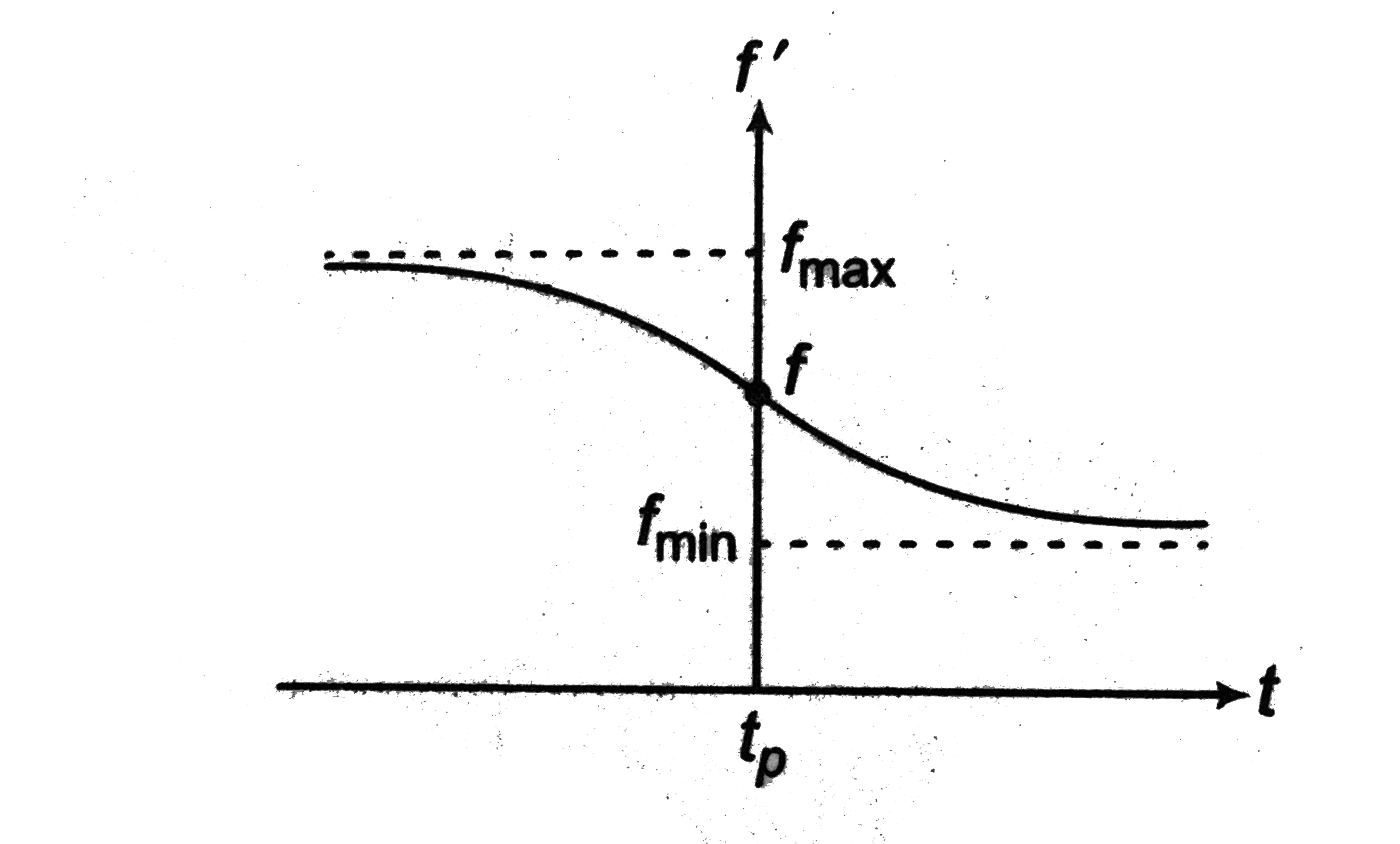
|
|
| 19. |
A particle is projected vertically up with a velocity sqrt(gR). Where R is the radius of the earth, g is the acceleration due to gravity, then the maximum height reached is |
| Answer» ANSWER :B | |
| 20. |
The coordinates of a body moving in a plane at any instant of time t are x=alphat^(2)and y=betat^(2). The velocity of the body is |
|
Answer» Solution :`X = alpha t^(2) rArr v_(x) = (DX)/(d t) = 2 alpha t` `y = beta t^(2) rArr v_(y) = (dy)/(d t) = 2 beta t` `therefore` velocity `v = SQRT((v_(x)^(2) + v_(y)^(2))) rArr sqrt((2alpha t)^(2) + (2 beta t)^(2))` `= 2t sqrt(alpha^(2) + beta^(2))` |
|
| 21. |
An electron and a proton are detected in a cosmic ray experiment, the first with kinetic energy 10 keV, and the second with 100 keV. Which is faster, the electron or the proton? Obtain the ratio of their speeds. (electron mass =9.11xx10^(-31)kg, proton mass =1.67xx10^(-27)kg, 1 eV= 1.60xx10^(-19)J). |
|
Answer» <P> SOLUTION :The electron is FASTER, `v_(E )"/"v_(p)= 13.5` |
|
| 22. |
The angle theta between the vector vec(p)=hat(i)+hat(j)+hat(k) and unit vector along X-axis is |
|
Answer» `COS^(-1)((1)/(sqrt3))` |
|
| 23. |
A projectile is thrown with a speed of 98 ms^(-1) in a direction 30^(@)abovethe horizontal . Find the time of flight , range and height to which it rises . |
|
Answer» SOLUTION :Given : Initial velocity` = u = 98 ms^(-1)` Time of flight ` = t(2 u sin theta)/(g) = ( 2 xx 98 sin 30^(@))/(9 . 8)` `= (2 xx 98) / ( 9 . 8) xx (1)/(2) = 10 secs` Range R ` = v_(x) xx t = u cos theta xx t` ` = 98 xx cos 30^(@) xx 10 = 848 . 7 m ` Maximum height , `h_("max") = (u^(2) sin^(2) theta)/(2g)` ` =((98)^(2) xx (sin 30)^(2))/( 2 xx 9 . 8) = 122. 5 m ` `h_("max") = 122.5m ` |
|
| 25. |
In the diagram shown a ray of light is incidetn on the interface between1&2at angle slightly greater than critical angle.The light suffers total internal reflections at this surface .After that the light ray falls at the interface at this interface .After that the light ray falls at the interface reflection..Which of the following relations should hold true? |
|
Answer» `mu_(1)LT mu_(2)lt mu_(3)`  For T.I.R at interface of`mu_(1)` &`mu_(2)` `igtC rArr "SIN" i GT"Sin" C_(1)…….(1)` taking REFRACTION at interface of `mu_(1)` & `mu_(2)` `mu_(1)"Sin"C_(1)=mu_(2)"Sin"90^(@) rArr "Sin"C_(1) =(mu_(1))/(mu_(2))…….(2)` From (1)&(2) `sin i gt (mu_(2))/(mu_(1))` For I.T.R. at interface of `mu_(2)`&`mu_(3) 90^(@)-i gt C_(2)` `sin(90^(@)-i)gt"Sin" C_(2) rArr cosigtsinC_(2).....(3)` taking refractin at interface of `mu_(2)&mu_(3)` `mu_(1)"Sin"C_(2)=mu_(3)"Sin"90^(@) rArr "Sin"C_(2) =(mu_(3))/(mu_(1)).............(4)` from(3)&(4) `"cos"igt(mu_(3))/(mu_(1)) rArr sqrt(1-sin^(2)i)gt(mu_(3))/(mu_(1))` `1-(mu_(2)^(2))/(mu_(1)^(2))gt(mu_(3)^(2))/(mu_(2)^(1))` `mu_(1)^(2)-mu_(2)^(2)gtmu_(2)^(3)` `mu_(1)^(2)-mu_(3)^(2)gtmu_(2)^(2)` obiously `mu_(1)^(2)-mu_(2)^(2)gtmu_(3)^(3)` |
|
| 26. |
A heavy uniform chain lies on horizontal table top. If the co-efficient of friction between the chain and the table surface is 0.5, the maximum percentage of the length of the chain that can hang over one edge of the table is |
| Answer» ANSWER :B | |
| 27. |
Obtain Bernoulli's equation of rest fluid. |
|
Answer» Solution :Bernoulli.s equation `P_(1)+(1)/(2)rhov_(1)^(2)+rhogh_(1)=P_(2)+(1)/(2)rhov_(2)^(2)+rhogh_(2)` When fluid is rest , its velocity at every POINT is zero. In above equation `v_(1)=0,v_(2)=0`, `P_(1)+rhogh_(1)=P_(2)+rhogh_(2)` `thereforeP_(1)-P_(2)=rhog(h_(2)-h_(1))` |
|
| 28. |
The energy emitted per second by a black body at 1227^(@)C. If the temperature of the black body is increased to 2727^(@)C, calculate the energy emitted per second in terms of E in the second case. |
|
Answer» |
|
| 29. |
Describe the working of Bunsen burner on the basis of Bernoulli's principle. |
Answer» Solution :In this, the gas comes out of the nozzle with HIGH velocity, hence the pressure in the stem decreases. So outside air reaches into the BURNER through an air VENT and the mixture of air and gas gives a BLUE flame.
|
|
| 30. |
Using dimensions method show that the speed of sound in a material medium of modulus of elasticity E and density rho is v prop sqrt(E/(rho)) |
|
Answer» <P> Solution :`vprop E^(x)rho^(y)``v=kE^(x)rho^(y)` ……1 k is a DIMENSIONLESS constant Dimensions of `E=("Stress")/("Strain")=ML^(-1)T^(-2)`. Strain has no dimensions Taking the dimensions of equation (1) on both SIDES `LT^(-1)=[ML^(-1)T^(-2)]^(x)[ML^(-3)]^(y)=M^(x)L^(-x)T^(-2x)M^(y)L^(-3y)` `M^(0)LT^(-1)=M^(x+y)L^(-x-3y)T^(-2x)` Equating the dimensios on both sides of T `-1=-2x,x=1//2` of M `x+y=0, y=-x-1//2` Substituting the values of x and y in equation (1) we get `v=k E^(1//2)p^(-1//2)` or `v prop sqrt(E/(rho))` |
|
| 31. |
A ring has a mass of 0.5kg and radius 1m. The moment of inertia of the ring about its diameter is |
|
Answer» `0.75kgm^(2)` |
|
| 32. |
A 7.5 cm thickside wall of an oven is primarily made of insulation with a thermalconductivity of 0.04 W/m K. Conditions on theinsideof wall fixthe temperature of that sideat 420K.The electriccoils within theoven dissiplate 36.5 watts of electrical energy to make upfor the heatloss through the wall . Calculatethe wall surfacearea.perpendicularto heat flow, so that tempera - ture on the othersideof the wall does not exceed 310 K. |
|
Answer» Solution :Under thestipulations of one - dimensionalsteadyheat CONDUCTION , theelectrical ENERGY dissipationrate within the oven must EQUAL the conductionheatransfer rateacross the wall . That is `Q = (KA(t_(1) - t_(2)))/(delta) , 36.5 = (0.04A (420 - 310))/(0.75) = 5.87 A` Hence, the requiredwall surface area `rArr A = (36.5)/(5.87) = 6.218 m^(2)` |
|
| 33. |
(A): In a pressure cooker the water is brought to boil. The cooker is then removed from the stove. Now on removing the lid of the pressure cooker, the water starts boiling again.(R ): The impurities in water bring down its boiling point.(2004) |
|
Answer» Both (A) and(R ) are TRUE and (R ) is the CORRECT EXPLANATION of (A) |
|
| 34. |
In the above problem the acceleration of the rocket during burning interval is : |
|
Answer» `(1200//12)m//s^(2)` |
|
| 35. |
A large tan filled with water to a height ''h'' is to be emptied through a small hole at the bottom. The ratio of the time taken for the level to fall from h to h//2 and that taken for the level to fall from h//2 to 0 is |
|
Answer» `SQRT(2)-1` |
|
| 36. |
Two persons of masses m and 2m are standing on a horizontal smooth surface of ice. They are initially seperated by a distance d. They are pulling each other holding a rope. They meet at a distance |
|
Answer» 2d/3 from HEAVIER person |
|
| 37. |
The orbital velocity of a satellite in a circular orbit close to the earth is v_0 . If the escape velocity of an object projected from the earth be v_e,then the ratio of these two velocities is |
|
Answer» `1:1` |
|
| 38. |
A body of mass 1kg is suspended from a weightless spring having force constant 600N//m Another body of mass 0.5 kg moving vertically upwards hits the suspended body with a velocity of 3 m//s and gets embedded in it. find amplitude of oscillation. |
|
Answer» Solution :By CONSERVATION of linear momentum in the collision `MV= (m+M)V` `implies V= (mv)/(m+M)= (0.5 xx 3)/((1+0.5))= 1m//"sec"` Now just after collision the system will have`KE= (1)/(2)(m+M)V^(2)` at equilibrium position. So after collosion by conservation of MECHANICAL energy `KE_("max")= PE_("max")` `(1)/(2)(m+M)V^(2)= (1)/(2)KA^(2) implies A= Vsqrt((m+M)/(K))= 1sqrt((1.5)/(600))= (1)/(20)m= 5cm` |
|
| 39. |
under minimum deviation condition in a prism, if a ray is a incident at an angle 30^@ the angle between the emergent ray and the second refracting surface of the prism is |
| Answer» ANSWER :D | |
| 40. |
The youngs modulus of the material of a rod is 20xx10^10pascal. When the longitudinal strain is 0.04%, The energy stored per unit volume is |
|
Answer» `4XX10^(-3)J//m^(3)` |
|
| 41. |
The rates of fall of temperature of two identical solid spheres of different materials are equal at a certain temperature : |
|
Answer» Their SPECIFIC HEAT CAPACITIES are equal |
|
| 42. |
A circular disc is rotating about its natural axis with angular velocity of 10" rads"^(-1). A second disc of same mass is joined to it coaxially. If the radius of disc is half of the radius of the first, then they together rotate with an angular velocity of |
|
Answer» `2.5" rads"^(-1)` |
|
| 43. |
A massless conical flask filled with a liquid is kept on a table in a vacuum. The force exerted by the liquid on the base of the flask is W_(1). The force exerted by the flask on the table is W_(2). a) W_(1)=W_(2) b) W_(1)gtW_(2) c) W_(1)ltW_(2) d) The force exerted by the liquid on the walls of the flask is (W_(1)-W_(2)) |
|
Answer» a, and C are CORRECT |
|
| 44. |
A body is imparted a velocity v from the surface of the earth. If v_(0) is orbital velocity and v_(e) be the escape velocity then for : v = v_(0) the body follows a circular track around the earth. (B). v gt v_(0) but lt ve, the body follows elliptical path around the earth. (C). v lt v_(0), the body follows elliptical path and return to surface of earth. (D). v gt v_(e), the body follows hyperbolic path and escape the gravitational pull of the earth. |
| Answer» Answer :D | |
| 45. |
Derive the expression formoment of inertia of a uniform ring about an axis passing thorugh the centre and perpendicular to the plane. |
Answer» Solution :Consider a uniform ring of mass M and radius R . Let us find the moment of inertia of thering about an axis passing through its centre and perpendicular to the plane. Let us take an infinitesimally small mass (dm) of length (DX) of the ring. This (dm) is located at a distance R, that is the radius of the ring from the axis as SHOWN in figure. The moment of inertia (dI) of this small mass (dm) is `dI=(dm)R^(2)` The length of the ring is its circumference (2R). As the mass is uniformly distributed, the mass per UNIT length `(LAMDA)` is `lamda=("mass")/("length")=M/(2pir)` The mass (dm) of the infinitesimally small length is dm `=lamda dx=M/(2pir)dx` Now the moment of inertia (I) of the ENTIRE ring is `I=intdI=int(dm)R^(2)` `=int(M/(2piR)dx)R^(2)` `I=(MR)/(2pi)int dx` In order to cover the entire length of the ring, the limits of integration are taken from 0 to `2piR`. `I=(MR)/(2pi)int_(0)^(2pir)dx` `I=(MR)/(2pi)[x]_(0)^(2piR)=(MR)/(2pi)[2piR-0]` `I=MR^(2)` |
|
| 46. |
A ball does not pass through a copper ring at room temperature. The same ball, after heating, passes through the same ring. It shows due to beating, the ball |
|
Answer» expands |
|
| 47. |
A cyclist comes to a studding stop in 10 m. During this process, the force on the cycle due to the road is 200 N and is directly opposed to the motion. How much work does the road do on the cycle? |
| Answer» SOLUTION :`W = Fd cos theta = (200 N) (10 m) cos 180^@ = -2000 J. ` | |
| 48. |
The surface tension of a liquid is 80 dyne/cm. Its relative density is 0.8. If the angle of contact between the liquid and glass is 60^(@), find the height to which the liquid rises in a glass capillary tube of radius 1 mm. (Assume g = 10ms^(-2)) |
|
Answer» Solution :Radius of the capillary tube R = 1 mm = 0.1 cm, density d = 0.8 gm/c.c acceleration due to gravity G = `10ms^(-2)=1000cms^(-2)`, surface tension T = 80 dynes/cm angle of contact `theta=60^(@)`, The height of liquid column in capillary tube h = `(2Tcostheta)/(RGD)` `rArrh=(2xx80xxcos60^(@))/(0.1xx1000xx0.8)=1cm` |
|
| 49. |
A circular ring is cut from a platinum tube of 8.5 cm iknternal diameter nad 8.7 cm external diameter and supported horizontally from the pan of a balance, and supported horizontally from the pan of a balance, so that it comes in contact with the water in a glass vessel. If an extra weight of 3.97 g, is required to pull it away from water, calculate the surface tension of water. |
|
Answer» Solution :When the ring is supported horizonally so that it COMES in CONTACT with water, there will be downward force due to surface tension. Downward pull on the inner circumference of the ring `2piR_(1)xxS` where `R_(1)` is the internal radius. Dowward pull on th outer circumference of the ring `=2piR_(2)xxS` where `R_(2)` is the external radius. Total downward pull or force on the ring due to surface tension `=sxx2pi(R_(1)+R_(2))` If m is the mass of the extra load requried to pull it AWAY, the load = MG so that `mg=Sxx2pi(R_(1)+R_(2))` `S=(mg)/(2pi(R_(1)+R_(2)))` `m=3.97g=3.97xx10^(-3)kg, g=9.8m//s^(2)` `R_(1)=8.5/2cm=4.25xx10^(-2)m` `R_(2)=8.7/2cm=4.35xx10^(-2)m` `S=(3.9xx10^(-3)xx9.8)/(2pi(4.25+4.35)xx10^(-2))` `=(3.97xx9.8)/(2pixx8.6)xx10^(-1)=0.07199N//m` |
|
| 50. |
Give the expression for the forque acting on a simple pendulum about the support. |
|
Answer» Solution :Torque on a SIMPLE pendulum about the support is DUE to the tangential component of the force. Torque `=-L(sm sin THETA),` where .L. is the length of the pendulum. The negative sign indicates that the above the torque TENDS to reduce the angular displacement. |
|