

Saved Bookmarks
This section includes 7 InterviewSolutions, each offering curated multiple-choice questions to sharpen your Current Affairs knowledge and support exam preparation. Choose a topic below to get started.
| 1. |
A body is moving unidirectionally under the influence of a source of constant power supplying energy. Which of the diagrams shown below correctly shows the displacement time curve for its motion? |
|
Answer»
|
|
| 2. |
Iron floats over mercury because density of mercury is more than the density of iron. Coefficient of volumetric expansion of iron and mercury are35 xx 10^(-6)""^(@) C^(-1).and 180 xx 10^(-6)""^(@) C^(-1). Now consider an iron cube floating in a bowl of mercury at 0^(@) C. When temperature is increased upt0 25^(@)C. then choose the correct options. |
|
Answer» Cube submerges more at 25°C |
|
| 3. |
An amount of heat Q is supplied to a monatomic ideal gas to expand at constant volume .calculatethe ratio of work w done by the gas and the heat supplied . |
| Answer» SOLUTION :W/Q =2/5 | |
| 4. |
Three masses of 2 kg, 3 kg and 4 kg are located at the three vertices of an equilateral triangle of side 1 m. What is the M.I. of the system about an axis along the altitude of the triangle and passing through the 3 kg mass? |
|
Answer» |
|
| 5. |
Coefficient of cubical expansion of solid is (0.0000027//^(@) C). If the temperature is measured on Fahrenheit scale. Numerical value of coefficient of linear expansion of solid id |
|
Answer» `0.000009//^(@) F` |
|
| 6. |
Glass windows may be broken by a far away explosion.Why? |
| Answer» Solution :A distant EXPLOSION sends out sound waves of large amplitude in all DIRECTIONS. As these sound waves strike the glass window,they set them into FORCED oscillations.Since glass is BRITTLE,glass windows BREAK as soon as they start oscillating. | |
| 7. |
Velocity of a particle at time t=0 is 2ms^(-1).A constant acceleration of 2ms^(-2)acts on the particle for 1 second at an angle of60^(@)with its initial velocity. Find the magnitude of velocity at the end of 1 second. |
|
Answer» `SQRT(3)` m/s |
|
| 8. |
Define - Astronomical unit? |
|
Answer» SOLUTION :Astronomical unit is defined as the MEAN distance of the earth from the sun . It is USED ATRONOMY to measure distance of planets. `1 AU = 1.496 XX 10^(11)`m |
|
| 9. |
A metal bar 70 cm long and 4.00 kg in mass supported on two knife-edges placed 10 cm from each end. A 6.00 kg load is suspened at 30 cm from one end. Find the reactions at the knife-edges. (Assumes the bar to be of uniform cross section and homogeneous). |
|
Answer» Solution :The rod AB, the positions of the knife edges `K_(1)` and `K_(2)` is shown in figure. The centre of gravity of the rod at G and the suspended load is P. The weight of the rod W acts at its centre of gravity G. The rod is UNIFORM in cross section and HOMOGENEOUS, hence G is at the centre of the rod, `AB=70cm` `therefore AG=BG=35cm` `PG=5cm therefore AP=30cm` `AK_(1)=BK_(1)=10cm` `K_(1)G=K_(2)G=25cmandg=9.8ms^(-2)` and weight of rod `W=4kgxx9.8=39.2N` suspended load at P, `W_(1)=6kgxx9.8=58.8N` `R_(1)andR_(2)` are the normal reaction of the support at the knife edge `K_(1)andK_(2)` respectively. For the translation equilibrium of the rod `R_(1)+R_(2)-W_(1)-W=0""...(1)` `therefore R_(1)+R_(2)-58.8-39.2=0` `therefore R_(1)+R_(2)=98""...(2)` `W_(1)` and W act vertically down and `R_(1)andR_(2)` act vertically up. For rotational equilibrium `therefore -R_(1)(K_(1)G)+W_(1)(PG)+R_(2)(K_(2)G)=0...(3)` `therefore -R_(1)(0.25)+58.8(0.05)+R_(2)(0.25)=0` `therefore 0.25R_(1)-0.25R_(2)=2.94` `therefore 0.25(R_(1)-R_(2))=2.94` `therefore R_(1)-R_(2)=(2.94)/(0.25)` `therefore R_(1)-R_(2)=11.76N""...(4)` Sum of eqn. (2) and (4), `2R_(1)=109.76` `therefore R_(1)=54.88NorR_(1)~~55N` In eqn. `R_(1)+R_(2)=98,R_(1)=54.88` `R_(2)=98-54.88` `therefore R_(2)=43.12N or R_(2)=43N` |
|
| 10. |
The least count of a stop watch is 1/5 sec. The time of 20 oscillations of a pendulum is measured to be 25 sec. The maximum percentage error in this measurement is |
| Answer» ANSWER :C | |
| 11. |
When a man walks he waves his hands, because………. |
|
Answer» to retain constant velocity. |
|
| 12. |
In steady state condition, the temperatures at the two ends of a metal rod of length 25 cm are 100^(@)C and 0^(@)C. Then temperature at a point 8cm from the hot end is |
| Answer» Answer :A | |
| 13. |
A ball at rest is dropped from a height of 12m. It loses 25% of its kinetic energy in striking the ground , find the height to which it bounces. How do you account for the loss in kineticenergy ? |
|
Answer» `mgh'=75%"of" mgh` h'=0.75h=9m` |
|
| 14. |
In the system shownn in figure mass m is released from position A. Suppose potential energy of 2m at point A with respect to point B is E. Dimensions of m are negligible and all surfaces are smooth. When mass m reaches at point B then, match the following. |
|
Answer» |
|
| 15. |
The angle between vec(a) and vec(b) " is " 0^(@) then angle between 2 vec(a) and -3 vec(b) is |
|
Answer» `PI//3` |
|
| 16. |
A ball is dropped vertically from a height h above the ground. It hits the ground and bounces up vertically to a height h/2. Neglecting subsequent motion and air resistance, its velocity v varies with the height h as |
|
Answer»
|
|
| 17. |
What is meant by kinetic energy? |
| Answer» SOLUTION :The energy POSSESSED by a BODY due to its motion is called KINETIC energy. | |
| 18. |
For the figure, which of the following is correct ? |
|
Answer» `VEC(A) +vec(B) = vec(C)` |
|
| 19. |
The potential energy of a particle of mass 0.1kg, moving along the x-axis, is given by U(x) = U_(0)(1 - cos x) where U_(0) is in meter. It can be concluded that |
|
Answer» The particle is ACTED upon by a CONSTANT FORCE |
|
| 20. |
Show that stress required to double the length of wire (or) to produce 100% longitudinal strain is numerically equal to Young's modulus. |
|
Answer» Solution :`l_(1)=l, l_(2)=2l` `Deltal=2l-l=l, Y=(((F)/(A)))/(((Deltal)/(l)))` But as `(Deltal)/(l)=1`, HENCE `(F)/(A)=Y` |
|
| 21. |
If the resultant of any two vectors vec(A) and vec(B) is numerically equal to the either vector, the angle between the vectors can be: |
|
Answer» `cos^(-1) (-(B)/(2A)) and cos^(-1) (-(A)/(2B))` |
|
| 22. |
"No real gas is truly ideal". When does a real gas approach ideal gas behaviour? |
| Answer» SOLUTION :At LAW PRESSURES and HIGH TEMPERATURES. | |
| 23. |
A faulty thermometer has its fired points marked as 5^(@)and95^(@). The temperature of a body as measured by the faulty thermometer is 59^(@). Find the correct temperature of the body on Celsius scale. |
|
Answer» |
|
| 24. |
A horizontal board is oscillating with an amplitude of 3 m. If the frequency of oscillation is 15 per minute, find the minimum value of coefficient of friction in order that a body placed on the board will A not slide when the board oscillates ? |
|
Answer» |
|
| 25. |
Schematic diagram of capillary rise in a narrow tube is shown in the figure. On the surface of the moon, the liquid in a capillary |
|
Answer» same HEIGHT as on earth. |
|
| 26. |
Imperfections in experimental procedure gives …........ error. |
|
Answer» RANDOM |
|
| 27. |
The angular velocity and amplitude of a simple pendulum are w and A respectivley. At a displacement x. If its KE is T and PE is U then the ratio of T to U is |
|
Answer» `(X^(2)W^(2))/(A^(2)-w^(2)x^(2))` |
|
| 28. |
You are given four sources of light each one providing a light of single colour- red, blue, green and yellow. Suppose the angle of refraction for a beam of yellow light corresponding toa particular angle of incidence at the interface of two media is 90^@ which of the following statements is correct, if the source of yellow light is replaced with that of other lights without changing the angle of incidence? |
|
Answer» The beam of RED LIGHT WOULD undergo total internal reflection |
|
| 29. |
A sample Of milk diluted with water has a density of 1050" kgm"^(-3), If pure milk has a density of 1080kgm^(-3), then find the percentage of water by vehmse in the milk. |
|
Answer» Solution :Let .V. be the volume of diluted milk and v be the volume of WATER in it. MASS of pure milk `=(V-v) xx "density"=(V-v) xx -1080` Mass of water `=vxx "density"=v xx 1000` Density of diluted milk `=("Milk of pure milk +mass of water")/(V)` i.e, `1050=((V-v) 1080+1000v)/(V)` 1050V=1080V-1080v+1000v 1050V=1080V-80v `therefore` 80v=30V & v/V=3/8` % of the water by volume `=3/8 xx 100 =37.5%` |
|
| 30. |
Pressure P, volume V and temperature T of a certain material are related by P = alpha T^(2)//V where alpha is contant. Work done by the material when temperature changes from T_(0) to 2T_(0) and pressure remains constant is |
|
Answer» `3alpha T_(0)^(2)` As pressure is kept CONSTANT, so `dV = ((2 alpha T)/(P)) dT` `:.W = int PdV = UNDERSET(T_(0))overset(2T_(0))int P ((2 alpha T)/(P)) dT = 2 alpha[(T^(2))/(2)]_(T_(0))^(2T_(0)) = 3 alpha T_(0)^(2)` |
|
| 31. |
It is possible to project a particle with a given speed in two possible ways so that it has the same horizontal range 'R'. The product of time taken by it in the two possible ways is |
|
Answer» R/g |
|
| 32. |
A gas at a pressure of 1 atm is compressed at a constant pressure from 10.0 litres to 2.0 litres. If 500 J of heat energy leaves the gas calculate (i) the work done by the gas and (ii) the change in its internal energy. |
|
Answer» Solution :`P = 1 ATM = 101325 N//m ^(2)` `Delta V = (2-10) =- 8` litres `=0 8 xx 10 ^(-3) m ^(3)` Work DONE `= Delta W = P Delta V` `= 101325 xx (-8 xx 10 ^(-3))` `=- 826J` Heat LEAVING the gas `= Delta Q =- 500 J` Changle in internal energy `= Delta U =?` `Delta U = Delta Q - Delta W` `=- 500 + 826` `= 326 J` |
|
| 33. |
When bits of camphor are dropped on water, they move erratically. Why? |
| Answer» SOLUTION :When bits of camphor are dropped on water, they reduce the surface TENSION where they are dipping. Since the shape of camphor bits is IRREGULAR, UNEQUAL forces of surface tension act on them. | |
| 34. |
A cricket ball of mass 150 g moving with aspeed of 126km/hhitsat the middle of the bat , held firmly at its position by the batsman . The ball movesstraight back to the bowler after hitting the bat . Assuming thatcollision between ball and bat is completely elastic and the two remain in contact for 0.001s s , the force that the batsman had to apply toholdthe bat firmly at its place would be |
|
Answer» `10.5` N `Deltat ` = time of contact = `0.001` s u = 126 km/h = `(126 xx1000)/(60 xx60)` m/s = 35 m/s `v = - 126 km//h = - 35 m//s` Change in momentum of the BALL `Deltap = m Deltav = m(v-u)` ` =3/20 (-35 -35)`kg-m/s ` = 3/20 (-70)` `=-21/2 ` ForceF = `(Deltap)/(Deltat)` `= ((-21/2)/(0.001))N ` ` = - 0.05 xx10^(4)` N Here , -ve sign SHOWN that forcewill be opposite to the directionof motion of the ballbefore COLLISION . |
|
| 35. |
The displacement of particle from its mean position (in meter) is given by Y = 0.2 sin( 10 pit+1.5 pi) cos (10 pit+1.5pi ). The motion of the particle is |
|
Answer» PERIODIC but not SHM |
|
| 36. |
(A) : When an electron and proton are released from rest, though they are moving their center of mass remains at rest.(R ) : Proton is heavier than electron. |
|
Answer» Both 'A' and 'R' and TRUE and 'R' is the CORRECT EXPLANTATION of 'A' |
|
| 37. |
If a sphere is rolling, the ratio of translational energy to total kinetic energy is given by: |
|
Answer» Solution :The expression for total kinetic energy in pure ROLLING is, `KE=KE_("TRANS")+KE_(NOT)` For any object the total kinetic energy as per given equation `KE=(1)/(2)MV_(CM)^(2)+(1)/(2)Mv_(CM)^(2)((K^(2))/(R^(2)))` `KE=(1)/(2)Mv_(CM)^(2)(1+(K^(2))/(R^(2)))` Then `(1)/(2)Mv_(CM)^(2)(1+(K^(2))/(R^(2)))=(1)/(2)Mv_(CM)^(2)+(1)/(2)Mv_(CM)^(2)((K^(2))/(R^(2)))` The above equation suggests that in pure rolling the ratio of total kinetic energy, translational kinetic energy and rotational kinetic energy is given as, `KE:KE_("TRANS"):KE_("ROT"): : (1+(K^(2))/(R^(2))):1: ((K^(2))/(R^(2)))` Now, `KE_("TRANS"): KE_(ROT) : : 1: ((K^(2))/(R^(2)))` For a solid spere, `(K^(2))/(R^(2))=(2)/(5)` Then, `KE_("TRANS") : KE_("ROT") : : 1: (2)/(5) or KE_("TRANS") : KE_(NOT) : : 5:2` |
|
| 38. |
A roller of mass 300kg rests against a step of height 20 cm. If the radius of the roller is 50 cm find the minimum horizontal force to be applied passing through its center of mass to take the roller on to the step. |
|
Answer» Solution :Taking the moments of forces about .O. h=0.2m, R=0.5m , `x^(2)=R^(2)-(R-h)^(2)` `x=sqrt(R^(2)-(R-h)^(2))=0.4m` To climb up the step, moment due to HORIZONTAL FORCE `GE`moment due to weight. `Fxx(R-h)gemgx` `Fge(mgx)/(R-h)` `Fge(300xx9.8xx0.4)/(0.3)=3920N` 
|
|
| 39. |
A scalar quantity and a vector quantity having the same dimensions are |
|
Answer» GRAVITATIONAL potential and latent HEAT |
|
| 40. |
A woman is travelling in a car at a speed of 25ms^(-1) she is movinng away from a source producing a sound of 512Hz.Calculate the frequency of sound heard by her(speed of sound in air =340ms^(-1) |
| Answer» SOLUTION :`V^.` = `(v(V-V_L))/V` ,`v^.` = 474Hz | |
| 41. |
A woman is travelling in a car at a speed of 25ms^(-1) she is movinng away from a source producing a sound of 512Hz.Name the phenamenon that explains this variation |
| Answer» SOLUTION :DOPPLER EFFECT | |
| 42. |
Three discs A, B and C having radii 2m, 4m and 6 m respectively are coated with carbon black on their other surfaces. The wavelengths correspondiing to maximum intensity are 300 nm, 400 nm and 500 nm, respectively. The power radiated by them are Q_(a),Q_(b) and Q_(c) respectively |
|
Answer» `Q_(a)` is MAXIMUM |
|
| 43. |
A metre - long tube open at one end, with a movalble piston at the other end, shows resonance with a fixed frequency source (a tunning fork of frequency 340 Hz)when the tube length is 25.5 cm or 79.3 cm. Estimate the speed of sound in air at the temperature of the experiment. The edge effects may be neglected. |
|
Answer» Solution :`347 MS^(-1)` HINT : `v_(n) = ((2n-1)v)/(4l) , n= 1,2,3`…. For a PIPE with one end CLOSED |
|
| 44. |
State the empirical laws of static and kinetic friction |
Answer» SOLUTION :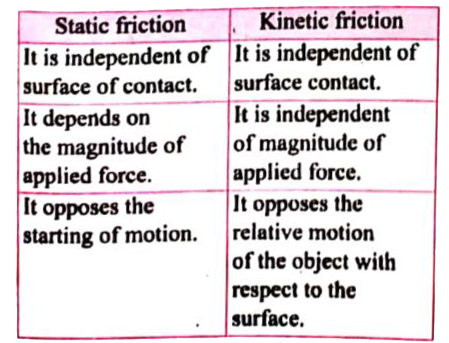 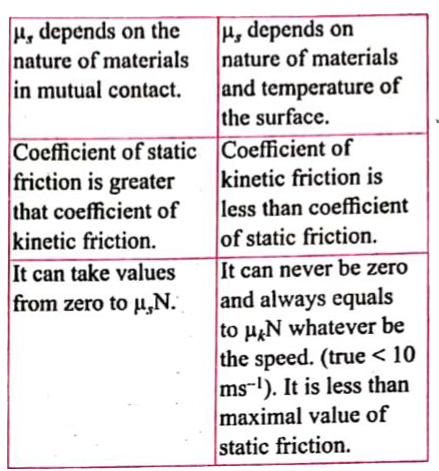
|
|
| 45. |
A homogeneous cylinder of mass M and radius R is pulled on a horizontal plane by a horizontal force F acting through its mass centre. Assuming rolling without slipping what is the angular acceleration of the cylinder ? |
| Answer» Solution :`ALPHA=(TAU)/(I)=(F.R)/((3)/(2)MR^(2))=(2F)/(3MR)` | |
| 46. |
The angle between anti-parallel vectors is |
|
Answer» `0^(@)` |
|
| 47. |
thecentre ofgravityofa bodyon theearthcoincides with itscentreofmass fora smallobject whereasfor anextendedobject it maynot ,whatis thequalitaitve meaningof smallandextended in thisregard ? for whichof thefollowingtwo coincides ? A building, a pond , a lake ,amountain? |
|
Answer» SOLUTION :whentheverticalheightof THEOBJECT is verysmallas compared to THEEARTH 'sradius, wecall the object small,otherwiseit isextended . (i)Buildingandpond aresmallobjects. (ii)A DEEP lakeanda mountainare examples of extended OBJECTS . |
|
| 48. |
What value of temperature in farenheit scale Becomes half than value in celcius scale ? |
|
Answer» Solution :`T_(F)=(9)/(5)T_(C)+32T_(F)=1/2T_(C)` `:.(1)/(2)T_(C)=(9)/(5)T_(C)+32` `:.(9)/(5)T_(C)-(1)/(2)T_(C)=-32` `:.T_(C)=-(320)/(13)` `T_(C)=-24.61" "^(@)C` `:.T_(F)=(T_(C))/(2)` GIVEN, `=-(24.61)/(2)` `=12.305" "^(@)F` |
|
| 49. |
The heat capacity of a body depends on : |
|
Answer» the heat GIVEN |
|
| 50. |
The properties of a surface are different from those of the bulk liquid because the surface molecules |
|
Answer» are SMALLER than other molecules |
|


