

Saved Bookmarks
This section includes 7 InterviewSolutions, each offering curated multiple-choice questions to sharpen your Current Affairs knowledge and support exam preparation. Choose a topic below to get started.
| 1. |
A heavy uniform log of mass M is pulled up an incline surface with the help of two parallel ropes as shown in figure. The ropes are secured at point A and B. The height of the incline is h and itsinclination is theta. (a) Find the minimum force F_(0) needed to roll the log up the incline. (b) Find the work done by the force in moving the log from the bottom to the top of the incline if the applied force is F = 2F_(0) |
|
Answer» (B) `2 Mgh |
|
| 2. |
A telescope has an objective of focal length 50cm and an eyepiece of focal length 5cm. The least distance vision is 25cm. The telescope is focused for distinct vision on a scale 2m away from the objective. Calculate (a) magnification produced and (b) separation between objective and eye piece. |
|
Answer» SOLUTION :GIVEN `f_0=50cm and f_e=5cm` For objective `1/v_0-1/-200=1/50 therefore 1/v_0=200/3 cm` `m_0=v_0/u_0=((200//3))/(-200)=-1/3` For eyepiece `1/-25 -1/u_e= 1/5` `therefore u_e=25/6 cm and m_e=v_e/u_e=(-25)/(-(25//6))=6` a) MAGNIFICATION m=`m_0 times m_e=-2` b) SEPARATION between objective and eyepiece, `L=v_0+|u_e|=200/3+25/6=425/6=70.83cm` |
|
| 3. |
A liquid takes 5 minutes to cool from 80^(@)C" to "50^(@)C. How much time will it take to cool from 60^(@)C" to "30^(@)C ? The temperature of the surroundings is 20^(@)C. |
|
Answer» Solution :According to Newtons law of cooling `K=C/(ms)` `((theta_(1)-theta_(2))/t)=K[((theta_(1)+theta_(2))/2)-theta_(0)]` Substituting the VALUES, ER get `((80-50)/5)=K[((80+50)/2)-20]to(1)` and `((60-30)/t)=K[((60+30)/2)-20]to(2)` SOLVING EQUATIONS (1) and (2), we get t = 9 minutes |
|
| 4. |
If I, be the moment of inertia of a thin rod about an axis perpendicular to its length and passing through its centre of mass and I_2 be the moment of inertia of the ring formed by bending the rod, then the ratio I_(1) : I_(2) is: |
| Answer» ANSWER :B | |
| 5. |
A jeweller claims that he sells ornaments made of pure gold that has the relative densityof 19.3. he cells an ornament weighing 20.250 gf to a person. The clever person weighs the ornament immersing it in pure water and find it weights 19.075 gf. Is teh ornaments made of pure gold? what is the percentage of impurty in the ornament if any? |
|
Answer» Solution :Weight of ORNAMENT in air `=20.250 gf` weight of ornamet in water = `19.075 gf` Loss of weight in water =` 20.259 - 19.075` `=1.175 gf` RELATIVE density of ornament is `rho_(0)^(') = ("weight in air")/("loss of weight in water")` `=(20.250)/(1.175) = 17.234` As the measured relative density `rho_(0)^(') (=17.234)`is LESS than the true relative density `rho_(0)=(19.3)`, so ITHE ornament is not made of pure gold. `%` impurity in ornament = `(rho_(0)-rho_(0)^('))/(rho_(0)) xx 100` `=(19.3 - 17.234)/(19.3) xx 100 = 10.7%` |
|
| 6. |
Which of the following is not a path function ? |
|
Answer» `DELTA Q` The INTERNAL energy is INDEPENDENT of path. |
|
| 7. |
The volume of a specific gravity bottle is 50 c.c at 15^(@)C. Find its volume at 100^(@)C ( a glass is 9 xx10^(-6) //^(@)C). |
| Answer» SOLUTION :`50.12 c.c` | |
| 8. |
A body of mass 2kg moving on a horizontal surface with an initial velocity of 4 ms^(-1), comes to rest after 2 second. If one wants to keep this body moving on the same surface with a velocity of 4 ms^(-1), the force required is |
| Answer» Solution :`v=u+at , F=ma` | |
| 9. |
One of the two limbs of a U-tube of uniform bore is closed by means of a cork. Some water and paraffin oil are in the tube. Water level in the open tube is 2 cm higher than that in the closed tube and a 10 cm column of paraffin is above it. If the cork is removed, then by what height will the level of water in the closed limb rise or fall? (Density of paraffin = 0.8g*cm^(-3)) |
|
Answer» SOLUTION :Let us assume that, when the cork is removed, the water level below the oil column will fall by H with respect to the level of water in the other limb Now, pressure at D = pressure at A. or, `hxx1xxg=10xx0.8xxg` or, h = 8 cm.  Here, the cross-section of the U-tube is uniform. So, if the height of the water column FALLS through X cm in ONE limb, the difference in the level of water in the two limbs will increase by 2 x cm. So, the initial difference in the level of water = -2cm and the final difference = +8cm. `therefore" "2x=8-(-2)=10" "thereforex=5cm` So, when the cork is removed, the height of the water column will rise by 5 cm in that limb. |
|
| 10. |
Choose the correct statement of the following. |
|
Answer» unable to change by itself the state of rest |
|
| 11. |
A geyser heats water flowing at the rate of 4 litre per minute from 30^(@)C to 85^(@)C. If the geyser operates on a gas burner then the amount of heat used per minute is |
|
Answer» `9.24 XX 10^(5)J` |
|
| 12. |
In the above question disc B is brought in contact with disc A, they acquire a common angular velocity in time t. The average frictional torque on one disc by the other during this periodis: |
|
Answer» `(2I omega)/(3t)` `I(2omega)+(2I)omega=(I+2I)omega_(1)impliesomega_(1)=(4OMEGA)/(3)"".....(i)` Initial angular momentum of A: `L_(1)=I(2omega)=2Iomega` Final angular momentum of A: `L_(2)=I(4omega//3)` Angular impulse = Change in angular momentum `taut=|L_(2)-L_(1)|impliestaut=(2Iomega)/(3)impliestau=(2Iomega)/(3t)` OPTION (a) is correct. |
|
| 13. |
A body .A. with a momentum .P. collides with another identical stationery body .B. one dimensionally. During the collision, .B. gives an impulse .J. to the body .A.. Then the coefficient of restitution is |
|
Answer» Solution :According to law of conservation of linear momentum, `m _(1) U _(1) + m_(2) u_(2) = m _(1) V _(1) + m _(2) v _(2)` i.e., `m u + m (0) = mv _(1) + mv _(2) IMPLIES P - P _(1) = P _(2) ` where `P _(2) = J,` GIVEN `therefore` Coefficient of resistution, ` e = (v _(2) -v _(1))/( u ) = (mv _(2) - mv _(1))/( m u ) = (P_(2) - P_(1))/( P )` `= (P _(2) - (P-P_(2)))/( P ) = (2P _(2) - P _(1))/( P ) therefore e = (2 J - P )/(P) = (2J)/(P) -1 ` |
|
| 14. |
Heat is supplied to a diatomic gas at constant pressure. The ratio of DeltaQ:DeltaU:DeltaW is: |
|
Answer» `5:3:2` |
|
| 15. |
Whch of the following statements is incorrect ? |
|
Answer» In PURE translation motion , every particle of the body moves with the same velocity at any instant of time . |
|
| 16. |
Which of the processes described below are irreversible? a) The increase in temperature of an iron rod by hammering it b) A gas in a small container at a temperature T_(1) is brought in contact with a big reseroir at a higher temperature T_(2) which increases the temperature of the gas c) A quasi-static isothermal expansion of an ideal gas in cylinder fitted with a frictionless piston d) An ideal gas is enclosed in a piston cylinder arrangement with adiabatic walls. A weight W is added to the piston, resulting in compression of gas |
|
Answer» only a,B are correct |
|
| 18. |
A particle of mass 10^(-2)kg, under the action of a force F(x) = - (k)/(2x^(2)) , is in motion along the positive x-direction. At time t = 0, the position of the particle is x = 1.0 m, and velcoity = 0, If k = 10^(-2) Ncdot m^(2),find the velocity when the particle is at x = 0.50 m. |
|
Answer» |
|
| 19. |
A loaded bus is more comfortable in motion than an empty bus . Why ? |
|
Answer» Solution :For a loaded BUS the acceleration is less so force on the passengers is less. As a result, IMPULSE EFFECTS are less Hence we FEEL comfort to travel in loaded bus. Reasons : 1) Mass of loaded bus is more. So acceleration produced by engine is less. Where as for an empty bus, weight is less so acceleration is high (Here we assume that engine of bus generates CONSTANT force) 2) For a loaded bus weight is more. So normal reaction and frictional force are high for empty bus N.R is less so friction is less. |
|
| 20. |
Match column-I with Column-II : {:("Column-I","Column-II"),("(1) Moment of inertia of solid sphere about any diameter",(a)2/3MR^2),("(2) Moment of inertia of solid sphere about the tangent to its boundary",(b) 2/5MR^2),(,(c) 7/5 MR^2):} |
|
Answer» |
|
| 21. |
A spherical ball rolls on a table without slipping .The fraction of its total energy associated with rotations |
|
Answer» `2/7` |
|
| 22. |
A wire of length L, mass m and carrying a current I is suspended from point O as shown, An another infinitely long wire carrying the same current I is at a distance L below the lower end of the wire. Given i=2A, L=1m and m=0.1kg (In 2=0.693) What want to keep the suspended wire stationary by palcing a third inifinitely long wire carrying an upward current. Then this wire should be placed |
|
Answer» to the LEFT of SUSPENDED wire |
|
| 23. |
A wire of length L, mass m and carrying a current I is suspended from point O as shown, An another infinitely long wire carrying the same current I is at a distance L below the lower end of the wire. Given i=2A, L=1m and m=0.1kg (In 2=0.693) What is the angular acceleration of the wire just after it is released from the position shown ? |
|
Answer» `6.2xx10^(-8)(rd)/(s^(2))` |
|
| 24. |
A wire of length L, mass m and carrying a current I is suspended from point O as shown, An another infinitely long wire carrying the same current I is at a distance L below the lower end of the wire. Given i=2A, L=1m and m=0.1kg (In 2=0.693) At what distance r from the suspended wire, the new wire (having the same current) should be placed to keep it stationary. |
|
Answer» `2.9`m |
|
| 25. |
A black body with an initial temperature of 300^(@)C is allowed to cool inside an evacuated enclosure surrounded by melting ice at the rate of 0.35^(@)C per second. If the mass, specific heat and surface area of the bodyare 32gm, 420 J kg^(-1)K^(-1) and 8 cm^(2) respectively, calculate the stefan's constant. |
|
Answer» Solution :`sigmaA(T^(4)-T_(0)^(4))=mc (dT)/(dt)` `A=8xx10^(-4)m^(2), T=300+273=573K, T_(0)=0^(@)C=273K` `m=32xx10^(-3)KG, c=420Jkg^(-1)K^(-1),(dT)/dt=0.35^(@)C//sec` `sigma= (mc)/(A(T^(4)-T_(0)^(4)))XX(dT)/dt` =`(32xx10^(-3)xx420xx0.35)/(8xx10^(-4)xx(573^(4)-273^(4)))` = `5.76xx10^(-8)Wm^(-2)K^(-4)` |
|
| 26. |
From what height a block of ice must fall into a well so that (1^(th))/100 of its mass may he melted (g = 10m//s^(2)) |
|
Answer» 300 m |
|
| 27. |
Explain reflection and refraction of waves. |
|
Answer» Solution :"When a wave reaches to a BOUNDARY and if the second medium at boundary is RIGID, then this wave will be returned back and it is called reflection of wave". OR "The PHENOMENON of returning back of wave from fixed support is called reflection. Incident wave and reflected wave follow usual law of reflection. Incident wave and reflected wave follow usual law of reflection. If the boundary is not completely rigid or is an interface between two different elastic media, the EFFECT of boundary conditions on an incident pulse or a wave is somewhat complicated. A part of the wave is reflected and a part is transmitted into the second medium. If a wave is incident OBLIQUELY on the boundry between two different media the transmitted wave is called the refracted wave. The incident and refracted waves obey Snell.s law of refraction. |
|
| 28. |
In the equation ((1)/(P beta)) = (y)/(k_B T) ,when P is the pressure, y is the distance, k_Bis Boltzmann constant and T is the temperature. dimensions of betaare |
|
Answer» `M^(-1) L^1T^2` |
|
| 29. |
Moment of inertial of a uniform horizontal solid cylinder of mass M about an axis passing through its edge and perpendicular to the axis of the cylinder when its length is 6 times its radius R is |
|
Answer» `(39)/(4)MR^(2)` |
|
| 30. |
Statement I : A particle is thrown vertically upwards. If air resistance is taken into consideration then retardation in upward journey is more than the acceleration in downward journey. Statement II : Some mechanical energy is lost in the form of heat due to air friction. |
|
Answer» Statement I is TRUE, statement II is true, statement II is a CORRECT EXPLANATION for statement I. |
|
| 31. |
(A) : A coin placed on a rotating disc flies away if the angular velocity is gradually increased (R ) : Static friciton is self adjusting in nature. |
|
Answer» Both 'A' and 'R' and TRUE and 'R' is the correct EXPLANTATION of 'A' |
|
| 32. |
The velocity of a gas molecule is comparable to that of a rifle bullet. Yet, a gas molecule spends a much longer time than a bullet does to travel equal distances .Explain. |
| Answer» Solution :A gas molecule suffers multiple collisions with the other molecules in the gas. As a result, it cannot move straight but TRAVELS any finite distance along a random zig-zag PATH. On the other hand,a rifle BULLET is MUCH heavier than gas molecules. Collisions with very light air molecules cannot after the straight path of the bullet. So the bullet travels a finite distance in a much shorter TIME. | |
| 33. |
Obtain an expression for the position vector of centre of mass of a system n particles in two dimension. |
Answer» Solution :Suppose that there are three particles not LYING in a straight line so they are taken in a plane.  Suppose the coordinates of three particles of masses `m_(1),m_(2)andm_(3)` are `(x_(1),y_(1)),(x_(2),y_(2)) and (x_(3),y_(3))` in two dimension respectively. If the centre of MASS of this system is `(X,y)` then X-coordinate of the centre of mass, X-coordinate = `(m_(1)x_(1)+m_(2)x_(2)+m_(3)x_(3))/(m_(1)+m_(2)+m_(3))` and Y-coordinate = `(m_(1)y_(1)+m_(2)y_(2)+m_(3)y_(3))/(m_(1)+m_(2)+m_(3))` `therefore` Centre of mass, `(X, Y)=((m_(1)x_(1)+m_(2)x_(2)+m_(3)x_(3))/(m_(1)+m_(2)+m_(3)),(m_(1)y_(1)+m_(2)y_(2)+m_(3)y_(3))/(m_(1)+m_(2)+m_(3)))` If all three particles having same mass, `m_(1)=m_(2)=m_(3)=m` assume, `therefore x`-coordinate of centre of mass, `X=(mx_(1)+mx_(2)+mx_(3))/(m+m+m)` `=(x_(1)+x_(2)+x_(3))/(3)` and y-coordinate `Y=(my_(1)+my_(2)+my_(3))/(m+m+m)` `=(y_(1)+y_(2)+y_(3))/(3)` Hence centre of mass of system form by three particles of same mass will be at MIDDLE of triangle form by these three particles. The centre of mass of three particles which are not lying on a line is WRITTEN as, Coordinate of C.M. `(X,Y)=(m_(1)(x_(1),y_(1))+m_(2)(x_(2),y_(2))+m_(3)(x_(3),y_(3)))/(m_(1)+m_(2)+m_(3))` Coordinate of centre of mass of n particle which are not in line. `(X,Y)=(m_(1)(x_(1),y_(1))+m_(2)(x_(2),y_(2))+...m_(n)(x_(n),y_(n)))/(m_(1)+m_(2)+...m_(n))` OR `(X,Y)=(Sigmam_(i)(x_(i).y_(i)))/(M)` where `M=Sigmam_(i)` total mass of system and x-coordinate and y-coordinate of centre of mass of system, `X=(m_(1)x_(1)+m_(2)x_(2)+...m_(n)x_(n))/(m_(1)+m_(2)...m_(n))=(Sigmam_(i)x_(i))/(M)` and `Y=(m_(1)y_(1)+m_(2)y_(2)+...m_(n)x_(n))/(m_(1)+m_(2)...m_(n))=(Sigmam_(i)y_(i))/(M)` |
|
| 34. |
The pulley and strings shown in the figure are smooth and of negligible mass. For the system to remain in equilibrium, the angle theta should be |
|
Answer» `0^(@)` Draw FBD of `sqrt2m` is `2T cos theta=sqrt2mg` |
|
| 35. |
Static friction opposes impending motion. Choose the CORRECT statement : |
|
Answer» Both kinetic friction and STATIC friction are INDEPENDENT of the area of CONTACT |
|
| 36. |
An object falls from a bridge that is 45m above the water . It falls directly into a small row-boat moving with constant velocity that was 12 m from the point of impact when the object was released. What was the speed of the boat ? |
|
Answer» Solution :Boat velocity `v=s/t, "But"s=12m` `:. T=s/u=12/v`…(1) Ball has fallen from a HEIGHT of 45M, `u=0` `S=ut+1/2at^(2)` `45m=0+1/2xxgt^(2)=1/2xx10xx((12)/v)^(2)` `v^(2)=1/2xx10xx(144)/(45)=(720)/(45)` `v^(2)=16` `:. V=4 m//s` |
|
| 37. |
If v= (3i + 4j+ 5k) ms^(-1) is the instantaneous velocity of a body of mass 1.50kg. Calculate its kinetic energy. |
|
Answer» SOLUTION :`V= (3I + 4j + 5k) MS^(-1) M= 1.5kg` Kinetic ENERGY K.E `= (1)/(2) MV^(2)` `=(1)/(2) 1.5 (3i + 4j + 5k) .(3i + 4j+ 5k)= 37.5` joules |
|
| 38. |
Towmassesm_(1) and m_(2)(m_(1)gtm_(2)) are incontact with each other on a smooth horizontal surface calculate the magnitude of contact force between them |
Answer» Solution :Let usconsidertwoblocksof masses `m_(1)`and`m_(2) (m_(1) gt m_(2))` . Keptin contactwitheach otheron asmoothhorizontalfrictionalsurfaceasshownin the figure 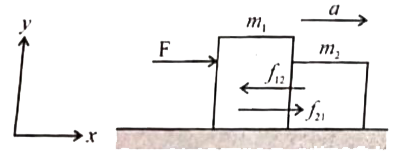 Bythe application of ahorizontalforceF boththe blocksaresetintomotionwithacceleration asimultaneouslyin thedirectionof theforce F . Tofind theacceleration `VEC(a)` Newton'ssecondlawhas tobeappliedto thesystemmass `m=m_(1)+ m_(2)` If weselectthe motionof the twomassesalongthe positivex direction`F hat(j)= MAHAT(i)` Theaccelerationof thesystemis given by `:.,a= (F )/( m_(1) + m_(2))` Theforce exerted by teh block`m_(1)` on `m_(2)` dueto itsmotionis calledforceof contact `(f_(n))`Accordingto Newton's thirdlaw the block`m_(2)` willexert anequivalentoppositereaction Figureshowsthe freebodydiagramof block`m_(1)` 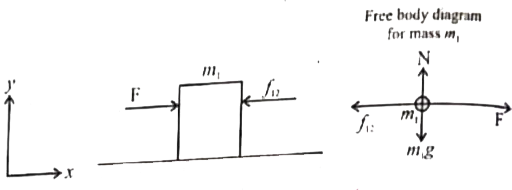 `Fhat(i) - f_(12) hat(i) = m_(1)a hat(i)` Bycomparingthe componentsof theaboveequationwe get `F-f_(12)= m_(1) a` `f_(12) = F - m_(1) a` Substitutingthe value of accelerationfromequation(1) in (2)we get ` f_(12) = f- m_(1) (F)/(m_(1)+m_(2))` `F_(12)= (Fm_(2))/(m_(1) +m_(2))` EQUATION (3) showsthat themagnitudeofcontactforcedependson mass`m_(2)`whichprovides the reactionforce. Notethat thisforceis actingalongthe negativex direction`m_(1)` isgiven by `f_(12)= - (Fm_(2))/( m_(1) + m_(2))` For `m_(2)` thereis onlyone forceforceactingon itthe xdirectionand it isdenoted by`f_(21)` . thisforceis EXERTEDBY mass `m_(1)` .THEFREE bodydiagramfor mass `m_(2)` is shown in the figure . 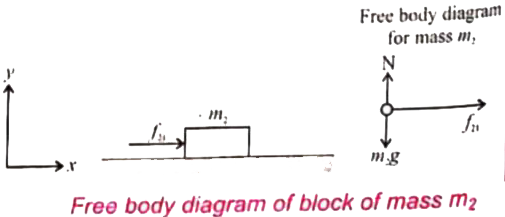 ApplyingNewton'secondlaw for mass `m_(2)` `f_(21) hat(i) = m_(2) hat(i)` Bycomparingthe componentson bothsidesof the aboveequation `f_(21) = m_(2) a` Substitutingforaccelerationfromequation (1)in equation(4) we get `f_(21) = (Fm_(2))/( m_(1) +m_(2))` In thiscase the magnitude of the contactforce is `f_(21) = (Fm)/(m_(1) + m_(2))` |
|
| 39. |
A vehicle of mass 120kg is moving with a velocity of 90kmph What force should be applied on the vehicle to stop it in 5s. |
|
Answer» |
|
| 40. |
Which two of the given transverse waves will give stationary wave when get superimposed? z_(1) = a cos (kx-omegat) ""(A)z_(2) = a cos (kx +omegat) ""(B) z_(3) = a cos (ky - omegat) ""(C ) |
|
Answer» A and B |
|
| 41. |
A missile is launched at an angle of 60^(@) to the vertical with a velocity sqrt(0.75 gR) from the surface of the earth (R is the radius of the earth). Find its maximum height from the surface of earth. (Neglect air resistance and rotation of earth). |
|
Answer» Solution :From CONSERVATION of MECHANICAL energy `(1)/(2)mv_(0)^(2)-(GMm)/(R )=(1)/(2)mv_(1)^(2)-(GMm)/(R+h)` ….(i) Also from conservation of angular momentum `mv_(0)R SIN 60^(@) = mv_(1) (R+h)` ….(II) Solving (i) and (ii) and putting `v_(0) = sqrt((3GM)/(4R))`, we GET `h ~~ 0.25 R`. 
|
|
| 42. |
The vein of healthy person is horizontal and its length is 0.04 m and has internal radius 1 mm. At 37^@ C, the average velocity of blood through the vein is 4 cm s^(-1). Find (a) the rate of flow of the blood (b) the velocity at the mid point of the vein and c) the decrease in pressure at the other end of the vein. Take eta_("blood") = 3.98 xx 10^(-1) P_a s) |
| Answer» Solution :`1.25xx10^(-7) m^3 s^(-1) , (b) 0.08 MS^(-1) , (C) 50.9 P_a s ` | |
| 43. |
Two particles A and B move with constant velocities v_(1)"and " v_(2)along two mutually perpendicular straight lines towards the intersection point O. At moment t=0, the particle were located at distance 1_(1)"and"1_(2)from O, respectively. Find the eime , when they are nearest and also the shortest distance between them . |
|
Answer» SOLUTION :After time .t. , the position of the point A and B are`(1_91)-v_(1)t)"and"(1_(2)-v_(2)t), `RESPECTIVELY The distance L between the POINTS A.andB. are `L_(2)=(1_(1)-v_(1)t)^(2)+(1_(2)-v_(2)t)^(2)` Differentiating with restect to time, `2L(dL)/(dt)=2(1_(1)-v_(1)t)(-v_(1))+2(1_(2)-v_(2)t)(-v_(2))` From MINIMUM value of `L(dL)/(dt)=0` PUTTING the value of t in equation (1) `L_(min)=|1_(1)v_(2__)+1_(2)v_(1)|/sqrt(v_(1)^(2)+v_(2)^(2))` 
|
|
| 44. |
What is the angular velocity of a body on'the surface of the earth at the equator ? Also find its linear velocity. Given radius of the earth is 6400 km. Period of rotation of the earth = 24 hours. |
|
Answer» |
|
| 45. |
If momentum of a body increase by 25% its kinetic energy will increase by |
|
Answer» 25% `p_(2)/p_(1)=5/4impliesp^(2)5/4p_(1) therefore v_(2)=5/4v_(1)` `"kinetic energy"=1/2mv(2)` `Einftyv^(2) E_(2)=(25)/(16)E_(1)` `"Increase in"K.E.=(E_(2)-e_(1))/e_(1)XX100=((25)/(16)E_(1)-E_(1))/E_(1)xx100` `=((25-16)/16E_(1))/E_(1)xx100=9/(16)xx100=56.25%` |
|
| 46. |
A 100kg gun fires a ball of 1 kg horizontally from a cliff of height 500m It falls on the ground at a distance of 400 m from the bottom of the cliff . Find the recoil veloctiy of the gun (acceleration due to gravity = 10 ms^(-2)) . |
|
Answer» Solution :Here , `m_(1) = 100 kg , m_(2) = 1 kg , h = 500 m ,` `x = 400 m` Let u be VELOCITY of ball and t be time TAKEN by the ball to hit the GROUND From `h = (1)/(2) g t^(2)` `500 = (1)/(2) x 10t^(2)` `t = sqrt(100) = 10 s` From `x = ut, u = (x)/(t) = (400)/(10) = 40 m//s` If is recoil velocity of gun then according to principle of conservation of linear momentum `m_(1) upsilon = m_(2) u` `upsilon = (m_(2)u)/(m_(1)) = (1)/(100) xx 40 = 4.0 m//s`  . |
|
| 47. |
A man waves his arms, while walking. This is due: |
|
Answer» to keep constant velocity |
|
| 48. |
A body of mass 2 kg is projected vertically up with a velocity of 100 ms^(-1). If it rises to a height of 400m, the energy utilized to overcome friction is (g= 10 ms^(-2)) |
| Answer» ANSWER :B | |
| 49. |
A planet of mass m is in an elliptical orbit about the sun with an orbital period T. If A be the area of orbit, then its angular momentum would be |
|
Answer» `(2MA)/(T)` `(A)/(T)=(L)/(2m)or L=(2mA)/(T)`. |
|