

Saved Bookmarks
This section includes 7 InterviewSolutions, each offering curated multiple-choice questions to sharpen your Current Affairs knowledge and support exam preparation. Choose a topic below to get started.
| 1. |
The power of a motor is 200W. If the unit of length is halved, that of mass is doubled and that of time is also doubled, then the power of the motor in the new system is |
|
Answer» 3200 W |
|
| 2. |
A golf ball of mass 60 gis hit with a striker. Find the impulse of the hit if the ball stops after travelling a horizontal distance of 50 m with a uniform retardation of 4 mcdot s^(-2). |
|
Answer» |
|
| 3. |
P-V diagram of a diatomic gas is a straight line passing through origin. What is the molar heat capacity of the gas in the process |
|
Answer» R |
|
| 4. |
Take the effect of bulging of earth and its rotation in account. Consider the following statements. A) There are points outside the earth where the value of g is equal to its value at the equator B) There are points outside the earth where the value of g is equal to its value at the poles |
|
Answer» Both A and B are CORRECT |
|
| 5. |
Define degree. |
| Answer» Solution :DEGREE is the UNIT of measurement which is USED to determine the SIZE of an ANGLE . | |
| 6. |
A shell is thrown vertically up. The shell at the highest point explodes into two equal fragments. The centre of mass of the two fragments. |
|
Answer» GOES further up and then falls |
|
| 7. |
A helium balloon has its rubber envelope of weight w_("Rubber") and its is used to lift a weight of w_("Load"). The volume of fully inflated balloon is V_(0). The atmospheric temperature is T_(0) throughout and the atmospheric pressure is known to change with height y according to equation P = P_(0)e^( – ky)where k is a positive constant and P_(0) is atmospheric pres- sure at ground level. The balloon is inflated with sufficient amount of helium so that the net upward force on is F_(0) at the ground level. Assume that pressure inside the balloon is always equal to the outside atmospheric pressure. Density of air and helium at ground level is rho_(a) and rho_(He) respectively. (a) Find the number of moles (n) of the helium in the balloon. For following two questions assume n to be a known quantity. (b) Find the height (y(0)) at which the balloon is fully inflated. (c) Prove that the balloon will be able to rise to height y_(0) if (nRT_(0)g)/(P_(0))(rho_(a)-rho_(Hg)) gt w_("Rubber"+w_("Load") |
|
Answer» (b) `y_(0)=(1)/(K)LN((P_(0)V_(0))/(nRT_(0)))` |
|
| 8. |
The internal energy of a perfect gas does not change during |
|
Answer» ISOTHERMAL process |
|
| 9. |
What is meant by phase of a particle executing SHM ? |
|
Answer» Solution :The Phaseof particle EXECUTING S.H.M express the position and DIRECTION of motion of the particle at that instant with respect its mean position. `Y=A sin (omega t+phi_(0))` The PHASE of a particle at any instant COMPLETELY specifier the state of the particle. |
|
| 10. |
A body is in pure rotation. The linear speed v of the particle, the distance r of the particle from the axis and the angular velocity omega of the body are related as omega=(v)/(r ). Thus |
|
Answer» `omegaalpha(1)/(R )` |
|
| 11. |
A point mass x = 20 kg, is suspended by a massless spring of constant 2000 N/m. The point mass is released when elongation in the spring is 15 cm. The equation of displacement of particle as function of time is (take, g =10m//s^(2)) |
|
Answer» y = 10 sin 10T |
|
| 12. |
Calculate rate of flow of glycerin of density 1.25xx10^(3)kg//m^(3) through the conical section of a horizontal pipe, if the radii of it ends are 0.1 m and 0.04 m and pressure drop across its length is 10N//m^(2). |
|
Answer» <P> Solution :According to continuity equation.`(V_(2))/(V_(1))=(A_(1))/(A_(2))=(r_(1)^(2))/(r_(2)^(2))=((0.1)^(2))/((0.04)^(2))=25/4` and according to Bernoull.s equation for ahorizontal tube `P_(1)+1/2rhoV_(1)^(2)=P_(2)+1/2rhoV_(2)^(2)` `V_(2)^(2)-V_(1)^(2)=2((P_(1)-P_(2)))/(RHO)` `=2xx((10N//m^(2)))/((1.25xx10^(3)kg//m^(3)))` `=16xx10^(-3)m^(2)//s^(2)` but `V_(2)=25/4V_(1)=6.25V_(1)` `[(6.25)^(2)-1^(2)]V_(1)^(2)=16xx10^(-3)m^(-2)//s^(2)` or `V_(1)~~0.0205m//s` the rate of VOLUME flow `=A_(1)V_(1)=pi(0.1)^(2)xx(0.02)` `=6.28xx10^(-4)m^(3)//s` And the rate of mass flow is `(DM)/(dt)=rho AV` `=(1.25xx10^(3)kg//m^(3))xx(6.28xx10^(-4)m^(3)//s)` `=0.785kg//s` |
|
| 13. |
A point mass 10 g moves in the xy plane with a velocity 2 ms^(-1)along a straight line. Find the magnitude and direction of its angular momentum (i) with respect to the origin O and (ii)with respect to the origin O. The magnitude of the position vector vecris 0.5 m and the angle theta = 30^(@). |
|
Answer» Solution :`m = 10g = 0.010 kg` `v= 2ms^(-1) ,R = -0.5 m` OO. =` r SIN theta` `=0.5 sin 30` =0.25 m Angular momentum about O `=MVR sin theta` `=0.01 XX 2 xx 0.25` `=5 xx 10^(-3) J.s.` Angular momentum about O. = 0, because the direction of the velocity passes through O.. |
|
| 14. |
A particle executing simple harmonic motion along y -axis has its motion described by the equation y =A sin(omega t )+ B. The amplitude of the simple harmonic motion is |
|
Answer» Solution :Given : `x=A sin (omega t- phi) ""...(1)` `y= B sin omega t""...(2)` In equation (1) use, `sin (A-B)= sin A COS B+ cos A sin B` (1) `rArr x= A sin omega t. + A phi A cos omega t. sin phi x-Asin omega t. cos phi= A cos omega t sin phi` Squaring on both sides we get, `(x-A sin omega t. cos phi)^(2)=A^(2) cos^(2) omega t sin^(2) phi ....(3)` In equation (2) ` sin omega c` can be re- written as, `(Y)/(b)` [ from equation (2)]. Also, use, `cos^(2) omega t=I- sin^(2) omega t` in equation (3) `:. (3)` becomes `(x-A(y)/(B). cos phi)^(2)=A^(2)(1-(y^(2))/(B^(2))) sin ^(2) phi` On EXPANSION. `x^(2)+(A^(2)y^(2))/(B^(2)) cos^(2) phi-(2xAy)/(B) cos phi` `=A^(2) sin^(2) phi-(A^(2)y^(2))/(B^(2)) sin phi....(4)` `x^(2)+(A^(2)y^(2))/(B^(2))( sin^(2) phi+ cos^(2) phi)-(2xyA)/(B) cos phi` `=A^(2) sin^(2) phi "" ( -: byA^(2))` we get, `(x^(2))/(A^(2))+(y^(2))/(B^(2))*1 -(2xy)/(AB) cos phi= sin^(2) phi ""...(5)` Hence proved. Special cases : `varphi=(pi)/(4), "cos" (pi)/(4)=(1)/(SQRT(2)) & "sin" (pi)/(4)=(1)/(sqrt(2))` in equation (5) we get, `(x^(2))/(A^(2))+(y^(2))/(B^(2))-((sqrt(2))XY)/(AB)=(1)/(2)` The above equation is an equation of tilted ellipse. |
|
| 15. |
A 20 cm long capillary tube is dipped in water The water rises upto 8 cm . If the entire arrangement is put in freely falling elevator,the length of water column in capillary tube willbe ? |
| Answer» Solution :In FREELY falling elevator `g=0` .HENCE ,water rises in TUBE .`(h=(2costheta)/(rrhog))`. Therefore water fill whole tube So, length of water column in tube is 20 CM . | |
| 16. |
A particle is subjected to two mutually perpendicular simple harmonic motions such that its X and y coordinates are given by X=2 sin omegat , y=2 sin (omega+(pi)/(4)) The path of the particle will be: |
|
Answer» SOLUTION :Given : `x=A sin (omega t- phi) ""...(1)` `y= B sin omega t""...(2)` In equation (1) use, `sin (A-B)= sin A cos B+ cos A sin B` (1) `RARR x= A sin omega t. + A phi A cos omega t. sin phi x-Asin omega t. cos phi= A cos omega t sin phi` Squaring on both SIDES we get, `(x-A sin omega t. cos phi)^(2)=A^(2) cos^(2) omega t sin^(2) phi ....(3)` In equation (2) ` sin omega c` can be re- WRITTEN as, `(Y)/(b)` [ from equation (2)]. Also, use, `cos^(2) omega t=I- sin^(2) omega t` in equation (3) `:. (3)` becomes `(x-A(y)/(B). cos phi)^(2)=A^(2)(1-(y^(2))/(B^(2))) sin ^(2) phi` On expansion. `x^(2)+(A^(2)y^(2))/(B^(2)) cos^(2) phi-(2xAy)/(B) cos phi` `=A^(2) sin^(2) phi-(A^(2)y^(2))/(B^(2)) sin phi....(4)` `x^(2)+(A^(2)y^(2))/(B^(2))( sin^(2) phi+ cos^(2) phi)-(2xyA)/(B) cos phi` `=A^(2) sin^(2) phi "" ( -: BYA^(2))` we get, `(x^(2))/(A^(2))+(y^(2))/(B^(2))*1 -(2xy)/(AB) cos phi= sin^(2) phi ""...(5)` Hence proved. Special cases : `varphi=(pi)/(2)` in equation (5) `(x^(2))/(A^(2))+(y^(2))/(B^(2))=1` The above equation of an ellipse whose centre is origin. |
|
| 17. |
A plumb bob hanging from the ceiling of railroad car actsas an accelerometer . Derive the general expression relating the horizontal acceleration a of the car with the angle theta made by the bob with the vertical . Find theta when a = 1.5 ms^(-2) and a when theta = 10^(@) [Hint: Apply d' Alembert's principal.] |
|
Answer» |
|
| 18. |
Tanks A and B open at the top contain two different liquids upto certain height in them. A hole is made to the wall of each tank at a depth h from the surface of the liquid. The area of the hole in B is twice that of in A. If the liquid mass flux through each hole is equal, then the ratio of the densities of the liquids respectively, is |
|
Answer» `2/1` |
|
| 19. |
A cylinder of mass 10kg and radius 0.15m is rolling perfectly on a plane of inclination 30^(@). The coefficient of static friction mu_s=0.25 If the inclination theta of the plane is increased, at what value of theta does the cylinder begin to skid and not roll perfectly. |
Answer» Solution : Given, `m=10kg,r=0.15m,theta=30^(@),mu_3=0.25` `I=(MR^2)/2=(10xx(0.15)^2)/2=0.1125kgm^2` From the FIGURE, `((mgsintheta-mu_kmgcostheta)/(1+(K^2)/(R^2))=ma` i.e, `[(gsintheta-mu_kgcostheta)/(1+K^2)/(R^2))]=a` Taking `mu_k=0` (not given) `a=(gsintheta)/(1+(K^2)/(R))` where `(K^2)/(R^2)`=1/2` for a cylinder`:. a=`(gsintheta)/(3/2)=2/3gsintheta` We know that `tau=Iprop=fR` i.e `f=(Iprop)/(R)`i.e `f=(mR^2)/(2R)xxa/R"":.f=1/3mgsintheta` `f=1/3xx10xx9.8xxsin30^(@)=5xx3.267=16.335` `:.` Force of kinetic FRICTION=16.34N WORK done against friction while in motion=0 For the cylinder to KID `mu=1/3tantheta` i.e `tantheta=3xx0.25=0.75` `:.theta~~37^(@)` |
|
| 20. |
The thermal radiation emitted by a body is proportional to T^(n) where T is its absolute temperature. The value of n is exactly 4 for |
|
Answer» A blackbody |
|
| 21. |
The amount of work dne in lifting a body of mass 'm' from the surface of the earth to a height equal to twice the radius of the earth is |
|
Answer» `(2GMm)/(3R)` |
|
| 22. |
A particle is subjected to two simple harmonic motions along x and y directions according to x=3sin100pit, y=4sin100pit. |
|
Answer» SOLUTION :Given : `x=A sin (omega t- phi) ""...(1)` `y= B sin omega t""...(2)` In equation (1) use, `sin (A-B)= sin A cos B+ cos A sin B` (1) `rArr x= A sin omega t. + A phi A cos omega t. sin phi x-Asin omega t. cos phi= A cos omega t sin phi` Squaring on both sides we get, `(x-A sin omega t. cos phi)^(2)=A^(2) cos^(2) omega t sin^(2) phi ....(3)` In equation (2) ` sin omega c` can be re- written as, `(Y)/(b)` [ from equation (2)]. Also, use, `cos^(2) omega t=I- sin^(2) omega t` in equation (3) `:. (3)` becomes `(x-A(y)/(B). cos phi)^(2)=A^(2)(1-(y^(2))/(B^(2))) sin ^(2) phi` On expansion. `x^(2)+(A^(2)y^(2))/(B^(2)) cos^(2) phi-(2xAy)/(B) cos phi` `=A^(2) sin^(2) phi-(A^(2)y^(2))/(B^(2)) sin phi....(4)` `x^(2)+(A^(2)y^(2))/(B^(2))( sin^(2) phi+ cos^(2) phi)-(2xyA)/(B) cos phi` `=A^(2) sin^(2) phi "" ( -: byA^(2))` we get, `(x^(2))/(A^(2))+(y^(2))/(B^(2))*1 -(2xy)/(AB) cos phi= sin^(2) phi ""...(5)` Hence proved. Special cases : `varphi=pi` in equation (5) `(x^(2))/(A^(2))+(y^(2))/(B^(2))+(2xy)/(AB)=0` (or) `((x)/(A)+(y)/(B))^(2)=0` (or) `(x)/(A)-=(y)/(B) rArr y=-(B)/(A).x` The above equation ISA equation of a striaght line passing through origin with NEGATIVE SLOPE. |
|
| 23. |
A car moving with a velocity of 72KMPH stops its engine just at the foot of a hill. If the car ascends a height of 12m, the energy lost in overcoming friction is (g= 10 m//s^(2)) |
|
Answer» 0.4 |
|
| 24. |
A particle executing simple harmonic motion along - y - axis has its motion described by the equation y=Asin(omegat)+B , the amplitude of the example harmonic motion is |
|
Answer» Solution :Given : `x=A sin (OMEGA t- phi) ""...(1)` `y= B sin omega t""...(2)` In equation (1) use, `sin (A-B)= sin A cos B+ cos A sin B` (1) `rArr x= A sin omega t. + A phi A cos omega t. sin phi x-Asin omega t. cos phi= A cos omega t sin phi` Squaring on both sides we get, `(x-A sin omega t. cos phi)^(2)=A^(2) cos^(2) omega t sin^(2) phi ....(3)` In equation (2) ` sin omega c` can be re- written as, `(Y)/(b)` [ from equation (2)]. Also, use, `cos^(2) omega t=I- sin^(2) omega t` in equation (3) `:. (3)` becomes `(x-A(y)/(B). cos phi)^(2)=A^(2)(1-(y^(2))/(B^(2))) sin ^(2) phi` On expansion. `x^(2)+(A^(2)y^(2))/(B^(2)) cos^(2) phi-(2xAy)/(B) cos phi` `=A^(2) sin^(2) phi-(A^(2)y^(2))/(B^(2)) sin phi....(4)` `x^(2)+(A^(2)y^(2))/(B^(2))( sin^(2) phi+ cos^(2) phi)-(2xyA)/(B) cos phi` `=A^(2) sin^(2) phi "" ( -: BYA^(2))` we get, `(x^(2))/(A^(2))+(y^(2))/(B^(2))*1 -(2xy)/(AB) cos phi= sin^(2) phi ""...(5)` Hence proved. Special cases : `varphi=0` in equation (5) we get, `(x^(2))/(A^(2))+(y^(2))/(B^(2))-(2xy)/(AB)*1=0` (or) `((x)/(A)-(y)/(B))^(2)=0` (or) `(x)/(A)=(y)/(B) rArr y=(B)/(A) x` The above equation resmbles equation of a striaght line passing through origin with POSITIVE slope. |
|
| 25. |
A car moving with a speed of 40 km/h can be stopped by applying brakes after at least 2m. If the same car is moving with a speed of 80 km/ h. The minimum stopping distance will be…………….. |
|
Answer» 8 Here, `v _(1) = 40 km//h = 40 xx (5)/(18) = 11 m //s and ds _(1) = 2m` is given. `therefore 2 = ((11) ^(2))/( 2A _(1))` (From eq. (i)) `therefore 4A =121` `therefore a _(1) = 30 ms ^(-1)` Now, same CAR is there, so `a _(1) =a_(2) =a.` `therefore v _(2) = 80 km//h =8- xx (5)/(18) ~~22m//s and a _(1) =a_(2) =30 ms ^(-1) ,So, ds _(2) = ?` `therefore ds _(2) = ((22) ^(2))/(2 xx 30 )= (484)/(60) ` `therefore ds _(2) = 8m` |
|
| 26. |
Coefficient of thermal conductivity |
| Answer» Solution :COEFFICIENT of thermal conductivity of a material is numerically EQUAL to the amount of heat conducted per SECOND normallyper unit area of cross SECTION per unit temperature GRADIENT. | |
| 27. |
A horizontal wooden disc of mass 8 kg and diameter 1m is pivoted on frictionless bearing about a vertical axis through its centre.We put a toy train track model in the disc.The track has a negligible mass and average diameter 0.95 ra.The mass ofmodel train is 1.2 kg which can run with a battery.When we switch on the engine the train moves anticlockwise, soon attaining a constant speed of 0.6 m//s with respect to the track. Find the magnitude and direction of the angular velocity of the disc relative to the earth. |
|
Answer» |
|
| 28. |
A solid cylinder of mass 3 kg is rolling on a horizontal surface with velocity 4 ms^(-1). It collides with a horizontal spring of force constant 200 N m^(-1). The maximum compression produced in the spring will be |
|
Answer» 0.5 m According to law of conservation of mechanical energy Loss in kinetic energy = Gain in potential energy of spring of cylinder `1/2 mv^2 + 1/2 I omega^2 = 1/2 k x^2` `1/2 mv^2+ 1/2 kx^2 " or " x^2 = 3/2 (mv^2)/(k)` Here, `m = 3 kg , V = 4 ms^(-1), k = 200 N m^(-1)` Substituting the given values , we get `x^2= (3 xx 3 xx 4 xx 4)/(2 xx 200)" or " x = 0.6 m`. |
|
| 29. |
A thermocole cubical ice box of side 30 cm is of thickness 5cm. If 4kg of ice is put in the box, estimate the amount of ice remaining after 6 hours. The outside temperature is 45^(@)C and coefficient of thermal conductivity of thermocole = 0.01 W/mK. Given latent heat of fusion of ice = 335xx10^(3)J//kg. |
|
Answer» Solution :AREA of SIX faces of the box, `A=6l^(2)=6xx(0.3)^(2)=0.54m^(2)` thickness, L = 5 CM = 0.05 m, time, t = 6 h = `6xx3600s` temperature difference = `45-0=45^(@)C` Total heat entering in to the box in 6 hours. `Q=(KA(theta_(1)-theta_(2))t)/L=(0.01xx0.54xx45xx6xx3600)/0.05=104976J` If .m. be the amount of ice melted, then `m=Q/L_("ice")=(104976)/(335xx10^(3))=0.313kg` `THEREFORE` mass of ice left after `6h=4-0.313=3.687kg`. |
|
| 30. |
A cylinder of mass 10kg and radius 0.15m is rolling perfectly on a plane of inclination 30^(@). The coefficient of static friction mu_s=0.25 How much is the force of friction acting on the cylinder ? |
Answer» Solution : GIVEN, `m=10kg,r=0.15m,theta=30^(@),mu_3=0.25` `I=(MR^2)/2=(10xx(0.15)^2)/2=0.1125kgm^2` From the FIGURE, `((mgsintheta-mu_kmgcostheta)/(1+(K^2)/(R^2))=ma` i.e, `[(gsintheta-mu_kgcostheta)/(1+K^2)/(R^2))]=a` TAKING `mu_k=0` (not given) `a=(gsintheta)/(1+(K^2)/(R))` where `(K^2)/(R^2)`=1/2` for a cylinder`:. a=`(gsintheta)/(3/2)=2/3gsintheta` We know that `tau=Iprop=fR` i.e `f=(Iprop)/(R)`i.e `f=(mR^2/(2R)xxa/R"":.f=1/3mgsintheta` `f=1/3xx10xx9.8xxsin30^(@)=5xx3.267=16.335` `:.` Force of kinetic friction=16.34N Work done against friction while in motion=0 For the cylinder to kid `mu=1/3tantheta` i.e `tantheta=3xx0.25=0.75` `:.theta~~37^(@)` |
|
| 31. |
A cylinder of mass 10kg and radius 0.15m is rolling perfectly on a plane of inclination 30^(@). The coefficient of static friction mu_s=0.25 What is the work done against friction during rolling ? |
Answer» Solution : Given, `m=10kg,R=0.15m,theta=30^(@),mu_3=0.25` `I=(MR^2)/2=(10xx(0.15)^2)/2=0.1125kgm^2` From the FIGURE, `((mgsintheta-mu_kmgcostheta)/(1+(K^2)/(R^2))=ma` i.e, `[(gsintheta-mu_kgcostheta)/(1+K^2)/(R^2))]=a` TAKING `mu_k=0` (not given) `a=(gsintheta)/(1+(K^2)/(R))` where `(K^2)/(R^2)`=1/2` for a cylinder`:. a=`(gsintheta)/(3/2)=2/3gsintheta` We know that `tau=Iprop=fR` i.e `f=(Iprop)/(R)`i.e `f=(mR^2/(2R)xxa/R"":.f=1/3mgsintheta` `f=1/3xx10xx9.8xxsin30^(@)=5xx3.267=16.335` `:.` Force of kinetic friction=16.34N Work done against friction while in motion=0 For the cylinder to kid `mu=1/3tantheta` i.e `tantheta=3xx0.25=0.75` `:.theta~~37^(@)` |
|
| 32. |
A monkey A ( mass = 5kg) is climbing up a rope tied to a rigid support . The monkey B (mass=2kg ) is holding on to the tail of monkey A . If the tail can tolerate a moximum tension of 30N, what force should monkey A apply on the rope in order to carry monkey B with it ? (g=10 m//s^(2)) |
|
Answer» |
|
| 33. |
A String on a cello vibrates in its first normal mode with a frequency of 220 Hz. The vibrating segment is 70.0 cm long and has a mass of 1.20 g . (a) Find the tension in the string . (b) Determine the frequency of vibration when the string vibrates in three segments . |
|
Answer» Solution :The tension should be LESS than ` 500 N (~ 100 1b)` since excessiveforce on the four cello strings would break the neck of the instrument . If a string vibrates in three ANTINODES ( instead of ONE for the fundamental mode) , so the frequency should be three times grreater than the fundamental . From the string's length , we can find the wavelength . We then can use the wavelength with the fundamental frequency to find the wavr speed . Finally , we can find the tension fromthe wave speed and the LINEAR mass density of the string . When the string vibrates in the lowest frequency mode , the length of string forms a standing wave where is ` L = lambda//2` so the fundamental harmonic wavelength is `lambda = 2 L = 2( 0.700 m)` `= 1.40 m` and the speed is ` v = f lambda = ( 220 s^(-1)) ( 1.40 m) = 308 m//s` (a) . From the tension equation ` v = sqrt ((T)/( mu)) = sqrt ((T)/( m//L))` We get ` T = v^(2) m//L` or `T = ((308 m//s)^(2) ( 1.20 xx 10^(-3) kg))/( 0.700 m) = 163 N` (b). For the third harmonic , the tension , linear density and speed are the same , but the string vibrates in three segments . Thus , the wavelength is one - third of the fundamental wavelength . ` lambda_(3) = lambda_(1)//3` From the equation ` v= f lambda` , we find that the frequency three times as high . ` f_(3) = (v)/( lambda_(3)) = 3(v)/( lambda_(1)) = 3 f_(1) = 660 Hz` The tension seems reasonable , and the third harmonic is three times the fundamental frequency as excepted . Related to part (b) , some stringed instrument players use a technique to double the frequency of a note by playing a natural harmonic , in effect cutting a vibrating string in half . When the string is lightly touched at its midpoint to form a node there , the second harmonic is formed , and the resulting note is one octave HIGHER ( twice the original fundamental frequency ). 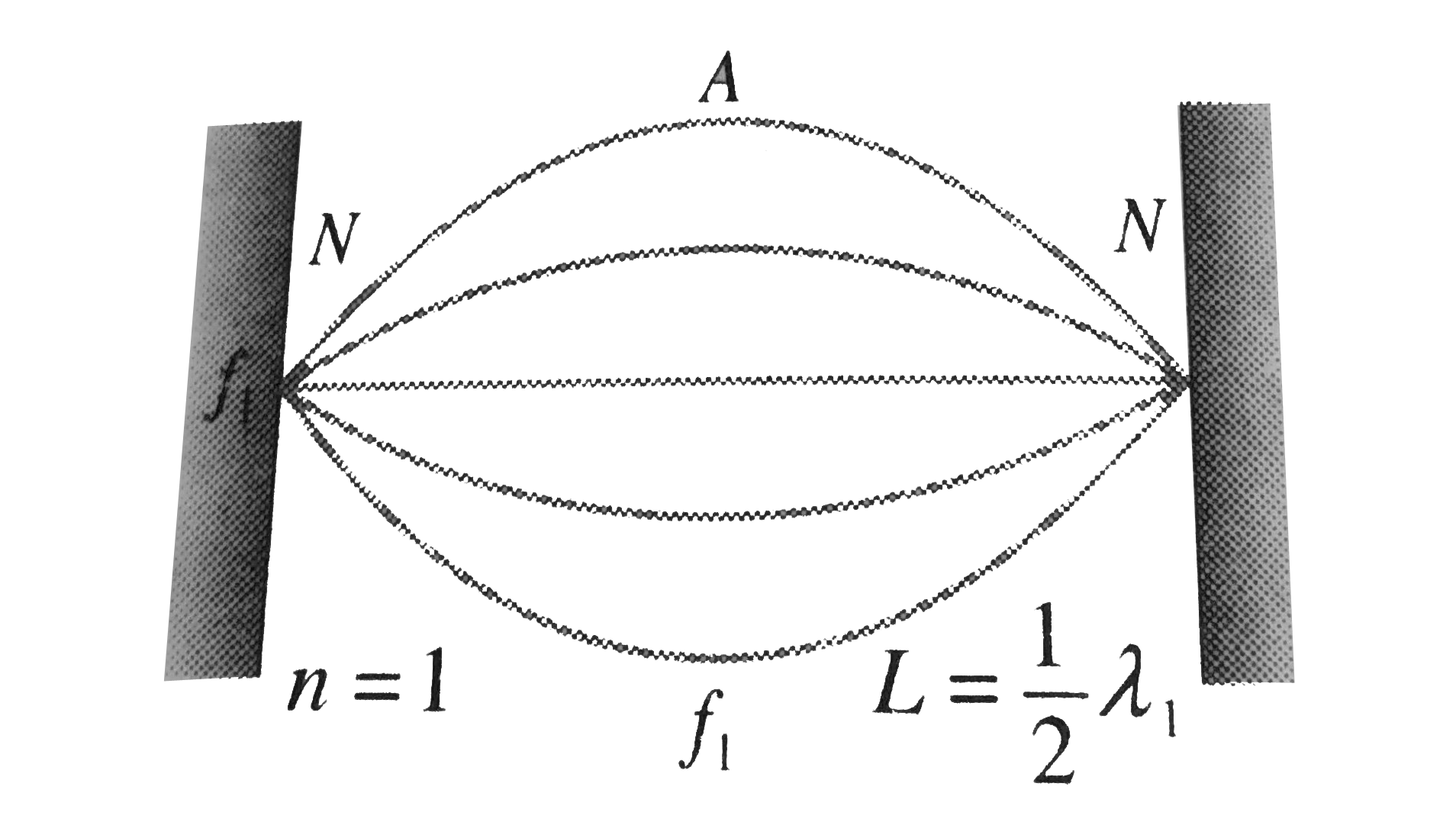 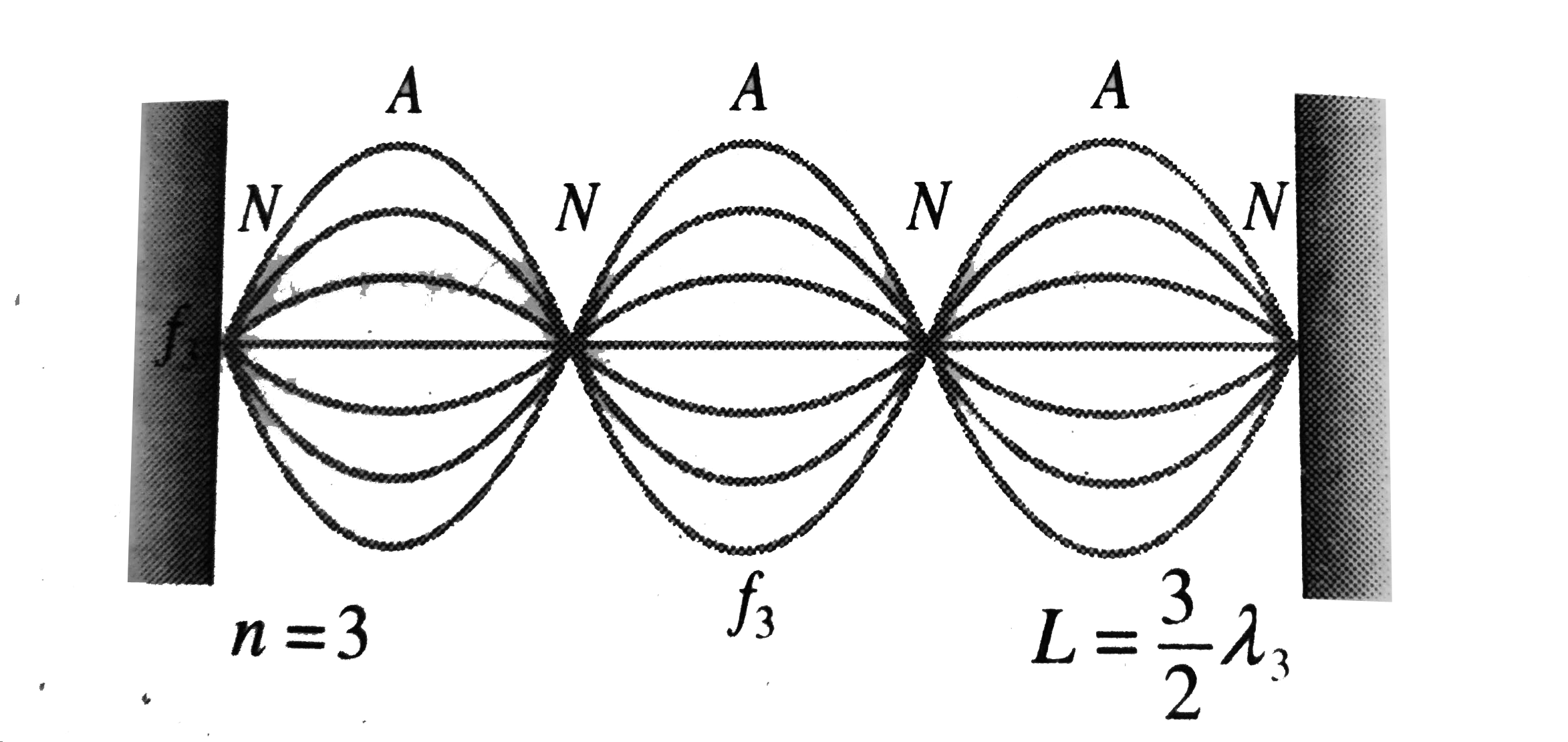
|
|
| 34. |
What Is the potential energy of a stretched wire ? |
|
Answer» 1/2load * extension |
|
| 35. |
The dimensional formula for universal gravitational constant is |
|
Answer» `ML^(-2)T^(2) ` |
|
| 36. |
Time varying force horizontal F = K_(o)t is applied on a block of mass 'm' placed at rest on a rough 8, the acceleration of the block horizontal surface ( mu is coefficient of friction). At a time t = (3mu mg)/(K_(0)), is given by a = p mug mu g where p = ...... (K_(0) is a positive constant) |
|
Answer» 2 |
|
| 37. |
The kinetic energy of a body is K. If one fourth of itsmass is removed and velocity is doubled, its new kinetic energy is |
| Answer» ANSWER :B | |
| 38. |
A body initially at rest is moving with uniform acceleration a. Its velocity after n seconds is v. The displacement of the body in last 2 s is |
|
Answer» `(2V(N-1))/(n)` |
|
| 39. |
Convert 3 ms^(-2) "to km" h^(-2)(ii) G = 6.67 xx 10^(-11) N m^(2) kg^(-2) to cm^(3) g^(-1) s^(-2) |
|
Answer» Solution :(i) `3 ms^(-2) = ((3)/(1000) km)((1)/(60xx60)HR)^(-2)` `= (3 xx (60 xx 60)^(2))/(1000) = 3.8880 xx 10^(4) "km" h^(-2) = 3.9 xx 10^(4) "km" h^(-2)` (ii) G = `6.67 xx 10^(-11) N m^(2) kg^(-2)` `= 6.67 xx 10^(-11) (kg m s^(-2)) (m^(2) kg^(-2))` `= 6.67 xx 10^(-11) kg^(-1) m^(3) s^(-2)` `= 6.67 xx 10^(-11) (1000 g)^(-1) (100 cm)^(3) (s^(-2))` `= 6.67 xx 10^(-11) xx (1)/(1000) xx 100 xx 100 xx 100 g^(-1) cm^(3) s^(-2)` `= 6.67 xx 10^(-8) g^(-1) cm^(3) s^(-2)` |
|
| 40. |
Discuss some salient features of gravitational, electromagnetic and nuclear forces. |
| Answer» SOLUTION :1 (a) 9 | |
| 41. |
A man is in a car moving with an acceleration of 5m*s^(-2) .Find the apparent value of the accelerationdue to gravity and the directionof pull of the earth with respect to him. |
Answer» Solution :Let the acceleration of theman inthe CAR be `veca` and acceleration due to gravity be `vecg`. Hence acceleration due to gravity RELATION to theman is, `vecg. =vecg-veca=vecg+(vec(-a))`. From Fig.2.44,  `g.=SQRT(g^2+a^2)=sqrt(9.8^2+5^2)` `=sqrt(121.04)=11m*s^(-2)` The ANGLE `theta` , which `vecg.` makes with `vecg`is given by `tan theta=a/g=5/(9.8)=0.51=tan27^@` `therefore theta =27^@` Hence, with respect to the man the earth.s pull is acting downward at an angle `27^@` with the vertical in the side opposite to his directionof motion. |
|
| 42. |
A car moves for half of its time at 80 km//h and for rest half of time at 40 km//h. Total distance covered is 60km. What is the average speed of the car |
|
Answer» |
|
| 43. |
Two cliff of heights 120m and 100.4m are separated by a horizontal distance of 16m. If a car has to reach from the first cliff to the second, the horizontal velocity of the car should be |
| Answer» Answer :D | |
| 44. |
A rocket is propelled by a gas which is initially at a temperature of 4000 K . The temperature of the gas falls to 1000 K as it leaves the exhaust nozzle. The gas which will acquire the largest momentum while leaving the nozzle, is |
|
Answer» Hydrogen |
|
| 45. |
A body is projected by making an angle 30^@ with horizontal with a velocity of39.2ms^-1. Find |
|
Answer» |
|
| 46. |
(a) One end of a steel rod (K = 46 J//m-s-.^(@)C) length 1.0 m is kept in ice at 0^(C ) and the end is kept in boling water at 100^(@)C. The area of cross-section ofthe rod is 0.4 cm^(2). Assuming no heat loss to atmosphere, find the mass of of the ice melting per second. Latent heat of fusion of ice = 3.36 xx 10^(5) J//kg (b) An icebox almost completely filled with ice at 0^(@)C is dipped into a large volume of water at 20^(@)C. The box has walls of surface area 2400 cm^(2), thickness 2.0 mm and thermal conductivity 0.6 W//m-^(@)C. Calculate the rate at which the ice melts in the box. Latent heat of fusion if ice = 3.4 xx 10^(5) J//kg. |
|
Answer» Solution :`R = (l)/(KA) = (1)/(46 xx 0.04 xx 10^(-4)) = (10^(6))/(184) .^(@)C//W` `i= (100 - 0)/(R ) = (100)/(10^(6)) xx 184 = 184 xx 10^(-4) W` `i= m L_(ice)` `184 xx 10^(-4) = m xx 3.36 xx 10^(5)` `m = 54.8 xx 10^(-9) kg//s` (B) `R = (l)/(KA) = (2 xx 10^(-3))/(0.06 xx 2400 xx 10^(-4)) = 0.14 .^(@)C//W` `i = (20 - 0)/(R ) = (20)/(0.14) = (1000)/(7) W` `i = mL_(ice)` `(1000)/(7) = m xx 3.36 xx 10^(5)` `m = 42.5 xx 10^(-5) kg//s` 
|
|
| 47. |
In S.H.M. at the equilibrium position (a) Amlitude is minimum (b) Acceleration is zero (c) Velocity is maximum (d) P.E. is maximum |
|
Answer» all true |
|
| 48. |
The velocity of flow of a liquid through a pipe at a point of radius r is v. At a point where the radius is 2r, the mass of the liquid flowing out per second is (d = density of the liquid) |
|
Answer» `2pi R^(2) "vd"` |
|
| 49. |
A pipe is running full of water. At a point A, it tapers from 200 cm^(2) cross sectionalara to 100 cm^(2) at other point B. If the pressure difference between A and B is 15 cm of water column, the rate of volume flow of water through the pipe is [g=10ms^(-2)] |
|
Answer» 20 lit/sec |
|