Saved Bookmarks
This section includes 7 InterviewSolutions, each offering curated multiple-choice questions to sharpen your Current Affairs knowledge and support exam preparation. Choose a topic below to get started.
| 1. |
Select the correct statement of the following statements for the following situation.When a steel ball is dropped in oil,…………… |
|
Answer» the ball stops. |
|
| 2. |
A block of mass 4 kg while at rest is attached to an unstretched spring. The force constant of spring is 24 Nm^(-1). If a constant horizontal force of 10 N is applied on the block, the spring gets compressed by 0.5m. What is the speed of the block at this point? |
|
Answer» SOLUTION :Given : `K = 24 N m^(-1) m = 4 kg, S = 0.5 m` work done by the APPLIED force provides kinetic energy to mass and elastic potential energy to the spring. `:. 10 xx 0.5 = (1/2 xx 4 xx v^2) + [1/2 xx 24 xx (0.5)^2]` or `5 = 2v^2 + 3 or 2v^2 = 2` or `v = 1 ms^(-1)` Speed of the block = `1 ms^(-1)` . |
|
| 3. |
For a given load (external force) steel is more deformed than rubber. |
| Answer» SOLUTION :FALSE. RUBBER is more DEFORMED than STEEL. | |
| 4. |
2gm of monoatomic gas occupies 2 litre volume at 8.3 xx 10^(5) pascal and at 127°C. then that gas is |
|
Answer» Hydrogen |
|
| 5. |
A satellite in force - free space sweeps stationary interplanetary dust at a rate (dM)/(dt)=av, Where M is the mass and v the sped of the satellite, and a is a constant. What is the deceleration the satellite experiences. |
|
Answer» `-AV^(2)` |
|
| 6. |
A table with smooth horizontal surface is placed in a cabin which moves in a circle of a large radius R = 100m with omega = 3 rad/s (see figure ) . A smooth pulley of small radius is fastened to the table . Two masses m and 2m placed on the table are connected through a string going over the pulley . initially the masses are held by a person with the strings along the outward radius and then the system is released from rest (with respect to the cabin ) . Then the magnitude of the initial accelerationof the mass m as seen from the cabins is n xx 100 . Find n . |
Answer»  `(2m) omega^(2) R - T = (2m) a "" ….. (i)` and `"" T - m omega^(2) R = ma "" …..(II)` After SIMPLIFYING, above equation , we get `a = 300 m//s^(2)` |
|
| 7. |
A sinusoidal harmonic wave is propagating along a string stretched along x – axis. A particle on the string at x = 1 m is found to be at its mean position travelling in positive y direction at t = 1 s. The amplitude, wavelength and frequency of the wave are 0.01 m, pi/2m and 20 Hz respectively. Write the equation of the wave if- (a) it is travelling along negative X direction (b) it is travelling along positive X direction. |
|
Answer» (B) `y=0.01 sin [40 pi (t-1)-4(x-1)]` |
|
| 8. |
The magnitudes to two vectors are 3 and 4 units and their scalar product is 6 units. The angle between the vectors is |
| Answer» Answer :A | |
| 9. |
State of the sphere at some instant of time is shown in figure. Surface below the sphere is rough. At the given instant, speed of the centre of the sphere is u and angular velocity about the centre is u/2r. Select correct statement (s) |
|
Answer» Direction of friction on the sphere is towards left Velocity of the bottom point B due to translation is u towards right and due to rotation it is u/2 towards left. Hence net velocity of the bottom point is towards right. So we can understand that friction will ACT towards eft in order to oppose this relative motion. Option (a) is correct whereas (b) is wrong. Further we can see that friction is applying TORQUE about the centre O hence angular momentum about the centre will not remain conserved. Hence option (c) is wrong All the forces are passing through the point B hence there is no torque about this point. So angular momentum about the point B remains conserved. Option (d) is also correct. 
|
|
| 10. |
A disc and a sphere of same radius but different masses roll off on two inclined planes of the same attitude and length. Which one of the two objects gets of the bottom of the plane first? |
|
Answer» Sphere `therefore aprop(1)/(1+(k^(2))/(R^(2)))` `therefore` Acceleration of sphere `a_(s)prop(1)/(1+(2R^(2))/(5R^(2)))=(5)/(7)` `therefore` Acceleration of disc `a_(d)prop(1)/(1+(R^(2))/(2R^(2)))=(2)/(3)` `therefore (a_(s))/(a_(d))=(5)/(7)XX(3)/(2)=(15)/(14)gt1` `therefore a_(s)gta_(d)` `therefore` Acceleration of sphere is more then acceleration of disc and hence sphere reach at first on the bottom. |
|
| 11. |
(A) : Power of machine gun is determined by both, the number of bullets fired per second and kinetic energy of bullets.(R ) : Power of any machine is defined as work done (by it) per unit time. |
|
Answer» Both (A) and (R ) are true and (R ) is the CORRECT explanation of (A) |
|
| 12. |
Two particles each of mass 1kg are seperated by a distance of 1m in a gravitational field. The work done to increase the separation Between them to 2m is |
|
Answer» G |
|
| 13. |
The mass of a capillary tube is 4.576 g. If a mercury thread is introduced into the tube, it weighs 4.925 g. If the length of this mercury thread is 3.435 cm, then determine the average diameter of the bore of the capillary tube. [specific gravity of mercury = 13.6] |
|
Answer» |
|
| 14. |
If omega_(1),omega_(2)omega_(3)omega_(4) are angular velocities of rotation of earth, seconds hand, minutes hand. hours hand of a watch respectively these values in decreasing order is |
|
Answer» `omega_(1),omega_(4)omega_(3)omega_(2)` |
|
| 15. |
Moving with a uniform acceleration from the state of rest a body covers 22 m during the 6th of its motion. What is the distance covered by if during the first 6 sec? |
|
Answer» 36 m |
|
| 16. |
(A) : The hard boiled egg and raw egg can be distinguished on the basis of spinning of both.(R ) : The moment of inertia of hard boiled egg is more as compare to raw egg. |
|
Answer» Both (A) and (R ) are TRUE and (R ) is the correct explanation of (A) |
|
| 17. |
Moment of inertia of a thin uniform rectangular sheet about an axis passing through the center of mass and perpendicular to the plane of the sheet is |
|
Answer» `(ML^(2))/(12)` |
|
| 18. |
What is fluid ? |
| Answer» Solution :A SUBSTANCE that flows EASILY is KNOWN as fluid Liquids and gases can flow and therefore , they are also INCLUDED in fluids. | |
| 19. |
An athlete covers 3 rounds on a circular track of radius 50 m. Calculate the total distance and displacement travelled by him. |
|
Answer» Solution :The total DISTANCE the athlete covered `=3XX` CIRCUMFERENCE of TRACK Distance `=3xx2pixx50m=300pim` or Distance `=300xx3.14=942m`  The displacement is zero, since the athlete reaches the same point A after three rounds from where he started. |
|
| 20. |
A particle of mass (m) is moving with constant velocity (v). Show that its angular momentum about any point renains constant throughout the motion. |
|
Answer» Solution :Let the particle of mass m move with constant velocity 7. As it is moving with constant velocity, its path is a straight line. Its momentum `(vecP = m vecv)` is also directed along the same path. Let us fix an origin (O) at a perpendicular distance (d) from the path. At a particular instant, we can connect the particle which is at position with a position Vector `vecr= bar(OQ)`. Take, the angle between the `vec r and vec q` as `theta`. The MAGNITUDE of angular momentum of that particle at that instant is, `L= OQ p sin theta= QO mv sin theta =mv (OQ sin theta)`  The term `(OQ sin theta)` is the perpendicular distance (d) between the origin and line along which the mass is moving. Hence, the angular momentum of the particle about the origin is, `L = MVD` The above expression for angular momentum L. does not have the angle. As the momentum ( p m ) and the perpendicular distance (d) are constants, the angular momentum of the particle is also constant. Hence, the angular momentum is associated with BODIES with linear notion also. If the straight path of the particle passes through the origin, then the angular momentum is zero, which is also a constant. |
|
| 21. |
The gravitational force is a _________ force. |
|
Answer» mere |
|
| 22. |
If the radius of the earth is suddenly halved keeping its mass constant find its time period of rotation around its own axis |
|
Answer» SOLUTION :When the radius of the earth gets reduced suddenly keeping its mass constant, the angular momentum of the earth constant. `Iomega` =constant `(2)/(5)MR^(2)xx(2PI)/(T)` constant t since mass .M. is constant `:.R^(2)ALPHAT` The radius changes FORM R to R/2. `(R^(2))/(((R^(2))/(4)))=(24"hour")/(T)"":.T=6` hour |
|
| 23. |
A solid cubeis placed on rough horizontal surface. The coefficient of friction between them is mu, where mult1/2. A variable horizontal force is applied on the cube's upper face perpendicular to one edge and passing through midpoint of that edge. The maximum acceleration with which it can move without toppling is [Acceleration due to gravity 'g'] |
|
Answer» `MU G` |
|
| 24. |
If the velocity of light c, the constant of gravitation G and Plank's constant h be chosen as fundamental units, find the dimensions of mass, length and time in terms of c, G and h. |
|
Answer» |
|
| 25. |
The ceiling of a hall is 40 m high. For maximum horizontal distance, the angle at which the ball may be thrown with a speed of 56ms^(-1)without hitting the ceiling of the hall is |
|
Answer» `25^(@)` |
|
| 26. |
The temperature of a physical pendulum, whose time period is T, is raised by Deltatheta. The change in its time period is |
|
Answer» `1/2 alphaDelta theta` `THEREFORE""(T')/T=((L')/l)^(2)=1+1/2(DELTAL)/l=1+1/2alphaDeltatheta` `therefore""Delta T T'-T=1/2alpha Delta theta |
|
| 27. |
An artificial satellite moving in a circular orbit around the earth has a total (kinetic + potential) energy E_(0). Its potential energy and kinetic energy respectively are |
|
Answer» `2E_(0) and -2E_(0)` Potential energy, `U=-(GMm)/(R)=2E_(0)` KINETIC energy, `K=+(GMm)/(2r)=-E_(0)`. |
|
| 28. |
Two pieces of glass plate one upon the other with a little water in between them cannot be separated easily because of |
|
Answer» INERTIA |
|
| 29. |
if two progressive waves travelling in the same direction interfere, then obtain the instaneous displacement of the combined wave. |
|
Answer» Solution :Let `y_(1) =A_(1) SIN ( omega t - kx_(1))` and `y_(2) = A_(2) sin ( omega t - kx_(2))` interfere with eacth other. `y = y_(1) + y_(2)= A_(1) sin ( omega t - kx_(1)) + A_(2) sin (omega t - kx_(2))` i.e., `y = R sin ( omega t - kx)` Where `R = sqrt(A_(1)^(2) + A_(2)^(2) + 2A_(1)A_(2) cos ( k ) ( x_(1) x_(2))) ` and `kx = phi = tan^(-1) [ (A_(1) sin kx_(1) + A2 sin kx_(2))/(A_(1) cos kx_(1) + A2 cos kx_(2))]` If `A_(1) =A_(2) = A` then `R = sqrt( A^(2) + A^(2) + 2A^(2) cos k(x_(1)-x_(2)))` i.e., `R= sqrt( 2)a sqrt(1+cosk(x_(1)-x_(2)))` For `R = R_("max"), cos k ( x_(1)-x_(2))=1rArr` `k(x_(1)-x_(2)) = 0,2pi, 4pi,"..."2n PI` i.e., Phase difference between the two waves `= 2n pi`. For `R =R_("MIN") cos k( x1-x2) = 1pi, 3pi,5pi,"......" ( 2n + 1) pi`. i.e., Phase differences between the twowaves `= ( 2n +1 ) pi `. For path difference PUT `pi = ( lambda )/( 2)`. |
|
| 30. |
An object of 18 gram mass is lying on slope of 60^(@). If 36 dyne force act on it what will be its acceleration in horizontal direction ? |
|
Answer» Solution :Horizontalcomponentof FORCE(in x-direction) `F_(x )= ` f cos `60^(@)` =18 DYNE Now`a_(x ) = (F_(x ))/( m )` `=(18)/(18)` `a_(x )= 1 CM^(2)` `mu= tantheta` `theta = tan^(-1)(mu)` |
|
| 31. |
A massless string passes around a frictionless pulley whose axis is horizontal. A monkey holds on to one end of the string and a body with the same mass as the monkey is attached to the other end. The monkey starts climbing upwards with an acceleration a. Then the other body moves |
|
Answer» DOWNWARD with an ACCELERATION a |
|
| 32. |
Using constraint method find the relation between acceleration of 1 and 2 |
|
Answer» SOLUTION :At any instant of time let `x_(1)"and " x_(2)` the displacement of 1 and 2 from a fixed line Then , `x_(1)+x_(2)`= constant or `x_(1)+x_(2)=l `(length of string) Differentiating with respect to time , we have `v_(1)+v_(2) =0 "or" v_(1)=-v_(2)` Again differentiating with respect to time , we get `a_(1)+a_(2)=0 "or" a_(1)=-a_(2)` This is the required RELATION between `a_(1)"and " a_(2)` .i.e, accelerations of 1 and 2 are equal but in opposite DIRECTIONS . 
|
|
| 33. |
Two similar capillary tubes of sufficient length are placed in water. One is placed vertically and the other is placed at 60^@ with the vertical. The length of the liquid rises into the tubes is in the ratio |
|
Answer» `1 :3` |
|
| 34. |
Calculate the temperature at which the rms velocity of a gas triples its value at S.T.P. [T_(1)=273K] |
|
Answer» SOLUTION :At STP temperature `T_(1)=273K` RMS velocity of a gas `(nu(rms))_(1)=nu` NEW RMS velocity of a gas, at temperature `(T_(2))` `(nu_(rms))_(2)=3nu` New TEMPERTAURE `T_(2)=?` `nu _(rms)=sqrt((3RT)/M)` `(nu_(rms))_(1)/(nu_(rms))_(2)=sqrt(T_(1)/T_(2)` `T_(2)=(nu_(rms))_(2)/(nu_(rms))_(1)^(2)xxT_(1)=((3nu)/nu)^(2)xx273` `T_(2)=9xx273=2457K` |
|
| 35. |
A woman pushes a trunk on a railway platform which has a rough surface. She applies a force of 100 N over a distance of 10m. Thereafter, she gets progressively tired and her applied force reduces linearly with distance to 50 N. The total distance through which the trunk has been moved is 20m. Plot the force applied by the woman and the frictional force, which is 50 N versus displacement. Calculate the work done by the two forces over 20 m. |
Answer» Solution : The plot of the applied FORCE is shown in Fig. 6.4. At `x= 20 m, F= 50 N (ne 0)`. We are given that the frictional force f is `|f|= 50 N`. It opposes motion and acts in a DIRECTION opposite to F. It is therefore, shown on the negative side of the force axis. The work done by the woman is `W_(F) to` area of the rectangle ABCD + area of the trapezium CEID `W_(F)= 100 xx 10+(1)/(2)(100+50)xx10` `= 1000+750 = 1750 J` The work done by the frictional force is `W_(f) to` area of the ractangle AGHI `W_(f)= (-50) xx 20= -1000 J` The area of the negative side of the force axis has a negative sign. |
|
| 36. |
A thin uniform rigid rod of length l is hinged at one end so that it can move ina vertical plane by rotating about a horizontal axis through upper end. The lower end is given a sharp blow and made to acquire a linear velocity Maximum height attained by lower end of the rod is: |
|
Answer» `(v_(0)^(2))/(3g)` for `v_(0)lt SQRT(6gl)` |
|
| 37. |
A shot is fired at a distance of 78.4 m from the foot of a pole 39.2 m high so that it just passes over it. Find the magnitude and the direction of the velocity of the shot. |
|
Answer» |
|
| 38. |
A position dependent force F=(7-2x+3x^2)N acts on a small body of mass 2 kg and displaces it from x=0 to x=5m. Work doen in joule is . |
|
Answer» 135 |
|
| 39. |
In a pipe closed at both ends the maximum amplitude of vibration is 5mm and the amplitude of vibration at a distance 5 cm form one end is 4.33 mm. The length of the pipe is 120 cm. To what mode of vibration does it correspond ? What is the frequency of the note emitted by the pipe ? Velcoity of sound in the gas enclosed in the pipe 336 m/s |
|
Answer» |
|
| 40. |
The mass of the earth is 6.00 xx 10^(24) kg and that of the moon is 7.40 xx 10^(22) kg. The constant of gravitation G= 6.67xx 10^(-11) N-m^(2)kg^(-2). The potential energy of the system is -7.79 xx 10^(28) J. The mean distance between the earth and moon is |
|
Answer» `3.80 XX 10^(8) m` |
|
| 41. |
If a spherical shell is cut into two pieces along a chord as shown in figure and point P and Q have gravitational intensities I_(P) and I_(Q) respectively, then |
|
Answer» <P>`I_(P) GT I_(Q)` |
|
| 43. |
The energy that is transferred from a body at a higher temperature to a body at a lower temperature |
| Answer» Solution :The whole HEAT absorbed from the source cannot be converted into heat. For the continuous conversion a part of the heat must be REJECTED, and for this there should be a body at a lower TEMPERATURE. | |
| 44. |
A particle of mass m is tied to a light string and rotated with a speed v along a circular path of radius r. If T is tension in the string and mg is gravitational force on the particle then, the actual forces acting on the particle are |
|
Answer» MG, and T only |
|
| 45. |
The false relation is |
|
Answer» <P>`bar(P) = bar(F) x vec(V)` |
|
| 46. |
Identify the correct order in which the value of normal reaction increases object is placed on rough horizontal surface(A) the object is pushed with the force F at an angle theta with horizontal(B) the object is pulled with the force F at an angle theta with horizontal(C ) The object is pushed down with the force F normally(D) object is pushed up with the force F normally |
| Answer» Answer :B | |
| 47. |
Identify the correct order in which the value of normal reaction increases, (object is placed on rough horizontal surface)(i) The object is pushed with the force F at an angle 'q' with horizontal(ii) The object is pulled with the force F at an angle 'q' with horizontal(iii) The object is pushed down with the force F normally(iv) The object pulled up with the force F normally |
|
Answer» i, ii, III, IV |
|
| 48. |
In older times, people used to think that the Earth was flat. Imagine that the Earth is indeed not a sphere of radius r, but an infinite plate of thickness H. What value of H is needed to allow the same gravitational acceleration to be experienced as on the surface of the actual Earth ? (Assume that the Earth's density is uniform and equal in the two models). |
|
Answer» `(2R)/(3)` |
|
| 49. |
Can two isothermal curves intersect? |
| Answer» Solution :No. If they intersect, then this would MEAN that the PRESSURE and VOLUME of the gas are the same at two different temperatures. This is not POSSIBLE. | |
| 50. |
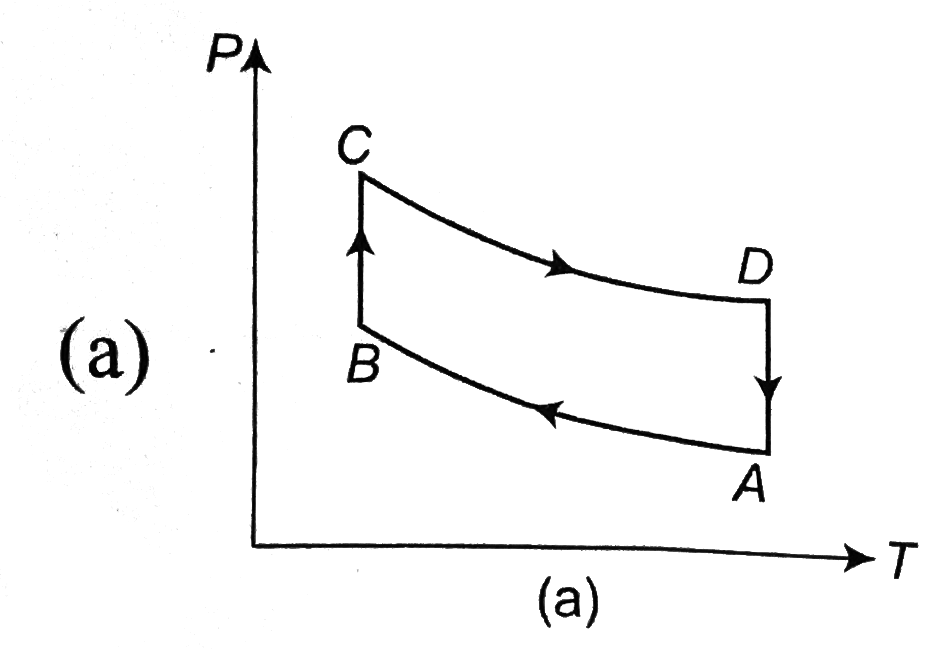
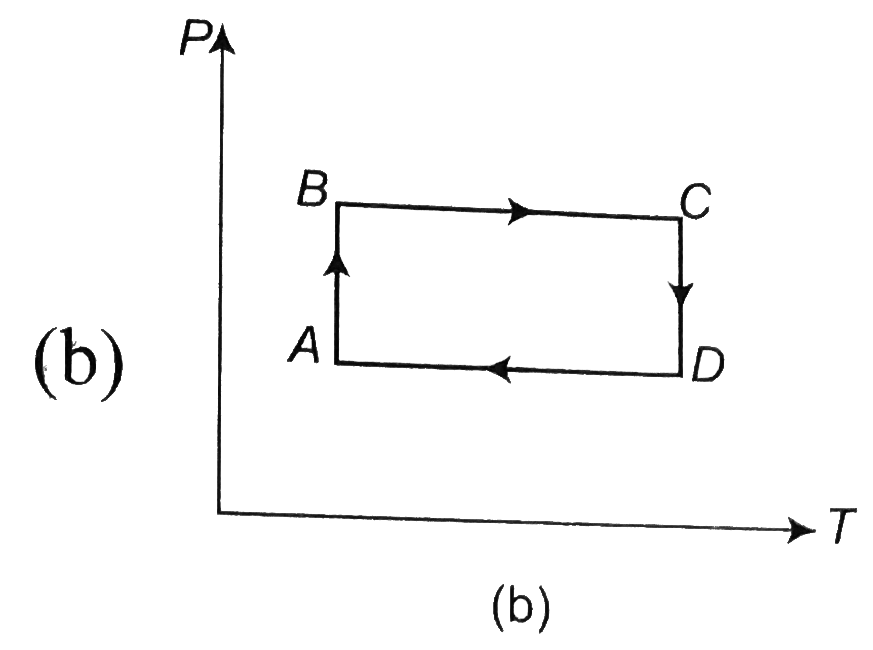
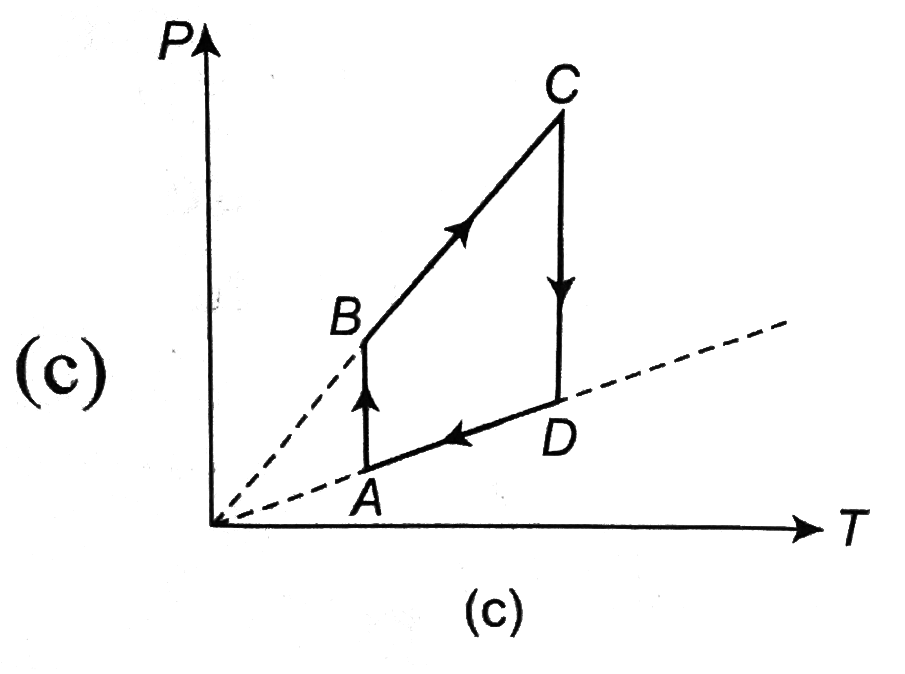
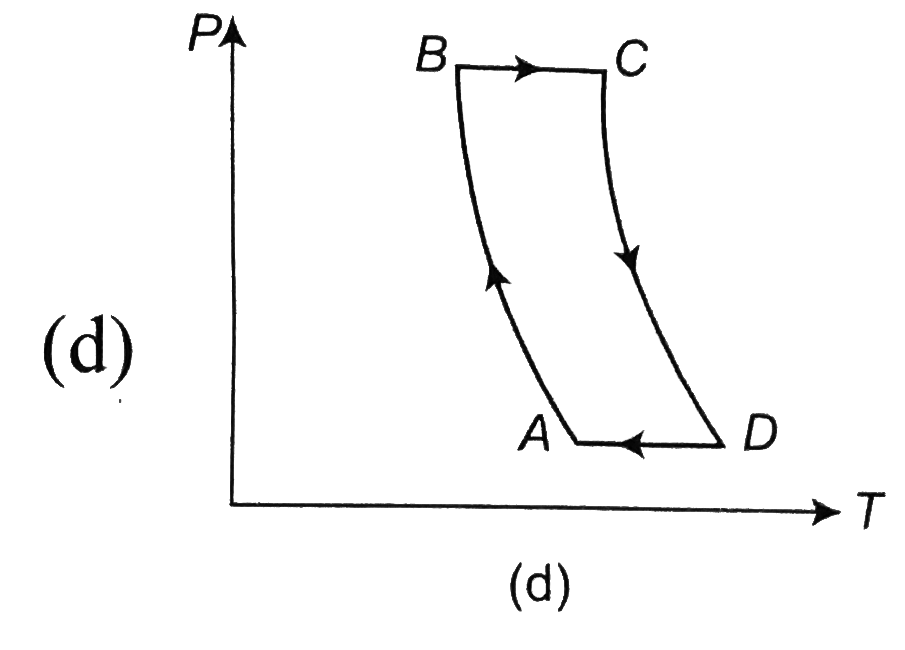
Density vs volume graph is shown in the figure. Find corresponding pressure vs temperature graph |
|
Answer»
(V decrease, `rho` increases) In isothermal PROCESS (`T` = constant), `rho prop 1/V` As `V` decreases, `P` increases. so, the `rho` increase, `V` decrease (`rhoV` CURVE) and `P` increase for `V` decrease (`P-T` curve) Options (B) and (c) may be correct. But process `B-C` is shown by a DOT in `(rho-V)` curve. It means `BC` is a isochoric process. Process `BC` in option (c) is a isochoric process because `P prop T`. |
|