

Saved Bookmarks
This section includes 7 InterviewSolutions, each offering curated multiple-choice questions to sharpen your Current Affairs knowledge and support exam preparation. Choose a topic below to get started.
| 1. |
Two bodies of identical masses with 2^(nd) body at rest collides with 1^(st) body, prove that the velocities of the bodies are reversed. |
|
Answer» Solution :When bodies have the same mass i.e., `m_(1)=m_(2)` and second body (usually called target) is at rest `(u_(2)=0)`, By substituting `m_(1)=m_(2) and u_(2)=0` in equations `v_(1)=((m_(1)-m_(2))/(m_(1)+m_(2)))u_(1)+((2m_(2))/(m_(1)+m_(2)))u_(2)""...(1)` and equations `v_(2)=((2m_(1))/(m_(1)+m_(2)))u_(1)+((m_(2)-m_(1))/(m_(1)+m_(2)))u_(2)," we get...(2)"`, from equations (1) `IMPLIES v_(1)=0` from equations (2) `implies v_(2)=u_(1)` |
|
| 2. |
Two concentricblacksphere'sare maintainedat temperatures200 K and 300 Krespectively. If thespacebetween themis evacuated, calculated the net rateof energytransferred betweenthe twosphere .(sigma = 5.67 xx 10^(-8) W.m^(-2)k^(4)) |
| Answer» SOLUTION :`368.7 W.m^(-2)` | |
| 3. |
A system consisting of two masses connected by a massless rod lies along the x-axis. A 0.4 kg mass is at a distance x = 2 m while a 0.6 kg mass is at a distance r = 7 m. The x-coordinate of the centre of mass is |
|
Answer» 5 m  The x-coordinate of the CENTRE of mass is `X_(CM) = (m_(1) x_(1) + m_(2) x_(2))/(m_(1) + m_(2))= (0.4 XX 2 + 7 xx 0.6)/(0.4 + 0.6) = 5` m |
|
| 4. |
The value of specific heat of water is 1 cal g^(-1) .^@C^(-1) at temperature ………. K. |
| Answer» SOLUTION :288 K | |
| 5. |
If the speed of a vehicle become 3 times for a given deceleration its stopping distance become ..... |
|
Answer» two `PROP v_(0)^(2)` `(d_(2))/(d_(1))= ((v_(0))_(2)^(2))/((v_(0))_(1)^(2)) = (3v_(0))/(v_(0)) = (3)^(2) `= nine |
|
| 6. |
Force constant and surface tension have the same dimensions in |
|
Answer» Mass |
|
| 7. |
The simple pendulum bob is given a horizontal velocity sqrt(gl) at the bottom. The angle with the vertical through which the ball swings before its velocity becomes zero is |
|
Answer» `120^(@)` |
|
| 8. |
From a circular ring of mass M and radius R, an arc corresponding to a 90^(@) sector is removed. The moment of inertia of the remaining part of the ring about an axis passing through the centre of the ring and perpendicular to the plane of the ring is k times MR^2. Then the value of k is |
|
Answer» `3//4`  Moment of inertia of a ring about an axis passing through the CENTRE and PERPENDICULAR to the ring is I= `MR^(2)` MASS of the remaining portion of the ring as SHOWN in figure (ii) is `M- (M)/(4)= (3M)/(4)` Moment of inertia of the remaining portion of the ring about the given axis is `I. = (3)/(4) MR^(2)` But `I. = K MR^(2)` (given) `therefore k = (3)/(4)` |
|
| 9. |
A body is revolving in a vertical circle with constant mechanical energy. The speed of thebody at the highest point is sqrt(2rg). The speed of the body at the lowest point is |
|
Answer» `SQRT(7GR)` |
|
| 10. |
Match the two colums : Column - I indicates a situation & Column - II indicates the fundamental forces in physics {:("Column - I","Column -II"),("A) Force between two protons","P) Gravitational force"),("B) force between two neutrons","Q) electromagnetic force"),("C) force between pen and finger","R) Strong nuclear force"),("D) Tension force in string ","S) Weak nuclear force"):} |
|
Answer» |
|
| 11. |
If emissivity of bodies X and Y are e_(x) and e_(y) and absorptive power are A_(x) and A_(y) then |
|
Answer» `e_(y) gt e_(x)` , `A_(y) gt A_(x)` 
|
|
| 12. |
A man of mass 60 kg is standing on a weighing machine kept in a box of mass 30 kg as shown in the diagram. If the man manages to keep the box stationary, find the reading of the weighing machine. |
|
Answer» Solution :we know that NORMAL REACTION = scale reading `"For MAN, T"=Mg-R` 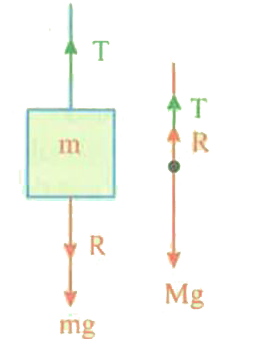 For box : `T=mg+R` `Mg-R=mg+R,""2R=(M-m)g` `R=((60-30)xx10)/(2)=150N` |
|
| 13. |
Three rods each of length L are hinged at their ends to form an equilateral triangle. Two rods are made of identical substance of coefficient of linear expansion alpha while the third rod is of 2alpha. When the system is heated, find the rate of change of area of triangle with temperature? |
|
Answer» |
|
| 14. |
A stone is projected vertically up to reach maximum height h. The ratio of its kinetic energy to its potential energy at a heighth4/5 h, will be |
|
Answer» `5:4` Potential energy = `mg XX (4h)/(5) = 4/5 mgh`,TOTAL energy = mgh `:.` KE at that height = `mgh - 4/5 mgh = 1/5 mgh` `:.` At a height `4/5 h `, the ratio of `(KE)/(PE) = (1/5 mgh)/(4/5 mgh) = 1/4`. |
|
| 15. |
An object A is dropped from rest the top of a 30m high building and at the same moment another object B is projected vertically upwards with an initial speed of 15m//s from the base of the building. Mass of the object A is 2kg while mass of the object B is 4kg. Find the maximum height above the ground level attained by the centre of mass of the A and B system (take g=10m//s^(2)) |
|
Answer» Solution :`m_(1)=4kg`, `m_(2)=2kg` Initially `4kg` is on the ground `:.x_(1)=0` `2kg` is on top of the building `:.x_(2)=30m` `x_(cm)=(m_(1)x_(1)+m_(2)x_(2))/(m_(1)+m_(2))` `=(0+2xx30)/(4+2)=10m` `:.` INITIAL height of CM=`10m` Initial VELOCITY of CM, `u_(cm)=(m_(1)u_(1)+m_(2)u_(2))/(m_(1)+m_(2))` `u_(cm)=(4xx15+0)/(4+2)=10`m/s upward Acceleration of `CM`, `a_(cm)=g=10m//s^(2)` downwards `:.` Maximum height ATTAINED by CM from initial position `h_(cm)=(u_(cm)^(2))/(2g)-(10^(2))/(20)-5m` `:.` Maximum height attained by CM of `4kg` and `2kg` from the ground `=10+5=15m` 
|
|
| 16. |
The average speed of blood in the artery (diameter =2cm) during the resting part of heart.s cycle is about 30 cm s^(-1). Is the flow laminar or turbulent? Density of blood 1.05xx10^(1) Kgm^(-1). Explain your answer eta=2.7xx10^(-3)Pa- Sec |
|
Answer» laminar |
|
| 17. |
A liquid rises to a height of 60 mm capillary tube of diameter 0.04 mm. If the density of that liquid is 0.8xx10^(3)Kgm^(-3), and angle of contact is 20^(@), find the surface tension of that liquid. |
|
Answer» |
|
| 18. |
A boy is sitting on a horizontal platform in the shape of a disc at a distance of 5m from its centre. The boy begins to slip when the speed of wheel exceeds 10 rpm The coefficient of friction between the boy and platform is. |
|
Answer» `pi^2//6` |
|
| 19. |
An ideal gas is taken around the cycle ABCA as shown in P-V diagram. The net work done during the cycle is equal to : |
|
Answer» <P> Solution :`W (1//2) (3V_(1) -V_(1)) xx(4P_(1) -P_(1))=3P_(1) V_(1)` |
|
| 20. |
A bomb falling freely bursts after 10 sec. (g=10ms^(-2))into two fragments of masses in the ratio of 2:1. The velocity of heavier fragment immediately after the explosion is 200 ms^(-1)vertically downwards. The velocity of the lighter fragment immediately after the explosion is |
|
Answer» `50 MS^(-1)` UPWARD |
|
| 22. |
What are the effects of (1) temperature on the angle of contact (2) impurity on the surface tension ? |
| Answer» Solution :ANGLE of contact INCREASES with INCREASE of temperature while SURFACE TENSION generally decreases with increase of temperature. | |
| 23. |
Which fundamental law forms the basis of Bernoullis equation ? |
| Answer» SOLUTION :CONSERVATION of ENERGY . | |
| 24. |
A force time graph for the motion of a body is as shown in figure. Change in linear momentum between 0 and 6s is |
|
Answer» zero `J=Deltap=m(v-u)` |
|
| 25. |
Water is flowing with velocity 4ms^(-1) in a cylinder of diameter 8 cm .It is connectedto a pipe with it end tip of diameter 2cm . Calculate the velocity of water at this free end. |
|
Answer» `4MS^(-1)` `A_(2)=pir_(2)^(2)=pixx10^(-4)m^(2)` Now USING equation , `A_(1)v_(1)=A_(2)v_(2)` `v_(2)=(A_(1)v_(1))/(A_(2))=(16pixx10^(-4)xx4)/(pixx10^(-4))=64ms^(-1)` Hence the velocity of water at free end is `v_(2)=64ms^(-1)` |
|
| 26. |
A cylinder of mass 5kg and radius 30cm, and free to rotate about its axis, receives an angular impulse of 3kg m^(2)s^(-1) initially followed by a similar impulse after every 4s. What is the angular speed of the cylinder 30s after the initial impulse? The cylinder is at rest initially. |
| Answer» SOLUTION :106.7 rad.sec | |
| 27. |
A billiard table whose length and width are as shown in the figure. A ball is placed at point A. at what angle theta the ball be projected so that after colliding with two walls, the ball will fall in the pocket B? assume that all collisions are perfectly elastic: (neglect friction) |
|
Answer» |
|
| 28. |
To slide a block up a rough plane of inclination 30^(@) with the horizontal the minimum force required is five times that required to slide the block down the plane. Both forces act parallel to the plane. What is the coefficient of friction between the block and the plane? |
|
Answer» |
|
| 29. |
The focal lengths of the objective and the eyepiece of a compound microscope are 2.0cm and 3.0 cm respectively. The distance between the objective and the eyepiece is 15.0cm. The final image formed by the eyepiece is at infinity. Find the distance of object and image produced by the objective, from the objective lens. |
|
Answer» SOLUTION :As final image is at infinity, the distance of intermediate image from EYE lens `u_E` will be GIVEN by `1/(-infty)-1/u_e=1/f_e` i.e., `u_e=-f_e=-3cm` and as the distance between the lenses is 15.0cm the distance of intermediate image (formed by objective) from the objective will be `v=L-u_e=L-f_e=15-3=12cm` and if u is the distance of OBJECT from objective. `1/12-1/u=1/2` i.e., `u=-2.4c` So object is at a distance of 2.4cm in front of objective. |
|
| 30. |
A ball of mass 0.12kg is being whirled in a horizontal circle at the end of string 0.5 m long. It is capable of making 231 revolutions in one minute. The breaking tension of the string is |
|
Answer» 3N |
|
| 31. |
Height of the body from the ground can be calculated by using the formula h=-ut+(1//2)gt^(2) in (a) A body projected vertically with velocity in .t. sec. (b) A body dropped from a ballon moving up with uniform velocity, reahces the ground in .t. sec. (c) A body dropped from a helicopter moving upwith uniform velocity, reaches the ground in .t. sec. (d) A body projected vertically from the ground reaches the ground in .t. sec. |
|
Answer» a, B and C are correct |
|
| 32. |
A glass rod of radius 1.0 mm is inserted symmetrically into a vertical capillary tube of radius 2.0 mm such that their lower ends are at the same level. The arrangement is now dipped in water. The height to which the water rises in the capillary tube is ( T= 75 xx 10^(-3) "N/m") |
|
Answer» 5 mm |
|
| 33. |
A solid uniform ball of volume V floats on the interface of two immiscible liquids. The specific gravity of the upper liquid is rho_(1) and that of lower one is rho_(2) and the specific gravity of ball is rho(rho_(1) lt rho lt rho_(2)). The fraction of the ball in the upper liquid Is |
|
Answer» `(rho_(2))/(rho_(1))` |
|
| 34. |
A man walking briskly in rain with speed v must slant his umbrella forward making an angle theta with the vertical. A student derives the following relation between theta and v as tan theta=v and checks that therelation has a correct limit when vto0,thetato0 as expected. Do you think the relation can be correct? If not guess out the correct relation. |
|
Answer» |
|
| 35. |
The ratio of the radii of gyration of a circular disc about a tangential axis in the plane of the disc and of a circular ring of the same radius about a tangential axis in the plane of the ring is …………. |
|
Answer» `1:sqrt(2)`  Moment of inertia about `y_(1)` `I_(y_(1))=(MR^(2))/(4)` According to parallel AXIS theorem, Moment of inertia about `y._(1)` `IY._(1)=(MR^(2))/(4)+MR^(2)` `therefore Iy._(1)=(5)/(4)MR^(2)` ALSO `Iy._(1)=Mk_(1)^(2)` Circular ring :  `Iy_(2)=(MR^(2))/(2)` According to parallel axis, Moment of inertia about `y._(2)` `Iy._(2)=(MR^(2))/(2)+MR^(2)` `therefore Iy._(2)=(3)/(2)MR^(2)` also `Iy._(2)=Mk_(2)^(2)` `therefore (k_(1)^(2))/(k_(2)^(2))=(I_(y._(1)))/(I_(y._(2)))=((5)/(4)MR^(2))/((3)/(2)MR^(2))` `therefore (k_(1)^(2))/(k_(2)^(2))=(5)/(6)` `therefore k_(1):k_(2)=sqrt(5):sqrt(6)` |
|
| 36. |
The value of g on the Earth surface is980 "cm/sec"^(2) Its value at a height of 64 km from the Earth surface is ............ "cms"^(-2) |
|
Answer» 960.4 |
|
| 37. |
Analogue of mass in rotational motion is |
|
Answer» gyration |
|
| 38. |
A gas is allowed to expand isothermally.The root mean square velocity of the molecules |
|
Answer» Will increase |
|
| 39. |
A small block of mass M move with velocity 5m/s towards another block of same mass M placed at a distance of 2m on a rough horizontal surface. Coefficient of friction between the blocks and ground is 0.25. Collision between the two blocks is elastic, the separation between the blocks, when both of them come to rest, is (g= 10 m//s^(2)) |
|
Answer» SOLUTION :Retardation due to FRICTION `= mu g= (0.25) (10) = 2.5M//s^(2)` Collision is elastic, i.e., after collision first BLOCK comes to rest and the second block acquires the velocity of first block. Or we can understand it in this manner that second block is PERMANENTLY at rest while only the first block moves. Distance travelled by it will be `s= (v^(2))/(2a)= ((5)^(2))/((2)(2.5))= 5m` `therefore` Final separaton will be `(5-2)= 3m` |
|
| 40. |
Two bodies A and B whose masses are in the ratio 1:2 are suspended from two separate massless springs of force constants k_(A) and k_(B) respectively. If the two bodies oscillate vertically such that their maximum velocities are in the ratio 1:2 the ratio of the amplitude A to that of B is : |
|
Answer» `SQRT((k_(B))/(2k_(A)))` AMPLITUDE of A : Amplitude of `B=sqrt(K_(B)), sqrt(8K_(A))` |
|
| 41. |
M grams of steam at 100^(@)C is mixed with 200g of ice at its melting point ina thermally insulated container. If it produces liquid water at 40^(@)C [heat of vaporization of water is 540cal/g and heat of fusion of ice is 80 cal/gl, the value of M is |
|
Answer» 30 mass of steam= m temperature of ice `T= 0^(@)C` temperature of steam `T= 100^(@)C` `ML_(f) + M(T. -T) C_(W) = mL_(v) + m(T.. - T.) C_(w)` `:. 200 XX 80 + 200 (40-0)1 = m xx 540 + m(100-40)(1)` `16000+ 8000= 540 m + 60m` `:. 24000= 600m` `:.m= (24000)/(600)= 40gm` |
|
| 42. |
A vehicle of mass m is moving on a rough horizontal road with momentum P. If the co-efficient of friction between the tyres and the road be mu, then the stopping distance is, |
|
Answer» <P>`(p)/(2MU mg)` |
|
| 43. |
A uniform disc of radius R is put over another uniform disc of radius 2R of same thickness and density. The peripheres of the two disc touch eachother. The position of their centre of mass is |
|
Answer» at `(R )/(3)` from the centre of the bigger disc towards the centre of the SMALLER disc |
|
| 44. |
A satellite is seen every 6 hours over the equator. It is known that it rotates opposite to that of earth.s direction. Then the angular velocity (in radian per hour) of satellite about the centre of earth will be |
|
Answer» `pi//2` |
|
| 45. |
When a listener approaches a source of sound , the sound appears to be ______ to the listener. [Fill in the blank ] |
|
Answer» |
|
| 46. |
A tall cylinder is filled with viscous oil. A round pebble is dropped from the top with zero initial velocity. From the plots shown, indicate the one that represents the velocity (v) of the pebble as a function of time (t). |
|
Answer»
|
|
| 47. |
A tall cylinder is filled with viscous oil. A round pebble is dropped from the top with zero initial velocity. From the plot shown in Fig. indicate the one that represents the velocity (v) of the pebble as a function of time (t). |
|
Answer»
|
|
| 48. |
The object at rest suddenly explodes into three parts with the mass ratio 2:1:1. The parts of other with equal speed 'v' the speed of the third part after explosion will be . |
|
Answer» `v` |
|
| 49. |
Two points are located at a distance of 10 m and 15 m from the source of wave. The period of oscillation is 0.05 sec and the velocity of the wave is 300 m/sec. What is the phase difference between the oscillations at two points ?. |
|
Answer» `pi/3` `therefore lamda = v T = (300) (0.05) = 15 m` Phase difference between two PARTICLES separted by distance `Delta X` is, `DELTAPHI = (2pi)/(lamda) Delta x` `= (2pi)/(15) (15-10)` `= (2pi)/(3) rad ` |
|
| 50. |
Two identical thin rods are moving on a smooth table, as shown. Both of them are rotating with angular speed omega, in clockwise sense about their centres. Their centres have velocity V in opposite directions. The rods collide at their edge and stick together. Length of each rod is L. (a) For what value of (V)/(omega L) there will be no motion after collision ? (b) If the ratio (V)/(omega L) is half the value found in (a) above, what fraction of kinetic energy is lost in the collision? |
|
Answer» (b) `(49)/(52)` |
|


