

Saved Bookmarks
This section includes 7 InterviewSolutions, each offering curated multiple-choice questions to sharpen your Current Affairs knowledge and support exam preparation. Choose a topic below to get started.
| 1. |
A glass rod when measured using a metal scale at 30^(@)C appears to be of length 100 cm. It is known that the scale was calibrated at 0^(@)C. Find true length of the glass rod at (a) 30^(@)C "" (b) 0^(@)C alpha_("steel")=8xx10^(-6).^(@)C^(-1) and alpha_("Metal")=26xx10^(-6).^(@)C^(-1) |
|
Answer» |
|
| 2. |
The time period of simple pendulum is T. When the length increases by 10 cm, its period is T_1. When the length is decreased by 10 cm, its period is T. Then the relation between T, T_1 and T_2 is |
|
Answer» `2/(T^2) = 1/(T_1^2) + 1/(T_2^2)` |
|
| 3. |
Heat absorbed by a metallic body is in the form of |
|
Answer» kinetic ENERGY of its molecules |
|
| 4. |
Rate of decrease of velocity of an object moving with 6.25m//s is (dv)/(dr) =-2.5 sqrtv.Where v is instantaneous speed. Time taken by object to come to rest is ............. |
|
Answer» 1s `therefore (dv)/(sqrtv)=-2.5 dt` `therefore INT _(6.25 ) ^(0) (dv)/(sqrtv) =-2.5 int _(0) ^(t) dt` `therefore [-2 sqrtv]_(6.25) ^(0)=-2.5t` ` therefore -2 XX SQRT (6.25) =-2.5 t` `therefore -2 xx 2.5 =-2.5t` `therefore t =2` SECOND |
|
| 5. |
One mole of an ideal monotomic gas undergoes a linear process from A to B in which its pressure p and its volume V change as shown in figure. The absolute temperature T versus volume V for the given process is |
|
Answer»
|
|
| 6. |
The area of the triangle having two sides vec(A)=hat(i)-2hat(j)-2hat(k)andvec(B)=2hat(i)+2hat(j)+3hat(k) is s |
|
Answer» `sqrt45 sq.unit` |
|
| 7. |
A body of mass 0.1kg released from a height of 50m reaches the ground with a velocity of 10ms^(-1) . The work done against air resistance is (g=10 ms^(-2)) |
| Answer» ANSWER :D | |
| 8. |
Teflon is coated on the surface of non-stick pans. Why? |
| Answer» SOLUTION :TEFLON coating makes the angle of contact between the pan and the OIL OBTUSE. THUS the frying pan becomes non-stickey. | |
| 9. |
If the earth was to suddenly contract to half its present size, without any change in its mass, then what will be the duration of the new days (in hours)? |
|
Answer» |
|
| 10. |
Which of the following functions of time represent (a) periodic and (b) non periodic motion? Give the period for each case of periodic motion [omega is any positive constant]. i) sinomegat+cosomegat ii) sinomegat+cos 2omegat+sin 4 omegat iii) e^(-2omegat) (iv) log(omegat) |
|
Answer» Solution :i) ` sinomegat+cosomegat` is a periodic function. It can also be written as `sqrt(2)sin(omegat+pi//4)` The periodic time of the function is `2pi//omega` ii) This is an example of a periodic motion. It can be noted that each term represents a periodic function with a different ANGULAR frequency. Since PERIOD is the least interval of time after which a function repeats its VALUE, `sin omegat` has a period `T_(0) = 2pi//omega: cos 2omegat`has a period `pi//omega= T_(0)//2`and `sin 4omegat` has a period `2pi//4omega = T_(0)//4`. The period of the first term is a multiple of the periods of the last two terms. Therefore, the smallest interval of time after which the sum of the three terms repeats is `T_(0)` and thus the sum is a periodic function with a period `2pi//omega`. iii) The function `E^(-omegat)`is not periodic, it decreases monotonically with increasing time and tends to zero as t tens to `prop` and thus, never repeats its value. IV) The function `log(omegat)` increase monotonically with time t. It, therefore, never repeats its value and is a non periodic function. It may be noted that as t tens to `prop log(omegat)` diverges to `prop`, it, therefore, cannot represent any kind of physical displacement. |
|
| 11. |
In the absence of intermolecular force of attraction, the observed pressure P will be |
| Answer» Answer :C | |
| 12. |
The energy required to shift a satellite from orbital radius .r. to radius 2r is E. What energy will be required to shift the satellite from orbital radius 2r to 3r? |
|
Answer» E |
|
| 13. |
A stone falls freely under gravity. It covers distances h_(1), h_(2) and h_(3) in the first 5 seconds, the next 5 seconds and the next 5 seconds respectively. The relation between h_(1), h_(2) and h_(3) is |
|
Answer» `h_(1) =h_(2) =h_(3)` `h = 1/2 g t^(2) (because v _(0) =0)` Now, `h _(1) = 1/2 g (5) ^(2)` `=1/2 (25G)""…(1)` `h _(1) + h_(2) =1/2 g(10) ^(2)` `=1/2 (100g)` `therefore h _(2) = 1/2 (100 g ) - 1/2 (25g)` `=1/2 (75g) =3 [1/2 (25g)]` `= 3h _(1) ""...(2)` `h _(1) + h _(2) + h_(3) = 1/2 g (15) ^(2)` `= 1/2 g (225)` `therefore h _(3) = 1/2 (225g) -1/2 (75g) -1/2 (25g)` `=1/2 (125g)` `= 5 [1/2 (25g)]` `= 5 h_(3) ""...(3)` |
|
| 14. |
A satellite can be in a geostationary orbit around earth in an orbit of radius r. IF the angular velocity of earth about its axis doubles, a satellites can now be in a geostationary orbit around earth of radius is (r )/((x)^(1//3)). Find the value of x |
|
Answer» |
|
| 15. |
Suppose a man stands at a distance from a cliff and claps his hands . He receives an echo from the cliff after 4 second . Calculate the distance between the man and the cliff . Assume the speed of sound to be 343 m s^(-1) |
|
Answer» Solution :The time taken by the SOUND to come back as echo is `2t = 4 IMPLIES t = 2S ` `therefore` The distance is d = vt (`343 m s^(-1)) (2s)` = 686 m |
|
| 16. |
Mention the factors which determine whether a planet would have an atmosphere or not. |
|
Answer» SOLUTION :The two such factors are:(i) The acceleration due to GRAVITY on the PLANET. (ii) SURFACE temperature of the planet. |
|
| 17. |
State the factors on which the coefficients of expansion of a liquid depend. |
|
Answer» Solution :The coefficient of real EXPANSION of a liquid depends on the NATURE of the liquid only. But, the coefficient of APPARENT expansion depends on the nature of the liquid, and also on the coefficient of VOLUME expansion of the material of its container. |
|
| 18. |
A glass U-tube is such that the diameter of one limb is 3.0 mm and that of the other is 6.00mm. The tube is inverted with the open ends below the surface of water in a beaker. What is the difference between the heightto which water rises in the two limbs? Surface tension of water is 0.07N/m. Assume that the angle of contact between water and glass is 0^(@). |
|
Answer» Solution :LET `P_(A)andP_(B)` are the pressure at points A and B respectively. The pressure at point C. `P_(C)=P_(A)-(2S)/(R_(1))` Where `R_(1)=(r_(1))/(COS0^(@))=r` The pressure at point D. `P_(D)=P_(B)-(2S)/(R_(2))` where, `R_(2)=(r_(2))/(cos0^(@))=r_(2)` If .h. is the difference between heights rise in two limbs, then `P_(D)-P_(C )=hrhog` or `(P_(B)-(2S)/(R_(2)))-(P_(A)-(2S)/(R_(1)))=hrhog` As `P_(A)=P_(B)andR_(1)=r_(1)=1.5mm`, `R_(2)=r_(2)=3.0mm`, so `2S((1)/(r_(1))-(1)/(r_(2)))=hrhog` `0.2xx0.07((1)/(1.5xx10^(-3))-(1)/(3xx10^(-3)))` `=hxx1000xx9.8` After solving, we get `h=4.76xx10^(-3)m` |
|
| 19. |
In a given process on an ideal gas, dW=0 and dQ lt 0 . Then for the gas |
|
Answer» The TEMPERATURE DECREASES |
|
| 20. |
A bullet fired at an angle of 30^(@) with the horizontal hits the ground 3 km away. By adjusting the angle of projection, can one hope to hit the target 5 km away? Assume that the muzzle speed to be fixed and neglect air resistance. |
| Answer» SOLUTION :MAXIMUM RANGE - 3.46 KM So it is not POSSIBLE. | |
| 21. |
The period T_0 for a planet of mass 'm' above the sum in a circular orbit of radius R depends on m,R and G where G is the gravitational constant. Find expression for time period by dimensional methods. |
|
Answer» SOLUTION :`T_(0)PROP m^(a)R^(b)g^©,mrarrM, R rarrL, Grarr M^(-1)L^(3)T^(-2), T_(0)rarrT :. T^(1) = K(M)^(a)(L)^(b)(m^(-1)L^(3)T^(-(2))^(C) )` comparing powers of M,L and T on either sides `a-c=0`….(1) `b=3c=0…(2) `2c=1rArr c=-1/2` `:. B=3/2and a=-1/2:. T_(0)=Km^(1/2)R^(3/2)G^(-1/2), T_(0)=KsqrtR^(3)/(GM)` |
|
| 22. |
Two point masses m and 2m initially at rest are at separation R apart and due to the mutual gravitational force they come togther and collide elastically and then separates and the process continues. The time period of the resulting oscillations is pisqrt((R)/(xg)), the value of x is__________(Take g = (Gm)/(R^(2))) |
Answer»  keep a mass `M`' at the centre of mass for `2m` such that `(GM'(2m))/((R//3)^(2)) = (G(2m)m)/((R )^(2)) rArr M' = (m)/(9)` `rArr (2PI (R//3))/(sqrt((GM')/((R//3))))` `rArr T = (2pi)/(sqrt(GM')) ((R )/(3))^(3//2)` `T' = (2)/(4sqrt(2)) = (2pi)/(sqrt((GM)/(9))) = (R^(3//2))/(sqrt(27))` `T' = (4piRsqrt(R))/(4sqrt(6)sqrt(gR^(2))) = (PI)/(sqrt(6)) sqrt((R )/(g))` |
|
| 23. |
A ray reflected successively from two plane mirrors inclined at a certain angle undergoes a deviation of 240^@. The number of observable images is |
|
Answer» 60 |
|
| 24. |
The horizontal component of the weight of a body of mass m is |
| Answer» Answer :C | |
| 25. |
A helicopter files horizontally with constant velocity in a direction theta east of north between two points A and B, at distance d apart. Wind is blowing from south with constant speed u , the speed of helicopter relative to air is nu where n gt 1. find the speed of the helicopter along AB. The helicopter returns from B to A with same speed nu relative to air in same wind. Find the total time for the journeys. . |
|
Answer» Solution :Velocity of helicopter w.r.t. groundn is given by `vec V_(Helicopter, air) = vec V_(Helicopter,air) + vec V _(Air) = vec V_(Air) + vec V_(Helicopter, air)` `|vec V_(H A)| = n u, |vec V_A| = u, |vec V_H| = V` Hence, the actual velocity of helicopter is the vector sum of its velocity of helicopter relative to air and velocity of air. Using cosine rule, for motion from `A to B`, `n^2 u^2 = u^2 + v^2 - 2 u v COS THETA` or `v^2 - 2 u v cos theta = u^2 (n^2 - 1)` or `(v - u cos theta)^2 = u^2 (n^2 - 1) + u^2 cos^2 theta` =`u^2 (n^2 - sin^2 theta)` `v - u cos theta = +- u sqrt(n^2 - sin^2 theta)` `v = u cos theta +- u sqrt(n^2 - sin^2 theta)` As `n ge 1`, `n^2 - sin^2 theta ge 1 - sin^2 theta ge cos^2 theta` Hence, speed of helicoper is `v = u cos theta + u sqrt(n^2 - sin^2 theta))` Now we consider motion from `B` to `A`. Similar to first case, the helicopter will return to `A along BA` when its velocity after being deflected by wind is along `BA`. Once again using consine rule inthe vector TRIANGLE, we get `n^2 u^2 = u^2 + V^2 - 2u V cos (180^@ - theta)` =`u^2 + V^2 + 2u V cos theta` `V = -u cos theta + u sqrt(n^2 - sin^2 theta)` The TOTAL time for motion `A` to `B` and `B` to `A`, `t = (d)/(v) + (d)/(V)` =`(d (u + V))/( uV)` =`(2 d usqrt(n^2 - sin^2 theta))/(u^2 (n^2 - sin^2 theta) - u^2 cos^2 theta)` =`(2 d usqrt(n^2 - sin^2 theta))/(u^2 (n^2 - 1)) = (2 dsqrt(n^2 - sin^2 theta))/(u(n^2 - 1))`. 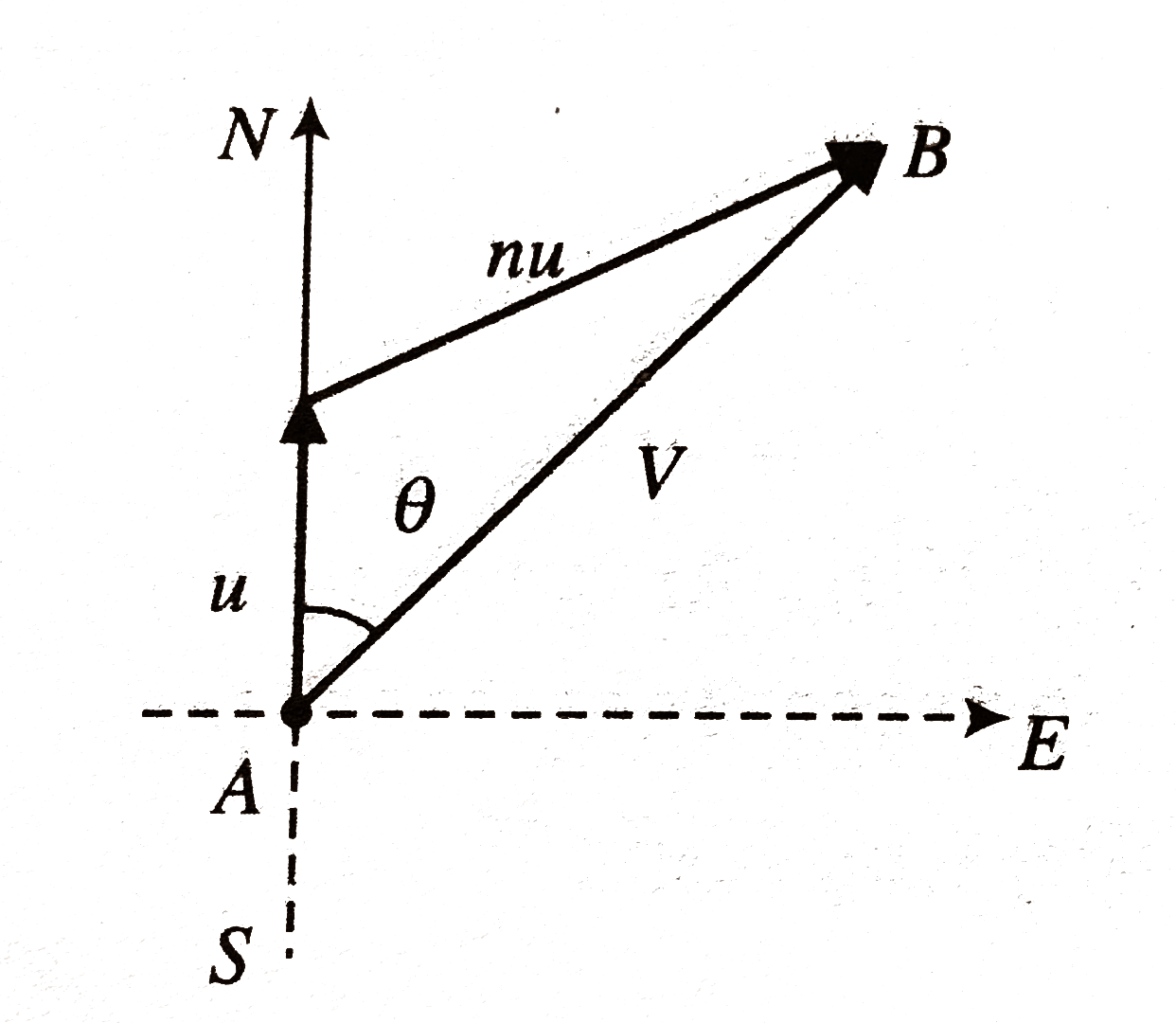 , 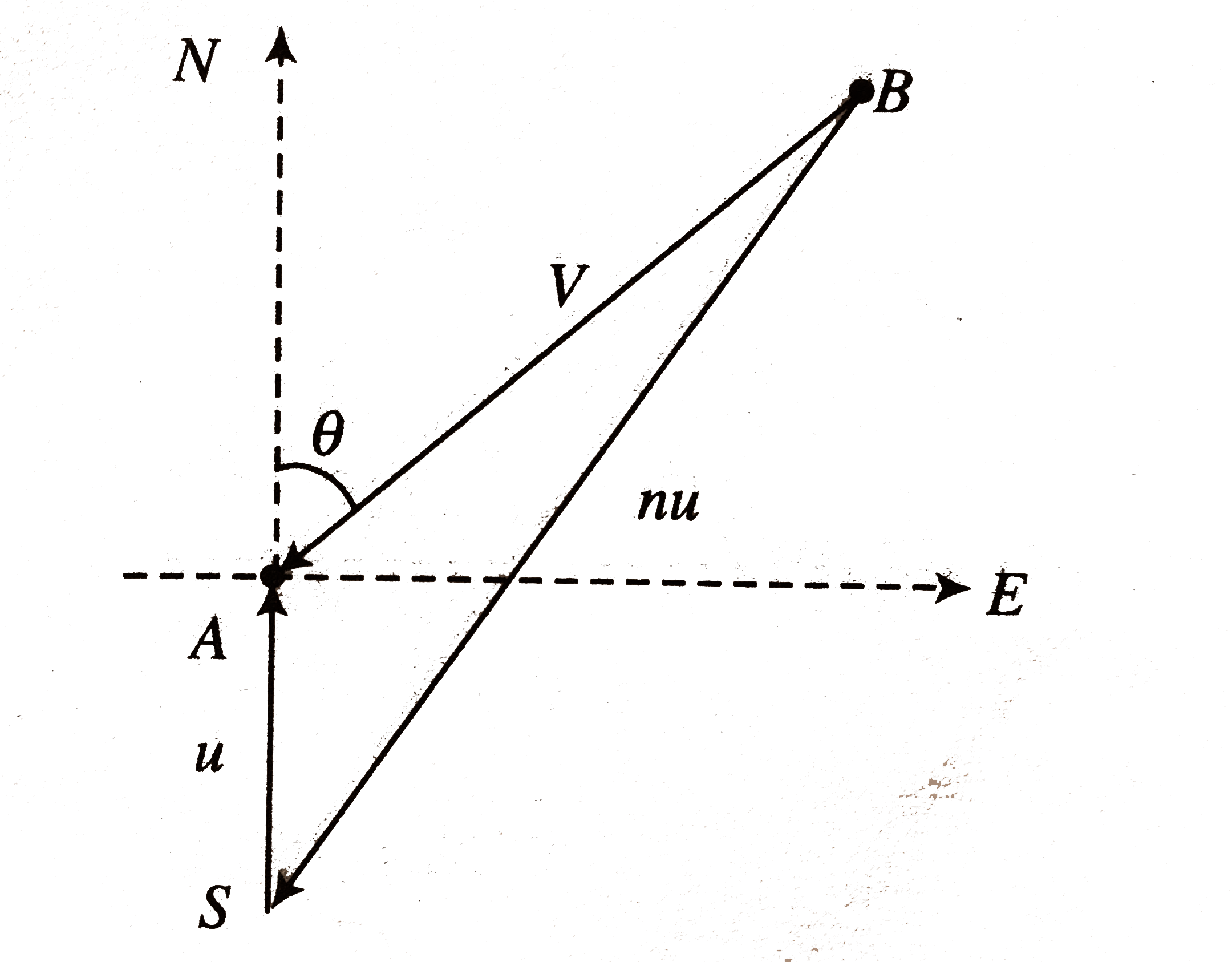 . |
|
| 26. |
On which conservationprinciple is Bernoulli's theorem established ? |
| Answer» SOLUTION :PRINCIPLE of CONSERVATION of ENERGY | |
| 27. |
A shell of mass 0.001 kg is fired by a gun of mass 10 kg. If the muzzle speed of the shell is 50 ms^(-1), what is the recoil speed of the gun ? |
|
Answer» |
|
| 28. |
To what height should a cylindrical vessel be filled with a homogeneous liquid to make the force with which the liquid presses on the side of the vessel equal to the force exerted by the liquid on the bottom of the vessel? |
|
Answer» EQUAL to the RADIUS |
|
| 29. |
(A): For an ideal gas, at constant temperature, the product of the pressure and volume is a constant. (R): The mean square velocity of the molecules is inversely proportional to mass. |
|
Answer» Both (A) and ( R) are true and (R ) is the CORRECT EXPLANATION of (A) |
|
| 30. |
The radius of circular orbits of two satellites A and B of the earth, are 4R and R, respectively. If the speed of satellite A ais 3V, then the speed of satellite B will be : |
|
Answer» 3V/4 |
|
| 31. |
Find the number of possible natural oscillations of air column in a pipe whose frequencies lie below f_(0) = 1250 Hz. The length of the pipe is l = 85 cm. The velocity of sound is v = 340 m//s. Consider two cases the pipe is opened from both ends. |
|
Answer» `3` Fundamental frequency `= (V)/( 2 l) = (340)/(2 xx 85) xx 100 = 200 Hz` Frequency of the other natural modes of oscillational are : `2 nd` harmonic frequency ` = 2 xx 200 = 400 Hz ` `3 rd` harmonic frequency ` = 3 xx 200 = 600 Hz` `4 TH` harmonic frequency ` = 4 xx 200 = 800 Hz` `5 th` harmonic frequency ` = 6 xx 200 = 1200 Hz` `7 th` harmonic frequency`= 7 xx 200 = 1400 Hz` You have to count only those harmonics whose frequencies are below `1250 Hz`. All the harmonics till `6 th` harmonic are possible , and obviously they are six in number . Second Method Fundamental frequency ` = 200 Hz` ` = n xx` fundamental frequency `= n xx 200``[ n is 1 , 2, ....]` Maximum value of `n = [ 12.50 //200] = 6 ([x]` REPRESENTS greatest less than or equal to `x` ). Now `n` is ALSO equal to the number of harmonic for which frequency is being calculated , highest harmonic possible ` = 6 th`. A all harmonics are possible in case of open tube , harmonics possible are `1 st , 2 nd , 3 rd , 4 th, 5 th , 6 th. ` Number of harmonics possible in this case `= 6`. |
|
| 32. |
The slope of graph v tot represents ...... |
|
Answer» VELOCITY |
|
| 33. |
What is friction ? Explain static frictional force is caused due to roughness of force at microscopic level. |
|
Answer» Solution :Wheneverthereis relativemotionbetweentwosurfacethe forcedue to L whichrelativemotionis retarded is calledfrictionalforce. Asshownin figureanobjectis placedon HORIZONTALSURFACE  Weightandnormalforcebalanceeach other LethorizonatalforceforceF isappliedto OBJECT `mu_(s )` is unitlessanddimensionlessRatioofmaximum staticfrictionand normalforceiscalledco -efficientof staticfrcition. Itsvalueis inrangeof 0.01to 1.5 ifobjectdoesnotmovethan`f_(s)gt mu_(s )N.` |
|
| 34. |
An object falls from a bridge which is 45 m above the water. It falls directly into a small row - boat moving with constant velocity that was 12m from the point of impact when the object was released. What was the speed of the boat ? |
|
Answer» Solution :VELOCITY of BOAT `=V=s/t,` Here s=12 m t=time FO fall of object from BRIDGE `=sqrt((2h)/(g)) =sqrt((2 xx45)/(10))=3s` `V=(12)/(3)=4ms^(-1)` |
|
| 35. |
Read the following statements and choose the correct answer. a) For a freely falling body the average velocity is proportional to square root of height of fall. b) For a freely falling body the displacements in successive equal time intervals are in the ratio 1:4:9: ...... c) For a vertically projected body the displacement during last second of time of flight changes with velocity of projection. d) For a body projected from the top of the tower the displacement of the body is negative when the body crosses the point of projection. |
|
Answer» a, c, d are true |
|
| 36. |
The gravitational force between two bodies is F. IF the mass of each body is doubled and the distance between them is halved, then the force between them will be |
| Answer» Answer :C | |
| 37. |
A vessel of volume V = 30l is separated into three equal parts by stationary semipermeable thin partitions. The left, middle and right parts are filled with m_(H_2) = 30g of hydrogen, m_(O_2), = 160g of oxygen, and m_(N_(2 )=70g) of nitrogen respectively. The left partition lets through only hydrogen, while the right partition lets through hydrogen and nitrogen both. What will be the pressure in each part of the vessel after the equilibrium has been set in if the vessel is kept at a constant temperature T = 300 K ? |
| Answer» SOLUTION :`P_1=1.3 XX 10^9 PA. p_2 =4.5 xx 10^9Pa, P_3 =2.0xx 10^(9) Pa` | |
| 38. |
A container of liquid is free fall without flyout of liquid is this container obay the principle of Archimedes ? |
| Answer» SOLUTION :No , for FREELY fall CONTAINER the resultant acceleration of gravity is ZERO and hence buoyantforce `m_(o)g` becomes zero . | |
| 39. |
The time period of a mass loaded spring is 'T'. If 20% of its turns are cut and removed, the same mass is attached to the remaining spring would oscillate with a time period of |
|
Answer» `(5T)/(4)` |
|
| 40. |
A 75kg man stands in a lift. What force does the floor exert on him when the elevator starts moving upward with an acceleration of 2 ms^(-2) Given: g = 10 ms^(-2). |
|
Answer» Solution :R-mg =ma , R= mg + ma = m(g+a) `=75(10 + 2) N = 900N` ` =(900)/(10)` kg wt. = 90 kg. wt |
|
| 41. |
Two light strings of length 4cm and 3cm are tied to a bob of weight 500gm. The free ends of the strings are tied to pegs in the same horizontal line and separated by 5cm. The ratio of tension in the longer string to that in the shorter string is |
|
Answer» 4:3 |
|
| 42. |
A particle of mass 'm' is attached to one end of a string of length 'l' while the other end is fixed to a point 'h' above the horizontal table, the particle is made to revolve in a circle on the table, so as to make P revolution per sec. The maximum value of P if the particle is to be contact with the table is |
|
Answer» `2pisqrt(gh)` |
|
| 43. |
A particle moves along a horizontal circle with constant speed. If .a. is its acceleration and .E. is its kinetic energy. (A) a is constant B) E is constant C) a is variable D) Eis variable |
|
Answer» A and B are CORRECT |
|
| 44. |
An air bubble doubles in radius on rising from the bottom of a lake to its surface. If the atmospheric pressure is equal to that of a column of water of height H, the depth of lake is |
|
Answer» (a) H |
|
| 45. |
A one mole of an an ideal gas expands adiabatically at constant pressure such that its temperature T prop (1)/(sqrt(V)). |
|
Answer» 1.3 But `P = (RT)/(V) :. ((RT)/(V))V^(gamma)` = constant `TV^(gamma - 1)` = constant or `T prop V^(1- gamma)` As `T prop (1)/(sqrt(V)) :. 1 - gamma = - (1)/(2)` or `gamma = 1 + (1)/(2) = (3)/(2) = 1.5` |
|
| 46. |
A tunning fork of frequency 340 Hz is vibrated just above a cylindrical tube. The length of the tube is L = 120 cm. Water is slowly poured into the tube. Determine the minimum height of water required for resonance. ( Take velocity of sound in airv = 340 m//s) |
|
Answer» Solution :Here , the tunning fork vibrates in resonance with the air column in the pipe closed at ONE end . The resonant frequency of the air column is GIVEN by ` f = (nv)/( 4l) where n = 1 , 2 , 3 , …` The length of the air column is given by ` l = (nv)/( 4f) = ( n (340))/( 4(340)) = 0.25 nm = 25 ncm` ` l = 25 cm , 75 cm , 125 cm ` Since the length of the tube is `120 cm`, THEREFORE , the POSSIBLE lengths of air column are ` l= 25 cm ` or ` l = 75 cm` If `h` is the height of water filled in the tube , then ` l + h = 120 cm` ` h = 120 - l` For minimum value of `h , l` is maximum , thus `h_(min) = 120 - l_(max) = 120 - 75 = 45 cm` |
|
| 47. |
State whether pressure applied on any part of a confined liquid is transmitted instantaneously to different parts of the liquid. Also state whether Pascal's law is applicable. |
| Answer» Solution :The pressure APPLIED on any part of a confined liquid does not reach different points of the liquid at once. The applied pressure is transmitted through compression and rarefaction within the liquid, and hence, with the VELOCITY of sound. During the transmission of pressure, Pascal.s LAW is inapplicable. Pascal.s law is VALID once the system comes to an equilibrium. | |
| 48. |
A piston of cross-section area 100 cm is used in a hydraulic press to exert a force of 10^(7) dynes on the water. The cross-sectional area of the other piston which supports an object having a mass 2000kg |
|
Answer» `100 cm^(2)` |
|
| 49. |
A large horizontal surface moves up and down in SHM with an amplitude of 1 cm. If a mass of 10 kg which is placed on the surface is to remain continually in contact with it, the maximum frequency of SHM will be………. |
|
Answer» `0.5 Hz` `therefore A omega^(2) = g` `therefore 4pi^(2) f^(2) = (g)/(A)` `therefore f^(2)= (g)/(4pi^(2)A)` `therefore f^(2)= (10)/(4(3.14)^(2)XX 0.01)` `therefore f^(2)= 25.36` `therefore f= 5.036 Hz` `therefore f approx 5 Hz`. |
|
| 50. |
The position of the centre of mass of a cube of uniform mass density will be at |
|
Answer» the centre of one face |
|


`</p>Answer :C)