

Saved Bookmarks
This section includes 7 InterviewSolutions, each offering curated multiple-choice questions to sharpen your Current Affairs knowledge and support exam preparation. Choose a topic below to get started.
| 1. |
Three moles of an ideal gas kept at a constant temperature of 300K are compressed from the volume of 10 litre to 5 litre. Calculate the work done required to compress this gas. |
|
Answer» |
|
| 2. |
On what does the value of coefficient of linear expansion depend ? |
| Answer» SOLUTION :TYPE of MATERIAL and TEMPERATURE. | |
| 3. |
By properly combining two prisms made of different materials, it is possible to (A) have dispersion, without average deviation (B) have deviation without dispersion (C ) have both dispersion and average deviation ( D) have neither dispersion nor average deviation |
|
Answer» (A) (B) and ( C) |
|
| 4. |
A solid sphere and a spherical shell roll down an incline from rest from same height. The ratio of times taken by them is |
|
Answer» `SQRT((21)/(25))` |
|
| 5. |
The equation of a simple harmonic motion is given by y = 3 sin.(pi)/(2) (50 t-x), where x and y are in metres and t is in seconds, the ratio of maximum particle velocity to the wave velocity is |
|
Answer» 25 m/s `y = 3 SIN .(pi)/(2)(50 t - x)` `implies ""y = 3 sin (25 pi t - (pi)/(2)x) ""...(i)` Comparing with standard equation `y = a sin (omegat - KX) ""...(ii)` `OMEGA=25pi, K = pi//2` Wave velocity, `v = (omega)/(k)=(25pi)/(pi//2)=50m//s` |
|
| 6. |
Co-efficient of static friction for a pair of materials such as Rubber tyre and wet road is …………. |
|
Answer» `1.0` |
|
| 7. |
A very small solid sphere is set rolling on a rough horizontal track which becomes circular after certain distance. Radius of the circular portion of the track is R which is large compared to radius r of the sphere. Ifaim is that sphere should complete the circle successfully then minimum required speed at the bottom is found to be sqrt((27gR)/(n)) Calculate . |
|
Answer» `N+Mg=(mv^(2))/(R)` Here note that radius of circular motion corresponding to centre of sphere is taken to be R because it is large in comparison to radius of sphere. To calculate minimum speed at the bottom we can assume critical most situation at the top point when normal reaction becomes zero (N=0) `rArr 0+mg+(mv^(2))/(R) rArr v= sqrt(gR) ""...(i)` Let us assume that corresponding speed at the bottom is w. We can apply conservation of mechanical energy because sphere performs pure rolling Loss in K.E.Gain in gravitational potential energy `(7)/(10) "mu"^(2)-(7)/(10) mv^(2)= mg (2R)` Substituting from equation (1) we get the following `(7)/(10) "mu"^(2)-(7)/(10) m ( sqrt(gR))^(2)= mg (2R)` `u= sqrt((27 gR)/(7))` On comparing with the GIVEN RESULT we get n=7. 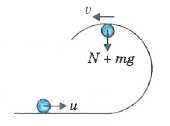
|
|
| 8. |
A man with a bucket of water in his hand is standing inside a lift moving upwards. Write (ii) whether the energy of the bucket remains unchanged. |
| Answer» Solution :HEIGHT of the BUCKET of water , with respect to the ground , INCREASES as the lift moves up . So thepotential ENERGY of the bucket increases. Hence, the TOTAL energy ofthe bucket increases. | |
| 9. |
What are overtones ? |
| Answer» SOLUTION :FREQUENCY of sound GREATER than the fundamental frequency are called OVERTONES. | |
| 10. |
A point moves along a circle of radius 20 cm with constant angential acceleration of 5cms^(-2). The time after which the normal acceleration of the point will be equal to tangential acceleration is |
|
Answer» 1s |
|
| 11. |
In a Carnot engine the temperature of the source and sink are T and T'', respectively. In the first instant the temperature of the source is increased by DeltaT, keeping the sink at T'' and then T'' is decreased by DeltaT keeping the source at T. In which case does the engine have greater efficiency? |
|
Answer» |
|
| 12. |
A polyster fibre rope of diameter 3cm has a breaking strength of 150kN. If it is required to have 600kN breaking strength. What should be the diameter of similar rope? |
|
Answer» 12cm The braking strength `F PROP A` `:. (F_(2))/(F_(1))= (A_(2))/(A_(1)) = (pi D_(2)^(2)//4)/(pi D_(1)^(2) //4) = (D_(2)^(2))/(D_(1)^(2))` or `D_(2) = D_(1) ((F_(2))/(F_(1)))^(1//2)= 3 ((600)/(150))^(1//2) = 6cm` |
|
| 13. |
In Millikan's oil drop experiment. What is the terminal speed of an uncharged drop of radius 2.0 times 10^-5 m and density 1.2 times 10^3 kg m^-3. Take the viscosity of air at the temperature of the experiment to be 1.8 times 10^-5 Pa s. How much is the viscosity force on the drop at that speed? Neglect buoyancy of the drop due to air. |
| Answer» SOLUTION :`5.8 CM s^-1,3.9 TIMES 10^-10 N` | |
| 14. |
Out of friction force and viscous force which depends upon velocity. |
| Answer» Solution :VISCOUS FORCE only depends UPON velocity. | |
| 15. |
In the question number 1, the angle phi which the velocity vector of stone makes with horizontal just before hitting the ground is given by |
|
Answer» `tan phi = 2 tan theta` `:.u_(y)^(2)=2gHandv_(y)^(2)=4gH:.v_(y)=sqrt2u_(y)` Final velocity MAKES angle `(phi)`with horizontal. `:.tanphi=(v_(y))/(u_(X))=sqrt(2)(u_(y))/(u_(x))=sqrt(2)tantheta` |
|
| 16. |
The displacement of a particle moving along the x-axis is given by equation x=2t^(3)-2"t"^(2)+60t+6.The possible acceleration of the particle when its velocity is zero is |
|
Answer» `-18m//s^2` |
|
| 17. |
The average depth of ocean is 2500 m. Calculate the fractional compression ((DeltaV)/(V)) of water at the bottom of ocean, given that the bulk modulus of water is 2.3 xx 10^(9) N//m^(2). |
|
Answer» <P> Solution :Pressure exerted at the bottom layer by water column of height h isP=h`sigma g = 2500xx1000xx10` `=2.5xx10^(7)N//m^(-2)` =STRESS BULK modulus `K=("Stress")/("STRAIN")=(P)/(DeltaV//V)` `(DeltaV)/(V) =(P)/(K)=(2.5xx10^(7))/(2.3xx10^(9))=1.08xx10^(-2)` =1.08% |
|
| 18. |
Which of the following pairs is related as in work and force ? |
|
Answer» ELECTRIC POTENTIAL and Electric intensity |
|
| 19. |
A particle moves in a circle of radius r with angular velocity omega. At some instant its velocity is v radius vector with respect to centre of the circel is r.At this particular instant centripetal acceleration a_(c) of the particle would be |
|
Answer» `omegaxxv` |
|
| 20. |
A metallic cube of side 100 cm is subjected to a uniform force acting normal to the whole surface of the cube. The pressure is 10^6 pascal. If the volume change by 1.5 xx 10^(-5) m^(3), calculate the bulk modulus of the material . |
|
Answer» SOLUTION :By DEFINITION, `K = (F/A)/((DeltaV)/(V)) = P (V)/(DeltaV)` `K = (10^6 XX 1)/(1.5 xx 10^(-5)) = 6.67 xx 10^(10) N m^(-2)` |
|
| 21. |
The block of mass m_1 shown in figure is fastened to the spring and the block of mass m_2 is placed against it. (a) Find the compression of the spring in the equilibrium position. (b) The blocks are pushed a further distance (2/k)(m_1 + m_2)g sin theta against the spring and released. Find the position where the two blocks seperate (c) What is the common speed of blocks at the time of separation ? |
| Answer» SOLUTION :`SQRT(3/4 (m_1 + m_2)) G SIN THETA` | |
| 22. |
A body is floating in a liquid with 1/5 of its volume outside the liquid. If the relative density of the body is 0.9, that of the liquid is ………….. . |
|
Answer» <P>`0.9xx5` |
|
| 23. |
A body of mass 'm' is raised from the surface of earth to a point which is at a height nR from the surface of the earth. The change in PE is |
|
Answer» `nmgR` |
|
| 24. |
(A) : If total energy of a satellite is positive the satellite escapes to infinity. (R) : When the orbit of satellite is elliptical KE and PE vary from point to point. |
|
Answer» Both (A) and (R) are true and (R) is the correct EXPLANATION of (A) |
|
| 25. |
A rigid body is rotating about fix axis. P and Q are its particles. Which of the following physical quantity is same for P and Q? |
|
Answer» ANGULAR MOMENTUM |
|
| 26. |
A body is in pure rotaion. The linear speed v of the particle, the distance r of the particle from the axis and the angular velocity omega of the body are related as omega=(v)/( r). Thus |
|
Answer» `omegaalpha(1)/( R)` |
|
| 27. |
Plot the corresponding reference circle for each of the following simple harmonic motions, indicate the initial (t=0) position of the particle, the radius of the circle, and the angular speed of the rotating particle. For simplicity, the sense of rotation may be fixed to be anti clockwise in every case (x is cm and t is in s) |
Answer» SOLUTION :1) `X= -2sin(3t+pi//3)` 2) `x= COS(pi//6-t)`  3) `x= 3COS(2pit+pi//4)`  `x= 2cospit` 
|
|
| 28. |
Statement I : Intersity of sound wave change when the listener moves towerds or away from the stationary source . Statement II : The motion of listener causes the apparent change in wavelength. |
|
Answer» Statement I is TRUE , statement II is true , statement II is a CORRECT EXPLANATION for statement I |
|
| 29. |
A car is moving 40 m due east, turns towards north moves 30 m, then turns 45^(@) east of north moves 20sqrt(2)m. The net displacement of car is (East is taken positive x-axis, North as positive y-axis) |
|
Answer» `50hat(i) + 60 HAT(J)` |
|
| 30. |
Weighing the earth : You are given the following data : g = 9.81 ms^(-2). R_(E) = 6.37 xx 10^(6)m, the distance to the moon R = 3.84 xx 10^(8)m and the time period of the moons revolution is 27.3 days. Obtain the mass of the earth M_(E) in two difference ways. |
|
Answer» Solution :We know that `M_(E) = (gR_(E)^(2))/(G) = (9.81 xx (6.37 xx 10^(6))^(2))/(6.67 xx 10^(-11)) = 5.97 xx 10^(24) kg` The moon is a SATELLITE of the Earth. ACCORDING to Kepler.s Third LAW |
|
| 31. |
White light forms a continuous spectrum of minimum wavelength 3800 A^@ corresponding to violet light and maximum wavelength 7800A^@ corresponding to red light. Find the minimum and maximum frequencies of white light |
|
Answer» `3.846 TIMES 10^14 HZ, 7.895 times 10^14 Hz` |
|
| 32. |
A boy is moving with constant velocity 10 m//s. A car starts from rest as the boy passes and accelerates at 5 m//s^(2). After how much time and at what distance the car meets the boy? Sketch v-t and s-t graphs for the boy and car. |
Answer» Solution :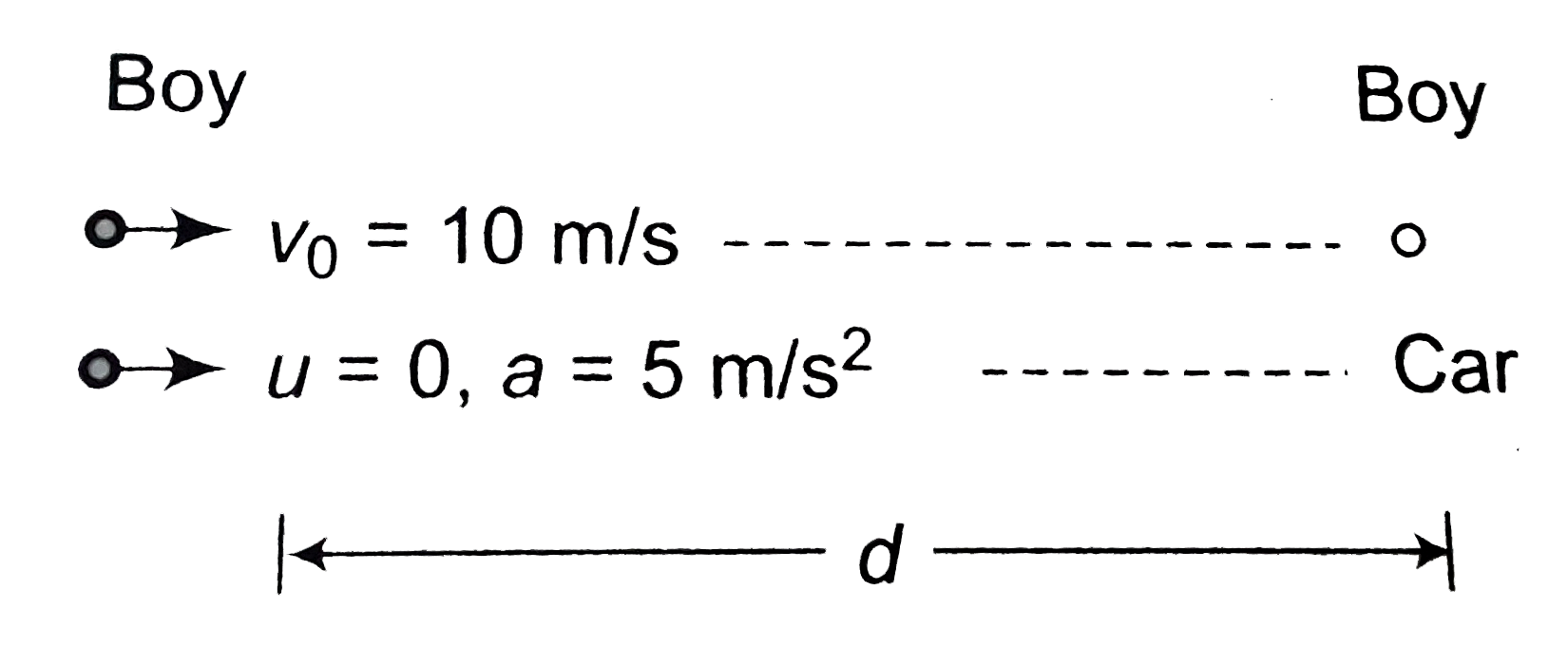 Let the car meets the boy after time t and at DISTANCE d. Boy: `d=v_(0)t=10 t …(i)` Car: `s=ut+1/2 at^(2)` `d=1/2.5t^(2)=5/2 t^(2) …(ii)` `10 t=5/2 t^(2)impliest=4 s` `d=10 t=40 m` Boy: `v=v_(0)=10 m//s` Shape: `y=10`, a straight line parallel to the t-axis Car: `v=u+at=0+5 t`, at `t=4 s`, `v=20 m//s` Shape: `y=5x`, Straight line, slope +ve 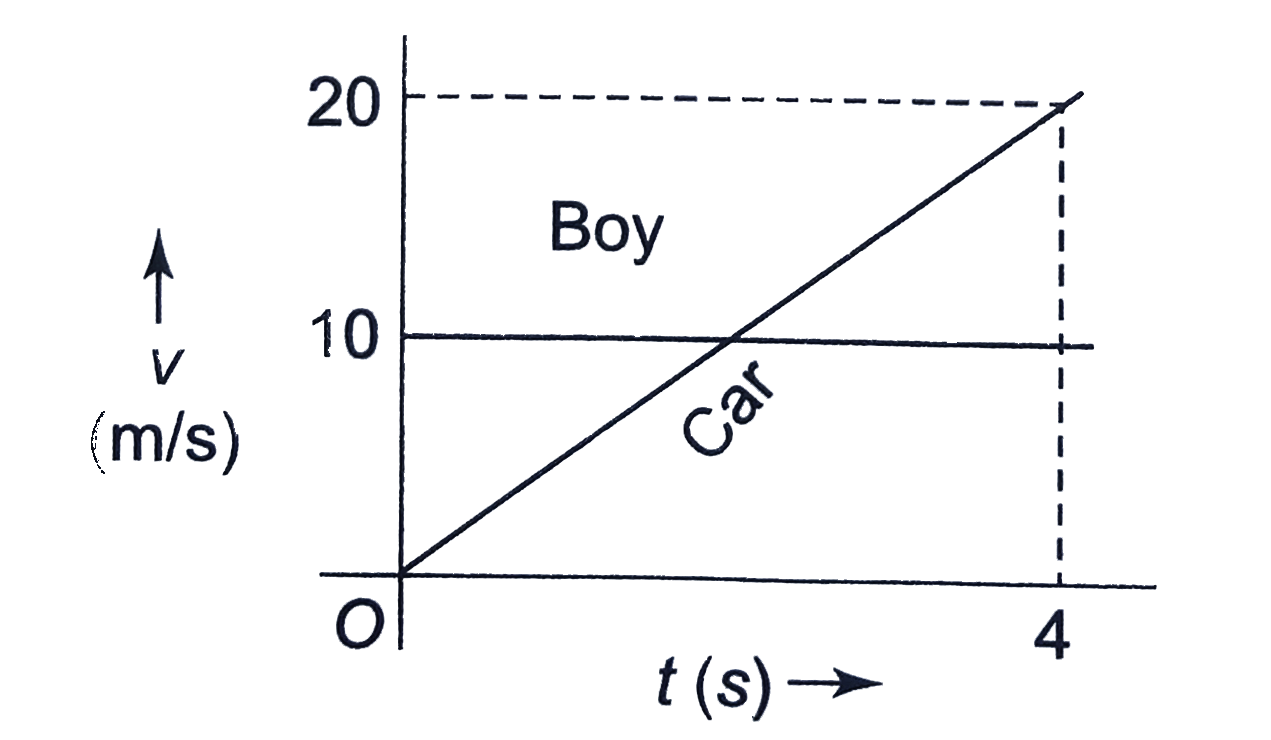 s-t graph Boy: `s=v_(0)t=10 t, t=4 s, s=40 m` Slope: `y=10x`, an inclined straight line of +ve slope Car: `s=ut+1/2 at^(2)=1/2xx5xxt^(2), t=4 s, s=40 m` Slope: `y=5/2x^(2)` (PARABOLA, OPEN upward) 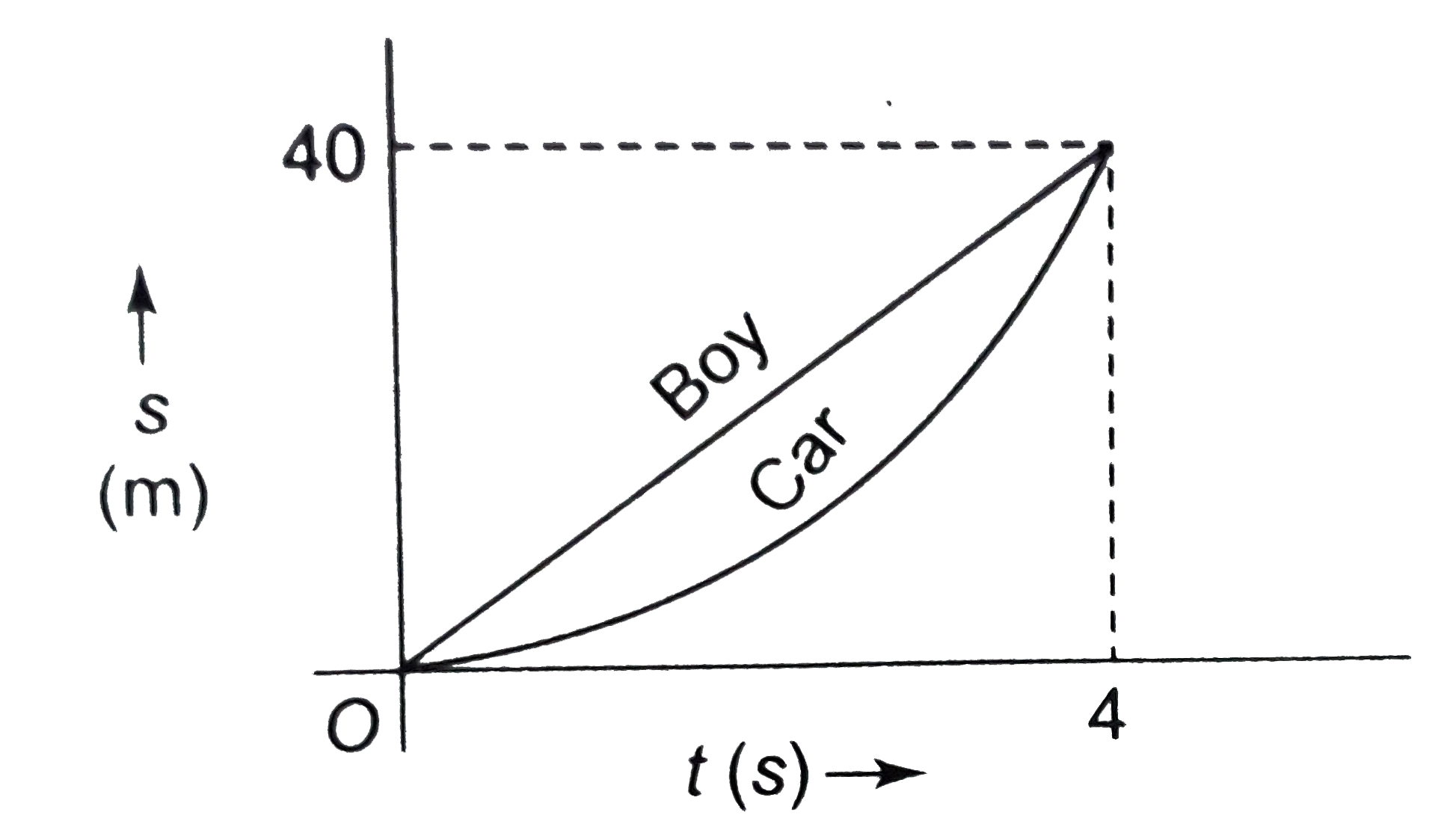
|
|
| 33. |
A uniform square plate S (side c) and a unifrom rectangular plate R(side b,a) have identical areas and mass [Fig.] Show that (i) I_(xR)//I_(xS) lt 1, (ii) I_(yR)//I_(yS) gt 1, (iii) I_(zR)//I_(zS) gt 1. |
|
Answer» Solution :By givenquestion Area of Squre=Area ofrectangular plate `IMPLIES C^(2)=axxbimpliesc^(2)=ab` Now by defination `(a) (I_(XR))/(I_(xs))=(B^(2))/(c^(2)) ""[:'Iprop(area)^(2)]` from thediagram Bltc `implies (I_(xR))/(I_(xS))=((b^(2))/(c^(2)))lt1impliesI_(xR)ltI_(xs)` (b)`(I_(yR))/(I_(YS))=(a^(2))/(b^(2))` asa gtc `(I_(yR)/(I_(ys))=((a)/(c))^(2)gt1` (c ) `I_(zR)- I_(zs) prop(a^(2)+b^(2)-2c^(2))=a^(2)+b^(2)-2ab=(a-b)^(2) ""[:' C^(2)=ab]` `implies (I_(zR)-I_(zS))gt0impliesI_(zR)/(I_(zs))gt1` |
|
| 34. |
A student initially at rest on a frictionless frozen pond throws a 2 kg hammer in one direction. After the throw, the hammer moves off in one direction while the student moves off in the other direction. Which of the following correctly describes the above situation ? |
|
Answer» The HAMMER will have the momentum with greater magnitude |
|
| 35. |
In problem 5, the CM of the plate is now in the following quadrant of x-y plane. |
|
Answer» I 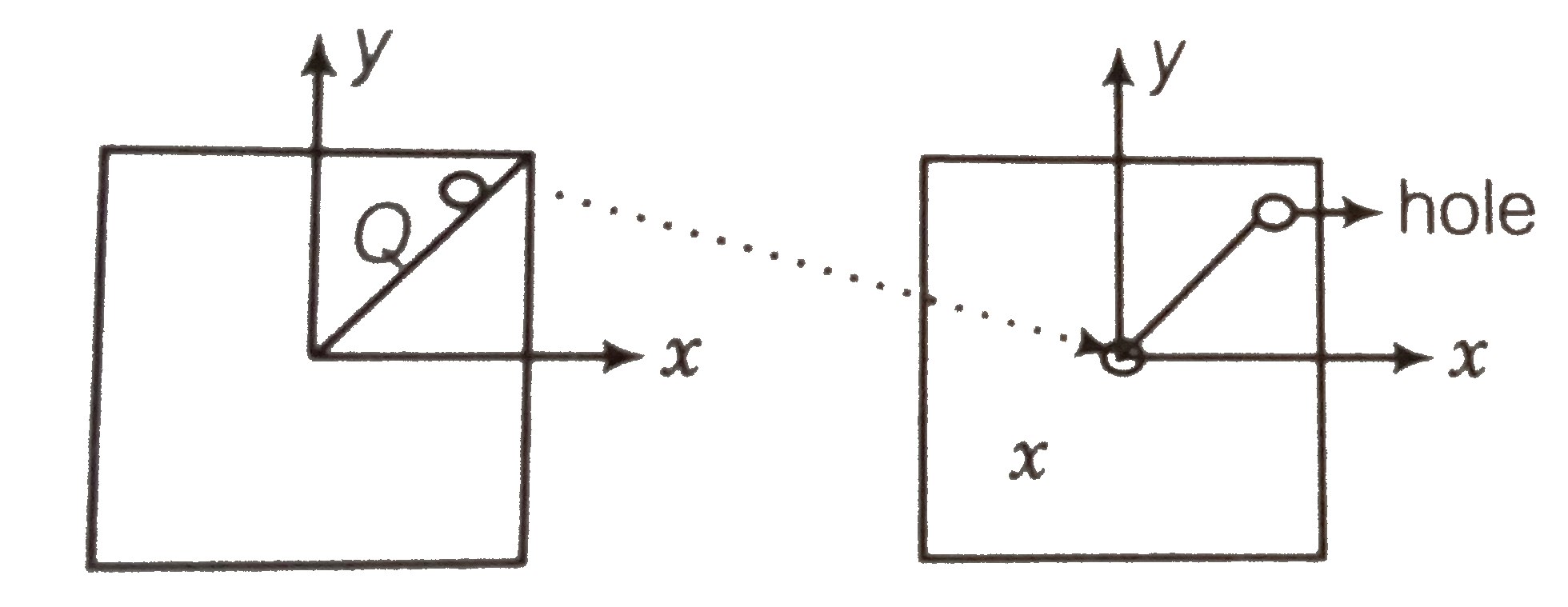 whenmassis removed, itwill beon thesamelinebutshifted away fromthecentreandbelow(IIIrd quadrant ) . POSITIONOF CMis shownby X inthediagram . |
|
| 36. |
A thermos bottle containing coffee is vigorously shaken. If coffee is considered a system, ( c) has work been done on it? |
| Answer» Solution :YES, the work has been done against the VISCOUS FORCES. | |
| 37. |
The two ends of a train moving with uniform acceleration pass a certain point with velocity u and v. Find the velocity with which the middle point of the train passes the same point. |
Answer» SOLUTION : Between `A, B:(V^(1))^(2)-u^(2)=2as//2` Between `B,C:v^(2)-(v^(1))^(2)=2as//2` `implies (v^(1))^(2)-u^(2)=v^(2)-v^(12)` `2(v^(1))^(2)=v^(2)+v^(2)` Velocity at mid POINT is `v^(1)=sqrt((u^(2)+v^(2))/(2))` |
|
| 38. |
If a temperature scale defines the freezing point of water as 100^(@)C and the boiling as 0^@what temperature on the scale corresponds to 25^@ C ? |
|
Answer» |
|
| 39. |
The lift force acting on the wing of an aeroplane is 2275 N.If the are aof the wing is 5ms^(2) and velocity of air on the lower surface of the wing is 30 m/s, velocity of air on the upper surface of the wing is (density of air is 1.3kg//m^(3)) |
|
Answer» 20m/s |
|
| 40. |
A particle is suspended vertically from a point O by an inextensible massless string of length L. A vertical line AB is at a distance of L//8 from O as shown. The object is given a horizontal velocity u. At some point, its motion ceases to be circular and eventually the object passes through the line AB. At the instant of crossing AB, its velocity is horizontal. Find u. . |
Answer»  Now, we have FOLLOWING equations (1) `T_(Q) = 0` Therefore, `mg sin theta = (mv^(2))/(L)` ….(1) (2) `v^(2) =U^(2) - 2gh = u^(2) - 2gL(1 + sin theta)` …..(2) (3) `QD = (1)/(2) ("range")` ….(3) `u = sqrt(gL(2+(3 sqrt(3))/(2)))`. |
|
| 41. |
An object is pushed up along a plane of inclination 30^(@). It comes down to the initial point after sometime with half the initial upward velocity. Find the coefficient of sliding friction between the body and the plane. |
|
Answer» |
|
| 42. |
An astronomical telescope has an agular magnification of magnitude 5 for distant objects. The separation between the objective and the eye piece is 36 cm and the final image is formed at infinity. The focal length f_(o) of the objective and the focal length f_(e) of the eye piece are |
|
Answer» `f_0 = 45 CM and f_e = - 9cm` |
|
| 43. |
Moment of inertia of a thin square plate about an axis passing through its diagonal is I. Its moment of inertia about an axis passing through its centre in the plane of the plate and making an angle theta with the diagonal is |
|
Answer» `I` |
|
| 44. |
If Plank constant (h) speed of free space light (c) and Newton gravitation constant (G) are chosen as the fundamental quantities, then dimensional formula of length will be ...... |
|
Answer» `sqrt((hc)/(G))` `:. l=kh^(a)G^(b)c^(d)` `M^(0)L^(1)T^(0)=(M^(2)L^(2)T^(-1))^(a)(M^(-1)L^(3)T^(-2))^(b) (M^(0)L^(1)T^(-1))^(d)` `=M^(a-b)L^(2a+3b+d) T^(-a-2b-d)` `a-b=0 "" ...(1)` `2a+3b+d=1 "" ...(2)` `-a-2b-d=0 ""...(3)` `:.` From equation (2) and (3) `5b+d=1 "" ...(4)` and `-3b-d=0 "" ...(5)` Add by equation (4) and (5) `2b=1` `:.b=(1)/(2) "" :. a=(1)/(2)` From equation (3) `:.-d=a+2b=(1)/(2)+1=(3)/(2)` `:.d=-(3)/(2)` `l=h^((1)/(2))G^((1)/(2))c^(-(3)/(2))` `:.l=((hG)^((1)/(2)))/(c^((3)/(2)))` `= (sqrt(hG))/(c^((3)/(2)))` |
|
| 45. |
Time period of a simple pendulum is 2s. If its length is increased by 4 times, then its period becomes………. |
|
Answer» `16s` `(T_1)/(T_2)= sqrt((l_1)/(l_2))` `(2)/(T_2)= sqrt((l)/(4L)) IMPLIES T_(2)= 4s`. |
|
| 46. |
Find the pressure in the air column at which the piston remains in equilibrium. Assume the piston to be massless and frictionless. |
Answer» Solution :LET `P_(a)`, be the air pressure above the PISTON. Applying Pascal.s law at point A and B.  `p_(atm)+rho_(w)(5)=P_(a)rho_(k)G(1.73)(SQRT(3))/(2),P_(a=138 kPa` |
|
| 47. |
A force of 1000 dynes acts on a particle of mass 500 g for10seconds.Calculate the velocity of the particle and kinetic energy produced. |
| Answer» SOLUTION :20cm/s,`10^5`ERGS | |
| 48. |
A solenoid has a core of inner radius 20 cm and outer radius 22 cm around which 3000 turns of wire are wound. If the current in the wire is 10 A, the field along the axis at distance of 2 m from the centre is given by |
|
Answer» `1.4 XX 10^(-4)T` |
|
| 49. |
What is the velocity of sound in perfectly rigid rod ? Why ? |
|
Answer» SOLUTION :Velocity of sound in a linear solid medium LIKE rod is given by `v = sqrt((Y)/(rho))` Where, Y = Young.s MODULUS `= (Delta P )/(((Delta l)/(l )))= 00` because for PERFECTLY rigid rod, `Delta l =0 ` ` therefore v = oo` |
|
| 50. |
A converging lens is used to form an image on a screen. When the upper half of the lens is convered by an opaque, screen then (A) Half the image will disapper (B) Completeimage will be formed (C ) intensity will image will decrease (D) Intensity of image will increase |
|
Answer» a & d are correct |
|