Saved Bookmarks
This section includes 7 InterviewSolutions, each offering curated multiple-choice questions to sharpen your Current Affairs knowledge and support exam preparation. Choose a topic below to get started.
| 1. |
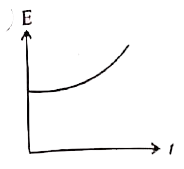
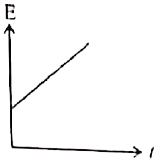
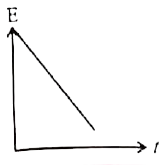
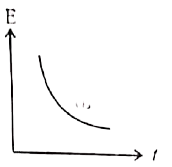
A particle is dropped from a height h. A constant horizontal velocity is given to the particle. Taking g to be constant everywhere, kinetic energy E of the particle with respect to time t is correctly shown in: |
|
Answer»
|
|
| 2. |
Two marks on a glass rod 10cm apart are found to increase their distance by 0.08mm when the rod is heated from 0°C to 100°C . A flask made of the same glass as that rod measures a volume of 1000 c.c at 0°C. The volume it measures at 100°C in c.c. is |
|
Answer» `1002.4` |
|
| 3. |
(A) : polar ice melts, day will be longer.(R ) : Moment of inertia increases and thus angular velocity decreases. |
|
Answer» Both (A) and (R ) are true and (R ) is the CORRECT EXPLANATION of (A) |
|
| 4. |
The pressure p and volume V of an ideal gas both increase in a process. |
|
Answer» Such a process is not possible |
|
| 5. |
Explain how the torque can be expressed as a vector product of two vectors ? How the direction and magnitude of torque is determined ? |
|
Answer» Solution :(i) For direction, the vector rule or RIGHT hand rule is used. `tau = r F sin theta` (II) The expression for the magnitude of torque can be written in TWO different WAYS by associating `sin theta` either with r of F in the following manner. `{:(tau = r (F sin theta) = r XX (F bot)),(tau = (r sin theta) F = (r bot) xx F):}` (iii) Here, `(F sin theta)` is the component of `vec(F)` perpendicular to `vec(r)`. Similarly, `(r sin theta)` is the component of `vec(r)` perendicular to `vec(F)` 
|
|
| 6. |
A ball dropped from a height of 2 m rebounds to a height of 1.5 m after hitting the ground. Then the percentage of energy lost is |
|
Answer» 25% % ENERGY LOST = `(U_1 - U_2)/(U_1) xx 100% = (mgh_1 - mgh_2)/(mgh_1) xx 100%` `= ((h_1 - h_2)/(h_1)) xx 100% = (2 - 1.5)/(2) xx 100% = 25%`. |
|
| 7. |
For the given system, initially the spring is unstretched and the block is at rest. There is no friction in pulley. If the block is relased at such conditions, find the maximum enlogation of the spring. |
|
Answer» |
|
| 8. |
A curved glass vessel full of water upto a height of 10 cm has a bottom of area 10 cm^(2), top of area 30 cm^(2) and volume 1 L. (i) Find the force exerted by the water on the bottom. (ii) Find the resultant force exerted by the sides of the glass on the water. (iii) If the glass vessel is covered by a jar and the air inside the jar is completely pumped out, what will be the answers to parts (a) and (b) (iv) If a glass vessel of different shape is used provided the height, the bottom area and the volume are unchanged, will the answers to parts (a) and (b) change. (Take, g=10 ms^(-2) , density of water =10^(3) kgm^(-2) and atmospheric pressure =1.01xx10^(5)Nm^(-2)) |
|
Answer» Solution :(i) Force exerted by the water on the BOTTOM `F_(1)=(rho_(0)+rhogh)A_(1)` Here, `rho_(0)`= atmospheric pressure `=1.01xx10^(5) Nm^(-2)` `rho= " density of water " =10^(3) kgm^(-3)` `g=10 ms^(-2), h=10 cm =0.1 m` and `A_(1) = " AREA of BASE " =10 cm^(2)=10^(-3) m^(2)` 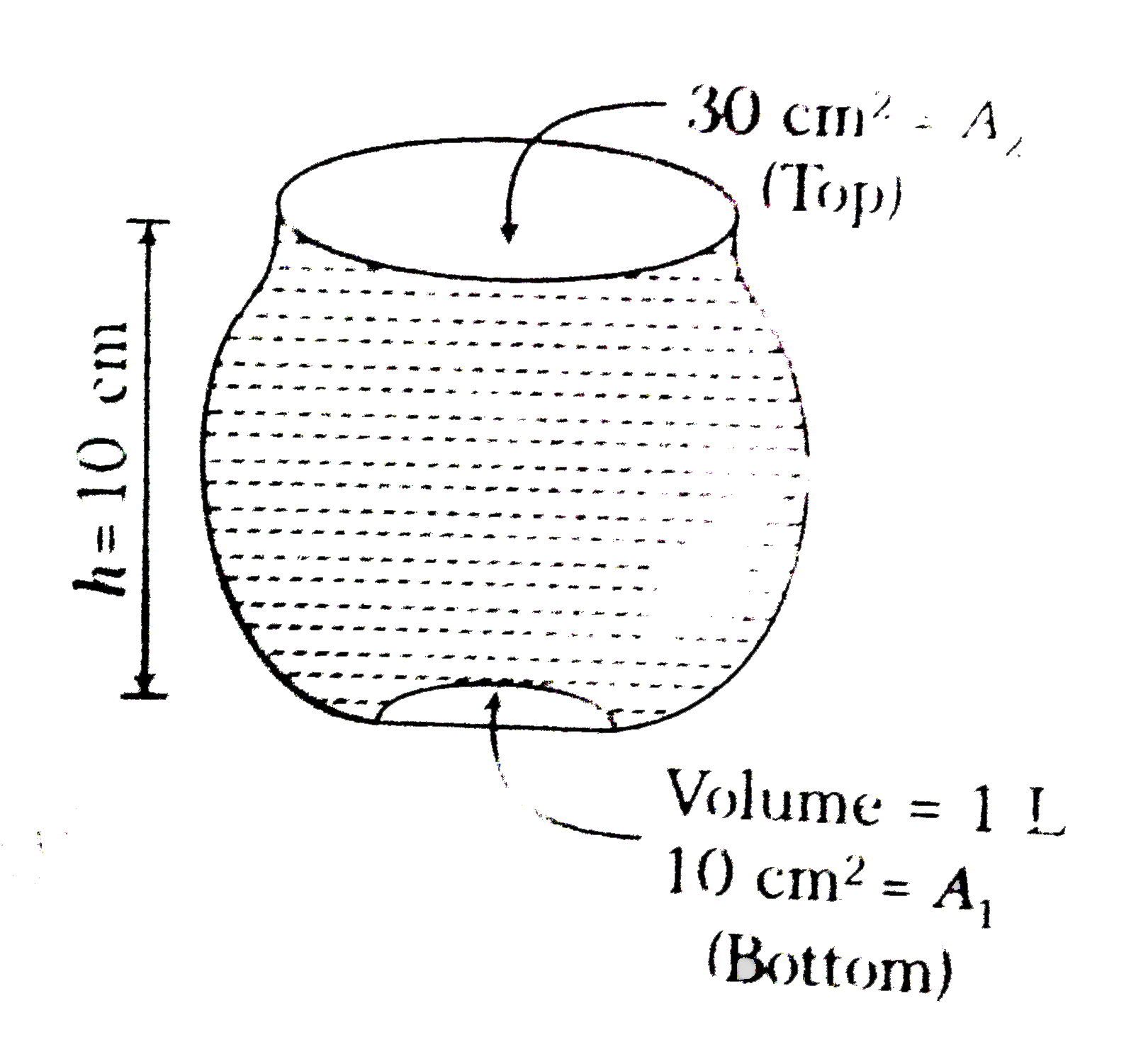 Substituting these values in Eq. (i), we get `F_(1)=(1.01xx10^(5)+10^(3)xx10xx0.1)xx10^(-3)` or `F_(1)=102 N` (downwards) (ii) Force exerted by atmosphere on water `F_(2)=(rho_(0))A_(2)` Here, `A_(2)= " area of top " =30 cm^(2)=3xx10^(-3) m^(2)` ` therefore F_(2)=(1.01xx10^(5))(3xx10^(-3))` =303 N (dwonwards) Force exerted by bottom on the water `F_(3)=-F_(1) or F_(3)=102 N` (upwards) Weight of water, w=(volume)(density)(g) `=(10^(-3))(10^(3))(10)` =10 N (downwards) Let F the force exerted by side walls on the water (upwards). Then for equilibrium of water (FBD) Net upward force=net downwardforce or ` F+F_(3)=F_(2)+w` `therefore "" F=F_(2)+w-F_(3)=303+10-102` or "" F=211 N (upwards) 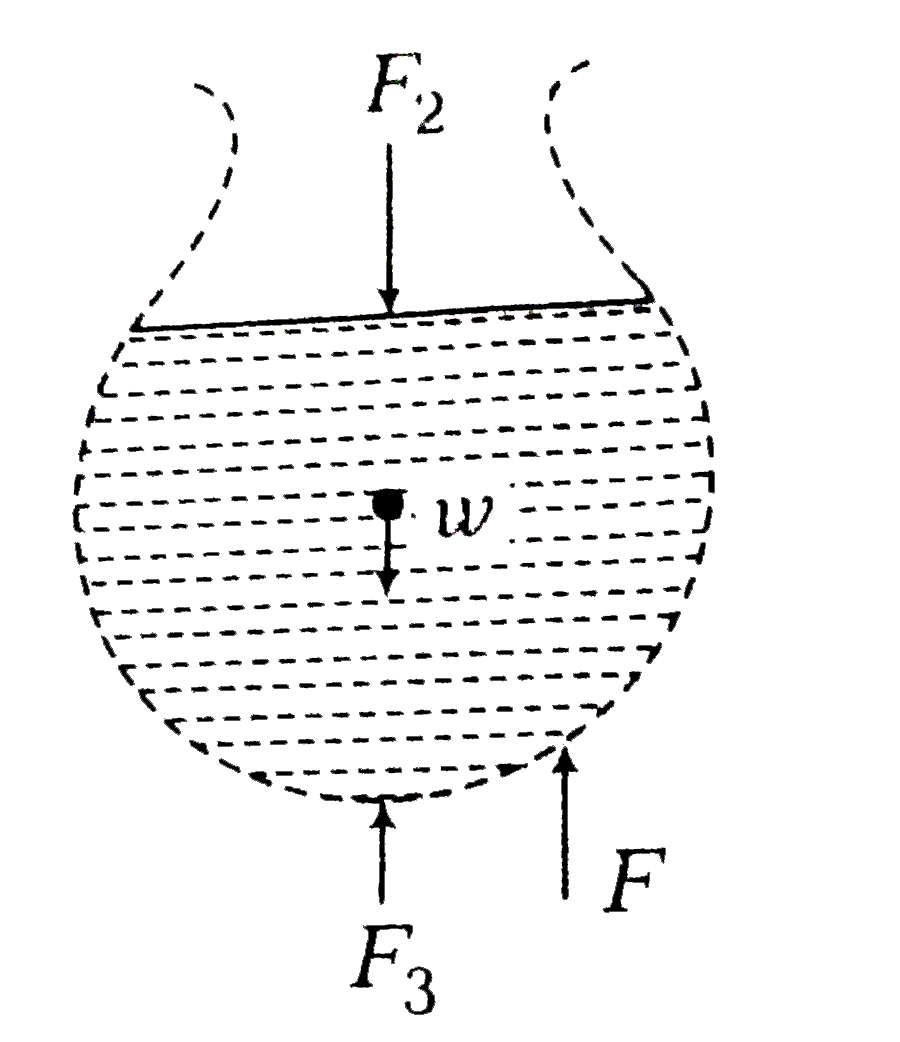 (iii) If the air inside the jar is completely pumped out, `F_(1)=(rhogh)A_(1) "" (as rho_(0)=0)` `=(10^(3))(10)(0.1)(10^(-3))` =1 N (downwards) In this case, `F_(2)=0` and "" `F_(3)=1 N` (upwards) `therefore "" F=F_(2)+w-F_(3)` `=0+10-1` =9 N (upwards) (iv) No, the answer will remain the same. Because the answers depend upon `rho_(0),rho,g, h,A_(a) " and " A_(2)` |
|
| 9. |
A vehicle covers certain distance at constant speed of 20 km h^(-1) in time interval 't' on linear path. Then it covers certain distance at constant speed of 30 km h^(-1)in the same time interval. What is the average speed of the vehicle ? |
|
Answer» Solution :Here `v _(j) v _(g) and v _(0)` are velocities of jet plane, combustion products ejected and observer on ground respectively. Suppose, jet plane is moving in +X-axis, Ejected combustion products are in -X-axis, Now `v _(j) = 500` km/hr `v _(0) = 0` (At REST) Velocity of jet plane w.r.t observer, `=v _(j)- v _(0) = 500 -0` ` = 50 km//hr. ""...(1)` Velocity of combustion products w.r.t jet plane, `v _(g) -v_(j) = - 1500 km.//hr.""...(2)` `v _(g) - v _(0) = 500 - 1500 = - 1000 km//hr` Velocity of ejected combustion products by observer on ground in opposite to jet plane is 1000 km/hr. |
|
| 10. |
A planet revolving round the sun. Its distance from the sun at apogge is r_(A) and that at perigee is r_(P). The masses of planet and sun are 'm' and M respectively, v_(A) is the velocity of planet at apogee and v_(P) is at perigee respectively and T is the time period of revolution of planet round the sun, then identify the worn answer. |
|
Answer» <P>`T^(2) = (pi^(2))/(2GM)(r_(A) + r_(P))^(3)` |
|
| 11. |
figure shows the motion of a particle along a straight line. Find the average velocity of the particle during the intervals (a) A to E, (b) B to E, (c ) C to E, (d) D to E, (e) C to D. |
Answer» Solution : (a) As the particle MOVES from A to E, A is the initial point and E is the FINAL point. The slope of the line drawn from A to E i.e., `(Deltax)/(Deltat)` gives the average velocity during that interval of time. The displacement `Deltax` is `x_(B)-x_(A)=10cm-0cm=+10cm` The time interval `Deltat_(EA)=t_(E)-t_(A)=10S`. `therefore` During this interval average velocity `barv=(Deltax)/(Deltat)=(+10cm)/(10s)=+1cms^(-1)` (b) During the interval B to E, the displacement `Deltax=x_(E)-x_(B)=10cm-4cm=6cm` and `Deltat=t_(E)-t_(B)=10s-3s=7S`. `therefore` Average velocity `barv=(Deltax)/(Deltat)=(6cm)/(7s)` `=+0.857cms^(-1)=0.86cms-1` (c ) During the interval C to E, the displacement `Deltax=x_(E)-x_(C)=10cm-12cm=2cm` and `Deltat=t_(E)-t_(C)=10s-5s=5s` `therefore barv=(Deltax)/(Deltat)=(-2cm)/(5s)=-0.4cms^(-1)` (d) During the interval D to E, the displacement `Deltax=x_(E)-x_(D)=10cm-12cm=-2cm` and the time interval `Deltat=t_(E)-t_(D)=10s-8s=2s` `therefore barv=(Deltax)/(Deltat)=(-2cm)/(2s)=-1cms^(-1)` (e) During the interval C to D, the displacement `Deltax=x_(D)-x_(C)=12cm-12cm=0` and the time interval `Deltat=t_(D)-t_(C)=8s-5s=3s` `therefore` The average velocity `barv=(Deltax)/(Deltat)=(0m)/(3s)=0ms^(-1)` (The particle has reached the same position during these 3s. The average velocity is ZERO because the displacement is zero). |
|
| 12. |
The spectrum of thermal radiation from a blackbody is |
|
Answer» CONTINUOUS SPECTRUM |
|
| 13. |
A bullet of mass 50 g moving with a velocity of 500 ms^(-1) enters into a wooden block and comes out of it with a velocity of 100 ms^(-1). Find the work done by the bullet while passing through the wooden block. |
|
Answer» |
|
| 14. |
The mass of a block is 87.2 g and its volume is 25 cm^(3). Its density upto correct significant figures is |
|
Answer» `3.488 g cm^(-3)` As mass has three SIGNIFICANT FIGURES and volume has two significant figures erefore as per rule, density will have two significant figures. ROUNDING off, we get, `"Density" = 3.5 g cm^(-3)` |
|
| 15. |
For any arbitrary motion in space, which of the following relations are true? a) v_("average") = (1//2)(v(t_(1) + v(t_(2)) b) v_("average") = [r(t_(2))-r(t_(1)]/(t_(2)-t_(1) v(t) = v(0) + at d) a_("average") = [v(t_(2))-v(t_(1))/[t_(2)-t_(1)) The average stands for average of the quantity over time interval t_(1) to t_(2) |
|
Answer» `vecv_("AVERAGE") = (1)/(2) [vecv(t_(1)) + vecv(t_(2))]` |
|
| 16. |
Find Torque about an Axis. |
Answer» Solution :(i) Consider a rigid body capable of rotationg about an AXIS AB as shown in Figure. Let the force F act at a point P on the rigid body.  (ii) The force F may not be on the PLANE ABP. The origin O at any random point on the axis AB is taken. (III) The torque of the force `VEC(F)` about O is, `vec(tau) = vec(r) xx vec(F)`. The component of the torque along the axis is the torque of `vec(F)` about the axis. To find it, we should first find the VECTOR `vec(tau) = vec(r) xx vec(F)` and then find the angle `varphi` between `tau` and AB. (Remember here, `vec(F)` is not on the plane ABP). The torque about AB is the parallel component of the torque along AB, which is `|vec(r) xx vec(F)| cos phi`. And the torque perpendicular to the axis AB is `|vec(r) xx vec(F)| sin phi`. |
|
| 17. |
Under an adiabatic process, the volume of an ideal gas gets doubled. Consequently, the mean collision time between the gas molecules changes from tau_(1) " to" tau_(2). If (C_(P))/(C_(V))= gamma for this gas, then a good estimate for (tau_(2))/(tau_(1)) is given by |
|
Answer» `(1)/(2)` `:. tau prop V^(1 + (gamma-1)/(2))` `:. tau= V^((1 + gamma)/(2))` `:. (tau_(1))/(tau_(i)) = ((2V)/(V))^((1 + gamma)/(2)) = (2)^((1 + gamma)/(2))` |
|
| 18. |
A steel wire is rigidly fixed at both ends. Its length mass and cross-sectionl area are 1m, 0.1kg and 10^(-8)m^(2) respectively. Tension in the wire is produced by lowering the temperature by 20^(@)C. If the transerverse waves are some up by plucking the wire at 0.25m from one end and assuming that the wire viberates with minimum number of loops possble for such a case. The frequency of viberation (in Hz) is found to be. 1.11. Find the value of K. Given alpha=1.21xx10^(-5).^(@)C^(-1). Y-2xx10^(11)N//m^(2) |
|
Answer» |
|
| 19. |
A pices of metal weighs 46 g air. When it is immersed in a liquid of specific gravity 1.24 at 27^(@)C, it weighs 30g. When the temperature si raised to 42^(@)C, the metal piece weighs 30.5 g. If the specific gravity of the liquid at 42^(@)C is 1.20, the coefficient of linear expansion of the metal is |
|
Answer» `(1.4xx10^(-5))/("^(@)C)` where `""F=V_(s)p_(t)g` `rArr""F'= V_(s)p_(t)'g` `""(F')/F=(V_(s)')/V_(s).(p_(l)')/(p_(l))or(F')/(F)=(1+gamma_(s)Delta theta)(p_(l'))/(p_(l))` `((46-30.6)/(46-30))=(1+3xx alpha_(s)xx15)((1.20)/(1.24))` or `""alpha_(s)=2.3xx10^(-5)//^(@)C` |
|
| 20. |
The force required to move a body up a rough inclined plane is double the force required to prevent the body from sliding down the plane. The coefficient of friction when the angle of inclination of the plane is 60^(@) is |
|
Answer» `(1)/(sqrt2)` `F_("down")=mg(sin theta-mu_(k)cos theta)`. |
|
| 21. |
The motion of a particle of mass m is described by h= ut + 1//2 "gt"^2 . Find the force acting on particle. |
|
Answer» Solution :`H =ut = 1/2 "GT"^2` find a by DIFFERENTIATING h TWICE w.r.t AsF =ma so F = mg |
|
| 22. |
The displacement of a particle executing simple harmonic motion is given by y= A_(0) +A sin omega t+ B cos omega t. Then the amplitude of its oscillation is given by: |
|
Answer» `A + B` Suppose `X= A sin omega t + B cos omega t` and TAKING `A= a cos phi and B= a sin phi`, `x= a sin omega t cos phi + a cos omega t sin phi` `=a [sin omega t cos phi + cos omega t sin phi]` `=a sin (omega t + phi)` and `A^(2) + B^(2) = a^(2) cos^(2) phi + a^(2) sin^(2) phi` `=a^(2) [cos^(2) phi + sin^(2) phi]` `=a^(2)` `sqrt(A^(2) + B^(2))=a` `:. y= A_(0) + x = [A_(0) + sqrt(A^(2) + B^(2))] sin (omega t + phi)` Comparing above equation with `y= A sin (omega t + phi)` AMPLITUDE `A.= A_(0) + sqrt(A^(2) + B^(2))` |
|
| 23. |
A steel sphereof mass 100 gm moving with a velocity of 4 m/s collides with a dust particle elastically moving in the same direction with a velocity of 1 m/s. The velocity of the dust particle after the collision is (dust partical is of mass neglisiable |
|
Answer» 8 m/s |
|
| 24. |
A ball is thrown vertically upwards. Which of the following graph/graphs represent velocity-time graph of the ball during its flight (air resistance is neglected) |
|
Answer» A |
|
| 25. |
An optional pyrometer is used for measuring high temperature, if it is calibrated for an ideal black body radiation. When the temperature of a red-hot piece of iron is measured in the open, the pyrometer gives too low value but when the same piece is in the furnace, the pyrometer gives the correct values of temperature for the iron piece . Explain. |
|
Answer» Solution :Optical PYROMETER MEASURES the amount of heat that is RADIATED from an object. If T is the temperature of red HOT ironpiece in the furnace, then heat radiated per second per unit area is ` E = sigma T^4` When the red-hot IRON piece is placed in the open with a temperature `T_0` , heat radiated per second per unit area is ` E. = sigma (T^4 - T_0^4)` So, E. < E and hence, optical pyrometer gives a low value for the temperature measured in the open. |
|
| 26. |
If vec(F)= 3hat(i) + 4hat(j) + 5hat(k) and vec(S) = 6hat(i)+ 2hat(j) + 5hat(k), find the work done by the force |
|
Answer» 51 units |
|
| 28. |
A machine gun fires 240 bullets per minute with certain velocity. If the mass of each bullet is 10^(-2)kg and the power of the gun is 7.2kW, find the velocity with which each bullet is fired |
|
Answer» Solution :Mass of each bullet `m= 10^(-2)kg` Power `=7.2 kW= 7.2 XX 10^(3)W` `(n)/(t)= 240` bullets/min `=(240)/(60)` bullets/sec Power `=(n((1)/(2)mv^(2)))/(t)= 7.2 xx 10^(3)= (240 xx (1)/(2) xx 10^(-2) xx v^(2))/(60)` `v^(2)= (7.2 xx 10^(3) xx 2)/(4 xx 10^(-2))= (7.2)/(2) xx 10^(5)= 3.6 xx 10^(5)` v= 600 m/s |
|
| 29. |
What will be the velocity of water when it passes from narrow tube to wider tube? |
|
Answer» Solution :Velocity of water decreases when it PASSES from narrow tube to WIDER tube because `a_(1)v_(1)=a_(2)v_(2)` `thereforea_(1)lta_(2)` so `v_(2)ltv_(1)` |
|
| 30. |
Two masses m_(1) and m_(2) are suspended from a spring of spring constant 'k' . When the masses are in equilibrium , m_(1) is gently removed. The angular frequency and amplitude of oscillation of m_(2) will be respectively |
|
Answer» `sqrt(k/(m_(2))),( m_(1)g)/k` |
|
| 31. |
Two masses 10 gm and 40 gm are moving with kinetic energies in the ratio 9:25. Theratio of their linear momenta is |
|
Answer» `5:6` |
|
| 32. |
The resultant if two vectors will be maximum, if they are_________. |
|
Answer» EQUAL VECTORS |
|
| 33. |
A car is moving with a velocity of 20m//s. The driver sees a stationary truck ahead at a distance of 100m. After some reaction time Deltat the brakes are applied producing a retardation of 4m//s^(2). What is the maximum reaction time to avoid collision? |
|
Answer» Solution :After applying the breaks, LET S be the distanc covered by the car before COMING to rest. `V^(2)=u^(2)+2as` covers distance s `therefore 0=20^(2)-2xx4s therefore s=(400)/(8)=50m` The car covers 50 m after applying breaks To avoid the clash, the remaining distance `100-50=50m` MUST be covered by the car with uniform velocity `20m//s` during the reaction TIME `Deltat` `therefore (50)/(Deltat)=20 therefore Deltat=(50)/(20)=2.5s` `therefore` The maximum reaction time `Deltat=2.5s` |
|
| 34. |
Sound of wavelength 100 cm travels in air. At a given point the difference in maximumand minimum pressure is 0.2 Nm^( –2). If the bulk modulus of air is 1.5 xx 10^(5) Nm^( –2), find the amplitude of vibration of the particles of the medium. |
|
Answer» |
|
| 35. |
Consider a mixture of 2 mole helium and 4 mole of oxygen. Compute the speed of sound in this gas mixture at 300 K. |
|
Answer» Solution :Number of molecules of helium=2 Number of molecules of oxygen =4 When helium and oxygen are mixed, hence molecular weight of the mixture of gases is given by `M_("mix") [(n_(1)M_(1)+n_(2)M_(2))/(n_(1)+n_(2))]` `=[(2xx4+4xx32)/(2+4)] kg //"MOL"` `=(8+128)/(6)=(136)/(6)` kg/mol `=22.6 xx10^(-3)` kg/ mol In addition, helium is monoatomic, `C_(v_(2))=(3R)/(2)` OXygen is diatomic `C_(v_(1))=(5R)/(2)` `:.` For example mixture `(C_(v))_("mix")=(n_(1)C_(v_(1))+n_(2)C_(v_(2)))/(n_(1)+n+(2))` `(C_(v))_("mix")=(2xx(3)/(2)R+4xx(5)/(2)R)/(2+4)=(13R)/(6)` From Meyor's relation `(C_(p))_("mix")=(C_(v))_("mix")+R` `(C_(P))_("mix")=(13)/(6)+R=(13R+6R)/(6)=(19R)/(6)` Ratio of specific heat capacitors of a mixture of gases is `y_("mix")(C_(p))/(C_(v))=((19R)/(6))/((13R)/(6))=(19)/(13)` According to Laplace, the speed of sound in a gas is `v= SQRT((gamma RT)/(M))` `v= sqrt((19)/(3)XX(8.31xx300)/(22.6xx10^(-3)))` `=sqrt((28420.2)/(1768)xx10^(4))` `=4.009xx10^(-2) m//s` `=400.9 m/s` `:.` The speed of sound `=400.9 m//s` |
|
| 36. |
Four thin uniform rods each of mass m and length I are arranged to form a square. Find the moment of inertia of the system about an axis (i) Passing through its centre and perpendicular to its plane. (ü) Passing through one of its sides. (üi) Passing through a corner and perpendicular to its plane. (iv) About a diagonal of the system |
|
Answer» Solution :M I. about an AXIS passing through its centre and PERPENDICULAR to its plane : `4[(ml^(2))/(12)+m((l)/(2))^(2)]=(4ml^(2))/(12)xx4` (ii) `1_(s)=(ml^(2))/(3)xx2+ml^(2)` `(5)/(3)ml^(2)` (iii) From parallel axex theorem `l=I_(C)+mr^(2)=(4ml^(2))/(3)+4m((l)/(sqrt(2)))=(10)/(3) ml^(2)` (iv) From perpendicular axes thorem `I_(z)=I_(x)=I_(y), I_(z)=2I_(x), I_(x)=(I_(z))/(2)=(I_(C))/(2)=(2)/(3)ml^(2)` 
|
|
| 37. |
The air pressure in the thermometer bulb at constant volume is 70 cm of mercury at 0^@C, 90 cm of mercury at 100^@C and 80 cm of mercury at room temperature T. Find the value of T. |
|
Answer» Solution :As `P PROP T` or `T prop P` ` therefore (T - T_0)/(T_100 - T_0) = (P - P_0)/(P_100 - P_0) = (80 - 70)/(90 - 70)` `(T - 0)/(100 - 0) = 10.20 RARR T = 10/20 xx 100` `T = 50^@C` |
|
| 38. |
A block of mass 2kg is pushed against a rough vertical wall with a force of 40N, coefficient of static friction being 0.5. Another horizontal force of 15 N, is applied on the block in direction parallel to the wall. Will the block move? If yes, in which direction? If no, find the frictional force exerted by the wall on the block. |
|
Answer» SOLUTION :It will MOVE at an angle of `53^(@)` with the 15N FORCE |
|
| 39. |
"1 kWh is a unit of power " . This statement is true or false ? If it is wrong then correct it . |
|
Answer» SOLUTION :ENERGY ,because WH is `("Work")/("TIME")XX " time work" [ :. "W = watt"] ` |
|
| 40. |
A stationary body explodes into four identical fragments such that three of them fly off mutually perpendicular to each other, each with same K.E. E_(0). The energy released in the explosion in the form of kinetic energy is NE_(0). Find N |
|
Answer» |
|
| 41. |
Assertion : The basic laws of electromagnetism govern all electric and magnetic phenomena. Reason : The attempts to unify fundamental forces of nature reflect the quest for unification. |
|
Answer» If both assertion and REASON are true and reason is the correct explanation of assertion. |
|
| 42. |
A thin circular ring M and radius r is rotating about its axis with a constant angular velocity omega. Four objects each of mass m are kept gently to the opposite ends of two perpendicular diameters of the ring. The angular velocity of the ring will be........... |
|
Answer» `((M-4m)omega)/(M+4m)`  `I_(1)` = moment of INERTIA of RING + moment of inertia of arrangement of FOUR object each of mass m `I_(1)=MR^(2)+(4m)r^(2)` According to the conservation of angular momentum `=[("Initial angular"),("momentum"),("of ring")]=[("Total angular"),("momentum of"),("system after"),("arrangment of object")]` `Iomega=I_(1)omega_(1)` `therefore Mr^(2)omega=(Mr^(2)+4mr^(2))omega_(1)` `therefore Momega=(M+4m)omega_(1)` `therefore` New angular velocity `omega_(1)=(Momega)/(M+4m)` |
|
| 43. |
A tunnel is dug along a chord of the earth at a perpendicular distance R/2 from the earth.s centre. The wall of the tunnel may be assumed to be frictionless. A particle is released from one end of the tunnel. The pressing force by the particle on the wall and the acceleration of the particle varies with x (distance of the particle from the centre of earth ) according to |
|
Answer»
|
|
| 44. |
Where shoulda geo-stationary satellite be launched? |
|
Answer» At equator |
|
| 45. |
The angular velocity and the amplitude of a simple pendulum is omega and A respectively. At a displacement x from the mean position if its kinetic energy is k and potential energy U, then the ratio of K and U is……….. |
|
Answer» `(x^(2) omega^(2))/((A^(2)-x^(2)omega^(2))` and potential energy `U= (1)/(2) m omega^(2) x^(2)` `THEREFORE (K)/(U)= (A^(2)-x^(2))/(x^2)`. |
|
| 46. |
The length, breadth and thickness of a block are measured with the help of a meter scale. Given 1 = (5.12 + 0.01) cm b = (10.15 + 0.01) cm, t = (5.28 + 0.01) cm.The percentage error in volume is |
|
Answer» `0.64%` |
|
| 47. |
A book is at rest on the table which exerts a normal force on the book if this force is consideredas reactionforcewhat is the action forceaccordingto newtonthirdlaw ? |
|
Answer» GRAVITATIONAL FORCE exerted by Earth on the book |
|
| 48. |
Verify the correctness of the equations v = u + at. |
|
Answer» Solution :In the DIMENSIONAL form `[L^(1) T^(-1) ] = [ L^(1) T^(-1) ] + [L^(1) T^(-2) ] [T^(1) ] = [L^(1) T^(-1) ]` The dimension for L on both sides is `1` The dimension for T on both sides is `-1 ` HENCE from the principle of homogeneity of dimensions the GIVEN equation is correct. |
|