

Saved Bookmarks
This section includes 7 InterviewSolutions, each offering curated multiple-choice questions to sharpen your Current Affairs knowledge and support exam preparation. Choose a topic below to get started.
| 1. |
Explain the study of thermal properties of matter by giving definitions of temperature and heat. |
|
Answer» Solution :Temperature is a relative measure, or indication of hotness or coldness. A hot utensil is said to have a high temperature and ice cube to have a low temperature. An object that has a higher temperature than another object is said to be hotter. Hot and cold are relative terms, like tall and short. We can perceive temperature by touch However, this temperature SENSE is somewhat unreliable and its range is too limited to be useful for scientific purposes. A glass of ice - cold water left on a table on a hot summer day eventually warms up whereas a cup of hot tea on the same table cools down. It means that when the temperature of a body, ice-cold water or hot tea in this case and its surrounding MEDIUM are different, heat transfer takes place between the system and the surrounding medium, until the body and the surrounding medium are at the same temperature. In the case of glass tumbler of ice cold water heat flows from the environment to the glass tumbler, whereas in the case of hot tea, it flows from the cup of hot tea to the environment. So, we can say that heat is the FORM of ENERGY transferred between two (or more) systems or a system and its surroundings by virtue of temperature difference. The SI unit of heat energy transferred is expressed in joule (J) which SI unit of temperature is kelvin (K), and `""^(@)C` is a COMMONLY used unit of temperature. |
|
| 2. |
Two boys of the same weight sit at the opposite ends of a diameter of a rotating circular table. What happens to the speed of rotationif they move nearer to axis of rotation? |
| Answer» SOLUTION :The moment of inertia of the system (ciruclar table+ two boys) decreases. To CONSERVE angular momentum (L`=I omega=` CONSTANT), the speed of rotation of the circular table INCREASES. | |
| 3. |
Distance between the centres of two stars is 10a. The masses of these stars are M and 16M and their radii a and 2a, respetively. A body of mass m is fired straight from the surface of the larger star towards the smaller star. What should be its minimum initial speed to reach the surface of the smaller star? Obtain the expression in terms of G, M and a. |
|
Answer» Solution :The distance x (from the smaller PLANET) where the gravitational PULL of two planet.s BALANCE each other will be given by `(-GMm)/x^2=(-G(16M)m)/(10a-x)^2` i.e.. So the body will reach the smaller planet due to planet.s gravitational field if it has sufficient energy to cross the point B (x = 2A), i.e., `1/2 m upsilon^2 gt m (V_B-V_S)` but `V_S=-[(16GM)/(2a)+(GM)/(10-2a)]=-(65GM)/(8a)`  `V_B=-[(16GM)/(8a)+(GM)/(2a)]=-(20GM)/(8a)` so `1/2 m upsilon^2gt m [(65GM)/(8a)-(20GM)/(8a)]` i.e., `upsilon_"min"=3/2 sqrt((5GM)/a)` |
|
| 4. |
(A) : According to the law of conservation of mechanical energy change in potential energy is equal and opposite to the change in kinetic energy.(R ) : Mechanical energy is not a conserved quantity. |
|
Answer» Both (A) and (R ) are true and (R ) is the CORRECT explanation of (A) |
|
| 5. |
A truck moves up a hill of icline 1 in 50 with a speed of 20 KMPH. If the resistance to the motion of the truck is 4% its weight, the speed of te truck while moving down hill utilising the same power is |
|
Answer» 20 KMPH |
|
| 6. |
One engine moves with a speed 10 m/s towards a cliff (high hill). It blows a whistle with frequency 660 Hz. Find the frequency of an echo (from cliff), heard by driver of this engine. Speed of sound in air is 340 m/s. |
Answer» SOLUTION : Here for reflected SOND, we can consider its imaginary source S. moving TOWARDS the cliff with a VELOCITY equal in magnitude and opposite in direction to that of real source of sound. Here, according to sign convention out of `v_(L) and v ._(S)` a velocity in a directon from listener to imaginary source is to be taken positive. Hence `v _(L) = 10 m//sand v._(S) =-10 m//s.` Now, we have, `(f _( L))/( v + v _(L)) = (f _(S))/( v + v ._(S))` `therefore ( f _(L))/( 340 + 10) = (660)/(340 -10)` `therefore f _(L) = 660 XX (350)/(330 ) = 700 Hz` |
|
| 7. |
A force vec(F) = 5 hat(i) -3hat(j) + 2hat(k) moves a particle from vec(r )_(1)= 2hat(i) + 7hat(j) + 4hat(k) " to " vec(r )_(2)= 5 hat(i) + 2hat(j)+ 8hat(k). Calculate the workdone. |
|
Answer» 38 units |
|
| 8. |
If a pendulum has significant amplitude (up to a factor of 1"/"e of original) only in the period between t= 0s" to "t= T sec, then T may be called the average life of the pendulum. When the spherical bob of the pendulum of mass 1kg suffers a retardation (due to viscos drag) proportional to into velocity with 'b' as the constant of proportionally, the average life time of pendulum is (assuming damping is small) in seconds. |
|
Answer» `(0.693)/(B)` |
|
| 9. |
A carwithout passengers moving with a constant velocity can be stopped in a distane of 20m. If the passengers add 40% of the weight, its stopping distance for the same braking force and velocity is (ignore friction) |
|
Answer» 14m |
|
| 10. |
A force applied by an engine on a train of mass 2.05 xx 10^(6) kg changes its velocity from 5 ms' to 25 msin 5 min. The power of the engine is |
|
Answer» 1.025 MW |
|
| 11. |
A beam of white light passing through a hollow prism gives no spectrum explain. |
|
Answer» Solution :Light travels from air to air in CASE of HOLLOW PRISM. NO refraction and no dispersion OCCUR. The glass slabs FORMING the prism and very thin and permit the rays to pass undeviated. Hence a hollow prism gives no spectrum. 
|
|
| 12. |
(A) : The sum of two vectors can be zero> ( R) : The vectors cancel each other, when they are equal and opposite. |
|
Answer» Both (A) and ( R) are TURE and ( R) is the correct EXPLANATION of (A) |
|
| 13. |
Two resistors of 10KOmega and 20KOmegaare connected in series. If tolerance of each resistor is 10% then tolerance of the combination will be |
|
Answer» 0.05 |
|
| 14. |
Mass of a ring is non - uniformly distributed around its geometric centre. If R is radius of the ring, then(a) Centre of mass does not coincide with geometric centre(b) Position of centre of mass from the geometric centre will be x(0lt xx lt R)(c ) Centre of mass will be nearer to the greater mass distribution (d) Centre of mass may lie out side the periphery |
|
Answer» only a and B are CORRECT |
|
| 15. |
S |
|
Answer» 0.11 |
|
| 16. |
If theta is the angle between unit vectors vec(A) and vec(B), " then " ((1- vec(A).vec(B)))/((1 + vec(A).vec(B))) is equal to |
|
Answer» `tan^(2) (THETA // 2)` |
|
| 17. |
The change in the value of .g. at a height .h. above the surface of the earth is the same as at a depth .d. below the surface of the earth. When both d & h are very much smaller than the radius of the earth, then which one of the following is correct |
|
Answer» d = H |
|
| 18. |
A particle of mass 5 kg is moving with a uniform speed of 3 sqrt(2) "cm s"^(-1) in the XY-plane along the line y = 2 sqrt(5) cm. The magnitude of its angular momentum about the origin in "g-cm"^(2) s^(-1) is |
|
Answer» zero `=30 sqrt(10)"g-cm"^(2)s^(-1)` 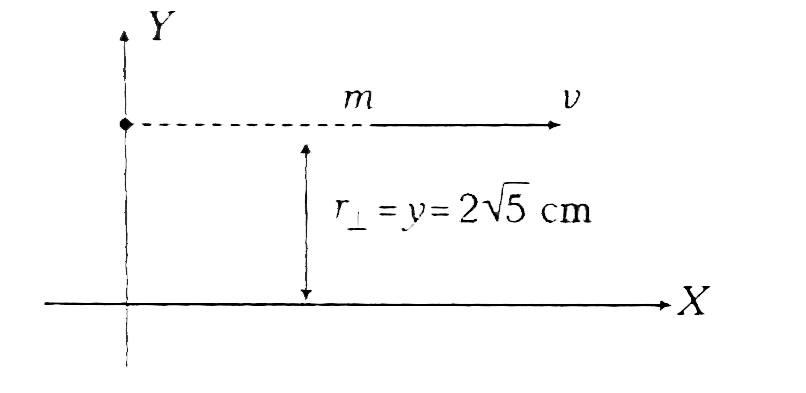
|
|
| 19. |
What is meant by Collinear vector ? Explain them . |
Answer» Solution :Collinear vectors are those which ACT ALONG the same LINE . The ANGLE between them can be `0^(@) or 180^(@)`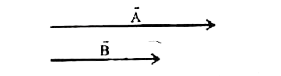
|
|
| 20. |
Two wires A and B are of same material. Their lengths are in the ratio 1:2 and diameters are in the ratio 2:1. When stretched by forces F_(A)andF_(B) respectively, they get equal increase in their lengths. Then the ratio F_(A)//F_(B) should be: |
|
Answer» `1:1` `Y_(A)=Y_(B)` `(F_A)/(pi(r_A)^(2)).(l_A)/(Deltal_A)=(F_B)/(pi(r_B)^(2)).(l_B)/(Deltal_B)` But,`Deltal_(A)=Deltal_(B)` `rArr(F_A)/(F_B)=(I_B)/(I_A).((r_A)/(r_B))^(2)=(2)/(1)((2)/(1))^(2)` `=8:1` |
|
| 21. |
A body cools down from 52.5^(@)C to 47.5^(@)C in 5 min and to 42.5^(@)C in 7.5 min. Find the temperature of the surroundings. |
|
Answer» Solution :Using NEWTON's law of cooling. `(T_(1)-T_(2))/t=k((T_(1)-T_(1))/2-T_(0))` we get `(52.5^(@)C-42.5^(@)C)/(5min)= k((52.5^(@)C+47.5^(@)C)/(5min)-T_(0))` `(5^(@)`C)/(5min) = k(50^(@)C-T_(0))`............(i) `(47.5^(@)C-42.5^(@)C)/(7.5min)= k(47.5^(@)C+42.5^(@)C)/(2)-T_(0)` `(5^(@)C)/(7.5min)=k(45^(@)C-T_(0))` FORM (i) and (ii), we get `(50^(@)C-T_(0))/(45^(@)C-T_(0))= (7.5)/(5)=3/2` or `T_(0)=35^(@)`C |
|
| 22. |
A solid sphere and a solid cylinder of same mass are rolled down on two inclined planes of heights h_(1) and h_(2) respectively. If at the bottom of the planethe two objects have same velocities, then the ratio of h_(1) : h_(2) is |
|
Answer» `2:3` `(K_(T))_("sphere")=(K_(T))_("CYLINDER")""("m and v are same")` `:. (5)/(7)(mgh_(1))=(2)/(3)(mgh_(2))rArr(h_(1))/(h_(2))=(14)/(15)`. |
|
| 23. |
Obtain the formula for the maximum safe speed (v_(max)) of a vehicle on a level curved road |
Answer» SOLUTION :(a)vehicleis shownmovingon ahorizontalcurvedroad. Themassof vehiclebe m andthe radiusbe R  FIGURE (b )showsthe vehiclemovingon a circulartrack thefrictionbetweenthe tyre and theroadsurfaceprovides theneccesarycentripetalforce In ordertomovesafely on thisroad `(mv^(2))/( R )`forceisrequiredand itshouldbe EQUALTO maximumfrictionalforce `(f_(g)) _(max)= mu_(s) N` where `mu_(s)` is thecoefficientof staticfrictionbetweenthe tyresof VEHICLE andthe road. the aboveformulashowsthat themaximumpermissiblelimitof thespeeddoes not dependuponthe massof vehicle or thepassengerto driver safelyon levelcircularroad.the abovegivenspeed calledmaximumpermissiblespeedshouldbe followed |
|
| 24. |
(A): Q heat is given to melt ice cube and magnitude of work done by ice on surrounding is W, then DeltaQ=Q-W (R ): First law of thermodynamics is applicable in this situation |
|
Answer» Both (A) and(R ) are TRUE and (R ) is the correct EXPLANATION of (A) |
|
| 25. |
An object of mass 0.2 kg executes simple harmonic oscillations along the x-axis with a frequency 25/(pi) Hz. At positon x=0.04m, the object has kinetic energy 0.5and (potential energy is zero at mean position) Find the amplitude of vibration . |
|
Answer» SOLUTION :`omega=2pif=SQRT(k/m)"":. k=(2pif)^(2)m` Total energy of oscillaion is `(0.5+0.4)=0.9J` `:.0.9=1/2kA^(2)` or `A=sqrt(1.8/k)=sqrt(1.8/((2pif)^(2)m))` `=1/(2pif)sqrt((1.8)/0.2)=1/(2pi(25/(pi)))sqrt(1.8/0.2)=3/50 m=6` CM |
|
| 26. |
A wire elongates by 1 mm when a load W is hung from it.if the same wires goes over a pulley and two weights W each are hung at the two endsthe elongation of the wire will be |
|
Answer» L mm |
|
| 27. |
If a simple pendulum oscillates with an amplitude of 50 mm and time period of 2s, then its maximum velocity is……….. |
|
Answer» `0.10 m"/"s` `AXX (2pi)/(T)= (50 xx 10^(-3))xx (2pi)/(2)` `=50xx 10^(-3)xx 3.14` `=150.7xx 10^(-3)` `approx 0.15 m"/"s`. |
|
| 28. |
A metal sphere is suspended in water at 0^(@)C by a thread when water is heated to 4^(@)C the tansion in the thread |
|
Answer» decreases |
|
| 29. |
A splash is heard 3.12s after a stone is dropped into a well 45 m deep. The speed of sound in air is [g=10 ms^(-2)] |
|
Answer» `330ms^(-1)` |
|
| 30. |
(i) Can a body in translatory motion have angular momentum? Explain (ii) Why is it more difficult to revolve a stone by tying it to a longer string than by tying it to a shorter string? |
|
Answer» Solution :Yes, a body in TRANSLATORY motion SHALL have angular momentum unless fixed point about which angular momentum is taken lies on the line of motion of body `|vecL|=rp SIN theta` =0 only where `theta=0^(@) or 180^(@)` (ii) Ml of stone `I ml^(2)(l to` length of string) l is large, `alpha` is very small `tau=I alpha` `alpha=(tau)/(I)=(tau)/(ml^(2))` If l is large a is very small `:.` more difficult to revolve. |
|
| 31. |
In the given ciruit diagram, initial charge on capacitor is zero. Choose the correct option (s): |
|
Answer» Current through battery just after closing of SWITCH is 12 A |
|
| 32. |
In old age arteries carrying blood in the human body become narrow resulting in an increases in the blood pressure .This follows from ….. |
|
Answer» Pascal's law `P+(1)/(2)rhov^(2)=`constant As velocity decreases pressure increases . Thus when arteries BECOME narrow ,blood pressure increases. |
|
| 33. |
A man is watching two trains , one leaving and the other coming in with equal speed of 4m .s^(-1) . If they sound their whistles , each of frequency 240 Hz , find the number of beats heard by the man (velocity of sound in air = 320 ms^(-1) ). |
|
Answer» |
|
| 34. |
The KE required to project a body of mass 'm' from the earth's surface to infinity is |
| Answer» Answer :C | |
| 35. |
A body is moving in a vertical circle of radius V by a string. If the ratio of maximum to minimum speed is sqrt(3):1 , the ratio of maximum to minimum tensions in the string is: |
|
Answer» `3:1` |
|
| 36. |
Object A and B have velocities 10//m//s.A is moving along East while B is moving towards North from the same point as shown . Find velocity of A relative to B (vecV_(AB)). |
|
Answer» SOLUTION :`vecV_(AB)=vecV_(A)-vecV_(B)` `:. |vecV_(AB)|=10sqrt(2)` 
|
|
| 37. |
Statement I: Air flows from a small bubbles to a large bubble when they are connected to each other by a capillary tube. Statement II: The excess pressure because of surface tension inside a spherical bubble decreases as its radius increases. |
|
Answer» Statement I is true, statement II is true , statement II is a correct EXPLANATION for statement I. |
|
| 38. |
A bullet of m ass 10 g m oving horizontal w ith a velocity of 400 ms^(-1) strikes a w ood block of m a ss 2 kg w h ic h is s u s p e n d e d by lig h t inex ten sib le strin g of length 5 m. As resu lt the c e n tre of gravity of th e block fo und to rise a v ertical distan ce of 10 cm . The sp eed of the bullet after it em erges on horizontally from the block will b e ...... |
|
Answer» 120 `ms^(-1)`  Momentumconvertationalrule Momentumconvertationalrule`(10)/( 1000)xx 400+ 2xx 0 = 2 xx v_(1)+ (10)/( 1000) xx v_(2)` Usingworkenergyrule MGH `=(1)/(2) Mv_(1) 2` `2 xx10 xx 0.1= (1)/(2)xx 2 xxv_(1)^(2)` Usingequation(1) `v_(1)= 1.40m//s` `4 =2xx 1.40+ 0.01v_(2)` `4-2.80= 0 .01v_(2)` `(1.20)/(0.01) =v_(2)` `v_(2) = 120 ms^(-1)` |
|
| 39. |
A uniform bar of length 12L and mass 48m is supported horizontally on two fixed smooth tables as shown in figure. A small moth (an insect) of mass 8m is sitting on end A of the rod and a spider (an insect) of mass 16m is sitting on the other end B. Both the insects moving towards each other along the rod with moth moving at speed 2v and the spider at half this speed (absolute). They meet at a point P on the rod and the spider eats the moth. After this the spider moves with a velocity v/2 relative to the rod towards the end A. The spider takes negligible time in eating on the other insect. Also, let v=L/T where T is a constant having value 4s. After starting from end B of the rod the spider reaches the end A at a time |
|
Answer» (a) `40s` But `L/v=T=4s` `:. t=80s` |
|
| 40. |
A uniform bar of length 12L and mass 48m is supported horizontally on two fixed smooth tables as shown in figure. A small moth (an insect) of mass 8m is sitting on end A of the rod and a spider (an insect) of mass 16m is sitting on the other end B. Both the insects moving towards each other along the rod with moth moving at speed 2v and the spider at half this speed (absolute). They meet at a point P on the rod and the spider eats the moth. After this the spider moves with a velocity v/2 relative to the rod towards the end A. The spider takes negligible time in eating on the other insect. Also, let v=L/T where T is a constant having value 4s. By what distance the centre of mass of the rod shifts during this time? |
|
Answer» (a) `(8L)/(3)` `:.` DISPLACEMENT of rod `=(v/6)t_2` `=(v/6)((16L)/(v))=(8L)/(3)` |
|
| 41. |
How long does it take a brick to reach the ground if dropped from a height of 65 m? What will be its velocity just before it reaches the ground ? |
|
Answer» 2S, 10m/s |
|
| 42. |
Two blocks of masses m and 3m on a horizontal surface are in contact with the ends of a horizontal massless spring. The coefficient of friction between m and surface and between 3m and surface is mu and mu//3 respectively. The two blocks are moved towards each other to compress the spring and then released. The two blocks move off in opposite directions covering distances S_(1) and S_(2) before comming to rest. S_(1):S_(2) is |
|
Answer» `1:9` |
|
| 43. |
A U-tube made up of two capillaries is held vertically and partially filled with a liquid of surface tension 50 dyne/crn. The diameters of bore of capillaries are 2 mm and 3 mm, respectively. What will be density of liquid if difference in menuscus levels is 1.30 cm. The angle of contact for that liquid ie zero degree. |
|
Answer» |
|
| 44. |
An engine is hauling a train of mass M kg on a level track at a constant speed v m/s. The resistance due to friction is f N/kg. What extra power must the engine develop to maintain the speed up a gradient of h in s ? |
|
Answer» |
|
| 45. |
The percentage error in the evaluation of the area of one surface of a rectangular sheet is 2.2%. The length and breadth are measured using a meter scale. If the breadth is 7.9 cm, calculate the length of the sheet? |
|
Answer» |
|
| 46. |
A large water tank has a hole in its wall near the bottom. The water level above the hole is 4.9m. The horizontal distance from the hole at which the water touches the ground, if the bottom of water tank is 4.9m above the ground |
|
Answer» `9.8cm` |
|
| 47. |
A spaceship is launched into a circular orbit of radius R close to the surface of the earth. The velocity to be imparted to the spaceship in the orbit to overcome the earth.s gravitational pull is (g is acceleration due to gravity) |
| Answer» Answer :B | |
| 48. |
If mechanical work done on the body then kinetic energy increases or decreases? |
| Answer» Solution :According to WORK energy THEOREM kinetic energy INCREASES . | |
| 49. |
A uniform solid sphere rolls on a horizontal surface with a linear speed of 10 m/s. It then rolls up a.plane inclined at 30° to horizontal. What is the height upto wlrich the sphere rises ? (See Fig.) Assume that the surface is frictionless. Also calculate the distance travelled by the Fig. sphere on the inclined plane ? |
| Answer» Solution :`mgh = (1//2)mv^(2) = (1//2) (2//3)MR^(2) xx (v^(2)//r^(2)) =(7//10)mr^(2), h=7v^(2)//10G = 7 xx 10^(2)//10 g = 7.14 m,s = 14.3`m | |
| 50. |
(A): If pressure of given mass of an ideal gas is doubled and volume is halved, then its internal energy will remain unchanged. (R) : Internal energy of an ideal gas is a function of temperature only. |
|
Answer» Both (A) and ( R) are true and (R ) is the CORRECT explanation of (A) |
|