Saved Bookmarks
This section includes 7 InterviewSolutions, each offering curated multiple-choice questions to sharpen your Current Affairs knowledge and support exam preparation. Choose a topic below to get started.
| 1. |
A body of mass 2 kg travels according to the law x (t) = pt + qt^(2) + rt^(3) where, q = 4m s^(-2) , p - 3m s^(-1) and r = 5m s^(-3). The force acting on the body at t = 2s is |
|
Answer» 136 n m=2kg Q= 4 `m//s^(2) , p-3 m//s ,r = 5 ms^(3)` `3t+ 4t^(2) + 5T^(3)` `a= (dx )/(DT )= 3(1) +(2t)+ 5(3t^(2))` at t =2 a= 8 +30(2) ForceF = ma `= 2xx 68` `136 N` |
|
| 2. |
A body of mass4kg rests in limiting equilibrium on a rouch plane whose slope is 30^(@). The slope is subsequently increased to 60^(@). Calculate (i) coefficient of limiting friction between the body and the surface, (ii) acceleration down the plane if coefficient of kinetic friction is 0.4, (iii) force required to prevent it from sliding down the plane, (iv) force required to just move it up the plane. (g = 9.8 m//s^(2)). |
|
Answer» |
|
| 3. |
A solid and hollow sphere roll down (pure rolling) from the top of a rough inclined plane. If the ratio between the times taken by them to reach the basis is sqrt(N) time ((sqrt(3))/(5)) then , N is equal to |
|
Answer» zero |
|
| 4. |
(A) : Water at th foot of the water fall is always at different temperature from that at the top.(R ) : The potential energy of water at the top is converted into heat energy during falling. |
|
Answer» Both (A) and (R ) are TRUE and (R ) is the CORRECT explanation of (A) |
|
| 5. |
Air expands from 5 litres to 10 litres at 2 atm pressure. External work done is |
|
Answer» 10J |
|
| 6. |
Two objects of masses 200 g and 500 g possess velocities 10hati ms^(-1) and 3hati+5hatj ms^(-1) respectively. The velocity of their centre of mass in ms^(-1) is |
|
Answer» `5hati-25hatj` |
|
| 7. |
A boy sees a ball go up and then down through a window 2.45 m high. If the total time that ball is in sight in 1s, the height above the window the ball rises is approximately |
|
Answer» 2.45 m |
|
| 8. |
Six identicles particles each of mass 0.5kg are arranged at the corners of a regular hexagon of side length 0.5m. If one of the particle is removed, the shift in the centre of mass is |
|
Answer» `(1)/(8)m` |
|
| 9. |
A disc is given an initial angular velocity omega_(0) and placed on horizontal surface as shown. The quantities which will not depend on the coefficient of friction is/are |
|
Answer» the time until pure ROLLIN beings. |
|
| 10. |
There are two springs, one delicate and another stiffer one. Which spring will have a greater frequencyof oscillation for a given load ? |
| Answer» Solution :We have,.v = 1/(2pi)sqrt(k)/(m) = 1/(2pi)sqrt g/l. So, when a hard SPRING is loaded with MASS m. The EXTENSION I will be lesser w.r.t delicate one. So frequency of the oscillation of the hard spring will be more and if time PERIOD is asked it will be lesser. | |
| 11. |
From the fllowing pair , choose the pair that does not have identical dimensions |
|
Answer» angular momemtum and PLANCK's CONSTANT |
|
| 12. |
Under what conditionsdoes a sudden phase reversal of waves on reflection takes place ? |
| Answer» SOLUTION :On reflection from a denser MEDIUM, a WAVE SUFFERS PHASE reversal. | |
| 13. |
A simple pendulum consisting a ball of mass 'm' tied to a string of length '1' is made to showing on a circular arc of angle 'q' in a vertical plane. At the end of this arc, another ball of mass 'm' is placed at rest. The momentum transferred to the ball at rest by swinging ball is |
| Answer» Answer :D | |
| 14. |
Two balls each of mass 0.06 kg moving in opposite directions each with a velocity of 8 ms^(-1) collide elastically and move back with equal velocities. Find the magnitude of change in momentum of each ball due lo collision |
|
Answer» |
|
| 15. |
The ratio of the radii of gyration of a circular disc and a circular ring of the same radii about a tangential axis perpendicular to plane of disc or ring is |
|
Answer» `1:2` `K_("DISC")=sqrt(((1)/(2)mR^(2)+mR^(2))/(m))=sqrt((3)/(2))R` `R_("ring")=sqrt((mR^(2)+mR^(2))/(m))=sqrt(2)R` `:. (K_("disc"))/(K_("ring"))=(sqrt(3//2))/(sqrt(2))=(sqrt(3))/(2)`. |
|
| 16. |
Due to capillary action a liquid will rise in a tube if the angle of contact is |
| Answer» Answer :A | |
| 17. |
The force on a body executing SHM is 2N when the displacement is 2cm. If the amplitude of oscilaltions is 5 cm what is the total energy associated with the SHM ? |
| Answer» SOLUTION :`12.5 XX 10^(-2)` J | |
| 18. |
When a plane is taking off on a runway the wind velocities at the top and bottom of the wings are found to be 40 ms(-1) respectively. If the wing span is 60 m^(2) find the dynamics lift on the density of air is 1.27 kg m^(-3). |
| Answer» SOLUTION :`26.7xx10^(3)N` | |
| 19. |
Find the minimum attainable pressure of one mole of an ideal gas, if during its expansion its temperature and volume are related as T = T_(0) + alpha V^(2)where T_(0) and alpha are positive constants. |
|
Answer» SOLUTION :Given that one MOLE of gas is used, thus from gas law, we have PV =RT or P `(RT)/(V) = (R)/(V) ( T_(0) + ALPHA V^(2)) [ "as" T = T_(0) + alpha V^(2) ] ` Here pressure P will be minimum, when `(dP)/(dV) = 0 " or " (dP)/(dV) = (RT_(0))/(V^(2)) + alpha R = 0 " or" V = sqrt((T_(0))/(alpha))` Thus pressure of the gas is minimum, when its volume is `V = sqrt((T_(0))/(alpha))` and at this volume , its temperature is given as `T = T_(0) + alpha V^(2) = T_(0) + alpha ( sqrt((T_(0))/(alpha)) )^(2) = 2T_(0)` Thus minimum VALUE of pressure is `P_(min) = (RT)/(V) = (R(2T_(0)))/(sqrt(T_(0)//alpha)) = 2R sqrt(T_(0) alpha)` |
|
| 20. |
A pulley radius 2 m is rotated about its axis by a force F=(20t-5t^(2)) newtom (where t is measured in seconds) applied tangentially. If the moment of inertia of the pulley about its axis of rotation is 10kg-m^(2) the number of rotations made by the pulley before its direction of motion reverses, is : |
|
Answer» Less than 3 |
|
| 21. |
A small mass m starts from rest and slides down the surface of a frictionless solid sphere of radius R. Calculate the angle at which the mass flies off the sphere. If there is friction between the mass and the sphere, does the mass of fly off at a greater or lesser angle than the previous one ? |
| Answer» Solution :`mg cos theta - N=mv^(2)//R, cos theta = V^(2)//RG`. If there is FRICTION, it will fly off at a greater distance | |
| 22. |
The anode voltage of a photocell is kept fixed. The wavelength lambda of the light falling on the cathode is gradually changed. The plate current I of the photocell varies as follows: |
|
Answer»
|
|
| 23. |
A ball of mass 100 g falls from rest vertically downwards through a distance of 40m and hits the ground. Find the kinetic energy and final velocity of the ball before it hits the ground (g = 9.8 ms^(-2)) |
|
Answer» |
|
| 24. |
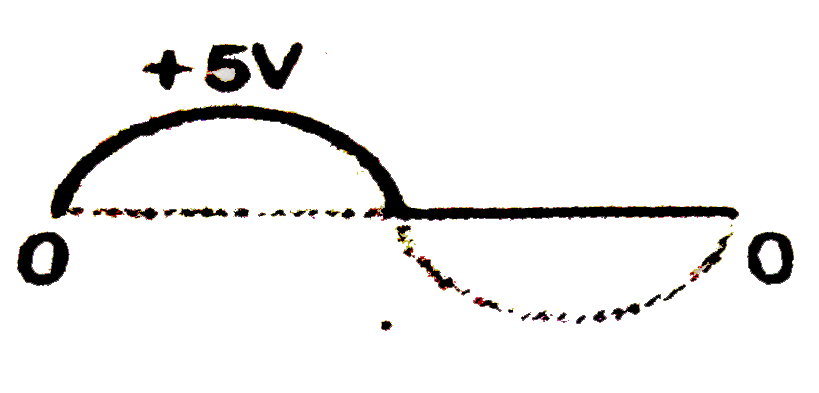
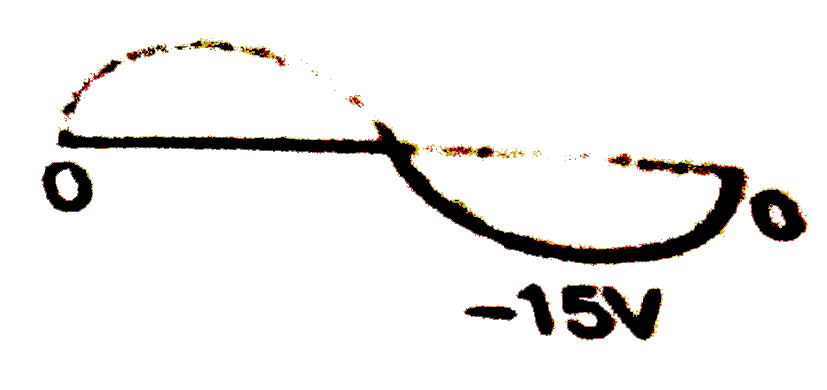
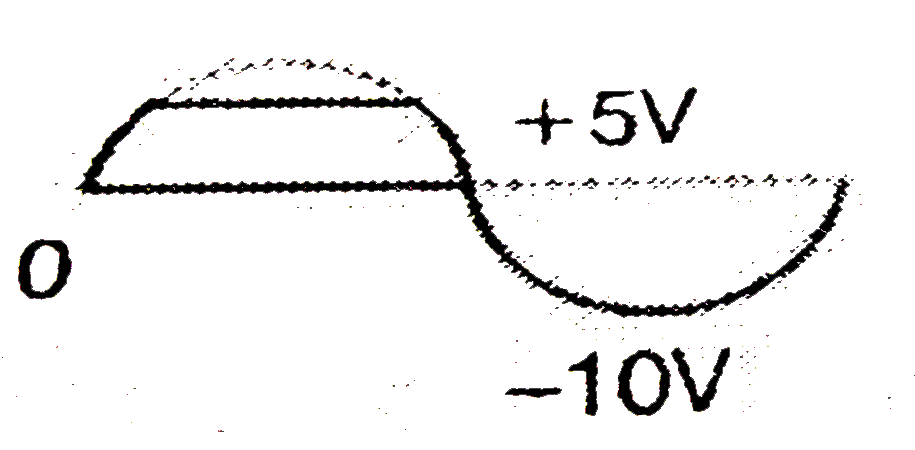
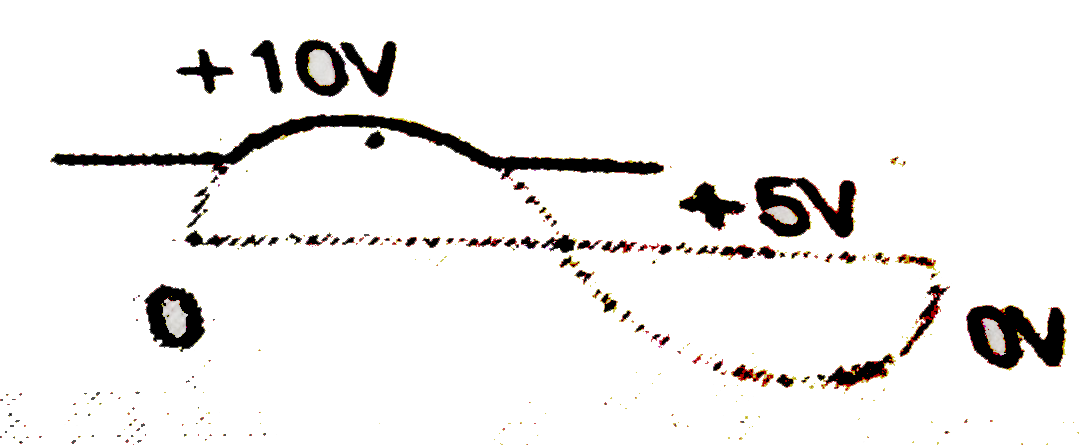
In the figure, D is an ideal diode and an alternating voltage of peak value 10 volts si connected as input V_(1). Which of the following figures represents the correct waveform of output voltage V_(0) ? |
|
Answer»
|
|
| 26. |
If vec(A) = 2i + 3j and vec(B) =2 j + 3k the component of vec(B) along along vec(A) is |
|
Answer» 6 |
|
| 27. |
The distance between Ahmedabad and Vadodara is 100 km. Two trains set-off simultaneously from Ahmedabad and Vadodara towards each other. The speed of these trains are 45 kmh^(-1) and 30 kmh^(-1) respectively. When will they cross each other ? |
|
Answer» Solution :Speed of train set off from Ahemdabad, `v_(A) = 45 KM H ^(-1)` Speed of train set off from Vadodara, `v _(B)( = - 30 km h ^(-1)` (this train is moving in opposite direction) `x_(BO) - x_(AO) = 100 km` When both trins meet, the relative displacement will be zero. i.e., `x _(B) - x_(A) = 0` `therefore x_(B) - x_(A) = (x _(BO) - x _(AO)) + (v _(B) - v_(A)) t ` `therefore 0=100 + (-30 -45) t` `therefore 75 t = 100` `therefore t = (100)/(75) = 4/3` hours. |
|
| 28. |
Give the magnitude and direction of the net force acting on (a) a drop of rain falling down with a constant speed, (b) a cork of mass 10 g floatingon water, (c) a kite skillfully held stationary in the sky, (d) a car moving with a constant velocity of 30 km/h on a rough road, (e) a high-speed electron in space far from all material objects, and free of electric and magnetic fields. |
| Answer» Solution : (a) to (d)No net FORCE according to the First LAW (e)No force, since it is FAR awayfrom all material agencies producing electromagnetic and gravitational FORCES. | |
| 29. |
The co-ordinates of centre of mass of particles of mass 10,20 and 30 gm are (1,1,1) cm. The position co-ordinates of mass 40gm which when added to the system , the position of combined centre of mass be at (0,0,0) are |
|
Answer» `(3//2,3//2,3//2)` |
|
| 30. |
7500 cal of heat is supplied to 100g of ice 0 ""^(@)C. If the latent heat of fusion of ice is 80 cal g^(-1) and latent heat of vaporization of water is 540 cal g^(-1), the final temperature of water is |
|
Answer» `100^(@)C` |
|
| 31. |
If an object of mass 2 kg is thrown up from the ground reaches a height of 5 m and falls backto the Earth (neglect the air resistance) Calculate (a) The work done by gravity when the object reaches 5 m height (b) The work done by gravity when the object comes back to Earth (c) Total work done by gravity both in upward and downward motion and mention the physical significance of the result |
|
Answer» SOLUTION :When the object goes up, the displacement POINTS in the upwand direction whereas thegravitational force acting on the object points in downward direction. Therefore, the ANGLE between gravitational force and displacement of the object is `180^(@)` (a) The work done by gravitational force in the upward motion Given that `dr = 5m and F = mg` `W_(up)=Fdrcos theta = mgdrcos 180^(@)` `W_(up)= 2xx10xx5xx(-1)=-100 JOULE``[cos180^(@)=-1]` (b) When the object falls back, both the gravitational force and displacement of the object are in the same direction. This implies that the angle between gravitational force and displacement of the object is `0^(@)` `W_(down)=Fdrcos0^(@)` `W=_(down)=2xx10xx5xx(1)=100joule``[cos0^(@)]` (c) The total work done by gravity in the entire trip (upward and downward motion) `W_("total")= W_("up") w_("down")=-100" joule + 100 joule "= 0` It implies that the gravity does not transfer any energy to the object. When the object is thrown upwards, the energy is transferred to the object by the extemal agcocy, which means that the object gains some energy. As soon as it comes back and hits the Earth, the energy GAINED by the object is transferred to the surface of the Earth (i e., dissipated to the Earth). |
|
| 32. |
A body of mass 1.0 kg is suspended from a weightless spring having force constant 600 N/m. Another body of mass 0.5 kg moving vertically upwards hits the suspended body with a velocity of3.0 m/sec and gets embedded in it. Find the amplitude of oscillation. |
|
Answer» SOLUTION :By conservation of LINEAR MOMENTUM in the collision `mv=(m+M)V` `impliesV=(mv)/(m+M)=(0.5xx3)/((1+0.5))=1` m/sec Now just after collision the system will have `KE=1/2(m+M)V^(2)` at equiibrium position. So after collision by conservation of MECHANICAL ENERGY `KE_("max")=PE_("max")` `1/2(m+M)v^(2)=1/2KA^(2)` `impliesA=Vsqrt(((m+M)/k))=1sqrt(1.5/600)=1/20m=5cm` |
|
| 33. |
In figure (i) the man walks2 m carrying a mass of 15 kg on his hands .In figure (ii) , he walks the same distancepullingthe ropebehind him . The ropegoesover a pulley , and a mass of 15 kg hangsat its other end . In which case is the work done greater ? |
|
Answer» Solution :In figure (a) force is applied on the mass , BYTHE manin vertically upward direction but distanceis movedalongthe horizontal.Sothe ANGLE between gravitational force ( in downward) and distance is `theta = 90^(@)` .HENCE work done `W = Fd cos 90^(@)` ` :. W = 0 ` From figure (b) Man walks horizontally by rope as a result tensionforce EXERTS in the rope after pulley and if body of mass 15 kg makes displacement of 2m . in upward direction then work dne , `W = Fd cos 0^(@)` = Fd = mgd ` = 15 xx 9.8 xx2 = 294 J ` Hence , work is more in case (b) |
|
| 34. |
A satellite is revolving in a circular orbit round the earth at a height of 3200 km. If the acceleration due to gravity at that height is 4.378 m//s^2 , find the orbital speed of the satellite. |
| Answer» SOLUTION :`6.483 KMS^(-1)` | |
| 35. |
A car running with a velocity 72 kmph on a level road, is stopped after travelling a distance of 30m after disengaging its engine (g = 10ms^(-2)). The coefficient of friction between the road and the tyres is |
|
Answer» 0.33 |
|
| 36. |
Physics involves the study of |
| Answer» Answer :(d) | |
| 37. |
Three objects, A : (a solid sphere), B : (a thin circular disk) and C : (a circular ring), each have the same mass M and radius R. They all spin with the same angular speed omega about their own symmetry axes. The amounts of work (W) required to bring them to rest, would satisfy the relation. |
|
Answer» `W_(A)gtW_(C)gtW_(B)` `therefore W=(1)/(2)Iomega^(2)` `therefore WpropI [because (1)/(2),W" SIMILAR"]` Now, for solid sphere, `I_(A)=(2)/(5)MR^(2)=0.4 MR^(2)` For disc, `I_(B)=(1)/(2)MR^(2)=0.5MR^(2)` for RING, `I_(C)=MR^(2)=MR^(2)` `therefore I_(C)gtI_(B)gtI_(A)` because `W_(C)gtW_(B)gtW_(A)` |
|
| 38. |
Two particles move in a uniform gravitational field an acceleration "g". At the initial moment the particles were located at same point and moved with velocities u_(1) = 0.8ms^(-1) and u_(2) = 4.0ms^(-1) horizontally in opposite directions. Find the distance between the particles at the moment when their velocity vectors become mutually perpendicular. (g=10ms^(-2)) |
|
Answer» Solution :`t = SQRT((u_(1)u_(2))/(g)), "X" = (u_(1)+u_(2))t` 0.48m 
|
|
| 39. |
The unit vector perpendicular to vectors a=3hati+hatj and =2hati-hatj-5hatk is |
|
Answer» `+-((HATI-3hatj+hatk))/(SQRT(11))` `axxb=|(hati, hatj, hatk),(3,1,0),(2,-1,-5)|=(-5)hati-(-15-0)hatj+(-3-2)hatk` `=-5hati+15hatj-5hatk` `R=axxb=-5(hati-3hatj+hatk)` `HATR=(hati-3hatj+hatk)/(sqrt((1)^(2)+(-3)^(2)+(1)^(2)))=(hati-3hatj+hatk)/(sqrt(11))` |
|
| 40. |
A capillary tube of radius r is dipped vertically in a liquid of density d, surface tension T and angle of contact theta then the pressure difference just below the two surface, one in the beaker and the other in the capillary tube, is : |
|
Answer» ` ( 2T)/( r)` |
|
| 41. |
Viscosity is the property of liquids by virtue of which they ………….. . |
|
Answer» oppose the relative MOTION of its PARTS |
|
| 42. |
On an average a human heart is found to beat 81 times in a minute. Calculate its frequency and period. |
| Answer» SOLUTION :`F= 1.35 HZ, T = 0.74s` | |
| 43. |
An aluminiumum foil of relative emittance 0.1is placed in between two concentric spheres at temperatures 300K and 200k respectively.Calculate the temperature of the foil after the steady state is reached .Assume that the spheres are perfect black body radiators. Also calculate the rater of energy transfer between one of the spheres and the foil. [sigma=5.67xx10^(-8)S.I. Unit] |
|
Answer» Solution :Let T be the temperature of the foil .When the steady STATE is rerached, `esigma(T_(1)^(4)-T^(4)=esigma(T^(4)-T_(2)^(4))` `300^(4)-T^(4)=T^(4)-(200)^(4)` `T^(4)=4.85xx10^(9)` T = 263.8 K Rate of energy transfer= E =`esigma(T_(1)^(4)-T^(4))` `0.1xx5.67xx10^(-8) [300^(4)-(263.8)^(4)]` `18.5 W// m^(2)` |
|
| 44. |
A simple pendulum is hanging from a per inserted in a vertical wall. Its bob is stretched to horizontal position from wall and is left free to move, the bob hits the wall. If coefficient of restitution is2/sqrt(5) After how many collision the amplitude of vibration will become less than 60° (Hint: h_(n) le h(1- cos theta)) |
|
Answer» 6 |
|
| 45. |
If three particles each of mass m are placed at the three corners of an equilational triangle of side 1, the workdone to increase the side of that triangle 21 is: |
| Answer» Answer :B | |
| 46. |
(A): Centrifugal force is reactionary force of centripetal force (R): A simple pendulum is oscillating in vertical plane then mean position net force on pendulum is zero. |
|
Answer» If both A ANDR are TRUE and R is the CORRECT explanation of A |
|
| 47. |
A solid cylinder of mass 'm' rolls without slippling down an inclined plane making an angle theta with the horizontal. The frictional force between the cylinder and the incline is |
|
Answer» `mgsintheta` |
|
| 48. |
If vectors vecA and vecB are 3i-4j+5k and 2i + 3j - 4k and 2hat(i)+3hat(j)-4hat(k) respectively find the unit vector parallel to vecA + vecB |
|
Answer» `(5i-j+k)/(SQRT(27))` |
|
| 49. |
A particle performs linear SHM of period (2pi)/(omega) about a centre O and is observed to have a velocity b omega sqrt(3) when at a distance b from O. If the particle is moving towards the positive extremity at that instant, show that it will travel a further distance b in a time (pi)/(3omega) before coming momentarily to rest. |
|
Answer» SOLUTION :GIVEN `T=(2pi)/(omega), v=b omega sqrt(3)` and `x=b` SUBSTITUTING in `v=omega(A^(2)-x^(2))` we get `b omega sqrt(3)=omegasqrt(A^(2)-b^(2))` squaring `3b^(2)omega^(2)=omega^(2)(A^(2)-b^(2))` `3b^(2)=A^(2)-b^(2)implies4b^(2)=A^(2)=A=+-2b` The time taken (t) to travel from the mean position to a distance b can be found from `x=A sin omegat` We have `x=b,A=2b"":. b=2b sin omegat` `sin omegat=1/2,omegat=(pi)/6impliest=(pi)/(6 omega)` `:.` Further time taken to reach the extreme position `=T/4-(pi)/(6omega)=(2pi)/(4omega)-(pi)/(6omega)=(pi)/(3omega)` It will momentarily come to rest when it reaches the positive extreme position. Furtherdistance travelled `=A-b=2b-b=b` |
|
| 50. |
(A): Air pressure in a car tyre increases during driving. (R) : Absolute zero temperature is not zero energy temperature. |
|
Answer» Both (A) and ( R) are true and (R ) is the correct explanation of (A) |
|