

Saved Bookmarks
This section includes 7 InterviewSolutions, each offering curated multiple-choice questions to sharpen your Current Affairs knowledge and support exam preparation. Choose a topic below to get started.
| 1. |
Figure shows a rod length l resting on a wall and the floor. Its lower end A is pulled towards left with a constant velocity v. Find the velocity of the other end B downward when the rod makes an angle theta with the horizontal. |
|
Answer» Solution :In such type of problems, when velocity of one part of a body is GIVEN and that of other is required, we first FIND the relation between the two displacement, then differentiate them with respect to time. Here if the distance from the corner to the point A is x and up to B is y. Then `v=(dx)/(DT)& v_(B)=-(dy)/(dt)` (-sign DENOTES that y is DECREASING) Further, `x^(2)+y^(2)=l^(2)` Differentiating with repsect to time t `2x(dx)/(dt)+2y(dy)/(dt)=0 ""xv=yv_(B)` `v_(B)+(v)(x)/(y)=vcottheta` |
|
| 2. |
(A) By increasing the diameter of the objective of telescope. We can increase its range. ( R) The range of a telescope tells us how far away a star of some standard brightness can be spotted by telescope. |
|
Answer» Both A and R are true and R is the CORRECT explanation of A |
|
| 3. |
Explain how will you measure (i) the size of astronomical object and (ii) the distance of a nearby star. |
| Answer» SOLUTION : 1(C ).4 | |
| 4. |
A particle with restoring force proportional to displacement and resisting force proportional tovelocity is subjected to a force F sin omegat . If the amplitude of the particle maximum for omega=omega_(2) then (omega_(0) is the angular frequency of undampled oscillations ). |
|
Answer» `omega_(1)=omega_(0) ` and `omega_(2)!=omega_(0)` |
|
| 5. |
The temperature at which the speed of sound in air becomes double its value at 27^(@) C is ……….. . |
|
Answer» `54^(@) C` |
|
| 6. |
A body of mass M is attached to the lower end of a metal wire, whose upper end is fixed. The elongation of the wire is l. a) Loss in gravitational potential energy of M is Mg l b) The elastic potential energy stored in the wire is Mgl c) The elastic potential energy stored in the wire is 1/2 Mgl d) Heat produced is 1/2 Mgl |
|
Answer» only a, B are TRUE |
|
| 7. |
Arun and Babu carry a wooden log of mass 28 kg and length 10 m which has almost uniform thickness. They hold it at 1 m and 2 m from the ends respectively. Who will bear more weight of the log? [g=10 ms^(-2)] |
|
Answer» Solution :Let us consider the log is in mechanical equilibrium. Hence, the net force and net torque on the log must be zero. The gravitational force acts at the center of mass of the log downwards. It is cancelled by the normal reaction forces `R_(A) and R_(B)` applied upwards by Arun and Babu at points A and B respectively. These reaction forces are the weights BOME by them. The TOTAL weight, `W-mg=28 xx 10 = 280` N, has to be bome by them together. The reaction forces are the weights bome by each of them separately. Let us show all the forces acting on the log by DRAWING a free body diagram of the log. For translational equilibrium: The net force acting on the log must be zero. `R_(A)+(-mg)+R_(B)=0`  Here, the forces R, and R, are taken positive as they act upward. The gravitational force acting downward is taken negative.  The net torque acting on the log must be zero. For ease of calculation, we can TAKE the torque caused by all the forces about the point A on the log. The forces are perpendicular to the distances. Hence `(OR_(A))+(-4mg)+(7B_(R))=0` Here, the reaction force `R_(A)` cannot produce any torque as the reaction forces pass through the point of reference A. The torgue of force me produces a clockwise turn about the point A which is taken negative and torque of force `R_(B)` causes anti-clockwise tum about A which is taken positive `7R_(B)=4mg` `R_(B)=(4)/(7)Mg` `R_(B)=(4)/(7)xx28xx10=160 N` By substituting for `R_(B)` we get `R_(A)=mg=R_(B)` `R_(A)=mg=R_(B)` `R_(A)=28xx10=160N` As `R_(V)` is greater than `R_(A)` it is concluded that Babu bears more weight than Arun. The one closer to center of mass of the log bears more weight. |
|
| 8. |
A body describes simple harmonic motion with an amplitude of 5 cm and a period of 0.2s. Find the acceleration and velocity of the body when the displacement is 3 cm. |
|
Answer» Solution :Here, `A= 5 cm =0.05 m, T= 0.2s` `therefore omega = (2pi)/(T) = (2pi)/(02) = 10pi rad s^(-1)` When displacement is y, then acceleration `a= -omega^(2) y" and VELOCITY " V= omega SQRT(A^(2)- y^(2))` When `y= 3 cm = 0.03 m`. acceleration `a= -omega^(2)y` `= -(10pi)^(2) xx 0.03 = -3pi^(2) ms^(-2)` and velocity `v= omega sqrt(A^(2) -y^(2))` `= 10pi (sqrt((0.05)^(2) - (0.05)^(2)))` `=10pi (sqrt(0.0025- 0.0009))` `= 10pi (sqrt(0.0016)) = 10pi xx 0.04` `therefore v = 0.4pi ms^(-1)`. |
|
| 9. |
A body describes simple harmonic motion with an amplitude of 5 cm and a period of 0.2s. Find the acceleration and velocity of the body when the displacement is 0 cm. |
|
Answer» Solution :Here, `A= 5 cm =0.05 m, T= 0.2s` `therefore omega = (2PI)/(T) = (2pi)/(02) = 10pi RAD s^(-1)` When displacement is y, then acceleration `a= -omega^(2) y" and velocity " V= omega sqrt(A^(2)- y^(2))` When `y= 0 cm`. acceleration `a= -omega^(2)y` `= -(10pi)^(2) xx 0 = 0` and velocity `v= omega sqrt(A^(2) -y^(2))` `= 10pi (sqrt((0.05)^(2) - (0)^(2)))` `=10pi xx 0.05` `= 0.5pi ms^(-1)`. |
|
| 10. |
A cubical block of mass M and edge a slides down a rough inclined plane of inclinatione with a uniform velocity. The torque of the normal force on the block about its centre has a magnitude |
|
Answer» zero |
|
| 11. |
If vec(F) = 3hat(i) +4hat(j) + 5hat(k) and vec(S) = 6hat(i) + 2hat(j) + 5hat(k), find the work done by the force. |
|
Answer» 51 units |
|
| 13. |
Two billiard balls of the same size (radius r) and same mass are in contact on a billiard table. A third ball also of the same size and mass strikes them symmetrically and remains at rest after the impact. The coefficient of restitution between the balls is |
Answer» Solution : `sin theta = (r )/(2r)=(1)/(2), "" therefore theta = 30^(@)` From conservation of LINEAR momentum `m u = 2mv COS 30^(@)` or `v=(u)/(sqrt(3))` Now `e=("relative velocity of SEPARATION")/("relative velocity of approach")` in COMMON normal direction Hence, `e=(v)/(u cos 30^(@))=(u//sqrt(3))/(u sqrt(3)//2)=(2)/(3)` |
|
| 14. |
The work done to increase unit areaof the liquid. Surface at same temperature is called. |
|
Answer» SURFACE tension |
|
| 15. |
If each square cm of the sun's surface radiates energy at the rate of 6.42xx10^(3) Js^(-1) cm^(-2) , calculate the temperature of the sun's surface in degree celsius, assuming Stefan's law applies to the radiation. (Stefan's constant = 5.67xx10^(-8)Wm^(-2)K^(-4)) |
|
Answer» |
|
| 16. |
Steradian is the solid angle subtended at the centre of the sphere by its surface whose area is equal to _____ of the sphere. |
|
Answer» the radius |
|
| 17. |
Calculate the masses of silver, iron and aluminium which have the same thermal capacity as a litre of water. Their specific heats are 235.2 J Kg^(- 1)K^(-1), 130.2 JKg^(-1) K^(-1) and 924 JKg^(-1)K^(-1) respectively. |
|
Answer» |
|
| 18. |
If a comet suddenly hits the moon and imparts energy which is more than the toatl energy of the moon, what will happen? |
|
Answer» Solution :A comet with small velocity and high mass, doesn,t trigger the moon much. It jus makes a circular shaped impact. The moon is ment for the PROTECTION for LIFE on earth and to attain stability for the earth ROTATION. But a comet with LARGE mass and with large mass and with large velocity may destroy the moon completely or its impact makes the moon, GO out of its orbit. |
|
| 19. |
Uniform rod Ab is hinged at the end A in the figure. The other end of the rod is connected toa block through a massless string as shown. The pulley is smooth and massless. Masses of the block and the rod are same and are equal to 'm'. Acceleration due to gravity is g. The tension in the thread and angular acceleration of the rod just after releases of block from this position are |
|
Answer» `(3mg)/(8),(g)/(8l)` |
|
| 20. |
A heavy particle is suspended by a light thread, the other end of the thread being fixed to a point O. The particle is projected from its lower position in the horizontal direction in the vertical plane through O, with such a velocity that it leaves the circular path after an angular displacement theta Show that when the string again becomes taut it makes an angle 3theta-360^(@) with the downward drawn vertical. |
|
Answer» |
|
| 21. |
A child is standing with folded hands at the centre of a platform rotating about its central axis. The K.E. of the system is K. The child now stretches his arms so that the M.I of the system doubles. The K.E of the system now is |
| Answer» ANSWER :B | |
| 22. |
Derive an expression for kinetic energy in pure rolling. |
|
Answer» Solution :In perfectly inclastic collision, the loss in kinetic energy during collision is transformed to another form of energy like sound, thermal, heat. light ETC. LET `KE_(i)` be the total kinetic energy before collision and `KE_(f)` be the total kinetic energy after collision. Total kinetic energy before collision, `KE_(i)=(1)/(2)m_(1)u_(1)^(2)+(1)/(2)m_(2)u_(2)^(2)` ...(1) Total kinetic energy after collision. `KE_(f)=(1)/(2)(m_(1)+m_(2))V^(2)` ...(2) Loss of KE, `DeltaQ=KE_(f)-KE_(i)=(1)/(2)(m_(1)+m_(2))v^(2)-(1)/(2)m_(1)u_(1)^(2)-(1)/(2)m_(2)u_(2)^(2)` ...(3) Substituting equation `v = (m_(1)u_(1)+m_(2)u_(2))/((m_(1)+m_(2)))` in equation (3), and on simplifying (expand v by using the algebra `(a +b)^(2) = a^(2) +b^(2) + 2ab` , we get Loss of KE, `DeltaQ=(1)/(2)((m_(1)m_(2))/(m_(1)+m_(2)))(u_(1)-u_(2))^(2)` |
|
| 23. |
What is latent heat ? Explain with example. |
|
Answer» Solution :Certain amount of heat energy is transferred between a SUBSTANCE and its surroundings when it undergoes a change of state. The amount of heat per unit mass transferred during change of state of the substance is called latent heat of the substance is called latent heat of the substance for the process. For example, if heat is added to a given quantity of ice at `-10^(@)C`, the temperature of ice increases until it reaches its melting point `(0^(@)C)`. At this temperature, the addition of more heat does not increase the temperature but causes the ice to melt, or changes its state. Once the entire ice melts, adding more heat will cause the temperature of the water to rise. A similar SITUATION occurs during liquid gas change of state at the boiling point. Adding more heat to boiling water causes vaporisation, without increase in temperature. The heat required during a change of state depends upon the heat of transformation and the mass of the substance undergoing a change of state. Thus, if mass m of a substance undergoes a change from one state to the other, then the quantity of heat required is given by `Q=m" L or L"=Q/m` where L is known as latent heat and is a characteristic of the substance. Its SI unit `"J kg"^(-1)`. The value of L also depends on the pressure. Its value is usually quoted at standard atmospheric pressure. The latent heat for a solid liquid state change is called the latent heat of fusion `(L_(f))`, and that for a liquid-gas state change is called the latent heat of vaporisation `(L_(v))`. These are often referred to as the heat of fusion `(L_(f))` and the heat of vaporisation. A plot of temperature versus heat energy for a quantity of water is shown in figure,  When heat is added (or removed) during a change of state, the temperature remains constant. In figure the slopes of the phase lines are not all the same, which indicates that specific heats of the various states are not equal. For water, the latent heat of fusion and vaporisation are `L_(f)=3.33xx10^(5)" J kg"^(-1)` and `L_(v)=22.6xx10^(5)" J kg"^(-1)` RESPECTIVELY. That is `3.33xx10^(5)` J of heat are needed to melt 1 kg of ice at `0^(@)C`, and `22.6xx10^(5)J` of heat are needed to convert 1 kg of water to steam at `100^(@)C`. So, steam at `100^(@)C` carries `22.6xx10^(5)" J kg"^(-1)` more heat than water at `100^(@)C`. This is why burns from steam are usually more serious than those from boiling water. 
|
|
| 24. |
A rod of length l(lt2R) is kept inside a smooth sperical shell as shwon in fifure .mass of the rod is m Keeping mass to be constant I flength of the rod is increased ("but always " lt 2R ) the normal reaction at two ends of the rod |
|
Answer» will remain constant |
|
| 25. |
Assuming all the surface to be frictionless. The smaller block m ismoving horizontally with acceleration a and vertically downwards with acceleration a. Then magnitude of net acceleration of smaller block m with respect to ground |
|
Answer» `(2sqrt5mg)/((5m+M))` `mg-T=m2a…(i)` `N=ma …(ii)` Free body diagram for M For M, `2T-N=Ma…(iii)` on solving, `a=(2mg)/((M+5m))` Net ACCELERATION of m, `a_(m)=sqrt(4a^(2)+a^(2))=sqrt5a=(2sqrt5mg)/((5m+M))` 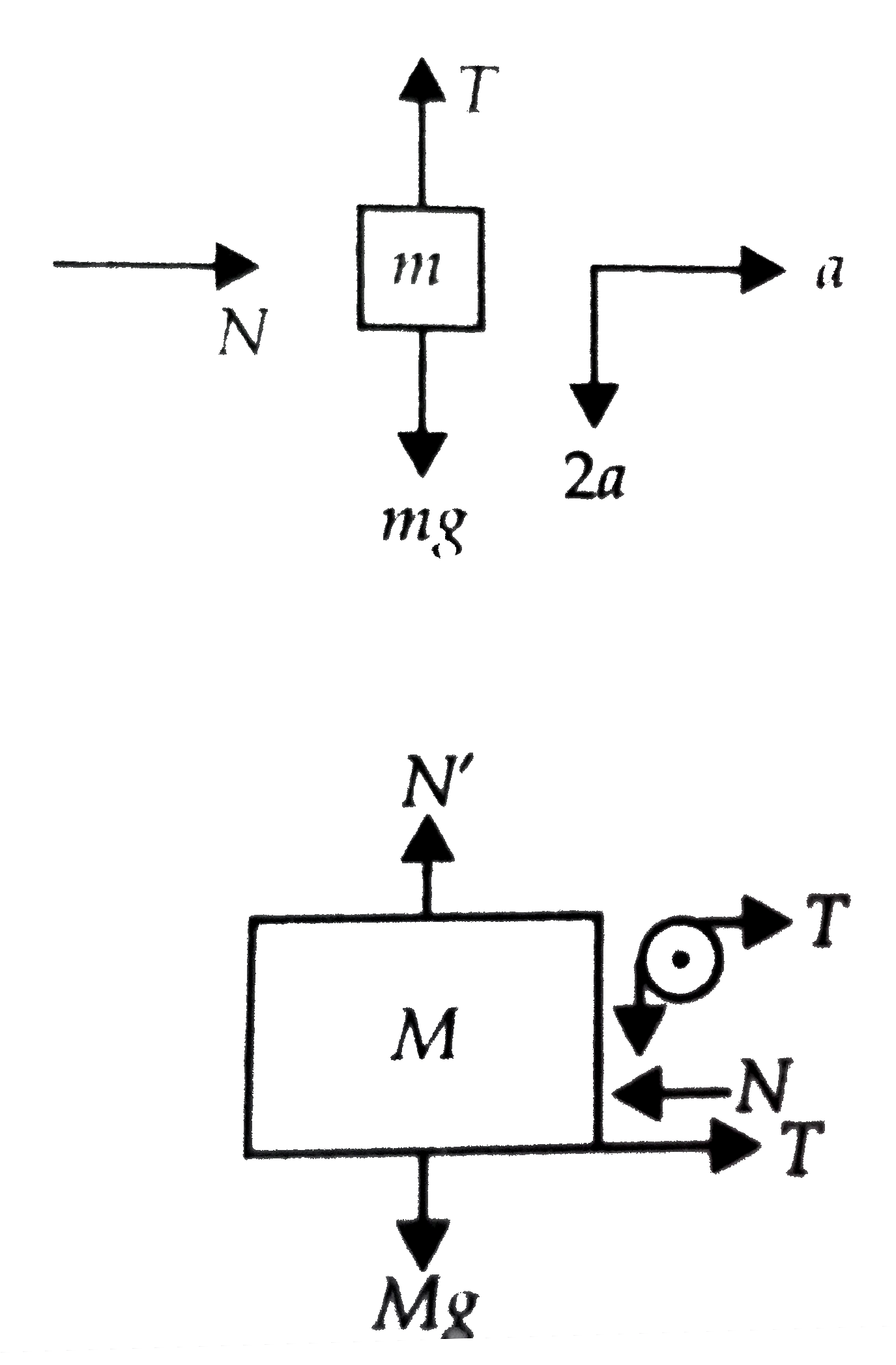
|
|
| 26. |
Mass m is connected with an ideal spring of natural length l whose other end is fixed on a smooth horizontal table. Initially spring is in its natural length. Mass m is given a velocity 'v' perpendicular to the spring and released. The velocity perpendicular to the spring when its length is, will be |
|
Answer» `("2vl")/(L+x)` |
|
| 27. |
A cart of mass 250 kg is taken along a polished inclined surface to the top of a platform which is at a height of 2 m above the ground level. Find the work done by the external force moving the cart to the top. |
|
Answer» SOLUTION :m = 250 kg, height h = 2 m, Work done W = MGH `= 250 XX 9.8 xx 2 = 250 xx 19.6` = 4900 J = 4.9 kJ |
|
| 28. |
The filament of a 60 watt electric light bulb of diameter 0.06 mm runs at a temperature of 3000K. Assuming that it radiates as a black bodyy, loses no energy except as radiation and receives no energy except that supplied electrically, find the length of the filament |
| Answer» Answer :A | |
| 29. |
A fruit dropped from the top of a tree of height 200 m high splashes into the water of a pond near the base of the tree. When is the splash heard at the top given that the speed of sound in air is 340 ms^(-1). |
|
Answer» Solution :Let TOTAL time `t=t_(1) + t_(2)`, where `t_(1)` is the time taken from top to SURFACE of WATER and `t_(2)` is the time taken by SOUND to reach the top. Calculation of `t_(1)`: Using `s= ut_(1) + 1/2at_(1)^(2)` Putting, u=0, a=g `=9.8 m//s^(2)` S= 200 m, we get `200 = 1/2 xx 9.8 xx t_(1)^(2)` `200 = 4.9 xx t^(2), t^(2) = 40.816` t= 6.3887 s. and Calculation of `t_(2)`: Using `V= s/t_(2)`, `t_(2) =s/v =200/340 = 0.588`s. `therefore` Total time `t=t_(1) + t_(2)` =6.3887 + 0.588 = 6.97 s The splash has heard at 6.97 s. |
|
| 30. |
What is acceleration ? What is the direction ? Also gives its unit. |
| Answer» SOLUTION :ime RATE of CHANGE of velocity is CALLED acceleration. Its direction is in the direction of change in velocity. Its unit is `m//s^(2)` | |
| 31. |
Assertion: Friction is necessary for abody to roll on a surface. Reason:Friction provides the necessary tangential force and torque. Which one of the following statement is correct? |
|
Answer» Assertion and REASON are TREU and reason explains assertion correctly. |
|
| 32. |
The displacement of a body of mass 2 kg varies with time t as S = t^2 + 2t, where S is in m and t is in s. The work done by all the forces acting on the body during the time interval t = 2to t =4 s is |
| Answer» ANSWER :B | |
| 33. |
A carnot engine opeates between two reservoirs of temperature 900K and 300K. The engine performs 1200J of work per cycle. The heat energy in (J) delivered by the engine to the low temperature reservoir in a cycle is |
|
Answer» 800J `:. eta =1- (300)/(900)` `:. eta= 1- (1)/(3)= (2)/(3)` and `eta= (W)/(Q)` `:. Q_(h) = (W)/(eta)` `Q_(h)` = Heat of SOURCE `:. Q_(h)= (1200)/(2) xx (3)/(1)` `:. Q_(h)= 1800J` Now `W= Q_(h) - Q_(L)` `:. Q_(L)= Q_(h) - W` `=1800-1200` `:. Q_(L)= 600J` |
|
| 34. |
The direction of torque is found using |
| Answer» Answer :B | |
| 35. |
At time t second, a particle of mass 3kg has position vector vecr metre, where vecr = 3t hati -4cos t hatj . The impulse of the force during the time interval 0 le t le pi/2 . |
|
Answer» `12 hatj Ns` |
|
| 36. |
Asphere of radius 10 cm and mass 25 kg isattached to the lower end of a steel wire of length 5 mand diameter 4 mmwhich is suspended from the ceiling of a room . The pointof support is 521 cmabove the floor. When the sphere is set swinging as a simple pendulum, its lowest point just grazes the floor. Calculate the velocity of the ball at its lowest position (Y_(steel) = 2xx10^(11) N//m^(2)). |
|
Answer» SOLUTION :L = 5cm, l = 5.01 - 5 = 0.01 m, m = 25 kg Young.s modulus `Y = (F//A)/(I //L) , A = pi xx (5 xx 10^(-4))^(2).^(2)` `F = (YIA)/L =(20 xx 10^(10) xx 0.01 xx pi xx (5 xx 10^(-4))^(2))/5 = 314 N` The tension in the string `T= MG + (mv^(2))/r,` where r = 5.11 m The centripetal force `=(mv^(2))/r = T - mg = F-mg` `v = sqrt((Fr)/m - gr) = sqrt((3.14 xx 5.11)/25) -9.8 xx 5.11) = 3.75` m/s |
|
| 38. |
The velocity-time graph of a particle in one dimensional motion is shown in Fig. 2 (NCT) . 15 . Which of the following formulae are correct for describing the motion of the particle over the time intervalt_1 and t_2. . |
| Answer» Solution :From the GRAPH we NOTE that the slope that the slope is MOT CONSTANT and is not uniform and is not uniform, hecne the relation (i), (ii) and (v) and are not correct, but the relations (iii), (iv) and (VI) are correct. | |
| 39. |
An object of mass m is projected from the ground with initial speed v_(0) Find the speed at height h. |
Answer» Solution :SINCE the gravitational force is conservative, the total energy is CONSERVED throughout the motion.  Final values of potential energy, kinetic energy and total energy are measured at the height h. By law of conservation of energy, the initial and final total ENERGIES are the same. `1/2mv_(0)^(2)=1/2mv^(2)+MGH` `v_(0)^(2)=v^(2)+2gh , v=sqrt(v_(0)^(2)-2gh)` |
|
| 40. |
A ball of mass m is through vertically upward from the ground and reaches a height h before momentarily coming to rest. If g is acceleration due to gravity, the impulse received by the ball due to gravity force during its flight is |
|
Answer» `sqrt(2M^(2)gh)` |
|
| 41. |
Can commutative law be applied to vector subtraction ? |
|
Answer» |
|
| 42. |
Derive the S.I. unit of joule in terms of fundamental units. |
| Answer» SOLUTION :`1J=1Nm=1kgms^(-2)xxm=1kgm^(2)s^(-2)` | |
| 43. |
A particle is moving east wards with a velocity of 15 ms^(-1). In a time of 10 s, the velocity changes to 15 ms^(-1) northwards. Average acceleration during this time is (in ms^(-2)) |
|
Answer» `3//sqrt(2)` NE |
|
| 44. |
In a screw gauge, 5 complete rotations of circular scale give 1.5 mm reading on pitch scale. Consider circular scale has 50 divisions. Least count of the screw gauge is |
|
Answer» 0.006 MM |
|
| 45. |
In Vander Waal's gas equation (P + (2)/(V^(2))) (V-b) = RT. Determine the dimensions of a and b. |
|
Answer» <P> SOLUTION :Since DIMENSIONALLY similar quantities can only be ADDED`[P] [(a)/(V^(2))] rArr [a] = [PV^(2)] = [M^(1)L^(5)//T^(-2)]` [b] = [V] = `[L^(3)]` . |
|
| 46. |
A 40 cmlong wire havinga mass 3.1 gm and area of cross section 1mm^(2) is stretched between the support 40.05 cm apart. In its fundamental mode , it vibrates with a frequency 1000//64 Hz. Find the young's modulus of the wire in the form X xx 108 N-m^(2) and fill value of X. |
|
Answer» |
|
| 47. |
A 0.02 kg weight produces an extension of 0.02 m in a vertical spring. A mass of 0.1kg is suspended at its bottam and is left after putting down. What is the period of oscillation ? |
|
Answer» |
|
| 48. |
Given the vector vecA=2hati+3hatj what is 3vecA? |
|
Answer» SOLUTION :`3vecA=3(2hati+3hatj)=6hati+9hatj` The VECTOR `3vecA` is in the same DIRECTION as vector `VECA`. |
|
| 49. |
Can a room be cooled by leaving the door of an electric refrigerator open? |
| Answer» Solution :No. When the door of the refrigerator is KEPT open, it EXTRACTS a HEAT Q from the room. Work W is done on it by the electric motor and more heat Q+W is rejected to the room itself. Hence the room will get slightly HEATED. | |