

Saved Bookmarks
This section includes 7 InterviewSolutions, each offering curated multiple-choice questions to sharpen your Current Affairs knowledge and support exam preparation. Choose a topic below to get started.
| 1. |
The absolute zero is the temperature at which |
|
Answer» water freezes |
|
| 2. |
A chain of length l and mass m lies on the surface of a smooth hemisphere of radius R gt l with one end tied to the top of the hemisphere. Find gravitational potential energy of the chain with reference to the top of the hemisphere |
|
Answer» |
|
| 3. |
The spring shown in figure is unstretched when a man starts pulling on the cord. The mass of the block is M. If the man exerts a constant force F, findthe energy stored in the spring when the block passes through the equilibrium position . |
| Answer» SOLUTION :`F^2/(2K)` | |
| 4. |
The spring shown in figure is unstretched when a man starts pulling on the cord. The mass of the block is M. If the man exerts a constant force F, findthe amplitude and the time period of the motion of the block. |
| Answer» SOLUTION :`F/k 2PI SQRT(M/k)` | |
| 5. |
The spring shown in figure is unstretched when a man starts pulling on the cord. The mass of the block is M. If the man exerts a constant force F, find the kinetic energy of the block at this position. |
| Answer» SOLUTION :`(3F^3)/(2K)` | |
| 6. |
A student performing Searle's experiment for finding the Young's modulus Y of the material of a wire takes the following observations: Length of the wire (L) =2.890 m, diameter of the wire (D) = 0.082cm, mass suspended from the wire (M) =3.00 kg, extension in the length of wire (l) = 0.087 cm. Calculate the maximum permissible error in the value of Y. |
|
Answer» Solution :The Young.s MODULUS of the material is given by, `Y = (4MgL)/(piD^(2)l)` Here M = 3.00 kg `"":. Delta M `=0.01 kg L = 2.890m `"" :. DeltaL` = 0.001m D= 0.082 cm `"" :. D ` = 0.001 cm `l` =0.087 cm `"" :. Delta l` =0.001 cm The maximum permissible percentage ERROR in Y is `((DeltaY)/(Y))_("MAX")xx100 = ((DeltaM)/(M)xx100)+((DeltaL)/(L)xx100)+2((DELTAD)/(D)xx100)+((Deltal)/(l)xx100)` =`(0.01)/(3.00)xx100+((0.001)/(2.890)xx100)+2xx((0.001)/(0.082)xx100)+((0.001)/(0.087)xx100)` `~~0.33%+0.035%+2.44%+1.15%~~4%` |
|
| 7. |
Asolid sphere weights 10 N in air, 6 N in water and 8 N in a liquid. If the relative density of the liquid is N/10, then N is equal to ______ |
|
Answer» |
|
| 8. |
A canon can fire shells at speed u. Inclination of its barrel to the horizontal can be changed in steps of Delta theta = 1^(@) ranging from theta_(1) = 15^(@) to theta_(2) = 85^(@). Let R_(n) be the horizontal range for projection angle theta = n^(@). Delta R_(n) = |R_(n) - R_(n+1)| For what value of n the value of DeltaR_(n) is maximum? Neglect air resistance. (ii) A small water sprinkler is in the shape of a hemisphere with large number of uniformly spread holes on its surface. It is placed on ground and water comes out of each hole with speed u. Assume that we mentally divide the ground into many small identical patches – each having area DeltaS. What is the distance of a patch from the sprinkler which receives maximum amount of water ? |
|
Answer» |
|
| 9. |
The pressure P_(1) and density d_(1) of a diatomic gas (gamma = 7//5)change to P_(2) and d_(2) during an adiabatic opertation. If (d_(2))/(d_(1)) = 32, find (P_(2))/(P_(1)). |
|
Answer» Solution :In an adiabatic operation, `P_(1)V_(1)^(GAMMA) = P_(2)V_(2)^(gamma)` `:. (P_(2))/(P_(1)) = ((V_(1))/(V_(2)))^(gamma) = ((m)/(d_(1)) XX (d_(2))/(m))^(gamma) = ((d_(2))/(d_(1)))^(gamma)` `:. (P_(2))/(P_(1)) = (32)^(7//5) = (2^(5))^(7//5) = 2^(7) = 128 :. (P_(2))/(P_(1)) = 128`. |
|
| 10. |
By sucking through a straw, a student can reduce the pressure in his lungs to 750 mm of Hg (Density = 13.6g//cm^(3)). Using the straw, he can drink water from a glass upto a maximum depth of |
| Answer» ANSWER :C | |
| 11. |
A mass of 0.5 kg is suspended with the help of a rubber cord of length 40 cm and radius 1 mm. If the Young's modulus of rubber is 0.3kg*mm^(-2), then determine the time period of vertical oscillation of the mass. |
|
Answer» |
|
| 12. |
An impulse ''I'' given to a body changes its velocity from ''v_(1) "to" v_(2)''. The increase in the kinetic energy of the body is given by |
|
Answer» `I(v_(1)+v_(2))` |
|
| 13. |
A gale blows over a house. The force due to the gale on the roof is ………… . |
|
Answer» in the DOWNWARD DIRECTION |
|
| 14. |
If the time period (T) of vibration and liquid drop depends on surface tension (S), radius (r) of the drop and density (rho)of the liquid, then the expression of T is |
|
Answer» `T = K (SQRT(RHO r^3))/(S)` |
|
| 15. |
There are three forces F_(1) F_(2) and F_(3) acting on a body, all acting on a point P on the body. The body is found to move with uniform speed. (a) Show that the forces are coplanar. (b) Show that the torque acting on the body about any point due to these three forces is zero. |
Answer» Solution :As showninfigurethreeforces`F_(1)F_(2) F_(3)` act atpointP on body  ( a) Figureshowsthat forces arein same planethat isforces arecoplanerbodymoveswithconstantuniform SPEED(velocity ) `F= ma` `-m (c )` `F_(1)+ F_(2)+ F_(3) = 0` (B )Calculatingtorque of these forcesaboutpointP .Asforcespassesthrough Ptorqueaboutpoint P is zero . |
|
| 16. |
An orifice of area 10 sq.mm is made at the bottom of a vessel cotaining water to a height of 10m above the orifice. What is the force on the vessel |
|
Answer» `9.98N` |
|
| 17. |
What are concurrent forces ? |
|
Answer» Solution :Concurrentforces: iflineof actionof all givenforcespassesthroughsamepointthentheseforces are calledconcurrentforces If onlyforce`VEC(f ) ` ACTON a particlethen it hasaccelerated motion. Itcannotremaininequilibrium. If force`vec(F)_(1)` and `vec(F)_(2)`act on particlethen forequilibrium`Sigma vec(F)` = means thisconditionis shownfigure  If thereforce `vec(F)_(1) vec(F)_(2)`and `vec(F)_(3)` act onaparticlethen forequilibrium `Sigma vec(F )=0` `:.vec(F)_(3)= - (vec(F)_(1)+ vec(F)_(2))` This isrepresentedin diagram shownbelow  byparallelogram LAWOF forceresultantforce of`vec(F)_(1)` and `vec(F)_(2)` is prepresented by diagonalwhenforce`vec(F)_(3)` equalto samemagnitudeis appliedinoppositedirectionparticlewillbe inequilibrium By triangleof vector `vec(PQ)+ vec(QR)= vec(RP)= 0` `:. Sigma vec(F ) = 0` if `vec(F)_(1)+ vec(F)_(2) ` and`vec(F)_(3)` makeanglewithcoordinateaxisthen forequilibrium `vec(F )_(1y)+ vec(F)_(2y)+ vec(F )_(3y) = 0` `vec(F)_(1 Z)+ vec (f )_(1x )+ vec( F)_(3z) =0` where `vec(F)_(1x), vec(F )_(1y), vec(F )_(1z)` are respectivecomponentwithx , yandaxisrespectively. |
|
| 18. |
A water barrel having water upto a depth d isplaced on a table of height h. A small hole is made on the wall of the barrel at its bottom. If the stream of water coming out of the hole fallson the ground at a horizontal distance R from the barrel, then the value ofd is |
|
Answer» `(4h)/(R^(2))` |
|
| 19. |
If earth stops rotating, what is effect in the value of 'g' at equator ? |
| Answer» SOLUTION :`IMPLIES` The MAGNITUDE of G will be INCREASED by `Romega^2`. | |
| 20. |
Science is ever dynamic. There is no final theory in science and no unquestioned authority amongst scientists. As observation improve in detail / precison and experiments yield new result, theories are modified if necessary, to account for them. Thus, in science, approach is always 'open minded'. Read the above passage and answer the following questions :(i) What do you mean by 'open minded' approach ? (ii) What value of life do you learn from this? |
|
Answer» Solution :(i) In 'open minded'APPROACH, no points of view are overlooked without LOGICAL reasons. Every theory of science is to be updated, whenever required to that it is consistent with all the experimental data collected by that time. (ii) In day life, out approach to various situations must be open minded. We should not be ORTHODOX going by superstitous and OLD beliefs. Our views must be updated as and when required, through logical reasons. |
|
| 21. |
Two cars moving in opposite directions approach each other with speed of 22m//s and 16.5 m//s respectively.The driver of the first car blows a horn having a frequency 400Hz.The frequency heard by the driver of the second car is[velocity of sound 340 m//s] |
|
Answer» Solution :`f_(A) = f [(V+ v_(o))/(v - v_(s))] = 400 [(340 + 16.5)/(340- 22)]` `= 400 [(356.5)/(318)] = 400 xx 1.1210` `f_(A) = 448.4` HZ |
|
| 22. |
A thin prism P_1 with angle 4^@ and made from glass of refractive index 1.54 is combined with another prism P_2 made from glass of refractive index 1.72 to produce dispersion without deviation. What is the angle of the prism P_2? |
|
Answer» Solution :In CASE of thin prism `DELTA=(mu-1)A` when two prism are combined together `delta=delta_1+delta_2=(mu-1) A +(mu-1)A.` For producing DISPERSION without deviation `delta=0 i.e., (mu-1)A.=-(mu-1) A ` or `A.=- ((1.54-1))/((1.72-1)) times 4^@=-3^@` So the ANGLE of the other prism is `3^@` and opposite to the first. |
|
| 23. |
A wire of length 2m and cross-sectional area 2 xx 10^(-6) m^(2) is made of a material of Young's modulus 2 xx 10^(11) Nm^(-2). What is the work done in stretching it through 0.1 mm. |
|
Answer» Solution :Work done = `1/2 Y XX ("Strain")^(2) xx "Volume"` `=1/2 xx 2 xx 10^(11) xx((0.1 xx 10^(-3))/(2))^(2) xx (2 xx 10^(-6))` `-0.1 xx 10^(11) xx 10^(-12) = 0.1 xx 10^(-1)` Workdone `= 100 xx 10^(-4) J` |
|
| 24. |
The distance travelled by a body during last secondof its total flight is d when the body is projected vertically up with certain velocity . If the velocity of projection is doubled, the distance travelled by the body during last second of its total flight is |
| Answer» ANSWER :C | |
| 25. |
A motorist drives north for 35.0 minutes at 85.0 km//hand then stops for 15.0minutes. He next continues north travelling 130 km in 2.00 hours.(a)What is his total displacement ? (b)What is his average velocity ? |
|
Answer» |
|
| 26. |
Identify the correct statements from the following a) the collisions between the nuclei and fundamental particles are considered as elastic collisions b) Emission of an alpha particle by a heavy nucleus is an "elastic collision" c) The collision between two ivory balls is considered as "elastic collision" d) A running man jumps into a train. It is an "elastic collision" |
|
Answer» only a & B are true |
|
| 27. |
A body of mass 3 kg is moving along a straight line with a velocity of 24 ms^(-1). When it is at a point 'P' a force of 9 N acts on the body in a direction opposite to its motion. The time after which it will be at 'P' again is, |
| Answer» ANSWER :B | |
| 28. |
Accroding to newton's law of cooling (provided the difference of temperture is small ),the rate of loss of heat is proportional to |
|
Answer» the EXCESS TEMPERATURE |
|
| 29. |
The period of oscillation of a simple pendulum is given by T=2pi sqrt((l)/(g)). In finding the value of g, which quantity should be measured most accurately and why? |
|
Answer» Solution :`T=2pi sqrt((L)/(g)) rArr T^(2)=(4pi^(2)l)/(g)` `or g=4pi^(2)(l)/(T^(2))` `therefore"Fractional ERROR in g"=(DELTAG)/(g)=(Deltal)/(l)+(2DeltaT)/(T)` Note that any error in T is doubled up. Therefore, time should be measured most accurately. |
|
| 30. |
Explain why (a)The blood pressure in humans is greater at the feet than at the brain. |
| Answer» SOLUTION :The blood PRESSURE in humans is greater at the FEET than at the BRAIN because the height of the blood CLOUMN is morefor the feet as compared to that for the brain . | |
| 31. |
In a test experiment on a model aeroplane in a wind tunnel, the flow speeds on the upper and lowersurfaces of the wing are 70 m.s^-1 and 63 m. s^-1 respectively. What is the lift on the wing if its area is 2.5 m^2 ? Take the density of air to be 1.3 kg. m^-3. |
| Answer» SOLUTION :`1.5xx10^3 N` | |
| 32. |
It is difficult to stop bleeding from a cut in human body athigh altitude why? |
| Answer» Solution :At high ALTITUDE, the atmospheric pressure is LOW. There will be a GREATER pressure DIFFERENCE between blood pressure and atmospheric pressure. As a result of it, it is difficult to stop bleeding from a cut in the BODY at high altitude. | |
| 33. |
Give the expression for acceleration and period of oscillation of two equal masses supported by a common spring and excited by applying equal force on the sides of the two masses. |
Answer» SOLUTION :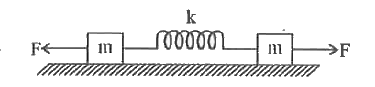 (a) Acceleration `a=(-2KY)/(m).` (B) Period of OSCILLATION `t=T=2pisqrt((m)/(2K)).` |
|
| 34. |
A soap film is formed in a circular frame. A loop of thread of length 2 pi r is lying on the film. If the film inside the loop is broken then the tension in the thread will be |
|
Answer» `2 PI R T` |
|
| 35. |
A particle A approach relative to a particle B with a velocity of 20m/s. If they collide head on and the coefficient of restitution is 1/4, the velocity with which A moves away from B after impact is |
|
Answer» 10 m/s |
|
| 36. |
A coin is sliding down on a smooth hemi spherical surface of radiusR. The height from the bottom, where it looses contact with the surface is |
|
Answer» `R//3` |
|
| 37. |
Satellites orbiting the earth have finite life and sometimes debris of satellites fall to the earth. This is because |
|
Answer» the solar cells and batteries in satellites run out Due to the viscous force acting on satellite, energy DECREASES continuously and radius of the orbit or height decreases gradually. |
|
| 38. |
If energy (E), momentum (p) and force (F) are chosen as fundamental units. The dimensions of mass in new system is |
|
Answer» `[E^(-1)p^(3)]` Let `m = kE^(a)p^(b)F^(c)` where k is a DIMENSIONLESS constant. `:.[M]= [ML^(2)T^(-2)]^(a)[MLT^(-1)]^(b)[MLT^(-2)]^(c)` or `[ML^(0)T^(0)]= [M^(a+b+c)L^(2A+b+c)T^(-2a-b-2c)]` EQUATING the powers of M, L and T we get a + b +c= 1, 2a + b + c = 0, -2a - b- 2c =0 Solving, we get a=-1, b= 2 and c=0 Hence `[m] = [E^(-1)p^(2)]` |
|
| 39. |
In an experiment of study of Newton.s law of cooling, a ball of metal is heated from inside a heater of 20 W in a room maintained at constant temperature of 20^(0)C. Following observations are made. i) Mass of the ball is 1 kg ii) Rate of increases of temperature decreases with rise of temperature iii) Temperature of ball becomes 50^(0)C after some tiime and then remains constant. iv) Specific heat of mettal is 500" Jkg"^(-1)""^(0)C^(-1). Corresponding to above observations, answer the following questions. Rate of loss of heat, when ball is at 50^(0)C is |
|
Answer» 10W |
|
| 40. |
In an experiment of study of Newton.s law of cooling, a ball of metal is heated from inside a heater of 20 W in a room maintained at constant temperature of 20^(0)C. Following observations are made. i) Mass of the ball is 1 kg ii) Rate of increases of temperature decreases with rise of temperature iii) Temperature of ball becomes 50^(0)C after some tiime and then remains constant. iv) Specific heat of mettal is 500" Jkg"^(-1)""^(0)C^(-1). Corresponding to above observations, answer the following questions. In 5 min temperature of ball rises from 20^(0)C to 30^(0)C. Total energy lost from the ball in this time interval is |
|
Answer» 250J |
|
| 41. |
In an experiment of study of Newton.s law of cooling, a ball of metal is heated from inside a heater of 20 W in a room maintained at constant temperature of 20^(0)C. Following observations are made. i) Mass of the ball is 1 kg ii) Rate of increases of temperature decreases with rise of temperature iii) Temperature of ball becomes 50^(0)C after some tiime and then remains constant. iv) Specific heat of mettal is 500" Jkg"^(-1)""^(0)C^(-1). Corresponding to above observations, answer the following questions. Assuming Newton.s law of cooling holds for the ball, rate of loss of heat, when the ball is at 30^(0)C is |
|
Answer» `(10)/(3)W` |
|
| 42. |
A uniform rod of mass m and length / makes a constant angle theta with an axis of rotation which passes through one end of the rod. Its moment of inertia about this axis is |
|
Answer» `(ML^(2))/(3)` Moment of INERTIA of the element about the AXIS = `((m)/(l) ""dx) (x sin theta)^(2)` `I = (m)/(l) sin^(2) theta int_(0)^(1) x^(2) dx = (ml^(2))/(3) sin^(2) theta` 
|
|
| 43. |
A student measure the distance traversed in freely fall of a body initially at rest in a given time. He uses this date to estimate the acceleration due to gravity (g). If the maximum percentage error in measurement of the distance and the time are e_(1) and e_(2) respectively. The percent age error in the estimation of g is |
|
Answer» `e_(1) + 2e_(2)` |
|
| 44. |
A nucleus is at rest in the laboratory frame of reference. Show that if it disintegrates into two smaller nuclei the products must move in opposite directions. |
|
Answer» Solution :Let MASS of nucelus is m and initial VELOCITY v=0 by law of conservation of linear MOMENTUM `vecp_(i)=vec_(F)` `0=m_(1)v_(1)+m_(2)vecv_(2)` `therefore VEC v_(2)=(m_(1))/(m_(2)).vecv_(1)` negative sign shows that velocity of both fragment are in mutually opposoite direction |
|
| 45. |
A block of wood of dimension 20cmxx10cmxx5cm floating on water such that surface of maximum area is contact with water. What extra force, (over its weight) is required to just deatech the block from water surface given that surface tension of water is 72 dyne/cm. |
|
Answer» |
|
| 46. |
Which one of the following is/are assumptions of kinetic theory of gases? |
|
Answer» The volume OCCUPIED by the molecules of the GAS is negligible |
|
| 47. |
Two blocks of masses m and 2m rest on a frictionless horizontal surface. They are connected by an ideal spring of relaxed length l and stiffness constant k. By means of a massless thread connecting the blocks the spring is held compressed to a length l//2. the whole system is moving with speed v in a direction perpendicular to the length of the spring. the thread is then burnt. Answer the following questions in terms of l,km,v The time period of oscillation of the system is : |
|
Answer» `2pisqrt((2m)/(3k))` |
|
| 48. |
(A): A lift ascending with decreasing speed means acceleration of lift is down wards. (R) : A body always moves in the direction of its acceleration. |
|
Answer» Both (A) and (R) are TRUE and (R) is the correct EXPLANATION of (A) |
|
| 49. |
Eight equal drops of water each of radius i=2mm are falling through air with a terminal velocity of 16 cm/s. The eight drops combine to form a big drop. Calculate the terminal velocity of big drop |
|
Answer» 16m/s |
|
| 50. |
Two blocks of masses m and 2m rest on a frictionless horizontal surface. They are connected by an ideal spring of relaxed length l and stiffness constant k. By means of a massless thread connecting the blocks the spring is held compressed to a length l//2. the whole system is moving with speed v in a direction perpendicular to the length of the spring. the thread is then burnt. Answer the following questions in terms of l,km,v After burning the string the speed of centre of mass is : |
|
Answer» LESS than `V` |
|