

Saved Bookmarks
This section includes 7 InterviewSolutions, each offering curated multiple-choice questions to sharpen your Current Affairs knowledge and support exam preparation. Choose a topic below to get started.
| 1. |
A man of mass m , standing at the bottom of the staircase of height L climbs it and stands at its top . |
|
Answer» Work done by all forces on MAN is equal to the RISE in potentialenergy mgL . As the pointon whichconatct forces are applied does not move hence work done by reaction forces will be zero . |
|
| 2. |
(A) : In isobaric process, during an expansion of a gas both volume and temperature of the gas increase (R ): Heat added to a gas partly gets converted into internal energy and remaining to do external work |
|
Answer» Both (A) and(R ) are TRUE and (R ) is the correct EXPLANATION of (A) |
|
| 3. |
If Q, E and W denote respectively the heat added, change in internal energy and the work done by a closed cycle process, then |
|
Answer» W=0 |
|
| 4. |
A wire stretched by 0.01 m when it is stretched by a certain force. Another wire of the same material but double the length and double the diameter is stretched by the same force. The elongation is |
|
Answer» 0.005m |
|
| 5. |
When two ice blocks are rubbed against each other some ice melts in between the two. Which law can explain the process? |
|
Answer» |
|
| 6. |
If vec(A) and vec(B)are two vectors , which of the statement is wrong ? |
|
Answer» ` VEC(A) + vec(B) = vec(B) + vec(A)` |
|
| 7. |
The volume of a given mass of gas at NTP is compressed adiabatically to 1/5th of its original volume. What is the new pressure ? gamma =1.4. |
|
Answer» <P> SOLUTION :`P _(2) = P _(1) (V _(1)//V _(2)) ^( GAMMA) =1 xx (5) ^(1.4)= 9.52` ATM |
|
| 8. |
What is the distance in km ofquasar from whigh light takes 3 billion years to reach us? c=3xx10^(5) km/s. |
|
Answer» |
|
| 9. |
In the above problem, let the trolley can be pulled from rest towards right with a constant force F. then |
|
Answer» The VELOCITY of the trolley car as a function of time 't' is `(FT)/(M + mu t)` |
|
| 10. |
A particle of mass m strikes elastically with a disc of radius R, with a velocity v as shown in the Fig. If the mass of the disc is equal to that of the particle and the surface of contact is smooth, find the velocity of the disc just after the collision. |
|
Answer» Solution :Impact takes PLACE along the line of impact, which is normal at the point of impact. Hence, the momentum of particle and the disc changes along line of impact. However, no external force acts on the system along the normal line. Hence we can conserve the LINEAR momentum of the system (disc + particle) along the normal. Since the MASSES of the disc and particle are equal, the particle completely DELIVERS component of its momentum `(mvcostheta)` along the normal. Velocity of the disc = `v _(1) = (v cos theta ) j` since `theta = (R//2)/(R ) = (1)/(2) cos theta = sqrt (1- ((1)/(2)) ^(2)) = (sqrt3)/(2) ,v _(1) = (sqrt3v)/( 2) hatj` Finaly the particle possess the velocity `v sin theta ` along x- axis and disc possesses the velocity `v cos theta` along y-axis. |
|
| 11. |
If bar(u) = 2bar(i) - 2bar(j) + 3bar(k) and the final velocity is bar(v) = 2bar(i) - 4bar(j) + 5bar(k) and It is covered in a time of 10 sec, find the acceleration vector. |
|
Answer» `(3bar(i) - 2bar(J)+2bar(K))/(10)` |
|
| 12. |
If the vectors 2 hat(i) + 3hat(j) + c hat(k) and -3i + 6k are orthogonal the value of c is |
| Answer» ANSWER :C | |
| 13. |
How is one second measured? |
| Answer» Solution :One SECOND is measured as the DURATION of 9, 192,631,770 PERIODS of the RADIATION coresponding to the transition between the two hyperfine levels of the GROUND state of the caesium-133 atom. | |
| 14. |
Two ideal gas thermometers A and B use oxyge,i and hydrogen respectively. The following observations are made.(##AKS_NEO_CAO_PHY_XI_V01_PMH_C12_SLV_011_Q01.png" width="80%"> (a) Whal is the absolute temperature of normal melti.ng point of sulphur as read by thermometer A and B ? (b) What do you think is the reason/or slightly different answers from A and B ? |
|
Answer» Solution :(a) For THERMOMETER A, `T_(tr) 273 K "" P_(tr) 1.250 x 10^(5)` Pa and T = ? , P = `1.797 xx 10^(5)` Pa We have T = `(P)/(P_(tr)) xx T_(tr) = (1.797xx 10^(5))/(1.250 xx 10^(5)) xx 273 = 392.46` K For thermometer B `T_(tr) = 273K , P_(tr) = 0.2 xx 10^(5) `Pa T = ? , P = 0.287 `xx 10^(5) " pa "T = (P)/(P_(tr)) xx T_(tr) = (0.287 xx 10^(5) xx 273 )/(0.2 xx 10^(5) = 391.75 `K The slight difference in temperature as read by two thermometers A and B are due to the FACT that oxygen and HYDROGEN do not behave like IDEAL gas. |
|
| 15. |
The physical qunatities not having same dimensions are |
|
Answer» TORQUE and work |
|
| 16. |
A tall cylinder is filled with viscous oil. A round pebble is dropped from the top with zero initial velocity. From the plot shown in figure, indicate the one that represents the velocity (v) of the pebble as a function of time (t) |
|
Answer»
|
|
| 17. |
Two blocks A and B of masses in and 2m, respectively, are connected with the help of a spring having spring constant, k as shown in Fig. Initially, both the blocks arc moving with same velocity v on a smooth horizontal plane with the spring in its natural length. During their course of motion, block B makes an inelastic collision with block C of mass m which is initially at rest. The coefficient of restitution for the collision is 1//2. The maximum compression in the spring is |
|
Answer» `sqrt((2m)/K)` 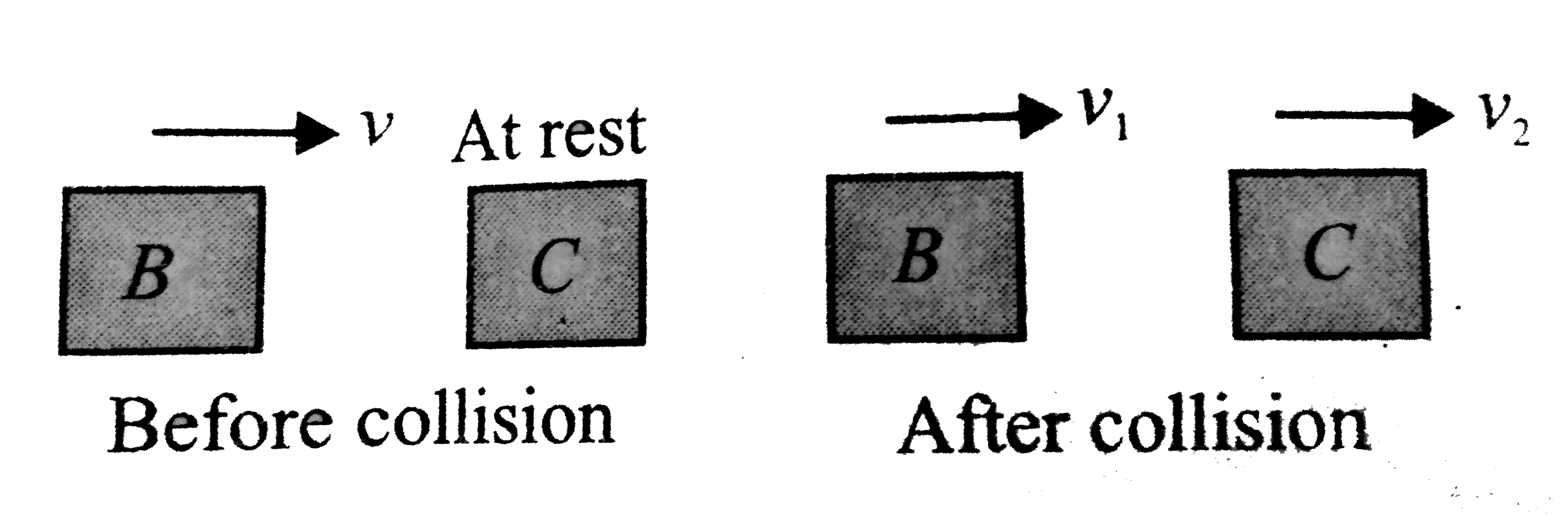 `2mv=2mv_(1)+mv_(2)` `1/2=(v_(2)-v_(1))/vimplies2v_(2)-2v_(1)=v` Solving above equation `v_(1)=v/2` and `v_(2)=v` Now for blocks `A` and `B` plus spring system, using reduced mass concept and applying WORK ENERGY theorem, let maximum compresion in spring be `x_(0)` and that the time of maximum compression relative velocity of blocks be zero. reduced mass is given by `"mu"=(mxx2m)/(3m)=(2m)/3` `0-(muxx(v-v//2)^(2))/2=-(kx_(0)^(2))/2impliesx_(0)=(sqrt(m/(6k)))v` |
|
| 19. |
Match Column-I with Column-II : {:("Column-I","Column-II"),("(1) SI unit of torque",(a)m),("(2) SI unit of radius of gyration",(b) Nm),(,(C) Js^-2):} |
|
Answer» |
|
| 20. |
An impulse J is applied on a ring of mass m along line passing through its centre O. the ring is placed on a rough horizontal durface. The linear velocity of centre of ring once it starts rolling without slipping is J/xm where 'x' is |
|
Answer» |
|
| 21. |
The dimensions of R in the equations Q=Q_(0)(1-e^(-t//RC)) are |
|
Answer» `[ML^(2)T^(-3)A^(-2)]` `thereforeRC=t` or `R=(t)/(C)=(t)/(Q//V)=(V.t)/(Q)` `R=[(ML^(2)T^(-2)])/([AT])([T])/([AT])=[ML^(2)T^(-3)A^(-2)]` |
|
| 22. |
The equation ofa wave moving on string y = 8 sin {pi (0.002 x - 4t)} where x , y are in centimeter and t in seconds . The velocity of the wave is ……… . |
|
Answer» 100 cm/s |
|
| 23. |
A particle executes SHM between x = -A and x = +A .The time taken for ti to go from 0 toA/2 is T_1 and to go from A/2 to A is T_2.Then |
|
Answer» `T_2=2T_1` |
|
| 24. |
A 5 kg stationary bomb is exploded in three parts masses 1 : 1 : 3 respectively. Parts having same mass move in perpendicular direction with the velocity 30 m/s. Then the velocity of the bigger part is |
|
Answer» |
|
| 25. |
The heighsy and horizontal distance x covered by a projectle in a time t seconds are given by the equation y=8t-5t^(2)and x=6t.If x and y are measured the velocity of projection is |
|
Answer» `8 MS^(-1)` |
|
| 26. |
A copper sphere with a few capacities is heated. The ratio of the percentage volume expansion of the solid part and the hollow part of the sphere will be |
|
Answer» UNEQUAL and positive |
|
| 27. |
A solid sphere is rotating about an axis as shown in figure. An insect follows the dotted path on the cricumference of sphere as shown . Match the following |
|
Answer» <P> |
|
| 28. |
Tube A has both ends open, while tube B has one and closed, otherwise they are identical the ratio of fundamental frequency of tubes A and B is |
|
Answer» `1:2` |
|
| 29. |
The potential energy of a particle of mass 2 kg moving along the x-axis is given by U(x) = 16(x^2- 2x) joule. Its velocity at x = 1 m is 2 m/s. Then: |
|
Answer» The particle DESCRIBE uniformly accelerated MOTION |
|
| 31. |
Is kinetic energy conserved in the process ? If not from where does the conserved in the process? If not form where does the change come about ? |
| Answer» SOLUTION :No the KE is increased and it comes from WORK DONE by man in the process. | |
| 32. |
A simple pendulum is swinging in a vertical plane. Its highest point above ground is 50 cm. If the maximum velocity of the pendulum is 1.4 ms^(-1), its lowest positio above ground is |
|
Answer» 20 cm |
|
| 33. |
If the frequency of SHM is v then frequency of kinetic energy is also v. |
| Answer» SOLUTION :FALSE, it is 2V. | |
| 34. |
Let A be a unit vector along the axis of rotation of a purely rotating body and vec(B) be a unit vector along the velocity of a particle P of the body away from the axis. The value of vec(A).vec(B) is |
|
Answer» 1 |
|
| 35. |
A drop of water of radius 10^(-5) m is falling through a medium whose density is 1.21 kg m^(-3) and coefficient of Viscosity 1.8xx10^(-4) poise. Find the terminal velocity of the drop. |
|
Answer» |
|
| 36. |
Explain in detail the working of a refrigerator. |
|
Answer» Solution :Refrigerator: A refrigerator is a Carnot.s engine working in the reverse order. Working Principle: The working substance (gas) absorbs a quantity of heat `Q_(L)` from the cold body (sink) at a lower temperature `T_(L)`. A certain AMOUNT of work W is done on the working substance by the compressor and a quantity of heat `Q_(H)` is rejected to the hot body (source) ie, the atmosphere at `T_(H)`. When you stand beneath of refrigerator, you can feel warmth air. From the first law of thermodynamics, we have `Q_(L) +W = Q_(H)"...(1)"` As a result the cold reservoir (refrigerator) further cools down and the surroundings (kitchen or atmosphere) gets hotter. Coefficient of PERFORMANCE (COP) `(beta)`: COP is a measure of the efficiency of a refrigerator. It is defined as the ratio of heat extracted from the cold body (sink) to the external work done by the compressor W. `COP=beta=(Q_(L))/(W)"...(2)"` From the equation (1) `beta=(Q_(L))/(Q_(H)-Q_(L))` `beta=(1)/((Q_(H))/(Q_(K))-1)"...(3)"` But we know that `(Q_(H))/(Q_(L))=(T_(H))/(T_(L))` But we know that `(Q_(H))/(Q_(L))=(T_(H))/(T_(L))` Substituting this equation into equation (3), we get `beta=(1)/((T_(H))/(T_(L))-1)=(T_(L))/(T_(H)-T_(L))` INFERENCES: 1. The greater the COP, the better is the condition of the refrigerator. A typical refrigerator has COP around 5 to 6. 2. Lesser the difference in the temperatures of the cooling chamber and the atmosphere, higher is the COP of a refrigerator. 3. In the refrigerator the heat is taken from cold object to hot object by doing external work. Without external work heat cannot flow from cold object to hot object. It is not a violation of second law of thermodynamics, because the heat is ejected to surrounding air and total entropy of `("refrigerator "+" surrounding")` is always increased. 
|
|
| 37. |
A block is in limiting equilibrium on a rough horizontal surface. If the net contact force is sqrt(3) times the normal force, the coefficient of static friction is |
|
Answer» `SQRT(2)` |
|
| 38. |
ACarnotenginewhoseefficiencyis 45%takesheat fromasourcemaintainedat atemperatureof 327^(@)C.Tohave an engineof efficiency60%whatmustbe theintaketemperaturefor thesameexhaust(sink)temperature |
|
Answer» Solution :Efficiency of Carnot engine `(eta_(1))=45%=0.45` Initial intake temperature `(T_(1))=327^(@)C=600K` NEW efficiency `(eta_(2))=60%=0.6` Efficiency of Carnot engine is given by `ETA=1-(T_(2))/(T_(1))` `T_(1)` is temperature of source , `T_(2)` is temperature of sink `"1st Case :"T_(2)=(1-eta)T_(1)=(1-0.45)xx600 rArr T_(2)=330K` `"2nd Case :"(T_(2))/(T_(1))=1-eta` `T_(1)=(T_(2))/(1-eta)=(330)/(1-0.6)=(330)/(0.4)` `T_(1)=825K=825-273, T_(1)=552^(@)C` |
|
| 39. |
The scalar product of two vec(A) and vec(B)is : |
|
Answer» AB SIN `theta` |
|
| 40. |
Find the speed of two objects if when they move uniformly towards each other, they get 4.0 metres closer each second and when they move uniformly in the samae direction with original speed, they get 4.0 metres closer each 10 sec. |
|
Answer» Solution :Let their speeds be `v_(1) and v_(2) and "let" v_(1)>v_(2)`. In First Case: Relative velocity, `v_(1)+v_(2)=4……….(1)` In Second Case: Relative velocity, `v_(1)-v_(2)= (4)/(10)=0.4……..(2)` SOLVING eqns. (1) and (2), we GET `v_(1)=2.2ms^(-1), v_(2)=1.8ms^(-1)` |
|
| 41. |
A batsman deflects a ball by an angle of 60^@without changing its initial speed of 20 ms^(-1) . What is the impulse imparted to the ball if its mass is 0.15 kg? |
|
Answer» 9Js |
|
| 42. |
Diameter of a plano-convex lens is 6cm its thickness at the centre is 3mm. Then the focal length of the lens, if the speed of light in the material of lens is 2 times 10^8 m//s |
|
Answer» 7.5cm |
|
| 43. |
A ball of mass m and density rho is immersed in a liquid of density 3rho at a depth and released. To what height will the ball jump up above the surface of liquid? (neglected the resistance of water and air). |
|
Answer» SOLUTION :Volume of ball `V=m/(rho)` Acceleration of ball INSIDE the liquid `a=(F_("net"))/m=("upthrust "-"WEIGHT")/m` `a=((m/(rho))(3rho)(g)-mg)/m=2G` (upwards) `:.` velocity of ball while reaching at surface `V=SQRT(2ah)=sqrt(4gh)` `:.` The ball will jump to a height `H=(v^(2))/(2g)=(4gh)/(2g)=2h` |
|
| 44. |
If two objects stick together after collision, then it is called elastic collision. |
|
Answer» |
|
| 45. |
Two satellites S_1 and S_2 are revolving round a planet in coplanar and concentric circular orbits of radii R_1 and R_2 in the same direction respectively.Their respective periods of revolution are 1 hr and 8 hr. The radius of the orbit of satellite S_1 is equal to 10^4 km. Their relative speed when they are closest , in kmph is : |
|
Answer» `pi/2xx10^4` |
|
| 46. |
Velocity of efflux in torricelli's theorem is given by v=sqrt(2gh) here h is the height of hole from the top surface, after that motion of liquid can be treated as projectile motion. Q. Liquid is filled in a vessel of square base (2mxx2m) upto a height of 2 m as shown in figure (i). in figure (ii) the vessel is tilted from horizontal at 30^(@) what is the velocity of efflux in this case. Liquid does not spills out? (a). 3.29m//s (b). 4.96m//s (c). 5.67cm (d). 2.68m//s |
|
Answer» Now `h=xsin60^(@)=1.23mthereforev=sqrt(2gh)=sqrt(2xx10xx1.23)=4.96m//s` |
|
| 47. |
Velocity of efflux in torricelli's theorem is given by v=sqrt(2gh) here h is the height of hole from the top surface, after that motion of liquid can be treated as projectile motion. Q. At what distance from point O, will be strike on the ground? (a). 5.24 m (b). 6.27 m 4.93 m (d). 3.95 m |
|
Answer» |
|
| 48. |
Velocity of efflux in torricelli's theorem is given by v=sqrt(2gh) here h is the height of hole from the top surface, after that motion of liquid can be treated as projectile motion. Q. What is its time of fall of liquid on the ground? (a). (1)/(sqrt(2))s (b). (1)/(sqrt(3))s (c). (1)/(sqrt(5))s (d). sqrt(2)s |
Answer» _S01_073_S01.png) `H=2sin30^(@)=1mthereforet=SQRT((2H)/(G))=(1)/(sqrt(5))s` |
|
| 49. |
A ball of mass m is rotated in a vertical circle with constant speed.The difference in tension at the top and botton would be |
|
Answer» 6mg |
|


