

Saved Bookmarks
This section includes 7 InterviewSolutions, each offering curated multiple-choice questions to sharpen your Current Affairs knowledge and support exam preparation. Choose a topic below to get started.
| 1. |
A 700 g solid cube having an edge of length 10 cm floats in water. What volume of the cube is outside water? |
|
Answer» `300 cm3` |
|
| 2. |
Sliding of the object occurs when |
|
Answer» `V_("trans") LT V_("rot")` |
|
| 3. |
A body of mass 10kg is suspended by a string and is pulledaside with a horizontal force of 49 N . Fond the tension in the string , if the body is in equilibrium under these forces. |
|
Answer» |
|
| 4. |
Solid angle subtended by hemisphere at centre is ...... . |
|
Answer» Solution :Surface area of sphere of radius `r=4pi r^(2)` `:.` Surface are of HEMISPHERE `DeltaA=2pi r^(2)` `:.` Solid ANGLE `=(DeltaA)/(r^(2))=(2pir^(2))/(r^(2))=2pi sr` |
|
| 5. |
A rod of length L whose lower end is fixed along the horizontal plane starts to topple from the vertical position. The velocity of the upper end of the rod when it hits the ground is |
|
Answer» `sqrt(3gL)` 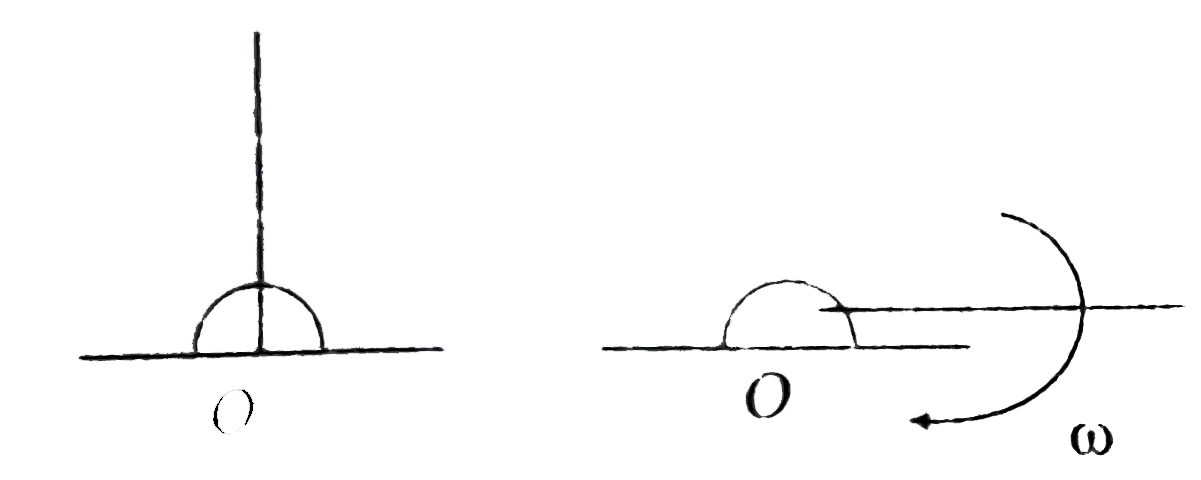 or `"MG"(L)/(2)=(1)/(2)((mL^(2))/(3))OMEGA^(2)or omega=sqrt((3g)/(L))` Now `v = r omega` (in pure rotation) `:. v=Lsqrt((3g)/(L))=sqrt(3gL)`. |
|
| 6. |
A coin rolls on a horizontal plane. What fraction of its total kinetic energy is rotational ? |
|
Answer» Solution :TotalK.E. `=1/2mv^(2) +1/2I omega^(2), I = (MR^(2))/2, omega = V/r` `=1/2 mv^(2) + 1/2(mr^(2))/2 xx v^(2)/2 = 1/2 mv^(2) + 1/4 mv^(2)` `=3/4 mv^(2)` REQUIRED FRACTION `=(1/4 mv^(2))/(3/4 mv^(2)) =1/3` |
|
| 7. |
An athlete in the olympic games covers a distance of 100m in 10s. His kinetic energy can be estimated to be in the range |
|
Answer» `200J-500J` |
|
| 8. |
A wheel is rotating with a speed of 500 rpm on a shaft. Second identical wheel, initially at rest is suddenly coupled on the same shaft. What is the speed of the resultant combination ? Assume that the moment of inertia of the shaft is negligible. |
|
Answer» Solution :`I_(1)omega_(1)=I_(2)omega_(2)` `I_(1)n_(1)=I_(2)n_(2)` `I_(1)(500)=2I_(1)n_(2)` `:.n_(2)=250` rpm |
|
| 9. |
Two narrow cylindrical pipes A and B have the same length . Pipe A is open at both ends and is filled with a monoatomic gas of molar mass M_(A). Pipe B is open at one end and closed at the other end and is filled with a diatomic gas of molar mass M_(B). Both gases are at the same temperature . a. If the frequency to the second harmonic of the fundamental mode in pipe A is equal to the frequency of the third harmonic of the fundamental mode in pipe B, determine the value of M_(A)//M_(B). b. Now the open end of pipe B is also closed ( so that pipe B is closed at both ends ). Find the ratio of the fundamental frequency in pipe A to that in pipe B. |
|
Answer» Solution :a. If `L` is the length of each pipe `A and B` , then fundamental FREQUENCY of pipe `A` ( open at both ENDS ) `n_(A) = (v_(A))/( 2L)`(i) Fundamental frequency of pipe `B` ( closed at one end) `n_(B) = (v_(B))/( 4L)`(ii) Given`2 n_(A) = 3 n_(B)` `2((v_(A))/(2L)) = 3((v_(B))/( 4L))` `rArr (v_(A))/(v_(B)) = (3)/(4)` But ` v_(A) = sqrt((gamma_(A) RT_(A))/( M_(A))) , v_(B) =sqrt((gamma_(B)RT_(B))/(M_(B)))` Given`T_(A) = T_(B)` For monoatomic get `gamma _(A) = (5)/(3)` For DIATOMIC get `gamma_(B) = (7)/(5)` `:. (v_(A))/(v_(B)) = sqrt({(gamma_(A))/(gamma_(B))) (M_(B))/(M_(A))}` `sqrt(((5//3)) /((7//5)) (M_(B))/(M_(A)))` ` = sqrt((25)/(21) (M_(B))/(M_(A)))` (i) From Eqs.(III) and (iv) `sqrt((25)/(21) (M_(B))/(M_(A))) = (3)/(4)` (ii) `(M_(A))/(M_(B)) = ((4)/(3))^(2) xx (25)/(21) = (400)/(189)` b. When pipe `B` is closed at both ends , fundamental frequency of pipe `B` becomes `n_(B) = (v_(B))/( 2L)`(v) Using Eqs. (i) ,(iii) and (v) , we get iii.`(n_(A))/(n_(B)) = (v_(A))/(v_(B)) = (3)/(4)` 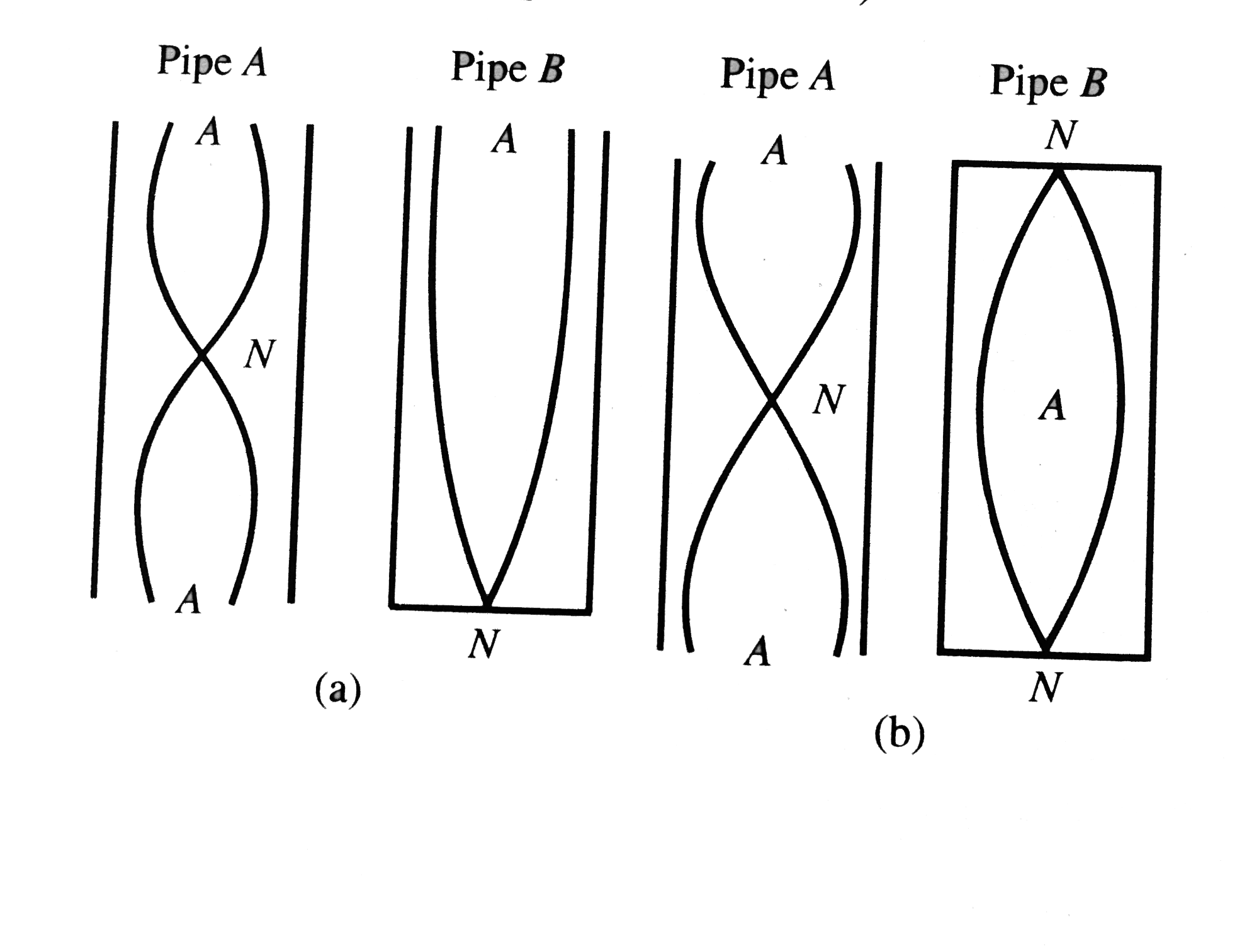
|
|
| 10. |
The length of a rectangular plate is measured as 10 cm by a vernier scale of least count 0.01 cm and its breadth as 5 cm by the same scale. The percentage error in area is |
|
Answer» `0.1%` |
|
| 11. |
What is common between bar and torr ? |
|
Answer» UNITS of Pressure |
|
| 12. |
The time period of a seconds pendulum is measured repeatedly for three times by two stop watches A, B. If the readings are as follows {:("S.NO",A,B),(1.,2.01 " sec",2.56 " sec"),(2.,2.10" sec",2.55" sec"),(3.,1.98 " sec",2.57" sec"):} |
|
Answer» A is more ACCURATE but B is more precise |
|
| 13. |
A spherical bubble of radius 0.3 mm is formed inside water at a depth of 20 cm. The surface tension of water at this depth is 75 dyne cm""^(-1)?. What will be total pressure inside this bubble if atmospheric pressure is 76 cm of mercury column and density of mercury is 13.6 "g/cm"^(3). |
|
Answer» |
|
| 14. |
A string is wound around a disc of radius r and mass M and at the free end of the string a body of mass m is suspended. The body is then allowed to descend. Show that the angular accelerationof the disc = (mg)/(R(M+(m)/(2))) |
Answer» Solution : The suspended body and the forces acting on the disc are shown in FIG. The EQUATION of the LINEAR motion of the suspended body is `ma=mg-T` (where T = tension in the string) `therefore T=m(g-a)` Now torque acting on disc `tau=RT [because vectau=vecrxxvecF]` `therefore Ialpha=RT` `therefore alpha=(RT)/(I)=(Rm(g-a))/(I)` `therefore alpha=(Rm(g-a))/(M(R^(2))/(2))[because I=(MR^(2))/(2)]` `therefore alpha=(2m)/(RM)(g-a)" but "a=Ralpha` `therefore alpha=(2mg)/(RM)-(2mRalpha)/(RM)` `therefore alpha+(2mRalpha)/(RM)=(2mg)/(RM)` `therefore alpha(1+(2m)/(M))=(2mg)/(RM)` `therefore alpha=(2mg)/(RM(1+(2m)/(M)))=(mg)/((R)/(2)(M+(2mM)/(M)))=(mg)/(R((M)/(2)+m))` |
|
| 15. |
A weight lifter lifts a mass of 250 kg with a force 5000 N to the height of 5 m. (a) What is the work done by the weight lifter! (b) What is the work done by the gravity? (c) What is the network done on the object? |
|
Answer» Solution :(a) When the weight lifter lifts the mass, force and DISPLACEMENT are in the same direction which means that the angle between them `THETA= 0^(@)`. Therefore, the work done by weight lifter `w_("weight lifter")=F_(u)hcostheta=F_(w)h(coso^(@))` `=5000xx5xx(1)=25,000"joule"=25KJ` (b) When the weight lifler lifts the mass, the gravity acts downwards which means that force and displacement are in OPPOSITE direction. Therefore, the angle between them `theta=180^(@)` `w_("gravity")=F_(g)hcostheta=mgh(cos180^(@))` The net work done (or total work done ) on the object `w_("net")=w_("weight lifter")+w_("gravity")` `=25KJ-12.5KJ=+12.5KJ` |
|
| 16. |
when a child sits stationary at one end of a long trolley moving uniformly with some speed on a smooth horizontal plane. The speed of the centre of mass of system (child and trolley), |
| Answer» Solution :No change in SPEED of SYSTEM as no EXTERNAL force is working | |
| 17. |
"A match stick can be lighted by rubbing it against a rough surface". Why? |
| Answer» Solution :Work DONE against friction is converted into HEAT, and is used to LIGHT the MATCH stick. | |
| 18. |
Explain why (or how): (a) in a sound wave a displacement node is a pressure antinode and vice versa. (b) bats can ascertain distances, directions, nature, and sizes of the obstacles without any ''eyes''. (c ) a violin note and sitar note may have the same frequency. yet we can distinguish between the two notes. (d) solids can support both longitudinal and transverse waves, but only longitudinal waves can propagate in gases, and (e ) the shape of a pulse gets distorted during propagation in a dispersive medium. |
|
Answer» Solution :(a) In a sound wave a point where pressrue is maximum there is said to be pressure antinode. Because of this, displacement of air particule at that point in ZERO and so there is said to be displacement node. Conversely, a point where pressure is minimum there is said to be pressure node. Because of this, displacement of air particle at that point is maximum and so there is said to be displacement antinode. (b) Bats are capable of producing and detecting ultrasonic wave (which are sound waves with frequencies greater than 20 kHz). Dependin upon the time interval between production of ultrasonic waves nad recption of its echo, bats can estimte the distance of an object producing echo, from itself. Also from the intensity of an echo, bats can come to know about nature and size of an object from which echo is produced. From the time interval between successive each, bets can come to know about the DIRECTION of echo and hence location of reflector object. (c) Though vilin and SITAR produce notes of same frequency, their wave forms are different and so their qualities the different which produce differenct pleasant effects on human ear. THat is why we can distinguish between sound notes of same frequency produced by violin and sitar. (d) Solid can sustain comprcssive as well as shearing stress. Hence both longitudinal and transverse waves can propagate in solid media. But in case of gases, they can sustain only compressive stress and so only longitudinal waves can be propagated in gases. (e) When any pulse passes through any dispersive mediu, its wavelength CHANGES (because of change in VELOCITY) which changes the shape of a pulse. Hence this pulse gets distored. |
|
| 19. |
The escape velocity of a body on the earth.s surface is v_(e). A body is thrown up with a speed of kv_e, where k >1, Assuming that the sun and planets do not influence the motion of the body, then the "velocity of the body at the infinite distance in: |
|
Answer» `v_(e)//SQRT(k^(2)-1)` |
|
| 20. |
A body executing SHM at a displacement x its PE is E_(1), at a displacement Y its PE is E_(2) The PE at a displacement (x+y) is |
|
Answer» `sqrt(E)=sqrt(E_(1))-sqrt(E_(2))` |
|
| 21. |
The angle of minimum deviation by prism is . Its critical angle will be |
|
Answer» `sin^-1 (TAN""A/2)` |
|
| 22. |
Why does a boy lean towards right hand side while carrying a bag in his left hand? |
| Answer» SOLUTION :When the body carries a bag in his left hand, his centre of gravity is SHIFTED TOWARDS left hand side. In order to attain stable equilibrium the BOY has to lean towards his left hand side. | |
| 23. |
If the value of 'g' on the surface of the moon is g/6, the time period of a pendulum on the surface of the moon w..t time period on the earth will be |
|
Answer» `sqrt(6)`TIMES |
|
| 24. |
A particle in a certain conservative force field has a potential energy given by U= (20 xy)/(z). The force exerted on it is |
|
Answer» `((20 y)/(Z)) hati + ((20x)/(z))hatj + ((20 xy)/(z^2))hatk` For a CONSERVATIVE field, `vecF = -vec(nabla)U` where , `vec(nabla) = hati (DEL)/(del x)+ hatj (del)/(del y) + hatk (del)/(del k)` `:. vecF = -[hati (del U)/(del x) + hatj (del U)/(del y) + hatk (del U)/(delz)]` `= - [hati (del)/(del x) ((20xy)/(z)) + hatj (del)/(del y)((20 xy)/(z)) + hatk (del)/(del z) ((20 xy)/(z))]` `= -((20y)/(z)) hati - ((20 x)/(z)) hatj + ((20 xy)/(z^2) hatk`. |
|
| 25. |
Three component sinusoidal waves progressing in the same directions along the same path have the same period byt their amplitudes are A, A/2 and A/3. The phases of the variation at any position x on their path at time t = 0 are 0, -pi/2 and -pi respectively. Find the amplitude and phase of the resultant wave. |
Answer» 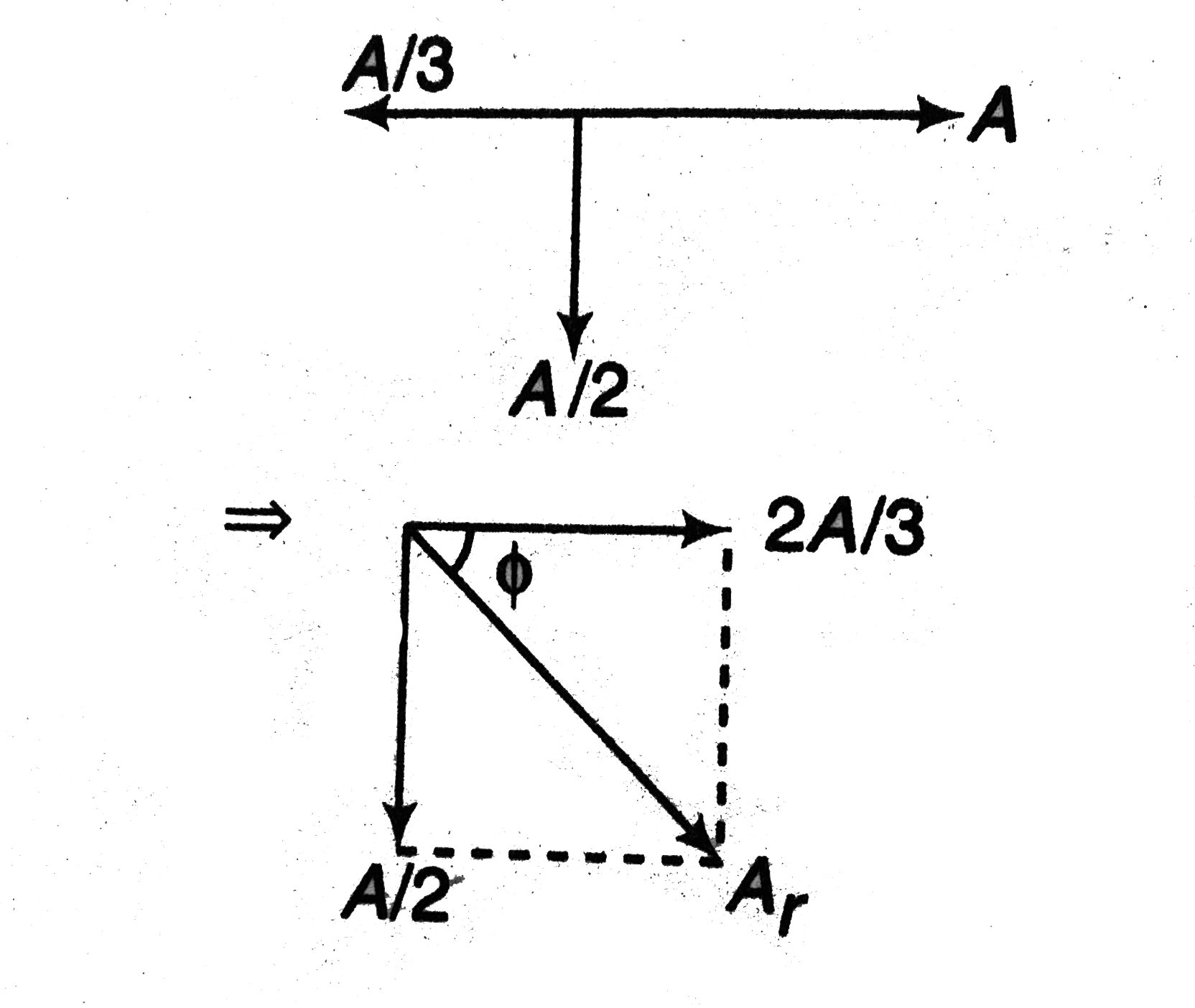 `A_r = SQRT ((2A)/3)^2 + (A/2)^2 ` `= 5/6 A ` `tan phi = - (A//2)/(2A//3) = -3/4` or`phi = tan ^-1 (3//4)` . |
|
| 26. |
(i) A conducting cylinder whose inside diameter is 4.00cm contains air compressed by a piston of mass m = 13.0 kg, which can slides freely in the cylinder shown in the figure. The entire arrangement is immersed in a water bath whose temperature can be controlled. The syetem is initially in equilibrium at temperature t_(1) = 20^(@)C. The initial height of the piston above the bottom of the cylinder is h_(i) = 4.00 cm. P_(atm) =1 xx 10^(5) N/m^(2) and g = 10m//s^(2). If the temperature of the water bath is gradually increased to a final temperature t_(f) = 100^(@)C. Find teh height h_(f) of the piston (in cm) at that instant? (ii) In the above question, if we again start from the initial conditions and the temperature is again gradually raised, and weights are added to the piston to keep its height fixed at h_(i). Find the value of teh added mass when the final temperature becomes t_(f) = 100^(@)C? |
|
Answer» `V_(i) = Ah_(i)` and `V_(f) = Ah_(f)` For air inside cylinder `n_(1) = n_(2) rArr (P_(i)V_(i))/(T_(i)) = (P_(f)V_(f))/(T_(f))` `rArr h_(f) = (h_(i)T_(f))/(T_(i)) = (4 XX 373)/(293) = (1492)/(293) cm` (II) Here volume is constant `(P_(i))/(T_(i)) = (P_(f))/(T_(f))` `m = (P_(atm)(T_(f)-T_(i))A+Mg(T_(f)-T_(i)))/(gT_(i))` `= (1 xx 10^(5) (80)pi(2xx10^(-2))^(2)+13(80)xx10)/(10xx293)` `= (320pi)/(293) (1+(13)/(4pi)) KG` |
|
| 27. |
A vessel containing 100g watera at 0^(@)C is suspended in the middle of a room. In 15 minutes the temperature of the water rises by 2^(@)C. When an equal amount of ice is placed in the vessel, it melts in 10 hours. Calculate the specific latent heat of fusion of ice. |
|
Answer» |
|
| 28. |
To withstand the shapes of concave mirrors against temperature variations used in high resolution telescope, they are made of |
|
Answer» quartz |
|
| 29. |
A force vec(F) = - k (y hat(i) + x hat(j)), where k is a positive constant, acts on a particle moving in the xy - plane. Starting from the origin, the particle is taken along the positive x - axis to a point (a, 0) and then parallel to the positive y - axis to a point (a, a). Calculate the total work done by the force on the particle. |
|
Answer» Solution :DISPLACEMENT vector, `d vec(s) = d x vec(i) + dy vec(J)` `therefore` Work done `W = int vec(F).d vec(s) = int - k(y hat(i) + x hat(j)).(d x hat(i) + dy hat(j))` `= - k int_((0,0))^((a,a)) (YDX + xdy) = - k int_((0,0))^((a,a)) d (xy) = - k|(xy)|_(0,0)^(a,a) = - k (a xx a) = - KA^(2)` |
|
| 30. |
The nearest star from our solar system is 4.29 light year away. How much is this distance in terms of par sec? How much parallax would this star (named Alpha Centauri) show when viewed from two locations of the earth six months apart in its orbit around the sun? |
|
Answer» Solution :(i) 1 light year `=9.46xx10^(15)m` 1 par SEC `=3.094xx10^(16)m` 1 light year `=(9.46xx10^(15))/(3.09xx10^(16))=0.306` par sec Distance of Alpha Centauri `=D=4.29` light years `=4.29xx0.396=1.313` par sec `D=4.29` light year `=4.29xx9.46xx10^(15)m` (ii) One astronomical UNIT `=1AU=1.5xx10^(11)m` The distance between the two LOCATIONS of the earth six months apart in its ORBIT around the sun `=d=2AU` Parallax `=theta=? , d = D theta` `theta=d/D=(2xx1.6xx10^(11))/(4.29xx9.46xx10^(15))` rad `=0.0739xx10^(-4)` rad `=0.0793xx10^(-4)xx(180xx60xx60)/(PI)` `theta=1.523` seconds of an arc. |
|
| 31. |
State Bernoulli's theorom. Given one application. |
|
Answer» Solution :In an ideal FLUID, sum of pressure, potential, kinetic ENERGY PER unit mass. Remains constant. APPLICATION : Spinning ball |
|
| 32. |
A metal sphere of radius r and specific heat s is rotated about an axis passing through its centre at a speed of n rotation/s. It is suddenly stopped and 50% of its energy is used in increasing its temperature. Then, the rise in temperature of the sphere is |
|
Answer» `2/5 (PI^(2)n^(2)r^(2))/S` |
|
| 33. |
The radius of a circle is measured to be (10.8+-0.3)m. Calcualte the area of the circle. |
|
Answer» `DeltaA//a=92.5//9375, DeltaA=92.5,` Area `=(9375+-92.5)CM^(2)` |
|
| 34. |
As we go from one planet to another planet will (a) the mass and (b) weight of a body changes. |
| Answer» SOLUTION : a) As we GO from one planet to another planet mass of the BODY does not change. Mass of a body is alwaysconstant. B) As we MOVE from one planet to another planet weight of the body changes. | |
| 35. |
In the figure shown, a small ball of mass 'm' can move without sliding in a fixed cylindrical track of radius R in vertical plane. It is released from the top. The resultant force on the ball at the lowest point of the track is |
| Answer» Answer :A | |
| 36. |
A metre long narrow bore held horizontally (and closed at one end) contains a 76 cm long niercury thread, which traps a 15 cm column of air. What happens if the tube is held vertically with the open end at the bottom ? |
Answer» Solution :If a is the area of cross- section of the tube (a),  Inilial volume of air, `V_(1) = 15 ` a initial pressure of air, `p_(1) ` 76 cm (of He column) On holding this tube of narrow bore vertically (b), let h be the vertical distance through which the mercury in the tube gets DEPRESSED to BALANCE the atmospheric pressure. Obviously, h denotes the final pressure of air, i.e., `P_(2) = h `. It is to be noted that the length of the air column left = length of the tube - length of Hg column `100 - (76- h) = (24 + h)` Final volume , `V_(2) = (24 + h)a ` Applying Boyle.s law, `P_(1) V_(1) = P_(2) V_(2) " or " 76 xx 15a ` = h (24 + h)a or`1140 = 24H + h^(2) " or " h^(2) + 24h - 1140 = 0` or `h = (-24 + sqrt((24)^(2) + 4 xx 1 xx 1140))/(2)` since h cannot be NEGATIVE tube, h= 23.8 cm . Thus, in the vertical position of lhe tube, 23.8 cm of rnercury flows out and the remaining 52.2 cm of n1ercury thread plus the 48 cm of air above it remain in equilibriun with the outside atmospheric pressure. |
|
| 37. |
In an astronomical telescope in normal adjustment straight black line of length L is drawn on the objective. The eye piece forms a real image of this line. The length of this image is L. The magnification of the telescope is |
|
Answer» `L/l` |
|
| 38. |
A ball of mass 'm' moving at a speed v makes a head on collision with an identical ball at rest. The kinetic energy of balls after the collision is 3/4th of the origial. If e is the coefficient of restitution, then : |
|
Answer» `v_(1) = (1-(1)/(SQRT(2)))/(2)V` |
|
| 39. |
A solid body of constant heat capacity 1 J//^(@)C is being heated by keeping it in contact with reservoirs in two ways: (i) Sequentially keeping in contact with 2 reservoirs such that each reservoir supplies same amount of heat . (ii) Sequentially keeping in contact with 8 reservoirs such that each reservoir supplies same amount of heat . In both the cases body is brought from initial temperature 100^(@)C to final temperature 200^(@)C. Entropy change of the body in the two cases respectively is |
|
Answer» 1n 2, 4 1n 2 Increase in temperature = `100^(@)C = 100 K` Heat CAPACITY, `C = 1 J//K` (i) For each heat reservoir, increase in temperature = `100/2 = 50 K` So, entropy change, `Delta S_(1) = C[int_(373)^(423) (DT)/(T) + int_(423)^(473) (dT)/(T)]` `= 1n (423)/(373) + 1n (473)/(423)` `= 1n(473)/(373)` (ii) For each heat reservoir, increase in temperature = `100/8 = 12.5 K` So, entropy change, `Delta S_(2) = C[int_(385.5)^(373) (dT)/(T) + .....+ int_(473)^(460.5) (dT)/(T)]` ` = 1n(473)/(373)` [Note: The VALUES of `Delta S_(1) and Delta S_(2)` does not match any of the given answers. if we take the temperatures to be 100 K and 200 K instead of `100^(@)C and 200^(@)C`, then `Delta S_(1) = Delta S_(2) = 1n2 J`. |
|
| 40. |
An aeroplane flying horizontal at an altitude of 490m with a speed of 180 kmph drops a bomb. The horizontal distance at which it hits the ground is |
|
Answer» 500m |
|
| 41. |
Dimension of angular velocity is |
|
Answer» `M^(0)L^(-1)T^(-2)` |
|
| 42. |
A swimmer is capable of swimming at 1.65ms- in still water. If he swims directly across a 180m wide river with water flow at 0.85ms^(-1)', how far down stream will he reach? How long will it take to reach the other side ? |
|
Answer» 1.82 min |
|
| 43. |
The force acting on a body it is a rest |
|
Answer» is gravitational FORCE |
|
| 44. |
A particle executes SHM with a frequency f. The frequency with which its KE oscillates is |
|
Answer» `f/2` |
|
| 45. |
(A) : Two bodies A and B are attracted towards each other due to gravitation. If A is much heavier than B then the centre of mass of the bodies moves towards A.(R ) : The centre of mass depends upon mass distribution of a body or a system of bodies and the coordinate system. |
|
Answer» Both (A) and (R ) are true and (R ) is the CORRECT EXPLANATION of (A) |
|
| 46. |
Water rises in a capillary tube upto a height of 10 cm whereas mercury depresses in it by 3.42 cm. If the angle of contact and density of mercury are 135° and 13.6 gm/cc respectively, then the ratio of the surface tension of water and mercury will be nearly |
|
Answer» `13:2` |
|
| 47. |
The maximum possible error in the difference of two quantities is………. |
|
Answer» DELTAZ = DELTAA +DELTAB` |
|
| 48. |
Bricks are passed on by one labourer to another at a height 3m from the ground, by being thrown upwards from the ground level.Bricks reach the second labourer, at a speed of 3 m*s^(-1). If the bricks were thrown up in such a way that they would reach the second labourer, at zero speed, what fraction of the work done by the thrower would have been saved ? |
|
Answer» |
|
| 49. |
If an object weighs 270 N at earth.s surface, the weight of the object at an altitude equal to twice the radius of earth is |
| Answer» Answer :C | |
| 50. |
The cross-sections of the two sides of a U-tube are 1cm^(2)and0.1cm^(2) respectively. Some water is poured inside the tube when it rise to the same height in both the limbs. What volume of a liquid of density 0.85g*cm^(-3) should be poured into the wider limb so that the water level rises by 15 cm in the narrow limb? |
|
Answer» Solution :At first, water rises up to the same level in both the arms. When the liquid is POURED into the wider limb, suppose the level of water FALLS by x cm and rises by 15 cm in the narrow limb. AC = BF = x , volume of the part AC = volume of the part BD or, `x xx1=15xx0.1or,x=1.5cm`  Let EC = h. Pressure at the point C = pressure at the point F or, `hxx0.85xxg=(15+1.5)xx1xxg` or, `h=16.5/0.85=19.41`cm So, the volume of liquid poured into the wider limb = `19.41xx1=19.41cm^(3)`. |
|