

Saved Bookmarks
This section includes 7 InterviewSolutions, each offering curated multiple-choice questions to sharpen your Current Affairs knowledge and support exam preparation. Choose a topic below to get started.
| 1. |
Tube A has both ends open, while tube B has one end closed , otherwise they are indentical. The raito of fundamental ferquency of tubes A & B is |
|
Answer» 1:2 |
|
| 2. |
State and explain Wien's displacement law. |
Answer» Solution :Thermal radiation EMITTED by a body consists of electromagnetic waves of different wavelengths and wavelengths of these waves FORM a continuous spectrum, but amount of electromagnetic waves of certain definite frequencies is more.  For example, in black radiation at room temperature (300 K) majority of the radiation consists of electromagnetic waves of wavelength `95,500" A"^(@)` (called infrared waves). On increasing its temperature, the amount of waves of smaller wavelength increases. At about 1100 K, as the waves of wavelength corresponding to red colour is more, the body appears red. Figure shows the graph of spectral emissive power `W_(lamda)` versus wavelengths `(lamda_(m))` at different temperatures. From the graph it is clear that with increase in temperature, wavelength `(lamda_(m))` corresponding to the maximum value of `W_(lamda)` decreases. Wien.s displacement law : ..The wavelength `(lamda_(m))` of a emitted radiation from the surface of any body is INVERSELY PROPORTIONAL to the ABSOLUTE temperature of the emitting surface... `:." "lamda_(m)T=` constant The above equation is called the Wien.s displacement law. The constant in above equation is called Wien.s constant and its value is `2.9xx10^(-3)" mK"` Remember : Here `lamda_(m)` is not maximum wavelength but radiation energy is maximum Value of Wien.s constant is `2.9xx10^(-3)" mK"` and 0.290 cm K in CGS system and dimensional formula is `[M^(0)L^(1)T^(0)K^(1)]`. This rule explains that by heating iron piece why it becomes first reddish, then greenish yellow and white at last. Wien.s law is useful to estimate temperature of surface of space objects like Sun, Moon and Star. Intensity of light is maximum for `14mum` wavelength from Moon and temperature of Moon is approximated as 200 K is as below, Here, `lamda_(m)=14mum=14xx10^(-6)m` Now from Wien.s law, `lamda_(m)T=` constant `:." T = "("constant")/(lamda_(m))=(2.9xx10^(-3))/(14xx10^(-6))` `T=207K` `:.T~~200K` Intensity of light is maximum for `lamda_(m)=4753Å` wavelength from Sun. Hence,according to Wien.s law, `lamda_(m)" T = constant"` `:.T=("constant")/(lamda_(m))` `:.T=(2.9xx10^(-3))/(4753xx10^(-10))` `=0.00061014xx10^(7)` `~~6101K` `~~6060` K (Value of textbook) This is temperature of surface of Sun not of inner side. The meaningful of surface of Sun not of inner side. The meaningful characteristic of curves of radiation from black body is they at universal and only depends on temperature but not on dimension, shape or matter. |
|
| 3. |
Springs are usually made of steel but not of copper why? |
| Answer» Solution :Elasticity of steel is more than that of coppper. It means that the elastic limit of limit is GREATER. Let us consider two springs of the same size, one of steel and another of copper.An equal TENSILE force is applied on both springs. On slowly increasing the magnitude of the applied force on the two springs it seen that,at a certain stage the steel spring still behaves like an elastic body but the copper spring undergoes a permanent DEFORMATION . For this reason, springs are usually made of steel but not of copper. More-over , copper is COSTLIER than steel. However, copper springs MAY be used where the applied force is not very high. | |
| 4. |
A person of mass 60 kg wants to lose 5 kg by goingup and down a 10 m high stairs. Assume he burns twice as much fat while going up than coming down. If 1 kg of fat is burnt on expending 7000 kilocalories, how many times must he go up and down to reduce his weight by 5 kg? Work done in moving up = mgh Work done in moving down =(mgh)/(2) Total work done =(3)/(2) mgh = (3)/(2) xx 60xx 10xx10 N number of trips |
|
Answer» SOLUTION :`5xx7000 XX 10^(3) xx4.2J = 60xx15 xx 10 xx N` `N =(21xx 7xx10^(6))/( 9000)= (147)/(9)xx 10^(3) =16.3 xx 10^(3)` times |
|
| 5. |
If stress is numerically equal to young's modulus the elongation will be |
|
Answer» 1/4 the ORIGINAL LENGTH |
|
| 6. |
A disc of mass 5 kg is kept floatinghorizontally in mid air by firing 10 bullets per second vertically up. If the mass of each bullet is 50 gm and bullets rebound with same speed, the speed of each bullet is, (g = 10 ms^(-2)) |
|
Answer» `100 ms^(-1)` |
|
| 7. |
A circular disc is rotating about its natural axis with angular velocity of 10 rads^(-1). A second disc of same mass is joined to it coaxially. If the radius of disc is half of the radius of the first, then they together rotate with an angular velocity of |
|
Answer» `2.5 rads^(-1)` |
|
| 9. |
A 100cm long stretched string is struck at a point 25 cm from one of its ends. Which of the overtones would be absent in the emitted notes ? |
|
Answer» |
|
| 10. |
For a particle acceleration is defined as veca=(-5xhati)/(|xx|) for X ne 0 "and" veca =0 "for" X=0. If the particle is initially at rest (a,0) what is period of of motion of the particle. |
|
Answer» `4sqrt(2a//5)SEC.` |
|
| 11. |
Consider a simple pendulum, having a bob attached to a string , that oscillates under the action of the force of gravity. Suppose that the period of oscillation of the simple. Pendulum depends on its length ( l) , mass of the bob ( m ) , and acceleration due to gravity ( g ) . Derive theexpression for is time period using method of dimension . |
Answer» Solution :(i) Let `theta` be the angle made by the string with vertical. When the bob is at the mean position `theta=0.` (ii) There are two forces acting on the bob. The tension T along the vertical force due to gravity (=mg). (iii) The force can be resolved into `mgcostheta` along a circle of LENGTH L and centre at this support point. (iv) Its radial ACCELERATION `(omega^(2)L)` and also tangential acceleration. So net radial force `= T - mg costheta` , While the tangential acceleration provided by `mg sintheta`the radial force gives zero torque. (v) So torque providedby the tangential component. `tau="Lmg"sintheta` `tau=Ialpha` (by Newton's law of rotational motion) `Ialpha=mgsinthetaL` `alphaimplies("mgL")/(I)sintheta` where I is the MOMENT of inertia , `alpha` is angular acceleration, (VI) The `theta` is to small, `sintheta=theta` `alpha=(mgL)/(I)theta,omega=sqrt((I)/(mgL))` [for simple HARMONIC `a(t) =-omega^(2)txxtheta" is small ]"and T=2pisqrt((I)/(mgL))""[:'omega=(2pi)/(T)]` |
|
| 12. |
The equation of a wave is y = 0.1 sin (100 pi t - kx) where x , y are in metres and t in seconds . If the velocity of the wave is 100 m/s , then the value of k is |
|
Answer» `1 m^(-1)` |
|
| 13. |
Pieces of glass and copper are heated to the same temperature. Why does the piece of copper feel hotter on touching? |
| Answer» Solution :COPPER is a good conductor of heat whereas glass is a bad conductor. So when copper is touched heat FLOWS from copper to the hand quickly. But heat conduction from glass to HUMAN BODY is slow. So the piece of copper feels hotter. | |
| 14. |
A heavy steel ball of mass greater than 1kg moving with a speed of 2 m/s collides head on with a stationary ping-pong ball of mass less than 0.1 gm. The collision is elactic. After the collision the ping pong ball moves approximately with speed of |
|
Answer» 2 m/s |
|
| 15. |
Three equal masses of m kg each are fixed at the vetrices of an equilateral triangle ABC (a) What is the force acting on a mass 2m placed at the centriod G of the triangle. (b) What is the force if the mass at the vertex A is doubled ? Take AG = BG = 1m |
|
Answer» Solution :The individual forces in vector notation are `F_(GA)=(G(m)(2M))/1hatj` `F_(GB)=(G(m)(2m))/1 (-hat1 cos 30^@- hatj SIN 30^@)` `F_(GC)=(G(m)(2m))/1 (hat1 cos 30^@ -hatj sin 30^@)` From the principle of superposition and the law of vector addition the resultant gravitational force `F_R` on(2m) is `F_R=F_(GA)+F_(GB)+F_(GC)` `F_R=2Gm^2hatj + 2Gm^2 (-hati cos 30^@ - hatj sin 30^@) + 2Gm^2 (hati cos 30^@ - hatj sin 30^@) =0` (b) By symmetry, the X-component of the force cancels out. The Y-component survives. `therefore F_R=4Gm^2 hatj - 2Gm^2 hatj =2Gm^2 hatj` |
|
| 16. |
The mean free path of gas molecules varies with the diameter d of the molecules as |
|
Answer» `d^-1` |
|
| 17. |
Two mettalic strips each of length l_(0) and thickness d, temperature T_(0) are riveted together so that their ends coincide. One strip is maxe of a metal of coeficient of expansioin alpha_(1) and the other of a metal with a coefficient alpha_(2), where alpha_(2)gtalpha_(1). When this bimetallic strip is heated to a temperature T_(0)+DeltaT, find the radius of curvature R of the strip. |
|
Answer» |
|
| 18. |
An ant moves on the floor of a room making two displacement. One of magnitude 3m and another of magnitude 4m. If the angle between the two displacements is 120^(@) what will be the magnitude of the resultant displacement ? |
|
Answer» 6.082m |
|
| 19. |
State Archimedes principle. |
|
Answer» Solution :When a BODY is partially or wholly IMMERSED in a fluid, it experiences an upward thrust equal to the weight of the fluid displaced by it and its upthrust acts through the CENTRE of gravity of the liquid displaced. Upthrust or BUOYANT FORCE = weight of liquid displaced. |
|
| 20. |
A system is taken along different path in the graph of Pto V from its initial state to final state. Which of following quantity does not depend on the path of the system ? |
|
Answer» EXCHANGE of HEAT Q |
|
| 21. |
Two satellites of masses 100kg and 200kg are revolving the earth at attitudes 6400 km and 44800km. The ratio of orbital velocity of the satellites is: |
|
Answer» `1:2` |
|
| 22. |
The average kinetic energy associated with the x component of the motion of a molecule is |
|
Answer» `(1)/(2)k_(B)T` |
|
| 23. |
Draw and explain thevariations of force of friction vs applied force graphically |
Answer» SOLUTION :THEVARIATION of bothstaticand kineticfrictionalforces with exertnalappliedforceis graphicallyshown in the FIGURE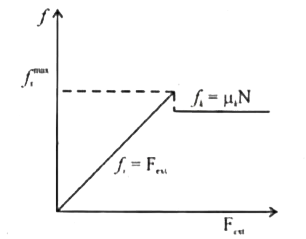
|
|
| 24. |
A solid metal sphere and a solid wooden sphere are having the same mass. If they are spinning with same angular velocity, then |
|
Answer» METAL sphere POSSESSES more ANGULAR momentum |
|
| 25. |
A thin equiconvex lens is made of glass of refrative index 1.5 and its focal length is 0.2m. If it acts as a concove lens of 0.5m focal length when dipped in a liquid, the refractive index of liquid is |
|
Answer» `17//8` |
|
| 26. |
If the distance between the centres of the atoms of potassium and bromine in KBr molecule is 0.282 xx 10^(-9) m, the centre of mass of this two particle system from potassium is (mass of bromine = 80 u and of potassium = 39 u). |
|
Answer» `9.3xx10^(-2)NM` |
|
| 27. |
A column of Hg of 10 cm length is contained in the middle of a narrow horizontal 1 m long tube which is closed at both ends. Both the halves of the tube contain air at a pressure 76 cm of Hg. By what distance will the column of Hg be displaced if the tube is held vertical? |
|
Answer» |
|
| 28. |
A uniform tube of length 60 cm stands vertically with its lower end dipping into water . First two air column lengths above water are 15 cm, when the tube resonds to a vibrating fork of frequency 500 H_(Z) . Find the lowest frequency to the tube will respond when it is open at both ends. |
|
Answer» `:. lambda = 60 cm` `nu = f lambda = (500) (0.6)` `= 300 m//s` Lowest frequency when OPEN from both ends is `(nu)/(2L)` . `= (300)/(2 xx0.6) = 250 H_(Z)` |
|
| 29. |
A solid sphere of radius R is resting on a smooth horizontal surface. A constant force F is applied at a height h from the bottom. Vhoose the correct alternative. |
|
Answer» SPHERE will ALWAYS slide whatever be the VALUE of h |
|
| 30. |
The weight of liquid column in a capillary tube is 11xx10^(-4)N. If the radius of tube is 7 mm, calculate the surface tension of liquid. |
|
Answer» Solution :Weight of liquid column `W=11xx10^(-4)N` Radius of CAPILLARY TUBE `r=7mm=7xx10^(-3)m` Weight of liquid column `W=2pirS` Surface tension `S=(W)/(2pir)=(11xx10^(-4))/(2xx(22)/(7)xx7xx10^(-3))impliesS=0.025N//m` |
|
| 31. |
A particle is projected at 60^(@) to the horizontal with a kinetic energy K. The kinetic energy at the highest point is: |
|
Answer» K |
|
| 32. |
Bernoulli's theorem is applicable to …………….. . |
|
Answer» FLOW of liquids |
|
| 33. |
What is displacement? Explain its general meaning by giving examples. |
|
Answer» SOLUTION :Displacement : The distance of the oscillator (simple harmonic body means oscillator) at any instant from the equilibrium (fixed or reference point) position is called displacement of the oscillator at that instant. The displacement is considered positive from one side of equilibrium point and negative from other side. In short, displacement prossess zero, positive and negative values. Displacement is refers to change with time of any physical property under consideration. Its examples are as follow : (1) In case of rectilinear motion of a steel ball on a surface, the distance from the starting point as a function of time is its position displacement. The choice of origin is a matter of convenience. (2)  Consider a block attached to a spring, the other end of which is fixed to a rigid wall, as shown in figure (a). The block moves on a FRICTIONLESS surface. The motion of the block can be described in terms of its distance or displacement x from the wall. (3) In figure (b), an OSCILLATING simple pendulum. its motion can be described in terms of angular displacement `theta` from the vertical.  For an oscillating simple pendulum, the angle from the vertical as a function of time may be regarded as a displacement variable. (4) The displacement variable may be taken in pressure variations with time in the propagation of sound WAVE in air. (5) The displacement variable may also take in the changing electric and magnetic fields in a ELECTROMAGNETIC waves. (6) The voltage across a capacitor, changing with time in an a.c. circuit is also a displacement variable. Hence, it is not so that the displacement variable always taken as in the context of position but above shown displacement variable may be taken. |
|
| 34. |
Define Chandraskhar limit. |
| Answer» Solution :It is the largest possible VALUE of mass of a WHITE dwarf STAR which is equal to NEARLY 1.4 times the mass of the sun. | |
| 35. |
Is friction , a conservative or non-conservative force ? |
| Answer» Solution :Non-conservative force. Friction ALWAYS OPPOSES the relative MOTION. So the net WORK done during FORWARD and backward motion is zero. | |
| 36. |
Find the torque of a force vecF = 7hati +3hatj -5hatk about the point whose position vector is vecr = hati - hatj + hatk. |
| Answer» SOLUTION :`2hati + 12hatj + 10HATK` | |
| 37. |
A pipe 20 cm long is closed at one end. Which harmonic mode of the pipe is resonantly excited by a 430 Hz source ? Will the same source be in resonane with the pipe if both end are open ? (speed of sound in air is 340 m s^(-1)). |
| Answer» SOLUTION :FIRST HARMONIC (FUNDAMENTAL), No | |
| 38. |
A swimmer's speed in the direction of flow of a river is 12kmh^(-1). Against the direction of flow of the river the swimmer's speed is 6kmh^(-1). Calculate the swimmer's speed in still water and the velocity of the river flow. |
|
Answer» SOLUTION :Let `v_(s)andv_(r)` represent the VELOCITIES of the swimmer and river respectively with respect to ground. `v_(s)+v_(r)=12""…..(1)` and `v_(s)-v_(r)=6""…..(2)` Adding the both EQUATIONS(1) and (2) `2v_(s)=12+6=18kmh^(-1)orv_(s)=9kmh^(-1)`. From EQUATION (1), `9+v_(r)=12orv_(r)=3kmh^(-1)` When the river flow and swimmer move in the same direction, the net velocity of swimmer is 12 kmph. |
|
| 39. |
A thermally insulated vertical cylinder of cross - section area A contains 3moles of an ideal monatomicgas under a piston of mass M. A heater supplying heat to the gas at constant rate PJ/s, is switched on at t = 0. The velocity of the piston is given by [Take atmospheric pressure as P_0] |
|
Answer» <P>`(2P)/(5p_0A + MG])` |
|
| 40. |
In Exercise 9, let us take theposition of mass when the spring is unstretched as x=0, and the direction from left to right as the positive direction of x-axis. Give x as a function of time t for the oscillating mass if at the moment we start the stopwatch (t=0), the mass is at the maximum compressed position. In what way to these functions for SHM differ from each other, in frequency, in amplitude or the initial phase? |
|
Answer» Solution :Amplitude from exercise : `14.9, A = 2 CM` Angular frequency `omega = sqrt((k)/(m)) = sqrt((1200)/(3)) = sqrt(400) = 20 RAD s^(-1)` Initial phase inthe maximum compressed position `phi = (3pi)/(2) rad` Displacement of block at time t `x(t) = A SIN (omega t+phi)` ` = 2sin (2omega t+(3pi)/(2))= -2cos 20 t cm`. Hence, in all these three CASES, amplitude and frequency are same but differ only in initial phase because motions starts from different positions. |
|
| 41. |
Explain why it is sometimes safer for a ship while floating on water to load more goods than to get rid of them. |
| Answer» Solution :For stable EQUILIBRIUM of a floating body, its centre of gravity should lie below its metacentre. So, if the metacentre LIES below the centre of gravity of a floating SHIP, then, to LOWER the position of its centre of gravity below the metacentre, more GOODS should be loaded in the hold of the ship. In that case, the ship will float under stable equilibrium and hence it is safer for a ship floating on water to be loaded with more goods. | |
| 42. |
The dimensions of (mu_(0)epsi_(0))^((1)/(2)) are |
|
Answer» `[L^(-1)T]` |
|
| 43. |
Tabulate , the displacement , velocity and acceleration is SHM. |
Answer» SOLUTION :
|
|
| 44. |
Does the damping force remain constant on a system executing shm? |
| Answer» Solution :No. It VARIES with VELOCITY of the oscillator. Damping FORCE is maximum when the velocity is HIGH and vice versa. | |
| 45. |
The reasons for phenomenal progress of physics in the last few centuries is/are |
|
Answer» The realization that not only qualitative THINKING but quantitative measurement is of primeimportance |
|
| 46. |
The mass of a unifprm rod is 0.4 kg and its length is 2 m. .Calculate the radius of gyration of the rod about an axis passing through its centre of mass and perpendicular to its length ? |
|
Answer» |
|
| 47. |
In Exercise 9, let us take theposition of mass when the spring is unstretched as x=0, and the direction from left to right as the positive direction of x-axis. Give x as a function of time t for the oscillating mass if at the moment we start the stopwatch (t=0), the mass is at the maximum streatched position. |
|
Answer» Solution :Amplitude from exercise : `14.9, A = 2 cm` ANGULAR frequency `omega = sqrt((k)/(m)) = sqrt((1200)/(3)) = sqrt(400) = 20 rad s^(-1)` Phase in the maximum stretched position `phi =(pi)/(2)rad` Displacement of block at time t `x(t) =A sin (omega t+phi)` putting thevalue ` = 2SIN (2omega t+(pi)/(2))= 2 cos 20 t cm`. |
|
| 48. |
In Exercise 9, let us take theposition of mass when the spring is unstretched as x=0, and the direction from left to right as the positive direction of x-axis. Give x as a function of time t for the oscillating mass if at the moment we start the stopwatch (t=0), the mass is at the mean position. |
|
Answer» SOLUTION :Amplitude from exercise : `14.9, A = 2 cm` Angular frequency `omega = sqrt((k)/(m)) = sqrt((1200)/(3)) = sqrt(400) = 20 RAD s^(-1)` Initial PHASE at mean position `phi = 0` Displacement of block at time t `x(t) = A sin(omega t+phi)` putting the abovevalues `= 2 sin(2 omega t +0)` ` =2 sin 20 t cm""[therefore omega = 20 rad s^(-1)]` |
|
| 49. |
The static friction |
|
Answer» INCREASES LINEARLY |
|
| 50. |
A solid sphere is kept over a smooth surface as shown in figure. It is hit by a cute at height h above the centre C. If the surface is rough, then after hitting the sphere, in which case the force of friction is in forward direction. |
|
Answer» In CASE 1 |
|