

Saved Bookmarks
This section includes 7 InterviewSolutions, each offering curated multiple-choice questions to sharpen your Current Affairs knowledge and support exam preparation. Choose a topic below to get started.
| 1. |
A solid sphere is kept over a smooth surface as shown in figure. It is hit by a cute at height h above the centre C. In case 1, h=(R)/(2) and in case 1 the sphere acquires a total kinetic energy k_(1) and in case 2 total kinetic energy is k_(2) . Then, |
|
Answer» `k_(1)=k_(2)` |
|
| 2. |
A particle is moving in the xy plane on a sinusoidal course determined by y = A sin kx, where k and A are constants. The X component of the velocity of the particle is constant and is equal to v_(0) and the particle was at origin at time t = 0. Find the magnitude of the acceleration of the particle when it is at point having x co ordinate x = (pi)/(2k). |
|
Answer» |
|
| 3. |
What is oscillatory motion? Give its examples. |
|
Answer» SOLUTION :If a body moves to and fro back and forth or up and down about a fixed point in a definite interval of time, such a motion is called an oscillatory motion. For example : (1) A BALL placed in a bowl will be in equilibrium at the bottom. If displaced a little from the point, it will perform oscillatory in the bowl. (2) The motion of the pendulum of a wall clock is oscillatory motion. (3) The motion of a loaded spring, when the load attached to the spring is palled once a little from its mean position and left to itself. Every oscillatory motion is periodic, but every periodic motion need not be oscillatory. RESTORING force is produced in such type of motion HENCE no external force CONSTANTLY needed for continuation this motion. Such type of motion is also known as harmonic motion. |
|
| 4. |
A ball of mass .m., moving with uniform speed, collides elastically with another stationary ball. For what mass of stationary ball the incident ball will lose maximum kinetic energy? |
|
Answer» |
|
| 5. |
Explain the lift of an aircraft wing using Bernoulli's principle. |
|
Answer» SOLUTION :The WINGS of an airplane (aerofoil) are so designed that its upper SURFACE is more curved than the lower surface and the FRONT edge is broader than the real edge. As the aircraft moves, the air moves FASTER above the aerofoil than at the bottom as shown in Figure. According to Bernoulli's Principle, the pressure of air below is greater than above, that creates an upthrut called the dynamic lift to the aircraft. 
|
|
| 6. |
A particle moving withg uniform retardation covers distance 18 m .14 m and 10 m in successive seconds .It comes to rest after travelling a further distance of |
|
Answer» 50m |
|
| 7. |
A source of sound moves towards an observer with a velocity 108km//h and the observer also moves towards the source with the velocity 5 km/h, then the velocity of sound is |
|
Answer» `320ms^(-1)` |
|
| 8. |
What is the moment of inertia of a ring about a tangent to the circle of the ring? |
|
Answer» Solution :The tangent to the ring in the plane of the ring is PARALLEL to one of the DIAMETERS of the ring. The DISTANCE between these two parallel axes is R, the radius of the ring. Using the parallel axes theorem,  `I_("tangent")=I_(dia)+MR^(2)=(MR^(2))/(2)+MR^(2)=(3)/(2)MR^(2)`. |
|
| 9. |
A sphere can roll on a surface inclined at an angle theta if the friction coefficient is more than (1)/(7)g tan theta . If a sphere is relased from rest on the incline |
|
Answer» it will stay at rest |
|
| 10. |
What work has to be done to make a hoop out of a copper band of length l=3m,width h=6 cm and thickness delta =1mm? (Y of copper =1.3xx10^(11) ""Nm^(-2) ) [Hint: Consider strain energy in a a thin layer and intergraate from r-delta//2 "to" r+delta//2] |
|
Answer» |
|
| 11. |
A 1 kg block situated on a rough incline is connected to a spring of spring constant 100 Nm^(-1) as shown in Fig. 6.17. The block is released from rest with the spring in the unstreched position. The block moves 10 cm down the incline before coming to rest. Find the coefficient of friction between the block and the incline. Assume that the spring has a negligible mass and the pulley is frictionless. |
| Answer» SOLUTION :`= 0.125` | |
| 12. |
In which of the following cases is the angular momentum conserved ? |
|
Answer» The planet Neptune moves in an elliptical orbit with the sun at one of the foci of the ellipse. |
|
| 13. |
State galileo 's law of inertia |
| Answer» SOLUTION :A bodymovingin astraightlinewithcertainspeedwillcontinuemovingin thesamestraightline WITHA samespeedin theabsenceof anyexternalforce . | |
| 14. |
A prism of refractive angle 4^@ is made of a material of refractive index 1.652. Find its angle of minimum deviation. |
|
Answer» SOLUTION :`A=4^@, mu=1.652, DELTA=?` SUBSTITUTING in `delta=A(mu-1)=4^@(1.652-1)` `=4^@ TIMES 0.652=2.608^@` |
|
| 15. |
Three vectors satisfy the relation A.B = 0 and A.C = 0, then A is parallel to |
|
Answer» C |
|
| 16. |
Match the following according to conversion by heat : |
|
Answer» |
|
| 17. |
In the digram shown in figure |
|
Answer» `X=A+B-C+D` We GET` Y=B+C-Aand Z=B+C` |
|
| 18. |
G = 6.67xx10^(-11) N m^(2)(kg)^(-2) = ………. (cm)^(3)s^(-2)g^(-1). |
|
Answer» Solution :`G-6.67xx10^(-11) Nm^(-2)(kg)^(-2)` `=6.67xx10^(-11) (kg MS^(-2)) m^(2) kg^(-2) "" ( :. 1N= 1K g ms^(-2))` `=6.67xx10^(-10) m^(3)s^(2)-kg^(-1)` `=6.67xx10^(-11)(10^(2) cm)^(3)s^(-2)(10^(3) g)^(-1)` `=6.687xx10^(-11)xx10^(6)cm^(3)s^(-2)xx10^(-3) g^(-1)` `=6.67xx10^(-8) cm^(3) s^(-2)g^(-1)` |
|
| 19. |
If a disc of mass m and radius r is reshaped into a ring of radius2r, the mass remining the same, the radius of gyration about centrodal axis perpendicular to plane goes up by a factor of |
|
Answer» `SQRT(2)` `K_(R)=sqrt((I_(PR))/(m))=sqrt((m(2R)^(2))/(m))=2r` `:. (K_(R))/(K_(D))=2 sqrt(2)`. |
|
| 20. |
Figures depicts two circular motions. The radius of the circle, the period of revolution, the initial position and the sense of revolution are indicated on the figures. Obtain the simple harmonic motions of the x-projection of the radius vector of the rotating particle P in each case. |
Answer» Solution :(a) As shown in figure, SUPPOSE a particle moving with uniform circular motion is at `P_1` at time t=0 and makes and angle `PHI = 45^(@)((pi)/(4)RAD)` with POSITIVE x-axis. After time `t_1` it covers an angle `omega t` and reaches at `P_2` and makes an angle `theta = omega t + phi` with positive x-axis.  Makes an angle `theta = (2pi)/(T)t+ (pi)/(4)` The projection of OP on the x-axis at time t is given by `x (t) = A COS ((2pi)/(T)t+(pi)/(4))" have "OP_(2) = A cos (omega t+phi)` It `t= 4s` then, `x(t) = A cos ((2pi)/(4)t+(pi)/(4)) = A cos ((pi)/(4)+(pi)/(4)) = A sin (pi)/(4)`. Which is a SHM of amplitude A, period 4s and an initial phase `= (pi)/(4) rad`. (b) As shown in figure, suppose a particle moving with uniform circular motion is on P at time t=0 and makes an angle `phi = 90^(@) =(pi/2)` with positive x-axis after a time t, it covers an angle of `omega t` and reaches at `P_1` with clockwise direction and makes an angle of `theta = (pi)/(2) - omega t`. The projection of `P._1` on the x-axis `OP._1`.  `x(t) = B cos theta = B cos((pi)/(2)- omega t)= B sin omega t` `= B cos (omega t-(pi)/(2))""[therefore cos(-theta)= cos theta]` `therefore x(t) = B cos ((pi)/(15)t- (pi)/(2))` This represents a SHM of amplitude B, period T= 30s and an initial phase of `-(pi)/(2)`. |
|
| 21. |
The following does not give the unit of energy |
| Answer» Answer :D | |
| 22. |
The handles of a table-drawer are equidistant from the sides of the drawer and are distant c from each other. Show that it will be impossible to pull the drawer out by pulling one handle if l le mu c where l is the length of the drawer from back to front and mu is the coefficient of friction [Hint : Consider a force applied at inclination theta with the knob of the handle. Apply conditions for translational and rotational equilibrium. Hence show it is possible to draw when tan theta ge (l-muc)/(mu^(2)c+2mu^(2)x+2muI) Since tan theta is positive, l ge mu c] |
| Answer» | |
| 23. |
An ideal gas expands in such a way that its. Pressure and volume satisfy with the condition PV^2= constant. During this process, the gas is |
|
Answer» HEATED |
|
| 24. |
A conveyer belt is moving at a constant speed of 2 ms^(-1) A box is gently dropped on it. The coefficient of friction between them is mu = 0.5. The distance that the box will move relative to belt before coming to rest on it, taking g= 10 ms^(-2), is |
|
Answer» `0.4 m` ` thereforea = (f)/( m )= (mu mg)/( m)= mu g= 0.5xx 10= 5 MS^(-2)` USING`v^2- u^2= 2aS ` ` 0^2 -2^2 =2 (-5) xx SimpliesS= 0.4m` |
|
| 25. |
In Exercises 3.13 and 3.14, we have carefully distinguished between average speed and magnitude of average velocity. No such distinction is necessary when we consider instantaneous speed and magnitude of velocity. The instantaneous speed is always equal to the magnitude of instantaneous velocity. Why? |
| Answer» SOLUTION :In Exercises 3.13 and 3.14, we have CAREFULLY DISTINGUISHED between average SPEED and magnitude of average velocity. No such distinction is necessary when we CONSIDER instantaneous speed and magnitude of velocity. The instantaneous speed is always equal to the magnitude of instantaneous velocity. Why? | |
| 26. |
Explain the motion of blocks connected by a string in (i) vertical motion (ii) horizontal motion . |
Answer» Solution : Verticalmotion : Let us considertwoblocksof masses `m_(1)` and `m_(2) (m_(1) gtm_(2))`connectedby alightandinextensiblestringthatpassesovera pulley 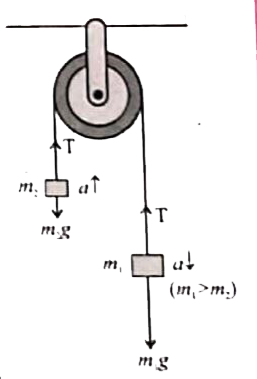 Let thetensionin thestringbe Tand acceleration aWhenthe systemisreleasedboth theblocksboth thestartmoving`m_(2)`verticallyupwardwithsameaccelerationa. The gravitationalforce `m_(1)`GON MASS `m_(1)` is usedto lift the mass `m_(2)` theupwarddirection is selectedas ydirection. the free bodydiagrams ofbothmasses. 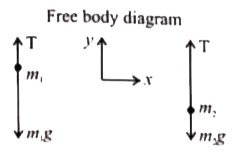 Horizontal motion : in this case mass `m_(2)` is kept on a horizontal table and mass `m_(1)`is hanging through a smalll pulley it is assumed that there is no friction on the surface 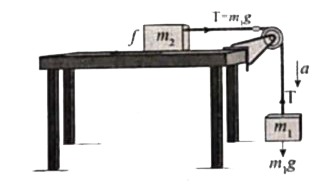 As both the BLOCKS are CONNECTEDTO the unstrechable stringif `m_(1)` moves with an acclereation a downward athen `m_(2)`also moves iwth the same acceleration a horizontally The forces acting on mass `m_(2)`are (i) horizontal tension (T) exerted by the string (ii) upward normal force (N) exerted by the surface (iii) Downard normal gravitational force `(m_(2)g)` The forces acting on mass `m_(1)` are (i)Tension (T) acting upwards (ii) Downward gravitational force `(m_(1)g)` the free body diagrams for both the masses is 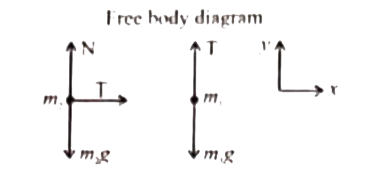
|
|
| 27. |
State the theorem of parallel axis. |
|
Answer» Solution :The moment of inertia of a BODY about any axis is EQUAL to the sum of moments of inertia of the body about a parallel axis passing through the centre of mass and the product of mass of the square of the DISTANCE between the TWO parallel axes. i.e., `I=I_0+Md^2` |
|
| 28. |
In Fig. there are n identical suspended with wires of equal length. The spheres are almost in contact with each other. Sphere 1 is pulled aside and released. If sphere 1 strikes sphere 2 with velocity u. find an expression for velocity v_(n) of the nth sphere immediately after being struck by the one adjacent to it. The coefficient of restitution for all the impacts is e. |
|
Answer» Solution :LET velocities of SPHERE `1` and `2` after COLLISION be `v_(1)` and `v_(2)`, respectively, then `(v_(2)-v_(1))/u=e` and `mv_(2)+mv_(1)="mu"` From above equations `v_(2)=((1+e)u)/2` Now sphere `2` will collide with sphere `3` and affter collision velocity of `3` can be formed as `v_(3)=((1+e)/2)^(2)u` Hence, similarly velocity of `nth` sphere can be formed as `v_(N)=((1+e)/2)^(n-1)u` |
|
| 29. |
Block of mass m is placed on frictionless slope with angle 0. Normal force acting on block due to surface will be ..... |
|
Answer» MG perpendicularcomponentofweightmg thatismg cos`theta`providenormalforce N = mg cos`theta ` 
|
|
| 30. |
A gas consisting of rigid diatomic molecules is expanded adiabatically. How many times has the gas to be expanded to reduce the R.M.S velocity of the molecules 1.5 times ? |
| Answer» SOLUTION :7.6 TIMES | |
| 31. |
A force of (7hati +6hatk) newton makes a body move on a rough plane with a velocity of (3 hatj+4hatk) ms^(-1). The power in watt is |
| Answer» Solution :POWER, `P , vecF .Vecv = (7 hati + 6hatk).(3hatj + 4hatk) = 24 W`. | |
| 32. |
A piece of wire is bent in the shape of a parabola y = kx^(2)(y-axis vertical) with a bead of mass 'm' on it. The bead can slide on the wire without friction. The wire is now accelerated parallel to the x-axis where the with an acceleration'a'. The distance of the new equilibrium position of the bead isa/(xgk) where the bead can stay at rest with respect to the wire from y-axis. The value of x' is |
|
Answer» |
|
| 33. |
A 6kg mass collides with a body at rest. After the collision, they travel together with a velocity one third the velocity of 6 kgmass.The mass of the secon body is |
|
Answer» 6 kg |
|
| 34. |
What is called forced convection ? |
| Answer» Solution :If the MOVEMENT of material is DONE by artificial INSTRUMENTS like Fan, pump, etc. then CONVECTION is called forced convection. | |
| 35. |
Calculate the amount of energy released if 27 drops of diameter 10^(-9)m each coalesce to form a bigger drop. The surface tension of water is 0.072 N/m. |
|
Answer» |
|
| 36. |
A particle of mass m_(1)=4 kg moving at 6hat(i) m/s collides perfectly elastically with a particle of mass m_(2)=2kg moving at 3hat(i)m//s. |
|
Answer» VELOCITY of centre mass is `5hat(i)m//s` |
|
| 37. |
When a body moves along a rough horizontalsurface which of the following formula is incorrect |
|
Answer» RETARDATION `a=(F)/(m)= mu g` |
|
| 38. |
The temperatures T_1 and T_2of two heat reservoirs in the ideal Carnot engine are 1500^@C and 500^@Crespectively. Which of these, increasing T_1 by 100^@Cor decreasing T_2 by 100^@C , would result in a greater improvement in the efficiency of the engine? |
|
Answer» INCREASING `T_1` |
|
| 39. |
Suppposing Netwon's law of gravitationa for gravitation forces overset rarr(F_(1)) and overset rarr(F_(2)) between two masses m_(1) and m_(2) at positions overset rarr(r_(1)) and oversetrarr(r_(2)) read oversetrarr(F_(1)) = - oversetrarr(F_(2)) = -(oversetrarrr_(12))/(r_(12)^(3)) GM_(0)^(2) ((m_(1)m_(2))/(M_(0)^(2)))^(n) where M_(0) is a constant of dimension of mass, oversetrarr(r_(12)) =oversetrarr(r_(1)) -oversetrarr(r_(2)) and n is a number. in such a case, |
|
Answer» the ACCELERATION DUE to gravity on earth will be different for different objects. Acceleration due to gravity, `g = (F)/(mass) = (GM_(0)^(2(1 - n)))/(r_(12)^(12)) ((m_(1)m_(2))^(n))/(mass)` Thus acceleration due to gravity on earth is different for different objects. In this situation Kepler's third law will not be valid. When `n` is negative, then `g = (GM_(0)^(2(1 + n)))/(r_(12)^(12)) ((m_(1)m_(2))^(-n))/(mass)` which is POSITIVE as `M_(0) gt m_(1)` or `m_(2)`. Therefore, object ligher than water will sink in water. |
|
| 40. |
Which oneof the force does not depend on the velocity - frictional force betweencontact surface of two solid or viscous force ? |
| Answer» SOLUTION :Frictiona FORCE between CONTACT -SURFACE of two SOLIDS does not depend on velocity . | |
| 41. |
The force constant of a particle of mass 1 kg is SHM of amplitude 4 cm is 100N/mwhen particle is at mean position at t=0 then find macimum speed. |
|
Answer» `0.4 m//s` |
|
| 42. |
The electric force between two electric charges is given by F= (1)/(4pi epsi_(0))(q_(1)q_(2))/(r^(2)). where is a distance . between charges q_(1) and q_(2) . So, unit and dimensional formula of epsi_(0), is ...... and...... respectively. |
|
Answer» `N^(1)C^(2)m^(-2),M^(-1)L^(-3)T^(4)A^(2)` `:.epsi_(0)=(q_(1)q_(2))/(4pi Fr^(2))` `:.` Units of `epsi_(0)=(C^(2))/(Nm^(2))=N^(-1)C^(2)m^(-2)` `[epsi_(0)]=([C^(2)])/([N][m^(2)])=(A^(2)T^(2))/((M^(1)L^(1)T^(-2))(L^(2)))` `=M^(-1)L^(-3)T^(4)A^(2)` |
|
| 43. |
Give values of amplitude at node and anti-node. |
|
Answer» SOLUTION :Amplitude at nodal point =0 Amplitude at antinodal point = 2A = MAXIMUM amplitude in a stationary wave (Where A = amplitude of one of two COMPONENT waves of stationary waves). |
|
| 44. |
For the damped oscillator x(t)= x_(m) e^(-bt"/"2m), if m= 250gm, k= 85 N"/"m and b= 70 g"/"s, the period of motion is |
|
Answer» `0.34 SEC` |
|
| 45. |
A gas with C_(P)//C_(V)= goes from an initial state (P_(1), V_(1), T_(1)) to a final state (P_(2), V_(2), T_(2)) through an adiabatic process. The work done by the gas is a)nR((T_(1)-T_(2)))/(gamma-1) b)(P_(1)V_(1)-P_(2)V_(2))/(gamma-1) c) nRgamma(T_(1)-T_(2)) |
|
Answer» a and B are TRUE |
|
| 46. |
Two metal balls having masses 50g and 100gcollides with a target with same velocity. Then the ratio of their rise in temperatures is |
|
Answer» `1:2` |
|
| 47. |
A body is dropped from a height 135 m. If after 3 sec acceleration due to gravity of earth cases to act then the further time of descent is (g=10m//s^(2)) |
|
Answer» 3 sec |
|
| 48. |
A well insulated box is packed with ice at 0°C and kept in a room at a temperature of 30°C. The lid of the box is made of a cardboard sheet of thickness 4 mm and area 100 "cm"^(2). If the ice melts at the rate of 0.045 kg per hour, calculate the thermal conductivity of cardboard assuming that heat can enter the box only through the lid. [L.H. of fusion of ice = 336 "KJ/kg" ] |
|
Answer» |
|
| 49. |
Intensity of Magnetization has the same dimensions as |
|
Answer» MAGNETIC susceptibility |
|