

Saved Bookmarks
This section includes 7 InterviewSolutions, each offering curated multiple-choice questions to sharpen your Current Affairs knowledge and support exam preparation. Choose a topic below to get started.
| 1. |
When liquid medicine of density rho is to be put in the eye, it is done with the help of a dropper. As the bulb on the top of the dropper is pressed, a drop forms at the opening. We first assume that the drop formed at the opening is spherical because that requires in its surface energy . To determine the size, we calculate the net verticle force due to the surface tension T when the radius of the drop is R. when the force becomes smaller than weight of the drop, the drop gets detached from the dropper. ii. If r=5xx10^-4m, rho=10^3 kg. m^-3, g=10m.s^-2, T = 0.11 N. m^-1 the radius of the drop when it detaches from the dropper is approximately |
|
Answer» `.14xx10^-3` m |
|
| 2. |
When liquid medicine of density rho is to be put in the eye, it is done with the help of a dropper. As the bulb on the top of the dropper is pressed, a drop forms at the opening. We first assume that the drop formed at the opening is spherical because that requires in its surface energy . To determine the size, we calculate the net verticle force due to the surface tension T when the radius of the drop is R. when the force becomes smaller than weight of the drop, the drop gets detached from the dropper. iii. After the drop detaches, its surface energy is |
|
Answer» `1.4xx10^-6 J` |
|
| 3. |
linear expansion is change in length of an object with temperature. Show that the cofficient of volume expansion is thrice its cofficient of linear expansion. |
| Answer» SOLUTION :PROVE `alpha_v=3alpha_l`. | |
| 4. |
A simple pendilum is swinging in a vertical plane. The ratio of its potential energies when it is making angles 30^(@) and 60^(@) with the vertical is |
|
Answer» `1: (2- SQRT3)` |
|
| 5. |
Which one of the following statement is an incorrect statement? |
|
Answer» work done by a force `W=F.dr cos theta` `=(1)/(2)((mv)^(2))/(m)=(p^(2))/(2m)` |
|
| 6. |
If any satellite has kinetic energy 6 xx 10^(9)J , then what its potential energy ? Total energy? |
|
Answer» Solution :`implies` If satellite has kinetic ENERGY X then its potential energy is - 2x and total energy is - x `:.`Here, kinetic energy is `6 xx 10^(9 )J`hence potential energy `= -12 xx 10^(9) J`and total energy `=-6 xx10^(9)J` |
|
| 7. |
A vessel contains 8 gm of air at 400 K. Some amount of air leaks out through a hole provided to it. After some time, the pressure is halved and the temperature is changed to 300 K. Find the mass of air escaped. |
|
Answer» <P> Solution :Initial of the air `(m_(1))=8gm` , Initial TEMPERATURE `(T_(1))=400K`, Initial pressure of the air `(P_(1))=P`Final mass of the air `=m_(2)`, Final temperature `(T_(2))=300K` Final pressure of the air `(P_(2))=P//2` From the GAS equation, `P_(1)/(m_(1)T_(1))=P_(2)/(m_(2)T_(2)) rArr m_(2)=P_(2)/P_(1) TIMES T_(1)/T_(2) times m_(1)=(P//2)/P times 400/300 times 8=1/2 times 4/3 times 8=16/3=5.33` `therefore m_(2)=5.33` GM, Mass of the gas escaped `=m_(1)-m_(2)=8-5.33=2.67gm` |
|
| 8. |
A shell of mass 0.02 kg is fird by a gun of mass 10 kg. If the muzzle speed of the shell is 600 ms^(-1), what is the recoil speed of the gun ? |
|
Answer» 0.12 m/s |
|
| 9. |
In the above problem car got a stopping distance of 80m on cement road then mu_(k) is (g = 10 m//sec^(2)) . |
|
Answer» `0.2` |
|
| 11. |
Repeat the previous problem in the following cases: |
|
Answer» Solution :(i) `(v_(A//B))_(along AB)=V-0=v` `t=d/v` (II) 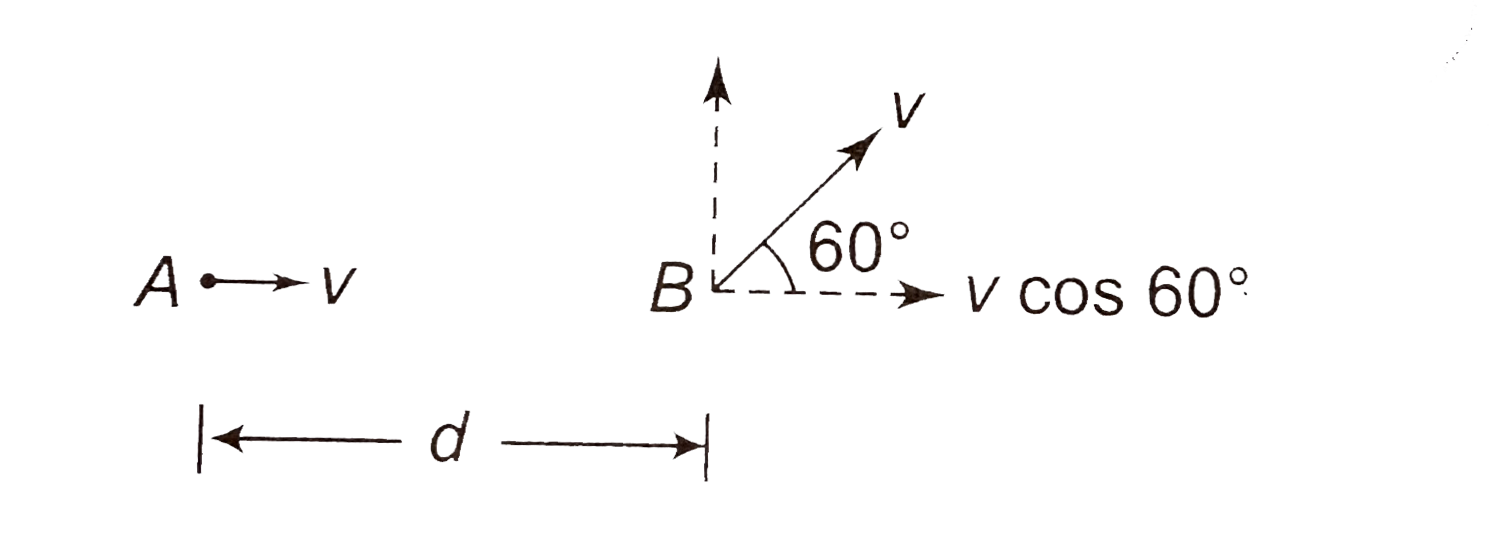 `(v_(A//B))_(along AB)=v-vcos 60^(@)=v/2` `t=d/(v/2)=(2D)/v` |
|
| 12. |
Two slabs A & B having lengths l_(1)andl_(2), respectively, and same cross - section have thermal conductivities K_(1)andK_(2) respectively. They are placed in contact and a constant temperature difference is maintained across the combination. The ratio of the quantities of heat flowing through A and B in a given time is |
|
Answer» `K_(1)/l_(1):K_(2)/l_(2)` |
|
| 13. |
Discuss the properties of scalar and vector |
|
Answer» Solution :PROPERTIES of vector (CROSS) product. (i) The vector product of any two VECTORS is always another vector whose direction is perpendicular to the plane containing these two vectors, i.e., orthogonal to both the vectors `vecA` and `vecB` , EVEN though the vectors`vec A` and `vecB` MAY or may not be mutually orthogonal. (ii) The vector product of two vectors is not commutative, i.e.,`vecA xxvecB ne vecB xx vecA` But , `vecA xx vecB = - [vec B xx vecA]` Here it is worthwhile to note that`|vecA xx vecB| = |vecB xx vecA| = AB sin theta`i.e., in the case of the product vectors `vecA xx vecB` and `vecB xx vecA ` , the magnitudes are equal but directions are opposite to each other, Properties of scalar product (i) The product quantity `vecA . vecB`is always a scalar. It is positive if · the angle between the · vectors is acute (i.e.,< `90^@` ) and negative if the angle between them is obtuse `(i.e. 90^@ lt theta lt180^@ )` . (ii) The scalar product is commutative, i.e ` vecA.vecB = vecB.vecA` (iii)The vectors obey distributive law i.e `vecA (vecB + vecC) = vecA. vecB + vecA. vecC` (iv)The angle between the vectors` theta = cos^(-1) [ (vecA.vecB)/(AB) ]` |
|
| 14. |
If the temperature of sun is doubled,the rate of energy received on earth wil be increased by a factor roughly |
|
Answer» 2 |
|
| 16. |
A force acts on a 3 g particle in such a way that position of particle as a function of time is given by x=3t - 4t^2 + t^3 where x is in metre and is in sec. The work done during first 4 s is |
|
Answer» 570 mJ `V = (DX)/(dt) = (3 - 8t + 3t^2) , a = (d^2 x)/(dt^2) = (-8 + 6t)` `W = intFdx = INT m(d^2x)/(dt^2) ((dx)/(dt)) dt` `= int_(0)^(4) (3 xx 10^(-3)) (6t - 8)(3t^2 - 8t + 3) dt` `= 3 xx 10^(-3) int_(0)^(4) (18 t^3 - 48t^2 + 18t - 24t^2 + 64t - 24)dt` `= 3 xx 10^(-3) [(18t^4)/(4) - (72 t^3)/(3) + (82t^2)/(2) - 24 t]_(0)^(4)` `= 528 xx 10^(-3) ` Joule = 528 mJ . |
|
| 17. |
Fora rotatingbody about fixed axis , |
|
Answer» every particlemovesin a circle |
|
| 18. |
An ideal gas is subjected to cyclic process involving four thermodynamic states, the amounts of heat (Q) and work (W) involved in each of these states are Q_(1)= 6000 J ,Q_(2)= -5500 J, Q_(3) = -3000 J,Q_(4) =3500 J W_(1) = 2500 J, W_(2) = -1000 J,W_(3) =-1200 J:W_(4) = x J The ratio of the net work done by the gas to the total heat absorbed the gas is eta . The values of x and eta respectively are |
|
Answer» 500 , 7.5% |
|
| 19. |
In a two dimensional motion, instantaneous speed v_(0) is a positive constant. Then which of the following are necessarily true ? |
|
Answer» The ACCELERATION of the PARTICLE is zero |
|
| 20. |
What is meant by threshold of hearing ? |
| Answer» Solution :Our EAR can detect the SOUND with INTENSITY range from `10^(-2) omega m^(-2)` to `20 omega m^(-2)` is called theshold of hearing. | |
| 21. |
The farthest objects in our universe discovered by modern astronomers are so distant that light emitted by them takes billions of years to reach the Earth. These objects (known as quasars) have many puzzing features, which have not yet been satisfactorily explained. What is the distance in km of a quasar from which light takes 3.0 billion years to reach us ? |
| Answer» SOLUTION :`2.8xx10^(22) KM` | |
| 22. |
The equation of a sound wave is y = 0.0015 sin (62.8 x + 316 t) . Find the wavelength of the above ………. . |
|
Answer» 0.2 units |
|
| 23. |
If 3 moles of a monoatomic gas is mixed with 6 moles of a diatomic gas at room temperature, thengammaof the mixture is |
|
Answer» 1.49 |
|
| 24. |
(A): According to the law of equipartition of energy, internal energy of an ideal gas at a given temperature, is equally distributed in translational and rotational kinetic energies.(R) : Rotational kinetic energy of a mono. atomic gas is equal to its translational kinetic energy |
|
Answer» Both (A) and ( R) are TRUE and (R ) is the CORRECT EXPLANATION of (A) |
|
| 25. |
During the phenonmenon of resonance |
|
Answer» the amplitude of oscillation becomes LARGE |
|
| 26. |
For different satellite revolving around a planet in different circular orbit, which of the following shows the relation between the angular momentum L and the orbital radius r? |
|
Answer» `L PROP r^2` Now ANGULAR momentum L = mvr `= msqrt((GM)/r )xx r =m sqrt(GMR)` |
|
| 27. |
Distinguish free vibrations from forced vibrations. |
Answer» SOLUTION :
|
|
| 28. |
A mercury drop of diameter 1xx10^-2 m breaks into 8 mercury droplets of equal size. Determine the work done in this process. Surface tension of mercury =0.435N. M^-1.' |
| Answer» SOLUTION :`1.4xx10^-5 J` | |
| 29. |
Simple harmonic motion is the projection of uniform circular motion on |
|
Answer» Solution :(i) Let us consider a particle of mass m moving with uniform speed v along the circumference of a circle whose radius is r in anti-clockwise direction (as shown in Figure). (ii) It is assumed thatthe oriin with the centre O of the circle. (iii) If `omega` is the angular displacement of the particle at any instant of time t, then `theta= omegat`.By PROJECTING the uniform circular motion on its diameter a simple harmonic motion is obtained. (iv) This mass that we can associate a map (or a relationship) between uniform circular (or revolution) motion to vibratory motion. (v) Conversely. any vibratory motion or revolution can be mapped touniform circular motion. The position of a particle moving on a circle is projected on to its vertical diameter or on to a line parallel to vertical diameter. (vi) Similarly, we can do it for HORIZONTAL axis or a line parallel to horizontal axis. EXAMPLE : Let us consider a spring mass system (or oscillation of pendulum) as shown in figure. When the spring moves up and down (or pendulum moves to and FRO), the motion of the mass of bob is mapped to points on the circular motion of the circular motion.  THUS, if a particle undergoes uniform circular motion then the projection of the particle on the diameter of the circle (or on a line paralle to the diameter) traces straightline motion that is simpleharmonic in nature. The circle is known as reference circle of the simple harmonic motion. |
|
| 30. |
A child swinging on a swing in standing position and she suddenly sits on it, then the time period of the swing will be |
|
Answer» increases |
|
| 31. |
A particle is acted by a force F = kx, where .K. is a positive constant. Its P.E at x = 0 is zero. Which curve correctly represents the variations of potential energy of the block with respect to .x. |
|
Answer»
|
|
| 32. |
A rocket is fired from the earth towards the sun. At what distance from the earth’s centre is the gravitational force on the rocket zero ? Mass of the sun= 2 xx 10^(30) kg.Mass of the earth = 6xx10^(24)kg. Neglect the effect of other planets etc. (orbittal radtus = 1.5 xx 10^(11) m ). |
| Answer» SOLUTION :`2.6 XX 10^(8)` m | |
| 33. |
A particle of mass 2 mg moves with constant speed and is found to pass two points 5.0 m apart in a time interval of 5 ms. The kinetic energy of the particle is |
|
Answer» `1.0 J` Particle is moving with constant speed, so Speed, v = `("distance between TWO points")/("time interval") = (5m)/(5 xx 10^(-3) s) = 10^3 ms^(-1)` `:.` KE = 1/2 mv^2 = 1/2 (2 xx 10^(-6))(10^(3))^(2) = 1J` |
|
| 34. |
(A): When a shell at rest explodes, the centre of mass fragments Continues at rest (R) : In explosion the linear momentum of the system does not remains conserved. |
|
Answer» Both .A. and .R. are true and .R. is the CORRECT EXPLANATION of .A. |
|
| 35. |
The direction of vecAxxvecB is given by |
|
Answer» right HAND SCREW rule |
|
| 36. |
A force of 5N acts on a particle along a direction making an angle of 30^(@)with vertical . Its vertical component will be : |
|
Answer» Solution :`F = 5N, theta = 30^(@)` `F sin theta = 5 sin 30^(@)``= 5 XX (1)/(2) = 2.5 N` |
|
| 37. |
A simple pendulum made of a bob of mass m and a metallic wire of negligible mass has time period 2s at T = 0°C. If the temperature off the wire is increased and the corresponding change in its time period is plotted against its temperature, the resulting graph is a line of slope S. If the coefficient of linear expansion of metal is a then the value of S is : |
| Answer» ANSWER :C | |
| 38. |
A lead bullet, of initial temperature 27° C and speed 'v' kmph penetrates into a solid object and melts. If 50% of the kinetic energy is used to heat it, the value of V in kmph is (for leads melting point = 600K, latent heat of fusion = 2.5 xx 10^(-4) "Jkg"^(-1), specific heat = 125 "J kg"^(-1) K^(-1) ) |
|
Answer» 1800 |
|
| 39. |
Does moment of inertia depend upon the angular velocity of the body ? |
| Answer» SOLUTION :This is to increase the value of `VECR`so that `vectau = vecr xx vecF` is high for a GIVEN value of `vecF`. | |
| 40. |
State and establish principle of conservation of mechanical energy . |
|
Answer» Solution :Let this principle will be obtain in one dimension . If a body UNDERGOES distance `Deltax` by conservativeforceF then according to work energy (WE) theorem , `DeltaK = F (x) Deltax ""….(1)` but according to definition of POTENTIAL energy for conservative FORCE , `-DeltaV = F(x)Deltax ""....(2)` From equation (1) and (2) , `DeltaK = - DeltaV ` `:. DeltaK + DeltaV = 0 ` ` :. Delta(K+V) =0` ` :. ` The change of kinetic energy and potential energy is zero . That means sum of kinetic energy for conservative force , ` -DeltaV = F(x) Deltax ""....(2)` From equation (1) and (2) , `DeltaK+DeltaV = 0 ` ` :. Delta(K+V) = 0 ` ` :. ` The chance of kinetic energyand potential energy is zero . That means sum of kinetic energy and potential energy is a constant . ` :. K+V ` = constant Over the whole path , `x_(i) ` to `x_(f)` this means that `K_(i) +V(x_(i))=K_(f) +V(x_(f))` ` :. ` The quantity `K + V(x) ` is called the total mechanical energy of the system . The kinetic energy K and potential energy V(x) is called the total mechanical energy of the system . The kinetic energy Kand potential energy V(x) MAY vary from point to point but the sum remains constant . Mechanical energy is conserved in conservative field . That means as we go above and above form earth.s surface the kinetic energy and potential energy increases . The principle of total mechanical energy is written as under : "The total mechanical energy of a system is conserved if the forces doing work on it are conservative ". "Under INFLUENCE of conservative forces the mechanical energy of a mechanically isolated " system remain constant. |
|
| 41. |
(A) Optical fibres are used to transmit light without any loss in its intensity over distance of several kilometers. (R ) Optical fibres are very thick and all the light is passed through it without any loss. |
|
Answer» Both A and R are TRUE and R is the CORRECT explanation of A |
|
| 42. |
A regular hexagon of side a stand in a vertical plane with one side on the horizontal ground. A particle is prljected such that it touches the four upper vertices of the hexagon before returning to the ground. Find the ratio of the velocity of the particle on reaching the ground to its minimum velocity. |
|
Answer» |
|
| 43. |
Give the expression for total energy supllied at a constant pressure for1 mole of gas. |
|
Answer» SOLUTION :`(DQ)_("pressure")=(F)/(2) RdT+RdT=RdT ((f+2)/(2))` where .f. is degrees of freedomof given GAS. |
|
| 44. |
To make a piece of paper float horizontally in air, we allow air to flow over the upper surface of the paper, but not below its lower surface. Why? |
| Answer» SOLUTION :If AIR is allowed to FLOW HORIZONTALLY over the upper surface of the paper, the velocity of air above the paper will be completively higher than that below it. According to Bernoulli.stheorem, the lower surface of the paper will experience a higher pressume than the upper surface. the resultant upward pressure keeps the piece of paper FLOATING horizontally in air. | |
| 45. |
Three concentricsphereical shells of radii r_(1) ,r_(2)and r_(3) have charge q_(1),q_(2) and q_(3) respectively . If the central sphere is now connected to theearthby a conductingwire , find the final potentials fo the three shells . |
|
Answer» Solution :WHENTHE middle SHELL is earthed , CHARGE flowsbetween the shell and the earthits potentialwill be zero . Letq BETHE final charge on themiddle shell . `V_(2) = (1)/(4PI in_(0))((q_(1))/(r_(2)) + (q)/(r_(2)) + (q_(3))/(r_(3))) = 0` `(q_(1)) /(r_(2)) + (q)/(r_(2)) + (q_(3))/(r_(3)) = 0` `(q)/(r_(2)) = - ((q_(1))/(r_(2))+ (q_(3))/(r_(3)))rArrq = - (q_(1) + (q_(3)r_(2))/(r_(3)))` Final potenital of innermostshell is . `V_(1) =(1)/(4 pi in_(0)) ((q_(1))/(r_(1)) + (q)/(r_(2)) +(q_(3))/(r_(3)))` Final potentialof middle shell is `V_(2) = 0` Final potential of outermost shell . `V_(3)= (1)/(4 pi in_(0)) ((q_(1) + q_(2) + q_(3))/(r_(3)))` |
|
| 46. |
An elastic string of constant k is attached to a block of mass m as shown. The block is given an extension of (2mg)/(k) from the equilibrium position and released. The time period of oscillations of the block is |
|
Answer» `2pi sqrt((m)/(k))` 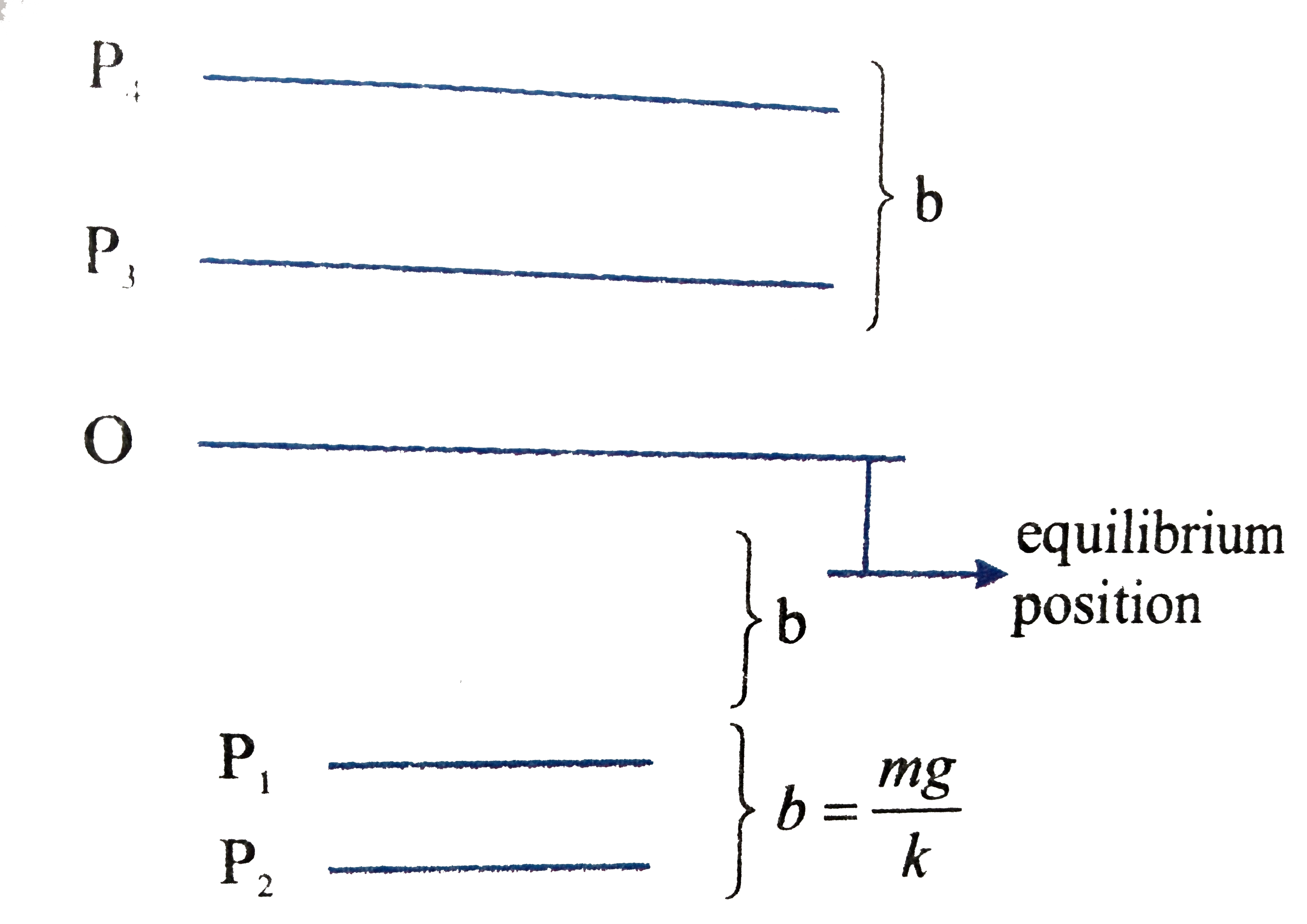 upto `P_(3), SHM` appears and between `P_(3) & P_(4), SHM` disapears. `= (2T_(1))/(3) +(t_(P_(3)P_(4))+t_(P_(4)P_(3))):` `:. T = t_(OP_(2))+t_(P_(2)O) +t_(OP_(3))+t_(P_(3)P_(4)) +t_(P_(4)P_(3)) +t_(P_(3)O)` where: `T_(1) = 2pi sqrt((,)/(k))` VELOCITY at `P_(3)` is: `v = omega sqrt(A^(2)-x^(2)) = omega sqrt(4b^(2)-b^(2)) = b omega sqrt(3)` `t_(P_(3)P_(4)) +t_(P_(4)P_(3)) = (2v)/(g)` |
|
| 47. |
The Bulk modulus of a perfect rigid body is |
|
Answer» 1 |
|
| 48. |
A thermodynamic system is taken through the cycle ABCD as shown in figure. Heat rejected by the gas during the cycle is |
|
Answer» 2PV In a cyclic process work done is equal to the area under the cycle and is positive if the cycle is CLOCKWISE and negative if anticlockwise. `:. Delta W = - "Area of REACTANGLE ABCD " = - P(2V) = -2PV` ACCORDING to first law of thermodynamics `Delta Q = Delta U + Delta W` or `Delta Q = Delta W` (As `Delta U = 0`) i.e., heat supplied to the system is equal to the work done So heat ABSORBED, `DETA Q = Delta W = -2PV` `:.` Heat rejected by the gas= 2PV 
|
|
| 49. |
A swimmer starts to swim from point a to cross a river. He wants to reach point B on the opposite side of the river. The line AB makes an angle 60^(@) with the river flow as hown. The velocity of the swimmer in still water is same as that of the water (i) In what direction should he try to direct his velocity ? Calculate angle between his velocity anf river velocity. (ii) Find the ratio of the time taken to cross the river in this situation to the minimum time in which he can cross this river. |
|
Answer» time to cross ` = (2d)/(SQRT(3) V)` Minimum time `t = (d)/(v)` `:.` Ratio `= 2 sqrt(3)`. 
|
|
| 50. |
If the speed of rotation of earth increases from existing speed, then the weight of a body is ...... |
|
Answer» increases at an equator and remain unchanged at pole. here `lamda=0` `:.g. = g - Romega^2` `:.` Angular SPEED increase, g. decreases At poles `lamda = 90^@` `:.g. = g ` `:.g.` remains constant |
|


