Saved Bookmarks
This section includes 7 InterviewSolutions, each offering curated multiple-choice questions to sharpen your Current Affairs knowledge and support exam preparation. Choose a topic below to get started.
| 1. |
Rain is falling vertically with a speed of 30 ms^(-1) . A woman rides a bicycle with a speed of 10 ms ^(-1) in the north to south direction . What is the direction in which she should hold her umbrella ? |
|
Answer» |
|
| 2. |
A hose shoots water straight up for a distance of 2.5 m. The end opening on the hose has an area of 0.75cm^(2). How much water will comes out in one minute? |
|
Answer» 31.3 lit |
|
| 3. |
Two bodies of m asses 10 kg and 20 kg respectively kept on a smooth, horizontal surface are tied to the ends of a light string, a horizontal force F = 600 N is applied to (i) A, (ii) B along the direction of string. What is the tension in the string in each case ? |
Answer» SOLUTION :(i)conditionwhenforceis appliedon objectB Lettensionin string= T Formotionof A formotionof B `(m_(2))/(m_(1))= (F-T)/( T )= (F)/( T )= (T )/( T ) - (F )/( T )-1` `:. , (30)/( 10)= (600)/( T )` (ii) Whenforceis appliedon lignterobject`(m_(1))`  Motionof A `m_(1)a = F - T` `m_(2)a = T` Bytakingratioof(2) and (1) `(m_(1))/(m_(2))= (F -T)/(T )= (F )/( T^(2)) - 1` `:. (30)/(20) =(600)/( T)` `:. T= 400 N` |
|
| 4. |
A body is projected up with velocity u. It reaches a point in its path at times t_1 and t_2 seconds from the time of projection. Then (t_1+t_2) is |
|
Answer» `(2U)/G` |
|
| 5. |
A physical quantity of the dimensions of length that can be formed out of c, G and e is [c is velocity of light, G is universal constant of gravitation and e is charge) |
|
Answer» <P>`c^(2)[G(E^(2))/(4piepsilon_(0))]^(1//2)` `(e^(2))/(4piepsilon_(0))= [F xx d^(2)]= [ML^(3)T^(-2)]` Dimensions of G=` [M^(-1)L^(3)T^(-2)]` Dimensions of `c= [LT^(-1)]` `l prop ((e^(2))/(4piepsilon_(0)))^(p) G^(q)c^(r)` `:. [L^(1)]= [ML^(3)T^(-2)]^(p)[M^(-1)L^(3)T^(-2)]^(q)[LT^(-1)]^(r)` On comparing both SIDES and solving ,we get `p= (1)/(2), q= (1)/(2)` and `r= -2` `:. [l]= (1)/(c^(2))[(Ge^(2))/(4piepsilon_(0))]^(1//2)` |
|
| 6. |
Which of the following affects the elasticity of a substance ? |
|
Answer» CHANGE in TEMPERATURE |
|
| 7. |
Two equal forces acting at a point, at right angle to each other have a resultant of 14.14N. The magnitude of each forces is |
|
Answer» 28.28 N |
|
| 8. |
These days people use steel utensils with copper bottom. This is supposed to be good for uniform heating of food. Explain this effect using the fact that copper is the batter conductor. |
Answer» Solution :Copper is better conductor than steel. At the BOTTOM of steel, if copper LAYER is given then copper will absorbs the heat QUICKLY and will pass it to FOOD in vessel. Due to that the food will be cooked quickly. 
|
|
| 9. |
What happens when a metal spring dissolves in an acid? |
| Answer» Solution :The INTERNAL ENERGY of the acid INCREASES followed by INCREASE in temperature | |
| 10. |
20 xx 10^(3)Kg of hot copper at 100^(0)C is put in a hole in a block of ice at 0^(0)C. this results in the melting of 2.5 xx 10^(-3)Kg of ice. Calculate the specific heat of copper. |
|
Answer» |
|
| 11. |
The volume of the bulb of a mercury thermometer at 0°C is V_0, and the cross section of the capillary is A_0. The coefficient of linear expansion of the glass is alpha_(g) per ""^(@) C, and the coefficient of cubical expansion of mercury is gamma_(Hg) per ""^(@) C. If the mercury just fills the bulb at 0^(@) C, what is the length of the mercury column in the capillary at a temperature of t^(@) C? |
|
Answer» `h= (V_0)/( A_0) [ (gamma_(HG)-3 alpha_(g))/( 1+ 2 alpha_(g) t) ]t` |
|
| 12. |
No heat flows between the system and surroundings. Then the thermdynamic process is |
|
Answer» isothermal |
|
| 13. |
A particle moves from a point (- 2 hati + 5 hatj)to (4 hatj + 3hatk) when a force of (4 hati + 3hatj) N is applied. How much work has been done by the force? |
|
Answer» 8J `VECF = (4 hati + 3 hatj) N, W = ?` Work done by force F in moving from `vec(r_1) ` to `vec(r_2)` `W = vecF . (vec(r_2) - vec(r_1)) = (4hati + 3hatj) . (4 hatj + 3hatk + 2 hati - 5 hatj)` `= (4 hati + 3 hatj) . (2 hati - hatj + 3 hatk) = 8 + (-3) = 5 J`. |
|
| 14. |
A ball at rest is dropped from height of 12m. It losses 25% of its kinetic energy on striking the ground and bounces back to a height h the value of h is |
| Answer» ANSWER :C | |
| 15. |
A block of mass .m. moving with a speed .v. compresses a spring through a distance .x. before its speed reduces by 25%. The spring constant of the spring is |
|
Answer» `(MV^(2))/(4x^(2))` |
|
| 16. |
The radius of a tube is doubled, the rate of flow increases by |
|
Answer» 8 TIMES |
|
| 17. |
A vector perpendicular to the vector (hat(i)+2hat(j)) and having magnitude 3sqrt(5) units is |
|
Answer» `3HAT(i)+6ht(j)` |
|
| 18. |
Calculate the mass of alcohol flowing in two minutes through a tube of radius 5 xx 10^(-4) m and length 0.5 m, if there is a constant pressure head of 0.6 m of alcohol. Density of alcohol is 800 kg//m^(3)Coefficient of viscosity of alcohol = 1.38 xx 10^(-3) Ns//m^(3)? |
|
Answer» |
|
| 19. |
A binary star consists of two stars A (mass 2.2M_(s)), and B of mass (11M_(s)) where M_(s) is the mass of the sun. They are separated by distance d and are rotating about their centre of mass, which is stationary. The ratio of the total angular momentum of the binary start to the angular momentum of star B about the centre of mass is |
|
Answer» 2 |
|
| 20. |
Three circular discs of same material and same thickness of radii r, 2r and 3r are placed on a horizontal plane such that their centres lie along a straight line. The radius of the middle disc is 2r and it touches the other two discs. The distance of the centre of mass of the system from the centre of the smaller disc is |
|
Answer» 2r |
|
| 21. |
A metre stick is balanced on a knife edge at its centre . When two coins , each of mass 5 g are put one on top of the other at the 12.0 cm mark , the stick is found to be balanced at 45.0 cm . What is the mass of the metre-stick ? |
|
Answer» 56 g |
|
| 22. |
At the instant when all the particles in the medium of a stationary wave are at their equilibrium positions the |
|
Answer» kinetic ENERGY becomes ZERO |
|
| 23. |
The distance of two planets from the Sun are 10^(13)and10^(12) metres respectively. The ratio of time periods of these two planets is: |
|
Answer» 100 |
|
| 24. |
A staw6 cmlongfloatsanwater. Thewaterfilmon onesidehassurfacetensionof 50dyne / cmonthe othersidecamphorreducesthe surfacetensionto 40dyne/cm. Theresultantforceactingon thestrawis 12 Kdyne. findK |
|
Answer» |
|
| 25. |
A particle executing simple harmonic motion of amplitude 5 cm has maximum speed of 31.4 cm/s. The frequency of its oscillation is……………. |
|
Answer» 3Hz MAXIMUMSPEED`V_(max)= 2 pietaxx A ` ` thereforen =(V_(max))/( 2PI A )= ( 31.4 xx 10^(-2) )/( 2 pixx 5XX 10^(-2)) =( 31.4 )/( 10 xx3.14) = n=1 Hz` |
|
| 26. |
Masses of 10 cm^(3) of water are 9.998 g and 10 g at 0^(@)C " and " 4^(@)C respectively. Find the average coefficient of real expansion of water within the range of these temperatures. |
|
Answer» Solution :Density of WATER at `0^(@)C,` `rho_(0)=9.998/10=0.9998g*CM^(-3).` Density of water at `4^(@)C, rho_(4)=10/10=1g*cm^(-3)` Therefore,the average coefficient of real expansion of water within the range of `0^(@)C " to "4^(@)C`, `GAMMA=(rho_(0)-rho_(4))/(rho_(0) times t)=(0.9998-1)/(0.9998 times (4-0))=-5 times 10^(-5@)C^(-1)` The NEGATIVE value of `gamma` indicates that water contracts when it is HEATED from `0^(@)C " to " 4^(@)C.` |
|
| 27. |
For a projectile, projected at an angle, the resultant velocity is : |
|
Answer» `sqrt(u^(2) + G^(2) t^(2) - 2 utg SIN theta)` |
|
| 28. |
The blood pressure in human is greater at the feet than at the brain. Why? |
| Answer» SOLUTION :The height of blood column is QUITE LARGE at feet than at the BRAIN, hence blood pressure at feet is greater. | |
| 29. |
200g of a solid ball at 20^(@)C is dropped in an equal amount of water at 80^(@)C. The resulting temperature is 60^(@)C. This means that specific heat of solid is |
|
Answer» One fourth of water Heat GAINED by the solid, `Q_(2) = 200 xx s_(s) xx (60-20)` According to the principle of calorimetry `Q_(1) = Q_(2)` `:. 200 xx s_(w) xx (80 -60) = 200 xx s_(w) xx (60-20)` or `s_(s) = (1)/(2) s_(w)` |
|
| 30. |
In an elastic collision between two billiard balls. The variation of potential energy is represented by the graph (here r is the distance between centres of the balls and R is radius of the ball) |
|
Answer»
|
|
| 31. |
What is the frequency of oscillation of a simple pendulum mounted in a cabin that is freely falling under gravity? |
| Answer» Solution :Gravity DISAPPEARS for a MAN under free fall. Hence, the FREQUENCY of the simple PENDULUM under this situation is zero | |
| 32. |
Determine the radius of a drop of water falling through air, if it covers 0-048 min 4 s with a uniform velocity. Assume the density of air as 0-00121 gm/cc and eta =1.8 xx 10^(5) Ns m^(-2). |
|
Answer» |
|
| 33. |
Two moles of a certain gas at a temperature T_0 = 300 K were cooled isochorically so that the pressure of the gas got reduced 2 times. Then as a result of isobaric process, the gas is allowed to expand till its temperature got back to the initial value. Find the total amount of heat absorbed by gas in this process. |
| Answer» SOLUTION :`2.48 KJ` | |
| 34. |
If a liquid of radius .R. is sprayed in to .n. small drops of equal radius .r. what is the work done in the process. |
|
Answer» Solution :The surface tension of liquid = T(say) Surface energy of large drop = `4piR^(2)T` Surface energy of all small drops together = `n4pir^(2)T` The total surface area of all small drops PUT together is more than the surface area of large drop. Hence the system REQUIRED EXTERNAL WORK to be DONE on it. `therefore` External work = total final energy - initial energy `W=n4pir^(2)T-4piR^(2)T""...(1)` The total volume of liquid is constant before and after spraying `therefore(4/3pir^(3))n=4/3piR^(3)rArrr=R/n^(1//3)rArrr^(2)=R^(2)/n^(2//3)" "...(2)` `thereforeW=4piR^(2)Tn/n^(2//3)-4piR^(2)T` `rArrW=4piR^(2)T[n^(1//3)-1]` |
|
| 35. |
If a square of side R/2 is removed from a uniform circular disc of radius R as shown in the figure, the shift in centre of mass is: |
|
Answer» `R/(4pi-1)` |
|
| 36. |
Air bubble formed in liquid is considered as a sphere of air .initially ,bubble obtained acceleration is in upward direction and it is risingin liquid why ? |
| Answer» Solution :Air bubble formed in liquid obtained ACCELERATION in upward DIRECTION and it is rising in liquid , because the DENSITY of air bubble `(rho)` is less than density of liquid `(sigma).(rholtsigma)` HENCE TERMINAL velocity of bubble is negative and hence it rises in liquid. | |
| 37. |
The initial and final temperatures are recorded by using a thermometer as (30.4pm0.2)^@C and (50.6 pm 0.3)^@CThe rise in temperature is |
|
Answer» `20.2^@C` |
|
| 38. |
A steel tank is filled with a gas at 150 atm and at 20^(@)C. If the pressure raises to 250 atm, the tankexplodes. Find the temperature at which the tank explodes. |
|
Answer» |
|
| 39. |
What is meant by significant figures ? Given any four rules for counting significant figures. |
| Answer» SOLUTION :1 (E ).5 and 6 | |
| 40. |
A rope is wound round a hollow cylinder of mass 3 kg and radius 40 cm. What is the angular acceleration of the cylinder if the rope is pulled with a force of 30 N. |
|
Answer» `0.25 "rad"s^(-2)`  `Ialpha=F xx r` `MR^(2) xx alpha = 30 xx (40)/(100)` , `(3 xx 40 xx 40 xx alpha)/(100 xx 100)=12` `(3 xx 16 xx alpha)/(100)=12` , `alpha=25 "rad" // s^(2)` |
|
| 41. |
A hollow glass sphere is balanced by counterpoising weights made of brass in a common balance. The whole system is then covered with an air-tight bell jar and the jar is evacuated. What will be the result? |
| Answer» Solution :Since the density of glass is LESS than the density of brass, the volume of the glass sphere is GREATER than the volume of the same mass of brass weights. So, in air, the glass sphere experiences a larger buoyant FORCE than the brass weights. Now, when the bell jar is evacuated, this buoyant force ceases to act hence the weight of the glass sphere becomes more than that of the brass weights. Hence, the end of the BALANCE beam containing the glass sphere will move downwards. | |
| 42. |
The displacement vector of a particle of mass m is given by r(t) = hati A cos omegat+ hatj B sin omegat. (a) Show that the trajectory is an ellipse. (b) Show that F= momega^(2)r |
|
Answer» Solution :Displacementvector`vec( r )= xhat(J )+ YHAT(j )` here `vec( r )= (ACOS t hat(j) ) = ( Bsinhat(I ))` Whichis equationof ellipse (b )velocityof theparticle `v= (DR )/( DT) = hat(I ) (d ) /(dt )+ hat(j ) (d ) /( dt ) ` Accelerationof theparticle(a ) ora= ` A (d ) /( d )(sinhat(j )+ B(d )/(dt ) coshat(j ))` `= [hat(j )cost + hat(j ) Bsint ]` forceactingon theparticle `f= ma=- m w^(2)r` Henceprove. |
|
| 43. |
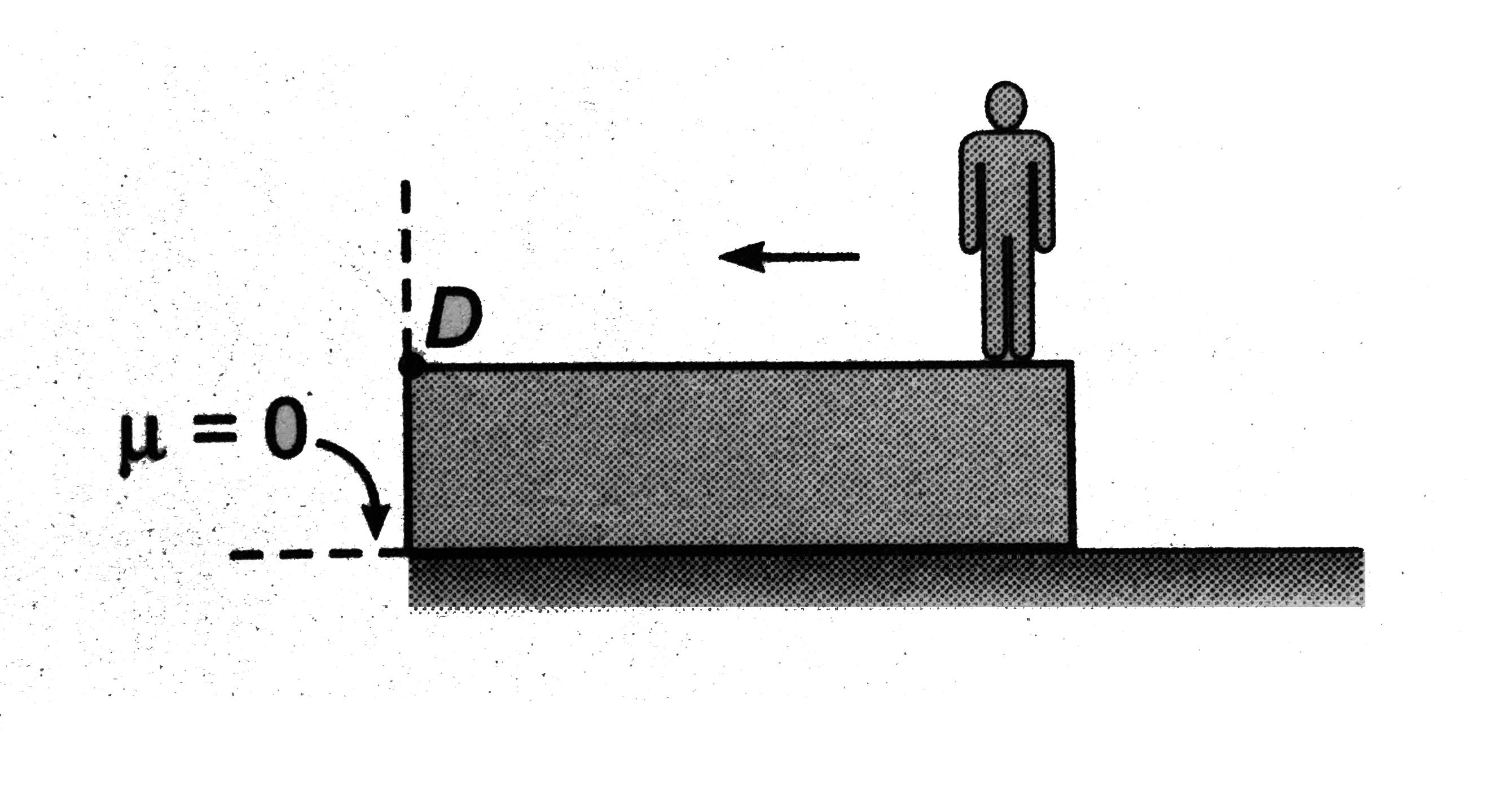
A man of mass 50 kg is runing on a plank of mass 150 kg with speed of 8 m//s relative to plank as shows in the figure (both were initially at rest and velocity of man with respect to ground any how remains constant). Plank is placed on smooth horizontal surface. The man, while runing, whistle with frequency f_(o). A detected (D) placed on plank detects frequency. The man jumps off with same velocity (w.r.t. to groung) from point D and slides on the smooth horizontal surface [Assume coefficient of friction between man and horizontal is zero]. The speed of sound in still medium is 330 m//s. Answer the following questions on the basis of above situations. The frequency of sound detected by D, after man jumps off the plank is |
|
Answer» `(332)/(324) f_(o)` `f_(2) = f_(o) ((nu - nu_(o))/(nu + nu_(s)))` `= f_(o) ((330 - 2)/(330 + 6)) = ((328)/(336)) f_(o)` |
|
| 44. |
A man of mass 50 kg is runing on a plank of mass 150 kg with speed of 8 m//s relative to plank as shows in the figure (both were initially at rest and velocity of man with respect to ground any how remains constant). Plank is placed on smooth horizontal surface. The man, while runing, whistle with frequency f_(o). A detected (D) placed on plank detects frequency. The man jumps off with same velocity (w.r.t. to groung) from point D and slides on the smooth horizontal surface [Assume coefficient of friction between man and horizontal is zero]. The speed of sound in still medium is 330 m//s. Answer the following questions on the basis of above situations. Choose the correct plot between the frequency the frequency detected by detector usrsus position of the man relative to detector. |
|
Answer»
SIMILARLY, `f_(2) lt f_(o)` but `f_(2) =` constant |
|
| 45. |
A body of mass 'm' slides down a smooth inclined plane having an inclination of 45^(@) with the horizontal. It takes 2s to reach the bottom. If the body is placed on a similar plane having coefficient friction 0.5, what is the time taken by it to reach the bottom? |
|
Answer» SOLUTION :2.828 SEC. |
|
| 46. |
A body of mass 'm' slides down a smooth inclined plane having an inclination of 45^(@) with the horizontal. It takes 4sec to reach the bottom. If the body is placed on a similar plane having coefficient of friction 0.5. What is the time taken for it to reach the bottom ? |
|
Answer» `4sqrt(2)SEC` |
|
| 47. |
(a) The potential energy of a harmonic oscillator of mass 2 kg in its resting position is 5 joules, its total energy is 9 joules and its amplitude is 1 cm. Calculate its time - period. (b) A particle of mass 5 g lies in a potential field V = (8x^2 +200) ergs/g. Calculate its time - period |
| Answer» SOLUTION :`3.14xx 10^(-2) s , (B) 1.571 s` | |
| 48. |
Of the following quantities which one has the dimensions different from the remaining three? (i) Energy density (ii) Force per unit area (iii) Product of charge per unit volume and voltage (iv) Angular momentum per unit mass |
|
Answer» (i) `("Force")/("Area")= ([MLT^(-2)])/([L^(2)])= [ML^(-1)T^(-2)]` `("Charge")/("Volume") XX "Voltage"= ("Charge")/("Volume") xx ("Work")/("Charge")= ("work")/("volume")= ([ML^(2)T^(-2)])/([L^(3)])= [ML^(-1)T^(-2)]` `("Angular momentum")/("MASS")= ([ML^(2)T^(-1)])/([M])= [M^(0)L^(2)T^(-1)]` Therefore, dimensions of (iv) is different. |
|
| 49. |
The stress-strain graphs for materials A and B The graphs are drawn to the same scale. (a) Which of the materials has the greater Young's modulus ? (b) Which of the two is the stronger material ? |
|
Answer» SOLUTION :It is clear from both the grpah that for material A. Slope of graph`= (("Stress")/("STRAIN"))` is greater. Hence YOUNG modulus `(("Stress")/("Strain"))` of material A is more. (b) The amount of stress required for fracting a material, corresponding to its fracture point GIVES the strength of material. Material A can withstand more strain than material B. Hence, material A is stronger than material B. |
|
| 50. |
If E, M,L and G denote energy, mass, angular momentum and universal Gravitational constant respectively, prove that (EL^(2) )/(M^(5) G^(2) ) is a dimensionless quantity. |
|
Answer» Solution :Taking dimensional FORMULAE energy (E ) `= ML^(2) T^(-2)` mass `(M) = ML^(0) T^(0)`, ANGULAR Momentum (L ) `=ML^(2) T^(-1)` Universal Gravitational constant (G) `= M^(-1) L^(3) T^(-2)` Substituting in `(EL^2)/( M^(5) G^(2) )`, we get `((ML^(2) T^(-2) )(ML^(2) T^(-1) )^(2) )/( (ML^(0)T^(0) )^(5) (M^(-1) L^(3) T^(-2) ) ^(2) )= (M^(1+2) L^(2+4) T^(-2-2))/(M^(5-2) L^(0+6) T^(0-4))` `= A` dimensionless quantity. |
|