

Saved Bookmarks
This section includes 7 InterviewSolutions, each offering curated multiple-choice questions to sharpen your Current Affairs knowledge and support exam preparation. Choose a topic below to get started.
| 1. |
Draw (i) position-time (ii) velocity-time and (iii) acceleration-time graph for the motion of an object under free fall. |
Answer» Solution :We assume the downward direction as the positive direction during this free fall.  (i) As u =0 , the displacement at any time t is h = `(1)/(2)"GT"^(2) " ""or"" " t^(2) = (2)/(g)h`. So the position-time graph is a parabola PASSING through the origin [ LIKE `X^(2) = 4 ay` on a x-y graph]. (ii) Initial velocity u = 0 so at any time t the velocity is v =gt. Hence the velocity-time graph is a straight line of positive slope passing through the origin [ like y = mx on a xy -graph] (iii) Acceleration (a) = acceleration DUE to gravity (g) = constant and positive. So the acceleration-time graph is parallel with time axis. |
|
| 2. |
A massless inelastic thread passes over a small frictionless pulley. Two identical blocks A and B of mass m = 2kg are attached with the thread. The system is initially at rest. A bullet C also of mass m strikes the block A from below with initial speed u as shown in figure and gets embedded in block A at t = 0 second. Then: a) Find the velocity of centre of mass system (block A plus bullet C and block B) Just after cxzollision. b) Time after which the string becomes taut again. |
|
Answer» |
|
| 3. |
The shaft of a motar is making 1260 rpm. The torque supplied by the motar is 100 Nm. The power of motar is |
|
Answer» 100 KW |
|
| 5. |
What determine the natural frequency ofbody ? |
|
Answer» SOLUTION :NATURAL frequency of a BODY is determined by (i) ELASTIC properties of the material of the body. (ii) Dimensions of the body. |
|
| 6. |
What ismeantby coefficient oflinearexpansionsuperficial&cubicalexpansion ? |
|
Answer» Solution :Linear : When a solidrod of initiallengthl isheatedthrougha temperature`Delta T` , itsfinallength(increased ) is GIVENBY `L = L_(0) + Delta L = L_(0)(1+ alpha DeltaT)` Where `alpha` is coefficientoflinearexpansion. It isgivenby `alpha= (Delta L)/(L_(0))XX (1)/( Delta T)` `alpha ` is definedas the increase inlengthperunitlengthperdegreerisein temperature . Supeerficial expansion : Whenasolidsheetof initialsurfacearea A isheatedthrogh a temperature`Delta T`itsfinalarea(INCREASES ) isgiven by `A' = A_(0)+DELTAA= A_(0)(1+ beta DeltaT)` `beta -` coefficient of superficialexpansion. It isgivenby,`beta = (Delta A)/(A_(0)) xx (1)/(DeltaT)` It isdefinedastheincrease in surfacearea perunitareaperdegreerise in temperature Cubicalexpansion : When asolidof initialvolumeVisheatedthroughatemperature`DeltaT`itsfinal volumeisgivenby `V' = V_(0) + DeltaV= V_(0) (1 + gammaDeltaT)` `gamma-`coefficient ofcubicalexpansionand itisdefinedastheincreasein volumeperunitvolumeperdegreerisein temperature `gamma = (DeltaV)/(V_(0))xx (1)/(Delta T)` |
|
| 7. |
N beads are restiog on a smooth horizontal wire which is circular at the end with radius r as shown in figure the masses of the beads are m, m//2,m//2.....,m//2^(n-1) respectively. Find the minimum velocity which should be iparted to the first bead of mass m such that the n^(th) bead wil fall in the tank shown in figure -40148. |
|
Answer» |
|
| 8. |
The oxygen molecule has a mass of 5.30 xx 10^(-26) kg and a moment of inertia of 1.94 xx 10^(-46) kg m^(2) about an axis through its centre perpendicular to the line joining the two atoms. Suppose the mean speed of such a molecule in a gas is 500 m/s and that its kinetic energy of rotation is two thirds of its kinetic energy of translation. Find the average angular velocity of the molecule. |
| Answer» SOLUTION :`6.7xx10^(12)` rad/s | |
| 9. |
A pendulum clock gives correct time at 20^(@)C at a place where g=10m//s^(2). The pendulum consists ball. If it is taken to a different place where g = 10.01m//s^(2) at what temperature the pendulum gives correct time (alpha of steel is 10^(-5)//""^(@)C) |
| Answer» Answer :D | |
| 10. |
A particle moves in the plane according to the law x=klt, y=kt(1-alphat), when k and alpha are positive constants, and t is the time, Find: a. the equation of the particle's trajectory y(x) (b) the velocity v and the acceleration a of the point as a function of time. |
|
Answer» |
|
| 11. |
(A) : Angular velocity of all the particles are same when a rigid body perform rotation.(R ) : The relation between angular velocity and linear velocity is v=w xx r where r is the radius of rotation about the axis. |
|
Answer» Both (A) and (R ) are true and (R ) is the CORRECT explanation of (A) |
|
| 12. |
A body is in accelerated motion. Is it possible that no work is done ? Give some example. |
| Answer» Solution :Yes, it is possible that work DONE is zero even when a body is in accelerated MOTION. This happens when FORCE is acting in a direction PERPENDICULAR to the direction of motion. For example, EARTH moving around the sun in a circular orbit under the gravitational force perpendicular to its path. Hence work done is zero, thoudh the motion is accelerated. | |
| 13. |
A solid cube of side 2a and mass M, sliding on a smooth surface with velocity v_(0) , collides inelastically with the raised edge of the table: |
|
Answer» Moment of INERTIA of cube about edge is `(4Ma^(2))/3` |
|
| 14. |
Determine the volume contraction of a solid copper cube, 10 cm on an edge, when subjected to a hydraulic pressure of 7.0xx10^(6) Pa. |
|
Answer» |
|
| 15. |
Statement A : If the lift is falling freely then the man on its floor experiences no reaction from the floor.Statement B : If the moves down with an acceleration a gt g, then the normal reaction becomes negative and the man feels floating up in the lift. |
|
Answer» A and B are CORRECT |
|
| 16. |
ABCFED is a uniform plate (shown in figure). ABC and DEF are circular arcs with common centre at O and having radii a and 2a respectively. This plate is lying on a smooth horizontal table. A particle of mass half the mass of the plate strikes the plate at point A while travelling horizontally along the x direction with velocity u. The particle hits the plate and rebounds along negative xwith velocity (u)/(2) . Find the velocity of point D of the plate immediately after the impact. [Take (28)/(9 pi) cong 1 ] |
|
Answer» |
|
| 17. |
A metal rod length l=100 cm is changed at two points A and B as shown in fig. Distance of each clamp from neared and is a=30 cm. if density and Young's modulus of elesticity of rod material are rho=9000 kg//m^(3) and Y=144 Gpa, respectively, calculate minimum and next higher frequency of natural longitudinal oscillations of the rod. |
|
Answer» Solution :Speed of longitudinal waves in the rod is `v = sqrt(( Y)/( rho)) = 4000 m//s` Since points `A and B` are clamped , therefore , nodes are formed at these points or rod oscillates with integer number of loops in the middle part . Let number of these loops be `m` . Since , LENGTH of each loop is `lambda //2` , therefore , ` m lambda//2 = ( 1 - 2 a)` or`m lambda = 80 cm`(i) Since the ends of the rod are free, therfore , antinodes are formed at each end of the rod or at one end of each end part is an antinode and at the other end is a node . It means that number of loops in each end part will be an odd multiple of half .Let these be `( 2n - 1)//2` where `n` is an integer.Then, `(( 2n -1)/( 2)) ( lambda)/(2) = a or ( 2n - 1) lambda = 120 cm`(II) Dividing Eq. (i) by Eq. (ii), `(m)/(( 2n -1)) = (2)/(3)`(iii) Minimum possible frequency corresponds to maximum possible wavelength , hence , minimum number of loops. Hence , from Eq. (iii) , for minimum frequency `m` should be wqual to `2 and ( 2 n -1 )` should be equal to `3 or n = 2`. Substituting ` m = 2` in Eq . (i), Maximum wavelength `lambda_(0) = 40 cm` Minimum frequency , `f_(0) = (v)/( lambda_(0)) = 10 KHz` NEXT HIGHER frequency corresponds to next higher integer values of `m and n` which satisfy Eq. (iii). Hence , for this case `m = 6 and ( 2n -1) = 9 or n = 5`. Substituting ` m = 6 ` in Eq. (i) , ` lambda = ( 80)/( 6) cm or ( 40)/( 3) cm` Therefore , next higher frequency , `f_(1) = (v)/( lambda) = 30 Hz` ( It means rod oscillates with odd harmonics.) 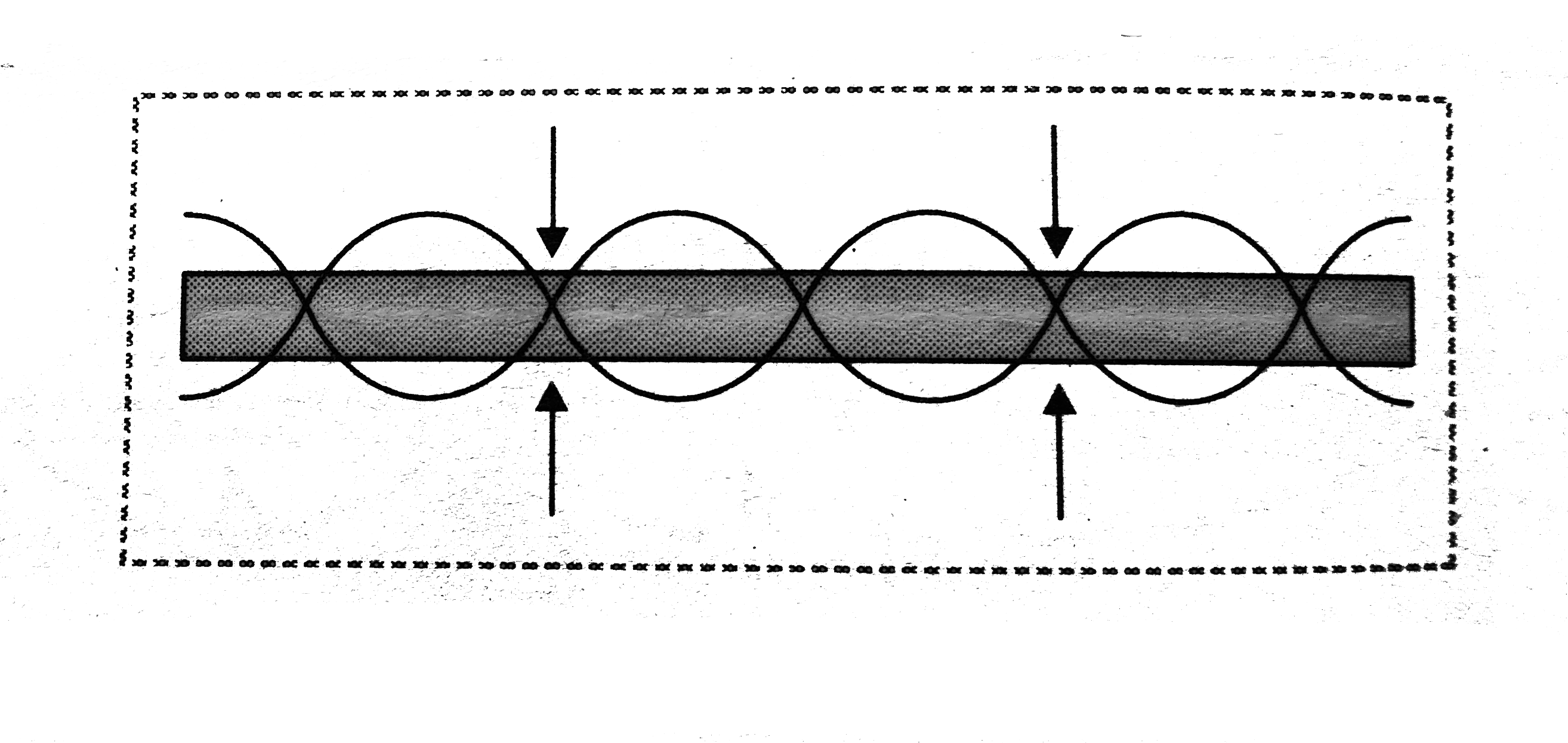 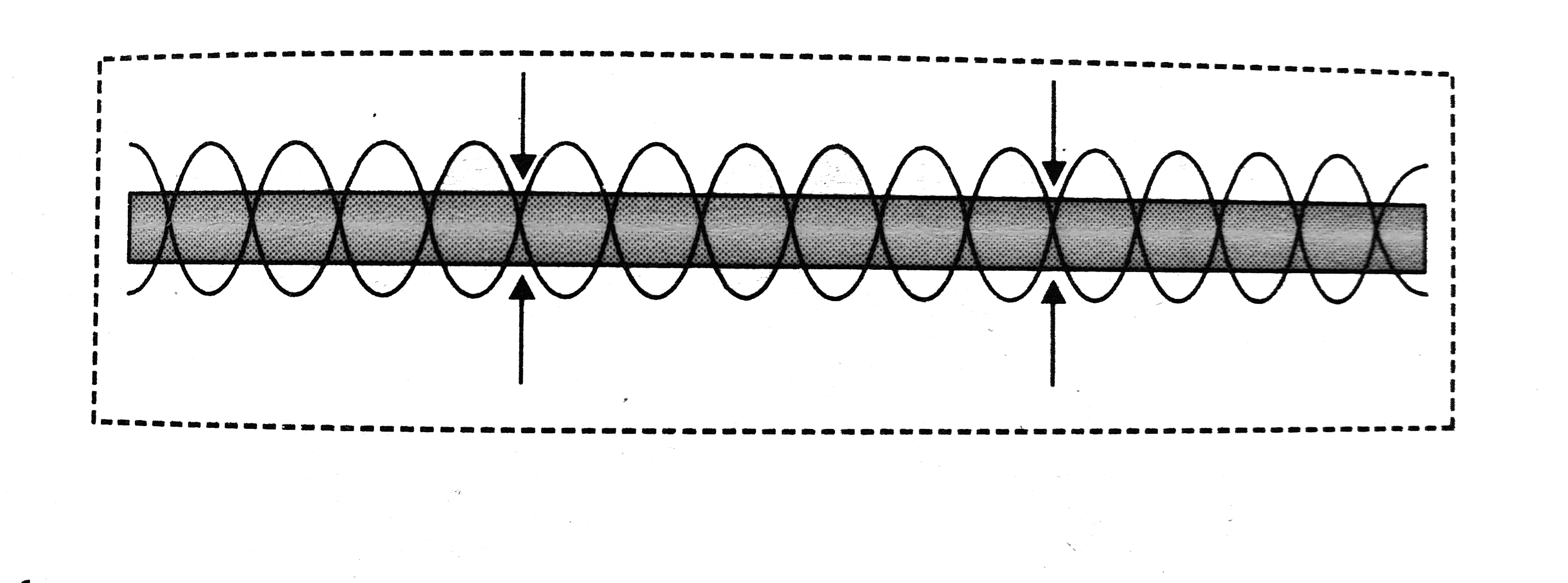
|
|
| 18. |
The gravitational potential energy of a body with unit mass at distance r from the centre of earth is U. The acceleration due to gravity on the same body t a distance 2r is |
|
Answer» U/r |
|
| 19. |
The gravitational field in a region is given by vec(E) = (5hat(i) + 12 hat(j))N//kg. If a particle of mass 2kg is moved from the origin to the point (12m, 5m) in this region , the change in gravitational potential energy is |
|
Answer» `-225 J` |
|
| 20. |
An artificial satellite is moving in a circular orbit around the earth. With a speed equal to half the magnitude of escape velocity from the earth. (a) Determine the height of the satellite above the earth's surface. (b) If the satellite is stopped suddenly in its orbit and allowed to fall freely onto the earth, find the speed with which it hits the surface of the earth. [g = 9.8 ms^(-2) "and " R_(E) = 6400 km] |
|
Answer» Solution :(a) We know that for satellite motion `v_(0) = SQRT((GM)/(R)) = Rsqrt((g)/((R+H)))` `["as g" = (GM)/(R^(2)) "and r = R + h"]` In this problem `v_(0) = (1)/(2)v_(e) = (1)/(2) sqrt(2gR)` `["as " v_(e) = sqrt(2gR)]` So `(R^(2)g)/(R+h) = (1)/(2)gR`, i.e., `2R = h+R` or `h = R = 6400 km` (b) By conservation of ME `0 + [-(GMm)/(r)] = (1)/(2) mv^(2) + [-(GMm)/(R)]` or `v^(2) = 2GM [(1)/(R) - (1)/(2R)]` [as r = R + h = R + R = 2R] `v = sqrt((GM)/(R)) = sqrt(gR) = sqrt(10 xx 6.4 xx 10^(6)) ~= 8km//s` |
|
| 21. |
A body of mass 1 kg is dropped from a height of 5m on to the ground. If the body penetrates 2 cm in to the ground, the average resistance offered by the ground on to the body is (g= 10 ms^(-2)) |
| Answer» ANSWER :A | |
| 22. |
The second lawof thermodynamics is the generalisation of the fact that I) Heat always flows from hot body to cold body by itself II) Heat can flow cold body to hot body itself III)It is impossible for a self acting machine un aided by any external agency to transfer heat from cold body to hotter body |
|
Answer» I & II |
|
| 23. |
Obtain expression for velocities of the two bodies after elastic collision in one dimension . |
|
Answer» SOLUTION :Consider elastic collision in one dimension as shown in figure . Suppose a ball of mass `m_(1)` moving with velocity`v_(1)` along X - axis undergoesan elasticcollision with a ball of mass `m_(2)` moving with velocity `v_(2i) and v_(1i) gt v_(2i)` Their final velocities are `v_(1F) and v_(2F)` respectively . Momentum is conserved in collision . `:. m_(1)v_(1i)+m_(2)v_(2i)=m_(1)v_(1f)+m_(2)v_(2f) ""...(1)` ` :. m_(1)(v_(1i)-v_(1f)) =m_(2)(v_(2f)-v_(2i))` Collision is elastic collision so kinetic energy isalso conserved . `1/2 m_(1)v_(1i)^(2)+m_(2)v_(2i)^(2) =m_(1)v_(1f)^(2)+m_(2)v_(2f)^(2) ....""(2)` ` :. m_(1)(v_(1i)-v_(1f))(v_(1i) +v_(1f))=m_(2)(v_(2f)-v_(2i)) (v_(2f)+v_(2i))` From equation(2) , `v_(1i)+v_(1f)=v_(2f)+v_(2i)` ` :. v_(1f)=v_(2f)+v_(2i)-v_(1i) ""....(3)` From equation(1) , `m_(1)v_(1i)+m_(2)v_(2i)=m_(1)(v_(2f)+v_(2i)-v_(1i))+m_(2)v_(2f)` `:. m_(1)v_(1i)+m_(2)v_(2i)=m_(1)v_(2f)=m_(1)v_(2f)+m_(1)v_(2f)+m_(1)v_(2i)-m_(1)v_(1)+m_(2)v_(2f)` `2m_(1)v_(1i)=m_(1)v_(2i)-m_(2)v_(2i)-m_(2)v_(2i)+m_(1)v_(2f)+m_(2)v_(2f)` `2m_(1)v_(1i)=(m_(1)-m_(2))v_(2i)+(m_(1)+m_(2))v_(2f)` If ball of mass `m_(2)`having intial velocity `v_(2i)=0` then `2m_(1)v_(1i) =(m_(1)+m_(2))v_(2f)` ` :. v_(2f) =(2m_(1)v_(1i))/(m_(1)+m_(2))` `v_(1f)=v_(2f)+v_(2i)-v_(1i)` ` = (2m_(1)v_(1i))/(m_(1)+m_(2))-v_(1i) "" [:. v_(2i)=0 " supposed"] ` `=(2m_(1)v_(1i)-m_(1)v_(1i)-m_(2)v_(1i))/(m_(1)+m_(2))` ` :. v_(1f) = (m_(1)v_(1i)-m_(2)v_(1i))/(m_(1)+m_(2))` ` :. v_(1f) = ((m_(1)-m_(2))v_(1i))/((m_(1)+m_(2)))` In theseequations if `m_(1),m_(2) and v_(1i) ` is giventhen thevalueof `v_(1f) and v_(2f)` can be calculated . |
|
| 24. |
You are given the following group of particles ,n_(1) represents the number of molecules with speed v_(1) Calculate (i)average speed (ii)rms speed (iii)Most probable speed. |
|
Answer» Solution :(i)AVERAGE speed `v_(ANG)=(n_(1)v_(1)+n_(2)v_(2)+n_(3)v_(3)+n_(4)v_(4)+n_(5)v_(5))/((n_(1)+n_(2)+n_(3)+n_(4)+n_(5))` `=(73)/(23)=3.17 MS^(-1)` (ii)root mean square speed is `V_(RMS)=((n_(1)v_(1)^(2)+n_(2)v_(2)^(2)+n_(3)v_(3)^(2)+n_(4)v_(4)^(2)+n_(5)v_(5)^(2))/(n_(1)+n_(2)+n_(3)+n_(4)+n_(5)))^(1//2)` `=((2xx1+4xx4+8xx9+6xx16+3xx25)/(2+4+8+6+3))^(1//2)=3.36 ms^(-1)` (iii)Most probable speed 3m/s by which largest molecules are moving at any time. |
|
| 25. |
Two masses of 3 kg and 4 kg are connected at the ends of a light inextensible string that passes over a frictionless pulley. Find the acceleration of the masses and the tension in the string, when the masses are released. |
|
Answer» |
|
| 26. |
What should be the radius of a capillary tube if the water has to rise to a height of 6cm in it. Surface tension of water =7.2xx10^(-2)Nm^(-1) (g=10ms^(-2)) |
|
Answer» Solution :Height `(H)=6cm=6xx10^(-2)m` Surface tension of WATER `(S)=7.2xx10^(-2)NM^(-1)` for water `theta=0, costheta=1` Density of water `(RHO)=1000kgm^(-3)` Surface tension `(S)=(hrrhog)/(2costheta)` Substituting the VALUES `7.2xx10^(-2)=((6xx10^(-2))(r)(1000)(10))/(2xx1)` `r=0.24xx10^(-3)m` |
|
| 27. |
Fill in the blanks using the words from the list appended with each statement Surface tension of liquids generally……..with temperature (increases/decreases) |
| Answer» SOLUTION :DECREASES | |
| 28. |
The specimen is taken in the form of 'disc' in Lee's disc method to find the thermal conductivity is a bad conductor. Why? |
| Answer» SOLUTION :Then the surface area A will be large with a SMALL VALUE for THICKNESS. | |
| 29. |
Can a body have a constant speed and still have a varying velocity? |
| Answer» SOLUTION :Yes. When a particle moving along the circumference of a circle with constant speed (UNIFORM CIRCULAR MOTION), its velocity changes because of change in its direction of motion at every POINT. | |
| 30. |
If axis of rotation of two identical cylinders, one solid and other hollow is taken as their geometrical axis. Then the ratio of radius of gyration of hollow one to that of solid is………… |
|
Answer» `(1)/(2)` `=(R)/(R//sqrt(2))=sqrt(2)` |
|
| 31. |
A non-uniform rod AB of weight w is supported horizontally in a vertical plane by two light strings PA and QB as shown in the figure.G is the centre of gravity of the rod. If PA and QB make angles 30^(@) and 60^(@) respectively with the vertical, the ratio ("AG")/("GB") is |
|
Answer» `(1)/(2)`  or `T_(1) cos 60^(@)=T_(2) sin 60^(@)` or `T_(1)= sqrt(3)T_(2)`…….(i) `(sqrt(3)T_(1))/(2)xxAG=(T_(2))/(2) XX BG` `therefore (AG)/(BG)=(T_(2))/(sqrt(3)T_(1))` But `(T_(2))/(T_(1))=(1)/(sqrt(3))` [ from Eq. (i)] HENCE, `(AG)/(BG)=(1)/(3)` |
|
| 32. |
Bernoulli's principle does not explain ………………. . |
|
Answer» curved path of a spinning ball |
|
| 33. |
For measuring temperature near absolute zero, the thermometer used is |
|
Answer» THERMOELECTRIC termometer |
|
| 34. |
Can a body have energy without having momentum? |
| Answer» SOLUTION :MOMENTUM of a boody `p=sqrt(2mEk)`THUS,a BODY can not haveK.E WITHOUT having momentum.However it can have P.E without having momentum. | |
| 35. |
A uniform disc of radius a and mass m, is rotating freely with angular speed omega in a horizontal plane. About a smooth fixed vertical axis through its centre. A particle, also of mass m, is suddently attached to the rim of the disc of the disc and rotates with it. The new angular speed is |
|
Answer» `(OMEGA)/(6)` `:. omega_(2)=(I_(1))/(I_(2)).omega_(1)=((1//2ma^(2)))/((1//2ma^(2))+ma^(2)).omega=(omega)/(3)`. |
|
| 36. |
Two bodies are projected with velocities v_(1)and v_(2) at a same instant of time as shown in the figure . For what value of (v_(1))/(v_(2)) , the bodies will collide ? |
|
Answer» |
|
| 37. |
(A) : Increasing the number of observations minimizes random errors. (R ) : Positive and negative random errors occur with equal probability. |
|
Answer» Both (A) and (R) are TRUE and (R) is the correct EXPLANATION of (A) |
|
| 38. |
Which physical quantities have the same dimensions of ML^(-1)T^(-2)? |
| Answer» SOLUTION :PRESSURE, STRESS, Young.s MODULUS. | |
| 39. |
The graph plotted between force and displacement of a particle executing S.H.M is |
|
Answer»
|
|
| 40. |
A structural steel rod has a radius 10 mm and a length of 2.0 m . A force 100 KN stretches it along its length. Calculate (a) Stress (b) Elongation and (c ) Strain on the rod. Young's modulus of structural steel is 2.0 xx 10 ^(11) Nm ^(-2). |
|
Answer» Solution :Stress `=3.18 XX 10 ^(8) NM ^(-2) ,` Elongation `DELTA L = 3.18 xx 10 ^(-3) m, ` STRAIN `= 0.16%` |
|
| 41. |
A mass executes a simple harmonic motion of average potential energy lt U gt and average kinetic energy lt E gt over one time period are related to……….. |
|
Answer» `LT E GT = lt U gt` `=(1)/(2) m omega^(2) A^(2)`. |
|
| 42. |
In above question, speed of block A, when the extension in spring is (x_(m))/(2), is: |
|
Answer» `2g sqrt((m)/(K))` |
|
| 43. |
A body of mass 2 kg is projected vertically up with a velocity of 100 ms^(-1) . If it rises to a height of 400 m, the energy utilized to overcome friction is (g=10ms^(-2)) |
|
Answer» 10 KJ |
|
| 44. |
A particle of mass m and velocity v_(0) is fired at a solid cylinder of mass M and radius R. The cylinder is initially at rest and is mounted on a fixed horizontal axle that runs through the centre of mass. The line of motion of the particle is perpendicular to the axle and at a distance d, less than R, from the centre and the particle sticks to the surface of hte cylinder, then |
|
Answer» ANGULAR speed of the SYSTEM just after the PARTICLE stick is `(2 mv_(0)d)/(R^(2)(M+2m))` |
|
| 45. |
The focal length of objective and eye lens of a microscope are 4 cm and 8 cm respectively. If the least distance of distinct vision is 24 cm and object distance is 4.5 cm from the objective lens, then the magnifying power of the microscope will be |
|
Answer» 18 |
|
| 46. |
Both of a sound source and a listener are approaching towards each other with the same speed(c)/(10) (speed of sound in air = c) . What will be the percentage of apparent increase or decrease in frequency of sound ? |
|
Answer» SOLUTION :Apparent frequency, ` n.= (c + u_(o))/(c- u_(S)) n ` So , apparent increases in frequency, ` n. - n = (u_(o) + u_(S))/(c - u_(S)) n ` ` therefore ` Percentage of change in frequency ` = (n.- n)/(n) XX 100 = (u_(O) + u_(S))/(c - u_(S)) xx 100` ` ((c)/(10)+ (c)/(10))/(c- (c)/(10)) xx 100 = 2/9 xx 100 = 22.2 % ` |
|
| 47. |
Unlike liquid there is no coefficient of apparent expansion in case of a gas-why? On,during the expansion of a liquid ,volume expansion of the container is taken into account,but not for a gas-Why? |
| Answer» Solution :When a liquid in a container is HEATED,both the liquid and the container expand. The coefficient of expansion of any solid is less than that of any liquid but not negligible. SO the expansion of the solid is not neglected. Thus in CASE of LIQUIDS we GET TWO coefficients of expansion.One is the coefficient of apparent expansion and the other is the coefficient of real expansion. In apparent expansion the expansion of the container is ignored.Whereas in real expansion the coefficient of expansion .A mass of gas is also heated of a liquid. But for the same rise in temperature. the expansion of a gas is nearly 100 times more than that of the container. Unless a very accurate measurement is required expansion of the container is neglected. Hence, no apparent expansion needs to be considered in case ofa gas. | |
| 48. |
Explain why adiabatic compression produces heating? |
| Answer» SOLUTION :During ADIABATIC COMPRESSION, HEAT is ABSORBED. So… | |
| 49. |
Choose the correct pair of the following pairs . |
|
Answer» Angular VELOCITY`omega = vr` |
|
| 50. |
Give two uses of Stoke's law. |
|
Answer» SOLUTION :From using using Stoke.s law, (1) Radius of drop can be DETERMINED. (2)Coefficient of VISCOSITY of LIQUID can be determined. |
|


