

Saved Bookmarks
This section includes 7 InterviewSolutions, each offering curated multiple-choice questions to sharpen your Current Affairs knowledge and support exam preparation. Choose a topic below to get started.
| 1. |
Explain uncertainty or error in given asurement by suitable example. |
|
Answer» Solution :Length and breadth of a thin rectangular plate is I = 16.2 cm and breadth b = 10.1 cm Least count of meterscale is 0.1 cm hence absolute error in measurement should be 0.1 cm. `l=(16.2+-0.1) cm` `b=(10.1+-0.1)cm` % error in measurement of length, `l=(16.2+-0.6%)` % error in measurement of breadth `b=(10.1+1%)` cm Area of rectangleular plate, A=lb `=16.2xx10.1=163. 62CM^(3)` % error in A : `=(DeltaA)/(A)xx100=(Deltal)/(l)xx100+(Deltab)/(b)xx100` `=(0.6%+1%)=1.6%` `DeltaA=(1.6xx163.62)/(100)=2.6` Area `:A=(163.62+-2.6) cm^(2)` Here minimum significant digit are 3 hence area should be represented as, `A~~163 +- 3 cm^(-2)` `:.` Error in measurement of area of plate is `3 cm^(2)` (2)If a set of experimental data is specified to .n. significant figures, a result obtained by combining the data will also be VALID to .n significant figures. However, if data is subtracted the number of significant figures can be reduced. For EXAMPLE, `12.9 g - 7.06 g = 5.84 g` Here, there are 3 significant digits. But in subtraction digit after decimal point are considered hence this will be represented as `5.8 g` (3) The relative error of a value of number specified to significant figure does not depend on .n. but also to the number itself. For example, in measurement of mass observation is m = 10.2 g then accuracy is `+-0.01g` `:.` Percentage error in 1.02g `=+-(Deltam)/(m)xx100%` `=+-(0.01)/(1.02)xx100%` `+-(1)/(1.02)%` `=+-(1)/(1.02)%` `~~+-1%` In another example m = 9.89 g inaccuracy is `+-0.01g` vPercentage error in measurement `=+-(0.01)/(9.89)xx100%` `=+-0.1011122%` `=+-0.1%` Intermediate result in a multistep computation should be calculated to one more significant figure in every measurement than the number of digits in the least precise measurement. For example, write reciprocal of 9.58 W.r.t. significant number `(1)/(9.58)=0.10438413` By rounding of result to 3 digit we get 0.104. But, if we take reciprocal of 0.104 upto 3 significant digit we get 9.62 and reciprocal of 0.1044 gives us 9.58. Hence, one more EXTRA significant digit is kept in intermediate step of complex multistep calculation in ORDER to avoid additional error in the process of rounding off the numbers. |
|
| 2. |
A rod of negligible heat capacity has length L, area of cross-section A and thermal conductivity K. The temperature of one end is maintained at 0^(@)C and the other end is slowly linearly varied from 0^(@)C to theta_(0)^(@)C in time t_(0) Assuming no loss of heat through the sides, find the total heat transimitted through the rod in time t_(0) |
|
Answer» Solution :RESISTANCE of rod `R = (L)/(KA)` The temperature of left end varies linearly from `0^(@)C` to `theta_(0).^(@)C` in the time `t_(0)` Temperature of left end at time `t` `theta = 0 + (theta_(0) - 0)/(t_(0)) t = (theta_(0))/(t_(0)) t` Heat current `i = (theta - 0)/(R ) = (theta)/(R )` `(DQ)/(dt) = (theta_(0))/(Rt_(0)) t` `int dQ = (theta_(0))/(Rt_(2)) int_(0)^(t_(0)) t dt` `Q = (theta_(0))/(Rt_(0)) (t_(0)^(2))/(2)` `= (theta_(0) t_(0))/(2 R) = (theta_(0) t_(0) KA)/(2 L)` 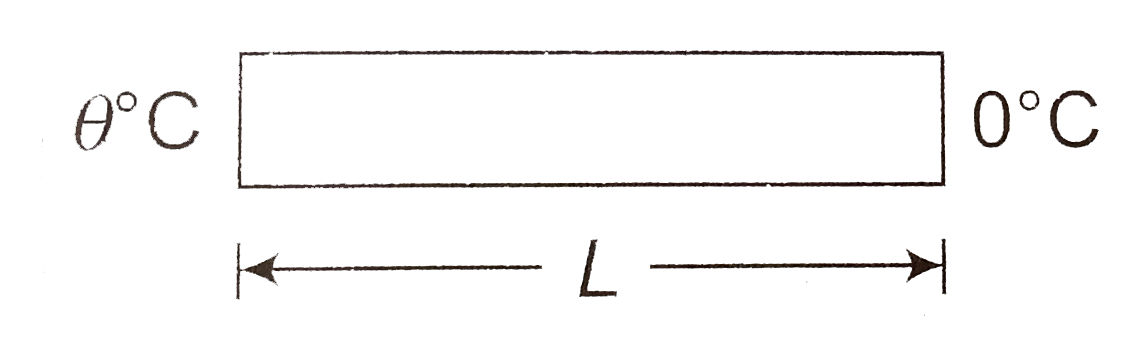
|
|
| 3. |
A thin sphericalshell radiusof r has a charge Q uniformly distributedon it . At the centreof theshell , a negativepointcharge-q is palced . If the shell is cutintotwo identical hemisphere , stillequibrium is mainated . Then find therelation betweenQ and q ? |
|
Answer» Solution :Here theoutwardelectricpressureat everypointon the shell dueto itsown chargeis . `P_(1) = (sigma^(2))/(2in_(0)) = (1)/(2 in_(0)) ((Q)/(4pir^(2)))^(2)` `P_(1)= (Q^(2))/(32 pi^(2) in_(0) r^(4))` Due to -q , the electricfieldon the surface of the shell is `E = (1)/( 4pi in_(0)) (q)/(r^(2))` Thiselectric FIELD pallseverypointof the shell in inward direction . Theinward pressureon the surface OFTHE shelldue tothe negative chargeis `P_(2) = sigma E ` ` = ((Q)/(4pi r^(2)))((1)/(4pi in_(0))(q)/(r^(2))) = (Qq)/(16pi^(2) in_(0)r^(4))` For equilibrium of the hemispherical shells `P_(2) geP_(1)`or `(Qq)/(16pi^(2) in_(0) r^(4)) GE (Q^(2))/(32 pi^(2) in_(0) r^(4))` `q ge (Q)/(2)` . |
|
| 4. |
A system is in stable equilibrium. What can we say about its potential energy? |
| Answer» SOLUTION :P.E. is MINIMUM | |
| 5. |
A child is standing with folded hands at the centre ofplatform rotating about its central axis. The kinetic energy of the system is K. The child now stretches his arms so that the moment of inertia of the system becomes doubled. The kinetic energy of the system now is |
|
Answer» 2 K As I is doubled , `omega` BECOMES half Now KE of ROTATION , `K = (1)/(2) I omega^(2)` SINCE I is doulbed and `omega` is halved , KE will become half i.e., `(K)/(2)` |
|
| 6. |
In a hydel power project, 2000 kg of water passes through the turbine every second. Water is falling from a height of 240m above ground. If the power output is 6.4Mw, the efficiency of the power house is (g= 10 ms^(-2)) |
| Answer» ANSWER :B | |
| 7. |
Given vecA + vecB + vecC + vecD = vec0, which of the following statements is not correct ? |
|
Answer» `vecA, vecB, vecC and vecD`must each be a null vector. (b) The statement is correct as proved below `vecA + vecB + vecC + vecD = vec0 or vecA + vecC = - (vecB + vecD)` `therefore |vecA + vecC| = |vecB + vecD|` (c ) The statement is correct and can be proved using triangular INEQUALITY. `|vecB| + |vecC| ge|vecR|""...(i)` `|vecR| + |vecD| ge|vecA|""...(II)` Using (i) and (ii), `|vecA| le |vecB| + |vecC| + |vecD|` (d) THe statement is correct as proved below `vecA + vecB + vecC + vecD = vec0 or vecA + (vecB + vecC) + vecD = vec0` The resultant sum of three vectors `vecA, (vecB+vecC)` and `vecD` can be zero only if `(vecB + vecC)` lies in the plane of `vecA and vecD` and these three vectors are represented by the three SIDES of a triangle taken in one order. IF `vecA and vecD` are collinear, then`(vecB + vecC)` must be in the line of `vecA and vecD`, only then the vector sum of all the vectors will be zero. 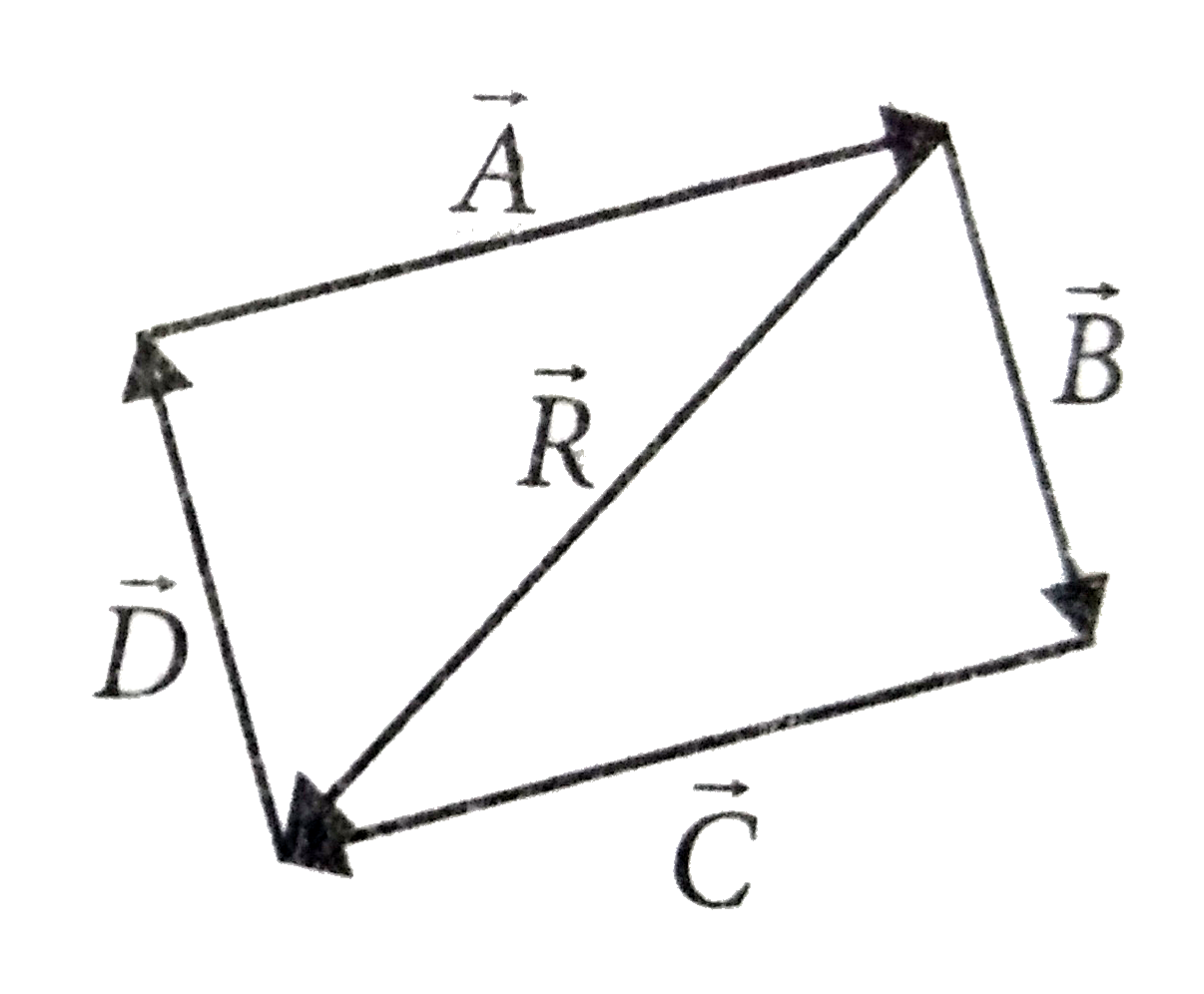
|
|
| 8. |
A person holds a block weighing 2kg between his hands & keeps it from falling down by pres-sing it with his hands. If the force exerted by each hand horizontally is 50N, the coefficient of friction between the hand & the block is (g=10ms^(-2)) |
|
Answer» 0.2 |
|
| 9. |
Newton's first law of motion describe the |
|
Answer» energy |
|
| 11. |
In case of a perfect blackbody |
|
Answer» Emissivity = 1 |
|
| 12. |
An air bubble of radius 1 mm moves up with uniform velocity of 0.109ms^(-1) in a liquid column of density 14.7xx10^(3)kg//m^(3). then coefficient of viscosity will be (g=10^(-2)) rho_("air")=1.3 kg//m^(2) |
|
Answer» `0.3Pa-s` |
|
| 13. |
Assertion : In the given figure shown, p_(1)=p_(2). Reason : Pressure at 1 is less than the atmospheric pressure. |
|
Answer» If both ASSERTION and REASON are CORRECT and Reason is the correct explanation of Assertion. |
|
| 14. |
In the arrangement shown in the figure, the block C begins to move down at a constant speed of 7.5 cm//s at time t = 0. At the same instant blockA is made to start moving down at constant acceleration. It starts at M and its speed is 30 cm//swhen it reaches N (MN = 20 cm). Assuming that B started from rest, find its position, velocity and acceleration when block A reaches N. |
|
Answer» `V_(B) = 45 cm//s (uarr)` `a_(B) = 22/5 cm//s^(2) (uarr)` |
|
| 15. |
Two blocks of masses 2 kg and 1 kg respectively are tied to the ends of a string which passes over a light frictionless pulley. The masses are held at rest at the same horizontal level and then released. The distance transversed by centre of mass in 2 seconds is (g = 10 m//s^(2)) |
|
Answer» 1.42 m |
|
| 16. |
What is the condition for the vectors 2i+3j - 4k and 3i - aj + bk to be parallel ? |
| Answer» Answer :A | |
| 17. |
A cylinder of fixed capacity 44.8 litre contains helium gas at standard temperature and pressure. What is the amount of heat needed to raise the temperature of the given gas by 15^@C ? |
| Answer» SOLUTION :It is CLEAR that the CYLINDER contains 2 MOLES of helium gas. Since helium is monatomic, `C_VtriangleT = 2xx3/2 XX 8.31 xx 15` = 374J | |
| 18. |
A man of mass 80 kg is riding on a small cart of mass 40 kg which is rolling along a level floor at a speed of 2 m/s. He is running on the cart so that his velocity relative to the cart is 3 m/s in the direction opposite to the motion of cart. What is the speed of the centre of mass of the system. |
|
Answer» 1.5 m/s |
|
| 19. |
A body of mass m is projected at an angle theta to the horizontal, the projectile at the highest point breaks into two fragments of equal masses. One of the fragments retraces its path to the point of projection. The velocity of the other fragment just after explosion is |
|
Answer» V cos `THETA` |
|
| 20. |
A book of weight 20N is pressed between two hands and each hand exerts a force of 40N. If the book just starts to slide down. Coefficient of friction is |
|
Answer» 0.25 |
|
| 21. |
You may have seen in a circus a motorcyclist driving in vertical loops inside a ‘deathwell’ (a hollow spherical chamber with holes, so the spectators can watch from outside). Explain clearly why the motorcyclist does not drop down when he is at the uppermost point with no support from below. What is the minimum speed required at the uppermost position to perform a vertical loop if the radius of the chamber is 25 m |
|
Answer» Solution :At the uppermost point `N + mg = (mv^2)/( R)`, where N is the normal force (downwards) on the motorcyclist by the ceiling of the chamber.The minimum possible SPEED at the uppermost point corresponds to N = 0. `i.e. v_("min") = SQRT(R_g) = sqrt(25 xx 10) = 16 ms^(-1)` |
|
| 22. |
Two balls of same density falls in a viscous medium. The radius of first ball being double than the radius of second ball, then how many times is the terminal velocity of second ball to that of first ball |
|
Answer» 1 |
|
| 23. |
A satellite is orbiting in an orbit with a velocity 4km/s Then find acceleration due to gravity at that height. |
|
Answer» Solution :As centripetal acceleration equal to acceleration DUE GRAVITY at that HEIGHT, then `a = (V^(2))/(r) = g_(h)` and `V^(2) = (GM)/(r) = (GR^(2))/(r)` `rArr r = (gR^(2))/(V^(2)) = (10 xx 6400 xx 6400 xx 10^(6))/(16 xx 10^(6))(g = 10 m//s^(2))` = 25600 km `therefore g_(h) = a = (V^(2))/(r) = (16 xx 10^(6))/(25600 xx 10^(3)) = (10)/(16)m//s^(2)` |
|
| 24. |
Which of the following have same dimension ? |
|
Answer» `LC` `:.[LC]=(1)/([W^(2)])=(1)/((M^(0)L^(0)T^(-1))^(2))=M^(0)L^(0)T^(-2)` (B) Unit of `(R)/(L)=("ohm")/("ohm" XX "sec") =(1)/(sec)` `:.[(R)/(L)]=(1)/([sec])=M^(0)L^(0)L^(-1)` `(C)[(L)/(R)]=(1)/([(R)/(L)])=M^(0)L^(0)T^(-1)` (D) UNITS `(C)/(L)=("FARADAY")/("Henry")=(("Columb")/("Volt"))/(ohm xx sec)=(1t)/(V xx RT)` `=(I)/(IRxxR)=(1)/(R^(2))` `:.[(C)/(L)]=[R]^(-2)` `=(M^(1)L^(2)A^(-2))^(-2)` `=M^(-2)L^(-4)T^(6)A^(4)` |
|
| 25. |
A vessel of volume V contains a mixture of 1 mole of Hydrogen and 1 mole of oxygen (both considered as ideal). Let f_(1) (upsilon) d(upsilon), denote the fraction of molecules with speed between (upsilon) and (upsilon + d (upsilon)) with f_(2) (upsilon) d (upsilon), similarly for oxygen then |
|
Answer» `f_(1) (upsilon)+f_(2)(upsilon)=f(upsilon)` obeys the Maxwell's distribution law. |
|
| 26. |
Define : Natural oscillations, free oscillation and forced oscillation. |
|
Answer» Solution :Natural Oscillation : When an oscillator is slightly disturbed from its equilibrium position and released, it starts oscillating. The oscillations performed by it in absence of any type of resistive force are known as natural oscillation. Angular FREQUENCY of natural oscillation is `omega_(0)` and frequency is `f_(0)`. Free Oscillation : When a system is displaced from its equilibrium position and released, it oscillates with its natural frequency. The oscillation are known as free oscillation. Angular frequency of free oscillation is `omega`. Forced (DRIVEN) Oscillations : The oscillations executed by system under the INFLUENCE of some external periodic force are called the forced oscillations. The angular frequency of forced oscillation is called `omega_(d)`. It is angular frequency of external force. In Practice oscillations executed is always in some medium, hence some type of damping force are always acting on the system and eventually oscillations die out with time. So to sustain the oscillations external periodic force are required. Example : When a child in a garden swing PERIODICALLY presses his feet against the ground. |
|
| 27. |
A bimetallic strip is made of aluminum & steel (alpha_(AI) gtalpha_("steel")) . On heating the strip will |
|
Answer» REMAIN straight 
|
|
| 28. |
A disc of paper of radius R has a hole of radius r. It is floating on a liquid of surface tension T. The force of surface tension of the disc is |
|
Answer» `Txx2piR` |
|
| 29. |
If the equation of motion of a projectile is y = 3x -1/8 x^(2), the range and maximum height are respectively (y and x are in metres). |
|
Answer» 18 m and 24 m |
|
| 30. |
Explain which property of liquid is used with temperature to measure it thermometer and how thermometer represent it ? |
|
Answer» Solution :A measure of TEMPERATURE is obtained using a thermometer. Thermometers are calibrated so that a numerical value may be assigned to a given temperature. The commonly used PROPERTY is variation of the volume of a liquid with temperature. Mercury and alcohol are the LIQUIDS used in most liquid-in-glass thermometers. For the definition of any standard scale, two fixed REFERENCE points are needed. The ice point and the steam point of water are two convenient fixed points and are known as the freezing and boiling points. These two points are the temperatures at which pure water freezes and boils under standard pressure. The two familiar temperature scales are the Fahrenheit temperature scale and the Celsius temperature scale. The ice and steam point have values `32" "^(@)F` and `212" "^(@)F` RESPECTIVELY, on the Fahrenheit scale and `"0 "^(@)C` and `"100 "^(@)C` on the Celsius scale. On the Fahrenheit scale, there are 180 equal intervals between two refernce points, and on the Celsius scale, there are 100. |
|
| 31. |
A body is acted on by a force given by F=(10+2t)N. The impulse received by the body during the first four seconds is |
| Answer» Solution :`J=intF.dt` | |
| 32. |
The Young's Modulus of steel is twice that of brass. Two wires of same length and of same area of cross-section, one of steel and another of brass are suspended from the same roof. If then the weights added to the steel and brass wires must be in the ratio of |
|
Answer» `1:1` Let `W_(S)` & `W_(B)` the weights hanged to steel & BRASS wires `l_(s)=l_(B)=l,A_(B)=A_(s)=A,Deltal_(s)=Deltal_(B)=Deltal` `Y=(Wl)/(ADeltal) orDeltal=(Wl)/(AY)` as`Deltal_(s)=Deltal_(B)` `:. (W_(s)l)/(AY_(s))=(W_(B)l)/(AY_(B))` `(W_(s))/(W_(B))=(Y_(B))/(Y_(B))=(2)/(1)` |
|
| 33. |
A mass 'M' is suspended by a rope from a rigid support. It is pulled horizontally with a force F. If the rope makes an angle ' theta' with vertical in equilibrium, then the tention in the string is |
|
Answer» `FSIN THETA` |
|
| 34. |
In materials like aluminium and copper, the correct order of magnitude of various elastic moduli is: |
|
Answer» BULK MODULII `LT` Young.s modulii `lt` SHEAR modulii |
|
| 35. |
A raindrop falling from a height .h. above ground, attains a near terminal velocity when it has fallen through a height (3/4)h. Which of the diagrams shown below correctly shows the change in kinetic and potential energy of the drop during its fall up to the ground ? |
|
Answer»
|
|
| 36. |
A uniform disc of diameter R/2 is put over another uniform disc of radius R of same thickness and density. The peripheries of the two disc touch each other. The centre of mass of the system from centre of big disc is |
|
Answer» R/10 |
|
| 37. |
The ratio of inertial force to viscous force represents |
|
Answer» MAGNUS effect |
|
| 38. |
The temperature T_(1) and T_(2) of heat reservoirs in the ideal Carnot engine are 1500^(@)C and 500^(@)C respectively. If T_(1) increases by 100^(@)C, what will be the efficiency of the engine ? |
|
Answer» `62%` `T_(2) = 500^(@)C = 500 + 273 = 773 K` `:. ETA = 1 - (T_(2))/(T_(1)) = 1 - (773)/(1873) = (1100)/(1873) = (1100)/(1873) xx 100% = 59%` |
|
| 39. |
How muchpower is required a lift a body of mass 50 kg to a heightof 120m in 1 minute? (g = 9.8 m//s^(2)) . |
|
Answer» Solution :Power `P = (mgh)/t ` ` (50 xx 9.8 xx120)/60` ` :. P = 980 W` `m = 50 kg ` `g = 9.8 m//s^(2)` ` h = 120 m ` t = 1 MINUTE = 60 seconds |
|
| 40. |
Several games such as billiards, marbles or carrom involve collisions. A ball at rest is dropped from a height of 12 m . It loses 25% of its kinetic energy on striking the ground. Find the height to which it bounces. |
|
Answer» SOLUTION :`75/100xxmgh_1 = mgh_2` `h_2 = 0.75h_1 = 0.75xx12=9m` |
|
| 41. |
A balloon has 5 gm of air. A small hole is pierced into it. The air escapes at a uniform rate with a velocity of 4 cm s^(-1). If the balloon shrinks completely in 2.5 second, then the average force acting on the balloon is |
| Answer» ANSWER :C | |
| 42. |
(A): The total translational kinetic energy of all the molecules of a given mass of an ideal gas is 1.5 times the product of its pressure and its volume. (R): The molecules of a gas collide with each other and the velocities of the molecules change due to the collision. |
|
Answer» If both (A) and (R) are true and (R) is the CORRECT explanation of (A) |
|
| 43. |
Two exactly similar wires of steel (Y=20 xx 10^11 dy//cm^2) and copper (Y=12xx10^11dy//cm^2)are stretched by equal forces. If the total elongation is 1cm elongation of copper wire is |
|
Answer» 3/5cm |
|
| 44. |
A man crosses a river in a boat. If he crosses the river in minimum time he takes 10 min with a drift 120 m . If he crosses the river taking the shortest path, he takes 12.5 min. What is the speed of the current ? |
|
Answer» `13 m*MIN^(-1)` |
|
| 45. |
A hollow sphere of simple pendulum is first filled with mercury and then with water . The time periods are in the ratio if their densities are in the ratio 13:6:1 |
|
Answer» `1:1` |
|
| 46. |
(A) Convex mirror is used as shaving mirror ( R) IN case of convex mirror if a real object is between its pole and focus, a magnified, erect vertual image is formed. |
|
Answer» Both A and R are TRUE and R is the correct EXPLANATION of A |
|
| 47. |
Two identical soap bubbles, each of radius .x., coalesce to form a bubble of radius .y., If P be the atmospheric pressure, and assuming that the process is isothermal, what is the surface tension of soap solution ? |
|
Answer» |
|
| 48. |
Statements : a) Motion of centre of mass depends on external forces applied on it. (b) The motion of the centre of mass of the body is called the translational motion of the body. |
|
Answer» Both a and B are TRUE |
|
| 49. |
A block of mass 0.1 kg is connected to an elastic spring of spring constant 640 Nm^(-1) and oscillates in a damping medium of damping constant 10^(-2) kg s^(-1).The system dissipates its energy gradually. The time taken for its mechanical energy of vibration to drop to half of its initial value, is closest to |
|
Answer» 2s |
|
| 50. |
Derive an expression for total acceleration in the non uniform circular motion. |
Answer» Solution :If the speed of the object in circular motion is not constant, then we have non-uniform circular motion. For example, when the bob attached to a string moves in vertical CIRCLE, the speed of the bob is not the same at all TIME. Whenever the speed is not same in circular motion, the particle will have both centripetal and tangential acceleration as shown in the figure.  The RESULTANT acceleration is obtained by VECTOR sum of centripetal and tangential acceleration. Since centripetal acceleration is `(v^2)/(r ) `.the magnitude of this resultant acceleration is given by `a_R = SQRT( (a_t^2 + ((v^2)/(r ) )^2)` This resultant acceleration makes an angle `theta ` with the radius vector as shown in figure . This angle is given by `tan theta = (a_t)/((v^2//r))` |
|


