

Saved Bookmarks
This section includes 7 InterviewSolutions, each offering curated multiple-choice questions to sharpen your Current Affairs knowledge and support exam preparation. Choose a topic below to get started.
| 2. |
What is the ratio of surface energy of 1 small drop and 1 large drop, if 1000 small drops combined to form 1 large drop |
|
Answer» `100:1` |
|
| 3. |
In Cavendish.s experiment , let each small mass be 20g and each large mass be 5 kg. The rod connecting the small masses is 50 cm long. while the small and the large speres are separated by 10.0 cm . The torsion constant is 4.8xx10^(-8)kgm^(2)s^(-2)and the resulting angular deflection is 0.4^(@)Calculate the value of universal gravitational constant G from this data. |
|
Answer» Solution :Here, m = 20g = 0.02 kg , M = 5 kg R = 10 cm = 0.1 m , 1 = 50 cm = 0.5 m `(theta=0.4^(0)=0.4^(0))(2pi//360^(0))=0.007` rad, `k= 4.8xx10^(-8) "kgm"^(2)s^(-2)` Thus, from `G = (kthetar^2)/(Mml)` on substitution `G = 6.72xx10^(-11) Nm^(2)kg^(-2)` |
|
| 4. |
Two copper rods and one aluminium rod of the same length are joined together to form an equilateral triangle ABC. A rod AD of another material connects the vertex A to the mid-point D of the base (aluminium) rod of the triangle. For small rise in temperature of the system there will be no tendency for the sides of the triangle to buckle. Determine the coefficient of linear expansion of the material of the rod AD. Given, alpha for copper =16 times 10^(-6@)C^(-1) " and " alpha for aluminium =26 times 10^(-6@)C^(-1). |
|
Answer» |
|
| 5. |
IF the refractive index of diamond is 2.4. Find the velocity of light is diamond. |
|
Answer» `1.25 TIMES 10^8 m//s` |
|
| 6. |
If the vectors vecP=ahati+ahatj+3hatk"and"vecQ=ahati-2hatj-hatk are perpendicular to each other. Find the value of a ? |
|
Answer» Solution :If VECTORS `vecP "and" vecQ` are perpendicular `RARR vecP.vecQ=0rArr (ahati + ahatj+3hatk).(ahati-2hatj-hatk)=0` `rArr a^(2)-2a-3=0rArra^(2)-3a+a-3=0rArra(a-3)+1(a-3)=0rArra=-1,3` |
|
| 7. |
(A) : A body may be accelerated even when it is moving at uniform speed. (R ) : When direction of motion of the body is changing then body may have acceleration. |
|
Answer» Both (A) and (R ) are TRUE and (R ) is the CORRECT EXPLANATION of (A) |
|
| 8. |
A steel wire of area of cross-section A and length 2L is clamped firmly between two points seperated by a distance .2L.. A body is hung from the middle point of the wire such that the middle point sags by a distance x. Calculate the mass of the body and the angle made by string with the horizontal |
Answer» SOLUTION : Since .`theta`. is small `sin theta = tan theta=(X)/(L)` `y=(F)/(A).(L)/(e )` `F=(YA e)/(L)=(YA)/(L)[(L^(2)+x^(2))^(1//2)-L]` `F=(YA)/(L)[L(1+(x^(2))/(2L^(2)))-L]=(YA)/(L)[L+(x^(2))/(2L)-L]` `F=(YA x^(2))/(2L^(2)) , 2T sin theta=Mg` `2(T)theta=Mg""(because " for small ANGLES "sin theta=theta)` `2Ftheta =Mg "" 2.(YA x^(2))/(2L^(2))theta=Mg` `(2YA x^(2))/(2L^(2)). (x)/(L)=Mg, ""M=(YAX^(3))/(L^(3)g)` `(x)/(L)=((Mg)/(YA))^(1//3), "Tan" theta=(x)/(L)` `"Tan"theta=((Mg)/(YA))^(1//3) rArrtheta ="Tan"^(-1)((Mg)/(YA))^(1//3)` |
|
| 9. |
An open glass tube is immersed in mercury in such a way that the length 8 cm extends above the mercury level. Now the open end of the tube is closed by a finger and raised further by 44 cm. What will be the length of air column above mercury in the tube. Take atmospheric pressure to be 76cm of mercury. Neglect capillary effect. |
|
Answer» 5.4 cm |
|
| 10. |
A large platform is moving with constant acceleration 'a' perpendicular to its plane in gravity free space. A particle of mass m is projected with speed u relative tothe platform at an angle theta with its plane from a point O on it. The angular momentum of the particle about O: |
|
Answer» ALWAYS INCREASES |
|
| 11. |
An ideal gas is taken through cycle 1231 (see figure) and the efficiency of the cycle was found to be 25%. When the same gas goes through the cycle 1341 the efficiency is 10%. Find the efficiency of the cycle 12341. |
|
Answer» |
|
| 12. |
Asolid metal sphere and a solid wooden sphere are having the same mass. If they are spinning with same angular velocity, then |
|
Answer» METAL SPHERE possesses more ANGULAR MOMENTUM |
|
| 13. |
A vehicle moves for 10 minutes at 20ms^(-1) due north and stops for five minutes. Then at continues due north at 40ms^(-1) for 20 minutes. Average velocity in the entire journey. |
|
Answer» `2.857ms^(-1)` |
|
| 14. |
A mercury thread of length 10 cm is contained in the middle of a narrow horizontal tube of length 100 cm. and sealed at both the ends. The air in both halves of the tube is under a pressure of 76 cm of Hg, What distance will the mercury column move if the tube is placed vertically ? |
|
Answer» SOLUTION :When the tube is horizontal, in fig., length of air COLUMN on either sideof 10 cm mercury THREAD, `V =(100-10)/(2) = 45 cm` Pressure of air in both halves of tube , P= 76 cm of Hg. when the tube is held vertically, LET the mercury column move down through a distance x as shown in fig. Let `P_(1), P_(2)` be the pressures and `V_(1), V_(2)` be the volume half respectively. Applying Boyle's Law to upper half `P_(1) V_(1) = PV` `P_(1) (54 +x) = 76 xx 45` `P_(1) = (76 xx 45)/(45 + x)` ...(i) Applying Boyle's Law to LOWER half `P_(2)V_(2) = PV` `P_(2) = (PV)/(V^2) = (76 xx 45)/(45-x)` ..(ii) Now ,`P_(2)` = pressure of air in upper half+ length of Hg col. `=(P_1) + 10` `:.` From (i) and (ii) ` (76 xx45)/(45 - x) = (76 xx45)/(45+x) +10` On solving we get `x = 2.948 cm`. |
|
| 15. |
If the rate of emission of heat of a substance is less than its rate of absorption, then its temperature. . .. . . . |
|
Answer» |
|
| 16. |
A large block of ice 50 m thick has a vertical hole drilled through it and is floating in the middle of a lake. The minimum length of the rope in metre required to scoop up a bucket full of water through the hole is. [Relative density of ice = 0.9] |
|
Answer» |
|
| 17. |
A platform makes SHM in vertical plane, with amplitude of oscillation being 0.2 m. If a coin is placed on the top, what is the least period of the oscillation so that the coin may not loose the contact? |
|
Answer» SOLUTION :For COIN not to loose contact `m(g-a_("max"))=0""g=a_("max")` `g=A((2PI)/T)^(2)""T=(2pi)/7` |
|
| 18. |
A body projected at 45^@with a velocity of 20 m/s has a range of 10m. The decrease in range due to air resistance is |
|
Answer» 0 |
|
| 19. |
Define acceleration due to gravity. |
| Answer» Solution :`IMPLIES` The acceleration which is gained by an object because of the gravitational FORCE is called acceleration DUE to gravity (G). | |
| 20. |
A boy standing on a stationary lift (open from above) throws a ball upwards with the maximum initial speed he can equal to 49 ms-1. How much time does the ball take to return to his hands ? If the lift starts moving up with a uniform speed of 5 ms^(-1) and the boy again throws the ball up with the maximum speed he can, how long goes the ball take to return to his hands ? |
| Answer» SOLUTION :10S, 10 s | |
| 21. |
A wheel is rotating with angular velocity 2 rad/s. It is subjected to a uniform angular acceleration 2 rad/s2 then the angular velocity after 10s is |
|
Answer» 12 rad/s Here `omega_(0)=2 "rad"//s^(2) t=10s` `omega=2+2xx10=22 "rad"//s` |
|
| 22. |
Statement 1: When a beam of highly energetic neutrons is incident on a tungsten target, no X-rays will be produced. Statement 2: Neutrons do not exert any electrostatic force on electrons or nucleus of an atom. |
|
Answer» Statement-1 is true, Statement-2: is true, Statement-2 is a correct explanation for Statement-1. |
|
| 23. |
A batsman deflects a ball by an angle of 45^(@) without changing its initial speed which is equal to 54 km/h. What is the impulse imparted to the ball ? (Mass of the ball is 0.15 kg.) |
|
Answer» Solution :LetI andjbe unitvectorin X and y directionrespectively. `P_(1)= mv_(1)` `p_(2) = mv_(2)` and `theta= (45^(@))/( 2) =22.5^(@)`  HENCE `p_(1) cos theta ` and `p_(2)cos theta`are insamedirectionmagnitudebut in oppositedirectionalsohencetheycanceleachotherin x-direction compomentin y- direction `Delta vec(p)=p_(2)cos theta- p_(1) cos theta (- j)` `= p costheta j +p costheta HAT(j) ` =2 ` cos theta ` Impulseofforceon ball `2 p cos theta` ` 2xx0.15xx 15 xxsin67.5^(@)` =`4.5xx 0.9239` SecondMethod  `p_(2)= mv[cos 45hat(j)+ sin45hat(j))` `=mv [cos45 +1) hat(j )= sin 45^(@) ]` `=2.22 sqrt(1.707^(2)) + (0.707)^(2))` `=4.2 N` |
|
| 24. |
In the determination of the sp heat capacity of a gas at constant pressure by Regnaults, method 0.03m^(3) of the gas was supplied from a reservoir at 10^(@)C and 16 atmospheric pressure. The pressure of the gas was reduce to 2 atmospheres at te end of the experiment, the temperature remaiing constant at 10^(@)C. The temperature of the oil bath of the apparatus was maintained at 150^(@)C. The hot gas was led into a calorimeter at 10^(@)C. The final temperature of the calorimeter and its contents was 31.5^(@)C and its water equivalent was 210g. If the density of the gas was 0.089kg per cubic metreat NTP, calculate the specific heat capacity of the gas at constant pressure. |
|
Answer» |
|
| 26. |
The waves produced by a motor boat sailing in water are …………. . |
|
Answer» TRANSVERSE |
|
| 28. |
The value of 'g' at a particular point on the surface of the earth is 9.8 ms^(-2). Suppose the earth suddenly shrinks uniformaly to half its present size without losing mass, then the value of 'g' on the surface of new earth will be |
|
Answer» `9.8 MS^(-2)` |
|
| 29. |
Discuss how the rolling is the combination of translational and rotational and also possibilities of velocity of different points in pure rolling, |
Answer» Solution :The rolling motion is the most commonly observed motion in daily life. The motion wheel is an example of rolling motion. Round OBJECTS like ring, disc, sphere etc. are in suitable for rolling. Let us study the rolling of a disc on a horizontal surface. Consider point P on the edge of the disc. While rolling the point undergoes TRANSLATIONAL motion along with its CENTER of mass and rotational motion with respect to its center of mass. Cycloid path followed.  Combination of Translation and Rotation: We will now see how these translational and rotational motions are related in rolling. If the radius of the rolling object is R, in one full rotation, the center of mass is displaced by `2piR` (its circumference). One would agree that not only the center of mass, but all the points on the disc are displaced by the same 2eR after one full rotation. The only difference is that the center of mass takes a straight path, but, all the other points undergo a path which has a combination of the translational and rotational motion. Especially the point on the edge undergoes a path of a cycloid as shown in the figure. As the center of mass takes only a straight line path, its velocity `V_(CM)` is only translational velocity `V_(TRANS)(V_(CM)=v_(TRANS))`. All the other points have two velocities. One is the translational velocity `v_(TRANS)` (which is also the velocity of center of mass) and the other is the rotational velocity `v_(ROT) (v_(ROT)= romega)`. Here, r is the distance of the point from the center of mass and `omega` is the angular velocity. The rotational velocity `v_(ROT)` is perpendicular to the instantaneous POSITION vector from the center of mass as shown in figure (a). The resultant of these two velocities is v. This resultant velocity v is perpendicular to the position vector from the point of contact of the rolling object with the surface on which it is rolling as shown in figure (b).  We shall now give importance to the point of contact. In pure rolling, the point of the rolling object which comes in contact with the surface is at momentary rest. This is the case with every point that is on the edge of the rolling object. As the rolling proceeds, all the points on the edge, one by one come in contact with the surface, remain at momentary rest at the time of contact and then take the path of the cycloid as already mentioned Hence, we can consider the pure rolling in two different ways. (i) The combination of translational motion and rotational motion about the center of mass. (or) (ii) The momentary rotational motion about the point of contact. As the point of contact is at momentary rest in pure rolling, its resultant velocity v is Zem (v=0). For example, in figure, at the point of contact, `V_(TRANS)` is forward to right and `v_(ROT)` is backwards to the left).  That implies that `v_(TRANS) and V_(ROT)` are equal in magnitude and opposite in direction `=V_(TRANS) -v_(ROT)= 0)`. Hence, we conclude that in pure rolling, for all the points on the edge, the magnitudes of `v_(TRANS) and v_(ROT)` are equal `(V_(TRANS)= V_(ROT))` As `v_(TRANS)=v_(CM) and v_(ROT)= Romega` in pure rolling we have, `V_(CM)=R omega` We should remember the special feature of the above equation. In rotational motion, as per the relation `v=r omega`, the center point will not have any velocity asr is ZERO. But in rolling motion, it suggests that the center point has a velocity `V_(CM)` given by above equation `V_(CM)-R_(omegA)`. For the topmost point, the two velocities `V_(TRANS) and and V_(ROT)` are equal in magnitude and in the same direction (to the right). Thus, the resultant velocity v is the sum of these two velocities, `v= v_(TRANS) + v_(ROT)` In other form, `v =2 v_(CM)` as shown in figure below. Velocity of different continue rollin 
|
|
| 30. |
Show that the escape velocity of an object from the speeds of two planets of masses 2M and 3M and radii 2R and R respectively. |
| Answer» Solution :As escape VELOCITY `= SQRT((2GM)/(R ))`, the RATIO is `1, sqrt(3)` | |
| 31. |
Two rods of equal mass m and length l lie along the x & y axis with their centres origin. What is the moment of inertia of both about the line x = y. |
|
Answer» `I_(zz) = (1)/(12) m l^(2) + (1)/(12) m l^(3) I_(zz) = (1)/(6) ml^(2)` `I_(1) + I_(1) + I_(zz)` (By symmetry) `2I_(1) = (1)/(6) ml^(2)` `I_(1) = (1)/(12) ml^(2)`. 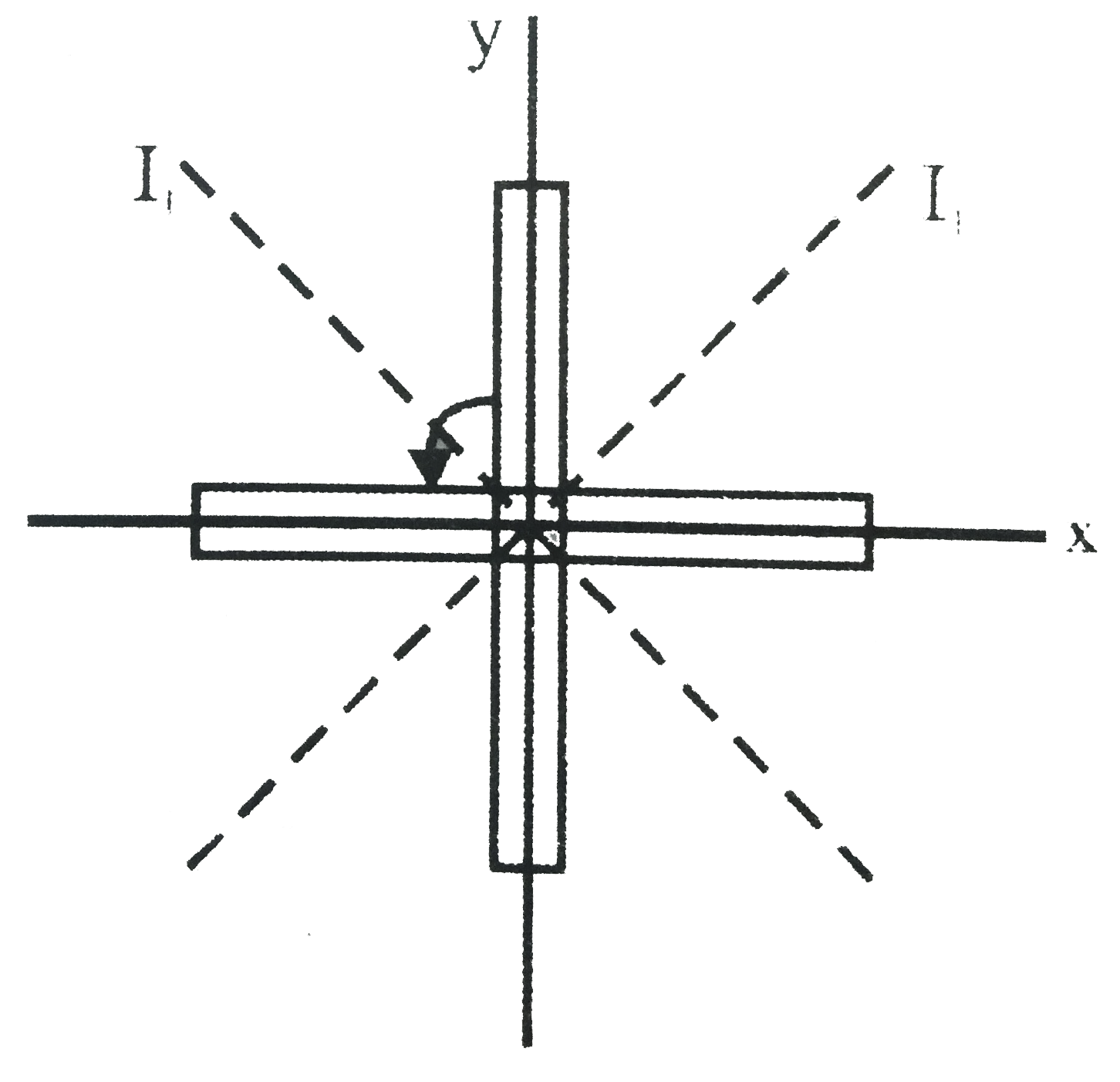 . .
|
|
| 32. |
One of the rectangular components of a velocity of 20 ms^(-1) is 10 ms^(-1). Find the other component. |
|
Answer» `10sqrt(3)MS^(-1)` |
|
| 33. |
Is it possible to change the temperature of a gas without supplying heat |
|
Answer» POSSIBLE in ISOTHERMAL process |
|
| 34. |
Arrange the vectors subtractions so that their magnitudes are in decreasing order. If the two vectors vecA and vecB are acting at an angle (|vecA| gt |vecB|) (a) 60^(@) ""(b) 90^(@) (c) 180^(@) "" (d)120^(@) |
| Answer» Answer :C | |
| 35. |
Give an example in which a force does work on a body but fails to change its K.E. |
| Answer» Solution :When a body is PULLED on a rough, HORIZONTAL surface with CONSTANT velocity. Work is done on the body but K.E remains unchanged | |
| 36. |
What will be distance covered by vehicle after applying brakes with retardation 2m //s^(2)if its velocity is 1.8 km//h ? |
| Answer» SOLUTION :`d _(s) = 255 m` | |
| 37. |
Two simple pendulums of time periods 2.0s & 2.1s are made to vibrate simultaneously. They are in phase initially , after how may vibrations are there in the same phase ? |
|
Answer» 21 |
|
| 38. |
Derive the equations of motion for a particleFalling vertically |
|
Answer» Solution :A body filling from a height h :Let us consider an object of mass m falling from a height 'h . Let us assume there is no air resistance, The object EXPERIENCES acceleration 'g' due to GRAVITY that is constant. a = g If the particle is thrown with initial VELOCITY 'u' downward that is in NEGATIVE - Y-aixs, then velocity and position of the particle at any time t is given by v = u + gt. . . (1) `y = ut +(1)/(2) g t^(2)"". . . (2)` When it is at a distance y from the hill -top , is `v^(2) = u^(2) +2gy "". . . (3)` Suppose the particle starts from rest. u = 0 For a point y from the hill -top v = gt ` y = (1)/(2) g t^(2)` `v^(2) = 2 gy` 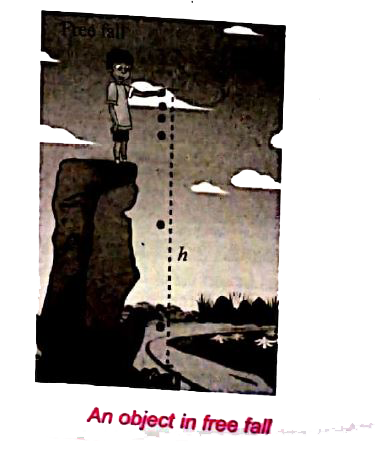
|
|
| 39. |
If an average person jogs, produces 1.25 xx 10^(5) cal min^(-1). This is removed by the evporation of sweat. The amount of sweat evaporated per minute if 1 kg requires 5.8 xx 10^(5) cal for evaporation is |
|
Answer» 0.25 kg |
|
| 40. |
The linear speed of the tip of second arm of a clock is v. The magnitude of change in its velocity in 30 second is ...... |
|
Answer» 2 v 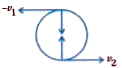
|
|
| 41. |
Estimate the mass of air in your class room at NTP. Here NTP implies normal temperature (room temperature) and 1 atmospheric pressure. |
|
Answer» Solution :The AVERAGE size of a class is 6 m length, 5 m breadth and 4 m height. The volume of the room `V= 6xx5xx4 = 120 m^(3)`. We can determine the NUMBER of mole. At room temperature 300K, the volume of a gas occupicd by any gas is equal to 24.6 L. The number of mole `mu=(120m^(3))/(24.6xx10^(-3)m^(3))~~"4878 mol"` Air is the mixture of about `20%` oxygen, `79%` nitrogen and remaining one percent are argon, HYDROGEN, helium and xenon. The molar mass mass of air is `"29 G mol"^(-1)`. So the total mass of air in the room `m=4878xx29xx10^(-3)=141.4kg` |
|
| 42. |
A projectile is fired with speed v_(0) at t=0 on a planet named ' Increasing Gravity ' . This planet is strange one, in the sense that the acceleration due to gravity increases linearly with time t as g(t)=bt, where b is a positive constant. 'Increase Gravity' If angle of projection with horizontal is theta, then the maximum height attained is |
|
Answer» `(1)/(3) ((v_(0)sintheta)^(3//2))/(SQRT(b))` `:. y` is maximum at `t=sqrt((2v_(0)sin theta )/(b))` or `y_(max)=(-(bt^(2))/(6)+v_(0)sin theta)t` `=(-(b)/(6)xx(2v_(0)sin theta )/(b)+v_(0)sin theta ) sqrt((2v_(0)sin theta)/(b))` `=(2)/(3)(v_(0)sintheta)/(sqrt(b))sqrt(2v_(0)sin theta)=((2v_(0)sin theta )^(3//2))/(3sqrt(b))` |
|
| 43. |
A disc of radius 50cm is such that its linear expansivity 'alpha' varies with the distance 'r' from its centre as alpha= alpha_(0) + alpha_(1) r where alpha_(0) = 1.8 xx 10^(-5)//°C and alpha_(1) = 1.2 xx 10^(-6)//m°C. Determine the increase in its surface area when heated through 40°C |
| Answer» Answer :C | |
| 44. |
What is the K.E per mircroscopic origin of temperature? |
|
Answer» Solution :The AVERAGE K.E. PER molecule `overline(KE) = eps=3/2kT` The equation implies that the temperature of a GAS is a meansure of the average translational `KGT E` per molecule of the gas . |
|
| 45. |
A cylinder is rolling towards a cube of same mass on rough horizontal surface ( coefficient of friction = mu) with velocity v_(0) as shown in figure. Assume elastic collision and friction is negligible between cube and cylinder. Then after collision |
|
Answer» Cylinder will stop permanently |
|
| 46. |
Assertion : The elastic spring force arises due to the net attraction or repulsion between the neighbouring atoms of the spring when it is elongated of compressed. Reason : The laws of derived forces such as spring force, friction force are independent of the laws of fundamental forces in nature. |
|
Answer» If both ASSERTION and reason are true and reason is the CORRECT explanation of assertion. |
|
| 47. |
An elevator starts moving upward with constant acceleration. The position time graph for the floor of the elevator is as shown in the figure. The ceiling to floor distance of the elevator is 1.5 m. At t = 2.0 s, a bolt breaks loose and drops from the ceiling. (a) At what time t_(0) does the bolt hit the floor? (b) Draw the position time graph for the bolt starting from time t = 0.[take g = 10 m//s^(2)] |
|
Answer» (B) `(##IJA_PHY_V01_C02_E01_070_A01##)` |
|
| 48. |
(A) : The direction of velocity and acceleration can be in any way. ( R) : The directionof acceleration depends on the direction of force, but not on the direction of velocity. |
|
Answer» Both (A) and ( R) are ture and ( R) is the CORRECT explanation of (A) |
|
| 49. |
A stone is dropped from top of a cliff . It is seen to hit the ground below after 4.2s how high is the cliff? |
|
Answer» |
|


