

Saved Bookmarks
This section includes 7 InterviewSolutions, each offering curated multiple-choice questions to sharpen your Current Affairs knowledge and support exam preparation. Choose a topic below to get started.
| 1. |
Express Newton's second law of motion in component form. Give its significance. |
|
Answer» SOLUTION :Intermsof cartesiancoordinates , thisequationcan bewritten as Bycomparingbothsidesthe three scalar equationare Theaccelerationalongthe ydirectiondepends only on thecomponentof forceactingalong the y -DIRECTION `f_(y) = ma_(y)` Significance: From the aboveequationsit isinferredthat theforceactingalong ydirectioncannotalterthe accelerationalong x direction. In the SAMEWAY `F_(z)` cannotaffect`a_(y)` and `a_(x)` |
|
| 2. |
The pressure on a square plate is measured by measuring the force on the plate and the length of the sides of the plate by using the formula p=(F)/(l^(2)). If the maximum errors in the measurement of force and length are 4% and 2% respectively, then the maximum error in the measurement of pressure is ............. |
| Answer» SOLUTION :`8%` | |
| 3. |
A body of mass 5 kg is acted upon by two perpendicular forces 8 N and 6 N. Give the magnitude and direction of the acceleration of the body. |
| Answer» SOLUTION :Resultant force = 10 N at an ANGLE of `tan^(-1) (3//4) = 37^@`with the DIRECTION of 8 N force. Acceleration =` 2 m s^(-2)`in the direction of the resultant force. | |
| 4. |
The internal energy of gas is given by U = 2PV. It expands from V_0 to 2V_0against a constant pressure P_0. The heat absorbed by the gas in the process. is N times P_0V_0then ‘N’ is equal to ___ |
|
Answer» |
|
| 5. |
A satellite is moving in a circular orbit around the earth with a speed equal to halt the escape speed from the earth. If 'R' is the radius of the earth, then the height of the satellite above the surface of the earth is |
| Answer» ANSWER :C | |
| 6. |
In Q.94, time for which the car decelerates is: |
|
Answer» `(ALPHA)/(alpha + BETA)t` |
|
| 7. |
The mass of spaceship is 1000 kg. It is to be launched from the earth's surface out into free space. The value of 'g' and 'R' (radicals of earth) are 10 m//s^(2) and 6400 km respectively. The required energy for this work will be : |
|
Answer» `6.4 XX 10^(11)` JOULES |
|
| 8. |
Dependence of intensity of gravitational field ( E ) of earth with distance( r ) from centre of earth is correctly represented by |
|
Answer»
|
|
| 9. |
Assume that a tunnel is dug across the earth. A ball is dropped into it. The time where it moves with a speed of sqrt(gR) is |
|
Answer» `2pi SQRT((R )/(g))` |
|
| 10. |
Masses 8, 2, 4, 2 kg are placed at the corners A, B, C, D respectively of a square ABCD of diagonal 80cm. What is the distance of centre of mass from A ? |
|
Answer» |
|
| 11. |
The acceleration of two bodies of mass m_1 and m_2in contact on a horizontal surface is |
|
Answer» `a = F/m` |
|
| 12. |
A block of mass m is projected up with a velocity v_0 along an inclined plane of angle of inclination theta=37^@. The coefficient of friction between the inclined plane AB and blocks is mu(=tan theta). Find the values of v_0 so that the block moves in a circular path from B to C. |
Answer» Solution :In traingle ABO, `R/l=tanthetaimpliesl=(4R)/(3)` 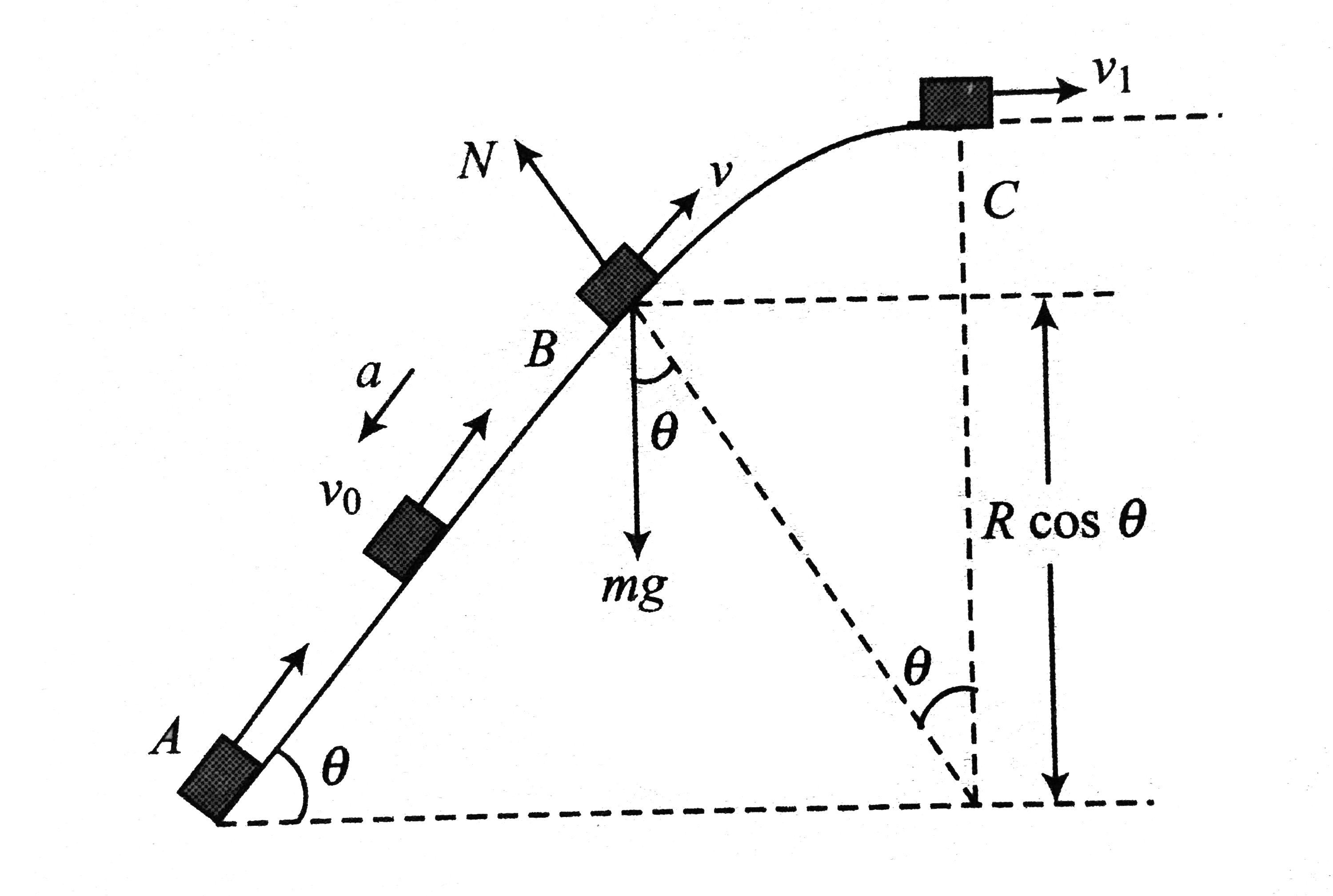 For CONTACT not to be lost at B: `mgcos THETA-N=(mv^2)/(R)` `impliesN=mg COS theta-(mv^2)/(R)= ge0` `impliesvlesqrt(gRcostheta)` (i) From B to C: `DeltaK+DeltaU=0` `(1/2mv_1^2-1/2mv^2)+mg(R-Rcostheta)=0` `impliesv_2=v_1^2+2gR(1-costheta)` (ii) From A to B: `a=gsin theta+mugcostheta` `=g sin theta+(TAN theta)g cos theta` `impliesa=2gsintheta` `implies v_2=v_0^2-2al` `impliesv^2=v_0^2-(4gsinthetaR)/(tantheta)` `impliesv^2=v_0^2-4gRcostheta` (iii) From Eqs (i) and (iii), `v_0^2-4gRcos thetalegRcos theta` or `v_0^2le5gRcos theta` `implies v_0^2le5gR(4/5)=4gRimpliesv_0lesqrt(4gR)` (iv) From Eqs (ii) and (iii), `v_1^2+2gR[1-cos theta]=v_0^2-4gRcostheta` `impliesv_1^2=v_0^2-2gR-2gRcos theta` Now to reach at `C:V_1ge0` or `v_0^2-2gR-2gRcosthetage0` `implies v_0gesqrt(2gR[1+costheta])` `impliesv_0gesqrt(2gR[1+4//5])impliesv_0gesqrt((18gR)/(5))` (V) From (iv) and (v) `sqrt((18gR)/(5))lev_0lesqrt(4gR)` |
|
| 13. |
Write down the time period of simple pendulum. |
Answer» Solution :A pendulum is a mechanical system which exhibits periodic motion. Ithas a bob with mass m suspended by a long string (assumed to be massless and inextensiblestring) and the other end is fixed on a stand as shown in Figure (a). At equilibrium, the pendulum does not oscillate and hangs verticallydownward. Such a position is known as mean position or equilibrium position. When a pendulum is displaced through a small displacement from its equilibrium position and released, the bob of the pendulum executesto and fro motion. Let 1 be the length of the pendulumwhich is TAKEN as the distance between the point of suspension and the centre of gravity of the bob. Two forces act on the bob of the pendulum at any displaced position, as shown in the Figure (d),  Normal component: The componentalong the string but in opposition to the direction of tension, `F_("as")=mg cos theta`. Tangential component: The componentperpendicularto the string i.e., alongtangential direction of arc of swing, `F_(ps)=mg SIN theta`. Therefore, the normal component of the force is , along the string, `T-W_("as")=m(v^(2))/(l)` Here v is speed of bob `T-mg cos theta=m(v^(2))/(l)"" ...(1)` From the Figure we can observe that the tangential component`W_(ps)` of the gravitationalforce always pointstowards the equilibrium positioni.e., the direction in which it always points OPPOSITE to the direction of displacement of the bob from the mean position. Hence, in this case, the tangential force is nothing but the restoring force. Applying Newton's second law along tangentialdirection, we have `m(d^(2)s)/(dt^(2))+F_(Ps)=0 rArr m (d^(2)s)/(dt^(2))= -F_(Ps)` `m(d^(2)s)/(dt^(2))= -mg sin theta "" ...(2)` where, s is the position of bob whichis measured along the arc. Expressing are length in terms of angular displacement i.e., `s=l theta ""...(3)` then its acceleration, `(d^(s))/(dt^(2))=l(d^(2)theta)/(dt^(2))""...(4)` Substituting equation (4) in equation (2), we get `l(d^(2)theta)/(dt^(2))= -g sin theta` `(d^(2)theta)/(dt^(2))=-(g)/(l)sin theta ""...(5)` Because of the presenceof `sin theta` in the above differentialequation, it is a non-linear DIFFERENTIAL equation (Here, homogeneous second order). Assume "the small oscillation approximation", `sin theta ~~theta`, the above differentialequation BECOMES linear differential equation. `(d^(2)theta)/(dt^(2))= -(g)/(l) theta""...(6)` This is the well known oscillatory differential equation. Therefore, the angular frequency of this oscillator (natural frequency of this system) is `omega^(2)=(g)/(l)rArr omega=sqrt((g)/(l))" in rad"s^(-1)` The frequency of oscillations is `f=(1)/(2pi) sqrt((g)/(l)) ` in Hz and time period of oscillations is `T=2pi sqrt((l)/(g))` in second. |
|
| 14. |
A square lead slab of side 40 cm and thickness 10 cm is subject to a shearing force (on its narrow face) of 9.0 xx 10 ^(4) N.The lower edge is riveted to the floor. How much will the upper edge be displaced ? Shear modulus of lead G=5.6 xx 10 ^(9) N//m ^(2) |
| Answer» SOLUTION :Displacement of upper edge `DELTA X =0.16mm` | |
| 15. |
Convert (i) 1Nm^(2)kg^(-2) into dyne cm^(2)g^(-2), (ii) 60Kmhr^(-1) into ms^(-1), |
|
Answer» `1Nm^(2)KG^(-2)=10^(5)` dyne `xx(10^(2)cm)^(2)xx(10^(3)g)^(-2)=10^(3)"dyne"cm^(2)g^(-2)` (II) `60kmh^(-1)=60xx1000mxx(3600)^(-1)s^(-1)=16.57ms^(-1)` |
|
| 16. |
From a solid sphere of mass M and radius R/2aspherical portion of radius ž is romoved as shown in figure. Taking gravitational potential V = 0 and r = oo , the potential at the centre of the cavity thus form is ......... . (G = Gravitational constant) |
|
Answer» `(-GM)/(2R)` `V_1 = - (GM)/(2R^3) [ 3R^2 -R^2/4] ""...(1)` and Gravitational POTENITAL of portion `R/2` `V_2 =-((3GM)/8)/(2(R/2))` Now , `V = V_1 -V_2` `=-(3GM)/(2R) +(GM)/(8R) +(3GM)/(8R)` `=- (12GM + GM + 3GM)/(8R)` ` = - (8GM)/ (8R)` `= - (GM)/R` 
|
|
| 17. |
The gravitational potential energy of the Moon with respect to Earth is: |
|
Answer» ALWAYS positive |
|
| 18. |
A horizontal cylinder has two sections ofunequal cross - sections, in which two pistons can move freely. The pistons are joined by a string. Some gas is trapped between the pistons. If this gas is heated, the pistons will |
|
Answer» MOVE to the left |
|
| 19. |
Water equivalent of a substance is equal to |
|
Answer» the MASS of the substance |
|
| 20. |
A cuboidal piece of wood has dimensions a, b and c in SI system of units. Its relative density is d which is numerically equal to 1/a, it us floating in a large body of water such that side a is vertical it is pushed down a bit and released. The time period of SHM executed by it is seconds. (Assume g=pi^(2)ms^(-2)) |
|
Answer» |
|
| 21. |
If a planet of mass .m. is revolving around the sun in a circular orbit of radius .r. with time period T, then the mass of the sun is |
|
Answer» `(4pi^2r^3)/(GT)` |
|
| 22. |
If planck's constant (h) and speed of light in vacuum (c ) are taken as two fundamental quantities, which one of the following can, in addition, be taken to express length, mass and time in terms of the three chosen fundamental quantities? (A) Mass of electron (m_(e)) (B) Universal gravitional constant (G) (C ) Charage of electron (e) (D) Mass of proton (m_(p)) |
|
Answer» C only |
|
| 23. |
A tangential force of 1000N is applied on upper surface of area 2mm^(2)which is 0.05 m from its fixed face. Find the shift of the upper surface with respect to its fixed face if its modulus of rigidity is0.30xx10^(11)Nm^(-2). |
|
Answer» 0.833 MM |
|
| 24. |
A metallic bob weighs 50 g in air. If it is immersed in a liquid at a temperature of 25^(@)C, it weighs 45g. When the temperature of the liquid is raised to 100^(@)C, it weighs 45.1 g. Calculate the coefficient of cubical expansion of liquid assuming the linear expansion of the metal to be 1.2 xx 10^(-5) //K. |
|
Answer» Solution :`(v _(1))/(v _(0)) (d _(1))/( d _(0)) = (4.9)/( 5) = ( V _(0) (1 + GAMMA _(1) x ) d _(0))/(d _(0) V _(0) (1 + gamma _(2) x )) = (1 + 75 gamma _(1))/( 1 + 75 gamma _(2)) = (49)/(50) therefore L = 75 x 49 gamma _(2) - 75 xx 50 gamma _(1)` `implies 75 (49 gamma _(2) - ( 50 xx 3.6)/(10 ^(5)))_ = 1 implies gamma = 0.000308//K.` It is a matter of common experience that bodies. |
|
| 25. |
Two simple harmonic motion y_(1)=A sin omega t and y_(2)=A cos omegat are sxuperimposed on a particle of mass m. Find the total mechanical energy of the particle. |
|
Answer» Solution :Phase difference between the two SHM is `90^(@)` Therefore RESULTANT amplitude is `A=sqrt(2a)E=1/2m OMEGA^(2)A_(R)^(2)` `=1/2momega^(2)(sqrt(2)A)^(2)=m omega^(2)A^(2)` 
|
|
| 26. |
We always see lighting before we hear thundering why ? |
| Answer» SOLUTION :The SPEED of light `(3 xx 10^ms^(-1) is much large than the speed of sound `(340 ms^(-1)`. consequently, the FALSE of light reaches US much earlier than the sound of thunder. | |
| 27. |
For body moving with uniform acceleration a change in velocity of body in Deltat time interval will be …... . |
|
Answer» |
|
| 28. |
A particle executes SHM along X-axis with a frequency (25/pi)Hz. The mass of the particle is 0.20kg. At the position x=0,04m, the kinetic energy is 0.50J and the potential energy is 0.4J. The potential energy is zero at mean position. Find the amplitude of oscillations (in cm). |
|
Answer» |
|
| 29. |
1/2 mole of Helium gas is contained in a container at S.T.P. the heat energy needed to double the pressure of the gas, keeping the volume constant (heat capacity of the gas= 3 J g^(-1)K_(-1)) |
|
Answer» 3276 J |
|
| 30. |
(A): If the volume of a body remains unchanged when subjected to tensile strain, the value of Poission's ratio is 0.5.(R) : Phosphor bronze has high Young's modulus and low rigidity modulus. |
|
Answer» Both (A) and (R) are TRUE and (R) is the correct explanation of (A) |
|
| 31. |
A mercury drop shaped as a round tablet of radius R and thickness h is located between two horizontal glass plates. Assuming that h |
|
Answer» |
|
| 32. |
An ideal gas is trapped between a mercury column and the closed lower end of a narrow vertical tube of uniform bore. The upper end of the tube is open to the atmosphere. (Atmospheric pressure is 76 cm of mercury). The length of the mercury and the trapped gas columns are 20 cm and 43 cm, respectively. What will be the length of the gas column when the tube is tilted slowly in a vertical plane through an angle of 60^(@) . Assume the temperature to be constant. |
|
Answer» Solution :Boyle.s law holds good because the temperature is CONSTANT. So, `P_(1) V_(1) = P_(2) V_(2) " or " P_(1) l_(1) = P_(2) l_(2)`, SINCE the bore is uniform `P_(1)= 76 + 20 = 96 ` cm of HG `l_(1) = 43 cm, P_(2) = 76 + " hcos" THETA = 76 + 20 cos 60^(@)` = `76 + 10 = 86 ` cm of Hg `l_(2) = ? i.e., 96 xx 43 = 86l_(2)` `rArr l_(2) = 48 cm` of Hg |
|
| 33. |
A rope ladder of length L is attached to a balloon of mass M. As the man of mass m climbs the ladder into the balloon basket, the balloon comes down by a vertical distance s. Then the increase in potential energy of man divided by the increase in potential energy of balloon is |
|
Answer» (a) `(L-s)/(s)` where `mg(L-s)` is the INCREASE in potential energy of the man and `mgs` is the increase in potential energy of the BALLOON because the balloon would have been lifted up but for the CLIMBING of the man. So Increase in PE of man/Increase in PE of balloon=`(mg(L-s))/(mgs)-(L-s)/(s)` |
|
| 34. |
Two identical balls A and B having velocities of 0.5 m/s and -0.3 m/s respectively collide elastically in one dimension. The velocities of B and A after the collision repsectively will be ………. |
|
Answer» `-0.3 m//s , 0.5 m//s ` So `v_(B) = 0.5 , v_(A) = - 0.3 ` |
|
| 35. |
A ball of mass 3M rolls from rest on a smooth flat table towards another ball of mass 2M at rest with a constant velocity 5m//s. When the two balls are separated by a distance 6m, the position of centre of mass from the mass 3M is |
| Answer» ANSWER :B | |
| 36. |
A satellite moves in an elliptical orbit about the earth such that at perigee and apogee positins the distance from the earth.s centre are respectively D and 4D. The correct relationship between the speeds at these two position is |
|
Answer» `v_(p) =v_(a)` |
|
| 37. |
Three spheres, each of mass 'm' and radius 'R' are kept in touch with each other such that their centres from an equilateral triangle. The M.I. of the system about a median of triangle is |
|
Answer» `(21)/(5)"MR"^(2)` |
|
| 38. |
A block X kept on an inclined surface just begins to slide if the inclination is theta_(1). The block is replaced by another block Y and it is found that it just begins to slide if the inclination is theta_(2)(theta_(2)gttheta_(1)). Then |
|
Answer» Mass of X = mass of Y |
|
| 39. |
The equation of motion of a body are given such that horizontal displacement x=3t meter and vertical displacemen. y=4t-5t^(2).meter, where t is in seconds.Find the angle of projection, velocity of projection and horizontal range? |
|
Answer» |
|
| 40. |
A body of mass 100gm is performing SHM with a period of 4.5sec and amplitude 7cm. Velocity of the body at equilibrium position in cm//"sec" is approximately |
|
Answer» 10 |
|
| 41. |
In the above problem time interval of which m strikes the pulley is sqrt((xMml)/((m+2m)F))then 'x' is |
|
Answer» |
|
| 42. |
Find the torque of a force 7 hat(i) + 3 hat(j) - 5 hat(k) about the origin. The force acts on a particle whose position vector is hat(i) - hat(j) + hat(k) |
|
Answer» SOLUTION :`VECF = 7hati + 3hatj - 5hatk and VECR = hati - hatj + hatk` TORQUE `vectau = vecr xx vecF` = `|{:(hati , hatj , hatk),(1,-1,1),(7,3,-5):}|` `= (5-3) hati - (7+5)hatj + (3-7)hatk` `vectau = 2hati - 12hatj + 10HATK` |
|
| 43. |
A flywheel requires 3 s to rotate through 234 radian. If its angular velocity at 3 s is 108 rad/s, find the initial velocity and uniform acceleration. |
|
Answer» Solution :t = 3S, 0 = 234 RAD, CO - 108 rad/s The INITIAL angular velocity is `omega_(0)` `theta = (OMEGA+omega_(0))/2 t , 234 = (108 + omega_(0))/2xx 3` `omega_(0) = 234 xx 2/3 - 108 = 48` rad/s Acceleration `=alpha = (omega- omega_(0))/t = (108 - 48)/3 = 20 rad//s^(2)` |
|
| 44. |
If vectors vec(A) and vec(B) are 3hat(i) - 4hat(j) + 5hat(k) and 2hat(i) + 3hat(j) - 4hat(k) respectively find the unit vector parallel to vec(A) + vec(B). |
|
Answer» `((5i - j + K))/(SQRT(27))` |
|
| 45. |
The nature of the graph of the effective length of a pendulum versus its time period will be |
|
Answer» linear |
|
| 46. |
A steel tape 1 m long is correctly calibrated for a temperature of 27.0^(@)C. The length of a steel rod measured by this tape is found to be 63.0 cm on a hot day when the temperature is 45.0^(@)C. What is the actual length of the steel rod on that day ? What is the length of the same steel rod on a day when the temperature is 27.0^(@)C ? Coefficient of linear expansion of steel =1.20xx10^(-5)K^(-1). |
|
Answer» SOLUTION :Length of steel tape at `27^(@)C`, `l_(0)=1m=100cm` `alpha=1.2xx10^(-5)K^(-1)` Length of steel tape `45^(@)C`, `l.=l_(0)+alphal_(0)Deltatheta` `=100+1.2xx10^(-5)xx100xx(45-27)` `=100+1.2xx10^(-3)xx18` `=100+0.0216` `:.l.=100.0216cm` Actual length of steel tape at `45^(@)C`, `l_(45)=(l.)/(l_(0))XXL"where "l=63." cm"` `=(100.0216xx63)/(100)""l_(0)=100" cm"` `=63.0136" cm"` No. of least SIGNIFICANT figures is 3 in `63.0` cm. HENCE actual length upto 3 significant figures is `63.0` cm. `:.` At `27^(@)C` temperature, 1 cm on measure tape is catually 1 cm. `:.` Length of tape at `27^(@)C=63.0xx1` `=63.0` cm |
|
| 47. |
If the Earth has no tilt what happens to the seasons of the Earth? |
| Answer» SOLUTION :If the Earth has no TILT, there will be no season as like now and the DURATION of day and NIGHT will be EQUAL through the year. | |
| 48. |
A mater scale is moving with unifrom velocity This implies . |
|
Answer» the force acting on the SCALE is zero but a torque about the center of mass can act on the scale . |
|
| 49. |
The radius of a curved path is r and the coefficient of friction between a car and the path is mu. What is the maximum speed at which the car can turn at a bend without skidding? |
|
Answer» |
|
| 50. |
A Carnot engine working between 300 K and600K has work output of 800 J per cycle. What is amount of heat energy supplied to the engine from source per cycle |
| Answer» Answer :D | |


