

Saved Bookmarks
This section includes 7 InterviewSolutions, each offering curated multiple-choice questions to sharpen your Current Affairs knowledge and support exam preparation. Choose a topic below to get started.
| 1. |
A vehicle of mass m is moving on a rough horizontal road with momentum p. If the coefficient of friction between the tyres and the road be mu, then the stopping distance is |
|
Answer» `p/(2 MU m g)` `= (1/(2m) xx m^2v^2)/(mu mg) = (p^2)/(2 mu m^2 g)`. |
|
| 2. |
Angular momentum of a moving body remains constant if |
|
Answer» an EXTERNAL force ACTS on the BODY |
|
| 3. |
Vectors vecA and vecB include an angle theta between them. If (vecA + vecB) and (vecA- vecB) respectively subtend angles alpha and beta with vecA, then (tan alpha + tan beta) is |
|
Answer» `((A sin theta))/((A^(2) +B^(2)cos^(2)theta)) ` where `alpha ` is the angle made by the vector `(vecA + vecB)` with `vecA`. Similarly, `tan beta= (B sin theta)/(A - B cos theta) ""…(ii)` where `beta` is the angle made by the vector `(vecA - vecB)` with `vecA`. Note that the angle between `vecA and (-vecB)` is `(180^(@) - theta)`. ADDING(i) and (ii), we GET `tan alpha + tan beta = (B sin theta)/(A + b cos theta) + (B sin theta)/(A -Bcostheta)` ` = (AB sin theta - B^(2) sin thetacos theta + AB sin theta + B^(2) SINTHETA cos theta)/((A + B cos theta)(A-Bcos theta))` ` = (2AB sin theta)/((A^(2) - B^(2) cos ^(2) theta))` |
|
| 4. |
A 1kg ball moving at 12 ms^(-1) collides head on with a 2kg ball moving in the opposite direction at 24 m/s. The velocity of each ball after the impact, if the coefficient of restitution is 2/3,is |
|
Answer» `-28m//s, - 4 m//s` |
|
| 5. |
The component of vec(A) along vec(B) is sqrt3 times that of the component of vec(B) " along " vec(A). Then A: B is |
|
Answer» `1 : SQRT3` |
|
| 6. |
SI unit of Stefan's constant is |
|
Answer» `W m^(-2) k^(-4)` |
|
| 7. |
A capillary due sealed at the top has an internal radius of r = 0.05 cm. The tube is placed vertically in water, with its open end dipped in water. Find greatest interger corresponding to the length (in water) of such a tube be for the water in it to rise in these conditions to a heighth = 1 cm ? The pressure The pressure of the air is P_(0) = 1 atm. = 7 cm of Hg , density of Hg = 13.6 //cm^(3), g = 9.8 m//sec^(2) The surface tension of water is sigma = 70 "dyne"//"cm". (assume temperature of air in the tube is constant) |
|
Answer» |
|
| 8. |
Centrifugal force is a |
|
Answer» pseudo force |
|
| 9. |
Water comes out of a hole at the bottom of a tank with a speed of 9.8ms^-1. The height of water in the tank is about |
|
Answer» 0.5 m |
|
| 10. |
A particle with restoring force proportional to displacement and resisting force proportional to velocity is subjected to a force F sin omega t. If the amplitude of a particle is maximum for frequency omega = omega_(1), while the energy is maximum for the frequency omega= omega_(2), then (where omega_(0) = natural frequency of oscillation of particle) |
|
Answer» `omega_(1) = omega_(0)` and `omega_(2) != omega_(0)` |
|
| 11. |
A lorry and a car of mass ratio 4:1 are moving with KE in the ratio 3:2 on a horizontal road. Now brakes are applied and braking forces produced are in the ratio 1:2. Then the ratio of stopping timings of lorry and car is |
|
Answer» `1:1` |
|
| 12. |
A copper wire and a steel wire of the same diameter and length are connected end to end and a force is applied which stretches their combined length by 1 cm. Then the two wires will have |
|
Answer» The same STRESS and STRAIN |
|
| 13. |
A projectile is fired vertically upwards from the surface of earth with a velocity Kupsilon_(e)where upsilon_eis the escape velocity and K lt 1Neglecting air resistance , show that the maximum height to which it will rise measured from the centre of earth is R//(1-K^2)where R is the radius of the earth . |
|
Answer» SOLUTION :If a body is PROJECTED from the surface of EARTH with a velocity `upsilon` REACHES a height h , by conservation of ENERGY `-(GMm)/R+1/2mv^(2)=-(GMm)/(R+h):. h=R/(1-K^(2)` |
|
| 14. |
A piston cylinder assembly contains 32g of oxygen at a pressure of 2.0 atmosphere and a temperature of27^@ CIt undergoes a cycle in which it is first heated at constant volume until the pressure becomes three times, then is expanded isothermally to reduce the pressure to the original value. Finally it is cooled, isobarically back to the original temperature. Calculate the work done and change in internal energy in each process. Represent the process on a P-V diagram. |
Answer» SOLUTION :
|
|
| 15. |
What are the factors that make ‘g’ the least at the equator? |
|
Answer» Solution :‘g. value is least at equator for the reasons 1) The equatorial radius of EARTH is maximum ` therefore g = (GM)/(R^2).g.` value value of .g. at equator is least because R is maximum. 2) Due to rotation of earth CENTRIFUGAL force acting on the bodies opposes gravitational pull of earth on the bodies. At equator centrifugal force is maximum. So .g. value is least at equator. |
|
| 16. |
Assertion : The projection of uniform circular motion on a diameter is SHM. Reason : A motion which has single frequency and constant amplitude is called SHM. |
|
Answer» ASSERTION and REASON are correct and Reason is correct explanation of Assertion |
|
| 17. |
An open vessel containing water is given by constant acceleration a in the horizontal direction. Then the free surface of water gets sloped with the horizontal at an angle theta given by |
|
Answer» `theta=tan^(-1)((a)/(G))` |
|
| 18. |
An elevator can carry a maximum load of 1800 kg (elevator + pasenger) is moving up with a constant speed of 2ms^(-1). The frictional force opposing the motion is 4000 N. Determine the minimum power delivered by the motor to the elevator in watts as well as in horse power. |
|
Answer» Solution :The downword force on the elevator is `F=mg+F_(r)=(1800xx10)+4000=22000N` The motor supply enough POWER to BALANCE this force. Hence. `P = FV = 22000 xx 2 = 44000` W = 59 hp |
|
| 19. |
The radius of the proton is about 10^(-15)m. The radius of the observable universe is 10^(26) m. Identify the distance which is half-way between, these two extremes on a logarithmic scale. |
| Answer» Solution :`10^(6)`m | |
| 20. |
Show that efficiency of Caront's ideal heat engine is eta=(1-(T_(2))/(T_(1))). |
|
Answer» Solution :Carnot.s ideal heat engine completes a sequence of isothermal and adiabatic expansion and isothermal and adiabatic COMPRESSION. The working SUBSTANCE returns to intial state. Heat absorbed by the system from the SOURECE at `T_(1)K` is `W_(1)=Q_(1)=muRT_(1)log_(e)((V_(2))/(V_(1)))."".......(1)` Total work done `W=W_(1)+W_(2)+W_(3)+W_(4)` Where `W_(1)&W_(3)` refres to isothermal process and `W_(2)&W_(4)` refers to adiabatic process. `W_(2)=(muRT)/((gamma-1))(T_(1)-T_(2))""` [adiabatic expansion] and `W_(4)=(-muRT)/((gamma-1))(T_(1)-T_(2))""` [adiabatic compression] So that `W_(2)+W_(4)=0` For an adiabatic expansion, `((T_(1))/(T_(2)))=((V_(3))/(V_(2)))^(gamma-1)"".......(2)` and adiabatic compression, `((T_(1))/(T_(2)))=((V_(4))/(V_(1)))^(gamma-1)"".......(3)` From (2) & (3) `(V_(3))/(V_(2))=(V_(4))/(V_(1))or(V_(3))/(V_(4))=(V_(2))/(V_(1))""............(4)` For isothermal expasion and compression, total work done `=W_(1)+W_(3)=muRT_(1)log_(e)((V_(2))/(V_(1)))-muRT_(2)log((V_(2))/(V_(4)))`. Applying (2) & (3) we get `W=muR(T_(1)-T_(2))log_(e)((V_(2))/(V_(1)))""............(5)` Hence efficiency `eta=(W)/(Q_(1))=((5))/((1))=(T_(1)-T_(2))/(T_(1))` i.e., `eta=1-(T_(2))/(T_(1))" also "eta=1-(Q_(2))/(Q_(1))" as "T_(2)propQ_(2)&T_(1)propQ_(1)`. 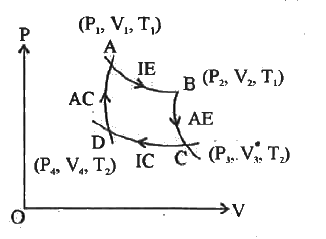
|
|
| 21. |
In the last problem take M = m and m_(0) = 2 m and calculate the acceleration of the wedge. |
|
Answer» |
|
| 22. |
A small car took off a ramp at a speed of 30 m//s. Immediately after leaving the ramp, the driver applied brakes on all the wheels. The brakes retarded the wheels uniformly to bring them to rest in 2 second. Calculate the angle by whichthe car will rotate about its centre of mass in the 2second interval after leaving the ramp. Radius of each wheel is r = 0.30 m . Moment of inertia of the car along with the driver, about the relevant axis through its centre of mass is I_(M) = 80 kg m^(2) and the moment of inertia of each pair of wheels about their respective axles is 0.3 kg m^(2). Assume that the car remained in air for more than 2 second . Also assume that before take- off the wheels rolled without sliding. |
|
Answer» |
|
| 23. |
Figure shows two blocks each of mass 2kg , connected by a string passing over two pulleys. One block rests on a smooth horizontal surface and theother blockhangs vertically. Assume pullyes to be frictionless and massless. What is the tension in the string? |
|
Answer» SOLUTION :From the free-body diagram of vertically HANGING 2kg block, 2g-T=2a……(i) CONSIDERING the 2kg block on the horizontal SURFACE, T=2a………(ii) COMBINING (i) and (ii) 2g-T =T or 2T=2g or T=g Newton =`9.8N` 
|
|
| 24. |
There are three Newton's laws of motion namely first, second and hird laws. We can derive |
|
Answer» SECOND and THIRD laws from the first LAW |
|
| 25. |
When a body is projected with a velocity equal to the orbital velocity how does it move ? |
| Answer» SOLUTION :It MOVES in a CIRCULAR ORBIT. | |
| 26. |
To simulate car accidents, auto manufactrers study the collisions of moving cars with mounted springs of differnet spring constants. Consider a typical simulation with a car of mass 1000 kg moving with a speed 18.0 km/h on a smooth road and colliding with a horizontally mounted spring of spring constant 6.25xx10^(3)N m^(-1). What is the maximum compression of the spring ? |
|
Answer» Solution :At maximum compression `x_(m)`, the potentia energy V of the spring is equal to the kinetic energy K of the moving car from the principle of conservation of MECHANICAL energy. `K = UrArr (1)/(2) m u^(2)=(1)/(2) kx_(m)^(2)` `rArr x_(m)= u SQRT((m)/(k)) rArr x_(m)= u sqrt((m)/(k))` We obtain `x_(m)=2.00m` |
|
| 27. |
A body is projected at angle 30^(@) to horizontal on a planet with a velocity of 80 ms^(-1) its time of flight is 4 seconds then acceleration due to gravity on that planet is |
|
Answer» `2ms^(-2)` |
|
| 28. |
“Momentum and changes in momentum are not always in same direction”. Explain by suitable example. |
Answer» Solution :Whenendof stringis tiedto stoneand itiswhirledin horizontalplanemagnitudeofmomentumremainsamebutdirectionofmomentum iscontinouslychanging. To changedirectionof momentumforceisrequiredwhichis suppliedby HAND . to changemomentumby largermagnitudelargerforceis TOBE APPLIED Dutto thispropertyNewtonsecondlaw isobtained. |
|
| 29. |
A carnot engine has efficiency 40 % and it absorbs heat from source at 500^@ K. How much should the temperature of source be increased so as to increase its efficiency by 60 % of original efficiency ? |
|
Answer» 1200 K `eta_1=1-T_2/T_1` `T_2/T_1=1-eta_1` `T_2/500=1-0.4` `THEREFORE T_2=0.6xx500` `therefore T_2`=300 K Now `eta_2=1-T_2/(T._1)` `T_2/(T._1)=1-eta_2` `300/(T._1)=1-0.6` `300/(T._1)=0.4` `therefore T._1=300/0.4` `therefore T._1`=750 K |
|
| 30. |
A stone must be projected horizontally from a point P, which is h meters above the foot of a plane inclined at an angle theta with horizontal as shown in figure. Calculate the velocity v of the stone so that it may hit the inclined plane perpendicularly> |
|
Answer» |
|
| 31. |
A ball is dropped from the height h on an inclined plane of inclination theta. If the coefficient of restitution is e, at what distance along the plane , the ball again collides with the plane. |
|
Answer» Solution :Velocity along the plane remains same , `_|_^(ar)` to the plane becomes `e` TIMES. `_|_^(ar)` to the plane: `0 = EV COS theta t - (1)/(2) g cos theta t^(2)` `rArr t = ( 2EV)/(g)` Along the plane : `d = v sin theta t + (1)/(2) g sin theta t^(2)` `= v sin theta ( 2ev)/(g) + (1)/(2) g sin theta ((2 ev)/(g))^(2)` ` = (2 ev^(2) sin theta)/(g) + (2 e^(2) v^(2) sin theta)/(g)` `= ( 2ev^(2) sin theta)/(g) (1 + e)``{v^(2) = 0 + 2gh}` ` = ( 2e xx 2gh sin theta(1 + e))/(g) = 4 e( 1 + e) h sin theta` `= 4 e( 1 + e) h sin theta` 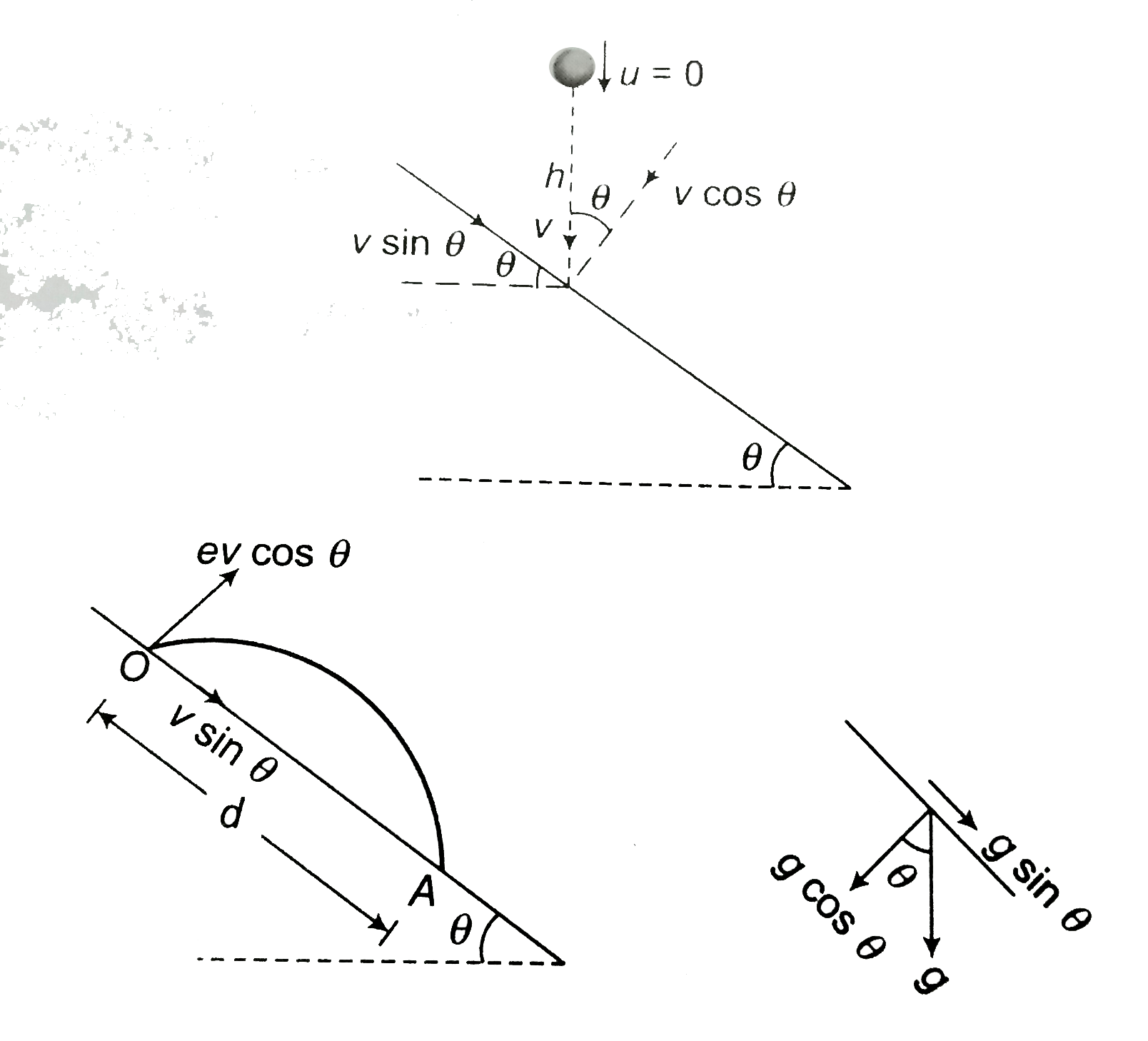
|
|
| 32. |
Which of the two , a small spring in a ball point pen and a shock absorbed spring in a motor cycle, has a greater force constant ? |
| Answer» Solution :The force CONSTANT of a shock absorbed spring is GREATER . | |
| 33. |
The displacement of a simple harmonic oscillator is given by y= 0.40 sin (440t +0.61). For this, what are the value of initial phase? |
|
Answer» SOLUTION :Comparing `y= 0.40 SIN (440T + 0.61)" with " y= A sin (OMEGA t+ phi)` INITIAL phase `phi = 0.61 rad`. |
|
| 34. |
On what value of alpha_(V) depends ? Write its unit. |
| Answer» Solution :`alpha_(V)prop(1)/(T)` hence INVERSELY proportion to TEMPERATURE. | |
| 35. |
The displacement of a simple harmonic oscillator is given by y= 0.40 sin (440t +0.61). For this, what are the value of amplitude. |
|
Answer» Solution :COMPARING `y= 0.40 sin (440T + 0.61)" with " y= A sin (omega t+ PHI)` AMPLITUDE `A= 0.40 m` |
|
| 36. |
The displacement of a simple harmonic oscillator is given by y= 0.40 sin (440t +0.61). For this, what are the value of angular frequency. |
|
Answer» Solution :Comparing `y= 0.40 sin (440t + 0.61)" with " y= A sin (OMEGA t+ phi)` ANGULAR FREQUENCY `omega = 440 rad s^(-1)` Frequency `f= (omega)/(2pi)` `=(440xx7)/(2xx22)= 70 Hz`. |
|
| 37. |
The displacement of a simple harmonic oscillator is given by y= 0.40 sin (440t +0.61). For this, what are the value of time period. |
|
Answer» Solution :Comparing `y= 0.40 SIN (440t + 0.61)" with " y= A sin (OMEGA t+ phi)` Periodic time `T= (2pi)/(omega)` `=(2xx22)/(440xx7)` `= 0.01428 THEREFORE T apporx 0.0143s` Periodic time `T= (1)/(f)` `=(1)/(70) = 0.01428 therefore T APPROX 0.0143s`. |
|
| 38. |
Surface tension is a property of liquid and it causes capillary rise in small tubes. Excess pressure inside a liquid drop is 60xxN/m^2. What will be the excess pressure inside a liquid bubble of the same radius formed by the same liquid? |
|
Answer» SOLUTION :EXCESS pressure inside a drop = 2S/R = `60xxNm^-2` `THEREFORE` Excess pressure inside abuble = 4S/R = `120Nm^-2` |
|
| 39. |
The displacement of two identical particles executing SHM are represented by equations x_(1)=4sin(10t+(pi)/2) and x_(2)=5cos (omegat). For what value of omega, energy of both the particles is same. |
|
Answer» 4 rad/s |
|
| 40. |
The work done by a gas during IsothermalExpansion depends on a) temperature of the gas b) number of moles c) temperature of surroundings |
|
Answer» both a and B are true |
|
| 41. |
A block of wood is floating on water. If the temperature is increased the apparent weight of the block of wood |
|
Answer» will REMAIN the same |
|
| 42. |
Give the expression for frequency of oscillation of a mass body as shown in the fig. |
|
Answer» Solution :EFFECTIVE spring constant `=(1)/(K)=(1)/(k_(1)+k_(2))+(1)/(k_(3))` `"i.e."(1)/(k)=((k_(1)+k_(2)+k_(3)))/((k_(1)+k_(2))k_(3))` Period of OSCILLATION `T=2pi sqrt(m((k_(1)+k_(2)+k_(3)))/((k_(1)+k_(2))k_(3)))` SINCE frequency of oscillation `n=(1)/(T)=(1)/(2pi)sqrt(((k_(1)+k_(2))k_(3))/(m(k_(1)+k_(2)+k_(3))).` |
|
| 43. |
Which force governs the structure of atomsand molecules ? |
| Answer» SOLUTION :The ELECTROMAGNETIC FORCE. | |
| 44. |
When ‘n’ identical droplets are combined to form a big drop, then the energy will be released If n identical small droplets each of radius r merge to form a big drop of radius R and the energyreleased in this process is absorbed by the big drop so as to increase its kinetic energy then the speed of the big drop (T be the surface tension and d be the density of the liquid droplets) |
|
Answer» |
|
| 45. |
Statement A : At absolute zero the substance has internal energy due to the vibrational motion of atoms with in the molecules. This is zero point energy. Statement B : First law of thermodynamics does not satisfy the condition under which a body can use its heat energy to produce the work. |
|
Answer» A is TRUE, B is false |
|
| 46. |
Two identical solid balls, one of ivory and the other of wet-clay are dropped from the same height on the floor. Which one will rise to a greater height after striking the floor and why? |
| Answer» Solution :Ivory ball is more ELASTIC than wet-clay ball, THEREFORE, it tends to regain its ORIGINAL SHAPE quickly after COLLIDING the floor and hence ivory ball wall rise higher. | |
| 47. |
110 J of heat is added to a gaseous system, whose internal energy increases by 40 J. Then the amount of external work done is |
|
Answer» 150 J |
|
| 48. |
If vecP = hat(i)+2hat(j)+6hat(k), its direction cosines are |
|
Answer» `(1)/(41),(2)/(41) and (6)/(41)` |
|
| 49. |
A pump on the ground floor of a building can pump up water tofill a tank of volume 30 m^(3) in 15 min . If the tank is 40 m above the ground , and the efficiency of the pump is 30% how much electric power is consumed by the pump? |
|
Answer» <P> Solution :`P= W/t = (MGH)/t`` = (30 xx10^(3) xx9.8 xx40)/(15xx60)` ` 13.07 KW` `eta =("Output power ")/("Input power") [ " Where " m = V_(RHO) = 30 xx10^(3)kg]` ` :."Input power " =("Output power")/eta` `=(13.07)/(0.30)` ` = 43.56 kW` `APPROX 43.6 kW` |
|
| 50. |
A body weight 72 N moves from the surface of earth at a height half of the radius of the earth , then gravitational force exerted on it will be ....... |
|
Answer» 72 N `:.W = (GM_em)/(R_e^2)"" :.72 = (GM_em)/(R_e^2)` Now w = `=(GM_em)/((R_e+R_e/2))=(GM_em)/((3/2R_e)^2)=(GM_em)/(3/2Re)=4/9(GM_em)/(-R_e^2)` `:. W. = 4/9 XXW` `:. W = 4/9 XX 72 = 32 N` |
|