

Saved Bookmarks
This section includes 7 InterviewSolutions, each offering curated multiple-choice questions to sharpen your Current Affairs knowledge and support exam preparation. Choose a topic below to get started.
| 1. |
What is meant by escape speedin the case of the Earth? |
|
Answer» Solution :The escape speed is independent of the direction on which the object is THROWN. Irrespective of whether the object is thrown vertically up, radially outwards or tangentially it requires the same INTIAL speed to escape Earth.s gravity FORCE. This can be written as, ` v_(e)= sqrt(2gh)` |
|
| 2. |
(A) : A dimensionless quantity may have unit. (R) : Two physical quantities having same dimensions, may have different units. |
|
Answer» Both (A) and (R) are TRUE and (R) is the CORRECT explanation of (A) |
|
| 3. |
A block of mass 2kg hangs from the rim of a wheel of radius 0.5m. On releasing from rest, the block falls through 5m height in 2s. The M.I. of the wheel will be |
|
Answer» `1" KG m"^(2)` |
|
| 4. |
What is equilibrium ? (or) Define mechanical equilibrium of a rigid body. |
| Answer» SOLUTION :A RIGID BODY is SAID to be in me angular momentum remain constant. | |
| 5. |
An external pressure P is applied on a cube at 0^(@)C so that it is equally compressed from all sides. K is the bulk modulus of the material of the cube and alpha is its coefficient of linear expansion. Suppose we want to bring the cube to its original size by heating. The temperature should be raised by : |
|
Answer» `3PKalpha` `therefore (DeltaV)/V=P/K " ["DeltaV=` change in volume] If INCREASE in temperature `Deltat` brings the CUBE to its ORIGINAL size, then `DeltaV=V*gammaDeltat " or, " Deltat=(DeltaV)/V*1/gamma=(DeltaV)/V*1/(3gamma)=P/(3Kalpha)` The option (B) is correct. |
|
| 6. |
A horizontal force applied on a body on a rough horizontal surface produces an acceleration 'a'. If co-efficient of friction between the body & surface which is m is 2 units. The value of m is |
|
Answer» 2/3 G |
|
| 7. |
A car weighs 1800kg. The distance between its front and back axles is 1.8m. Its centre of gravity is 1.05m behind the front axle. Determine the force exerted by the level ground on each front wheel and back wheel. |
Answer» SOLUTION : From the theorem of MOMENTS `F_1d_1=F_2d_2` (about B) `(2m_1g)(1.8)=(1800g)(0.75)` Force on `m_1=375kg wt=375xx9.8-3675N` on the front wheels. SIMILARLY, `(2m_2g)(1.8)=(1800g)(1.05)` (about A) Force on `m_2=525kg wt=525xx9.8=5145N`. on the BACK wheels. |
|
| 8. |
Two different liquids are flowing in two tubes of equal radius. The ratio of coefficients of viscosity of liquids is 52:49 and the ratio of their densities is 13:1, then the ratio of their critical velocities will be |
|
Answer» `4:49` |
|
| 9. |
A spool of wire rests on a horizontal surface as shown in figure. As the wire is pulled, the spool does not slip at contact point P. On separate trials, each one of the force F_(1),F_(2),F_(3) " and " F_(4) is applied to the spool. For each one of these forces the spool. |
|
Answer» will rotate anticlockwise if `F_(1)` is applied |
|
| 10. |
A body cools from 60^@C to 50^@C in 10 min of room If the room temperature is25^@ C and assuming Newton's cooling law holds good, the temperature of the body after 10 more minute. |
|
Answer» Solution :ACCORDING to newtons law ofcooling ` ( theta_2 - theta_1)/(t) = k [ (theta_2 + theta_1)/(2) - theta_0 ]` ` therefore (60 - 50)/(10)= k [ (60 + 50)/(2) - 25]` ` 1 = 30 k " or" k = 1/30` ` (50 - theta)/(10) = k [ (50 +theta)/(2) - 25 ] = k theta / 2 = (theta)/(60)` or ` 70 theta =3000, theta = 300/7 = 42.8^@C` |
|
| 11. |
A Trolley containing a liquid slides down a smooth inclined plane of angle 'a 'with the horizontal. Find the angle of inclinatin ' of the free surface with the horizontal |
| Answer» SOLUTION :`TAN ALPHA theta=alpha` | |
| 12. |
The mass of moon is 1% of mass of earth. The ratio of gravitational pull to earth on moon and that of moon on earth will be |
|
Answer» `1 : 1` |
|
| 14. |
A stone is projected from the top of a tower with velocity 20ms^(-1)making an angle 30^@with the horizontal. If the total time of flight is 5s and g= 10ms^(-2) |
|
Answer» the height of the tower is 75M |
|
| 16. |
A cannon shell is firedto hit a target at a horizontal distance d. However , it breaks into two parts of mass ratio 1 : 2 at its height point. The smaller part returns to cannon. The other part (i) will fall at a distance d//2 beyond the target (ii) have eight times the kinetic energy of smaller part (iii) the increase in kinetic energy of system after explosion is 200 % (iv) after explosion , heavier part will take more time as compared to smaller part , to strike the ground |
|
Answer» `(i) ,(II)` `x' = x_(0) - d = (3d)/(2) - d = (d)/(2)` (i) is `O.K`. Momentum conservation at the highest point is `3m v COS theta = - mv cos theta + 2mv' rArr v' = 2v cos theta` `(K_(2m))/(K_(m)) = ((1)/(2) ( 2 v cos theta)^(2))/((1)/(2) xx m ( v cos theta)^(2)) = 8` (ii) is `O.K`. `K.E.` before explosion `K_(i) = (1)/(2) xx 3m( v cos theta)^(2) = (3m)/(2) v^(2) cos^(2) theta` `K.E.` after explosion `K_(F) = (1)/(2) m(v cos theta)^(2) + (1)/(2) xx 2m ( 2v cos theta)^(2)` ` = (9m v^(2) cos^(2) theta)/(2)` `((K_(f))/(K_(i)) - 1) xx 100 = 200%` (iii) is `O.K.` Both parts will strike the ground simultaneously , (IV) is wrong. 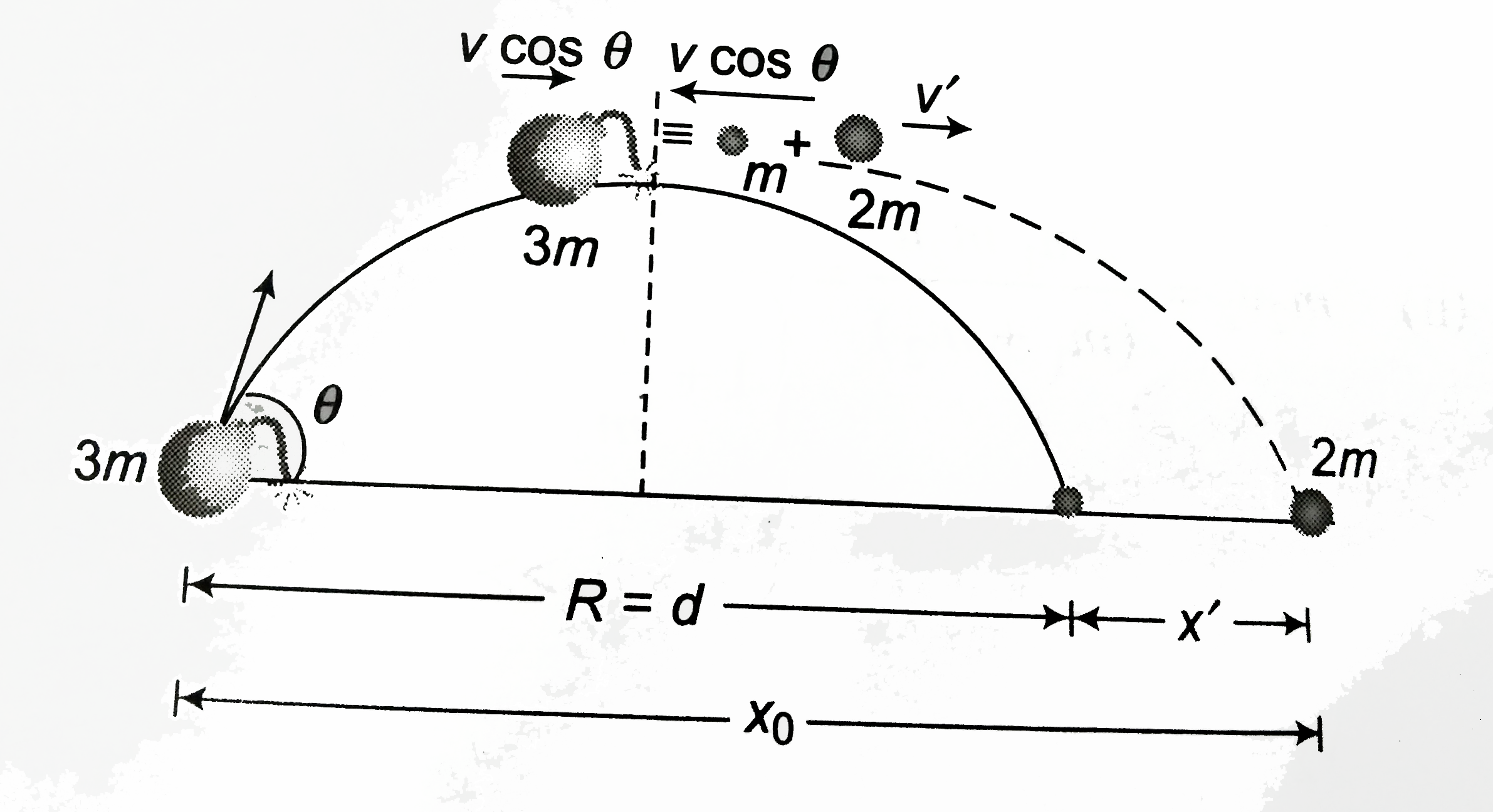
|
|
| 17. |
Obtain the force law for SHM from the displacement of SHM particle. |
|
Answer» Solution :Displacement of SHM particle at time t `X(t)= A cos (OMEGA t+ phi)"""……."(1)` where A= amplitude, `omega` = ANGULAR frequency and `phi`= initiall PHASE. Differentiating equation (1) w.r.t. time t `v(t)= (d[x(t)])/(dt)= (d)/(dt)[ A cos (omega t+phi)]` `v(t)= -A omega sin (omega t+phi)` Differentiating again w.r.t., time t `a(t) = (d[v(t)])/(dt)= (d)/(dt) [-A omega sin (omega t + phi)]` `therefore a(t) = -A omega^(2) cos (omega t + phi)` but `A cos (omega t+phi) = x(t)` `therefore a(t) = -omega^(2)x (t)` MULTIPLY by mass m on both sides `ma (t) = -m omega^(2) x(t)` `therefore F= -kx(t)" where "ma= F, m omega^(2) = k` `therefore F propto -x(t)`. |
|
| 18. |
Draw the P-T and V-T diagrams of an isochoric process of n moles of an ideal gas from pressure P_(0),volume V_(0)to pressure 4P_(0), indicating the pressures, and temperatures, of the gas, in the initial and the final states. |
|
Answer» Solution :From the equation of state for an ideal GAS `PV=NRT` (a) `P=(nRT)/(V)` i.e., `P prop T ( :. V="constant")` AT `P=P_(0) and V=V_(0), T=(P_(0)V_(0))/(nR) and` at `P=4P_(0), V=V_(0), T = (4P_(0)V_(0))/(nR)` The graph is a straight line (passing through the origin, when produced) shown in figure.  (B) Since, temperature increases from `(P_(0)V_(0))/(nR)` to `(4P_(0)V_(0))/(nR)`, volume remaining constant, so, the graph of`V-T` will be as shown in figure. 
|
|
| 19. |
The graph between two temperature scales A and B is shown in figure. Between upper fixed point and lower fixed point there are 150 equal division on A and 100 on scale B. The relationship for conversion between the two scales is given by |
|
Answer» `(t_(A)-180)/(100)=(t_(B))/(150)` `:.` RELATION for conversion of temperature of TWO scales, `(t_(A)-A" least point on A")/("No. of marks on A")=(t_(B)-B" least point on B")/("No. of marks on B")` `(t_(A)-30)/(150)=(t_(B)-0)/(100)` `:.(t_(A)-30)/(150)=(t_(B))/(100)` |
|
| 20. |
The sum of magnitudes of two forces acting at a point is 16N. If their resultant is normal to the smaller force and has a magnitude of 8N. Then the forces are: |
|
Answer» 6N and 10N |
|
| 21. |
Calculate the coefficient of real expansion from the following data. Weight of the specific gravity bottle = 40.25 gm , Weight of the bottle + liquid at 25^(@)C = 70.50 gm Weight of the bottle + liquid at 100^(@)C 69.20gm : Coefficient of linear expansion of glass = 0.000009//^(@)C |
|
Answer» Solution :`w _(1) = 40.25 gm, w _(2) = 70 . 50 gm and w _(3) = 69.20 cm,t _(1) ^(@) C = 25 ^(@) C and t _(2) ^(@) C = 100^(@)C` Coefficient of apparent ecxpansion of the liquid, `GAMMA _(a) = (w _(2) - w _(3))/( (w _(3) - w _(1)) (t_(2) -t _(1)))` ` = (70. 50 - 69.20)/( (69. 20 - 60.25) (10 0-25))= (1.30)/(28. 95 xx 75)= (1.30)/( 2171.25) = 0.0005987//^(@)C` `gamma _(gamma) = 3 alpha = 3 xx 0.000009 = 0.000027^(@)C ^(-1)` `gamma _(a) = 0.0005987 + 0.000027 = 0.0006327^(@)C ^(-1) ~~6.26 xx 10 ^(-4) //^(@)C ^(-1)` |
|
| 22. |
A simple pendulum ia hanging from a per inserted in a vertical wall. Its bob is stretched to horizontal position from wall and is left free to move, the bob hits the wall. If coefficient of restitution is (2)/(sqrt(5)). After how many collision the amplitude of vibration will become less than 60^(@)(Hint : h_(n) le h(1-cos theta)) |
|
Answer» 6 |
|
| 23. |
Consider the following statement A and B. Identify the correct choice in the given answer (A) In a one-dimensional perfectly elastic collision between two moving bodies of equal masses, the bodies exchange their velocities after the collision. (B) If a lighter body at rest surffers head-on and perfectly elastic collision with a very heavy body moving with a certain velocity after the collision both travel with same velocity |
|
Answer» A and B are CORRECT |
|
| 24. |
A particle is moving on a circular path of 10 m radius. At any instant of time, its speed is 5 ms^(-1) and the speed is increasing at a rate of 2 m s^2. The magnitude of net acceleration at this instant is |
|
Answer» `5 MS^(-2)` ` a_r= (v^2)/(r) = ( 5 xx 5 )/(10 ) = 2.5ms^(-2) ` Thenetaccelerationis ` a = sqrt( a_(r )^(2) + a_(t)^(2)) =sqrt((2.5)^2+2^2 ) = sqrt(10 .25) = 3.2ms^(-2)` |
|
| 25. |
A block of mass 5 kg resting on a horizontal surface is connected by a cord, passing over a light frictionless pulley to a hanging block of mass 5 kg. The coefficient of kinetic friction between the block and surface is 0.5. Tension in the cord is (take, g=9.8ms^(-2)) |
|
Answer» 49 N `=(5g-0.5xx5xxg)/(10)=(g)/(4)` Equation of motion for the hanging mass will be, `5g-T=5a=(5g)/(4)` `THEREFORE"" T=(15)/(4)g=(15xx9.8)/(4)=36.75 N` |
|
| 26. |
The radius of the bump on a road is r. What force does the road exert on a car ofmass m when the car passes the highest point on the bump ? Calculate the maximum speed with which the car can pass the highest point before losing contact wtih the road ? |
|
Answer» Solution :The forces acting on the CAR are the normal force exerted by the bumpacting VERTICALLY upwards at the highest point and the weight of the car mg acting vertically downwards. The resultant of these two forces gives the centripetal force. `mg - N = (mv^(2))/r` `N = mg - (mv^(2))/r`  The force exerted by the road on the car at the highest point `=mg - (mv^(2))/r` When the car just LOSES contact with the road the normal force exerted by the road on the car is zero (i.e, N= 0) `0= mg -(mv^(2))/r` `(mv^(2))/r = mg` `v^(2) = rg` `v = sqrt(rg)` So the maximum SPEED with which the car can pass the highest point is `v_("max") = sqrt(rg)` |
|
| 27. |
Two cylinders A and B have been placed in contact on an incline. They remain in equilibrium. The dimensions of the two cylinders are same. Which cylinder has larger mass? |
|
Answer» |
|
| 28. |
We explosions on other planets cannot be heard on the earth? |
| Answer» SOLUTION :SINCE no meterial medium is present in the space between the planets and the earth, the sound of EXPLOSION on the other planets cannot propagate UPTO the earth. | |
| 29. |
The velocity -time graph for a vehicle is shown in thefigure . Draw acceleration-time graph from it |
|
Answer» Solution :In time 0 to 2.5 s , ACCELERATION of the VEHICLE, a = slope of OA `= (20-0)/(2.5-0) = 8 ms^(-2)` In time 2.5 to 5s, velocity of the vehicle is uniform . So acceleration = 0 In time 5 to 7s , acceleration of the vehicle, a = slope of BC`= (0-20)/(7 -5)` `= - 10 ms^(-2)` Hence the acceleration-time graph will be as SHOWN in the figure . 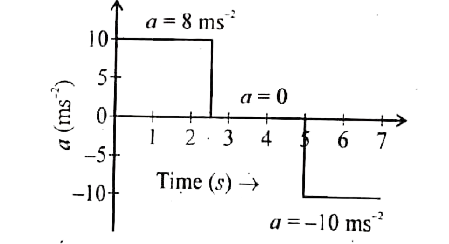
|
|
| 30. |
A particle is moving up with balloon with constant accelration (g/8) which starts from rest from ground and at height H particle is droped from balloon. After this event, time for which particle will be in air is sqrt((kH)/(g)). Find the value of k. |
|
Answer» `v=sqrt(9H)/(2)` Now let time is T `-H=sqrt(9HT)/(2)-(1)/(2)g t^(2)` |
|
| 31. |
When stirring by spoon is stop inamilk , it become at rest after sometime . Why ? |
| Answer» Solution :The viscous FORCE which is PRODUCED between two layer of the MILK OPPOSE the speed of the layers . So , after sometime the milk BECOMES stable. | |
| 32. |
A block of mass m= 1 kg, moving on a horizontal surface with speed v_(t)= 2 ms^(-1) enters a rough patch ranging from x= 0.10m" to "x= 2.01m. The retarding force F_(r ) on the block in this range is inversely proportional to x over this range, F_(r )= (-k)/(x)" for "0.1 lt x lt 2.01m = 0 " for "x lt 0.1m" and "x gt 2.01m where k= 0.5 J. What is the final kinetic energy and speed v_(f) of the block as it crosses this patch? |
|
Answer» Solution :From Eq. (6.8a) `K_(f)= K_(t)+int_(0.1)^(2.01)((-k))/(X)dx` `=(1)/(2)mv_(t)^(2)-kln(x) |{:(2.01),(0.1):}` `=(1)/(2) mv_(t)^(2)-k ln (2.01"/"0.1)` `=2-0.5 ln (20.1)` `= 2-1.5= 0.5 J` `v_(f)= SQRT(2K_(f)"/"m)= 1ms^(-1)` Here, note that ln is a symbol for the natural logarithm to the base e and not the lagarithm to the base `10[ln X= log_(e ) X= 2.303 log_(10)X]`. |
|
| 33. |
A 15 gm ball is shot from a spring gun whose spring has a force constat 600N/m. The spring is compressed by 5 cm. The greatest possible horizontal range of the ball for this compression is (g=10m//sec^(2)) |
|
Answer» Solution :`R_("MAX")=(U^(2))/g` But K.E ACQUIRED by ball =P.E of spring gun `implies1/2 m u^(2)=1/2kx^(2)impliesu^(2)=(kx^(2))/m`……….2 From EQUATIONS 1 and 2 `R_("max")=(kx^(2))/(mg)=(600xx(5xx10^(-2))^(2))/(15xx10^(-3)xx10)=10m` |
|
| 34. |
A homogeneous plate PQRST is as shown in figure. The centre of mass of plate lies at midpoint A if segment QT. Then the ratio of (b)/(a) is (PQ = PT = b , QR = RS = ST = a) . |
|
Answer» `(13)/(4)` `a^2 SIGMA (a)/(2) = sigma (1)/(2) ab SIN theta (1)/(3) b sin theta` or `(b)/(a) = sqrt((13)/(4))` 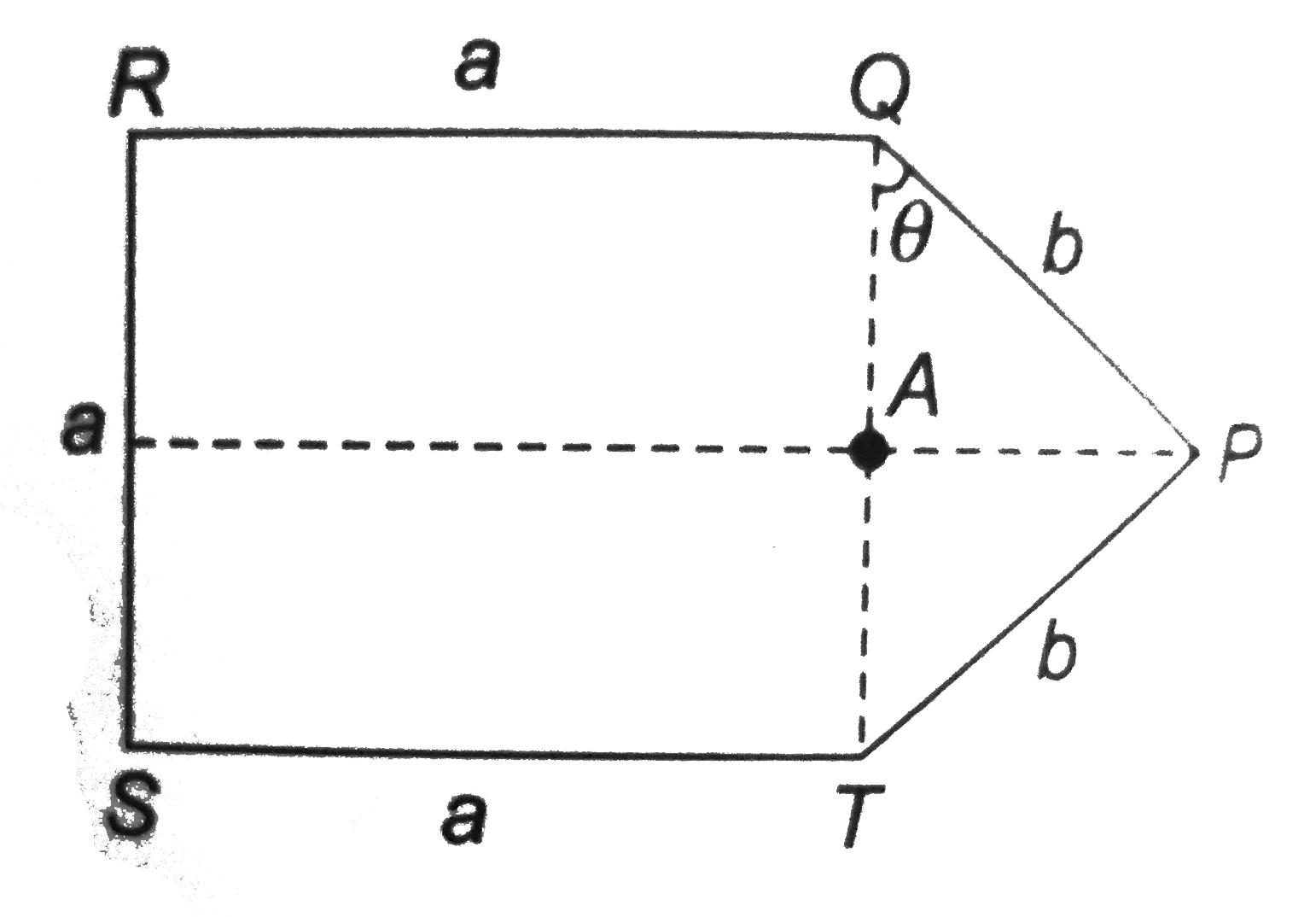 . .
|
|
| 35. |
Which one of the following is not a contact force? |
|
Answer» VISCOUS force |
|
| 36. |
The melting point of ice is 0^(0) C at 1 atm. At what pressure it will be- 1^(0) C? |
|
Answer» SOLUTION :Here `Delta = (-1 - 0) = - 1, T = 273 + 0 = 273 ` K and `V_(2) - V_(1) = (1 - (1)/(0.9) ) XX 10^(-3) m^(3) `(given ) L = 80 cal/g We have, `(Delta P)/(Delta T) = (L)/(T (V_(2) - V_(1)))` or `(Delta P)/((- 1)) = (80 xx 4.2 xx 10^(3))/(273 (1 - (1)/(0.9) ) xx 10^(-3))` `therefore Delta P = 132 xx 10^(5) N //m^(2) = 132 ` atm or `P_(2) - P_(1) = 132` atm `therefore P_(2) = 132 + P_(1) = 133` atm. |
|
| 37. |
A body .A. with a momentum .P. collides with another identical stationery body .B. gives an impulse .J. to the body .A.. Then the coefficient of restitution is |
|
Answer» Solution :According to LAW of conservation of linear MOMENTUM, `m_(1)u_(1)+m_(2)u_(2)=m_(1)v_(1)+m_(2)v_(2)` i.e., `m u+m(0)=mv_(1)+mv_(2)` `rArr P-P_(1)=P_(2)` where `P_(2)=J`, given `THEREFORE` Coefficient of restitution, `e=(v_(2)-v_(1))/(u)=(mv_(2)-mv_(1))/(m u)=(P_(2)-P_(1))/(P)` `= (P_(2)-(P-P_(2)))/(P)=(2P_(2)-P_(1))/(P)` `therefore = (2J-P)/(P)=(2J)/(P)=1` |
|
| 38. |
A wheel initially at rest acquires an angular velocity of 128 rad s^(-1) in 4 s. Hence its constant angular acceleration is ……….. |
|
Answer» 32 rad `s^(-2)` `THEREFORE alpha=(128-0)/(4)` `therefore alpha=32" rads s"^(-2)` |
|
| 39. |
Match the following : {:("List - 1","List - 2"),("a) Same negative dimensions of mass","e) Pressure,Rydberg constant"),("b) Same negative dimensions of length","f) Magnetic induction field, potential"),("c) Same dimensions of time","g) Capacity, Universal gravitational constant"),("d) Same dimensions of current","h) Energy density, Surface tension"):} |
|
Answer» a-g b-e c-h d-f |
|
| 40. |
Two small spheres of mass 5kg and 15kgare joined by a rod of length 0.5m and of negligible mass. The M.I. of the system about an axis passing through centre of rod and normal to it is |
|
Answer» `10KGM^(2)` |
|
| 41. |
Explain the reflection of wave at free support. |
Answer» Solution :As shown in FIGURE, the string is fastened to a ring which slides without friction on a rod. In this case, when the pulse arrives at the left end, the ring moves up the rod.  As the ring moves, it pulls on the string stretching the string and producing a reflected pulse with the same sign and amplitude as the incident pulse. Thus, in such a reflection, the incident and reflected PULSES reinforce each other, creating the maximum displacement at the end of the string, the maximum displacement of the ring is TWICE the amplitude of either of the pulses. Thus, the reflection is without any additional phase shift. Here, the reflection takes place without any phase change. Suppose the progressive wave is, `y _(1) (x,y) a sin (kx - omega t )` The reflected wave from OPEN end is: The reflected wave FORM open end is, `y _(r) (x,t) = a sin (kx + omega t )` If incident wave is moving in +X-direction, then reflected wave would be moving in -X-direction. Note: If progressive was is moving in + Y-direction then the reflected wave of `x _(i) (y,t) =a sin (kx - omega t ) is x _(r) (y,t) = - a sin (ky - omega t )` |
|
| 42. |
Explain by plats the position of particle executing simple harmonic motion at different time. |
Answer» Solution :The figure shows the positions of a particle executing S.H.M. are at discrete value to time, each interval of time being `(T)/(4)" where "phi = 0` and T is the period of motion.  For a given SHM, A is the amplitude, then the velocity and position of a particle at time t is determine by the phase `(omega t+ phi)` of cosine function. In the equation of SHM `x(t) = A cos (omega t+phi), phi =0" and " omega = (2pi)/(T)`, `x(t)= A cos ((2pi)/(T)t)` Now `t=0` `x(t)= A cos (0) = +A` Taking `t=(T)/(4)` `x(t)= A cos"" ((2pi)/(T)xx(T)/(4)) = Acos ""(pi/2)= 0` Taking `t=(T)/(2)` `x(t)= A cos ""((2pi)/(T)xx(T)/(2)) = Acos ""pi = -A` Taking `t=(3T)/(4)` `x(t)= A cos ""((2pi)/(T)xx(3T)/(4)) = Acos ""(3PI)/(2)= 0` Taking `t=T` `x(t)= A cos ""((2pi)/(T)xxT) = Acos ""2pi = +A` Taking `t=(5T)/(4)` `x(t)= A cos ""((2pi)/(T)xx(5T)/(4)) = Acos ""(5pi)/(2)= 0` From figure got following observations : (i) After period T, periodic (REPEATS) motion takes place. (ii) Period T remains fixed no MATTER what location you choose as the INITIAL (t=0) location. (III) The speed is maximum for zero displacement (at x=0) and zero at the extremes of motion (x= A). 
|
|
| 43. |
Two bodies of masses m_(1) and m_(2) are moving with velocities 1 ms^(-1) and 3ms^(-1) respectively in opposite directions. If the bodies undergo one dimensional elastic collision, the body of mass m_(1) comes to rest. Find the ratio of m_(1) and m_(2). |
|
Answer» Solution :`u_(1)=1 ms^(-1), u_(2)= -3 ms^(-1), v_(1)=0` `v_(1) = ((m_(1) -m_(2))/(m_(1) + m_(2)))u_(1) + ((2m_(2))/(m_(1) + m_(2)))u_(2)` `0 = ((m_(1)-m_(2))/(m_(1) + m_(2)))1 + ((2m_(2))/(m_(1) + m_(2)))(-3)` `m_(1)-m_(2)= 6m_(2), m_(1)= 7 m_(2), (m_(1))/(m_(2))= (7)/(1)` |
|
| 44. |
Give the definition of surface tension and formula in the context of (i) inter molecular forces (ii)potential energy (iii)work done. |
Answer» Solution :In below figure a free surface of liquid is shown A line of unit length in the MIDDLE of the surface except NEAR to WALL is shown . The force exerted on both SIDE of line, perpendicular to line and parallel to the surface . If length of line is l and force F, then surface tension `S=(F)/(l)`.  (i)Figure shown , on free surface of liquid if a line of unit length is out then the molecules one of side of line exert force on themolecules of other side of line perpendicular to the line and parallel to the surface then this force is known as surface tension (S). Here length (i)Figure shown , on free surface of liquid if a line of unit length is out then the molecules one of side of line exert force on themolecules of other side of line perpendicular to the line and parallel to the surface then this force is known as surface tension (S). Here length `S=(F)/(l)(("Newton")/("meter"))` (ii)The potential energy stored per unit area of a free surface of liquid is known as surface tension of liquid. `S=(E)/(A)(("Joule")/("metre")=("Newton"xx"metre")/("metre"^(2))=("Newton")/("metre"))` (iii)The work done to increase the unit surface area of a liquid is equal to the surface tension. `S=(W)/(DeltaA)(("Joule")/("metre"^(2))=("Newton")/("metre"))` (Note : surface tension is denoted by T.) |
|
| 45. |
Examine Tables 6.1-6.3 and express The daily intake of human adult in kilocalories. |
|
Answer» SOLUTION :The average human consumption in a day is `(10^(7)J)/(4.2xx10^(3)J"/"kcal) CONG 2400kcal` We point out a common misconception created by newspapers and magzines. They MENTION food values in calories and urge us to restrict DIET intake to below 2400 calories. What they should be saying is kilocalories (kcal) and not calories. A person consuming 2400 calories a day will soon strave to death! 1 food calorie is 1 kcal. |
|
| 46. |
(A) All zeros to the right of the last nonzero digit after the decimal point are significant. (B) If the number is less than one, all the zeros to the right of the decimal point but to the left of the first nonzero digit are not significant |
|
Answer» only A is correct |
|
| 47. |
Two particles 1 and 2 start simultaneously from origin and move along the positive X direction. Initial velocity of both particles is zero. The acceleration of the two particles depends on their displacement (x) as shown in fig. (a) Particles 1 and 2 take t_(1) and t_(2) time respectivelyfor their displacement to become x_(0). Find (t_(2))/(t_(1)). (b) Which particle will cover 2x_(0) distance in least time? Which particle will cross the pointx = 2x_(0) with greater speed? (c) The two particles have same speed at a certain time after the start. Calculate this common speed in terms of a_(0) and x_(0). |
|
Answer» |
|
| 48. |
When air is blown between two balls suspended close to each other, they are attracted towards each other. Why? |
| Answer» SOLUTION :The high velocity air between the BALLS REDUCES the pressure there. So they attracted towards each other. | |
| 49. |
A particle revolves rounda circular paththe acceleration of the particle is inversely proportional to |
|
Answer» radius |
|
| 50. |
Four particles of masses m, 2m, 3m and 4m are placed at the vertices of a rectangle ABCD as shown in the figure. The particles move from A to B, B to C. C to D and D to A respectively. In this process find the displacement of centre of mass of the system. |
Answer» Solution :We have `vecDeltar_(CM) =(m_(1)(vec(Deltan)) + m_(2)(vec(Deltar_(2))) + m_(3)vec(Deltar_(3)) + m_(4)vec(Deltar_(4)))/(m_(1) + m_(2) + m_(3) + m_(4))`  Where `m_(1) = m, m_(2) = 2m, m_(3) =3m, m_(4)= 4m` `vec(Deltar_(1)) = lhatj. vec(Deltar_(2)) = 2lhati.vec(Deltar_(3)) = - lhatj` and `vec(Deltar_(4)) =-2hati` This GIVES : `vec(DELTAR)cm =((m)(lhatj) + 2m(2lhati) + 3m(-lhatj) + 4m(-2lhati))/(m+2m + 3m + 4m) =-(2L)/5 hati - l/5 HATJ` |
|