

Saved Bookmarks
This section includes 7 InterviewSolutions, each offering curated multiple-choice questions to sharpen your Current Affairs knowledge and support exam preparation. Choose a topic below to get started.
| 1. |
Can you cool a room by keeping the fridge open ? |
| Answer» Solution :No. When work is done on the COMPRESSOR, the working substance absorbs HEAT from a LOW temperature body and rejects the heat ABSORBED + work done by compressor to the ROOM. Thus the room will become warmer. | |
| 2. |
In the aboveproblem, the CMof the plateis nowin the followingquadrantof x - y plane. |
|
Answer» I |
|
| 3. |
Two forces 10N each inclined to each other at angle 120^(@) act on a 6kg mass at rest. Its kinetic energy after 12 s is |
|
Answer» 400J |
|
| 4. |
Obtain an equation of momentum in terms of mass and kinetic energy . |
|
Answer» Solution :`K = 1/2 mv^(2)` `= 1/2 ((mv)^(2))/m` `=(p^(2))/(2m)` ` :. p = mv ` ` :. P = SQRT(2KM)` |
|
| 5. |
Consider the pervious situation with V_(R) gt V_(bR) Let V_(R)=V_(1):V_(bR)=V_(2) The time taken by the swimmer to have minimum drift is |
|
Answer» `(dV_(1))/((SQRT(V_(1)^(2)-V_(2)^(2)))V_(2))` |
|
| 6. |
theta=theta_0+omega_0t+1/2propt^2 from the first principles of differentiation. |
|
Answer» Solution :CONSIDER the DEFINITION for angular speed, i.e `omega=(dtheta)/(DT)` i.e `dtheta=omegadt` i.e `dtheta=(omega_0+propt)dt` i.e `intdtheta=intomegadt+inttdt` i.e `theta=omega_0t+prop.(t^2)/(2)+C` Where 'C' is a constant. When `t=0,theta=theta_0,C=theta_0` HENCE `theta=theta_0+omega_0+1/2propt^2` |
|
| 7. |
If velocity of light, acceleration due to gravity and normal atmospheric pressure are taken as the fundamental units, what will be the units of mass, length and time, given velocity of light as 3xx10^(8) ms^(-1) acceleration due to gravity 10ms^(-2) and normal pressure =10^(5)Nm^(-2) |
|
Answer» <P> Dividing the 1st two equation `T=3xx10^(8)//10=3xx10^(7)s`. Multiplying first and fourth `LT^(-1)xxT=L=3xx10^(8)xx3xx10^(7)=9xx10^(15)m`. Substituting in the 3rd EQUATIO `M=10^(5)//L^(-1)T^(2)=10^(5)xx9xx10^(15)xx9xx10^(14)=81xx10^(34)kg`. |
|
| 8. |
The Centre of mass of a solid cone along the line from the centre of the base to the vertex is at |
|
Answer» ONE FOURTH of the height |
|
| 9. |
In order to apply Newton's law of motion in an accelerated (non-inertial ) frame of reference, we make the use fo |
|
Answer» ELECTROSTATIC force |
|
| 10. |
A transverse harmonic wave on a string is described by y(x,t) =5.0 sin(48t + 0.0264 x + pi/6),where x and y are in cm and t in sec. The positive direction of x is from left to right. (a) What are its amplitude and frequency? (b) What is the least distance between two success in crests in the wave? |
|
Answer» SOLUTION :Here, y(X,t) = `5.0 sin(48t + 0.0264x + pi/6)` The general EQUATION of a plane progressive wave is, `v(x,t) = a sin[((2pi)/lambda(vt +x) + phi)]` It is OBSERVED that the given equation represent a travellig waveform right to left. Velocity, `V=48/0.0264 = 1818.18 cm s^(-1), r=5` cm. (a) Amplitude and frequency: Amplitude, `(2pi)/lambda = 0.0264` or `lambda = (2pi)/0.0264 cm = (2 xx 3.14)/(0.264) = 6.28/0.0264 = 237.8` cm frequency, From the equation `v= lambda v` `v= v/lambda =(1818.18)/(2pi) xx 0.0264 =(1818.18)/(2 xx 3.14) xx 0.0264` `=(1818.18)/(6.28) xx 0.0264 = 289.51 xx 0.0264 = 7.64` Hz (b) To find least distance between two successive crests in the wave. `lambda =(2pi)/(0.0264) =(2 xx 3.14)/(0.0264) = 6.28/0.0264` =237.8 cm= 2.38 m (C ) When `x = lambda/4` `phi =(2pi)/lambda xx lambda/4 = pi/2` rad. |
|
| 11. |
Find the power of an electric motor , if it lits 200 kg of water in 5 minutes from a well of 120 m depth. |
|
Answer» SOLUTION :Mass of water m = 200 kg Depth of WELL = height lifted = 120 m Time `t = 5xx60 sec = 300sec` Power `= ("Work DONE against GRAVITATIONAL force")/("time")` Power `= (mgh)/(t)=(200xx9.8xx120)/(5xx60)=784 W`. |
|
| 12. |
Obtain the scalar product of two mutually perpendicular vectors . |
|
Answer» Solution :If `vec(A) BOT vec(B)` then `THETA = 90^(@)` ` :. vec(A) .vec(B) = AB cos 90^(@)` =` 0 "" [ :. cos 90^(@) = 0]` This is the condition for mutually perpendicular of two NON - zero vectors . |
|
| 13. |
A man wants to draw a bucketfull of water in two different ways . As shown in figure .a. he draws the bucket directly and as shown in figure (b) he uses a pulley . The weight of the man is 50kg and the bucket with full water weighs 25 kg . Find the action on the floor by the man in the two caces .(Take g=10ms^(-2)) |
|
Answer» |
|
| 14. |
Water having surface tension of 0.075J/m^2 is poured in to a cylindrical vessel of radius 5cm. Find the surface energy possessed by it in 10^(-4) J(nearly) |
|
Answer» |
|
| 15. |
Under what condition, te Doppler will not be observed, if the source of sound moves towards the listener ? |
| Answer» Solution :Doppler effect will not be OBSERVED, if the SOURCE of sound moves towards the listener with a velocity GREATER than the velocity of sound. Same is ALSO true if listener moves with velocity greater than the velocity of sound towards the source of sound. | |
| 16. |
Asolid is highly compressible. Is its bulk modulus high? |
|
Answer» |
|
| 17. |
Two simple harmonic motions of angular frequency 100 and 1000 rad s^(-1) have the same displacement amplitude. The ratio of their maximum acceleration is……… |
|
Answer» `1 : 10` `therefore a_("max") propto omega^(2)` `therefore ((a_("max"))_1)/((a_("max"))_2) = ((omega_1)/(omega_2))^(2)= ((100)/(1000))^(2)= (1)/(100)`. |
|
| 18. |
The scope of physics is tremendously large, it studies the scale of length in the range of the order of |
|
Answer» `10^(-14)m`to `10^14`m |
|
| 19. |
Obtain the necessary condition v_(cm)=Romega for rolling body without stepping. |
Answer» Solution :When a rigid body (sphere, circular disc or WHEEL of vehicle) rolling without slipping then rolling motion exist.  As shown in figure a circular disc of radius R is rolling on its circular surface without slipping. Its centre of mass is on the geometric centre of the disc `V_(cm)` is the velocity of C. It is parallel to the surface level. The rotational motion of the disc is about axis. Which passes through centre. `P_(0),P_(1)andP_(2)` are the point on disc is shown in figure the velocity at these points, are obtained the sum of components of vectors. The resultant velocity at point `P_(1),vec(v_(1))=vec(v_(R))+vec(v_(cm))` where `vec(v_(R))` is the velocity at `P_(1)` point, `vec(v_(R))=Romega` `THEREFORE` The resultant velocity at point `P_(1),vec(v_(1))=Romega+Romega` [`because` are in same DIRECTION] [`because` velocity of cm, `vec(v_(cm))=Romega`] `therefore vec(v_(1))=2Romegaorvec(v_(cm))=2Romega` The position vector of `P_(2)` is `vecr`. So linear velocity at point `P_(2),vec(v_(r))=rvecomega`, which is perpendicular to position vector `vecr`. `therefore` The resultant velocity at point `P_(2)=vec(v_(2))=vec(v_(r))+vec(v_(cm))` `=vec(r_(omega))+vec(Romega)` `P_(0)` is instantaneously at rest and the velocity of this point `vec(v_(0))=vec(v_(R))+vec(v_(cm))`, here `v_(0)=0` `therefore 0=vec(v_(R))+vec(v_(cm))` but `vec(v_(R))andvec(v_(cm))` are in perpendicular direction when `|vec(v_(R))|=|-vec(v_(cm))|,P_(0)` becomes at rest. `therefore` Due to resultant velocity at point `P_(0)` zero, `v_(cm)=Romega`. This condition applies to all rolling bodies. |
|
| 20. |
"A horse has to pull a cart harder during the first few metres of its motion than later on ". Why ? |
| Answer» SOLUTION :Because STATIC FRICTION is GREATER than DYNAMIC friction | |
| 21. |
(A) : Animals curl into a ball, when they feel very cold. (R) : Animals by curling their body reduces the surf ace area and hence reduce the rate of loss of radiation. |
|
Answer» Both 'A' and 'R' are TRUE and 'R' is the CORRECT explanation of ' A' |
|
| 22. |
An elevator is going up. The variation in the velocity in the velocity of the elevator is as given in the graph. What is theheight to which the elevator takes the passengers |
|
Answer» 3.6 m |
|
| 23. |
Define wavelength. |
| Answer» Solution :For transverse WAVES, the distance between two NEIGHBOURING crests or troughs is known as the wavelength. For LONGITUDINAL waves, the distance between two neighbouring compressions or RAREFACTIONS is known as the ,vavelength. The SI unit of wavelength is METER. | |
| 24. |
A rod of length 2 m and mass 0.5 kg is fixed at one end and allowed to hang vertically from a rigid support. Find the work done in raising the other end of the rod until it makes an angle of 60^(@) with the vertical. (g = 10 ms^(-2)) |
|
Answer» Solution :Mass m = 0.5 kg , Length l = 2 m , `THETA = 60^(@)` Work DONE W `= "MG" (l)/(2) (1 - cos theta) = 0.5 xx 10 xx (2)/(2) (1 - cos 60^(@)) = 5 xx (1 - (1)/(2)) = 5 xx (1)/(2) = 2.5 J` |
|
| 25. |
The rate of change of angular momentum is |
|
Answer» Torque |
|
| 26. |
A body A is thrown up vertically from the ground with a velocity v_(0) and another body B is simultaneously dropped from from a height H. They meet at a height (H)/(2), if v_(0) is equal to |
|
Answer» `SQRT(2gH)` |
|
| 27. |
In the question number 61, the heat exchanged by the engine with thesurrounding for path D to A is (at constant pressure) |
|
Answer» `(5)/(2)P_(A)(V_(D)-V_(A))` `Q_(DA)=U_(DA)+W_(DA)` `=(3)/(2)(P_(A)V_(A)-P_(D)V_(D))+P_(A)(V_(A)-V_(D))` `=(3)/(2)P_(A)(V_(A)-V_(D))+P_(A)(V_(A)-V_(D))` `=(-5)/(2)P_(A)(V_(D)-V_(A))=(5)/(2)P_(A)(V_(A)-V_(D))` |
|
| 28. |
Consider a tuning fork which is used to produce resonance in an air column. A resonance air column is a glass tube whose length can be adjusted by a variable piston. At room temperature, the two successive resonances observed are at 20 cm and 85 cm of the column length. If the frequency of the length is 256 Hz, compute the velocity of the sound in air at room temperature. |
|
Answer» Solution :Given two SUCCESSIVE length (resonance) to be `L_(1) = 20` cm and `L_(2) = 85` cm The frequency is F = 265 Hz `v = f lambda = 2 f DELTA L = 2 f (L_(2) - L_(1))` `= 2 xx 256 xx (85 - 20) xx 10^(-2) ms^(-1)` ` v = 332. 8 m s^(-1)` |
|
| 29. |
For an oscillating simple pendulum is the tension in the string constant throughout the oscillation ? If not, when is it (a) the least (b) the greatest? |
| Answer» SOLUTION :No. The tension is different at different points of OSCILLATION. The tension at the extreme point is `mg COS theta `where `theta` is the DEFLECTION of the bob from the vertical. So its MAXIMUM value is mg when `theta = 0`i.e, at the equilibrium position. Least value is at the extreme position, where is maximum. | |
| 30. |
A string when attached by a weight of 4 Kg weight give a note of frequency 256.What will produce an octave of this note? |
|
Answer» 4 KG wt |
|
| 31. |
The friction coefficient between the plank and floor is mu. The man applies, the maximum possible force on the string and the system remains at rest. Then : |
|
Answer» friction FORCE between plank and surface is `(2 mu MG)/(1 +mu)` |
|
| 32. |
Statement I: An astronaut in an orbiting space station above the earth experiences weightlessness. Statement II: An object moving around the earth under the influence of earth's gravitation force is in a state of free fall. |
|
Answer» Statement I is true, statement II is true, statement II is a CORRECTEXPLANATION for statement I. |
|
| 33. |
In the absence of external forces the center of mass will be in a state of |
|
Answer» REST |
|
| 34. |
What is the displacement of the point of a wheel initially in contact with the ground when the wheel rolls forward half a revolution ? Take the radius of the wheel as R and the x-axis as the forward direction? |
|
Answer» Solution :From FIGURE , during HALF REVOLUTION of the wheel , the point A covers `piR(=AC)` horizontal distance while `2R(=BC)` vertical distance so here , `P=piR, Q=2R` `:."Displacement", b=sqrt(P^(2)+Q^(2))` `=sqrt((piR^(2))+(2R)^(2))=Rsqrt(pi^(2)+4)` and `THETA =n Tan ^(-1)(Q/P)=Tan ^(-1)((2R)/(piR))=Tan ^(-1)(2/pi)`with x-axis. i.e., Displacement has magnitude `Rsqrt(pi^(2)+4)` and makes an angle `Tan^(-1)(2/pi)`with x-axis. 
|
|
| 35. |
which of the following pairs do not have same dimensions |
|
Answer» FREQUENCY and ANGULAR velocity |
|
| 36. |
(A) If a plane glass slab is placed on the letters of different colours all the letters appears to be raised up to the same height. ( R) Normal shift is independent of colour of light. |
|
Answer» Both A and R are true and R is the CORRECT explanation of A |
|
| 37. |
The value of Poisson's ratio for steel is …….. |
| Answer» SOLUTION :`0.28` to `0.30` | |
| 38. |
A boy of mass 25 kg slides down a rope hanging from the branch of a tree. If the force of friction against him is 50N, the boy's acceleration is (g=10 ms^(-2)) |
|
Answer» `10MS^(-2)` |
|
| 39. |
If vec(A) and vec(B)are perpendicular then vec(A) . vec(B)=. . . . |
|
Answer» `|VEC(A)||vec(B)|` |
|
| 40. |
A body of mass m taken from the earth's surface to the height h = 3R (R = Radius of earth) The change in gravitational potential energy of the body will be ........ |
|
Answer» `2/3 MGR` (R = Radius of earth M = MASS of earth) For height h = 3R FORM the surface of earth and distance r form the centre of earth `r = R + h = R + 3R = UR` `U_2 =-(GMm)/(4R)` `U_2-U_1 =-(GMm)/(4R)+(GMm)/R` `=(GMm)/R [-1/4 +1]` `=(GMm)/R [-(1+4)/4]` `= (3GMm)/(4R)` Putting `GM=gR^2` `U_2 -U_1 = (3gR^2m)/(4R) = 3/4 mgR` |
|
| 41. |
Define 'Viscosity' ? |
| Answer» SOLUTION :Viscosity is DEFINED as .the property of a FLUID to oppose the relative motion between its layers.. | |
| 42. |
The magnitude of the force of ….. Between any two bodies in contact is ….. To between them. |
| Answer» SOLUTION :LIMITING friction, directly proportional , normal REACTION . | |
| 43. |
Statement - A : If a uniform metal disc is remoulded into a solid sphere, then the moment of inertia about the axis of symmetry increases than that before. Statement - B : For a given body and for a given plane, the moment of inertia is minimum about an axis passing through the centre of mass. |
|
Answer» Both A and B are WRONG. |
|
| 44. |
A horizontal pipe of cross-section diameter 5cm carries water at a speed of 4ms^(-1). The pipe is connected to a smaller pipe with a cross-sectional diameter 4cm. The velocity of water through the smaller pipe is |
|
Answer» `6.25 ms^(-1)` `:. V_(2) = v_(1) (A_(1))/(A_(2)) = v_(1) ((D_(1))/(D_(2)))^(2) = 4 xx ((5)/(4))^(2) = 6.25 ms^(-1)` |
|
| 45. |
A piece of metal floats on mercury. The coefficients of volume expansion of the metal and mercury are gamma_(1) " and " gamma_(2) respectively. If their temperature is increased by DeltaT, then by what factor does the fraction of the volume of metal submerged in mercury change? |
|
Answer» |
|
| 46. |
A rod CD of length L and mass m is placed horizontally on a frictionless horizontal surface as shown. A second identical rod AB which is also placed horizontally ( perpendicular to CD) on the same horizontal surface is moving along the surface with a velocity v in a direction perpendicular to rod CD and its and B strikes the rod CD at end C and sticks to it rigidity. Then, |
|
Answer» VELOCITY of centre of mass of the system just after collision is `(v)/(4)` |
|
| 47. |
In an experiment if the measured values of a physical quantity are highly concurrent, these measurements are said to be |
|
Answer» ACCURATE |
|
| 48. |
The moment of inertia of a solid sphere with a density rho and radius R about its diameter is |
|
Answer» `(105)/(176)R^(5)rho` `=(2)/(5)((4)/(3)piR^(3)rho)R^(2)` `=(8)/(15)piR^(5)rho` `=(8)/(15)xx(22)/(7)R^(5)rho` `therefore I=(176)/(105)R^(5)rho` |
|
| 49. |
A disc of radius R is rotating with an angular speed omega_(0) about a horizontal axis. It is placed on a horizontal table. The coefficient of kinetic friction is mu_(k). (a) What was the velocity of its centre of mass before being brought in contact with the table ? (b) What happens to the linear velocity of a point on its rim when placed in contact with the table ? (c ) What happens to the linear speed of the centre of mass when disc is placed in contact with the table ? (d) Which force i sresponsible for the effects in (b) and (c ). (e) What condition should be satisfied for rolling to begin ? (f) Calculate the time taken for the rolling to begin. |
|
Answer» `t=(Romega_(0))^(2)/(mu_(k)g(1+(mR^(2))/(I)))` 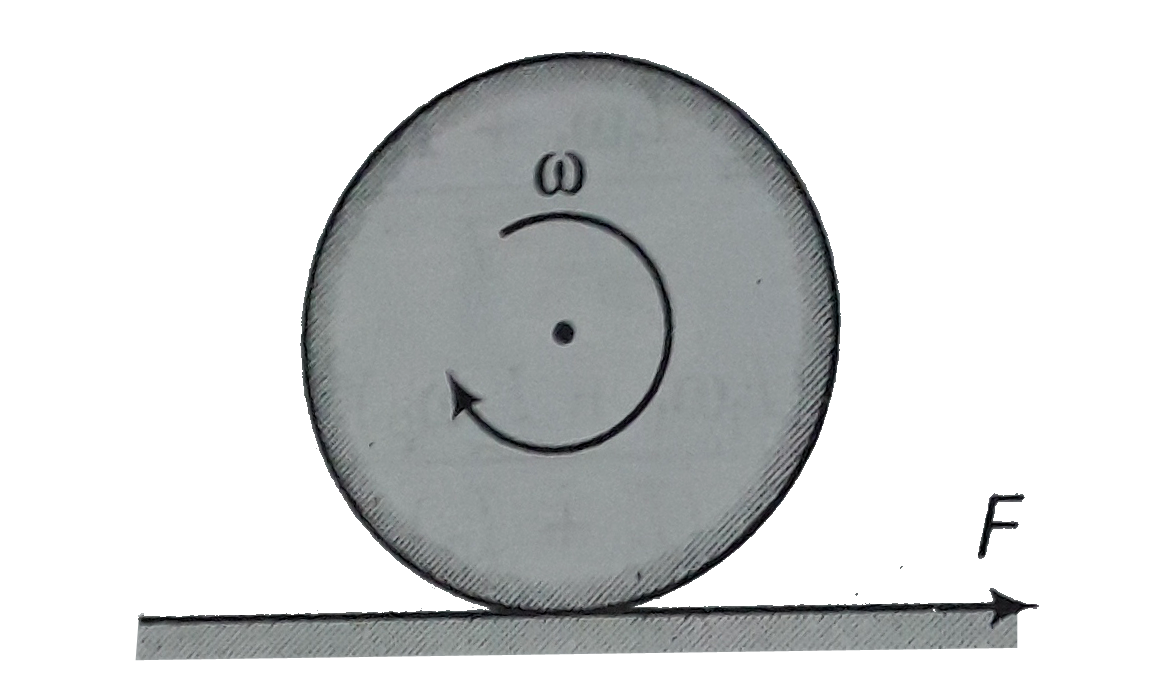 (b)when thedisc is placedin contact with thetable duetofrictionvelocityof a pointon therimdecreases , (c)when therotatingdiscis placed in correctwith the tabledueto frictioncentre of massacquiriessomelinear velocity. frictionisresponsiblefor theeffects in (b) and ( c) (e)whenrollingstarts `v_(CM)-omegaR.` 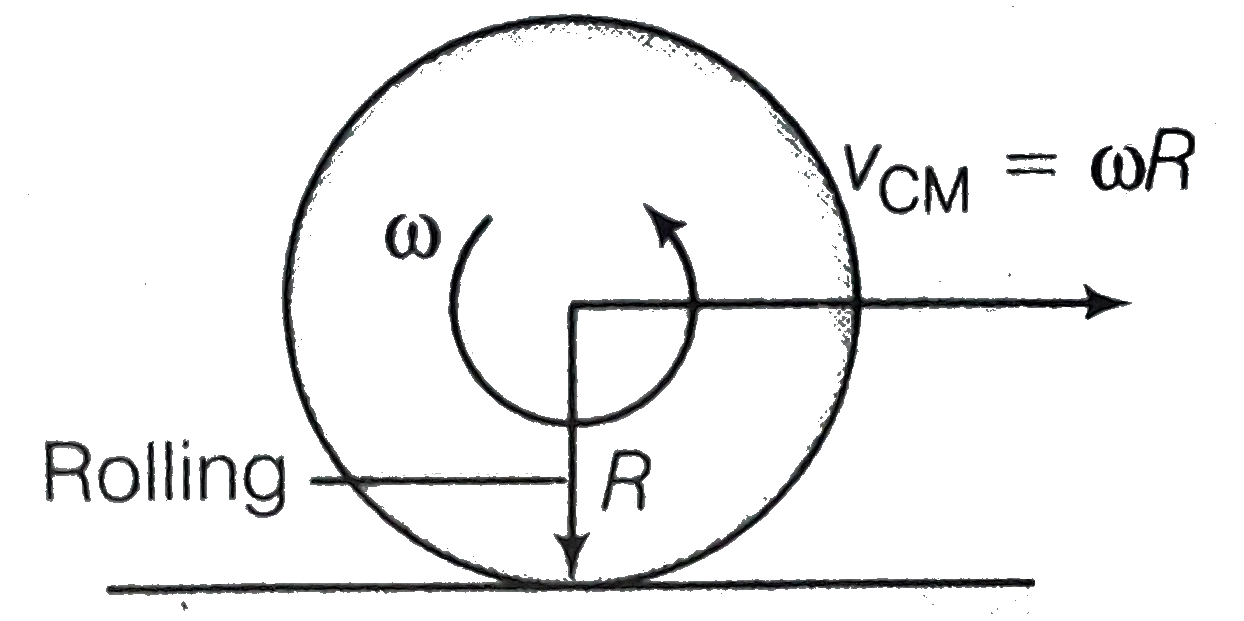 where `omega` is angular speedof thediscwhenrolling just starts. (f)Accelerationproduced in CENTRE of massdue to friction `a_(CM)=(F)/(m)=(mu_(k)mg)/(m)=mu_(k)g.` 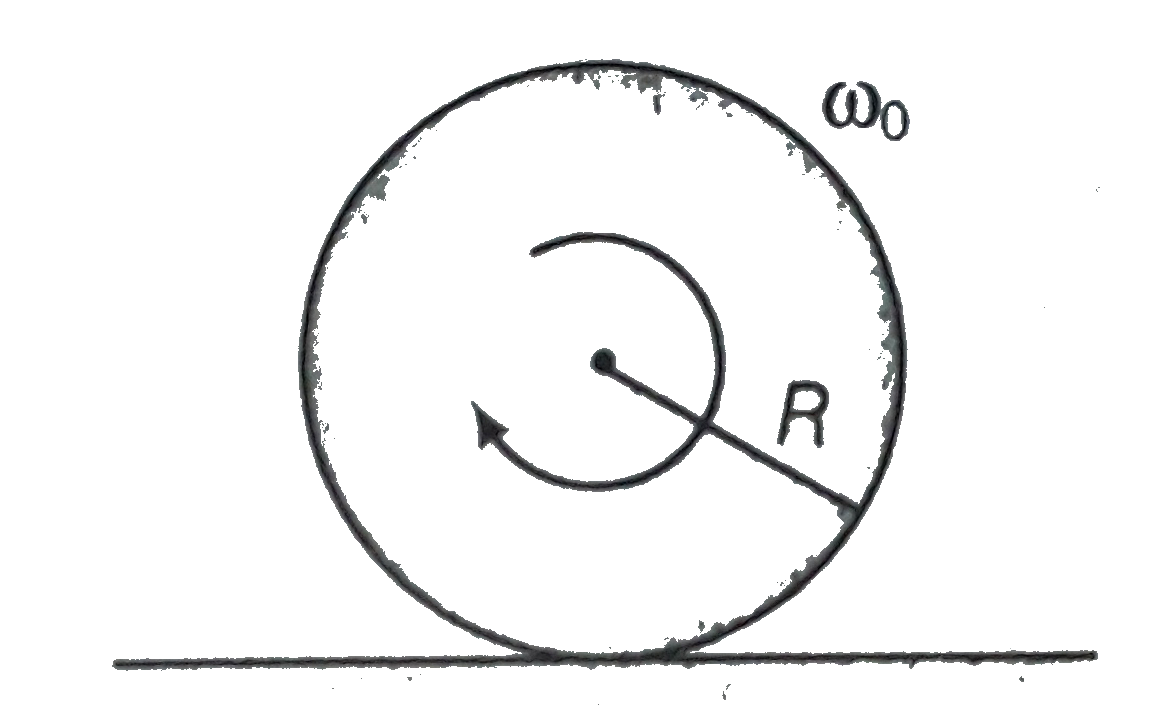 Angular retardation produced by the torquedueto fricton . `alpha=(tau)/(I)=(mu_(k)MGR)/(I) ""[:' tau=(mu_(k)N)R=mu_(k)mgR]` `therefore v_(CM=u_(CM))+a_(CM^(t))` ` implies V_(CM)=mu_(k)"GT" ( :'U_(CM)=0)` ` andomega=omega_(0)+at` ` implies omega=omega_(0)-(mu_(k)mgR)/(I)t` Forrolling withoutsliping ,`(V_(CM))/(R)=omega` `implies (V_(CM))/(R)=omega_(0)-(mu_(k)mgR)/(I)t` `(mu_(k)g t)/(R)=omega_(0)-(mu_(k)mgR)/(I)t` `t=(Romega_(0))/(mu_(k)g(1+(mR^(2))/(I)))` NOTE in thisproblem , frictional forcehelp in seting purerolloing motion . |
|
| 50. |
The displacement of two identical particles executing SHM are represented by equations x_(1)=4sin(10t+(pi)/6) and x_(2)=5cos omega t For what value of omega energy of both the particles is same. |
|
Answer» SOLUTION :`E=1/2mA^(2)omega^(2)""`i.e. `Eprop(AOMEGA)^(2)` `(A_(1)omega_(1))^(2)=(A_(2)omega_(2))^(2)""A_(1)omega_(1)=A_(2)omega_(2)` `4xx10=5xxomega""omega=8` UNIT |
|