

Saved Bookmarks
This section includes 7 InterviewSolutions, each offering curated multiple-choice questions to sharpen your Current Affairs knowledge and support exam preparation. Choose a topic below to get started.
| 1. |
Two identical containers A and B with frinctionless pistons contain the same ideal gas at the same temperature and the same volume V. The mass of gas A is m_(A) and that of B is m_(B). The gas in each cylinder is now allowed to expand in the pressure in A and B are found to be Delta P and 1.5 Delta P respectively. Then |
|
Answer» `4m_(A) = 9m_(B)` |
|
| 2. |
The amount ofwork done in lifting a body of mass .m. from the surface of the earth to a height equal to twice the radius of the earth is |
|
Answer» `(2GMm)/(3R)` |
|
| 3. |
A platform of mass m and counter weight of M + m (where, M = 3m) are connected by a light cord which passes over two smooth pulleys. A man of mass M is standing on the platform which is at rest. If the man leaps vertically upwards (and out of platform) with velocity 10 ms^(-1), find the distance through which the platform will descend ? |
| Answer» Answer :C | |
| 4. |
If energy (E), velocity (V) and time (T) are chosen as the fundamental quantities, the dimensional formula of surface tension will be: |
|
Answer» `[EV^(-2)T^(-1)]` `Sprop E^(a)V^(b)T^(c)` `M^(1)L^(0)T^(-2)=k[M^(1)L^(2)T^(-2)]^(a)[L^(1)T^(-1)]^(b)[T^(1)]^(c)` `M^(1)L^(0)T^(-2)=k[M^(a)L^(2a)T^(-2a)]L^(b)T^(-b)T^(c)` Comparison `..........` `c=-2` So the dimensional FORMULA for surface tension will be `[E^(1)V^(-1)V^(-2)]` Alternate solution : Surface tension `=("Surface energy")/("Area")` [Surface tension] `=([E])/([VT]^(2))=[EV^(-2)T^(-2)]` |
|
| 5. |
The minimum and maximum velocities of a projectile are 10ms^(-1) and 20ms^(-1) respectively. Find the horizontal range and maximum height (g=10ms^(-2)) |
|
Answer» |
|
| 6. |
How is the speed of a planet , related to the position of the planet ? |
|
Answer» <P> SOLUTION :Since angular momentum is a CONSTANT.`(v_(p))/(v_(A))=(r_(A))/(r_(A))`where, `v_(P)` - Speed at the perihelion `v_(A)` - Speed at the apchelion `r_(A)` - Distance of the planet at the apehelion and`r_(A)` - Distance of the planet at the perihelion. |
|
| 7. |
One ice skater of mass m moves with speed 2v to the right, while another of the same mass m moves with speed v toward the left, as shown in figure I. Their paths are separated by a distance b. At t = 0, when they are both at x = 0, they grasp a pole of length b and negligible mass. For t gt 0, consider the system as a rigid body of two masses m separated by distance b. as shown in figure II. Which of the following is the correct formula for the motion after t = 0 of the skater initially at y = b//2 ? (I) |
|
Answer» `x = 2vt, y = b//2` `2 m v_(cm) - m (2v) - mv` `v_(cm) = (v)/(2)` towards RIGHT from conservation of angular momentum `J_(F) = J_(i)` `I omega = 2 mv (b)/(2) + mv (b)/(2)` `2 m((b)/(2))^(2) omega = (3)/(2) mvb rArr omega = (3v)/(b)`. it will have TRANSLATION and rotational motion about `C.M` `x = v_(cm) t + (b)/(2) sin omega t rArr x = 0.5 t + 0.5 si n(3vt)/(b)` `y =(b)/(2) cos omega t rArr y = 0.5 b co s (3vt)/(b)`. 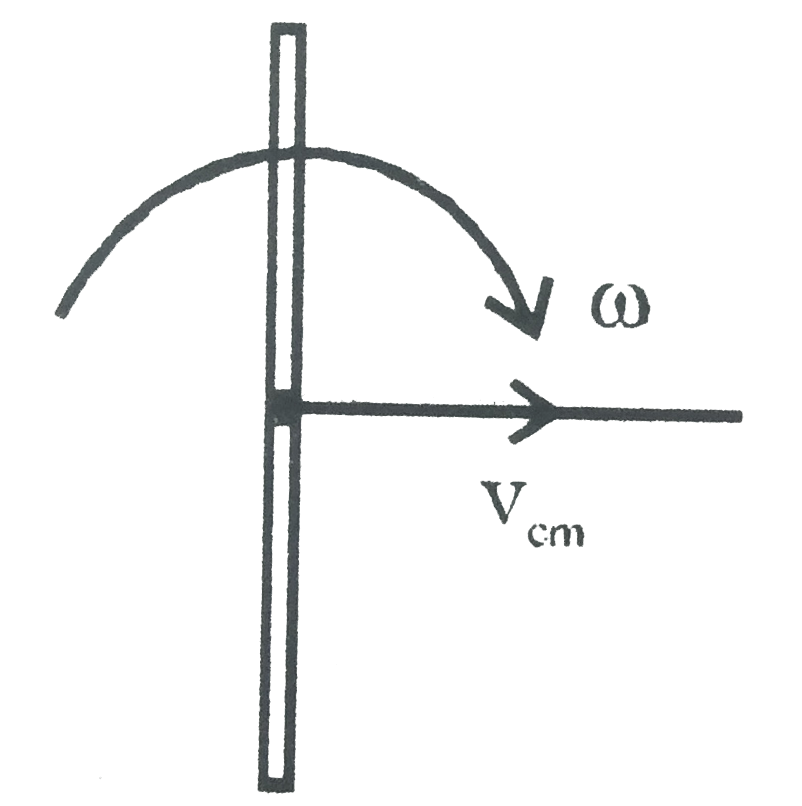 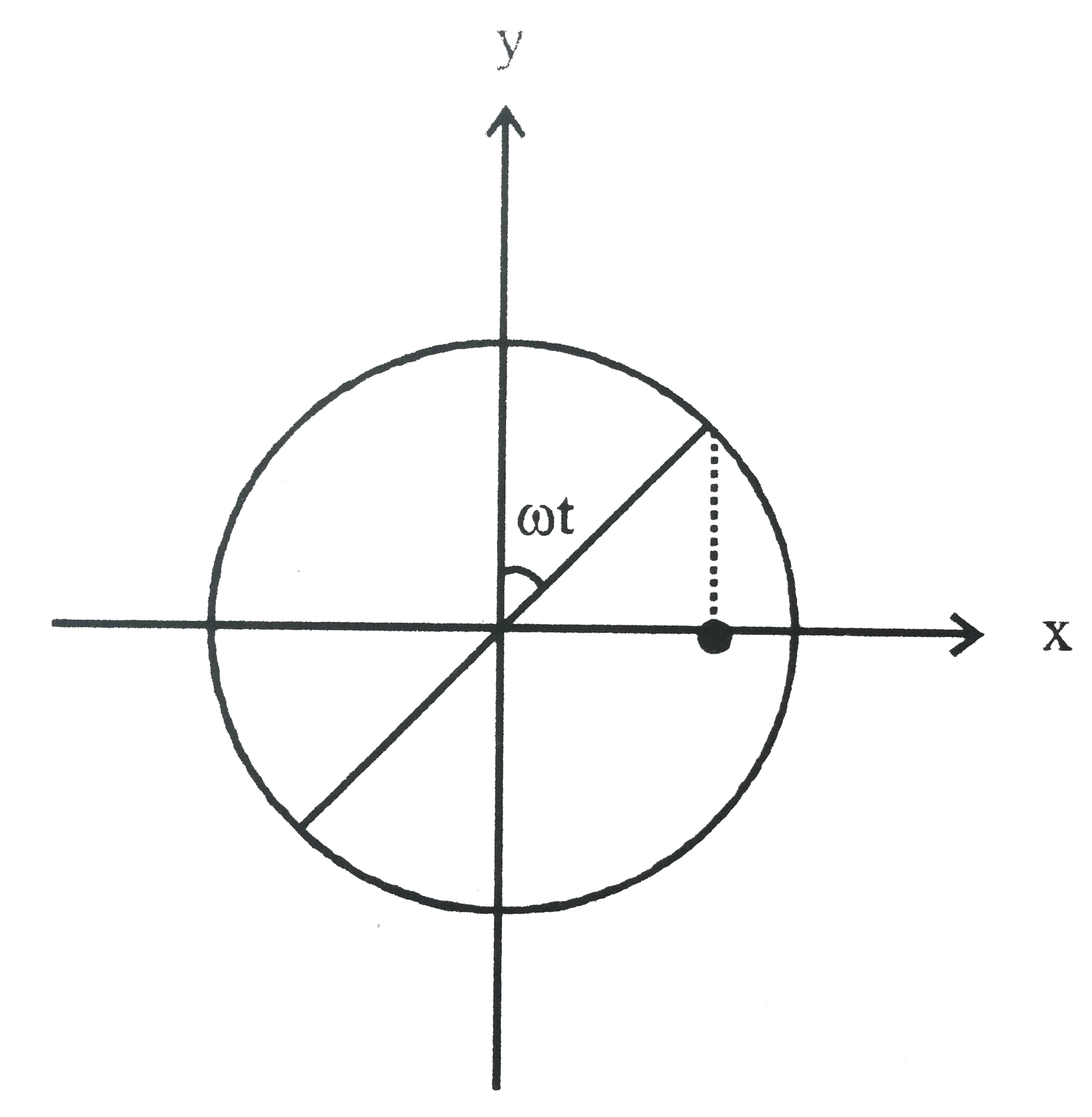 . .
|
|
| 8. |
The resultant of two vectors vec(A) and vec(B) is perpendicular to vec(A) and equal to half of the magnitude of vec(B). Find the angle between vec(A) and vec(B) ? |
|
Answer» SOLUTION :Since `VEC(R)` is perpendicular to `vec(A)`. figure SHOWS the three vectors `vec(A), vec(B)` and `vec(R)` angle between `vec(A)` and `vec(B)` is p-q `sin q = (R)/(B) = (B)/(2B) = (1)/(2)` `rArr q = 30^(@) rArr` angle between A and B is `150^(@)`. 
|
|
| 9. |
When a stationary wave is formed, then its frequency is : |
|
Answer» `sqrt(2)` that of the individual WAVES |
|
| 10. |
The beats are not heard if the difference in frequencies of the two sounding notes is more than 10. Why? |
| Answer» SOLUTION :If the difference in frequencies of the two waves is more than 10, we shall hear more then 10 beats for second. Due to PERSISTENCE of hearing, our ear is not able to distinguish between two sounds as separate. If the time internal between them is LESS than `(1/10)` th of a second. HENCE beats heard will not be distinct if the NUMBER of beats produced per second is more than 10. | |
| 12. |
A body is moving unidirectionally under the influence of a source of constant power. Its displacement in time t is proportional to |
|
Answer» `t^(1/2)` |
|
| 13. |
On what factors does radius of gyration of body depend? |
| Answer» SOLUTION :MASS DISTRIBUTION | |
| 14. |
Energy density E (energy per unit volume ) of the medium ar a distance r from a sound source varies acording to the curve shown in figure. Which of the following are possible? |
|
Answer» The source may be a point isotropic source `E=I//v` Where I is intenssity at that point and v is wave propagation velocity. it MEANS energy density E is directly propagation to intensity I. if power emitted by a point source is P then intensity at a distance r from it is equal to `I=(P)/(4pir^(2)) or Iprop (1)/(r^(2))` Hence, the shape of the curve between I and r will also be same as that given in figure of the quetion. hence, option (a) is correct. if the source is a plane sound source then intensity at EVERY point in FRONT of the source then intensity at every point in front of the source will be same if damping does not take place. but if damping takes place then the amplitude of oscillation of medium particle decrease with distance. hence, the intensity decrease with the distance from the source. in that case, the curve between I andr may have the same shape as shown in the figure given in the equation. hence, option (b) is also correct. if the source is a plane source, intensity at every point of the source will be the same. but if power if the source is decreasing with time then intensity will also decrease with time. but at an instant, intensity at every point in front of source will be same. therefore, the energy density at every point in front of source will also be same, though it will decrease with time. hence, option (c ) is wrong. intensity, `I=2pi^(2)n^(2)a^(2)pv` SINCE, intensity `I prop p` (density of medium) and density `I` is decrease with distance, therefore, the density `p` also decrease with distance from the source. hence, option (d) is also correct. |
|
| 15. |
A mass 'm attached to a spring oscillates with a period 2 seconds when the mass is increased by 2kg the period increases by 1 second. The initial mass 'm' is |
|
Answer» 4kg |
|
| 16. |
Water is used in hot water bottels,because |
|
Answer» it is a GOOD conductor |
|
| 17. |
A hole is made at a depth h on the wall of a container containing a liquid. The velocity of efflux of the liquid through the hole is |
|
Answer» ZERO |
|
| 18. |
Consider a mixture of 2 mol of helium and 4 mol of oxygen. Compute the speed of sound in this gas mixture at 300 K. |
|
Answer» Solution :Helium =-2 mole, OXYGEN =- 4mol He and `O_(2)` are mixed, hence molecular weight of the mixture of gases `M_("mix") =(n_(1)M_(1) + n_(2)M_(2))/(n_(1)+n_(2)) =(2 xx 4+ 4 xx 32)/(2+4)` `=(8+128)/6 = 136/8 = 22.6 xx 10^(-3) kg mol^(-1)` Futher as He is monoatomic `Cv_(1)=3R//2` and `O_(2)` is diatomic `Cv_(2) = 5R//2`, hence for the mixture `(Cp)_("mix") =(CV)_("mix") +R = (13R)/6 +R= (19R)/6` `therefore lambda_("mix") =(Cp)/(Cv) =(19R//6)/(13R//6) = 19/13` Acceleration to Laplace, be speed of sound `v=SQRT((lambda RT)/(M))` `=sqrt(19/13 xx (8.31 xx 300 xx 6)/(1.36 xx 10^(-3))) = sqrt((284202)/1768 xx 10^(3))` `=sqrt((28420)/1768 xx 10^(4))` `v= 400.9 ms^(-1)` |
|
| 19. |
Determinea vector product of vec(A)=hat(i)+hat(j)+hat(k)and vec(B)=-3hat(i)+hat(j)+hat(k) |
|
Answer» `3HAT(i)-HAT(J)+4hat(K)` |
|
| 20. |
Heat cannot by itself flow from a body at lower temperature to a body at higher temperature is a statement or consequence of |
|
Answer» `1^(st)` LAW of thermodynamics |
|
| 21. |
A cylinder has a movable piston on its top. The piston has a mass of 7 kg and an area of6xx 10^(-4)m ^(2).The piston can slide up and down, keeping the pressure of the ideal gas enclosed in the cylinder constant. What is the work done if the temperature of 0.5 mol of the gas in raised from 30^(@)C to 250^(@)C? [ R = 8.31 J mol ^(-1) K ^(-1)] |
|
Answer» Solution :The pressure of the gas is kept constant. The work done on the gas is `W = P Delta V.` `PV = n RT , P Delta V= n R Delta T` `therefore` Word done `= n R Delta = 0.5 xx 8. 31 (250 - 30) = 914 .1 J` |
|
| 22. |
The temperature of two bodies measured by a thermometer are t_(1) = 20^(@)C pm 0.5^(@)C and t_(2)=50^(@)C pm 0.5^(@)C. Calculate the temperature difference and the error theirin. |
|
Answer» SOLUTION :`t. = t_(2)-t_(1) = (50^(@)Cpm0.5^(@)C)-(20^(@)Cpm0.5^(@)C)` `t. = 30^(@)C pm 1^(@)C` |
|
| 23. |
For transmission of heat from one place to the otther, medium is required in |
|
Answer» CONDUCTION |
|
| 24. |
A rod of length L and mass M is acted on by two unequal forces F_1 and F_2 ( lt F) as shown in the figure. The tension in the rod at a distance y from the end A is given by |
|
Answer» `F_1 (1- (y)/(L))+F_2 ((y)/(L))` Asmassof therodis M ,so ACCELERATIONOF therodis ` a=((F_1 -F_2))/(M)` Now consideringthe motionofthe rod[ whosemassisequalto `(m//L)`y]then theequationof MOTIONIS ` F_1-T= (M )/(L )y xx a` whereT isthetensionin therodat B . `orF_1 -T=(M )/(L)y xx ((F_1-F_2)/(M))` `orT= F_1 (1- (y)/(L ) ) +F_2((y)/(L ))` secondmethod: tocalculatetensionat Bwecan alsoconsiderthe motionof theotherof the rodi.e.,BC. thentheequationof motionwill be ` T- F_2=(M )/(L )(l-y) xx a` ` orT =F_2(M )/(L )(L-y) xx ((F_1 -F_2))/(M)` ( USING(i)) `orT=F_1 ( 1- (y)/(L ))+F_2((y)/(L ))` |
|
| 25. |
Can two unequal force that lie in same plane produce equilibrium ? |
|
Answer» |
|
| 26. |
The gravitational field in a region is given by E = (5hat(i) + 12 hat(j)) Nkg^(-1). If a particle of mass 2kg is moved from the origin to the point (12 m, 15 m) in this region, the change in gravitational potential energy is |
| Answer» ANSWER :B | |
| 27. |
The work done by a force 2hati-hatj+5hatk when it displaces the body from a point (7.2.5) is |
|
Answer» 5units |
|
| 28. |
A uniform square sheet has a side length of 2R. If one of the quadrants is removed, the shift in the centre of mass |
|
Answer» `(R )/(3sqrt(2))` |
|
| 29. |
A taut string is made of two segments. To the left of A it has a linear mass density of mu kg//m and to the right of A its linear mass density is 4 mu kg//m. A sinusoidal pulse of amplitude a is travelling towards right on the lighter string with a speed V = 2 cm//s. Draw the shape of the string after (a) 1 s (b) 2.5 s |
|
Answer» |
|
| 30. |
The kinetic friction is always(A) Less than static friction(B) Greater than rolling friction |
|
Answer» Both A and B are TRUE |
|
| 31. |
A rocket is moving with constant acceleration 6. Assume external forces on it to be zero. Exhaust gases escape with velocity u relative to the rocket. Find how its mass changes with time if its initial mass is m_0. |
|
Answer» Solution :`F = (d)/(dt) (-MU) = -U(dM)/(dt)` ( since u is constant ) `:. M omega = -u (dM)/(dt)` ( where ` omega` is its acceleration ) `(dM)/(M) =(-d omega)/( u)` Integrating LOG `M=-(omega)/(u)t+C` when t=0, `M=M_0` so ` C= log M_0 , log M = -(omega)/(u) t + log M_0 :. log (M)/(M_0) = -(omega)/(u) t` ` (M)/(M_0)=e^((omega)/(u)t) or M = M_0e^((omega)/(u)t)` Thus , the MASS of the rocket changes exponentially |
|
| 32. |
Obtain the dimensions of (1) coefficient of thermal conductivity (2) Gas constant (3) Boltzmann constant (4) Planck's constant. |
|
Answer» Solution :Dimensions of TEMPERATURE `=[K]` 1. COEFFICIENT of thermal conductivity `K=(Qx)/(A(T_(1)-T_(2))t)` Q- heat ENERGY x- distance , A-area of cross section `T_(1),T_(2)` temperature t-time Dimension of K`=([ML^(2)T^(-2)][L])/([L^(2)][K][T])` `=[MLT^(-3)K^(-1)]` 3. Gas constnat `R=PV//T`, where T is for temperature Dimensions of `R=([ML^(-1)T^(-2)][L^(3)])/([K])` `=[ML^(2)T^(-2)K^(-1)]` 3. Boltzmann constant k, energy `=3//2kT` `k=("Dimensions of Energy ")/("Dimensions of TEMP")` `=([ML^(2)T^(-2)])/([K])` `=[ML^(2)T^(_2)K^(-1)]` 4. Planck.s constnat H `E=hv,h=E/v,` E for energy and v for frequency `h=([ML^(2)T^(-2)])/([T^(-1)])=[ML^(2)T^(-1)]` |
|
| 33. |
The velocity of sound in a gas depends on ………. . |
|
Answer» Wavelength only |
|
| 34. |
Three particles of masses 1kg, 2kg and 2kg are placed at the corners of an equilateral triangle. The co-ordinates of A,B,C are (0,0) (2,0) and (x,y), the co-ordinates of their centre of mass are |
|
Answer» `(6)/(5),(3)/(5)` |
|
| 35. |
An old man walks 10 m dueeast from his house and then turns to his left at an angle of 60^@with east. He thenwalks 10 m inthat directionand falls down on the ground and got injured. His grandson observing him moves straighttowards him from theinitial positionof his grandfaher, helped himtostand and take him safely to home . |
Answer» SOLUTION :
|
|
| 36. |
Which of the following laws gives a method of measuring force ? |
|
Answer» NEWTON 's firstof MOTION |
|
| 37. |
An ideal gas undergoes cyclic process ABCDA as shown in given P-V diagram. The amount of work done by the gas is |
|
Answer» `6P_(0)V_(0)` |
|
| 38. |
Three particles of masses 1 kg, 2 kg and 2 kg are placed at the corners of an equilateral triangle. The co-ordinates of A,B,C are (0,0) (2.0) and (x,y), the co-ordinates of their centre of mass are |
|
Answer» `(6)/(5),(3)/(5)` |
|
| 39. |
Solve the previous problem if the blocks A and B are of different shapes as shown in figure-2.203. |
|
Answer» |
|
| 40. |
If the mass of the Venus is 0.814 times that of the earth and radius is 0.967 times that of the earth, find the escape velocity on the venus. |
| Answer» SOLUTION :`10.28 KMS^(-1)` | |
| 41. |
A solid cylinder of mass 50 kg and radius 0.5 m is free to rotate about the horizontal axis . A massless string is wound around the cylinder with one end attached to it and other hanging freely . Tension in the string required to produce an angular acceleration of 2 revolutions s^(-2) is |
|
Answer» 25 N Radius of the cylinder , R = 0.5 m Angular acceleration , `ALPHA = 2 rev s^(-2)` `= 2 xx 2pi rad s^(-2) = 4pi rad s^(-2)` Torque , `tau = TR` Moment of inertia of the solid cylinder about its AXIS , `I = (1)/(2) MR^(2)` `therefore` Angular acceleration of the cylinder , `alpha = (tau)/(I) = (TR)/((1)/(2) MR^(2))` `T = (MR alpha)/(2)= (50 xx 0.5 xx 4pi)/(2) = 157 N` 
|
|
| 42. |
Find the molar heat capacity in a process of a diatomic gas if it does a work of Q/4 when a heat of Q is supplied to it |
|
Answer» Solution :`dU=C_(v) dT = ((5)/(2)R)dT (or) dT=(2(dU))/(5R)` from first law of THERMODYNAMICS `dU=DQ -dW = Q-(Q)/(4) = (3Q)/(4)` Now molar heat capacity `C=(dQ)/(dT) = (Q XX 5R)/( 2(dU)) = (5RQ)/(2((3Q)/(4)))=(10)/(3) R` |
|
| 43. |
Water contained in a tank flows through an orifice of diameter 2 cm, under a constant pressure difference of 10cm of water column. The rate of flow of water through the orifice |
|
Answer» 44 cc/s |
|
| 44. |
A lead shot of 1mm diameter falls through a long column of glycerin. The variation of its velocity v with distance covered is represented by |
|
Answer»
|
|
| 45. |
A women throws an object of mass 500 g with a speed of 25 ms- 1 .(a) W hat is the im pulse im parted to the object ? (b) If the object hits a wall and rebounds with half the original speed, what is the change in momentum of the object ? |
|
Answer» Solution :Mas of the object(m ) = 500 G = 0.5 kg Speedof the object( v) = 25 `m//s` ( a)impulseimparted to theobject= CHANGEIN momentum `=mv - mu` `=0.5 (25 -0) = 12.5 N s` ( b)Halfof initialvelocityis `=-(25)/( 2 )m//s` CHANGE inmomentum= m(v - v) `=0.5 (-12.5- 25 )` `=-18.75 NS` |
|
| 46. |
If two bodies experience collisionwhen they are moving opposite to each other .When does its total kinetic energy becomes zero ? |
| Answer» SOLUTION :When TWO bodies stick after COLLISION then its kinetic ENERGY will be zero . | |
| 47. |
The gravitational force between two identical objects at a separation of 1m is 0.0667 mg-wt. Find the mass of each object (G = 6.67 xx 10^(-11) Nm^(2)//kg^(2) and g = 10m//s^(2)) |
|
Answer» Solution :GIVE that r = 1 m , F `= 0.0667 xx10^(-6)xx10N and ` Let `m_1 = m_2 =m ` The gravitational FORCE `F = (Gm_1m_2)/r^2` `0.0667xx10^(-6) xx10=6.67 xx10^(-11) xxm^2/1^2 IMPLIES m = 100kg ` |
|
| 48. |
Statement I: When a body dropped from a height explodes in mid air its centre of mass keeps moving in vertically downward direction. Statement II: Explosion occurs under internal forces only External force is zero. |
|
Answer» STATEMENT I is true, statement II is true, statement II is a correct EXPLANATION for statement I. |
|
| 49. |
If length and breadth of a plate are (40 + -0.2) and (30 + -0.2)cm, the absolute error in measurement of area is |
|
Answer» `10CM^(2)` |
|
| 50. |
An iron sphere of mass 20 xx 10^(-3) "kg" falls through a viscous liquid with terminal velocity 0.5 m/se. The terminal velocity (in m/se) of another iron sphere of mass 54 xx 10^(-2) kg is |
|
Answer» 4.5 |
|


